
Life, 1915-01-28 · page 23 of 40
Life — January 28, 1915 — page 23: what you’re looking at
What you’re looking at
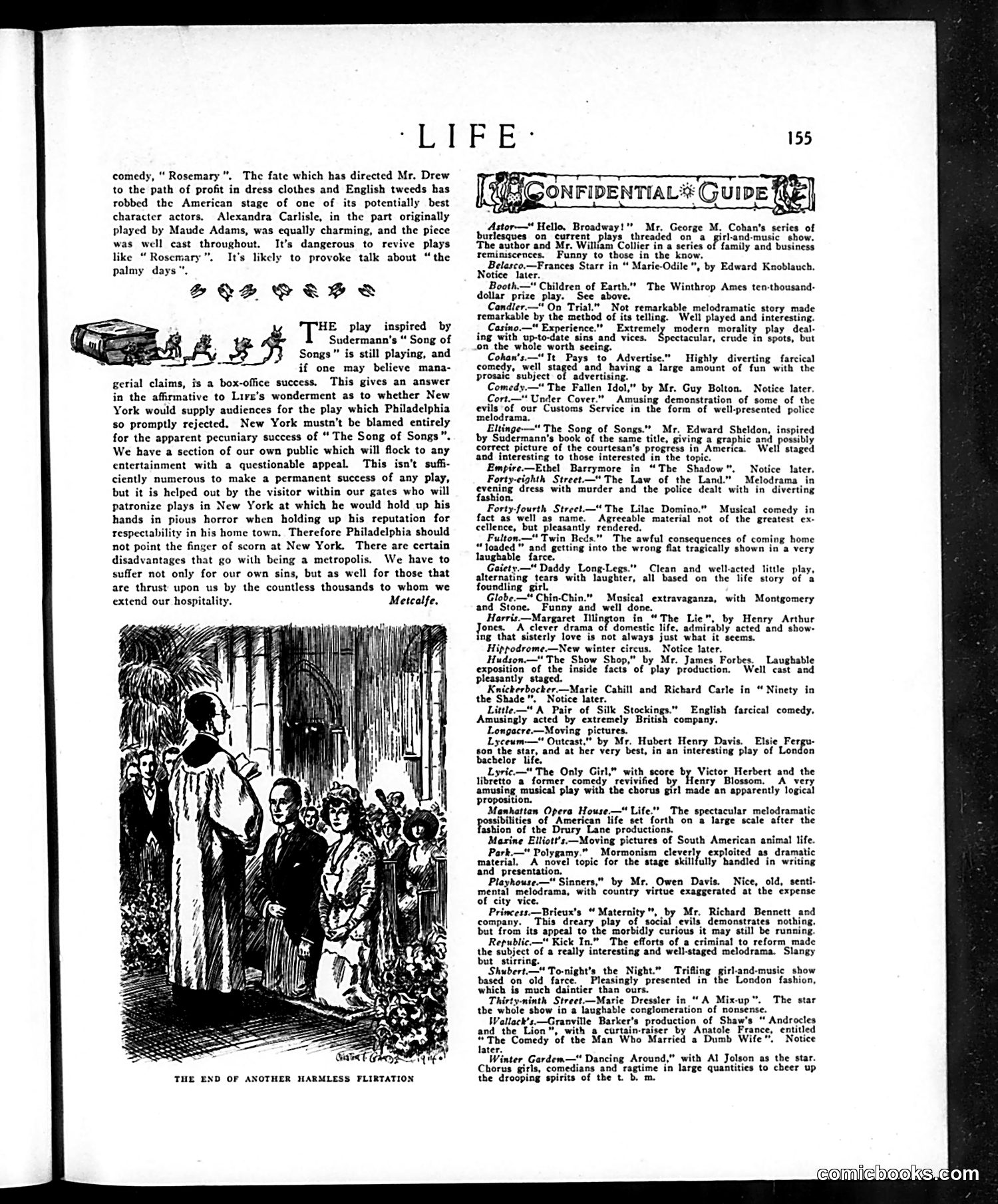
This page contains theatrical reviews and a political cartoon titled "The End of Another Harmless Flirtation." The cartoon depicts a well-dressed man (appears to be a wealthy gentleman or politician) exiting through a doorway while a woman in modest dress remains behind, observed by onlookers. The scene suggests a clandestine affair or improper relationship ending. The satire likely critiques hypocrisy among the upper classes—the man can exit respectably into society while the woman faces social consequences. The title's irony suggests such "flirtations" were routine among the privileged yet treated as scandalous when exposed. The page's main content is a "Confidential Guide" to Broadway theaters, reviewing current plays including *The Song of Songs*, *Experience*, and *Chin-Chin*. The reviews discuss theatrical merit and moral content, reflecting early 1900s concerns about propriety in entertainment—the very hypocrisy the cartoon satirizes.
📄 Transcribed text from this page (OCR, searchable)
Machine-transcribed from the original scan — historical spelling and the odd misread are preserved.
“Donk Ee comedy, “ Rosemary". The fate which has directed Mr. Drew to the path of profit in dress clothes and English tweeds has robbed the American stage of one of its potentially best character actors. Alexandra Carlisle, in the part originally played by Maude Adams, was equally charming, and the piece was well cast throughout. It’s dangerous to revive plays like “Rosemary”. It's likely to provoke talk about “ the palmy days”. FRA SRS HE play inspired by Fe Sudermann’s “ Song of a3) j Rg Songs" is still playing, and Mass if one may believe mana- gerial claims, is a box-office success. This gives an answer in the affirmative to Live's wonderment as to whether New York would supply audiences for the play which Philadelphia so promptly rejected. New York mustn’t be blamed entirely for the apparent pecuniary success of “ The Song of Songs”. We have a section of our own public which will flock to any entertainment with a questionable appeal. This isn't suffi- ciently numerous to make a permanent success of any play, but it is helped out by the visitor within our gates who will patronize plays in New York at which he would hold up his hands in pious horror when holding up his reputation for respectability in his home town. Therefore Philadelphia should not point the finger of scorn at New York. There are certain disadvantages that go with being a metropolis. We have to suffer not only for our own sins, but as well for those that are thrust upon us by the countless thousands to whom we extend our hospitality. Metcalfe. THE END OF ANOTHER HARMLESS FLIRTATION Geiger; rio UMGONFIDENTIAL*% GUIDE it e| EA A, Astor—* Hello, Broadway!" Mr. George M. Cohan’ urlesques on current plays threaded on’ a_ girl The author and Mr. William Collier in a series of family and business remimscences. Funny to those the know. Belasco.—Frances Starr in “ Marie-Odile”, by Edward Knoblauch. Notice later. Booth. Children of Earth.” The Winthrop Ames ten-thousand- dollar prize play. above. Candler.— On Trial.” Not remarkable melodramatic story made remarkable by the method of its telling. Well played and interesting. _ Casino.—" Experience.” Extremely modern morality play deal- ing with up-to-date sins and vices. Spectacular, crude in spets, but on the whole worth seeing. Cohan’: Tt Pays to Advertise.” Highly diverting farcical comedy, well see and having a large amount of fun with the prosaic’ subject of advertising. Comed; The Fallen Idol,” by Mr. Guy Bolton. Notice later. Cort. Under Cove: , Amusing demonstration of some of the evils of our Customs Service in the form of well-presented police melodrama. Eltinge—" The Song of Songs." Mr. Edward Sheldon, inspired by Sudermann’s book of the same title, giving a graphic and possibly correct picture of the courtesan's progress in-America. Well staged and interesting to those interested in the topic. Empire-—Ethel Barrymore in “The Shadow”. Forty-eighth Street—“ The Law of the Land evening dress with murder and the police dealt fashion. Forty-fourth Strect.—" The Lilac Domino.” Musical comedy in fact as well as name. Agreeable material not of the greatest ex- cellence, but pleasantly rendered. Twin Beds." The awful consequences of coming home and getting into the wrong flat tragically shown in a very jiety.—" Daddy Long-Legs.”” Clean and well-acted little play, alternating tears with laughter, all based on the life story of a foundling girl. Globe-—" Chin-Chin.” Musical extravaganza, with Montgomery and Stone. Funny and well done. Harris.—Margaret Ilington in “The Lie”, by Henry Arthur Jones. A clever drama of domestic life, admirably acted and show: ing that sisterly love is not always just what it seems. Hippodrome.—New winter circus. Notice later. Hudson.—" The Show Shop,” by Mr. James Forbes, Laughable exposition of the inside facts of play production. Well cast and pleasantly sta Knickerbocker.—Marie Cahill and Richard Carle in “ the Shade". Notice later. Little —"A Pair of Silk Stocks Amusingly acted by extremely Brit Longacre.—Moving pictures. Lyceum—" Outcast,” by Mr. Hubert Henry Davis. Elsie Fergu- son the star, and at her very best, in an interesting play of London bachelor life. Lyric —""The Only Girl” with, score by, Victor Herbert and the libretto a former comedy’ revivified by Henry Blossom. A very amusing musical play with the chorus girl made an apparently logical Proposition. Manhattan Opera House — Life.” The spectacular melodramatic sibilities of American life set forth on a large scale after the fashion of the ‘Lane productions. Marine Elliott’s.—Moving pictures of South American animal life. Polygamy.” Mormonism cleverly exploited as dramatic A novel topic for the stage skillfully handled in writing and presentation, Playhouse—" Sinners,” by Mr. Owen Davis. Nice, old, senti- mental melodrama, with country virtue exaggerated at ‘the expense of city vice. Princess-—Brieux’s “ Maternity", by Mr. Richard Bennett and company. This dreary play of evils demonstrates nothi but from its appeal to the morbidly curious it may still be Republic.—" Kick In.” The efforts of a criminal to reform made the subject of a really interesting and well-staged melodrama. Slangy but stirring. Shubert.—" To-night's the Night.” Trifling girl.and-music show based on old farce. Pleasingly presented in the London fashion, which is much daintier than ours. Thirty-ninth Street—Marie Dressler in “A Mix-up". the whole show in a laughable conglomeration of nonsense. Wallack’s.—Granville Barker's production of Shaw's “ Androcles and the Lion”, with a curtain-raiser by Anatole France, entitled “The Comedy of the Man Who Married a Dumb Wife”, Notice later. Winter, Gerdem— Dancing Around,” with Al Jolson as the star. Chorus girls, comedians and ragtime in large quantities to cheer up the drooping spirits of the t. b. m. Notice later. Melodrama in in diverting inety in English farcical comedy. company. The star