
Life, 1915-01-28 · page 19 of 40
Life — January 28, 1915 — page 19: what you’re looking at
What you’re looking at
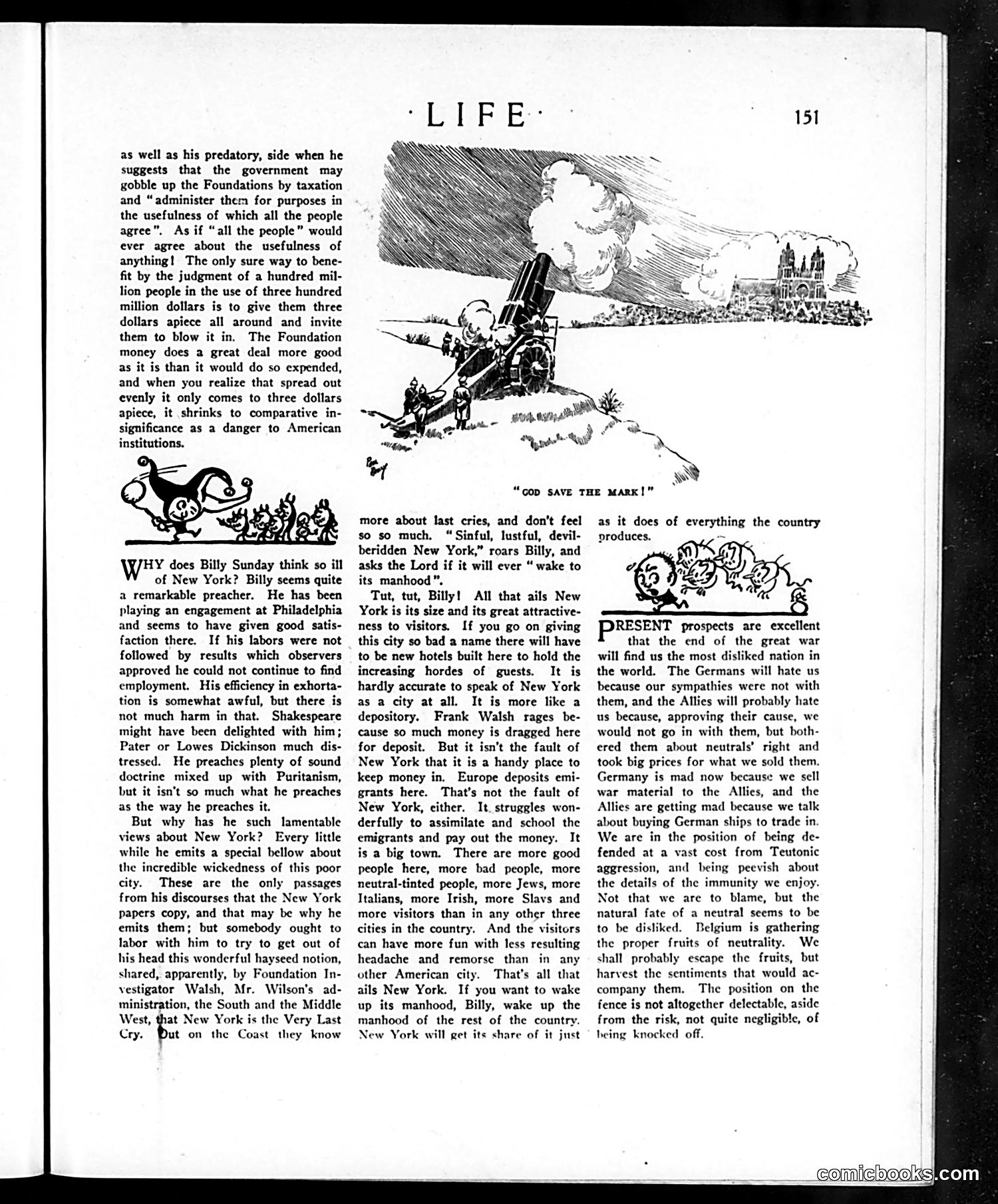
This page contains two satirical pieces attacking prominent figures and attitudes of the era (appears to be WWI period, given references to "the great war"). **The main cartoon** depicts a cannon labeled "GOD SAVE THE MARK!" aimed at a European cathedral, satirizing American military/financial intervention in European affairs. **The text critiques Billy Sunday**, a famous evangelist preacher, for his repeated condemnations of New York City as sinful and wicked. The author argues Sunday's attacks are unfair—New York's "wickedness" is merely a byproduct of its size and role as a major commercial/immigration hub. The piece defends the city as performing admirably in assimilating immigrants and managing capital flow, suggesting critics like Sunday (and Foundation Investigator Frank Walsh, apparently) unfairly scapegoat New York rather than addressing nationwide moral failings. **The closing section** predicts America will be disliked globally after WWI—by Germans for supporting the Allies, and by the Allies for not fully committing to their cause—satirizing American diplomatic neutrality and hesitation. The page exemplifies Life's role as a vehicle for sophisticated political commentary mocking public figures and conventional pieties.
📄 Transcribed text from this page (OCR, searchable)
Machine-transcribed from the original scan — historical spelling and the odd misread are preserved.
as well as his predatory, side when he suggests that the government may gobble up the Foundations by taxation and “administer them for purposes in the usefulness of which all the people agree”. As if “all the people” would ever agree about the usefulness of anything! The only sure way to bene- fit by the judgment of a hundred mil- lion people in the use of three hundred million dollars is to give them three dollars apiece all around and invite them to blow it in. The Foundation money does a great deal more good as it is than it would do so expended, and when you realize that spread out evenly it only comes to three dollars apiece, it shrinks to comparative in- significance as a danger to American institutions, Wry does Billy Sunday think so ill of New York? Billy seems quite a remarkable preacher. He has been playing an engagement at Philadelphia and seems to have given good satis- faction there. If his labors were not followed by results which observers approved he could not continue to find employment. His efficiency in exhorta- tion is somewhat awful, but there is not much harm in that. Shakespeare might have been delighted with him; Pater or Lowes Dickinson much dis- tressed. He preaches plenty of sound doctrine mixed up with Puritanism, but it isn’t so much what he preaches as the way he preaches it. But why has he such lamentable views about New York? Every little while he emits a special bellow about the incredible wickedness of this poor city. These are the only passages from his discourses that the New York Papers copy, and that may be why he emits them; but somebody ought to labor with him to try to get out of his head this wonderful hayseed notion, shared, apparently, by Foundation In- vestigator Walsh, Mr. Wilson’s ad- ministration, the South and the Middle West, that New York is the Very Last Cry. bat on the Coast they know “Gop SAVE THE MARK!" more about last cries, and don’t feel so so much, “Sinful, lustful, devil- beridden New York,” roars Billy, and asks the Lord if it will ever “wake to its manhood”. Tut, tut, Billy! All that ails New York is its size and its great attractive- ness to visitors. If you go on giving this city so bad a name there will have to be new hotels built here to hold the increasing hordes of guests. It is hardly accurate to speak of New York as a city at all. It is more like a depository. Frank Walsh rages be- cause so much money is dragged here for deposit. But it isn’t the fault of New York that it is a handy place to keep money in. Europe deposits emi- grants here. That’s not the fault of New York, either. It. struggles won- derfully to assimilate and school the emigrants and pay out the money. It is a big town. There are more good people here, more bad people, more neutral-tinted people, more Jews, more Italians, more Irish, more Slavs and more visitors than in any other three cities in the country. And the visitors can have more fun with less resulting headache and remorse than in any other American city. That's all that ails New York. If you want to wake up its manhood, Billy, wake up the manhood of the rest of the country. New York will get its share of it just as it does of everything the country produces. ~ PRESENT Prospects are excellent that the end of the great war will find us the most disliked nation in the world. The Germans will hate us because our sympathies were not with them, and the Allies will probably hate us because, approving their cause, we would not go in with them, but both- ered them about neutrals’ right and took big prices for what we sold them. Germany is mad now because we sell war material to the Allies, and the Allies are getting mad because we talk about buying German ships to trade in. We are in the position of being de- fended at a vast cost from Teutonic aggression, and being peevish about the details of the immunity we enjoy. Not that we are to blame, but the natural fate of a neutral seems to be to be disliked. Belgium is gathering the proper fruits of neutrality. We shall probably escape the fruits, but harvest the sentiments that would ac- company them. The position on the fence is not altogether delectable, aside from the risk, not quite negligible, of heing knocked off.