
Life, 1915-01-28 · page 5 of 40
Life — January 28, 1915 — page 5: what you’re looking at
What you’re looking at
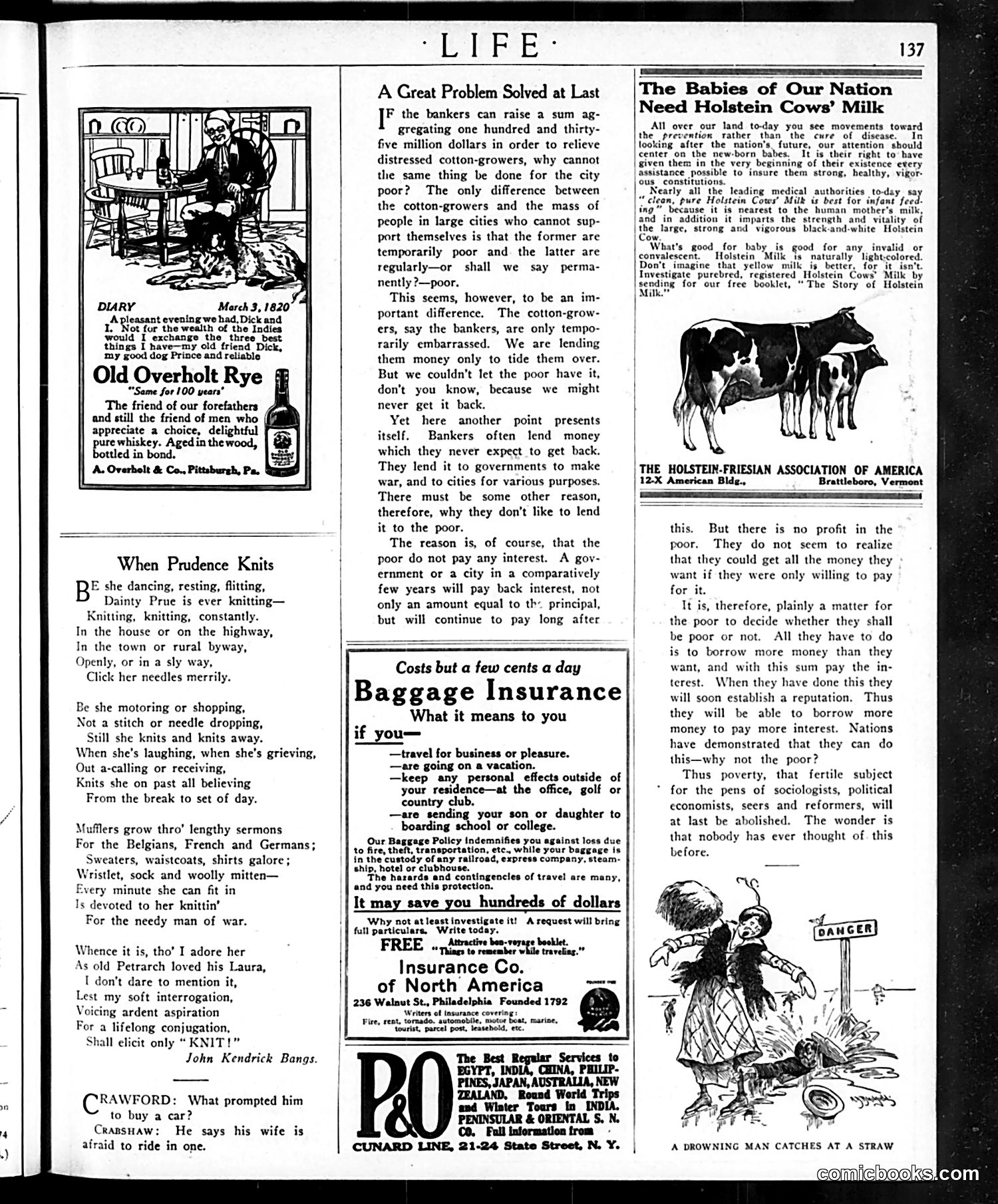
This page is primarily **advertising and light humor** rather than political satire. The main cartoon shows two men in an office discussing banking policy. The text debates whether banks should lend money to poor urban residents versus temporarily embarrassed cotton farmers. The satire suggests **class hypocrisy**: bankers justify lending to farmers as temporary hardship while refusing poor city-dwellers the same consideration, though both may be equally unable to repay. Other content includes: - A poem "When Prudence Knits" celebrating women's wartime knitting efforts - An insurance company advertisement - A brief joke about a man afraid to ride in a car - A drowning safety illustration The page reflects **1910s-1920s concerns** about poverty, banking practices, and women's wartime domestic contributions, though most space is devoted to commercial advertising.
📄 Transcribed text from this page (OCR, searchable)
Machine-transcribed from the original scan — historical spelling and the odd misread are preserved.
A pleasant, evening we had, Dick and I. Not for the wealth of the Indies would I exchange the three best things I have—my old friend Dick, my good dog Prince and reliable Old Overholt Rye “Same for 100 years” The friend of our forefathers J |] and still the friend of men who appreciate a oie, delightful mre whiskey. Aged in the w ttled in eae ae A. Overholt & Co., Pittsburgh, Pa, When Prudence Knits BE she dancing, resting, flitting, Dainty Prue is ever knitting— Knitting, knitting, constantly. In the house or on the highway, In the town or rural byway, Openly, or in a sly way, Click her needles merrily. Be she motoring or shopping, Not a stitch or needle dropping, Still she knits and knits away. When she’s laughing, when she’s grieving, Out a-calling or receiving, Knits she on past all believing From the break to set of day. Mufflers grow thro’ lengthy sermons. For the Belgians, French and Germans; Sweaters, waistcoats, shirts galore; Wristlet, sock and woolly mitten— Every minute she can fit in Is devoted to her knittin’ For the needy man of war. Whence it is, tho’ I adore her As old Petrarch loved his Laura, I don't dare to mention it, Lest my soft interrogation, Voicing ardent aspiration For a lifelong conjugation, Shall elicit only “KNIT!” John Kendrick Bangs. CRAWForD: What prompted him to buy a car? CransHaw: He says his wife is afraid to ride in one. ge Ll hal pial oh 137 A Great Problem Solved at Last F the bankers can raise a sum ag- gregating one hundred and thirty- five million dollars in order to relieve distressed cotton-growers, why cannot the same thing be done for the city poor? The only difference between the cotton-growers and the mass of people in large cities who cannot sup- port themselves is that the former are temporarily poor and the latter are regularly—or shall we say perma- nently ?—poor. This seems, however, to be an im- portant difference. The cotton-grow- ers, say the bankers, are only tempo- rarily embarrassed. We are lending them money only to tide them over. But we couldn't let the poor have it, don’t you know, because we might never get it back. Yet here another point presents itself. Bankers often lend money which they never expect to get back. They lend it to governments to make war, and to cities for various purposes. There must be some other reason, therefore, why they don't like to lend it to the poor. The reason is, of course, that the poor do not pay any interest. A gov- ernment or a city in a comparatively few years will pay back interest, not only an amount equal to th~ principal, but will continue to pay long after Costs but a few cents a day Baggage Insurance What it means to you if you— —travel for business or pleasure. —are going on a vacation. —keep any personal effects outside of your residence—at the office, golf or country club. —are sending your son or daughter to boarding school or college. Our Baggage Policy indemnifies you against loss due to fire, thet, transportation, etc. while your baggage is in the custody of any railroad, express company, steam- ship, hotel or clubhouse. The hazards and contingencies of travel are many, and you need this protection. It may save you hundreds of dollars ‘Why not at least investigate it! A request will bring fall particulars, Write today, Insurance Co. of North America 236 Walnut St., Philadelphia Founded 1792 Weiters of Insurance covering Fire, rent, tornado. automobile, tourist, parcel post, leasebold, ete. CUNARD LINE, 21-24 State Street, N. Y. Sr The Babies of Our Nation Need Holstein Cows’ Milk All over our land to-day you see movements toward the prevention rather than the cure of disease. In |tooking after the nation’s, future, our attention should center on the new-born babes. It is their right to have | given them in the very beginning of their existence every assistance possible to insure them strong, healthy, vigor ous, constitutions. Nearly all the leading medical authorities to-day. sa; “clean, pure Holstein Cows’ Milk is best for infant feed- ing” because it is nearest to the human mother's milk, and in addition it imparts the strength and vitality of the large, strong and vigorous black-and-white Holstein ‘ow. | What's good for baby is good for any invalid or |convalescent. Holstein Milk is naturally light-colored. |Don’t imagine that yellow milk is better, for Investigate purebred, registered Holstein Cows’ Milk by fending for our free booklet, “The Story of Holstein Milk. | | | THE HOLSTEIN-FRIESIAN ASSOCIATION OF AMERICA Bid Brattleboro, Vermont this. But there is no profit in the poor. They do not seem to realize that they could get all the money they want if they were only willing to pay for it. It is, therefore, plainly a matter for the poor to decide whether they shall be poor or not, All they have to do is to borrow more money than they want, and with this sum pay the in- terest. When they have done this they will soon establish a reputation. Thus they will be able to borrow more money to pay more interest. Nations have demonstrated that they can do this—why not the poor? Thus poverty, that fertile subject for the pens of sociologists, political economists, seers and reformers, will at last be abolished. The wonder is that nobody has ever thought of. this before.