
Life, 1915-01-28 · page 16 of 40
Life — January 28, 1915 — page 16: what you’re looking at
What you’re looking at
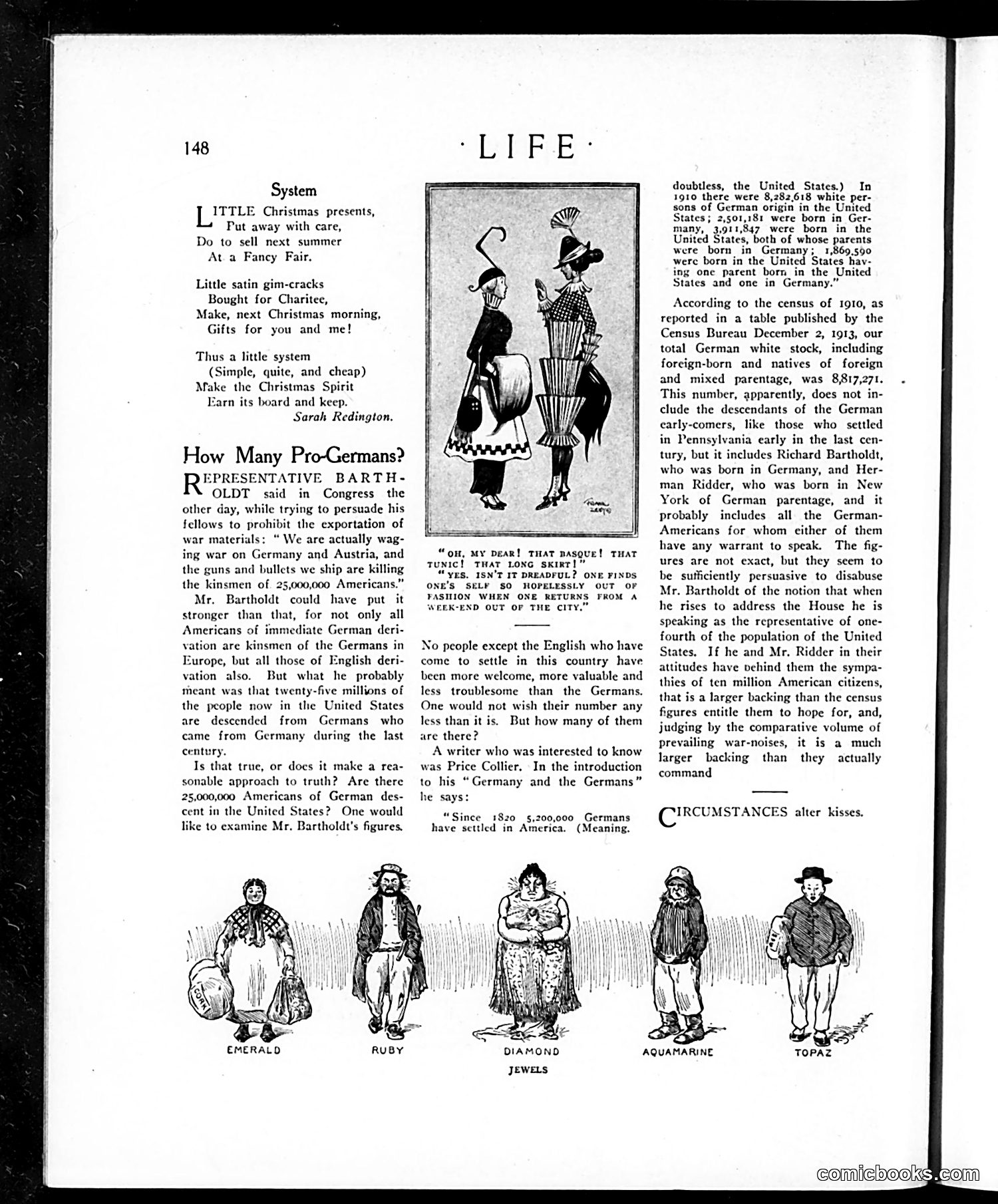
This page addresses **German-American loyalty during World War I**, a contentious issue in 1910s America. **Main Article:** "How Many Pro-Germans?" challenges Representative Bartholdt's claim that 25 million Americans of German descent oppose war material exports to Allied powers. The author uses census data to deflate this figure, arguing that approximately 8.8 million German-Americans exist—a significant but minority population. The point: German-Americans' political influence is overstated; they don't represent "one-fourth of the population." **The Cartoon:** The bottom illustration shows five figures labeled with gemstone names (Emerald, Ruby, Diamond, Aquamarine, Topaz)—likely caricatured ethnic stereotypes used to represent different immigrant groups. The humor is unclear without identifying who these represent. **Context:** During WWI, German-Americans faced suspicion of disloyalty. This article defends them against exaggerated claims while simultaneously questioning their political power—essentially arguing they're numerous but not dangerously influential.
📄 Transcribed text from this page (OCR, searchable)
Machine-transcribed from the original scan — historical spelling and the odd misread are preserved.
System ITTLE Christmas presents, Put away with care, Do to sell next summer Ata Fancy Fair. Little satin gim-cracks Bought for Charitee, Make, next Christmas morning, Gifts for you and me! Thus a little system (Simple, quite, and cheap) Make the Christmas Spirit Earn its board and keep. Sarah Redington. How Many Pro-Germans? EPRESENTATIVE BARTH- OLDT said in Congress the other day, while trying to persuade his fellows to prohibit the exportation of war materials: “ We are actually wag- ing war on Germany and Austria, the guns and bullets we ship are the kinsmen of 25,000,000 Ame: Mr. Bartholdt could have put it stronger than that, for not only all Americans of immediate German deri- vation are kinsmen of the Germans in Europe, but all those of English deri- vation also. But what he probably meant was that twenty-five millions of the people now in the United States are descended from Germans who came from Germany during the last century, Is that true, or does it make a rea- sonable approach to truth? Are there 25,000,000 Americans of German des- cent in the United States? One would like to examine Mr. Bartholdt’s figures, EMERALD “on, My Dear! THAT mAsguE! THAT Tunic! THAT LONG sKirT!” YES. ISN'T IT DREADFUL? ONE FINDS ONE'S SELF SO HOPELESSLY OUT OF FASHION WHEN ONE RETURNS FROM A WEEK-END OUT OF THE cITY,” No people except the English who have come to settle in this country have been more welcome, more valuable and less troublesome than the Germans. One would not wish their number any less than it is. But how many of them are there? A writer who was interested to know was Price Collier, In the introduction to his “Germany and the Germans” he says: “Since 1820 120,200,000 Germans have settled in America. (Meaning. DIAMOND JEWELS doubtless, the United States.) In 1910 there were 8,282,618 white per- sons of German origin in the United States; 2,501,181 were born in Ger- many, 3,911,847 were born in the United States, both of whose parents were born in Germany; 1,869,590 were born in the United States hav- ing one parent born in the United States and one in Germany.” According to the census of 1910, as reported in a table published by the Census Bureau December 2, 1913, our total German white stock, including foreign-born and natives of foreign and mixed parentage, was 8,817,271. This number, apparently, does not in- clude the descendants of the German carly-comers, like those who settled in Pennsylvania early in the last cen- tury, but it includes Richard Bartholdt, who was born in Germany, and Her- man Ridder, who was born in New York of German parentage, and it probably includes all the German- Americans for whom either of them have any warrant to speak. The fig- ures are not exact, but they seem to be sufficiently persuasive to disabuse Mr. Bartholdt of the notion that when he rises to address the House he is speaking as the representative of one- fourth of the population of the United States, If he and Mr, Ridder in their attitudes have oehind them the sympa- thies of ten million American citizens, that is a larger backing than the census figures entitle them to hope for, and, judging by the comparative volume of prevailing war-noises, it is a much larger backing than they actually command JMSTANCES alter kisses. AQUAMARINE