
Life, 1915-01-28 · page 24 of 40
Life — January 28, 1915 — page 24: what you’re looking at
What you’re looking at
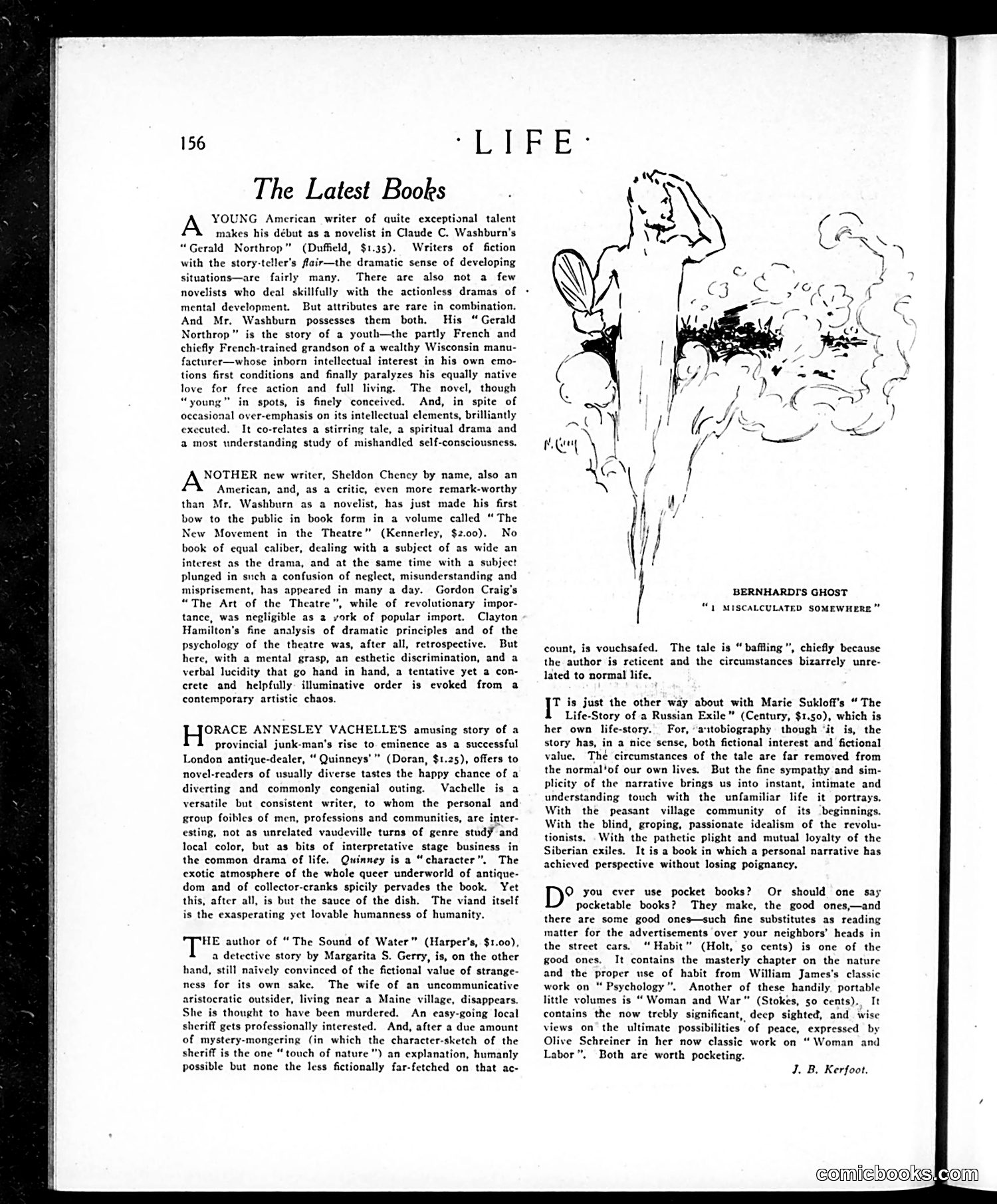
This is a straightforward literary review section from *Life* magazine, not primarily satirical. The page discusses several new novels and books from the early 20th century. The small cartoon titled "Bernhardt's Ghost" appears in the upper right—a sketchy drawing of a woman's face with the caption "I miscalculated somewhere." This likely references Sarah Bernhardt, the famous French actress who died in 1923. The joke seems to suggest Bernhardt, observing from beyond, reflects ruefully on some miscalculation during her life or career—though without more context, the specific reference remains unclear. The bulk of the page reviews books by American and British authors, praising writers like Claude C. Washburn and Sheldon Cheney for their literary merit, while critiquing others like Margarita S. Gerry for relying on artificial "strangeness" rather than genuine character development.
📄 Transcribed text from this page (OCR, searchable)
Machine-transcribed from the original scan — historical spelling and the odd misread are preserved.
CREE : The Latest Books YOUNG American writer of quite exceptional talent makes his début as a novelist in Claude C. Washburn’s “Gerald Northrop” (Duffield, $1.35). Writers of fiction with the story-teller's flair—the dramatic sense of developing situations—are fairly many, There are also not a few novelists who deal skillfully with the actionless dramas of mental development. But attributes are rare in combination. And Mr. Washburn possesses them both. His “Gerald Northrop” is the story of a youth—the partly French and chiefly French-trained grandson of a wealthy Wisconsin manu- facturer—whose inborn intellectual interest in his own cmo- tions first conditions and finally paralyzes his equally native love for frce action and full living, The novel, though “young” in spots, is finely conceived. And, in spite of occasional over-emphasis on its intellectual elements, brilliantly executed. It co-relates a stirring tale, a spiritual drama and a most understanding study of mishandled self-consciousness. NOTHER new writer, Sheldon Chency by name, also an American, and, as a critic, even more remark-worthy than Mr. Washburn as a novelist, has just made his first bow to the public in book form in a volume called “ The New Movement in the Theatre” (Kennerley, $2.00), No book of equal caliber, dealing with a subject of as wide an interest the drama, and at the same time with a subject plunged in such a confusion of neglect, misunderstanding and misprisement, has appeared in many a day. Gordon Craig's “The Art of the Theatre”, while of revolutionary impor- tance, was negligible as 2 york of popular import. Clayton Hamilton's fine analysis of dramatic principles and of the psychology of the theatre was, after all, retrospective. But here, with a mental grasp, an esthetic discrimination, and a verbal lucidity that go hand in hand, a tentative yet a con- crete and helpfully: illuminative order is evoked from a contemporary artistic chaos. ORACE ANNESLEY VACHELLE'S amusing story of a provincial junk-man's rise to eminence as a successful London antique-dealer, “ Quinneys’” (Doran, $1.25), offers to novel-readers of usually diverse tastes the happy chance of a diverting and commonly congenial outing. Vachelle is a versatile but consistent writer, to whom the personal and group foibles of men, professions and communities, are inter- esting, not as unrelated vaudeville turns of genre study and local color, but as bits of interpretative stage business in the common drama of life. Quinney is a “character”. The exotic atmosphere of the whole queer underworld of antique- dom and of collector-cranks spicily pervades the book. Yet this, after all, is but the sauce of the dish. The viand itself is the exasperating yet lovable humanness of humanity. HIE author of “ The Sound of Water” (Harper's, $1.00), a detective story by Margarita S. Gerry, is, on the other hand, still naively convinced of the fictional value of strange- ness for its own sake. The wife of an uncommunicative aristocratic outsider, living near a Maine village, disappears. She is thought to have been murdered. An easy-going local sheriff gets professionally interested. And, after a due amount of mystery-mongering (in which the character-sketch of the sheriff is the one “touch of nature") an explanation, humanly possible but none the less fictionally far-fetched on that ac- BERNHARDIS GHOST “| MISCALCULATED SOMEWHERE ” count, is vouchsafed. The tale is “baffling”, chiefly because the author is reticent and the circumstances bizarrely unre- lated to normal life. 'T is just the other way about with Marie Sukloff’s “The Life-Story of a Russian Exile” (Century, $1.50), which is her own life-story. For, ‘aitobiography though ‘it is, the story has, in a nice sense, both fictional interest and fictional value, Thé circumstances of the tale are far removed from the normal'of our own lives. But the fine sympathy and sim- plicity of the narrative brings us into instant, intimate and understanding touch with the unfamiliar life it portrays, With the peasant village community of its beginnings. With the blind, groping, passionate idealism of the revolu- tionists, With the pathetic plight and mutual loyalty of the Siberian exiles. It is a book in which a personal narrative has achieved perspective without losing poignancy, O you ever use pocket books? Or should one say pocketable books? They make, the good ones,—and there are some good ones—such fine substitutes as reading matter for the advertisements over your neighbors’ heads in the street cars. “Habit” (Holt, so cents) is one of the good ones. It contains the masterly chapter on the nature and the proper use of habit from William James's classic work on “ Psychology”. Another of these handily portable little volumes is “ Woman and War" (Stokes, 50 cents). It contains the now trebly significant, decp sighted, and wise views on the ultimate possibilities of peace, expressed by Olive Schreiner in her now classic work on “Woman and Labor”. Both are worth pocketing. J.B. Kerfoot. comichooks,