
Life, 1915-01-28 · page 22 of 40
Life — January 28, 1915 — page 22: what you’re looking at
What you’re looking at
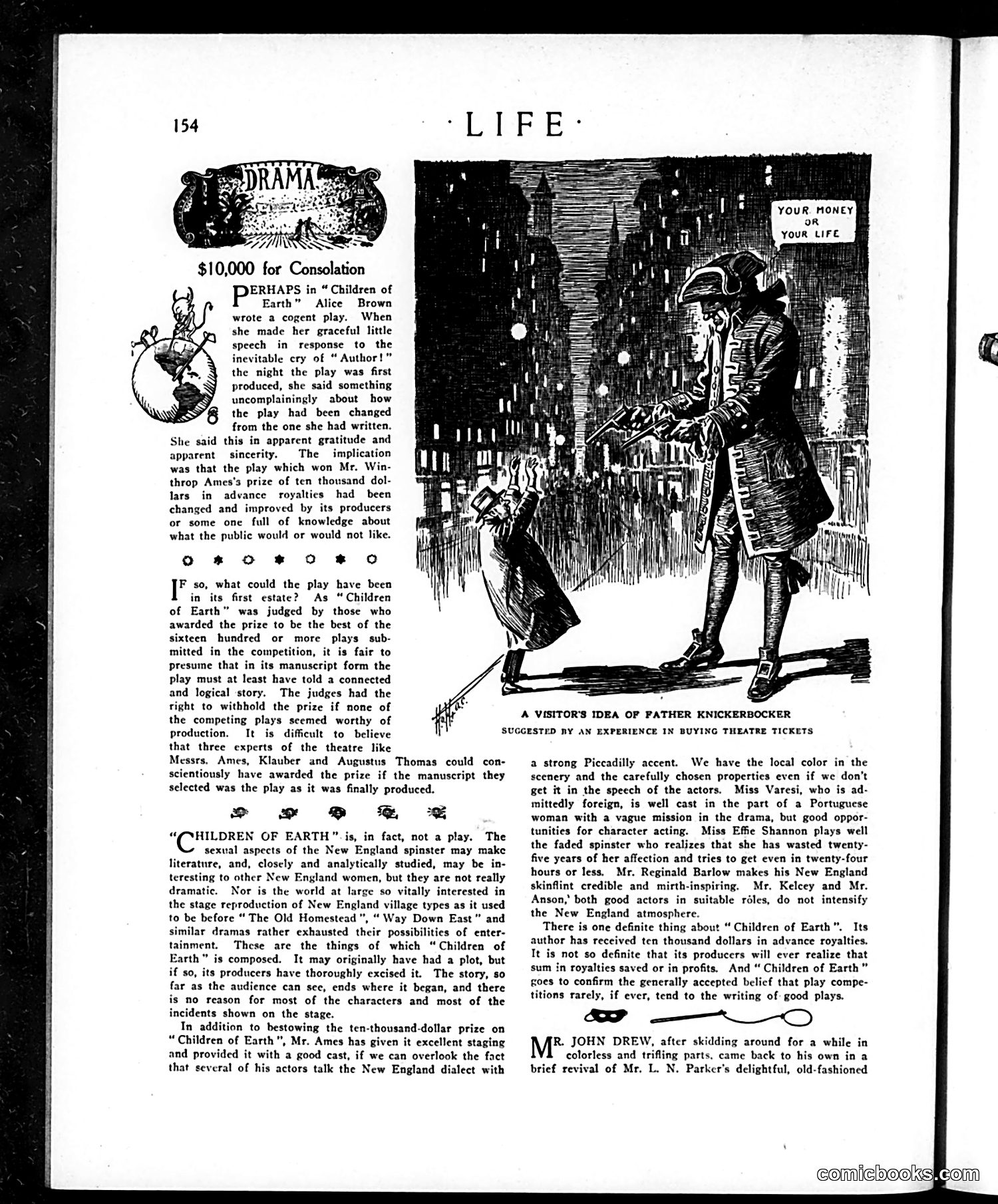
This page contains two distinct satirical pieces: **Left column ("$10,000 for Consolation"):** A theater critic reviews *Children of Earth* by Alice Brown, which won a $10,000 prize from producer Winthrop Ames. The satire attacks the play itself—claiming it lacks genuine plot, dramatic structure, or narrative logic. The critic sarcastically suggests the prize-winning manuscript must have been superior to the produced version, implying producers ruined it. The piece concludes that despite excellent staging and casting, the play remains fundamentally undramatic, dealing only with "sexual aspects of the New England spinster." The satire mocks both the play competition system and theatrical judgment. **Right cartoon:** Titled "A Visitor's Idea of Father Knickerbocker," it depicts a well-dressed man (Father Knickerbocker, a personification of New York City) robbing a woman at knifepoint while she clutches a theater ticket. The caption suggests this reflects "an experience in buying theatre tickets"—satirizing exorbitant Broadway ticket prices as highway robbery.
📄 Transcribed text from this page (OCR, searchable)
Machine-transcribed from the original scan — historical spelling and the odd misread are preserved.
$10,000 for Consolation ERHAPS in “Children of Earth” Alice Brown wrote a cogent play. When she made her graceful little speech in response to the inevitable cry of “ Author!” the night the play was first produced, she said something uncomplainingly about bow the play had been changed from the one she had written. She said this in apparent gratitude and apparent sincerity. The implication was that the play which won Mr. Win- throp Ames's prize of ten thousand dol- lars in advance royalties had been changed and improved by its producers or some one full of knowledge about what the public would or would not like. o *# Oo *€ 0 #€ 0 F so, what could the play have been in its first estate? As “Children of Earth” was judged by those who awarded the prize to be the best of the sixteen hundred or more plays sub- mitted in the competition, it is fair to Presume that in its manuscript form the play must at least have told a connected and logical story. The judges had the right to withhold the prize if none of the competing plays seemed worthy of production. It is difficult to believe that three experts of the theatre like Messrs, Ames, Klauber and Augustus Thomas could con- scientiously have awarded the prize if the manuscript they selected was the play as it was finally produced. aS SF BS GH S “(7 HILDREN OF EARTH” is, in fact, not a play. The sexual aspects of the New England spinster may make literature, and, closely and analytically studied, may be in- teresting to other New England women, but they are not really dramatic. Nor is the world at large so vitally interested in the stage reproduction of New England village types as it used to be before “ The Old Homestead”, “ Way Down East” and similar dramas rather exhausted their possibilities of enter- tainment. These are the things of which “Children of Earth” is composed. It may originally have had a plot, but if so, its producers have thoroughly excised it. The story, so far as the audience can see, ends where it began, and there is no reason for most of the characters and most of the incidents shown on the stage. In addition to bestowing the ten-thousand-dollar prize on “Children of Earth", Mr. Ames has given it excellent staging and provided it with a good cast, if we can overlook the fact that several of his actors talk the New England dialect with YOUR MONEY oR YOUR LIFE A VISITOR'S IDEA OF FATHER KNICKERBOCKER SUGGESTED RY AN EXPERIENCE IN BUYING THEATRE TICKETS a strong Piccadilly accent. We have the local color in the scenery and the carefully chosen properties even if we don't get it in the speech of the actors. Miss Varesi, who is ad- mittedly foreign, is well cast in the part of a Portuguese woman with a vague mission in the drama, but good oppor- tunities for character acting. Miss Effie Shannon plays well the faded spinster who realizes that she has wasted twenty- five years of her affection and tries to get even in twenty-four hours or less. Mr. Reginald Barlow makes his New England skinflint credible and mirth-inspiring. Mr. Kelcey and Mr. Anson,’ both good actors in suitable réles, do not intensify the New England atmosphere. There is one definite thing about “ Children of Earth”. Its author has received ten thousand dollars in advance royalties. It is not so definite that its producers will ever realize that sum in royalties saved or in profits. And “ Children of Earth” goes to confirm the generally accepted belief that play compe- titions rarely, if ever, tend to the writing of good plays. TF o_O 'R. JOHN DREW, after skidding around for a while in colorless and trifling parts, came back to his own in a brief revival of Mr. L. N. Parker's delightful, old-fashioned comichookskeom