
Life, 1915-01-28 · page 18 of 40
Life — January 28, 1915 — page 18: what you’re looking at
What you’re looking at
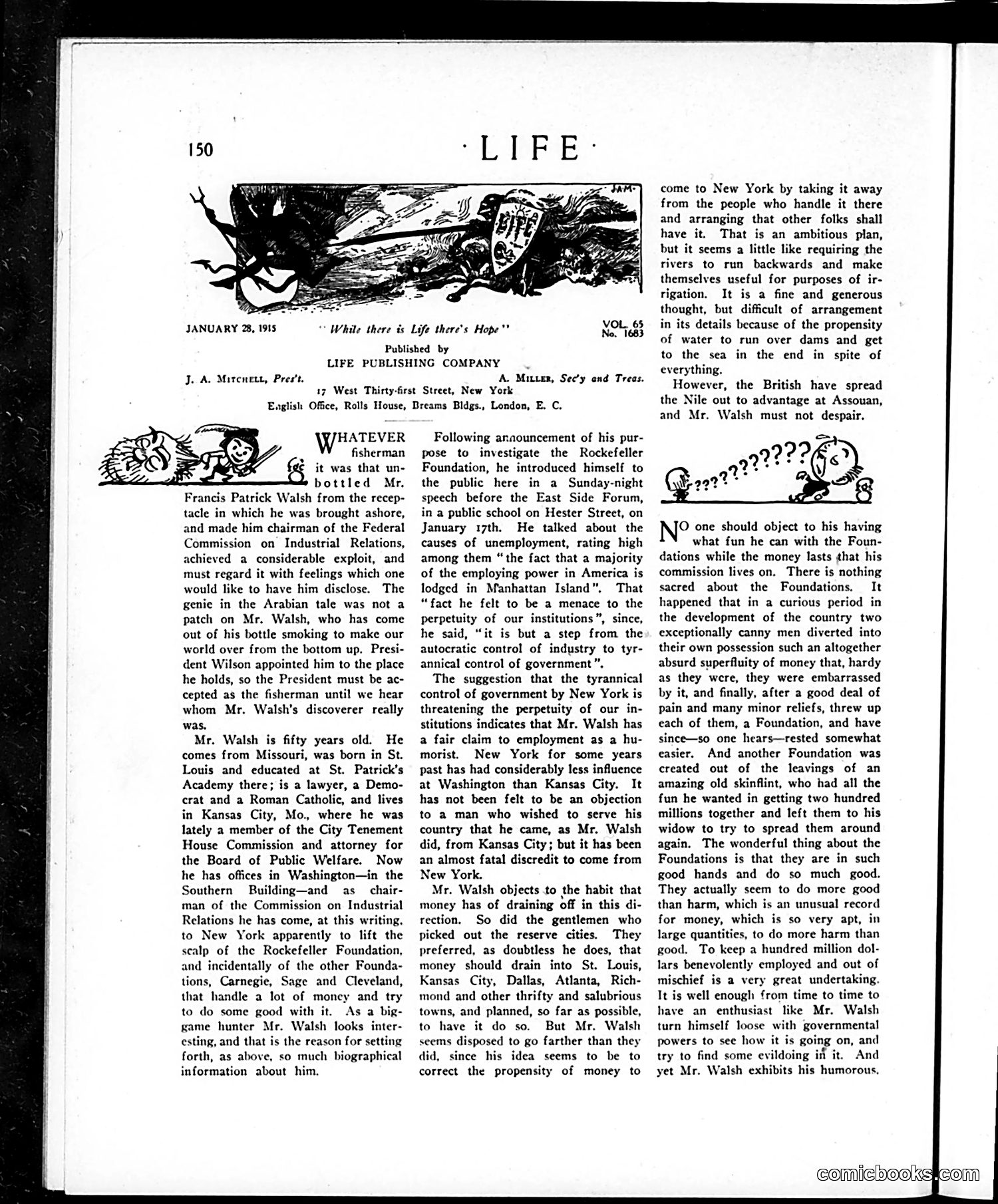
This article satirizes **Francis Patrick Walsh**, appointed by President Wilson to chair the Federal Commission on Industrial Relations. Walsh, a Kansas City lawyer, has announced plans to investigate major philanthropic foundations (Rockefeller, Carnegie, Sage, Cleveland) and spoke publicly about concentrating wealth and power threatening American democracy. Life's satire targets Walsh's ambitions as naive and contradictory. The magazine mocks his claim that Manhattan's concentrated wealth endangers institutions—noting New York actually has *less* influence in Washington than Kansas City. More pointedly, Life ridicules his scheme to redistribute foundation money away from New York as absurdly futile: "like requiring the rivers to run backwards." The piece portrays Walsh as earnest but humorously delusional, a "big-game hunter" pursuing foundations with crusading zeal while proposing economically impractical solutions to genuine unemployment and inequality problems.
📄 Transcribed text from this page (OCR, searchable)
Machine-transcribed from the original scan — historical spelling and the odd misread are preserved.
JANUARY 2, 1915 “While there is Life there's Hope"" Published by LIFE PUBLISHING COMPANY J. A. Mircnett, Pres’t. A. Muse, Sec’'y ond Trees. 17 West Thirty-first Street, New York English Office, Rolls House, Breams Bldgs., London, E. C. HATEVER fisherman it was that un- © bottled Mr. Francis Patrick Walsh from the recep- tacle in which he was brought ashore, and made him chairman of the Federal Commission on Industrial Relations, achieved a considerable exploit, and must regard it with feelings which one would like to have him disclose. The genic in the Arabian tale was not a patch on Mr. Walsh, who has come out of his bottle smoking to make our world over from the bottom up. Presi- dent Wilson appointed him to the place he holds, so the President must be ac- cepted as the fisherman until we hear whom Mr. Walsh's discoverer really was. Mr. Walsh is fifty years old. He comes from Missouri, was born in St. Louis and educated at St. Patrick's Academy there; is a lawyer, a Demo- crat and a Roman Catholic, and lives in Kansas City, Mo, where he was lately a member of the City Tenement House Commission and attorney for the Board of Public Welfare. Now he has offices in Washington—in the Southern Building—and as chair- man of the Commission on Industrial Relations he has come, at this writing, to New York apparently to lift the scalp of the Rockefeller Foundation, and incidentally of the other Founda- tions, Carnegie, Sage and Cleveland, that handle a lot of money and try to do some good with it. As a big- game hunter Mr. Walsh looks inter- esting, and that is the reason for setting forth, as above, so much biographical information about him. Following announcement of his pur- pose to investigate the Rockefeller Foundation, he introduced himself to the public here in a Sunday-night speech before the East Side Forum, in a public school on Hester Street, on January 17th. He talked about the causes of unemployment, rating high among them “the fact that a majority of the employing power in America is lodged in Manhattan Island". That “fact he felt to be a menace to the perpetuity of our institutions”, since, he said, “it is but a step from the autocratic control of industry to tyr- annical control of government”. The suggestion that the tyrannical control of government by New York is threatening the perpetuity of our in- stitutions indicates that Mr. Walsh has a fair claim to employment as a hu- morist. New York for some years past has had considerably less influence at Washington than Kansas City. It has not been felt to be an objection to a man who wished to serve his country that he came, as Mr. Walsh did, from Kansas City; but it has been an almost fatal discredit to come from New York. Mr. Walsh objects to the habit that money has of draining off in this di- rection. So did the gentlemen who picked out the reserve cities. They preferred, as doubtless he does, that money should drain into St. Louis, Kansas City, Dallas, Atlanta, Rich- mond and other thrifty and salubrious towns, and planned, so far as possible, to have it do so. But Mr. Walsh seems disposed to go farther than they did, since his idea seems to be to correct the propensity of money to come to New York by taking it away from the people who handle it there and arranging that other folks shall have it. That is an ambitious plan, but it seems a little like requiring the rivers to run backwards and make themselves useful for purposes of ir- rigation. It is a fine and generous thought, but difficult of arrangement in its details because of the propensity of water to run over dams and get to the sea in the end in spite of everything. However, the British have spread the Nile out to advantage at Assouan, and Mr. Walsh must not despair. 'O one should object to his having what fun he can with the Foun- dations while the money lasts that his commission lives on. There is nothing sacred about the Foundations. It happened that in a curious period in the development of the country two exceptionally canny men diverted into their own possession such an altogether absurd superfluity of money that, hardy as they were, they were embarrassed by it, and finally, after a good deal of pain and many minor reliefs, threw up each of them, a Foundation, and have since—so one hears—rested somewhat easier. And another Foundation was created out of the leavings of an amazing old skinflint, who had all the fun he wanted in getting two hundred millions together and left them to his widow to try to spread them around again. The wonderful thing about the Foundations is that they are in such good hands and do so much good. They actually seem to do more good than harm, which is an unusual record for money, which is so very apt, in large quantities, to do more harm than good. To keep a hundred million dol- lars benevolently employed and out of mischief is a very great undertaking. It is well enough from time to time to have an enthusiast like Mr. Walsh turn himself loose with governmental powers to see how it is going on, and try to find some evildoing if it. And yet Mr. Walsh exhibits his humorous, comichookss