
Life, 1915-01-28 · page 11 of 40
Life — January 28, 1915 — page 11: what you’re looking at
What you’re looking at
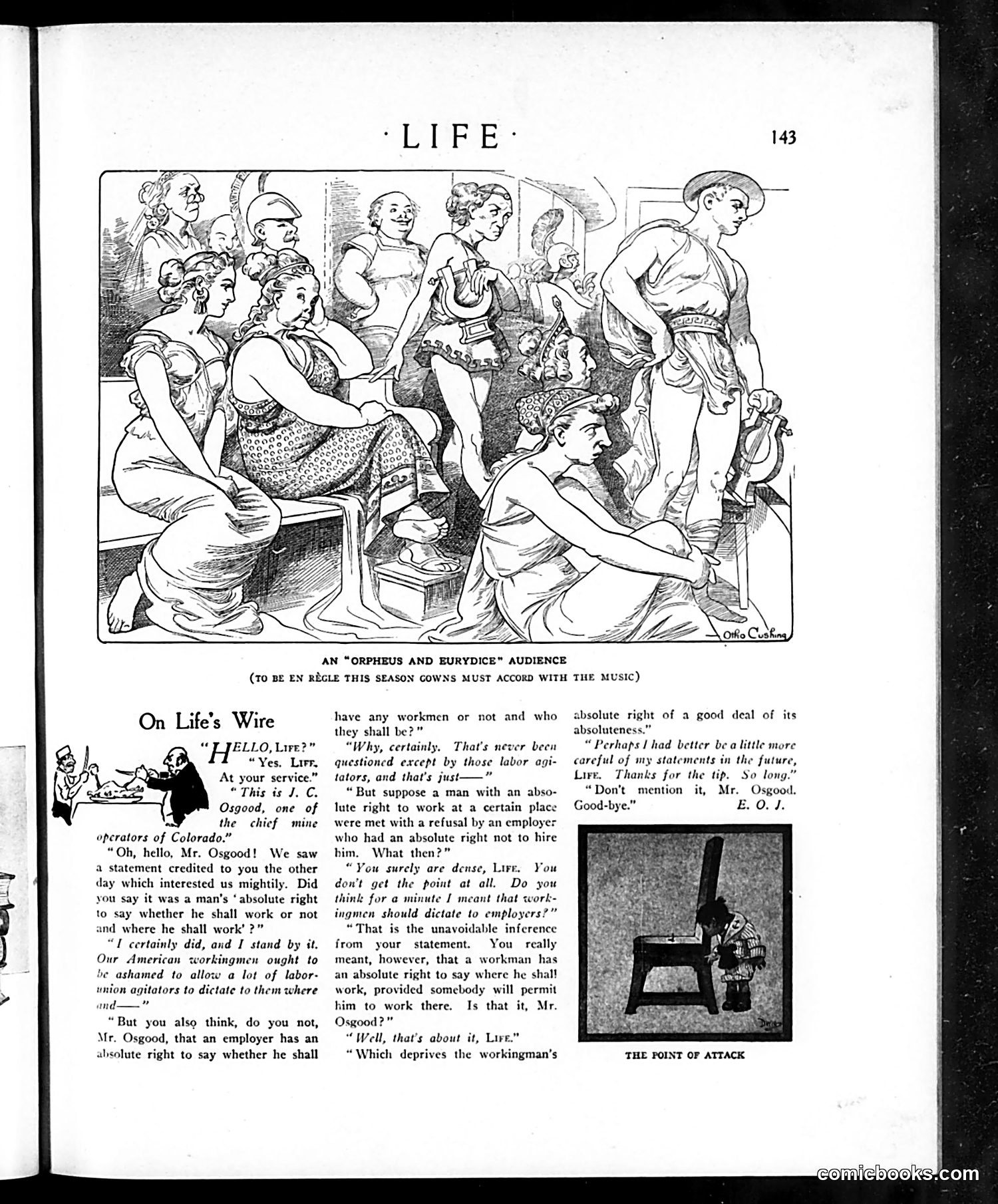
The top illustration is labeled "An 'Orpheus and Eurydice' Audience" with a note that "gowns must accord with the music"—a satirical jab at opera-goers' pretentiousness about formal dress codes. The main article, "On Life's Wire," features a debate between "Life" (the magazine personified) and "J.C. Osgood" about labor rights. The discussion centers on whether employers have an "absolute right" to dictate where workers can work, and whether workers should have collective bargaining power through unions. Osgood argues employers control hiring; Life counters that workers deserve say in their working conditions. This reflects early 20th-century labor disputes over union organizing and workers' rights—a contentious political issue of the era.
📄 Transcribed text from this page (OCR, searchable)
Machine-transcribed from the original scan — historical spelling and the odd misread are preserved.
AN “ORPHEUS AND EURYDICE” AUDIENCE (To BE EN REGLE THIS SEASON GOWNS MUST ACCORD WITH THE MUSIC) On Life’s Wire “TVELLO, Lire?” “Yes, Lirr, At your service.” “This is J.C. Osgood, one of the chief mine operators of Colorado.” “Oh, hello, Mr. Osgood! We saw a statement credited to you the other day which interested us mightily. Did you say it was a man's ‘absolute right to say whether he shall work or not and where he shall work’ ?” “TI certainly did, and I stand by it. Our American workingmen ought to be ashamed to allow a lot of labor- union agitators to dictate to them where und—” “But you also think, do you not, Mr. Osgood, that an employer has an absolute right to say whether he shall have any workmen or not and who they shall be?” “Why, certainly. That's never been questioned except by those labor agi- tators, and that’s just——” “But suppose a man with an abso- lute right to work at a certain place were met with a refusal by an employer who had an absolute right not to hire him, What then?” “You surely are dense, Lire. You don’t get the point at all. Do you think for @ minute J meant that work- ingmen should dictate to employers?” “That is the unavoidable inference from your statement. You really meant, however, that a workman has an absolute right to say where he shal! work, provided somebody will permit him to work there. Is that it, Mr. Osgood?” “Well, that’s about it, Lire.” “Which deprives the workingman’s absolute right of a good deal of its absoluteness.” “Perhaps | had better bea little more careful of my statements in the future, Lire. Thanks for the tip. So long.” “Don’t mention it, Mr. Osgood. THE POINT OF ATTACK