
A complete issue · 44 pages · 1914
Life — October 8, 1914
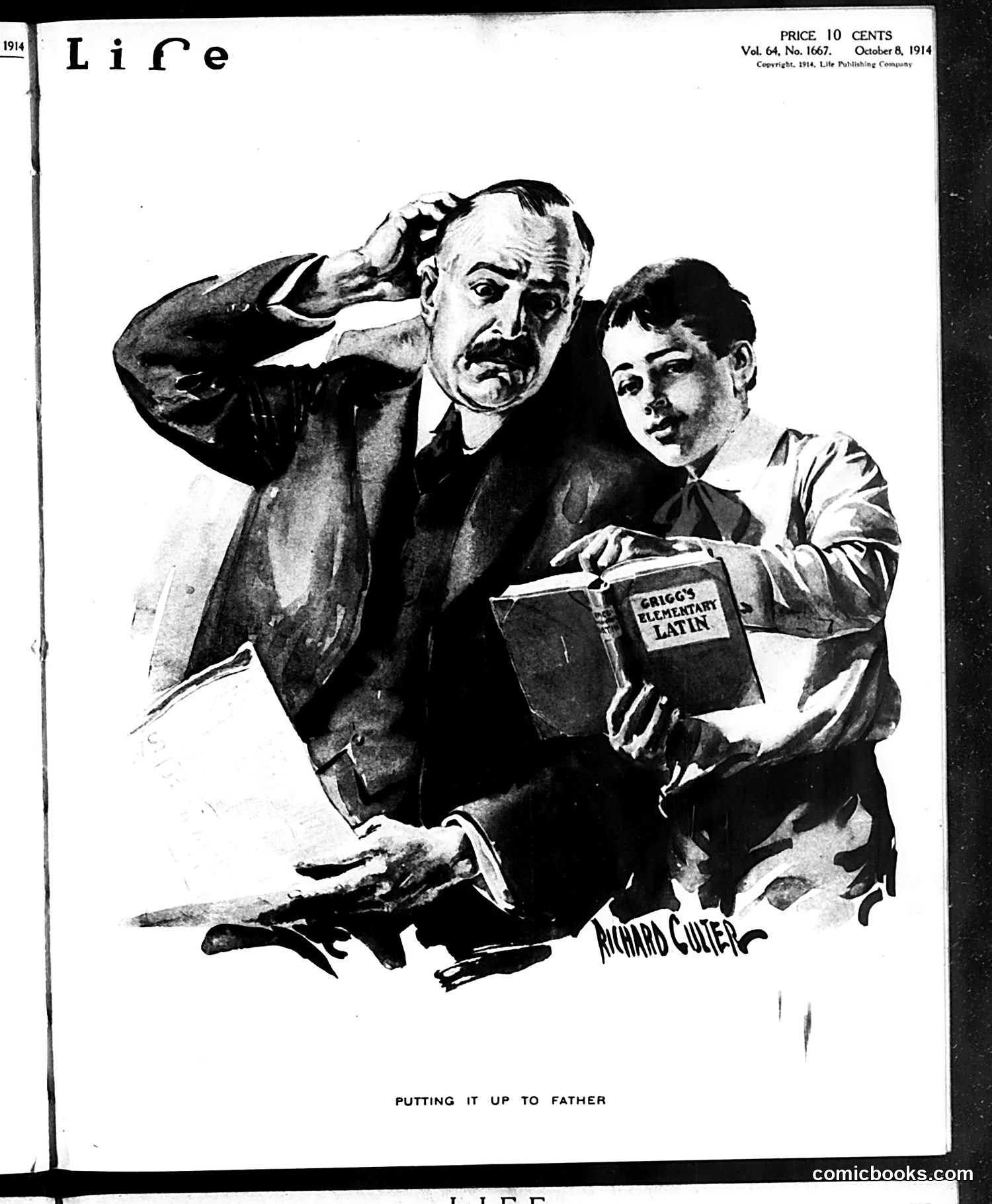
This Life magazine cover from October 8, 1914, depicts a domestic scene during the early months of World War I. An anxious father scratches his head while a young boy holds a Latin textbook (Griggs's Elementary Latin), apparently asking about his studies. The title "Putting It Up to Father" suggests the child is presenting a difficult problem to his parent. The cartoon likely satirizes American fathers' uncertainty about how to respond to their sons' education during wartime uncertainty. The specific reference to Latin—a classical language associated with traditional education—may critique how American institutions continued normal routines despite the momentous European conflict. The father's distressed pose suggests bewilderment about balancing ordinary domestic responsibilities with the anxieties of global war.

This page is **primarily an advertisement**, not a satirical cartoon. It promotes Colgate's Cold Cream in Life magazine, featuring a portrait of an elegant woman with 1920s-style finger waves and makeup. The ad emphasizes three qualities: "Cleanliness, Comfort, Charm"—typical marketing language for beauty products of this era. The product line shown includes a jar and tube of Colgate's Cold Cream. The advertisement promises Colgate quality and invites customers to "ask your dealer the price." A trial tube could be purchased for 4 cents from Colgate & Co. in New York. This reflects early 20th-century marketing strategies targeting women's beauty and personal grooming, positioning cold cream as essential to maintaining an attractive appearance.
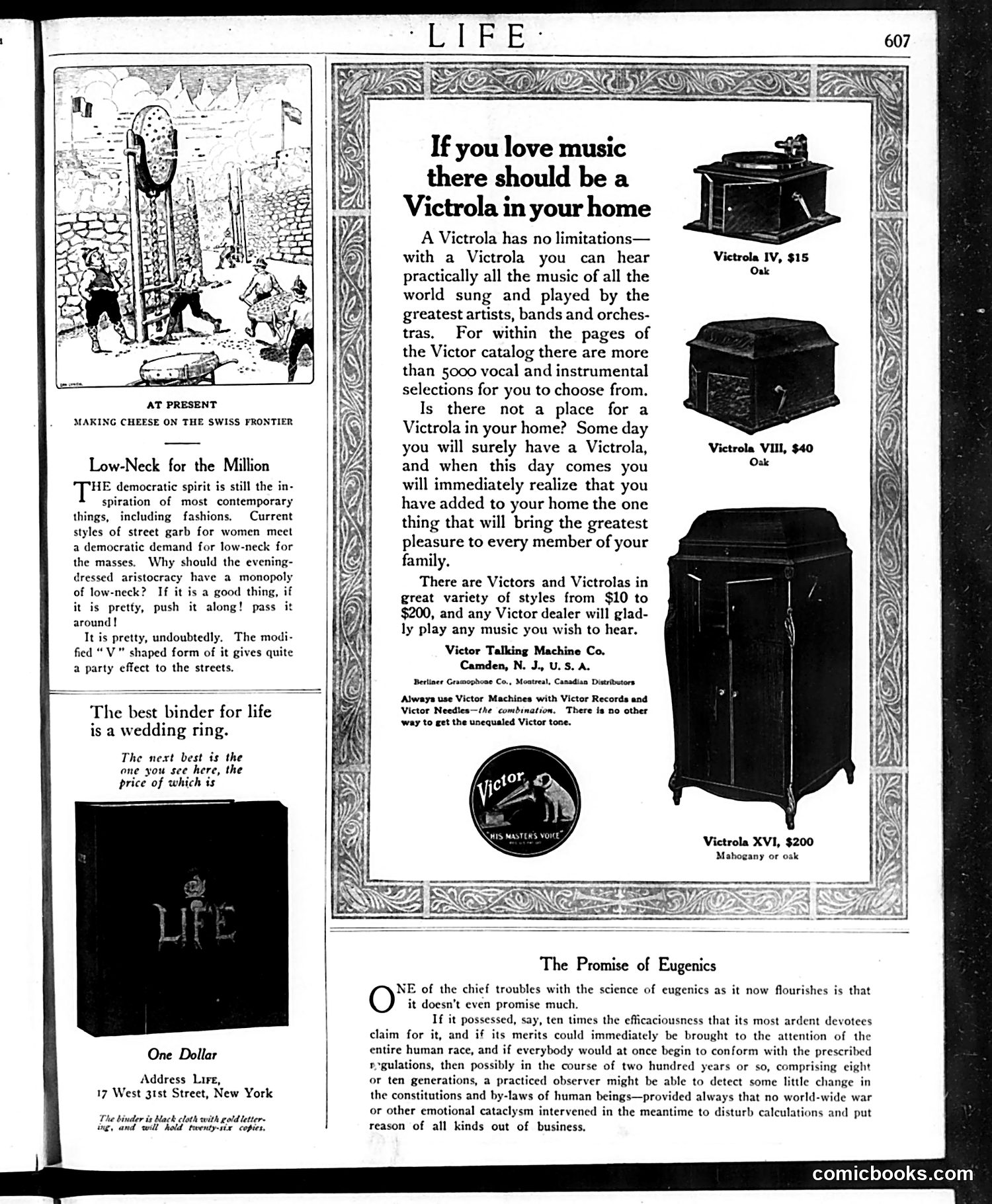
This page is primarily **advertising content** rather than editorial satire. The top-left cartoon ("At Present: Making Cheese on the Swiss Frontier") appears to be a humorous illustration of Swiss cheesemaking, though its specific satirical point is unclear from the image alone. The bulk of the page comprises **three advertisements**: one promoting low-neck fashion as democratic style, a wedding ring advertisement, and a substantial **Victor Victrola advertisement** showcasing phonograph models priced $10-$200. The Victrola ad emphasizes access to 5,000 musical selections. The bottom section begins an article on "The Promise of Eugenics," reflecting early 20th-century pseudoscientific interests that would later be discredited and weaponized by totalitarian regimes.
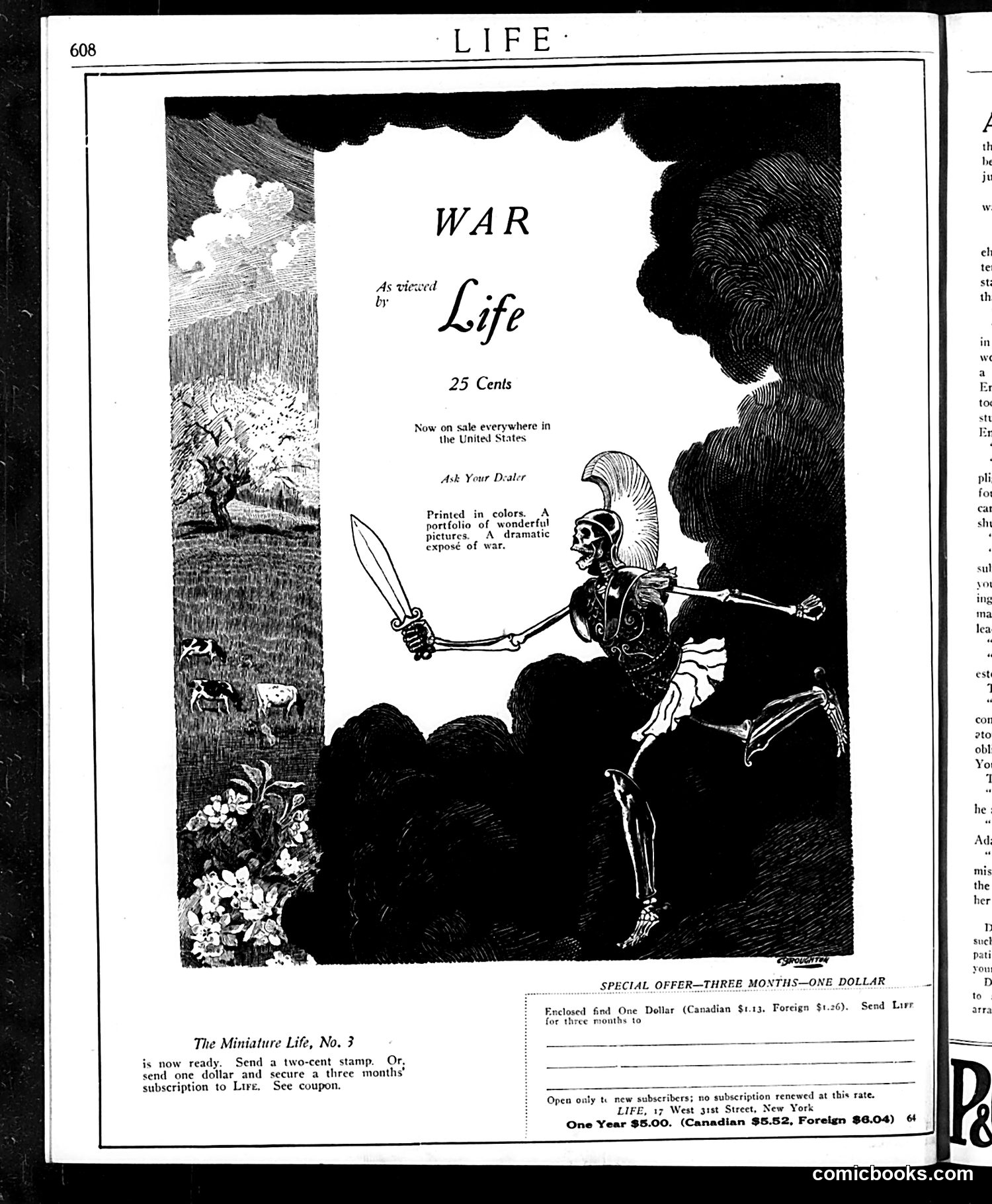
This page is primarily an advertisement for "War as Viewed by Life," a 25-cent special issue magazine offering "a dramatic exposé of war." The central image depicts a skeletal Death figure wielding a sword, surrounded by darkness and silhouetted masses—a stark anti-war visual metaphor. The left panel shows a pastoral landscape with peaceful rural life and animals, creating visual contrast with Death's dominion on the right. This juxtaposition suggests the satire's core message: war destroys peaceful civilian existence. The advertisement emphasizes "printed in colors" and a "wonderful portfolio," marketing the issue as a serious journalistic examination rather than entertainment. The special subscription offer (three months for one dollar) suggests Life positioned this as important social commentary during what appears to be the World War I era, when anti-war sentiment was growing in America.
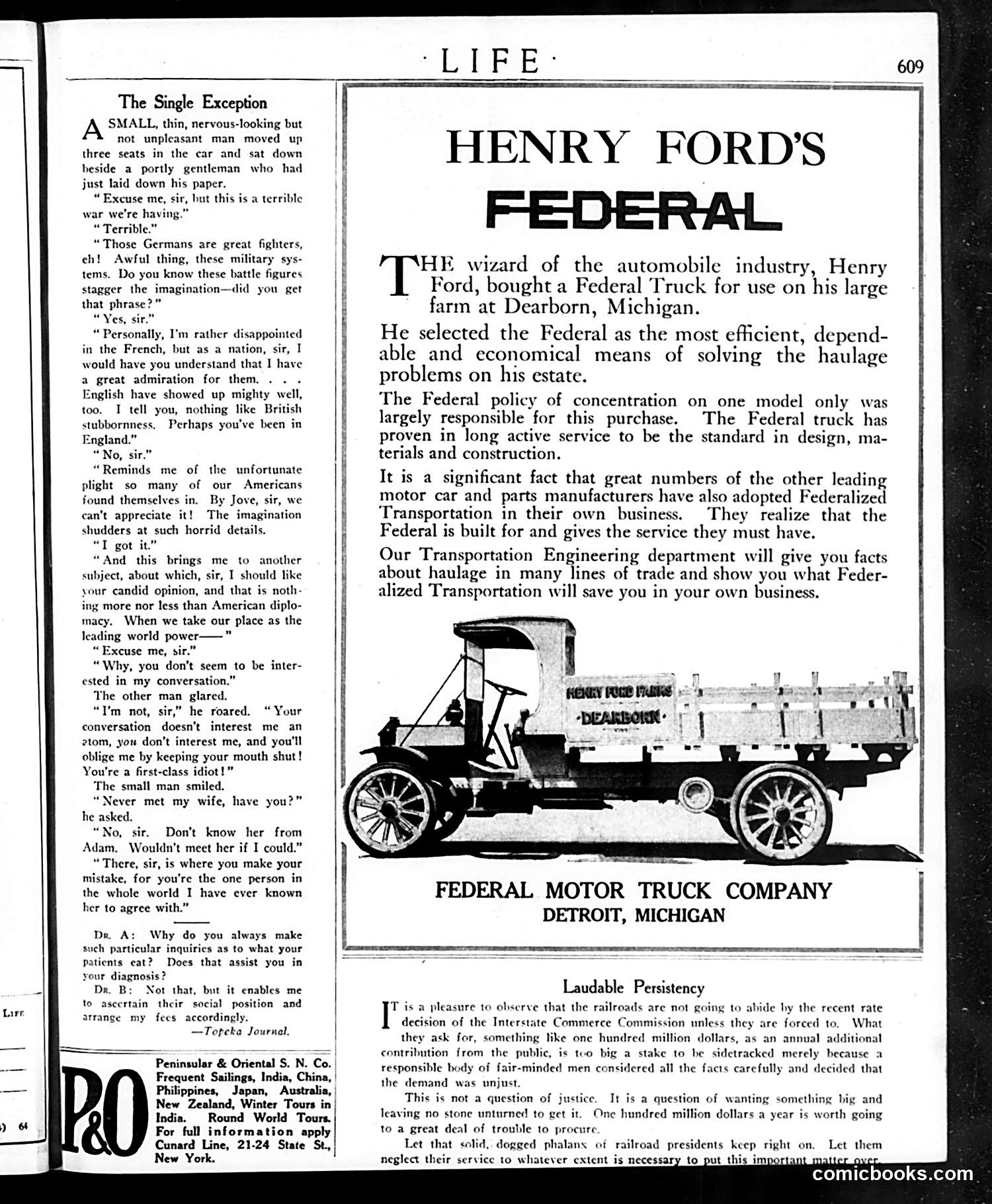
This page contains two distinct items: **Left column ("The Single Exception"):** A satirical dialogue between two men in a railway car. One criticizes German military systems; the other defends them, claiming British superiority. The satire mocks both jingoistic nationalism and condescending attitudes toward American imagination and diplomacy. The "single exception" appears to be a character who agrees with someone, suggesting rarity in finding common ground during wartime tensions. **Right column:** An advertisement for the Federal Motor Truck Company (Detroit) promoting their truck as chosen by Henry Ford for his farm. The copy emphasizes reliability and standardization. This is straightforward advertising, not satire. **Context:** Published during or shortly after World War I, the dialogue reflects period anxieties about American diplomatic standing and military preparedness.
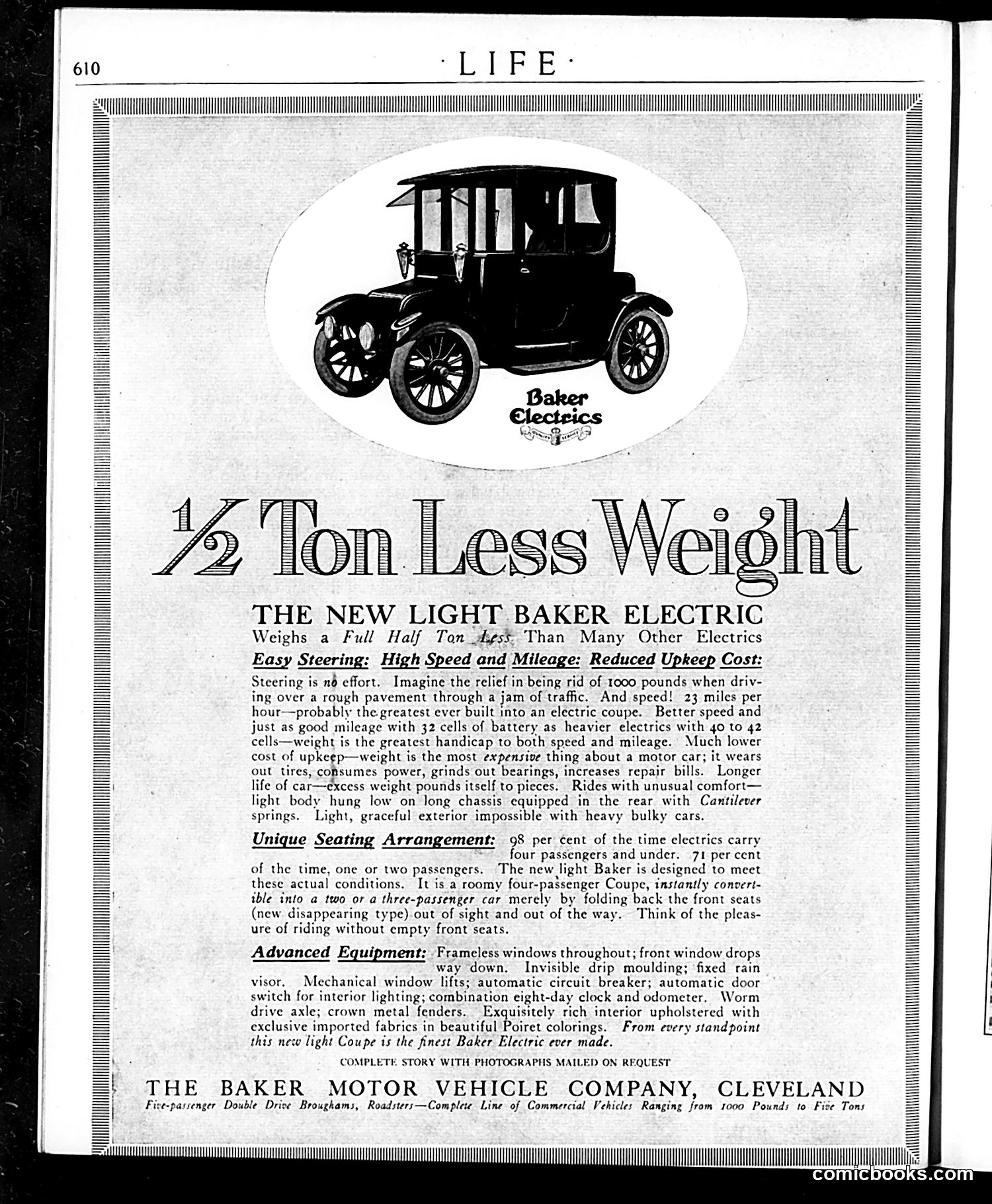
This page is **not a cartoon or satire** — it's a straightforward advertisement for the Baker Electric automobile, published in *Life* magazine (page 610). The ad promotes the "new light Baker Electric," emphasizing its advantages: it weighs half a ton less than competing electrics, requires minimal steering effort, achieves 23 miles per hour, and uses only 12 battery cells versus competitors' 40-42. The ad highlights practical benefits like reduced tire wear and lower maintenance costs. The seating arrangement is marketed as innovative — convertible from four-passenger to two or three-passenger configurations by folding front seats, addressing actual driving patterns of the era. This represents early automotive advertising targeting practical, efficiency-conscious buyers before internal combustion engines dominated the market. Electric vehicles were a viable transportation option in this period.
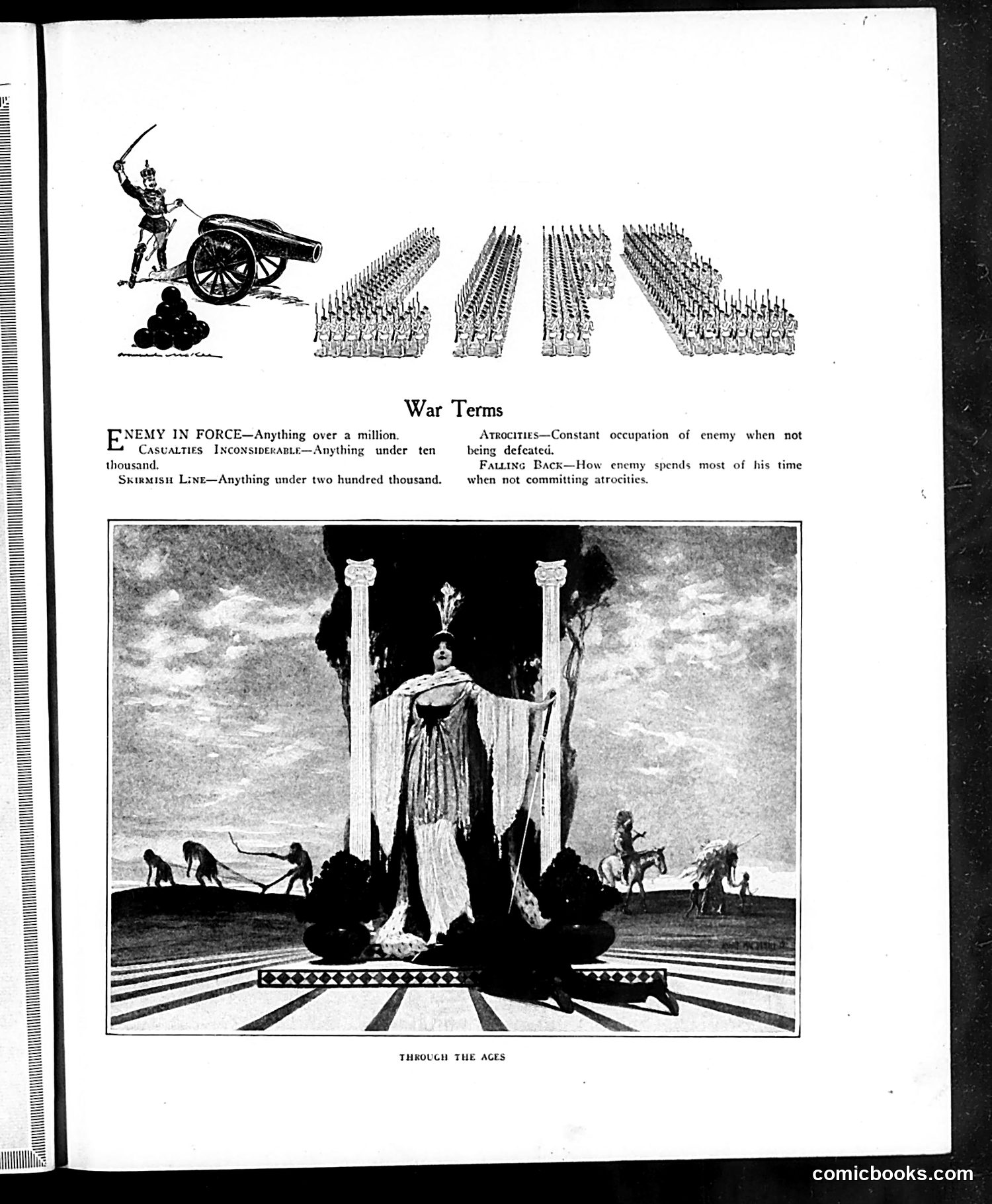
This page presents WWI-era propaganda defining military terminology. The top illustration uses the word "SINN" (formed by soldiers in formation) as a visual pun—likely referencing Sinn Féin, the Irish nationalist movement, though the specific satirical point is unclear without fuller context. Below, "War Terms" defines military concepts: - **Enemy in Force**: over one million troops - **Casualties Inconsiderable**: under ten thousand - **Skirmish Line**: under 200,000 - **Atrocities** and **Falling Back**: enemy occupation/retreat tactics The bottom image titled "Through the Ages" shows a robed female figure (likely Britannia, representing Britain) presiding over warfare across history—soldiers fighting below her in silhouette. This suggests Britain's eternal military dominance across time periods. The overall message frames British military superiority and minimizes enemy strength.
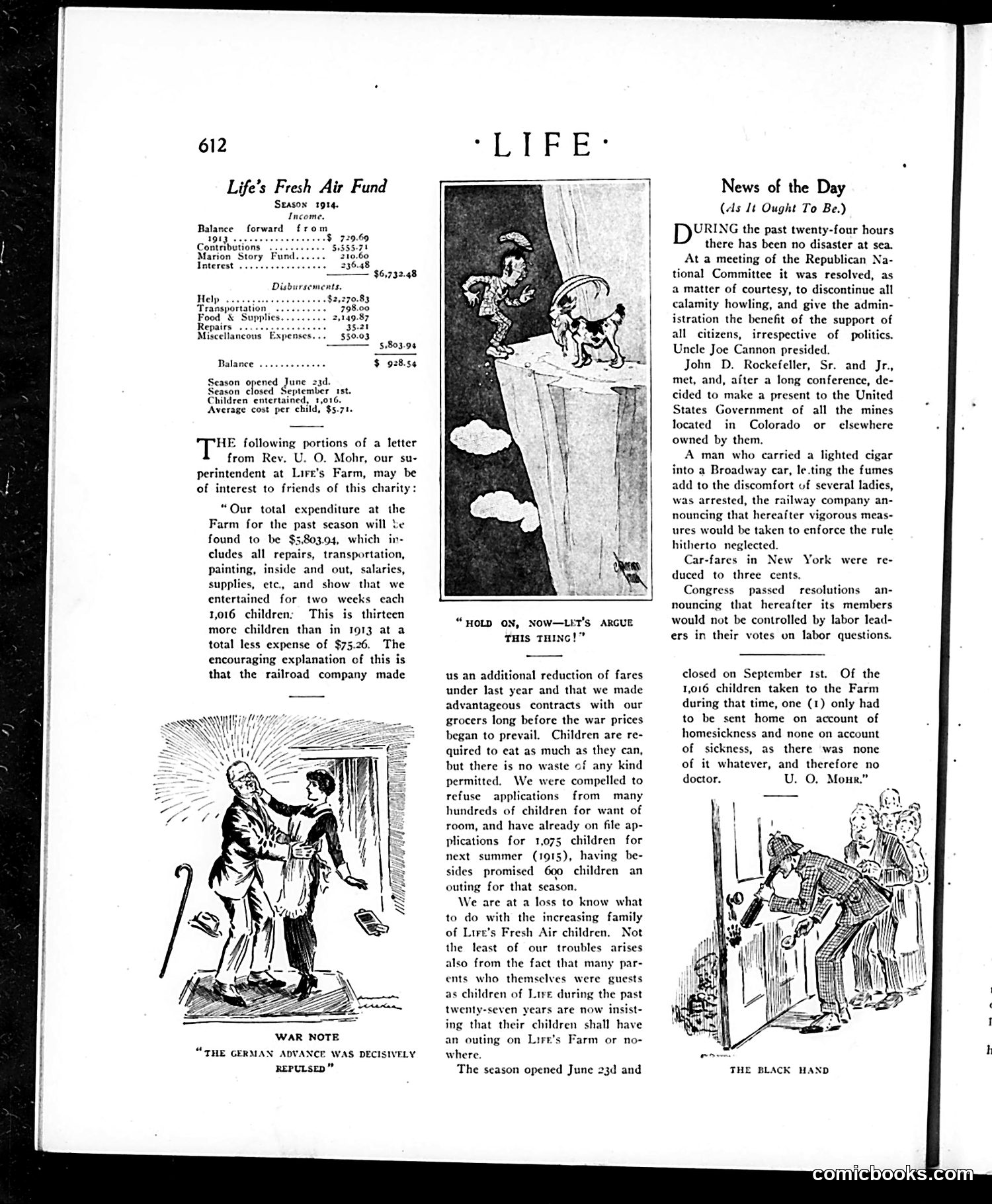
**"The German Advance Was Decisively Repulsed"** (bottom left): This cartoon depicts a German soldier being forcefully ejected by a French woman, satirizing early WWI combat. The caption uses the official military language of "repulsed" to humorously suggest Germany's failed invasion attempts on the Western Front during 1914. **"Hold On, Now—It's Argus This Time!"** (top right): A woman clings to a window ledge while a dog appears threatening below, referencing the Greek mythological figure Argus (known for his many eyes). The joke likely comments on heightened surveillance or paranoia during wartime. **"The Black Hand"** (bottom right): References the Serbian nationalist group blamed for assassinating Archduke Franz Ferdinand, triggering WWI's outbreak.
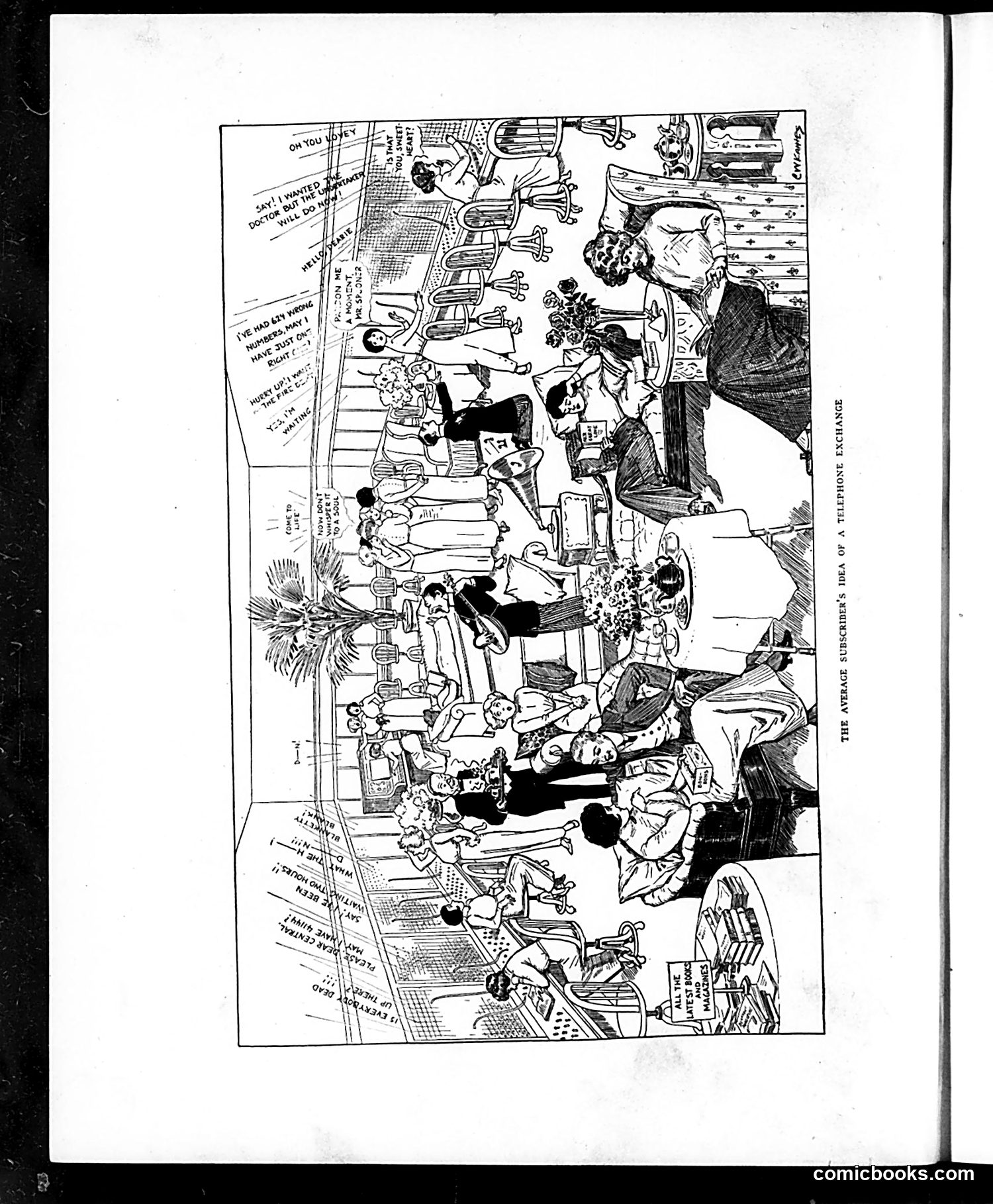
This appears to be a satirical cartoon depicting a telephone exchange or switchboard operation. The image shows multiple figures operating telephone equipment in what seems to be a chaotic scene. The caption reads "THE AVERAGE SUBSCRIBER'S IDEA OF A TELEPHONE EXCHANGE." The satire mocks how ordinary telephone users might imagine the inner workings of telephone exchanges—likely depicting it as disorganized or absurdly staffed. The cartoon suggests a humorous disconnect between public perception and reality of telephone infrastructure. Given Life magazine's focus on social satire, this likely critiques either public frustration with telephone service quality or pokes fun at misconceptions about how modern technology actually operates. The crowded, frantic composition emphasizes the comedic exaggeration of what customers thought happened behind the scenes when they made calls.
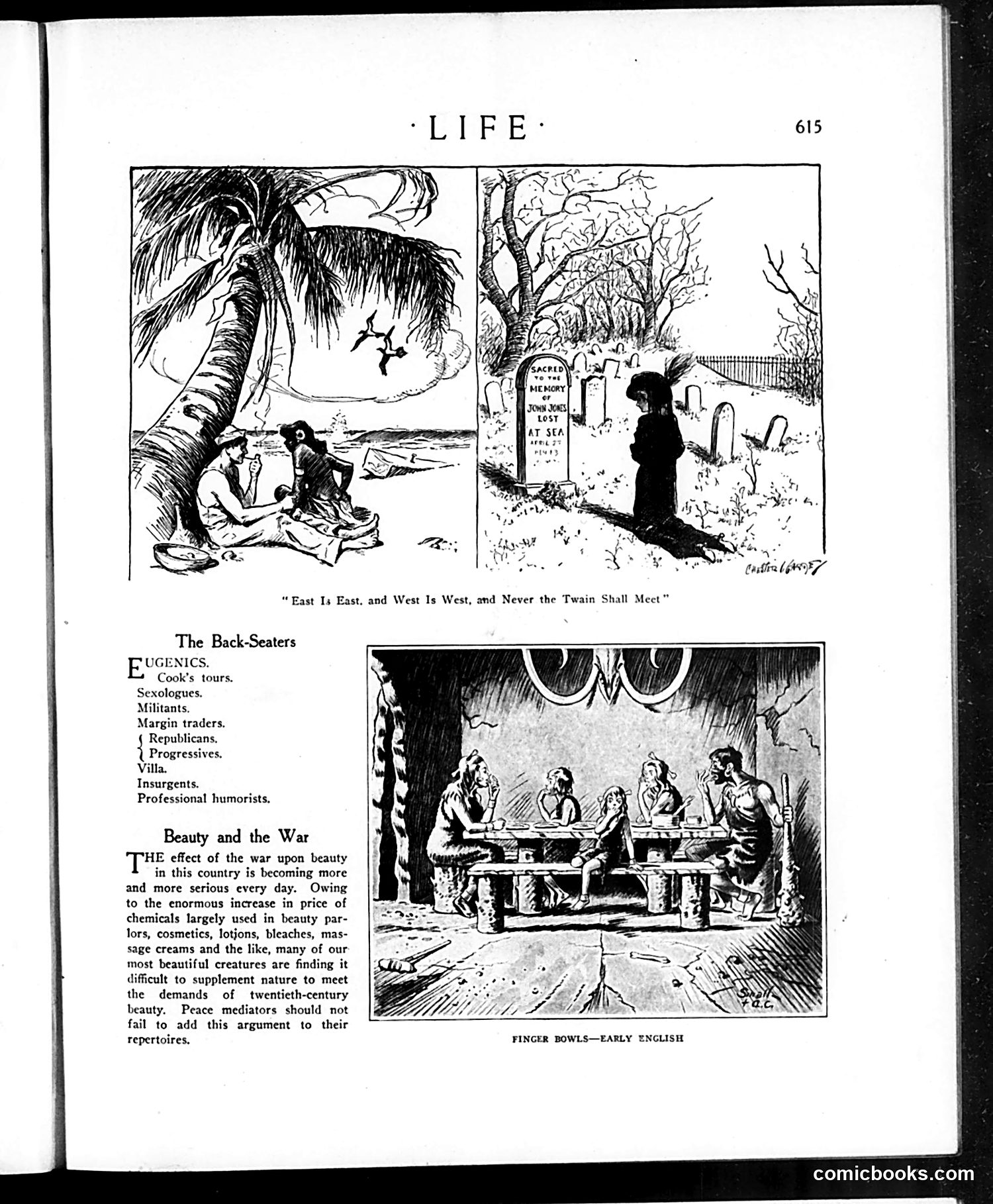
**Top Cartoons**: Two panels illustrate the caption "East Is East, and West Is West, and Never the Twain Shall Meet"—referencing Kipling's famous line about cultural divides. The left panel shows two figures relaxing under a palm tree on a tropical beach; the right depicts a figure at a graveyard. The satire appears to contrast leisure and mortality, possibly commenting on Eastern versus Western attitudes toward death or vacation culture. **"The Back-Seaters"**: A list mocking various groups attending Cook's tours and similar activities—eugenics enthusiasts, sexologists, militants, Republicans, Progressives, and professional humorists. This satirizes tourist culture and the eclectic mix of early 20th-century intellectuals and activists. **"Beauty and the War"**: The text argues that wartime chemical price increases make beauty products expensive, affecting women's ability to maintain appearance. This critiques how war economics impact civilian life, particularly women's access to cosmetics.
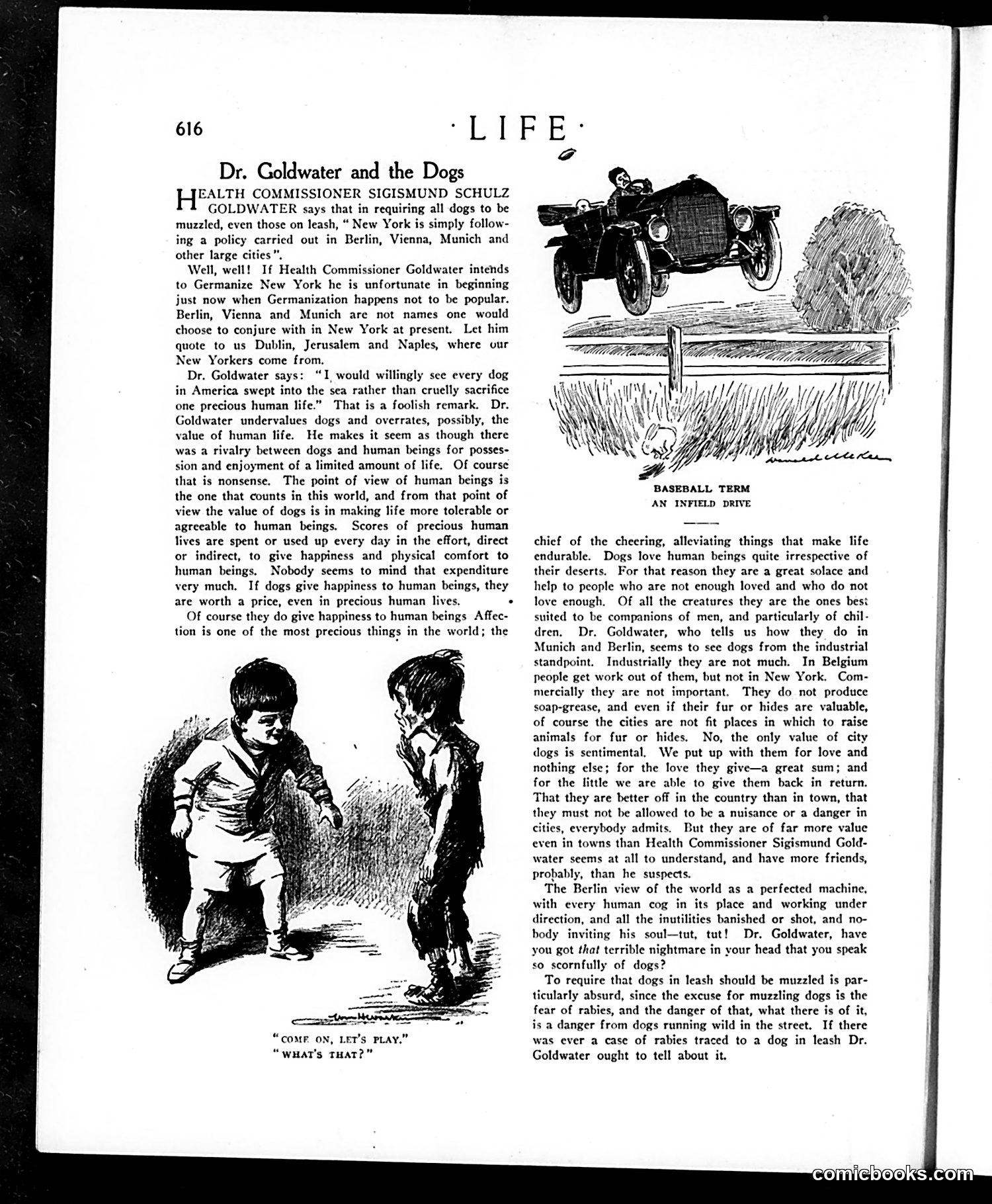
This satirical article criticizes Health Commissioner Sigismund Schulz's proposal to require muzzling all dogs in New York City. The piece defends dogs' value to human happiness and attacks the comparison to other cities (Berlin, Vienna, Munich) as inappropriate for New York. The article argues that city dogs provide sentimental companionship rather than economic value, making them worth protecting. It mocks Schulz's mechanistic, Prussian worldview ("every human cog in its place") as contrary to American values. The cartoons illustrate dogs' innocent social role—children playing together—suggesting that muzzling requirements are unnecessarily harsh. The satirist contends dogs are "better off in the country" but shouldn't be banned from cities where they bring joy to those "not enough loved."
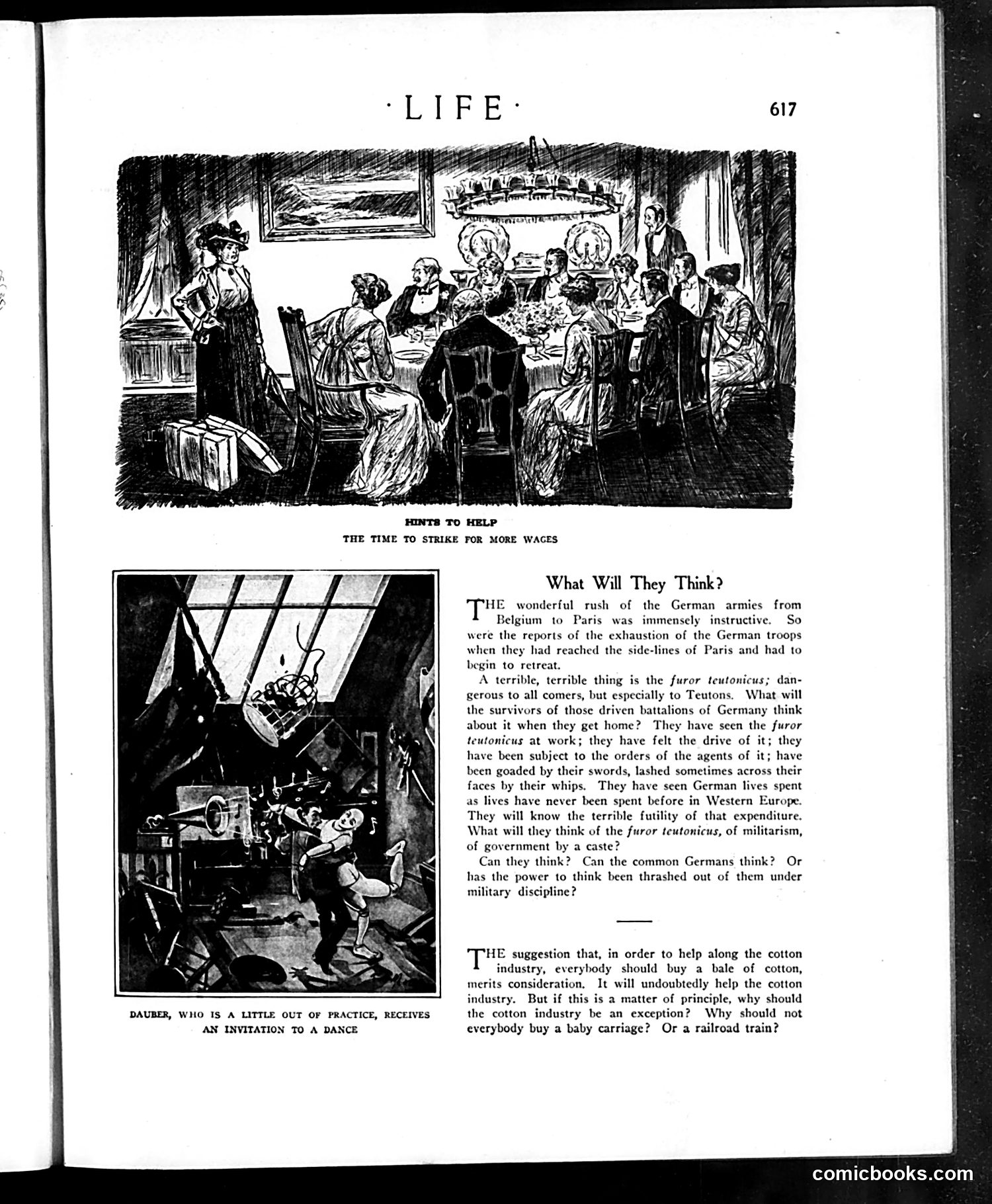
This page contains two satirical cartoons and accompanying editorial text criticizing German militarism and domestic labor movements during World War I. The top cartoon depicts wealthy individuals at a dinner party, captioned "HINTS TO HELP THE TIME TO STRIKE FOR MORE WAGES"—sarcastically suggesting the wealthy are inadvertently encouraging workers to demand raises. The lower cartoon, titled "DAUBEE, WHO IS A LITTLE OUT OF PRACTICE, RECEIVES AN INVITATION TO A DANCE," shows a figure in what appears to be a wartime factory or industrial setting, likely mocking someone unprepared for manual labor. The accompanying editorial discusses German soldiers' experiences and questions whether German citizens will accept militaristic rule. It also critiques proposals that everyone should buy cotton to support American industry, questioning why some industries deserve special treatment over others.
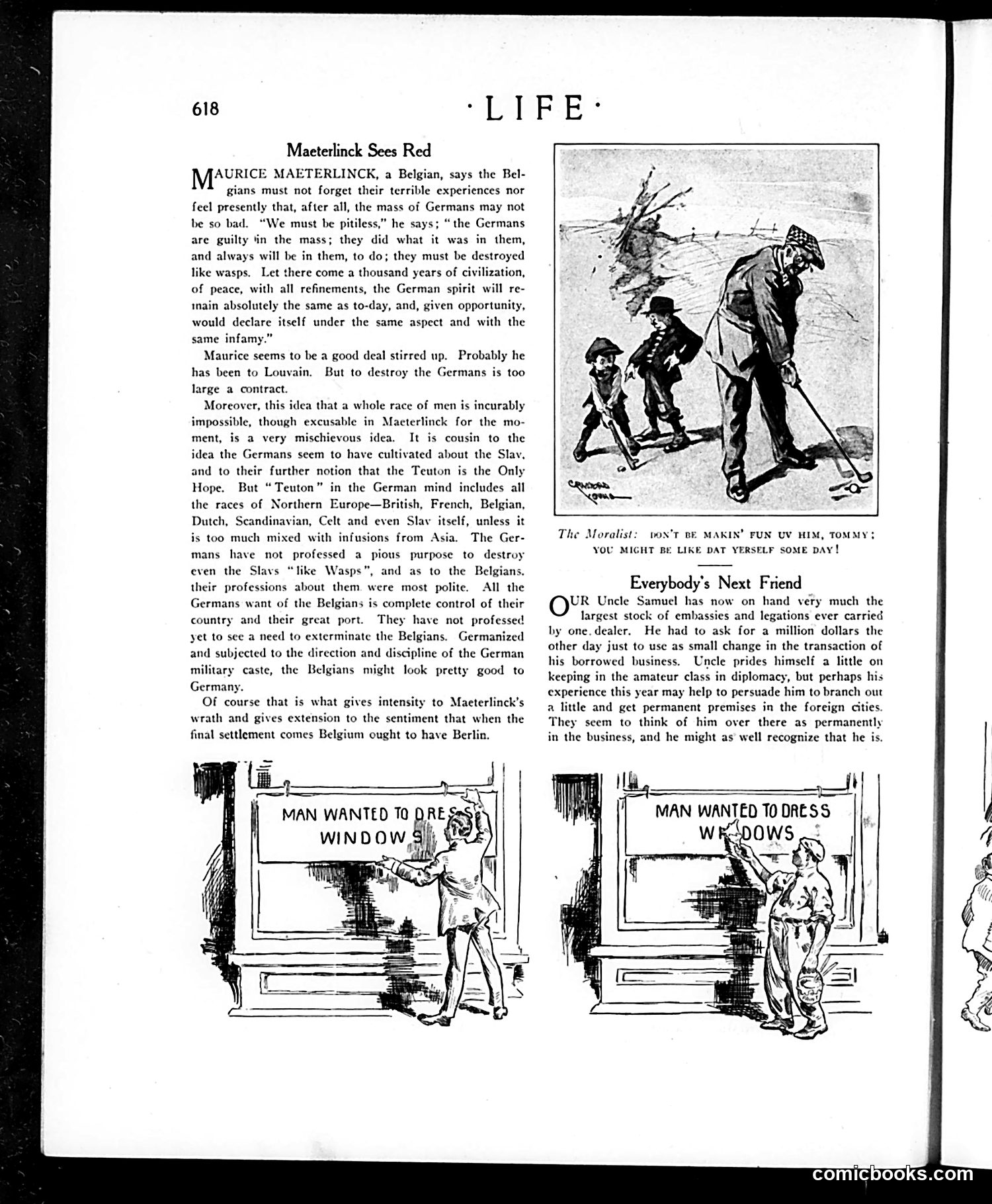
This Life magazine page contains two distinct elements: **"Maeterlinck Sees Red"** is an article about Belgian playwright Maurice Maeterlinck's bitter post-WWI views on Germans. The text quotes him arguing Germans are inherently destructive and must be permanently eliminated—a view the author finds extreme but understandable given Belgian suffering during the war. **"Everybody's Next Friend"** is a brief article about Uncle Sam's diplomatic efforts, humorously noting he's accumulating embassies and legations while trying to balance commercial interests with maintaining small foreign offices. Below are two cartoons showing help-wanted signs for "Man Wanted to Dresse Window" and "Man Wanted to Dress Wedows"—a visual pun where "widows" is misspelled as "wedows," with the joke playing on war-created widows needing assistance.
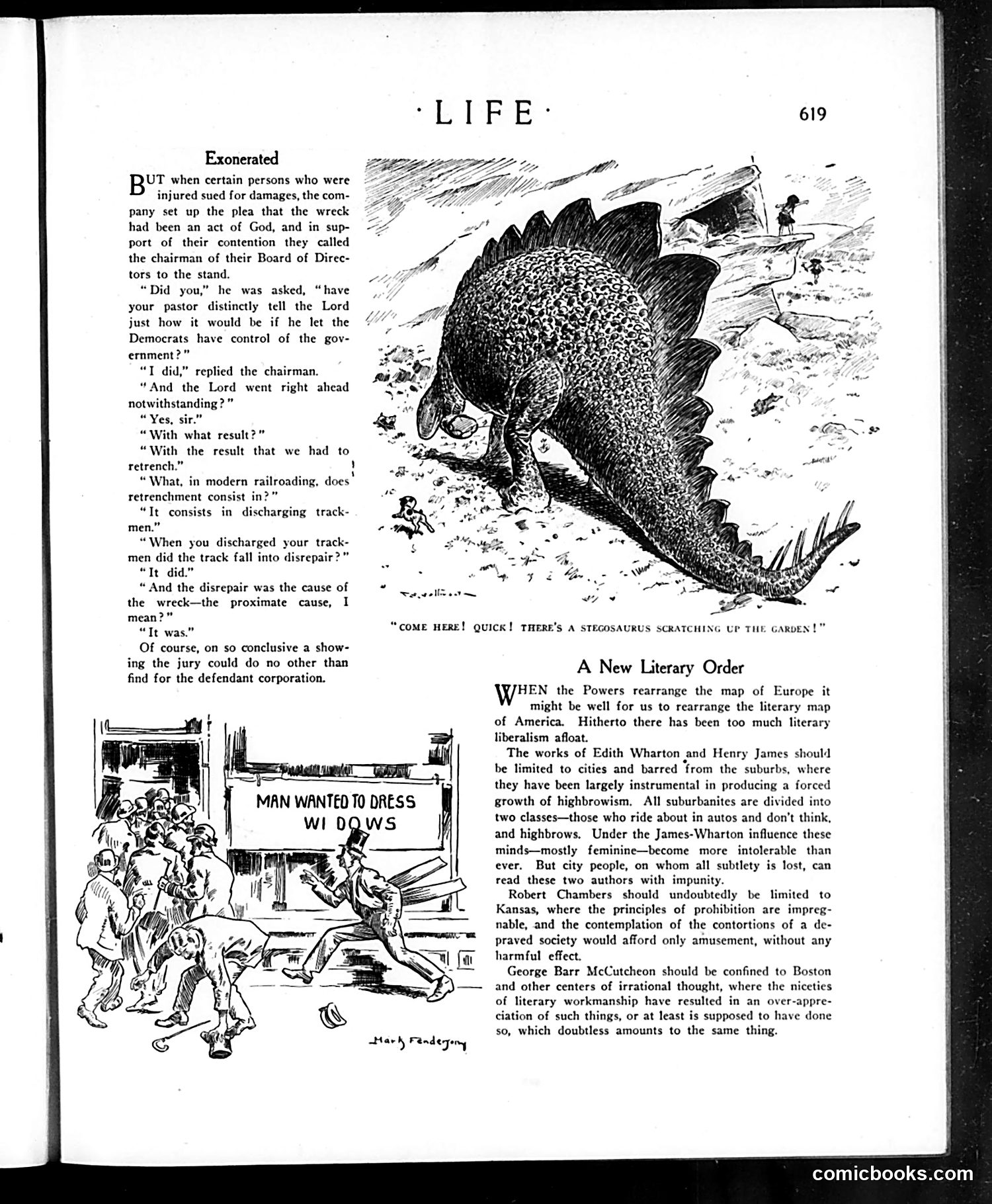
**"Exonerated" (top story):** This satirizes corporate legal tactics. A railroad company sued for damages from a wreck claims "act of God" as defense. Their Board chairman testifies he had his pastor pray that Democrats *wouldn't* control government—yet they did anyway, forcing the company to "retrench" (fire trackmen). The resulting track disrepair caused the wreck. The satire: through absurd circular logic, the company gets exonerated despite obvious negligence, because they blamed Divine will for their own cost-cutting decisions. **"A New Literary Order" (right column):** A tongue-in-cheek proposal to geographically restrict American authors by perceived social class. Edith Wharton and Henry James (sophisticated writers) should be banned from suburbs where they encourage "highbrowism" among women. Robert Chambers belongs only in prohibition-era Kansas. George Barr McCutcheon should be confined to Boston. The satire mocks both literary snobbery and provincial attitudes about who "deserves" access to serious literature. The cartoons lampoon corporate irresponsibility and literary elitism, respectively.
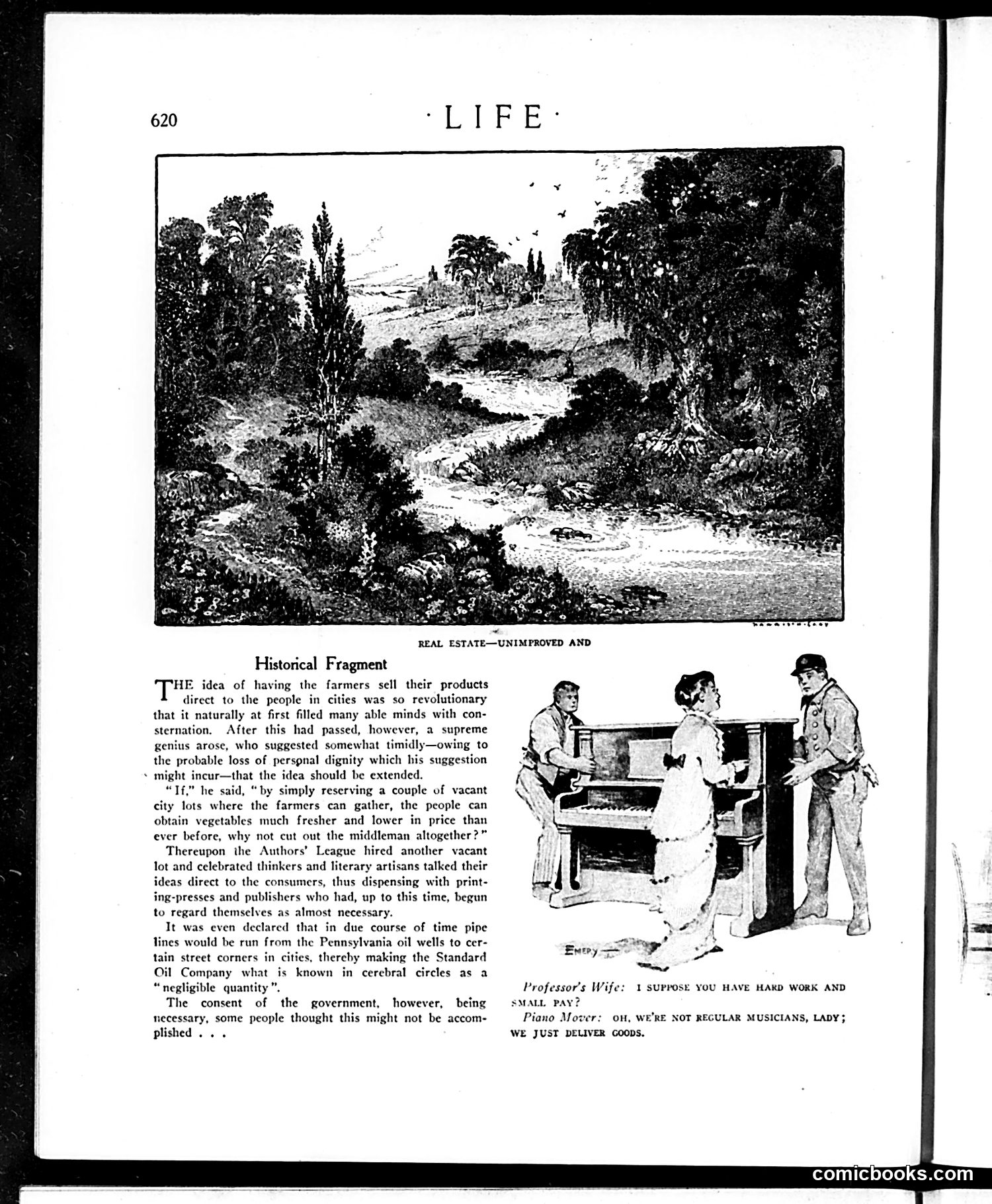
This Life magazine page contains satirical commentary on eliminating middlemen from commerce. The "Historical Fragment" ridicules the idea that direct farmer-to-consumer sales could extend to other industries—suggesting authors could sell ideas directly to readers without publishers, or oil could pipe directly to street corners, making Standard Oil "negligible." The accompanying cartoon jokes about the absurdity of this logic. A professor's wife asks a piano mover about his wages and hard work, expecting sympathy. He replies they're not musicians but "delivery men"—implying even moving pianos requires no special skill or compensation. The satire targets both those naively proposing to eliminate all intermediaries AND the class presumption that manual laborers deserve less consideration. It's early-20th-century commentary on industrial efficiency schemes and labor economics, presented through sharp comic irony.
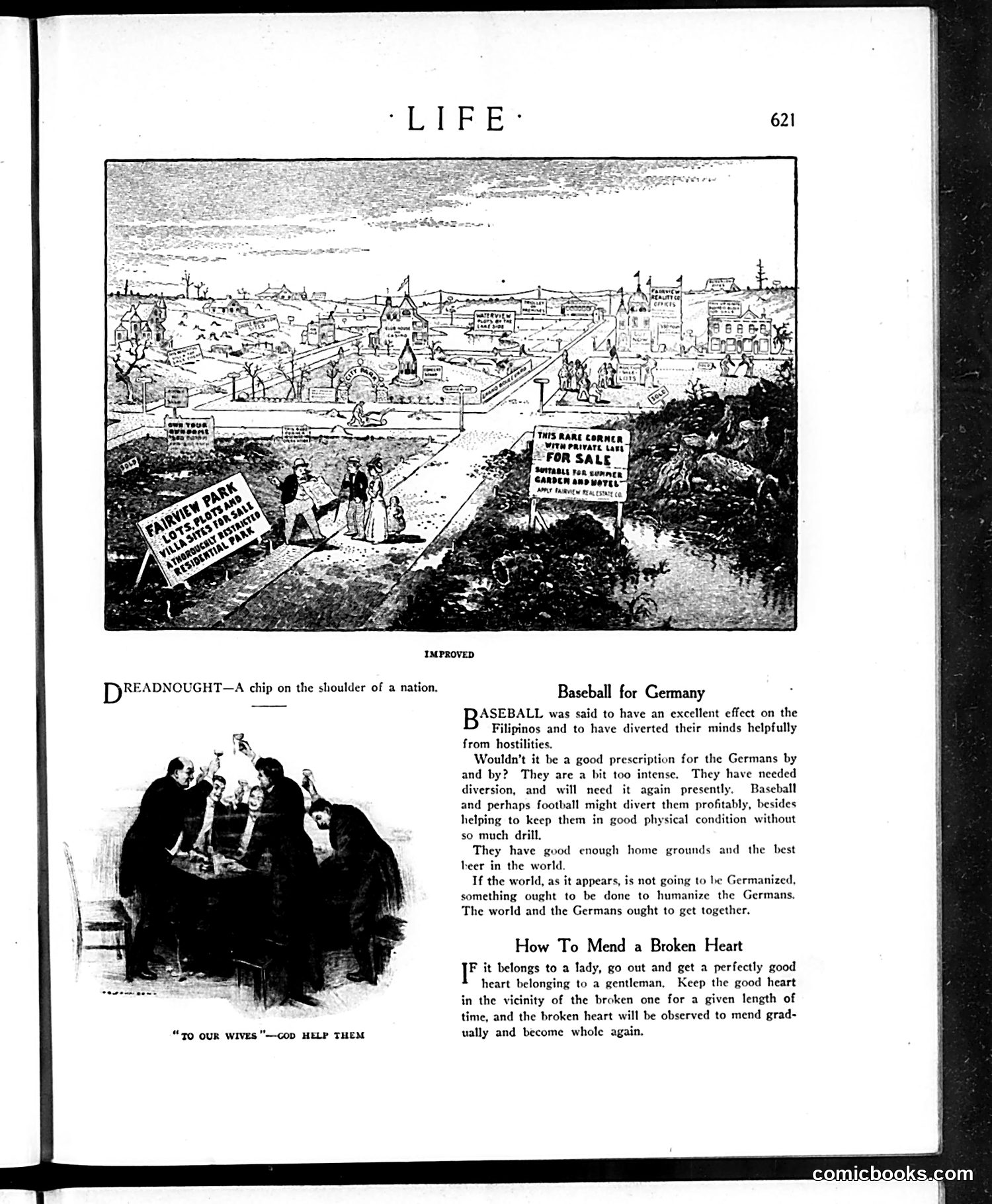
The top illustration depicts an idealized suburban development with real estate signs, reflecting early 20th-century American optimism about urban expansion and property sales. The main text piece, "Baseball for Germany," is post-WWI satire suggesting that Germans are dangerously intense and militant. The author proposes baseball as a "prescription" to pacify them—similar to how the sport allegedly distracted Filipinos from anti-colonial resistance. The piece darkly jokes that Germans need diversion "again presently," implying future conflict is inevitable. It's condescending commentary on both German character and American assumptions about sports' civilizing power. The accompanying sketch captioned "TO OUR WIVES—GOD HELP THEM" shows men gathered around what appears to be a woman, likely satirizing gender relations or domestic life. Below, "How To Mend a Broken Heart" is flippant romantic advice—essentially suggesting replacing a lost love with a new one through proximity. **Context**: This reflects post-WWI anxieties about Germany and American attitudes blending sporting optimism with skepticism about lasting peace.
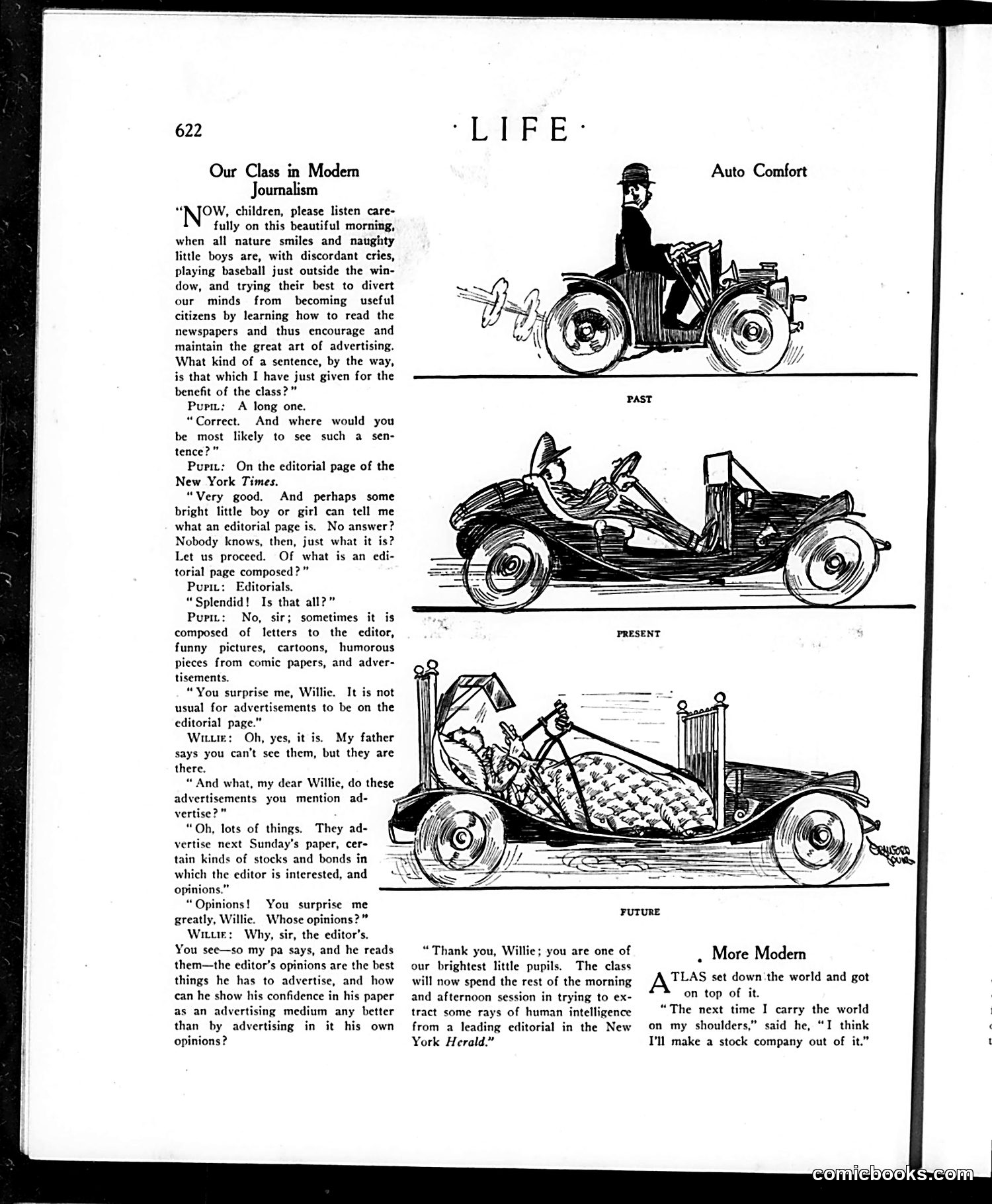
This is a satirical dialogue between a teacher and students about newspaper journalism, specifically critiquing editorial pages and their relationship to advertising. **The joke:** Willie, a precocious student, reveals that newspapers blur the line between editorial content and advertising. He notes that advertisements appear on editorial pages (supposedly reserved for opinion), and more pointedly—his father says the editor's own opinions function as advertising for the paper itself. The editor uses the editorial page to advertise his views, demonstrating "confidence" in his paper as an advertising medium. **The satire:** Life is mocking how newspapers disguise commercial interests as serious editorial content. The editorial page, meant to present reasoned opinion, actually serves the paper's financial interests and the editor's personal agenda. **The "Auto Comfort" cartoon series** shows vehicle evolution (past, present, future), culminating in Atlas carrying the world as a business venture—satirizing capitalist ambitions to monetize everything. The overall message: newspapers claim journalistic integrity while their "opinion" pages are fundamentally commercial enterprises.
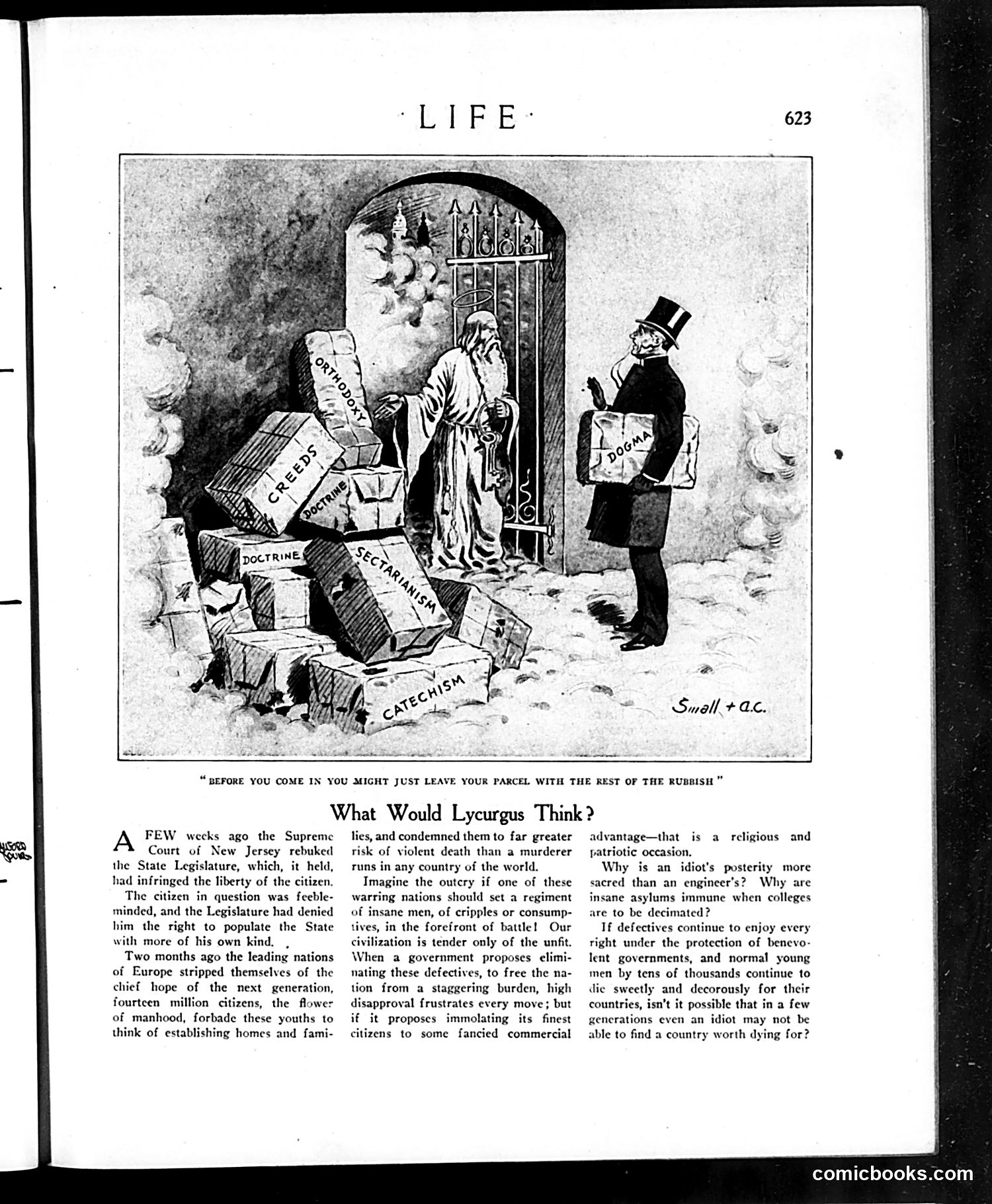
This 1910s satire critiques the perceived hypocrisy in how societies value lives. The cartoon shows a doorman turning away a well-dressed man carrying a "Dodges" parcel, telling him to leave it "with the rest of the rubbish"—alongside labeled boxes of "Catechism," "Doctrine," "Sectarianism," and "Creeds." The accompanying article (titled after the ancient Spartan lawgiver Lycurgus, known for selective breeding policies) argues that Western governments protect those deemed "unfit" through eugenic laws while simultaneously sending millions of healthy young men to die in World War I. The author sarcastically questions this contradiction: if society preserves the "defective" on moral grounds, why does it celebrate sacrificing the "finest citizens" for commercial or patriotic interests? The cartoon's visual joke suggests that outdated religious dogma ("the rubbish") should be discarded, while the article challenges the era's eugenics logic by exposing its fundamental inconsistency.
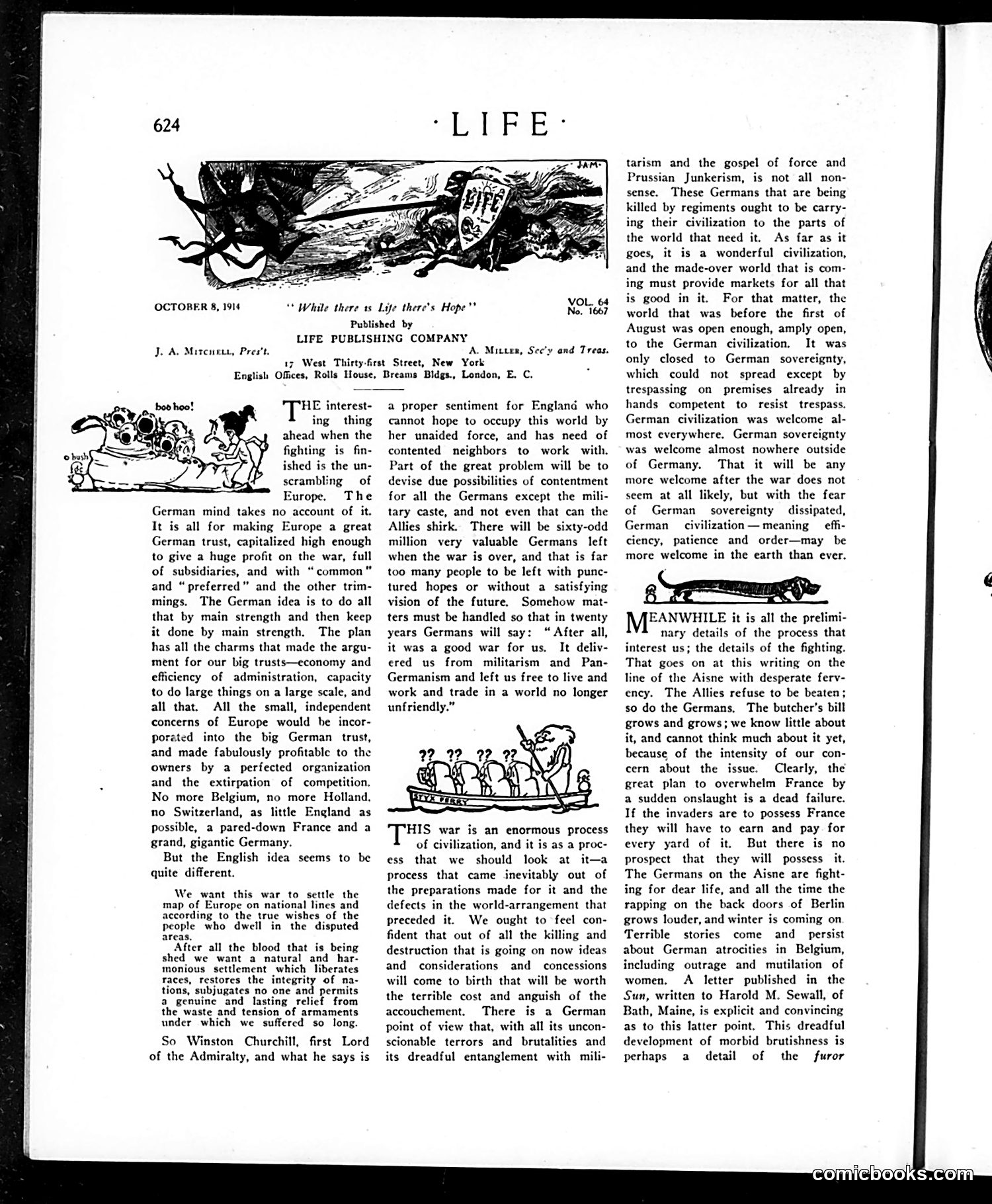
This page presents editorial commentary on World War I, dated just two months after it began. The text contrasts German and British post-war objectives: **The German Vision** (depicted as corporate/materialist): Germany aims to consolidate Europe into a profitable "trust," absorbing smaller nations (Belgium, Holland, Switzerland, France) into a unified German economic empire—efficiency through military dominance. **The British Vision** (depicted as idealistic): Britain seeks to redraw Europe's map according to national self-determination, liberating suppressed peoples and creating a genuinely peaceful international order. The cartoons (small illustrations accompanying the text) appear to satirize German ambitions as mechanistic and predatory, contrasting with British humanitarian ideals. **Context for modern readers**: This represents American *Life* magazine's early WWI perspective—sympathetic to Britain's framing of the conflict as a civilizational struggle between enlightened democratic values and Prussian militarism. The piece notably attempts to distinguish between Germans as a people and their militaristic leadership, suggesting post-war reconciliation is possible.
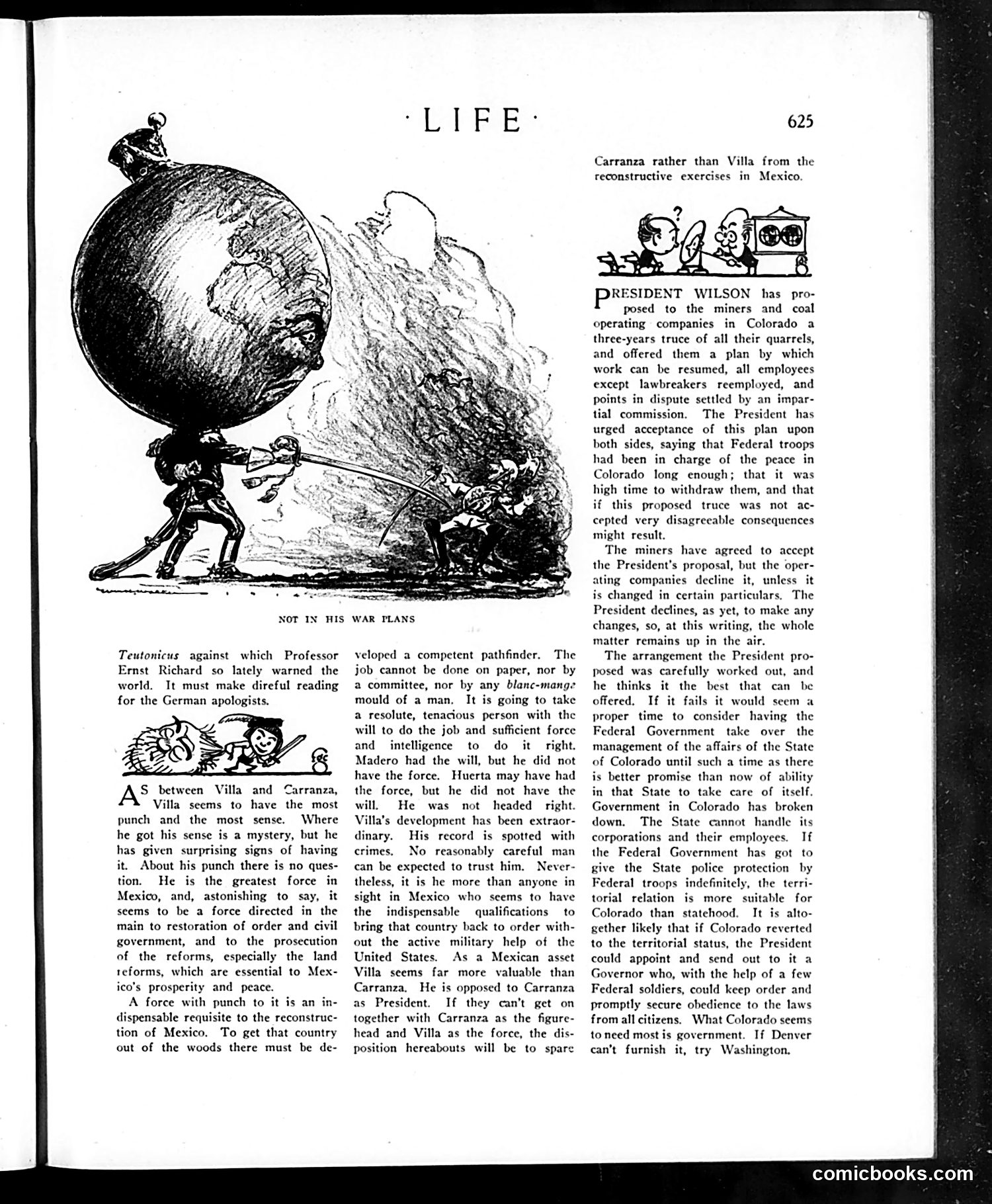
**The Main Cartoon ("Not in His War Plans"):** Shows a figure straining to push an enormous boulder labeled with the Mexican revolutionary leaders' names. This satirizes the Mexican Revolution's chaos—specifically the conflict between Villa and Carranza. The text argues Villa, despite his criminal record, possesses the "punch" and competence necessary to restore order in Mexico, whereas Carranza lacks practical force. The satire criticizes those expecting Mexico to self-govern without strong military leadership. **The Secondary Political Commentary:** Addresses President Wilson's proposed three-year truce between Colorado miners and coal companies. Wilson urged both sides to accept arbitration and withdraw Federal troops. The miners agreed; the companies refused unless terms changed. The author argues if Colorado cannot manage its own labor crisis, it should lose statehood and revert to territorial status under direct Federal control—a punitive suggestion reflecting frustration with state-level governance failure. Both pieces critique the tension between idealistic governance and practical necessity.
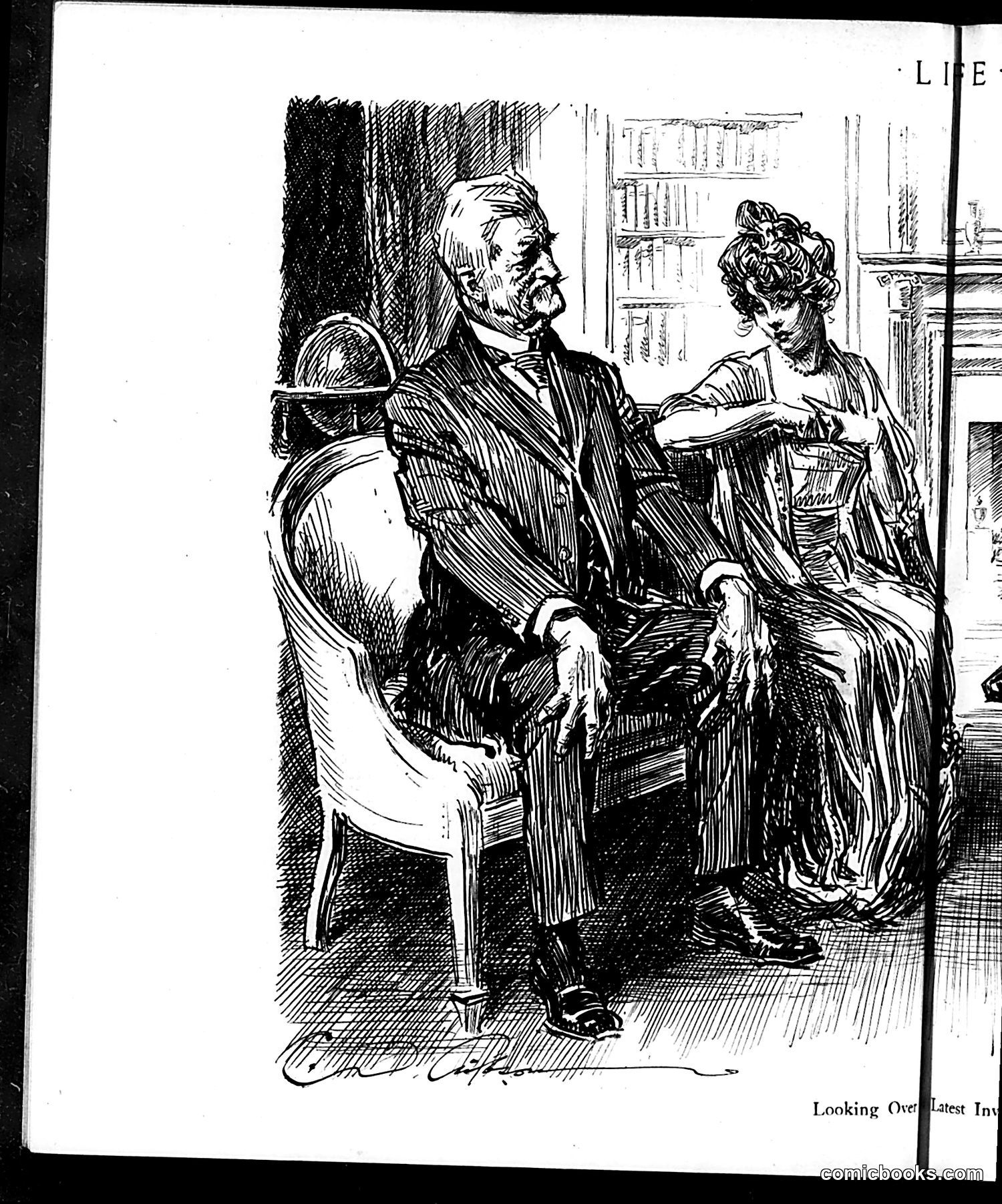
This is a pen-and-ink illustration showing two figures in what appears to be an indoor study or library setting (bookshelves visible in background). An older man with distinctive facial features sits in a chair while a woman in early 1900s dress stands nearby, appearing to show him something—possibly a document or publication. The caption reads "Looking Over Latest Inv[estments]" (text cut off). Without clearer OCR text or additional context identifying the specific figures, I cannot definitively state who these individuals represent or what satirical point is being made. The scene suggests commentary on financial matters or investments, likely topical to Life magazine's era, but the specific historical reference remains unclear from the image alone.
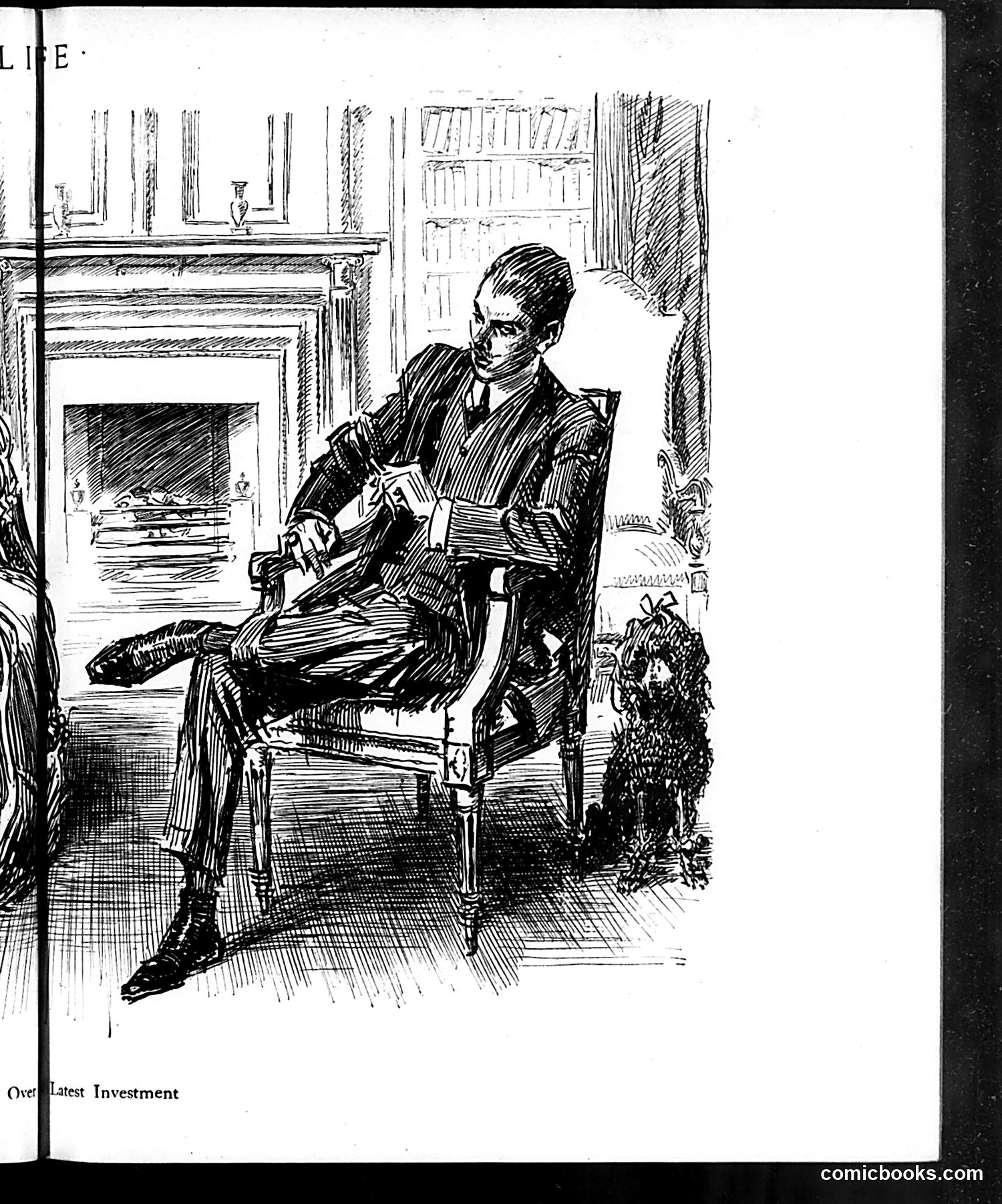
This satirical illustration depicts a well-dressed gentleman seated indoors, reading what appears to be financial documents or stock certificates. He's positioned near a fireplace in a comfortable domestic setting, with a potted plant visible at the right. The caption "Over Latest Investment" suggests the cartoon satirizes contemporary financial speculation or investment trends. The man's relaxed posture and formal attire suggest wealth and leisure, while his absorbed attention to documents implies serious financial interest. Without additional context about the specific historical moment Life magazine published this, the precise target of satire remains unclear. However, it likely mocks either optimistic investor behavior, risky financial practices, or the wealthy class's preoccupation with money during a particular economic period.
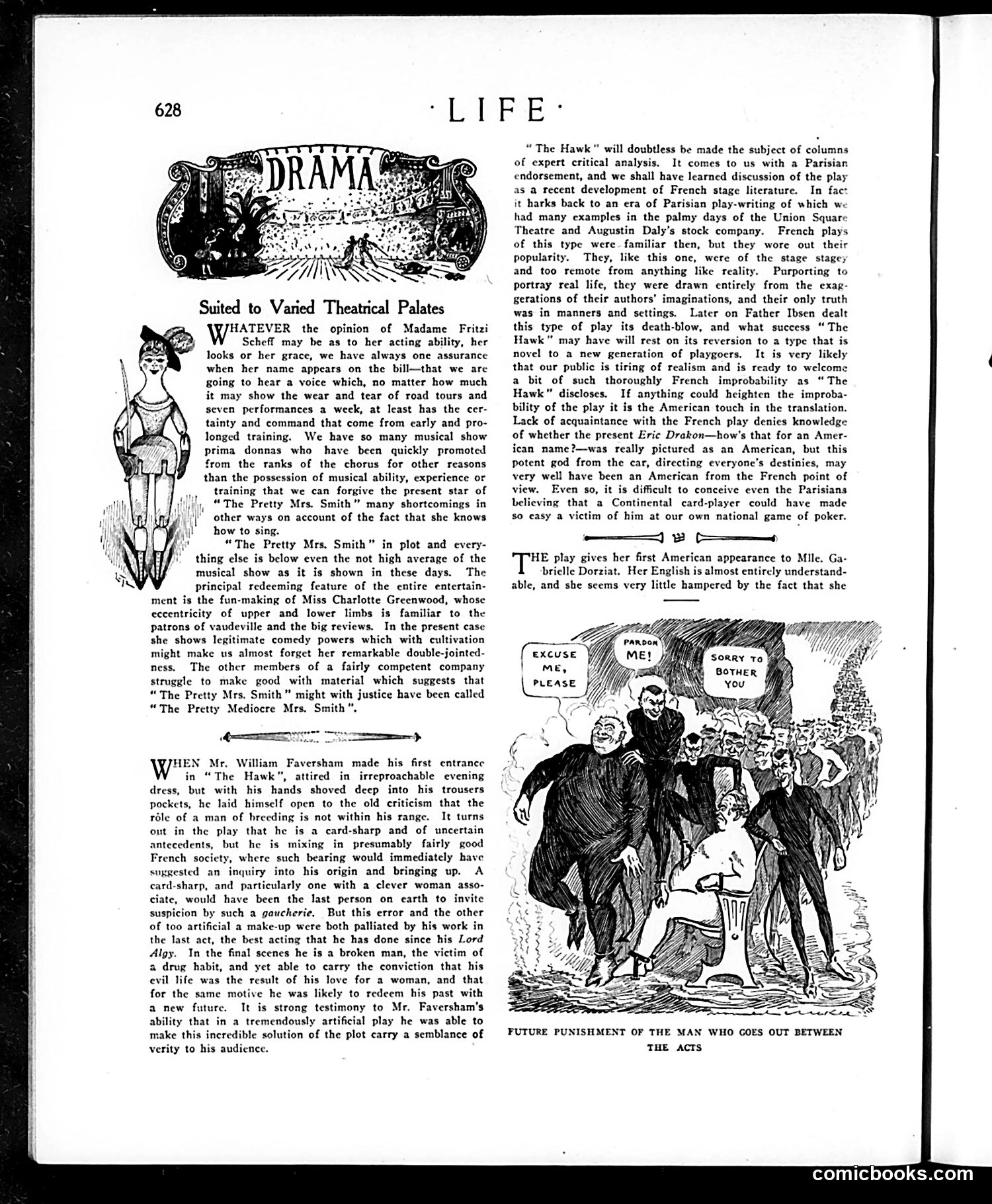
This is a drama criticism page from *Life* magazine reviewing three theatrical productions: "The Pretty Mrs. Smith," "The Hawk," and another play. The **cartoon** (bottom right) depicts a man being ejected between theater acts—satirizing the common practice of audiences leaving during intermission, likely because the entertainment was poor quality. The **text critiques** contemporary theater: 1. **"The Pretty Mrs. Smith"**: Critics praise Fritzi Scheff's trained singing voice but condemn the show itself as mediocre, noting it relies on Charlotte Greenwood's physical comedy rather than quality writing. 2. **"The Hawk"**: While praising actor William Faversham's final-act performance, critics fault his opening posture (hands in pockets) as ungentlemanly and note the play's artificiality. They compare it dismissively to outdated 19th-century French melodramas, contrasting such theatricality unfavorably with Henrik Ibsen's more realistic dramatic approach. The underlying satire suggests Broadway was producing derivative, unrealistic entertainment rather than serious dramatic innovation.
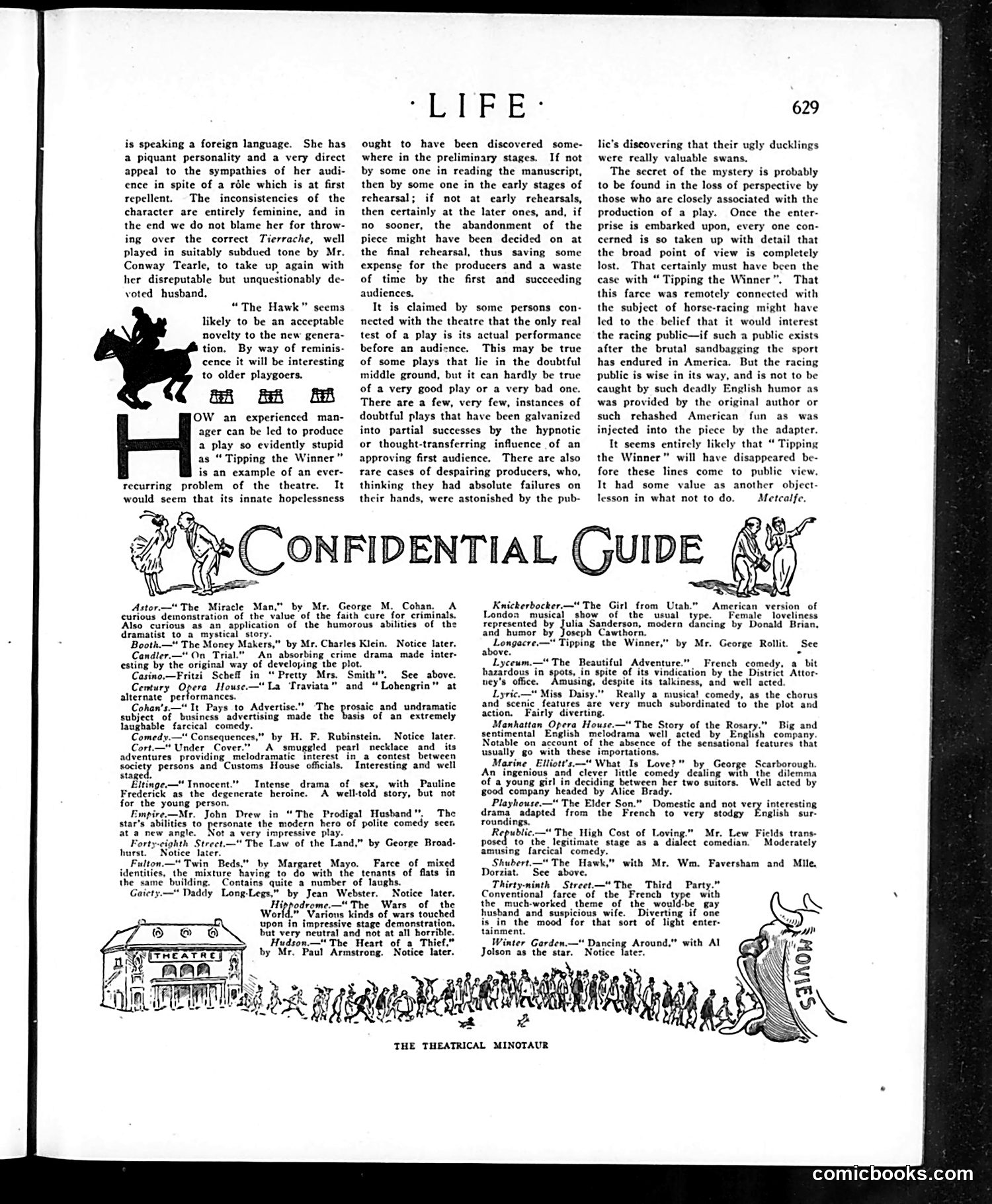
This page contains theater reviews and a "Confidential Guide" listing current Broadway productions. The main editorial critique discusses "Tipping the Winner," a farce about horse-racing that the reviewer considers hopeless—so fundamentally flawed it should have been abandoned during early rehearsals rather than reaching production. The author argues that while some claim a play's true test is live audience performance, obviously bad plays (unlike mediocre ones) should be identifiable before opening night. He speculates the production team lost perspective through involvement, and that American audiences interested in racing wouldn't be swayed by "deadly English humor." The piece concludes "Tipping the Winner" will likely close quickly, though it serves as a cautionary lesson. The guide lists other current shows including "The Miracle Man" and "The Girl from Utah," offering brief critical assessments of each production and cast members.
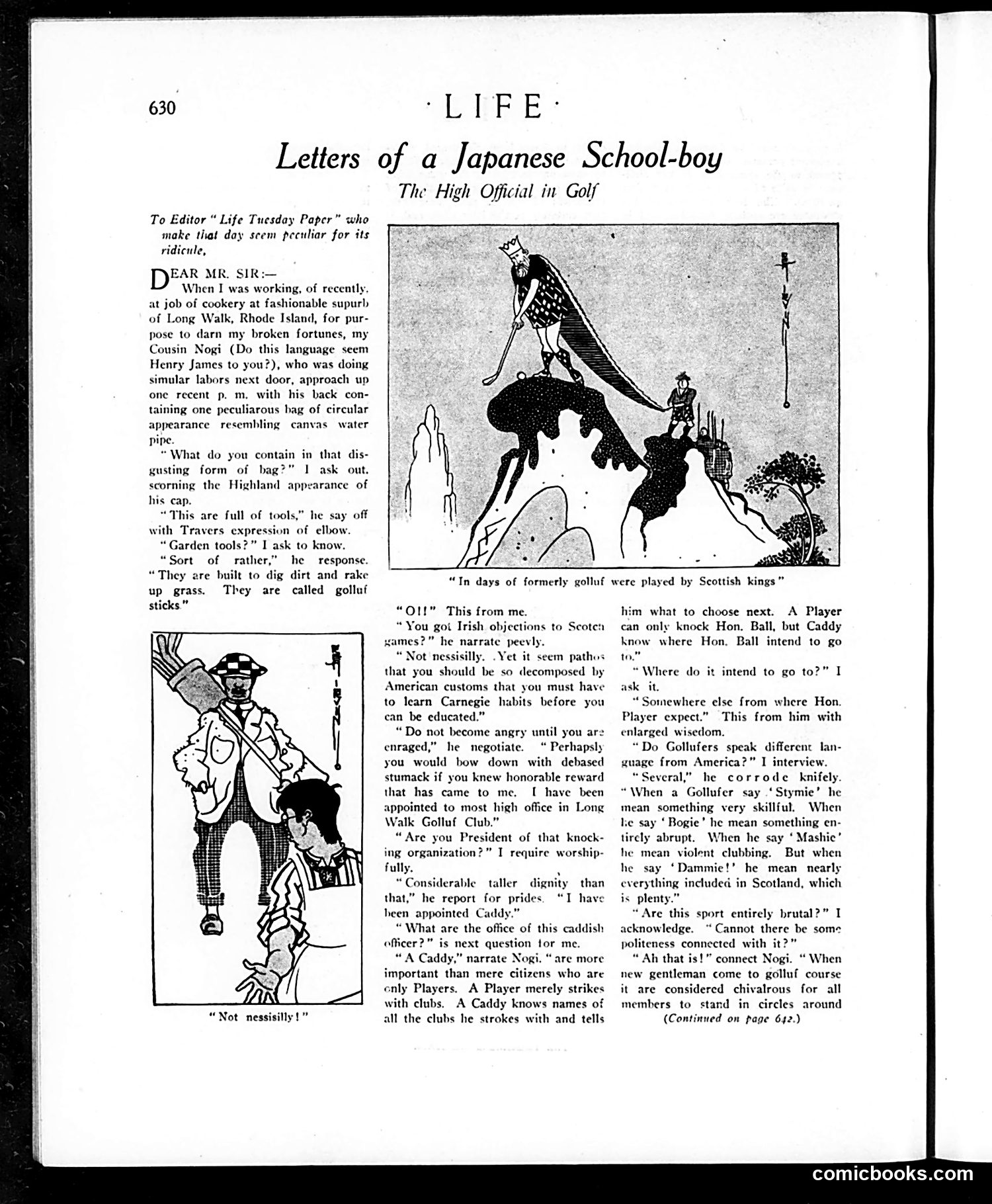
This is a satirical letter-format piece mocking both golf culture and stereotypical "broken English" immigrant speech. The narrator is a Japanese schoolboy working as a servant who encounters his cousin Nogi, newly employed as a caddy at an exclusive Rhode Island golf club. The satire operates on multiple levels: it ridicules golf's pretentiousness (treating a caddy as more important than players, golf's arcane terminology like "stymie" and "mashie"), while simultaneously employing exaggerated malapropisms and fractured syntax to caricature Japanese-accented English—a common racist trope in early 20th-century American humor. The cartoon illustrations show a tall caddy with Scottish bagpiper imagery (referencing golf's Scottish origins) instructing players. The humor assumes readers will find both the sport's snobbery and the character's speech patterns amusing. This reflects the casual xenophobia typical of *Life* magazine's era.
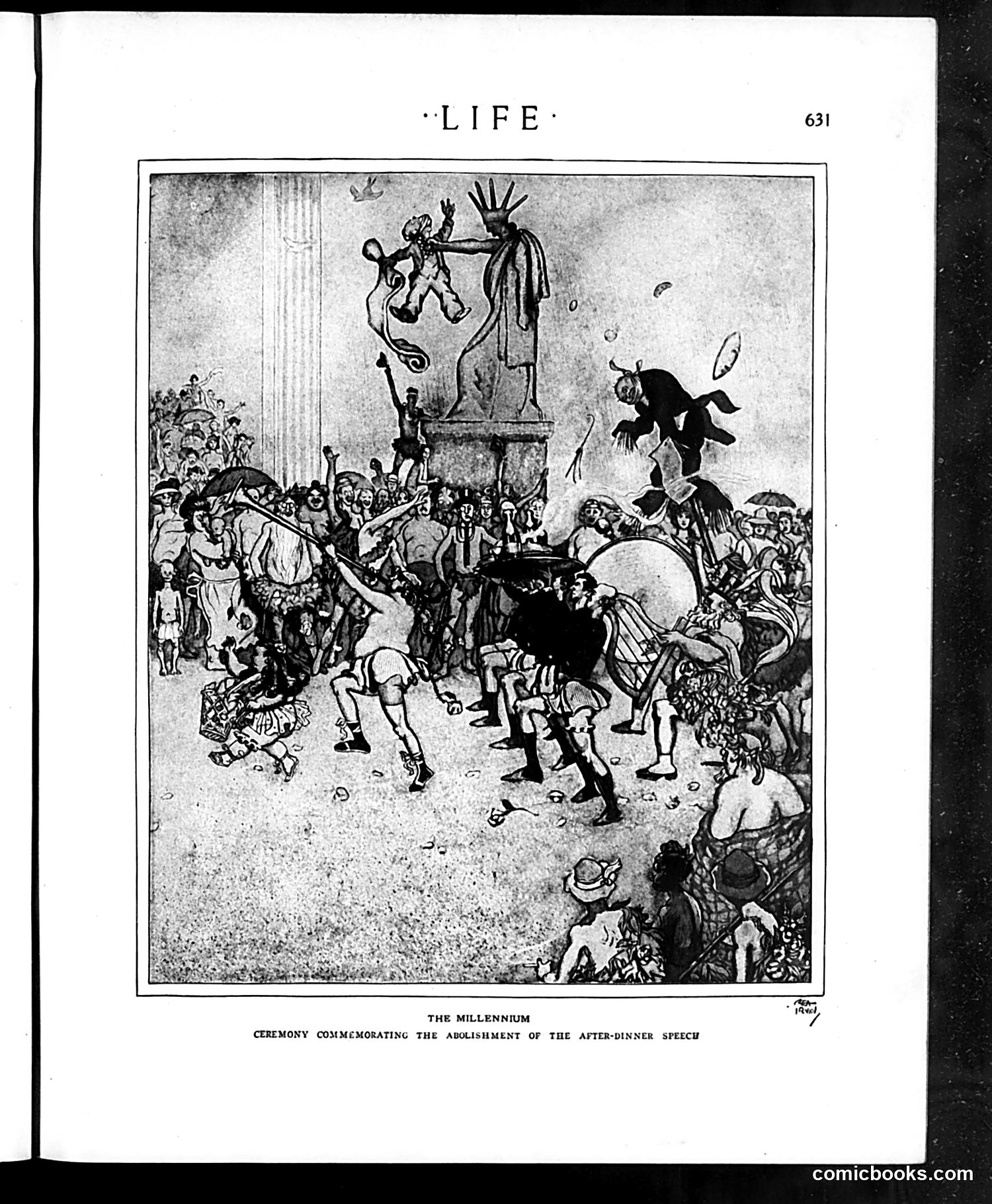
This satirical cartoon celebrates the abolishment of after-dinner speeches—a social custom apparently common enough in early 20th-century America to warrant mock-heroic commemoration. The image depicts a massive public ceremony with crowds gathered around a monument featuring classical allegorical figures (including what appears to be Liberty or Justice at the top). The crowd celebrates wildly, with people dancing, throwing objects in the air, and displaying jubilation typically reserved for major historical events. The satire works by treating the elimination of a tedious social obligation as if it were a momentous civilization-altering achievement worthy of monumental commemoration. This suggests after-dinner speeches were widely despised by Life's readers—so universally dreaded that their abolishment would be cause for genuine celebration. The exaggeration emphasizes how much the audience suffered through these speeches.
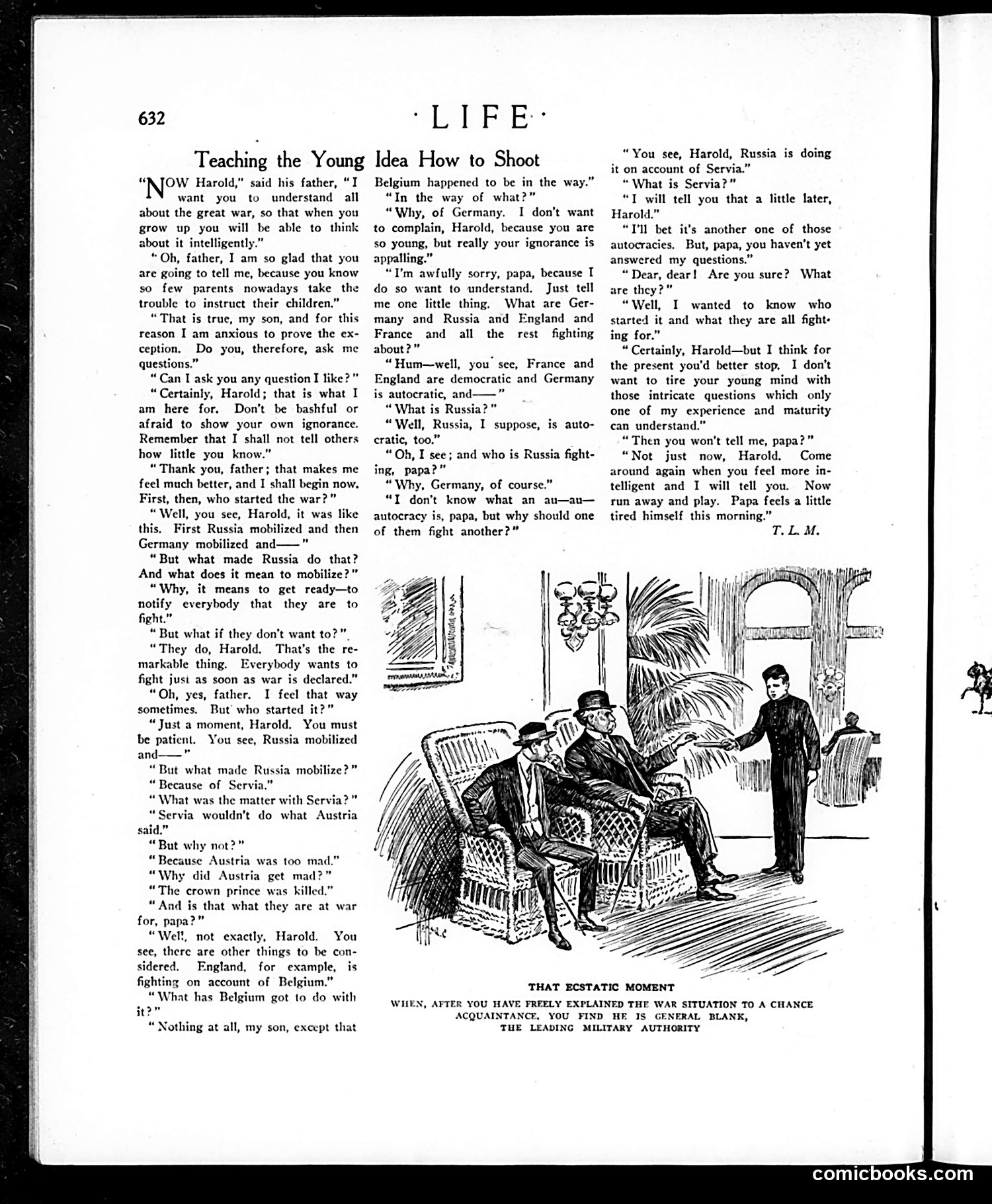
This satirical piece critiques the **confusing justifications for World War I**. A father attempts to explain the war's causes to his son Harold, but repeatedly fails—the narrative becomes circular and contradictory. **The satire's target:** The impossibility of rationally explaining why the war started. The father cites Serbia, Austria, Russia's mobilization, Belgium "being in the way," and democratic versus autocratic systems—yet none logically connect. When Harold asks the fundamental question ("what are they fighting for?"), the father abandons explanation entirely, claiming Harold's mind is too young to understand. **The caption's joke:** The bottom illustration shows the father discovering his conversation partner is "General Blank, the leading military authority"—implying even military leaders couldn't coherently explain the war's origins. The irony: those supposed to understand the war's rationale are as confused as anyone else. **Historical context:** Published during early WWI, this reflects widespread bewilderment over how a regional conflict became global, and the perceived inadequacy of official explanations.
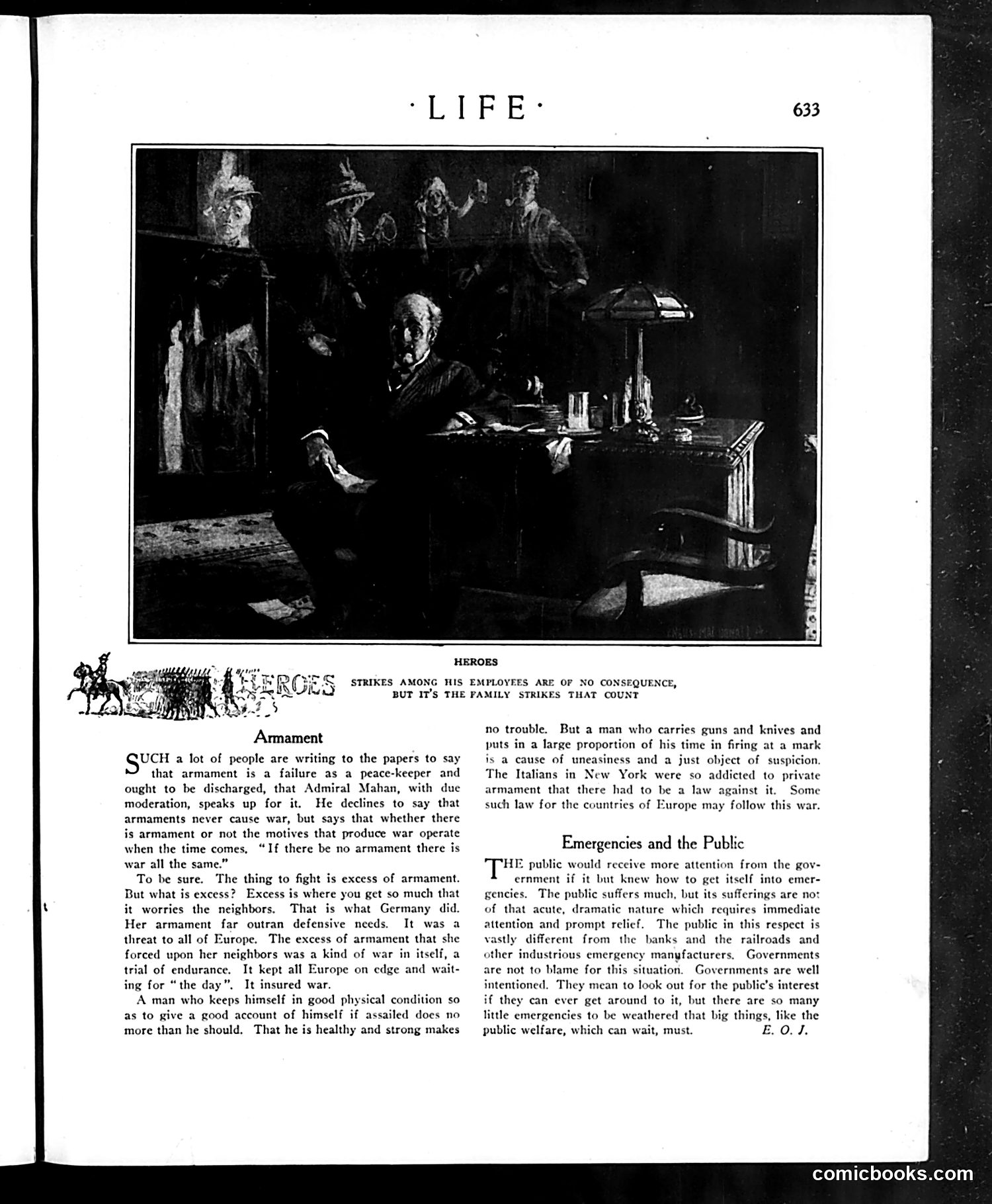
This page contains two opinion pieces rather than traditional cartoons. The "Heroes" section uses a dramatic illustration (showing what appears to be a military or governmental scene) as visual accompaniment to text debating armament policy, likely during or shortly after World War I. **The argument:** Admiral Mahan is cited defending military armament as a peace-keeper. The author distinguishes between reasonable defensive preparation (like a healthy man) versus excessive armament that provokes neighbors—comparing Germany's pre-WWI buildup to a man obsessively armed with guns and knives. The analogy to Italian immigrants in New York who were restricted from carrying weapons suggests governments should similarly limit European nations' arsenals. **The satire:** The title "Heroes" and subtitle suggest military/industrial figures claim strikes among employees are insignificant, but family strikes matter—a quip about how powerful figures ignore labor disputes while protecting business interests. The second section mocks government inefficiency: while banks get emergency attention, actual public welfare issues languish because governments prioritize "big emergencies" and ignore chronic problems.
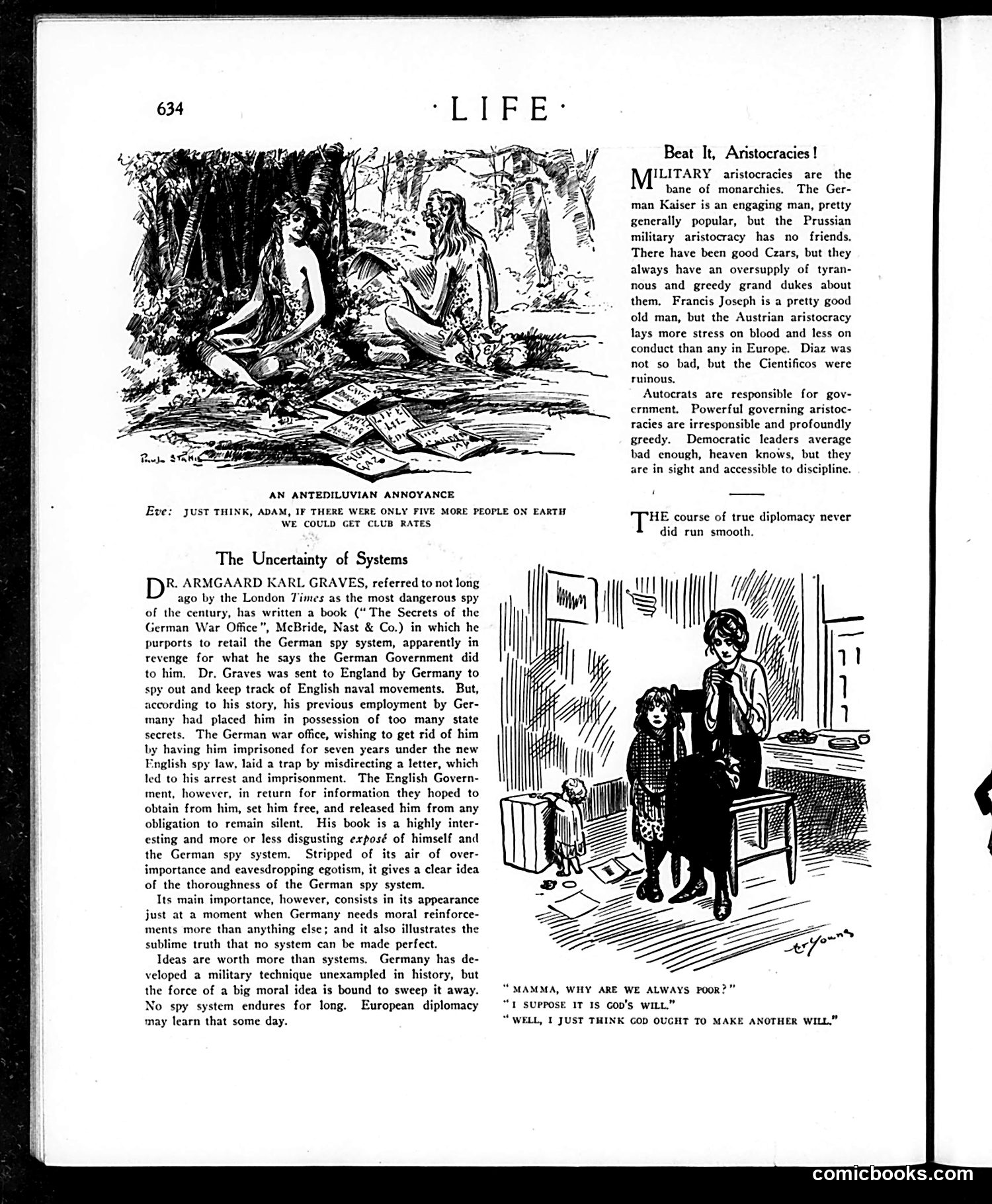
**Top Cartoon ("An Antediluvian Annoyance"):** Shows Adam and Eve in Eden, with Eve suggesting they could "get club rates" if five more people existed on Earth. This is a joke about modern social/commercial culture—the implication being that even in paradise, humans would commodify and monetize everything, seeking group discounts. **Main Article:** Discusses Dr. Armgaard Karl Graves, a real German spy who wrote an exposé of the German spy system. The piece argues that while Germany has developed military technique, moral ideas ultimately defeat spy systems and autocracies. This reflects WWI-era skepticism about German militarism. **"Beat It, Aristocracies!" Essay:** Criticizes military aristocracies across Europe—the German Kaiser's Prussian officers, Austrian Habsburgs, Russian Czars, and Mexican científicos—as irresponsible and greedy. Argues democratic leaders, though flawed, are at least accountable. **Bottom Cartoon:** A poor child asks why the family is always poor; mother attributes it to God's will. Child replies God should "make another will"—a class-conscious joke about wealth inequality and inheritance systems.
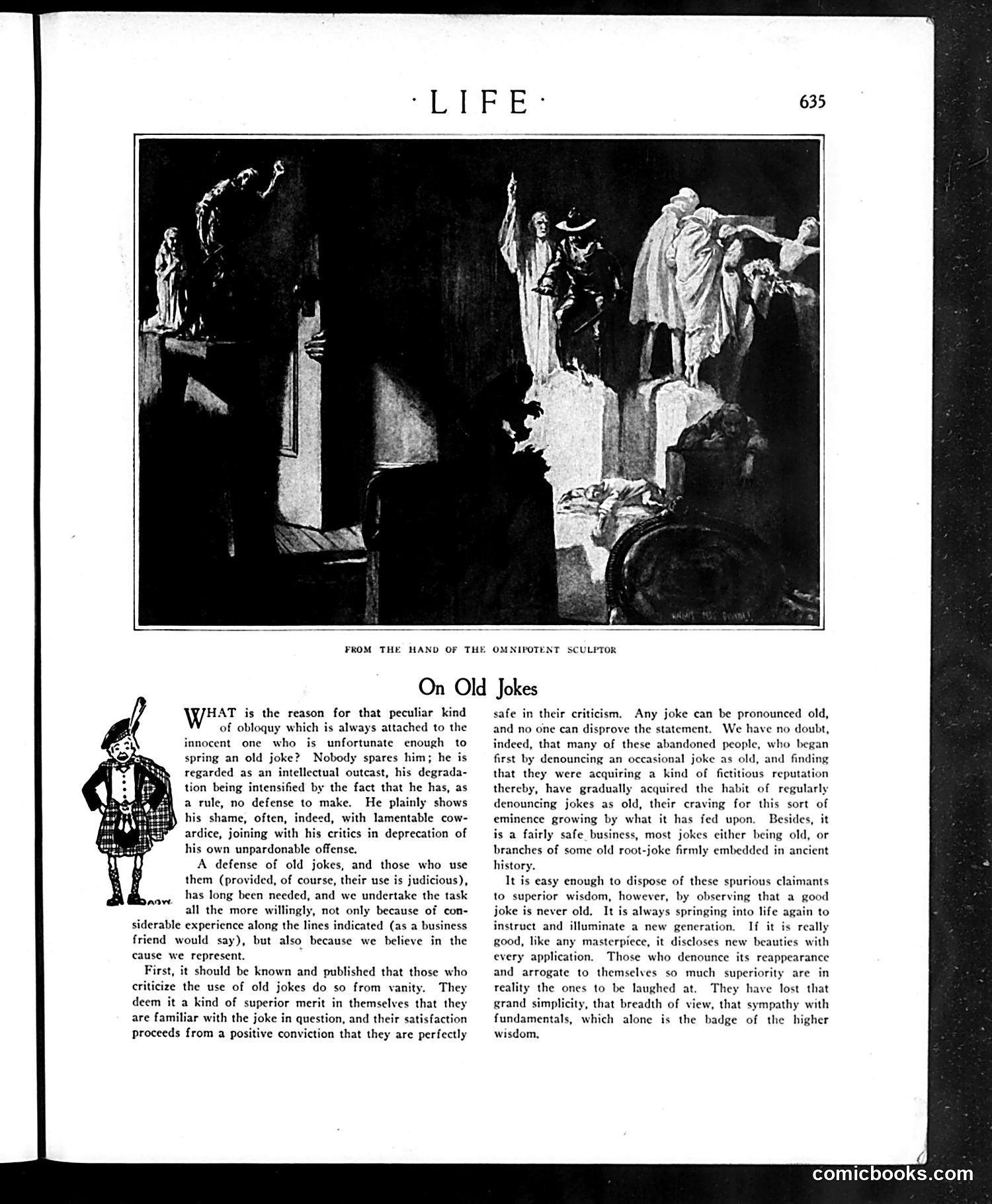
This page defends the use of old jokes against social criticism. The article argues that people who denounce familiar jokes as "old" do so from vanity—claiming superior wit by claiming familiarity. The author counters that genuinely good jokes are timeless, like masterpieces that reveal new meaning with each retelling and generation. The accompanying illustration (credited to an unnamed sculptor) appears to show a classical or allegorical scene, though its specific connection to the text is unclear—it may represent the timeless nature of humor or wisdom itself. The piece mounts a satirical defense: those who pride themselves on dismissing old jokes actually demonstrate intellectual narrowness and loss of "grand simplicity," the true mark of wisdom. The satire targets social pretension and performative superiority in intellectual circles—a recurring target of *Life* magazine's humor.
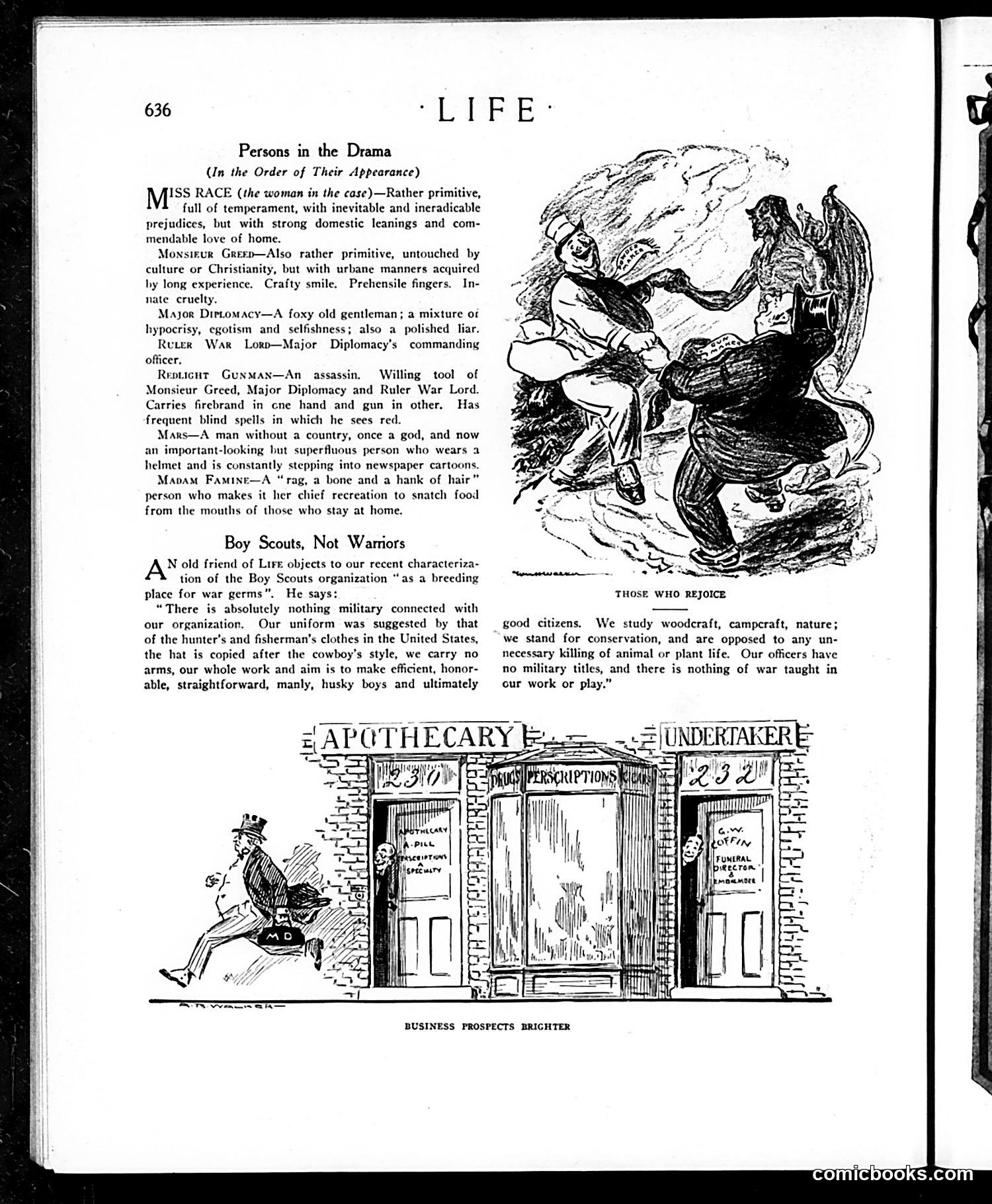
**"Persons in the Drama"** is a satirical character list for what appears to be a play or narrative about international conflict. The allegorical characters represent geopolitical forces: "Miss Race" (nations/peoples), "Monsieur Greed" (avarice), "Major Diplomacy" (deceit), "Ruler War Lord" (militarism), and "Redlight Gunman" (violence/assassination). "Mars" (god of war) and "Madam Famine" represent war's consequences. **"Boy Scouts, Not Warriors"** presents a reader's defense against Life's recent criticism that Boy Scouts function as "breeding place for war germs." The correspondent argues the organization teaches woodcraft and conservation, not militarism—uniforms derive from hunting/cowboy styles, not military dress, and officers hold no military titles. **Bottom cartoon** ("Business Prospects Brighter") shows an apothecary/undertaker shop, likely satirizing how war profiteers benefit from conflict and death. The page critiques both militarism generally and concerns that youth organizations were becoming militarized—a relevant anxiety during pre-WWI or interwar periods.
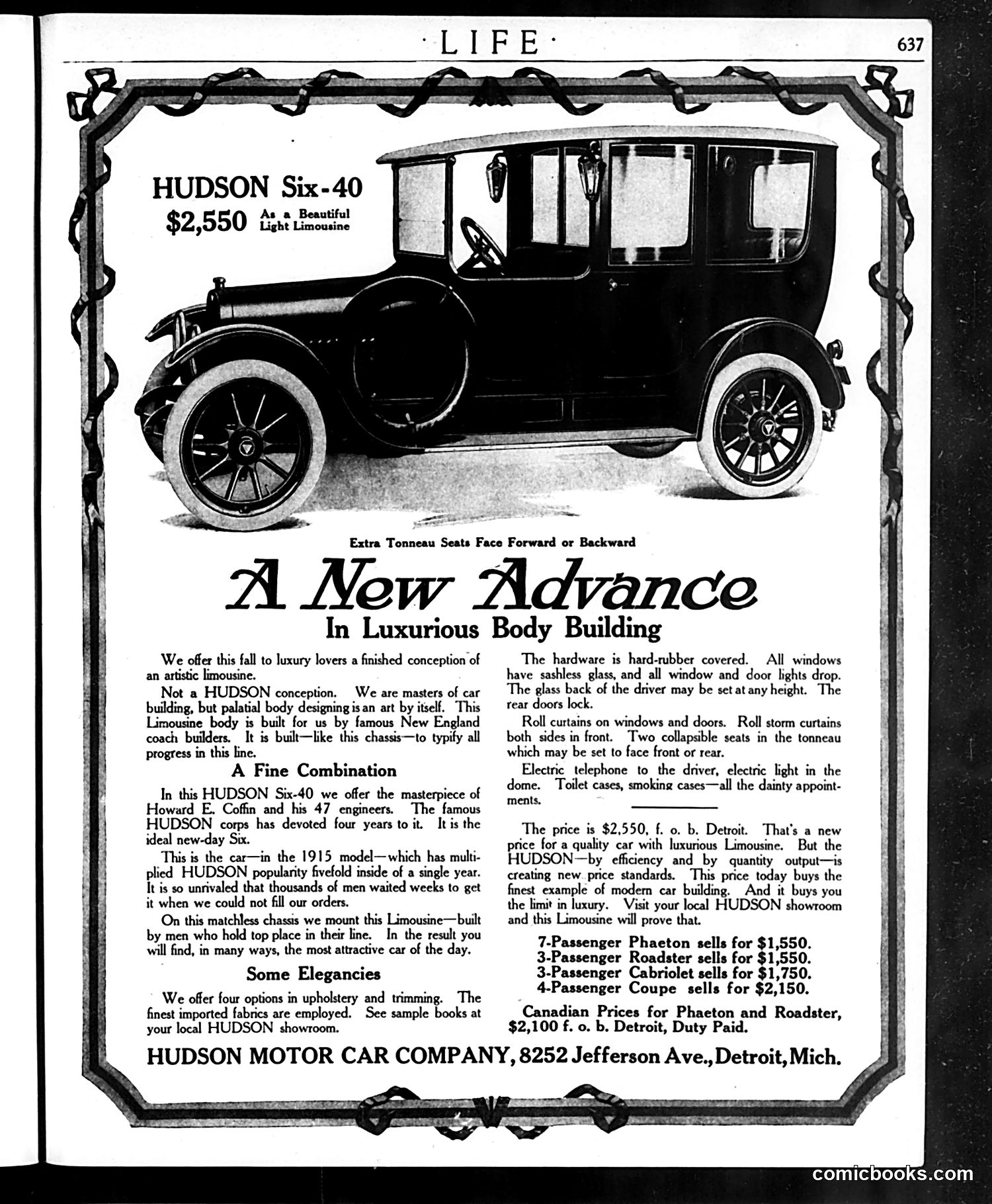
This is **not a cartoon or satire**—it's a straightforward automobile advertisement from Life magazine (page 637), likely from around 1915 based on internal references to the "1915 model." The page advertises the Hudson Six-40 luxury limousine at $2,550. It emphasizes the car's features: custom coachwork by New England builders, innovative engineering by Howard E. Coffin, luxurious appointments (electric telephone, toilet cases, collapsible tonneau seats), and fine imported fabrics. The advertisement's tone is aspirational marketing typical of the era, targeting wealthy buyers. It boasts of production delays due to demand ("thousands of men waited weeks") and positions Hudson as achieving "new price standards" through efficiency and quantity production—a claim that mass-production made luxury more accessible. This is period advertising content, not editorial satire.
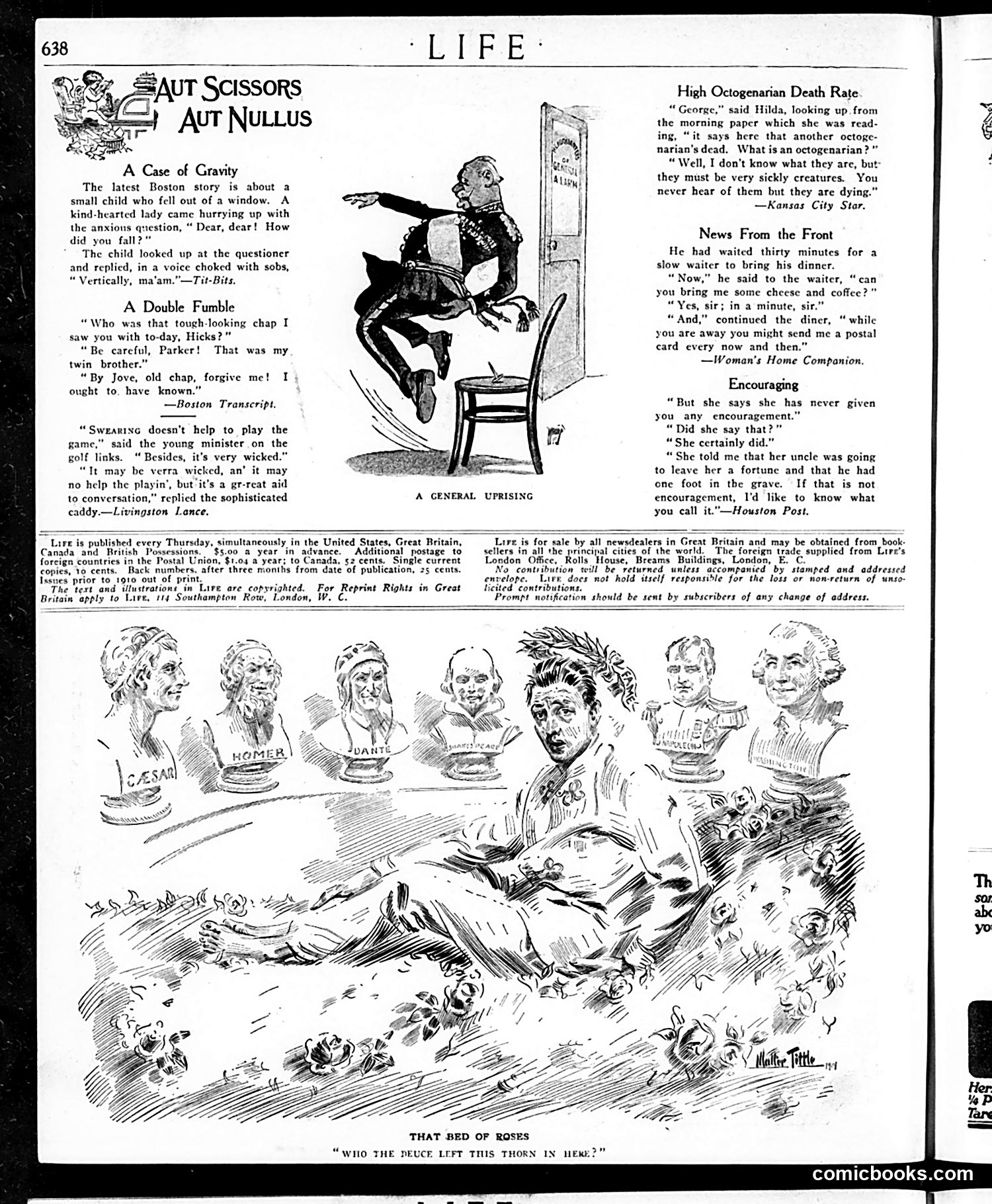
This page contains **humor shorts and a political cartoon** typical of Life's satirical format. The **main cartoon** ("That Bed of Roses") depicts a wounded soldier lying among roses, surrounded by busts of historical figures (appearing to include Caesar, Homer, Dante, and military leaders). The caption asks "Who the deuce left this thorn in here?" This is **WWI-era satire** critiquing the romanticization of war. The busts represent classical ideals of glory and heroism, while the soldier's suffering exposes the harsh reality: war is presented as a "bed of roses" by society and history, but contains deadly "thorns." The cartoon mocks the gap between how nations glorify conflict and soldiers' actual experience. The **surrounding humor shorts** are light domestic and social jokes unrelated to the main cartoon—touching on gravity, mistaken identity, golf etiquette, aging, restaurant service, and courtship. These represent Life's typical mix of gentle comedy reflecting middle-class American life of the period.
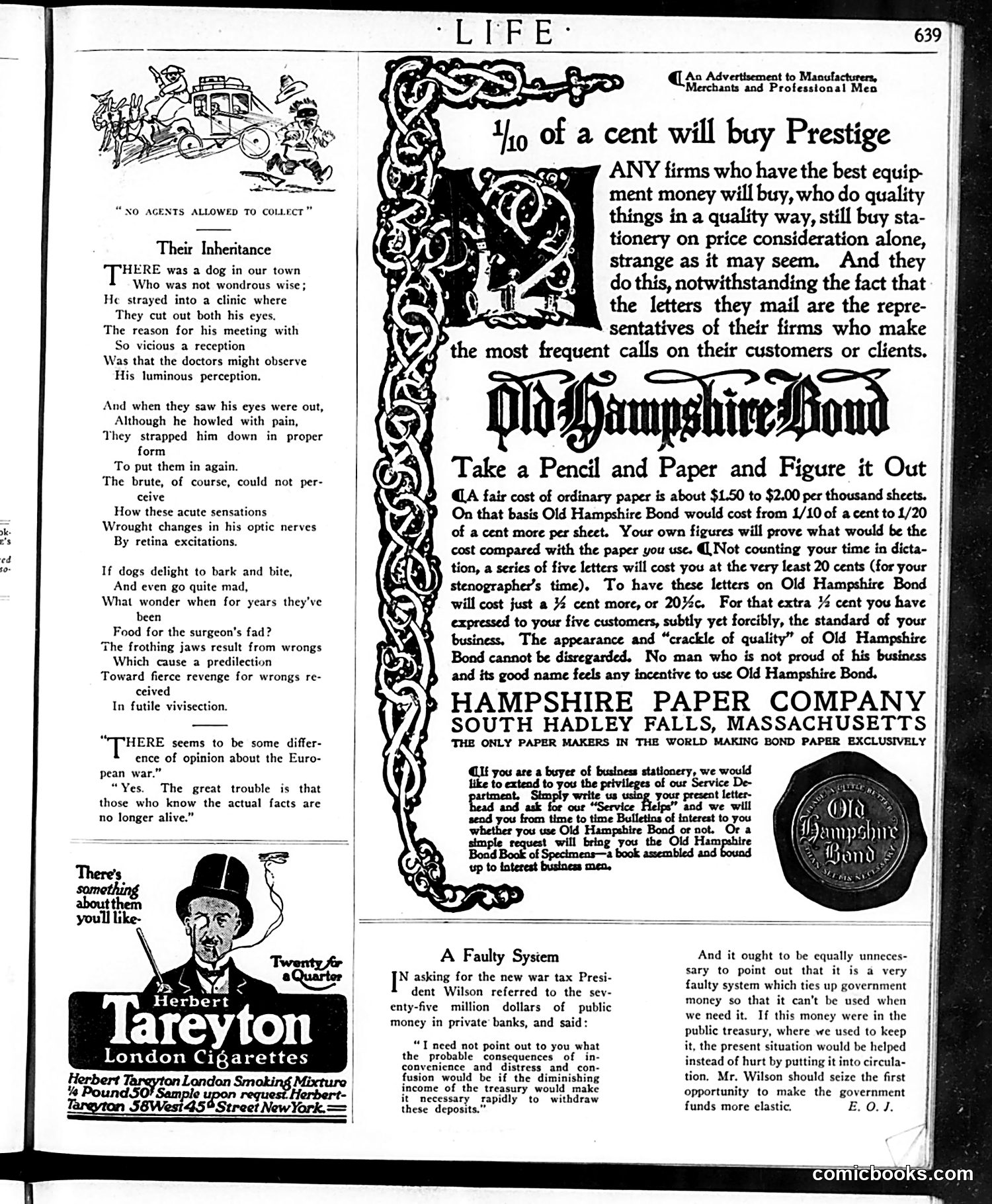
This page contains **multiple unrelated items** typical of Life's format: **"Their Inheritance"** — A satirical poem criticizing animal vivisection (medical experimentation on live animals). The narrative describes a dog whose eyes are surgically removed and replaced by doctors, then argues this cruel practice causes the animal's subsequent violent behavior. This reflects early 20th-century debates over animal testing ethics. **"There's something about them you'll like"** — A Herbert Tareyton cigarette advertisement (lower left). **Old Hampshire Bond Advertisement** — The dominant content. This is a business-to-business pitch arguing that quality paper, though marginally more expensive, enhances a company's professional reputation through correspondence. **"A Faulty System"** — A brief editorial discussing President Wilson's comments on seventy-five million dollars held in private banks rather than the public treasury, arguing this creates financial inefficiency during wartime. The page reflects concerns of the WWI era: animal welfare, business standards, and fiscal policy—typical subjects for Life's satirical commentary.
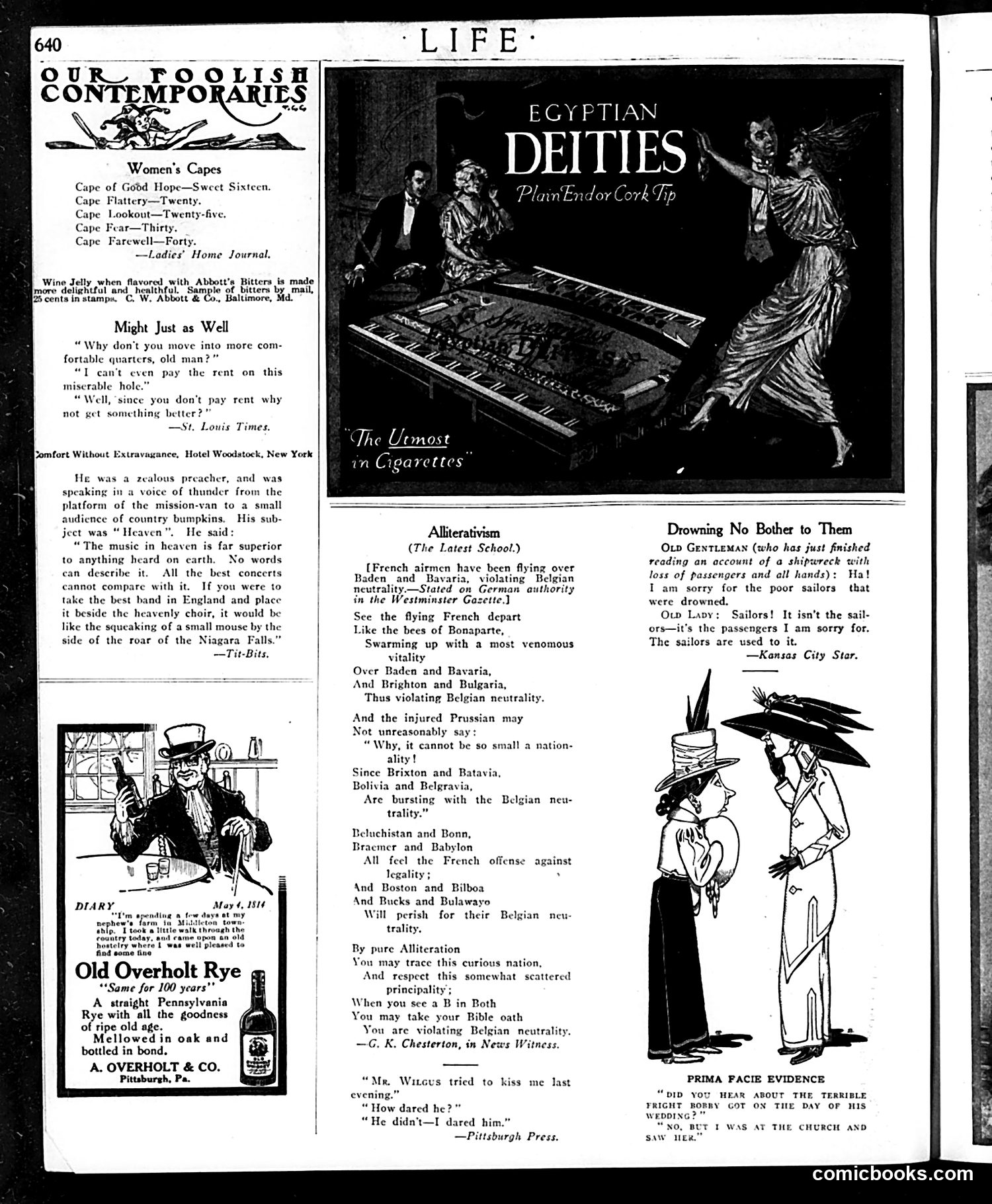
This page from *Life* magazine (dated May 4, 1914, based on the diary entry) contains several distinct satirical pieces: **"Alliterativism"** is a poem by G.K. Chesterton mocking German complaints about Belgian neutrality violations. French aircraft flew over Baden and Bavaria, and Germany protested—yet the poem humorously points out that Germany itself has violated neutrality elsewhere. The extended B-alliteration parodies overwrought German rhetoric while satirizing the absurdity of selective neutrality complaints during WWI. **"Drowning No Bother to Them"** is a class-conscious joke: an old gentleman expresses sympathy for drowned sailors in a shipwreck, but "Old Lady" (presumably working-class) corrects him—she pities the *passengers*, since sailors are accustomed to danger. The satire targets sentimental upper-class attitudes toward working-class hardship. The remaining items are brief jokes and advertisements typical of the era. The page reflects early WWI concerns and period social attitudes about class and propriety.
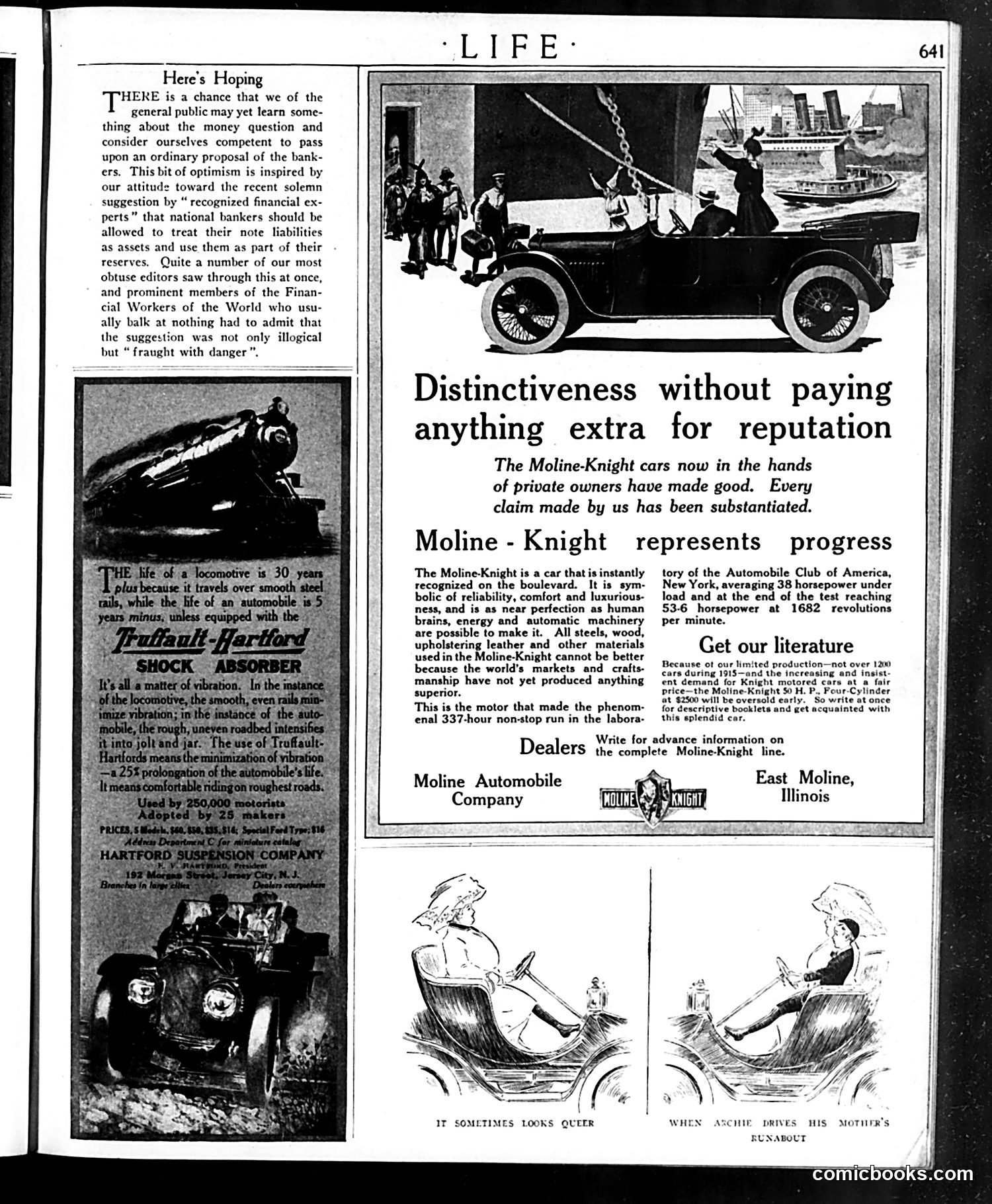
This page mixes editorial commentary with automotive advertising. **"Here's Honing" (Editorial):** The text satirizes banker proposals to treat their note liabilities as assets for reserve purposes. Life's editors mock this as illogical and dangerous financial maneuvering. The piece congratulates itself that even "obtuse editors" and financial workers recognized the scheme's absurdity—suggesting bankers were attempting to obscure bad practice behind expert jargon. **Moline-Knight Advertisement:** The dominant content advertises the Moline-Knight automobile, emphasizing reliability and value without premium pricing. It references a 337-hour endurance test and production limits (1,200 cars). **Bottom Cartoons:** Two simple sketch-gags about a young man (Archie) driving his mother's car—suggesting comedic situations arising from inexperienced youth operating a vehicle. These are lighthearted filler rather than satirical commentary. The page exemplifies Life's dual purpose: sharp social/financial criticism alongside commercial advertising.
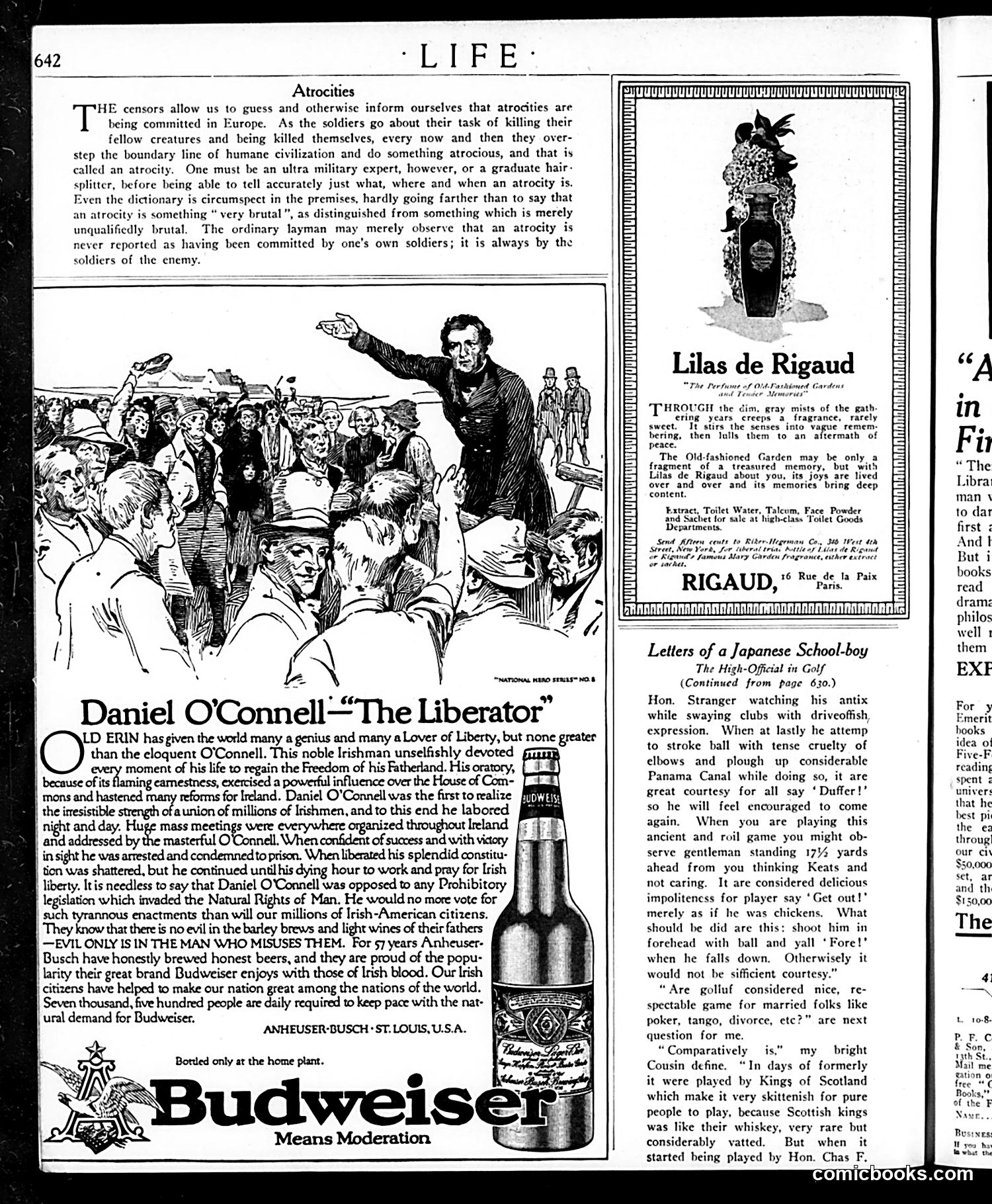
This page contains two distinct elements: **Main Content: "Daniel O'Connell—The Liberator"** A biographical sketch celebrating Irish nationalist leader Daniel O'Connell, emphasizing his fight for Irish freedom and opposition to restrictive laws. This is essentially a **Budweiser advertisement** disguised as historical tribute. The ad cleverly associates the beer brand with Irish-American values and freedom by praising O'Connell's opposition to "Prohibitory legislation which invaded the Natural Rights of Man"—a direct jab at Prohibition. The ad claims 7,500 workers sustain demand for Budweiser, positioning it as integral to American prosperity. **Secondary Content:** - A brief satirical piece on "Atrocities" discussing how wartime atrocities are only ever attributed to enemies, never one's own soldiers - Advertisement for "Lilas de Rigaud" perfume - Excerpt from "Letters of a Japanese School-boy" discussing golf etiquette The page is primarily advertising wrapped in editorial content, typical of Life magazine's format during this era (Prohibition era, based on anti-Prohibition messaging).
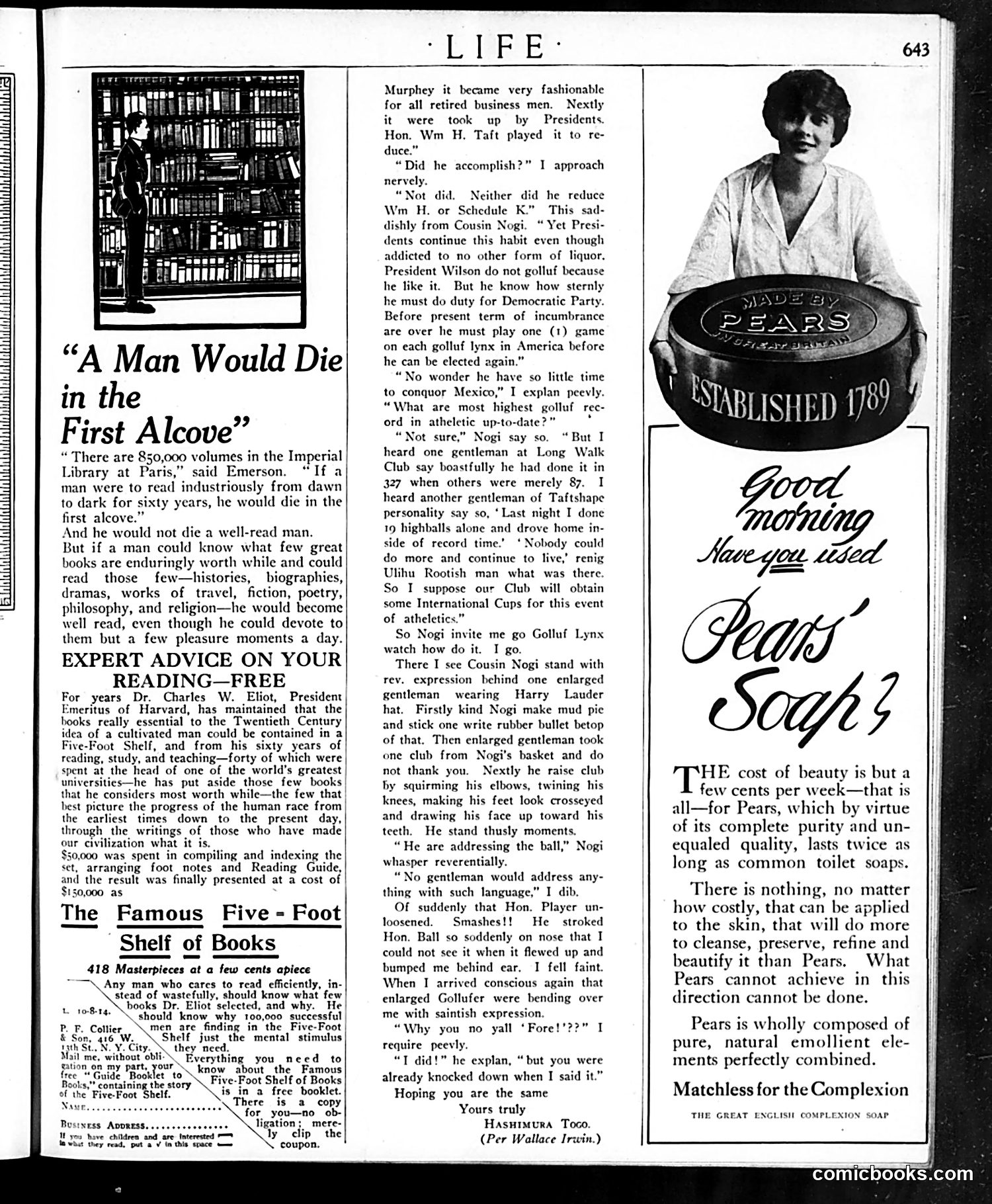
The page features a satirical piece (bylined "Hashimura Togo") mocking American golf culture and political figures' participation in it. The narrator, presented as a Japanese visitor (indicated by the pidgin English and the byline), observes that golf has become fashionable among retired businessmen and U.S. Presidents—specifically naming William Howard Taft, who supposedly played to lose weight without success. The satire targets President Wilson for feeling obligated to play golf on every American course before re-election, despite his Democratic principles against such leisure. The piece ridicules the competitive scorecard obsessions of golfers at "Long Walk Club," with exaggerated claims about record rounds. The left side advertises Harvard President Charles W. Eliot's "Famous Five-Foot Shelf of Books"—a curated collection of 418 classic works marketed as essential reading for cultured men. This reflects early-20th-century educational optimism about self-improvement through canonical literature. The right side contains a Pears soap advertisement emphasizing natural beauty and complexion care.
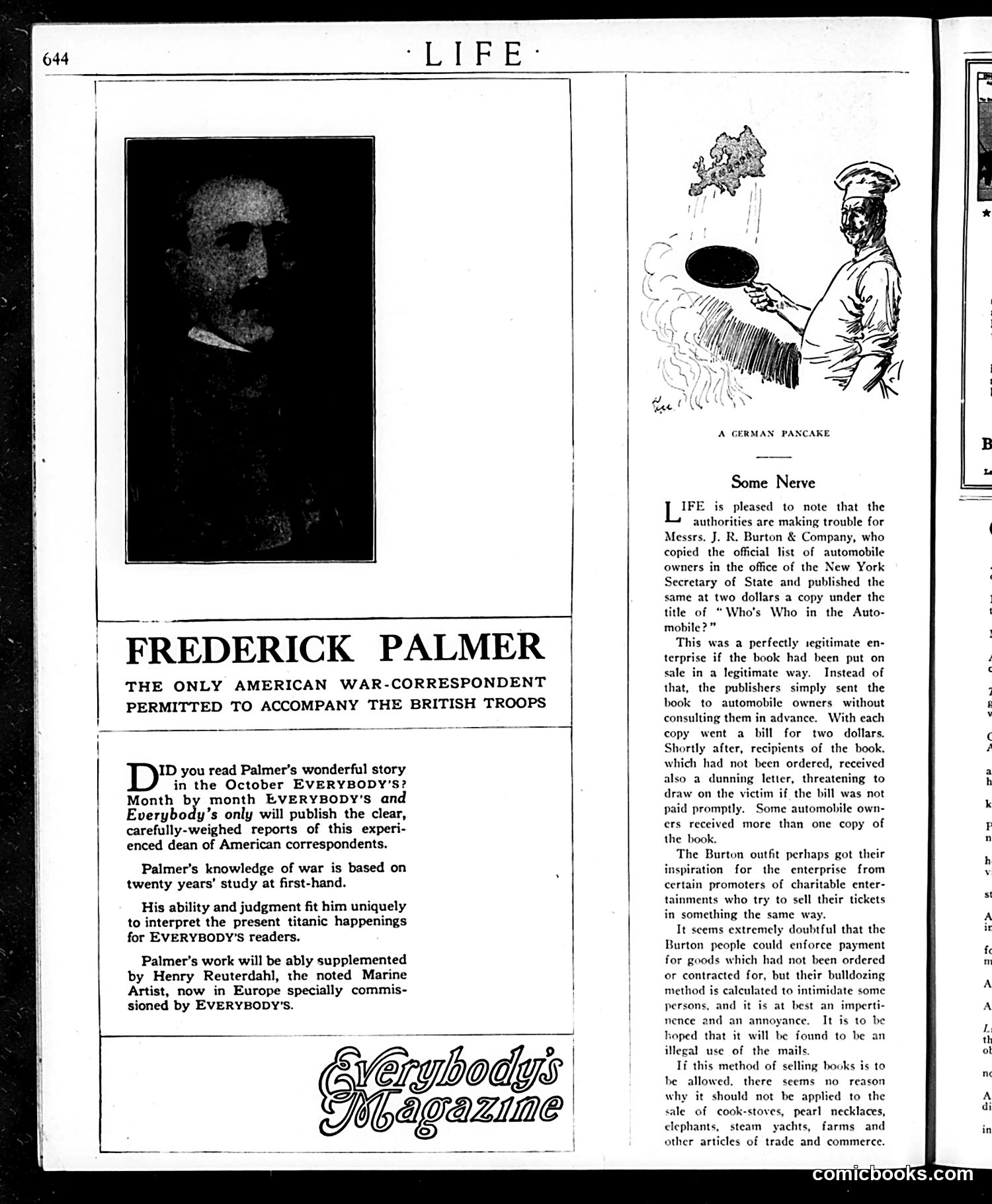
**Left side:** Advertisement for Frederick Palmer, a war correspondent, promoting his serialized reports in *Everybody's* magazine about World War I. Palmer was notably "the only American war-correspondent permitted to accompany the British troops"—a significant credential emphasizing exclusive access to war reporting. **Right side cartoon:** "A German Pancake" depicts a chef flipping something into a pan, likely satirizing German military tactics or aggression during WWI through the metaphor of cooking. **Main article:** "Some Nerve" criticizes the Burton Company's dubious sales tactics. They copied New York's official automobile owner list, mailed unsolicited books titled *"Who's Who in the Automobile"* to owners, then demanded payment with threatening dunning letters—essentially extortion. Life mocks this as an illegal mail scam and warns that legitimizing such tactics could enable similar fraud across commerce. The satire targets predatory business practices dressed up as legitimate enterprise.
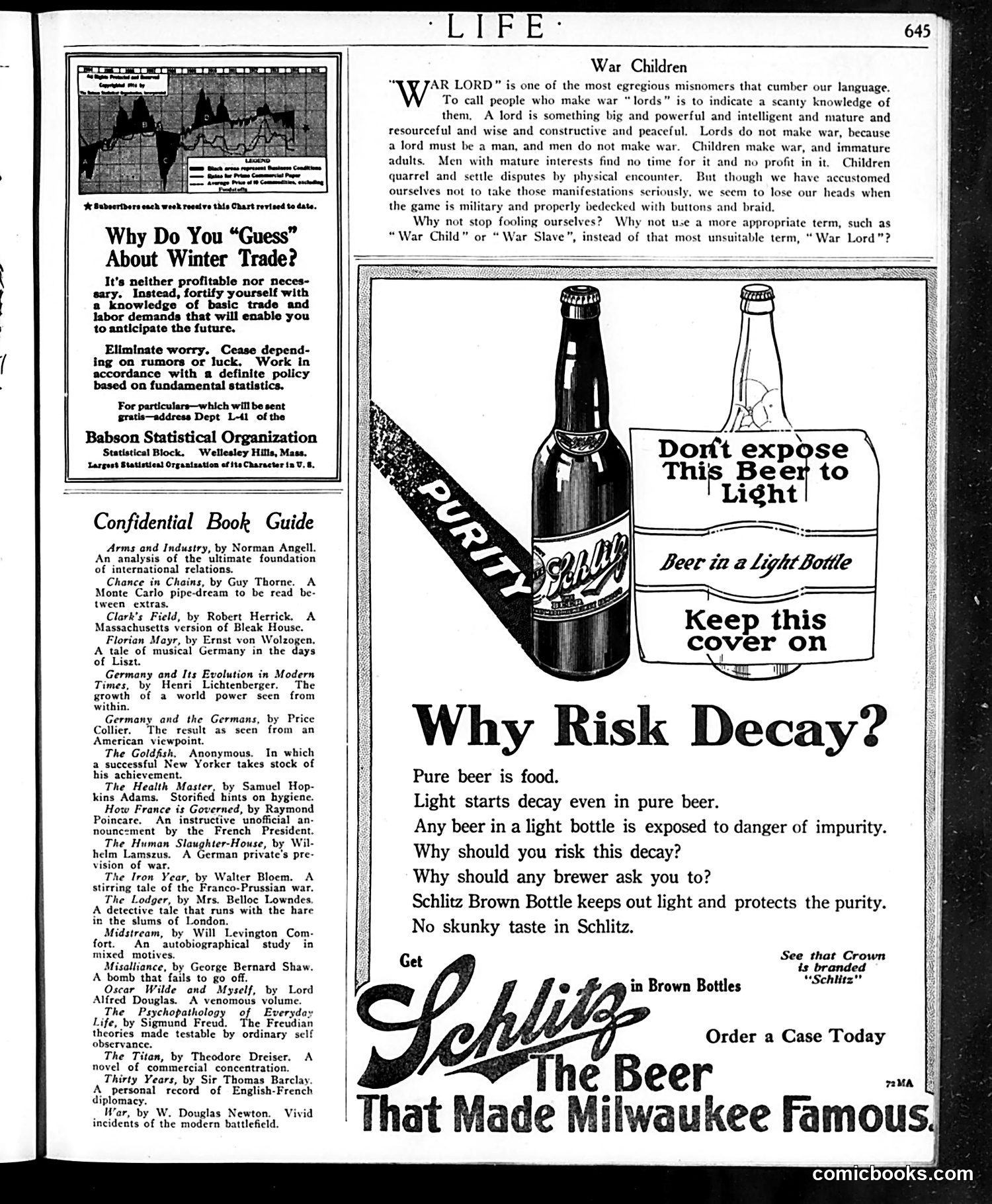
This page contains two distinct elements: **"War Children" Essay (top right):** A satirical argument that calls out the term "War Lord" as a misnomer. The author argues that true lords are mature, intelligent, and peaceful—qualities incompatible with making war. War-making, the piece contends, is childish behavior: immature adults settling disputes through violence like children fighting in a playground. The satire suggests we euphemize warfare with grandiose language ("War Lord") to dignify what is fundamentally juvenile behavior. The piece likely dates to the World War I era, when such anti-war sentiment was common in American publications. **Schlitz Beer Advertisement (center-right):** A product advertisement using pseudo-scientific messaging: light causes beer decay, so brown bottles protect purity better than clear ones. The ad asks rhetorical questions ("Why risk decay?") to convince consumers that Schlitz is superior. The page also includes book recommendations and a Babson Statistical Organization advertisement about business forecasting.
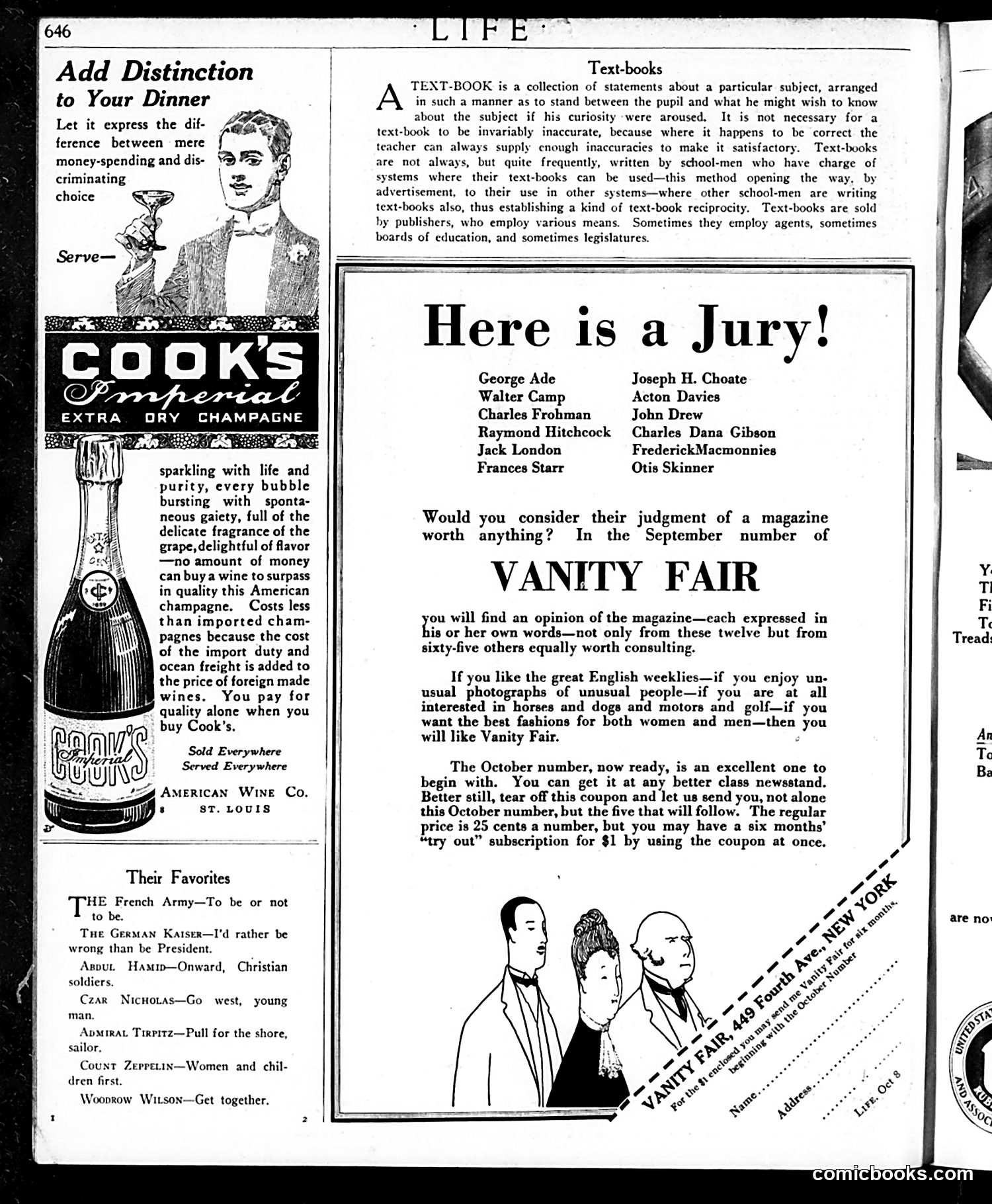
This page mixes advertising with satire typical of Life's early 20th-century format. **Main Content:** A Vanity Fair magazine advertisement features a "jury" of twelve prominent figures (including playwright Charles Frohman, actor John Drew, and sculptor Frederick MacMonnies) endorsing the publication. The joke is that their collective judgment about a magazine's quality is being presented as authoritative—yet the text sarcastically questions whether such opinions matter at all. **Satire:** The page includes a biting definition of "Text-books" that mocks educational publishing as deliberately inaccurate and self-serving, with publishers and textbook authors essentially promoting their own materials through reciprocal arrangements—a criticism of institutional corruption. **Historical Context:** The "Favorites" section lists world leaders (Kaiser, Czar Nicholas, Admiral Tirpitz) with satirical one-liners, reflecting WWI-era political commentary. Woodrow Wilson's entry—"Get together"—appears to reference contemporary peace efforts. The page demonstrates Life's role as a satirical publication attacking both commercial and political institutions.
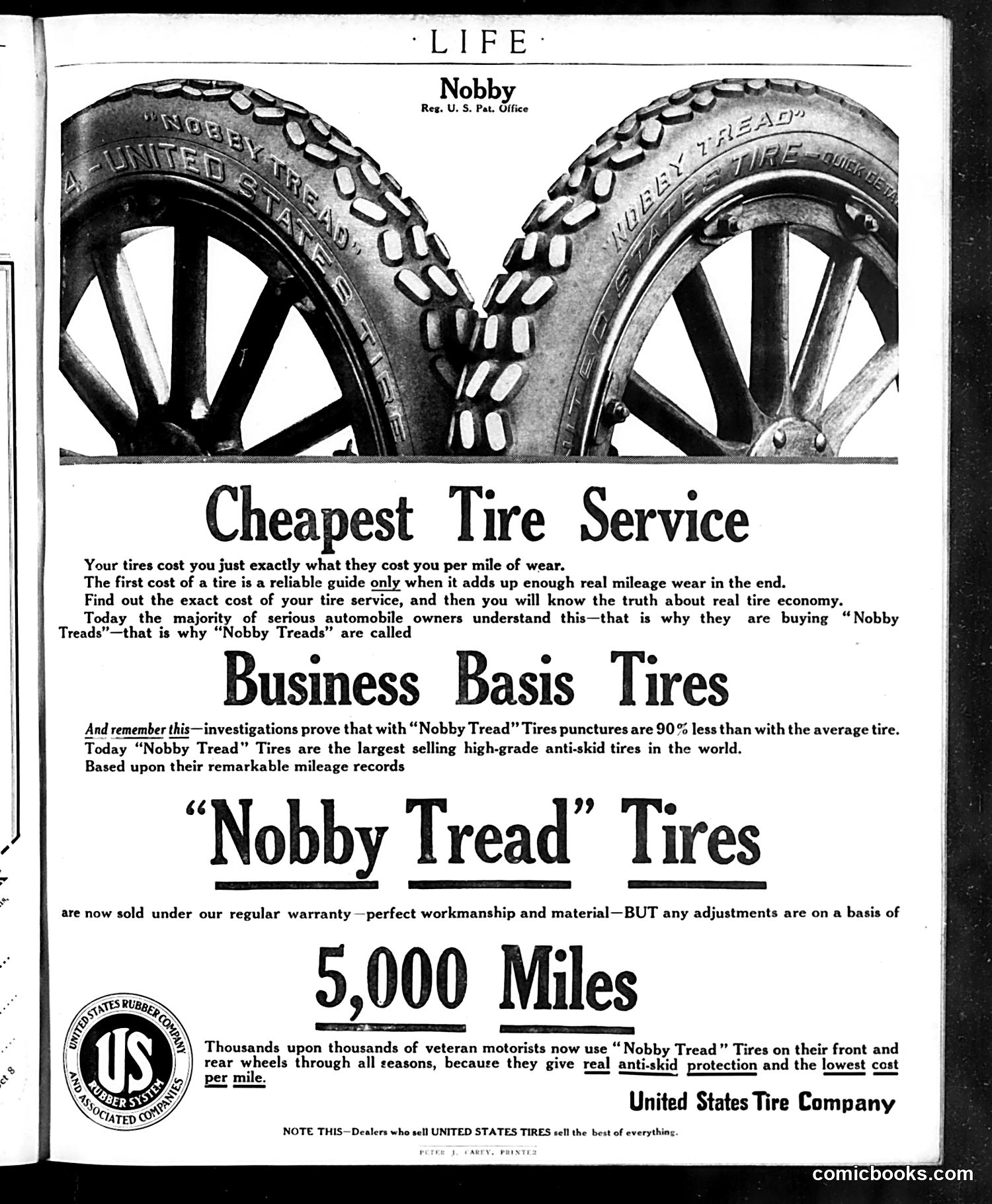
This is a **tire company advertisement**, not a political cartoon or satire. It appears in *Life* magazine (likely early 20th century) promoting "Nobby Tread" tires made by United States Tire Company. The page uses marketing rhetoric common to the era: claims of superior durability ("5,000 Miles" warranty), safety benefits ("90% less" punctures), and cost-effectiveness ("lowest cost per mile"). The two tire images showcase the product's tread design. The appeal targets "serious automobile owners" and "veteran motorists," positioning the brand as the choice of experienced, practical drivers who understand value over initial price. There is no satirical content or political commentary—this is straightforward commercial advertising designed to convince consumers that Nobby Tread tires deliver the best return on investment.
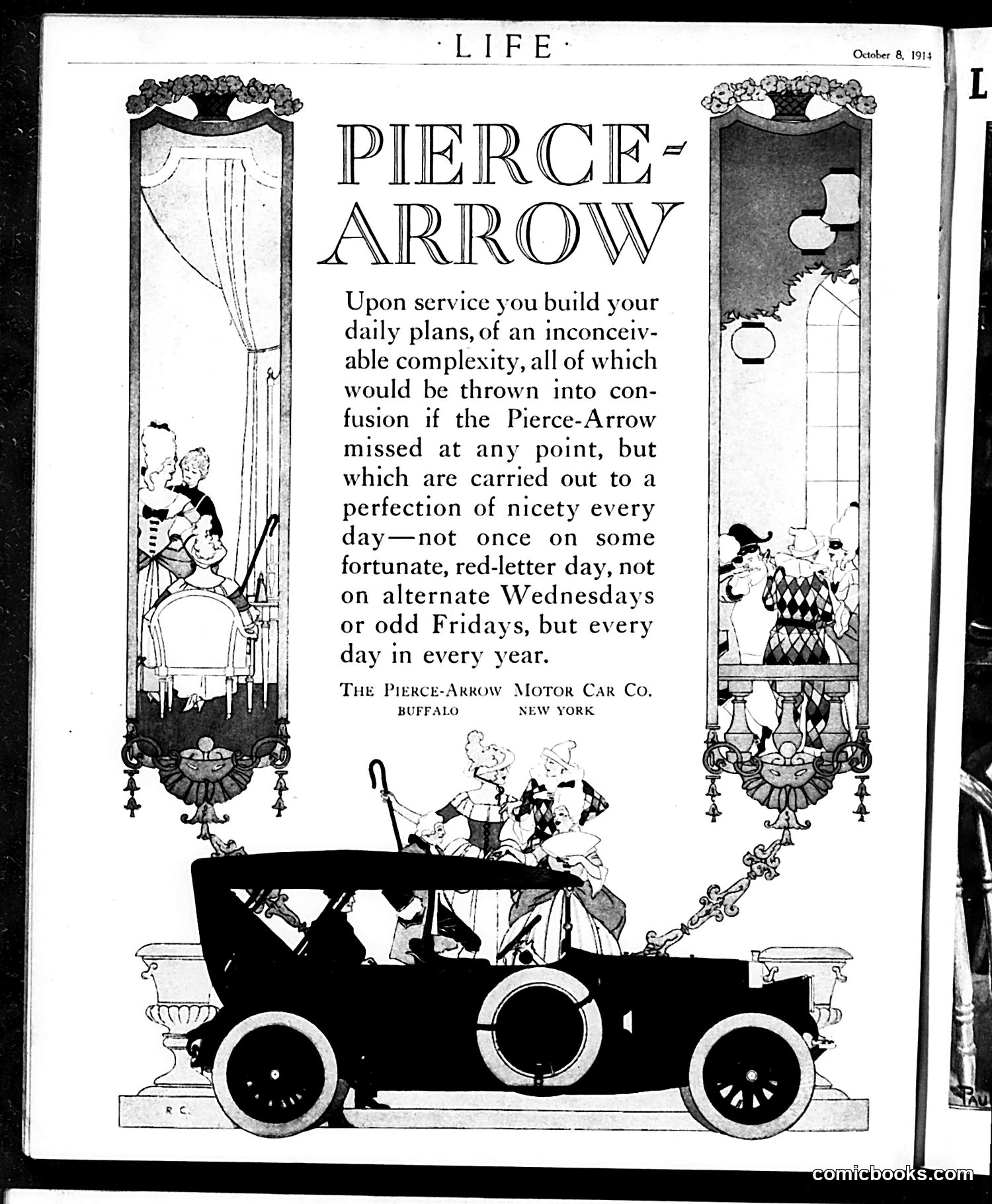
This is a **full-page advertisement** for Pierce-Arrow automobiles from October 1914, not political satire. The ad uses Art Deco-style decorative panels flanking an illustration of a luxury car filled with well-dressed passengers. The copy makes an upscale pitch: Pierce-Arrow vehicles are so reliable that customers can build complex daily schedules around them without fear of breakdown—operating with perfect consistency "every day in every year," not just on lucky days. The illustrated vignettes show affluent people in refined settings (theater boxes, social gatherings), suggesting Pierce-Arrow ownership signals high social status. The silhouetted automobile in the center emphasizes the car's role as essential to maintaining the elaborate social calendar of the wealthy. This reflects early 20th-century automobile marketing that equated car reliability with social reliability and respectability.