
Life, 1914-10-08 · page 26 of 44
Life — October 8, 1914 — page 26: what you’re looking at
What you’re looking at
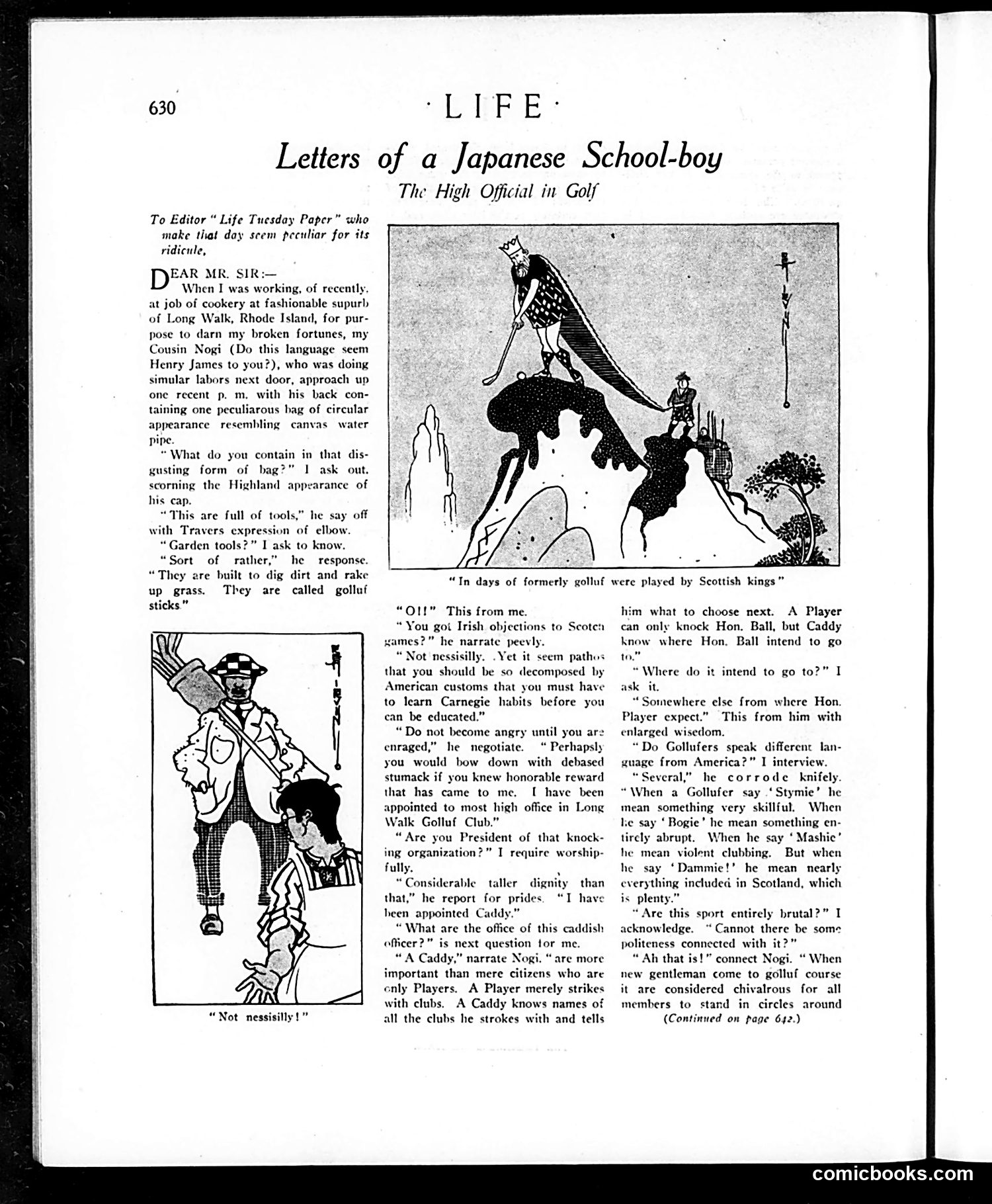
This is a satirical letter-format piece mocking both golf culture and stereotypical "broken English" immigrant speech. The narrator is a Japanese schoolboy working as a servant who encounters his cousin Nogi, newly employed as a caddy at an exclusive Rhode Island golf club. The satire operates on multiple levels: it ridicules golf's pretentiousness (treating a caddy as more important than players, golf's arcane terminology like "stymie" and "mashie"), while simultaneously employing exaggerated malapropisms and fractured syntax to caricature Japanese-accented English—a common racist trope in early 20th-century American humor. The cartoon illustrations show a tall caddy with Scottish bagpiper imagery (referencing golf's Scottish origins) instructing players. The humor assumes readers will find both the sport's snobbery and the character's speech patterns amusing. This reflects the casual xenophobia typical of *Life* magazine's era.
📄 Transcribed text from this page (OCR, searchable)
Machine-transcribed from the original scan — historical spelling and the odd misread are preserved.
To Editor “ Life Tuesday Paper” who make that day seem peculiar for its ridicule, D AR MR. SIR:— When I was working, of recently, at job of cookery at fashionable supurb of Long Walk, Rhode Island, for pur- pose to darn my broken fortunes, my Cousin Nogi (Do this language seem Henry James to you?), who was doing simular labors next door, approach up one recent p.m. with his back con- taining one peculiarous bag of circular appearance resembling canvas water pipe. “What do you contain in that dis- gusting form of bag?” I ask out. scorning the Highland appearance of his cap. “This are full of tools,” he say off with Travers expression of elbow. “Garden tools?” I ask to know. “Sort of rather,” he response. “They are built to dig dirt and rake up grass. They are called golluf “Not nessisilly !” OE RE Letters of a Japanese School-boy The High Official in Golf “In days of formerly golluf were played by Scottish kings” “OM” This from me. You goi Irish objections to Scoten nes?” he narrate peevly. Not nessisilly. .Yet it seem pathos that you should be so decomposed by American customs that you must have to learn Carnegie habits before you can be educated.” “Do not become angry until you are enraged,” he negotiate. “ Perhapsly you would bow down with debased stumack if you knew honorable reward that has came to me, [ have been appointed to most high office in Long Walk Golluf Club.” “Are you President of that knock- ing organization?” I require worship- fully, . “Considerable taller dignity than that,” he report for prides. “I have heen appointed Caddy.” “What are the office of this caddish officer?” is next question tor me. “A Caddy,” narrate Nogi, “are more important than mere citizens who are only Players. A Player merely strikes with clubs. A Caddy knows names of all the clubs he strokes with and tells him what to choose next. A Player can only knock Hon. Ball, but Caddy know where Hon, Ball intend to go in Where do it intend to go to?” I ask it. “Somewhere else from where Hon. Player expect.” This from him with enlarged wisedom. “Do Gollufers speak different lan- guage from America?” I interview. “Several,” he corrode knifely. “When a Gollufer say ‘Stymie’ he mean something very skillful. When le say ‘Bogie’ he mean something en- tirely abrupt. When he say ‘Mashic’ he mean violent clubbing. But when he say ‘Dammie!’ he mean nearly everything included in Scotland, which is plenty.” “Are this sport entirely brutal?” I acknowledge. “Cannot there be some politeness connected with it?” “ Ah that is!” connect Nogi. “ When new gentleman come to golluf course it are considered chivalrous for all members to stand in circles around (Continued on page 642.) comicbooks.com