
Life, 1914-10-08 · page 15 of 44
Life — October 8, 1914 — page 15: what you’re looking at
What you’re looking at
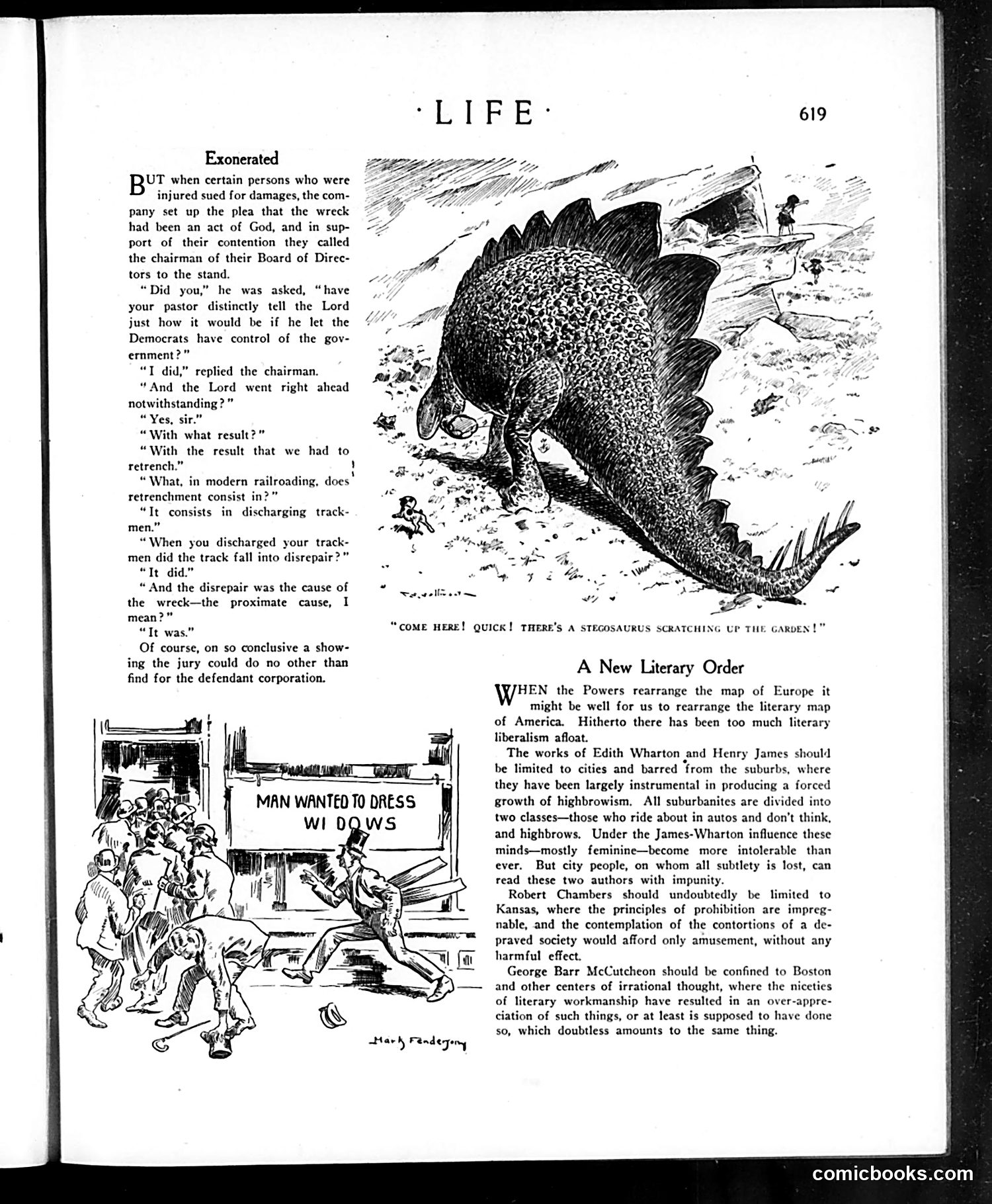
**"Exonerated" (top story):** This satirizes corporate legal tactics. A railroad company sued for damages from a wreck claims "act of God" as defense. Their Board chairman testifies he had his pastor pray that Democrats *wouldn't* control government—yet they did anyway, forcing the company to "retrench" (fire trackmen). The resulting track disrepair caused the wreck. The satire: through absurd circular logic, the company gets exonerated despite obvious negligence, because they blamed Divine will for their own cost-cutting decisions. **"A New Literary Order" (right column):** A tongue-in-cheek proposal to geographically restrict American authors by perceived social class. Edith Wharton and Henry James (sophisticated writers) should be banned from suburbs where they encourage "highbrowism" among women. Robert Chambers belongs only in prohibition-era Kansas. George Barr McCutcheon should be confined to Boston. The satire mocks both literary snobbery and provincial attitudes about who "deserves" access to serious literature. The cartoons lampoon corporate irresponsibility and literary elitism, respectively.
📄 Transcribed text from this page (OCR, searchable)
Machine-transcribed from the original scan — historical spelling and the odd misread are preserved.
Exonerated UT when certain persons who were injured sued for damages, the com- pany set up the plea that the wreck had been an act of God, and in sup- port of their contention they called the chairman of their Board of Direc- tors to the stand. “Did you,” he was asked, “have your pastor distinctly tell the Lord just how it would be if he let the Democrats have control of the gov- ernment?” “T did,” replied the chairman. “And the Lord went right ahead notwithstanding?” “Yes, sir.” “With what result?” “With the result that we had to retrench.” i “What, in modern railroading, does retrenchment consist in?” “Tt consists in discharging track- men.” “When you discharged your trac men did the track fall into disrepair?” “Tt did.” “And the disrepair was the cause of the wreck—the proximate cause, I mean?” “Tt was.” Of course, on so conclusive a show- ing the jury could do no other than find for the defendant corporation. Hark Fandegeny A New Literary Order HEN the Powers rearrange the map of Europe it might be well for us to rearrange the literary map of America. Hitherto there has been too much literary liberalism afloat. The works of Edith Wharton and Henry James should be limited to cities and barred from the suburbs, where they have been largely instrumental in producing a forced growth of highbrowism. All suburbanites are divided into two classes—those who ride about in autos and don’t think, and highbrows. Under the James-Wharton influence these minds—mostly feminine—become more intolerable than ever. But city people, on whom all subtlety is lost, can read these two authors with impunity. Robert Chambers should undoubtedly be limited to Kansas, where the principles of prohibition are impreg- nable, and the contemplation of the contortions of a de- praved society would afford only amusement, without any harmful effect. George Barr McCutcheon should be confined to Boston and other centers of irrational thought, where the niceties of literary workmanship have resulted in an over-appre- ciation of such things, or at least is supposed to have done so, which doubtless amounts to the same thing. comicbooks.com