
Life, 1914-10-08 · page 25 of 44
Life — October 8, 1914 — page 25: what you’re looking at
What you’re looking at
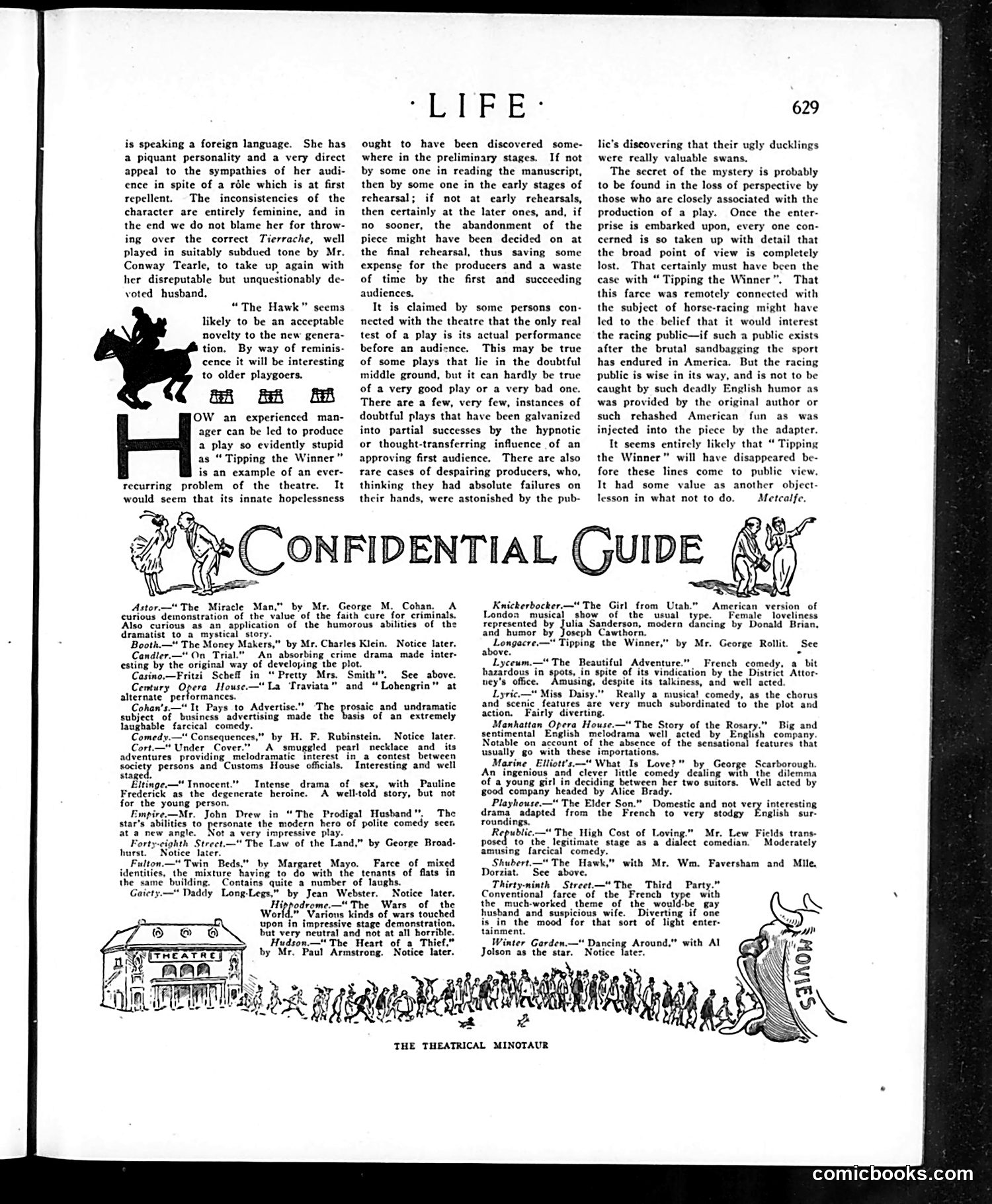
This page contains theater reviews and a "Confidential Guide" listing current Broadway productions. The main editorial critique discusses "Tipping the Winner," a farce about horse-racing that the reviewer considers hopeless—so fundamentally flawed it should have been abandoned during early rehearsals rather than reaching production. The author argues that while some claim a play's true test is live audience performance, obviously bad plays (unlike mediocre ones) should be identifiable before opening night. He speculates the production team lost perspective through involvement, and that American audiences interested in racing wouldn't be swayed by "deadly English humor." The piece concludes "Tipping the Winner" will likely close quickly, though it serves as a cautionary lesson. The guide lists other current shows including "The Miracle Man" and "The Girl from Utah," offering brief critical assessments of each production and cast members.
📄 Transcribed text from this page (OCR, searchable)
Machine-transcribed from the original scan — historical spelling and the odd misread are preserved.
is speaking a foreign language. She has a piquant personality and a very direct appeal to the sympathies of her audi- ence in spite of a réle which is at first repellent. The inconsistencies of the character are entirely feminine, and in the end we do not blame her for throw- ing over the correct Tierrache, well played in suitably subdued tone by Mr. Conway Tearle, to take up again with her disreputable but unquestionably de- voted husband, “The Hawk” scems likely to be an acceptable novelty to the new genera- tion, By way of remi: cence it will be interesting to older playgoers. i Gi A OW an experienced man- ager can be led to produce a play so evidently stupid as “Tipping the Winner is an example of an ever- recurring problem of the theatre. It would seem that its innate hopelessness “The Miracle Man,” by Mr. Astor. dramatist to_a mystical story. Booth. George M. curious demonstration of the value of the faith cure for criminals. Also curious as an application of the humorous abilities of the * The Money Makers,” by Mr. Charles Klein. Notice later. [Ey RsEe ought to have been discovered some- where in the preliminary stages. If not by some one in reading the manuscript, then by some one in the early stages of rehearsal; if not at early rehearsals, then certainly at the later ones, and, if no sooner, the abandonment of the piece might have been decided on at the final rehearsal, thus saving some expense for the producers and a waste of time by the first and succeeding audiences, It is claimed by some persons con- nected with the theatre that the only real test of a play is its actual performance before an audience. This may be true of some plays that lie in the doubtful middle ground, but it can hardly be true of a very good play or a very bad one. There are a few, very few, instances of doubtful plays that have been galvanized into partial successes by the hypnotic or thought-transferring influence of an approving first audience. There are also rare cases of despairing producers, who, thinking they had absolute failures on their hands, were astonished by the pub- Londoa musical and humor by above. 629 lic’s discovering that their ugly ducklings were really valuable swans. The secret of the mystery is probably to be found in the loss of perspective by those who are closely associated with the production of a play. Once the enter- prise is embarked upon, every one con- cerned is so taken up with detail that the broad point of view is completely lost. That certainly must have been the case with “ Tipping the Winner”, That this farce was remotely connected with the subject of horse-racing might have led to the belief that it would interest the racing public—if such a public exists after the brutal sandbagging the sport has endured in America. But the racing public is in its way, and is not to be caught by such deadly English humor as was provided by the original author or such rehashed American fun as was injected into the piece by the adapter. It seems entirely likely that “ Tipping the Winner” will have disappeared be- fore these lines come to public view. It had some value as another object- lesson in what not to do. Metcalfe, ickerbocker.—" The Girl from Utah.” show of represented by julia Sanderson, modern joseph Cawthorn. Longacre.—" Tipping the Winne: the loveliness by Donald Brian, usual “type. fancing " by Mr. George Rollit. See Candler.—* On Trial An absorbing crime drama made inter- esting by the original way of developing the plot. Casino.—Fritzi Schell in “Pretty Mrs. S: Cemury Opera House—" La Traviata” and alternate’ performances. Cohan's.—“It Pays to Advertise.” The subject of business advertising made the laughable farcical comedy. Comedy.—" Consequences,” by H. F. Rubinstein. Notice later. Cort.- Under Cover. A smuggled pearl necklace and its adventures providing melodramatic interest in a contest between society persons and Customs House officials. Interesting and well staged. Eltinge.—" Innocent.” Frederick as the degenerate heroine. ith”, See above. Lohengrin” at rosaic and undramatic asis of an extremely Intense drama of sex, with Pauline A welltold story, but not for the young person. Empire.—Mr. John Drew in “The Prodigal Husband". The Lyceum.—" The Beautiful Adventure.” French comedy, a bit hazardous in spots, in spite of its vindication by, the District Attor- ney’s office, Amusing, despite its talkiness, and well acted. Lyric.—" Miss Daisy.” Really a musical comedy, as the chorus and scenic features are very much subordinated to the plot and action. Fairly diverting. Manhattan Opera House.—" The Story of the Rosary.” Big and sentimental English melodrama well acted by English company. Notable on account of the absence of the sensational features that usually go with these importations. Marine Elliott's." What Is Love?” by George Scarborough. An ingenious and’ clever little comedy dealing with the dilemma of a young girl in deciding between her two suitors, Well acted by good company headed by Alice Brady. Playhouse.—" The Elder Son.” Domestic and not vei interesting drama adapted from the French to very stodgy English sur- round Mr. Lew Fields trans- star's abilities to personate the modern hero of polite comedy seer ‘ot Moderately at a new angle. very impressive play. Forty-cighth Strect.—" The Law of the Land,” by George Broad- hurst. Notice later. Fulton.—" Twin Beds.” by Margaret Mayo. Farce of mixed identities, the mixture haying to do with the tenants of flats in the same building. Contains quite a number of laughs. Gaicty.—" Daddy Long-Legs,” by Jean Webster. Notice later. Hippadrome—" The | Wars of | the World.” Various kinds of wars touched upon in impressive stage demonstration. but very neutral and not at all horribl Hudson.—" The Heart of a Thief.” Notice later. ic.—" The High Cost of Loving.” he legitimate stage as a dialect comedian. ing. farcical comedy. with Mr. Wm. Faversham and Mlle, Thirty-ninth | Street—" The Third Party.” Conventional farce of the French type with the much-worked theme of the would-be gay husband and suspicious wife. Diverting if one is in the mood for that sort of light enter- tainment. Winter Garden. Jolson as the star. Dancing Around.” with Al ja by Mr. Paul Armstrong. Notice late:. THE THEATRICAL MINOTAUR comicbooks.com