
Life, 1914-10-08 · page 20 of 44
Life — October 8, 1914 — page 20: what you’re looking at
What you’re looking at
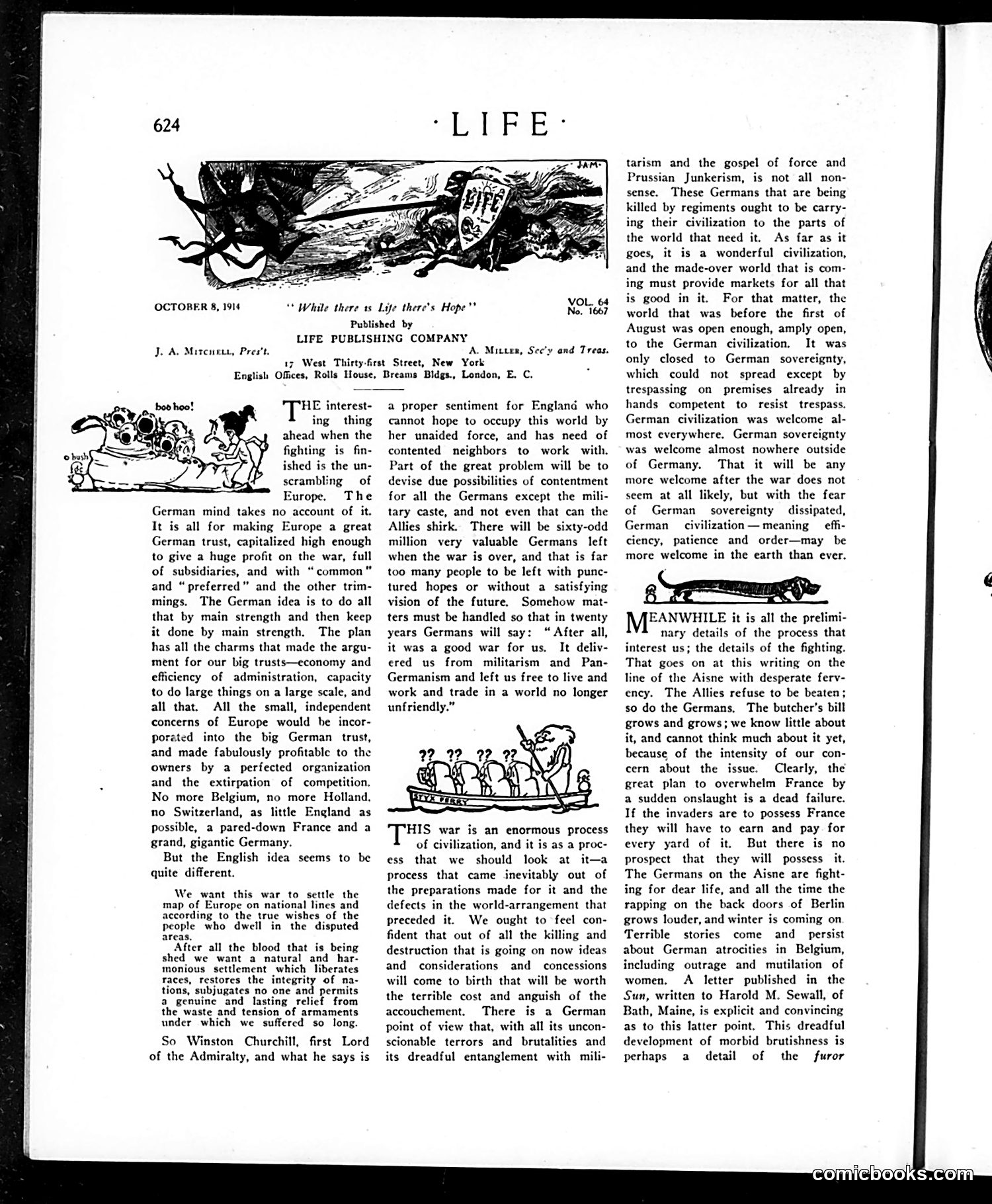
This page presents editorial commentary on World War I, dated just two months after it began. The text contrasts German and British post-war objectives: **The German Vision** (depicted as corporate/materialist): Germany aims to consolidate Europe into a profitable "trust," absorbing smaller nations (Belgium, Holland, Switzerland, France) into a unified German economic empire—efficiency through military dominance. **The British Vision** (depicted as idealistic): Britain seeks to redraw Europe's map according to national self-determination, liberating suppressed peoples and creating a genuinely peaceful international order. The cartoons (small illustrations accompanying the text) appear to satirize German ambitions as mechanistic and predatory, contrasting with British humanitarian ideals. **Context for modern readers**: This represents American *Life* magazine's early WWI perspective—sympathetic to Britain's framing of the conflict as a civilizational struggle between enlightened democratic values and Prussian militarism. The piece notably attempts to distinguish between Germans as a people and their militaristic leadership, suggesting post-war reconciliation is possible.
📄 Transcribed text from this page (OCR, searchable)
Machine-transcribed from the original scan — historical spelling and the odd misread are preserved.
OCTOBER 8, 1914 ‘* While there ts Life there's Hope"’ Published by LIFE PUBLISHING COMPANY J. A. Mitcneit, Pres’t. A. Minter, See’y and Treas. 17 West Thirty-first Street, New York English Offices, Rolls House, Breams Bldgs., London, E. C. 'HE interest- ing thing ahead when the fighting is fin- ished is the un- scrambling of Europe. The German mind takes no account of it. It is all for making Europe a great German trust, capitalized high enough to give a huge profit on the war, full of subsidiaries, and with “common” and “preferred” and the other trim- mings. The German idea is to do all that by main strength and then keep it done by main strength. The plan has all the charms that made the argu- ment for our big trusts—economy and efficiency of administration, capacity to do large things on a large scale, and all that. All the small, independent concerns of Europe would be incor- porated into the big German trust, and made fabulously profitable to the owners by a perfected organization and the extirpation of competition. No more Belgium, no more Holland, no Switzerland, as little England as possible, a pared-down France and a grand, gigantic Germany. But the English idea seems to be quite different. We want this war to settle the map of Europe on national lines and according to the true wishes of the people who dwell in the disputed areas. After all the blood that is being shed we want a natural and har- monious settlement which liberates races, restores the integrity of na- tions, subjugates no one and permits a genuine and lasting relief from the waste and tension of armaments under which we suffered so long. So Winston Churchill, first Lord of the Admiralty, and what he says is a proper sentiment for England who cannot hope to occupy this world by her unaided force, and has need of contented neighbors to work with, Part of the great problem will be to devise due possibilities of contentment for all the Germans except the mili- tary caste, and not even that can the Allies shirk. There will be sixty-odd million very valuable Germans left when the war is over, and that is far too many people to be left with punc- tured hopes or without a satisfying vision of the future. Somehow mat- ters must be handled so that in twenty years Germans will say: “After all, it was a good war for us. It deliv- ered us from militarism and Pan- Germanism and left us free to live and work and trade in a world no longer unfriendly.” HIS war is an enormous process of civilization, and it is as a proc- ess that we should look at it—a process that came inevitably out of the preparations made for it and the defects in the world-arrangement that preceded it. We ought to feel con- fident that out of all the killing and destruction that is going on now ideas and considerations and concessions will come to birth that will be worth the terrible cost and anguish of the accouchement. There is a German point of view that, with all its uncon- scionable terrors and brutalities and its dreadful entanglement with mili- tarism and the gospel of force and Prussian Junkerism, is not all non- sense. These Germans that are being killed by regiments ought to be carry- ing their civilization to the parts of the world that need it. As far as it goes, it is a wonderful civilization, and the made-over world that is com- ing must provide markets for all that is good in it. For that matter, the world that was before the first of August was open enough, amply open, to the German civilization. It was only closed to German sovereignty, which could not spread except by trespassing on premises already in hands competent to resist trespass. German civilization was welcome al- most everywhere. German sovereignty was welcome almost nowhere outside of Germany. That it will be any more welcome after the war does not seem at all likely, but with the fear of German sovereignty dissipated, German civilization — meaning _ effi- ciency, patience and order—may be more welcome in the earth than ever. Pr aa al EANWHILLE it is all the prelimi- nary details of the process that interest us; the details of the fighting. That goes on at this writing on the line of the Aisne with desperate ferv- ency. The Allies refuse to be beaten; so do the Germans, The butcher's bill grows and grows; we know little about it, and cannot think much about it yet, because of the intensity of our con- cern about the issue. Clearly, the great plan to overwhelm France by a sudden onslaught is a dead failure. If the invaders are to possess France they will have to earn and pay for every yard of it. But there is no prospect that they will possess it. The Germans on the Aisne are fight- ing for dear life, and all the time the rapping on the back doors of Berlin grows louder, and winter is coming on. Terrible stories come and_ persist about German atrocities in Belgium, including outrage and mutilation of women, A letter published in the Sun, written to Harold M. Sewall, of Bath, Maine, is explicit and convincing as to this latter point. This dreadful development of morbid brutishness is perhaps a detail of the furor