
Life, 1914-10-08 · page 29 of 44
Life — October 8, 1914 — page 29: what you’re looking at
What you’re looking at
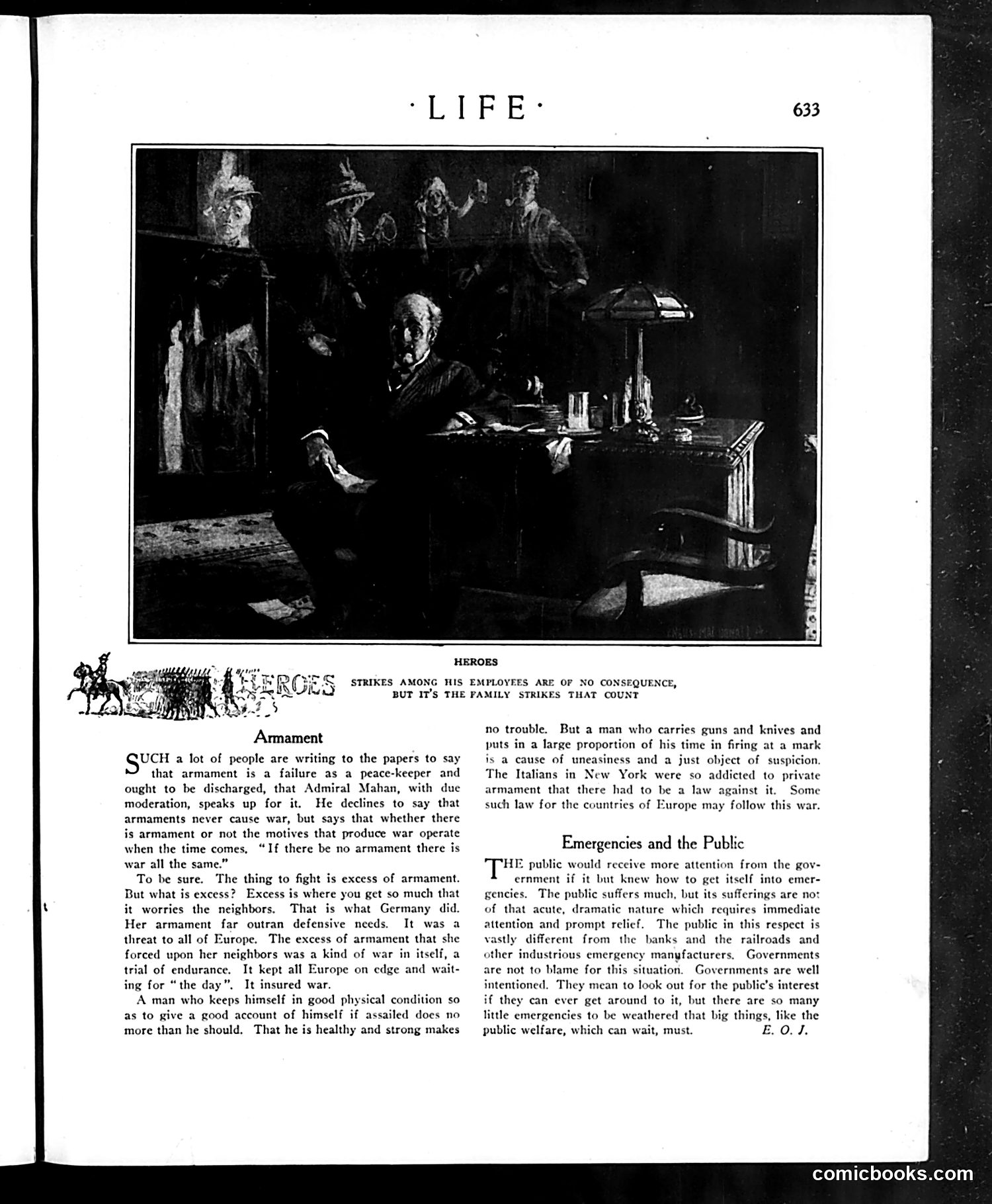
This page contains two opinion pieces rather than traditional cartoons. The "Heroes" section uses a dramatic illustration (showing what appears to be a military or governmental scene) as visual accompaniment to text debating armament policy, likely during or shortly after World War I. **The argument:** Admiral Mahan is cited defending military armament as a peace-keeper. The author distinguishes between reasonable defensive preparation (like a healthy man) versus excessive armament that provokes neighbors—comparing Germany's pre-WWI buildup to a man obsessively armed with guns and knives. The analogy to Italian immigrants in New York who were restricted from carrying weapons suggests governments should similarly limit European nations' arsenals. **The satire:** The title "Heroes" and subtitle suggest military/industrial figures claim strikes among employees are insignificant, but family strikes matter—a quip about how powerful figures ignore labor disputes while protecting business interests. The second section mocks government inefficiency: while banks get emergency attention, actual public welfare issues languish because governments prioritize "big emergencies" and ignore chronic problems.
📄 Transcribed text from this page (OCR, searchable)
Machine-transcribed from the original scan — historical spelling and the odd misread are preserved.
HEROES STRIKES AMONG HIS EMPLOYEES ARE OF NO CONSEQUENCE, BUT IT’S THE PAMILY STRIKES THAT COUNT UCH a lot of people are writing to the papers to say that armament is a failure as a peace-keeper and ought to be discharged, that Admiral Mahan, with due moderation, speaks up for it. He declines to say that armaments never cause war, but says that whether there is armament or not the motives that produce war operate when the time comes, “If there be no armament there is war all the same.” To be sure. The thing to fight is excess of armament. But what is excess? Excess is where you get so much that it worries the neighbors. That is what Germany did. Her armament far outran defensive needs. It was a threat to all of Europe. The excess of armament that she forced upon her neighbors was a kind of war in itself, a trial of endurance. It kept all Europe on edge and wait- ing for “the day”. It insured war. A man who keeps himself in good physical condition so as to give a good account of himself if assailed does no more than he should, That he is healthy and strong makes no trouble. But a man who carries guns and knives and puts in a large proportion of his time in firing at a mark is a cause of uneasiness and a just object of suspicion. The Italians in New York were so addicted to private armament that there had to be a law against it. Some such law for the countries of Europe may follow this war. Emergencies and the Public n from the gov- ernment if it but knew how to get itself into emer- gencies. The public suffers much, but its sufferings are not HE public would receive more attenti of that acute, dramatic nature which requires immediate attention and prompt relief. The public in this respect is vastly different from the banks and the railroads and other industrious emergency manufacturers. Governments are not to blame for this situation. Governments are well intentioned. They mean to look out for the public’s interest if they can ever get around to it, but there are so many hered that big things, like the E.0.]. little emergencies to be w public welfare, which can wait, must. comicbooks.com