
Life, 1914-10-08 · page 31 of 44
Life — October 8, 1914 — page 31: what you’re looking at
What you’re looking at
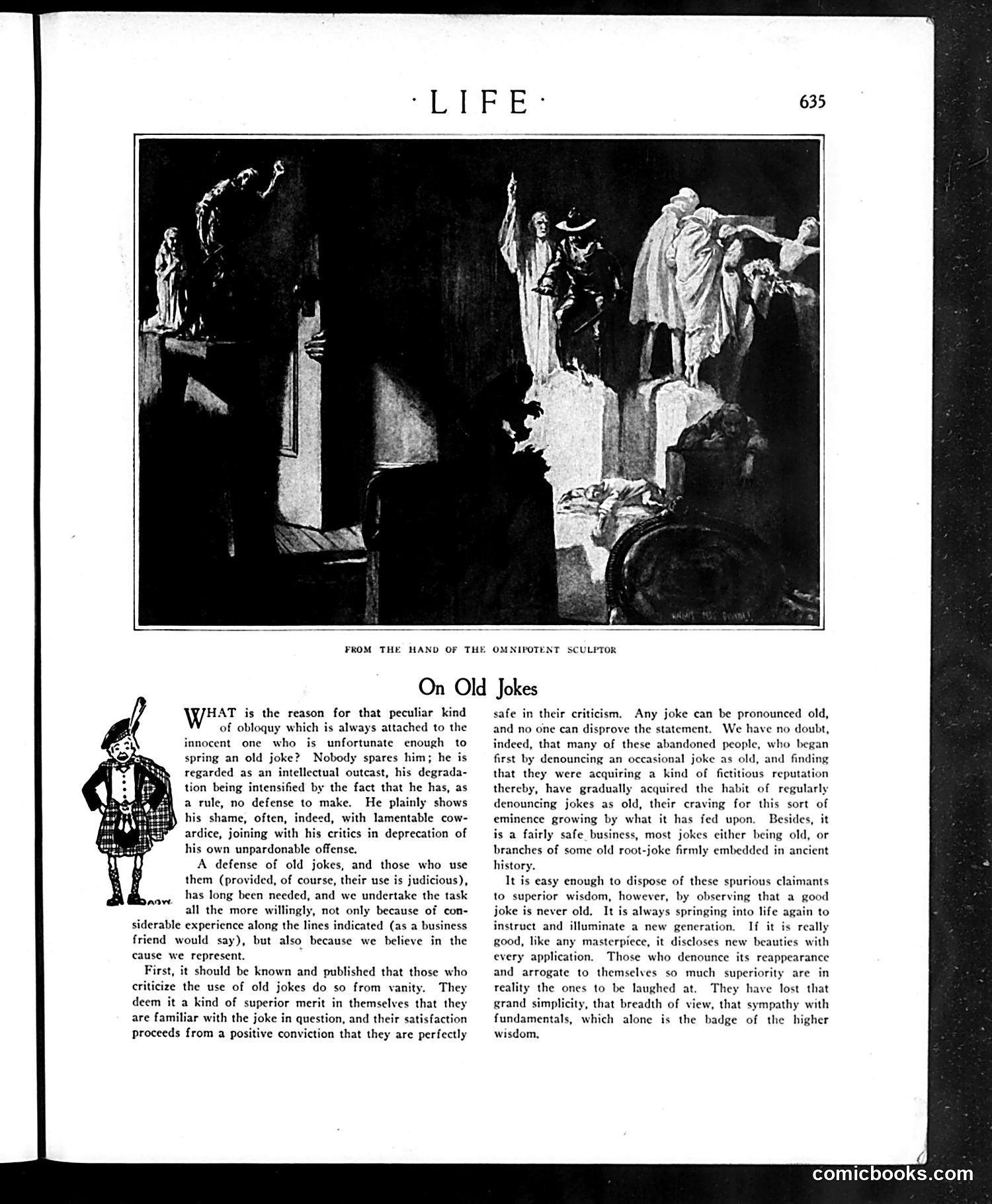
This page defends the use of old jokes against social criticism. The article argues that people who denounce familiar jokes as "old" do so from vanity—claiming superior wit by claiming familiarity. The author counters that genuinely good jokes are timeless, like masterpieces that reveal new meaning with each retelling and generation. The accompanying illustration (credited to an unnamed sculptor) appears to show a classical or allegorical scene, though its specific connection to the text is unclear—it may represent the timeless nature of humor or wisdom itself. The piece mounts a satirical defense: those who pride themselves on dismissing old jokes actually demonstrate intellectual narrowness and loss of "grand simplicity," the true mark of wisdom. The satire targets social pretension and performative superiority in intellectual circles—a recurring target of *Life* magazine's humor.
📄 Transcribed text from this page (OCR, searchable)
Machine-transcribed from the original scan — historical spelling and the odd misread are preserved.
FROM THE HAND OF THE OMNIPOTENT SCULPTOR On Old Jokes HAT is the reason for that peculiar kind of obloquy which is always attached to the innocent one who is unfortunate enough to spring an old joke? Nobody spares him; he is regarded as an intellectual outcast, his degrada- tion being intensified by the fact that he has, as a rule, no defense to make. He plainly shows his shame, often, indeed, with lamentable cow- ardice, joining with his critics in deprecation of own unpardonable offense. A defense of old jokes, and those who use them (provided, of course, their use is judicious), has long been needed, and we undertake the task all the more willingly, not only because of con- siderable experience along the lines indicated (as a business friend would say), but also because we believe in the cause we represent. , First, it should be known and published that those who criticize the use of old jokes do so from vanity. They deem it a kind of superior merit in themselves that they are familiar with the joke in question, and their satisfaction proceeds from a positive conviction that they are perfectly brow. safe in their criticism. Any joke can be pronounced old, and no one can disprove the statement. We have no doubt, indeed, that many of these abandoned people, who began first by denouncing an occasional joke as old, and finding that they were acquiring a kind of fictitious reputation thereby, have gradually acquired the habit of regularly denouncing jokes as old, their craving for this sort of eminence growing by what it has fed upon. Besides, it is a fairly safe business, most jokes cither being old, or branches of some old root-joke firmly embedded in ancient history. It is easy enough to dispose of these spurious claimants to superior wisdom, however, by observing that a good joke is never old, It is always springing into life again to instruct and illuminate a new generation. If it is really good, like any masterpiece, it discloses new beauties with every application. Those who denounce its reappearance and arrogate to themselves so much superiority are in reality the ones to be laughed at. They have lost that grand simplicity, that breadth of view, that sympathy with fundamentals, which alone is the badge of the higher wisdom, y, comicbooks.com