
Life, 1914-10-08 · page 12 of 44
Life — October 8, 1914 — page 12: what you’re looking at
What you’re looking at
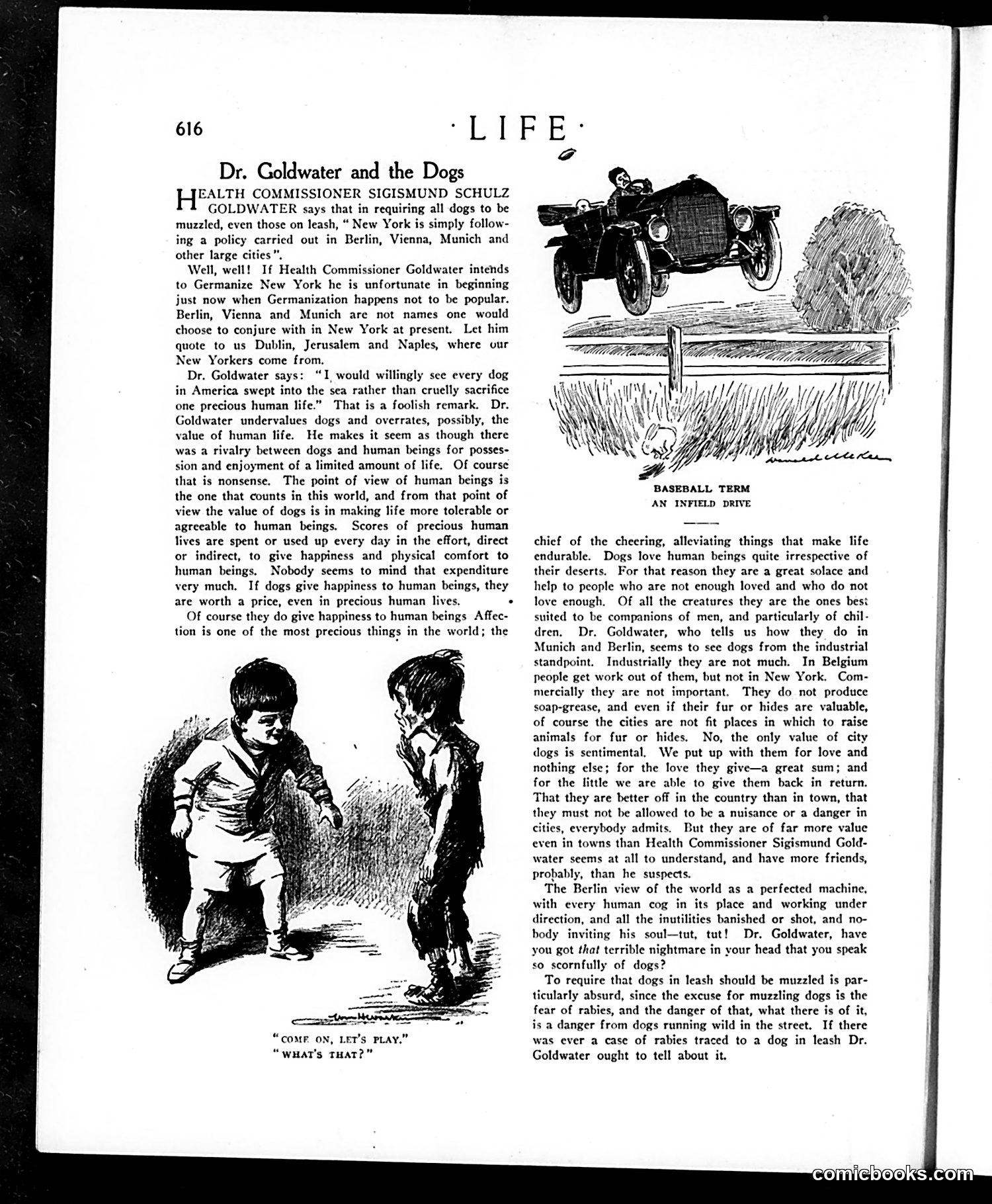
This satirical article criticizes Health Commissioner Sigismund Schulz's proposal to require muzzling all dogs in New York City. The piece defends dogs' value to human happiness and attacks the comparison to other cities (Berlin, Vienna, Munich) as inappropriate for New York. The article argues that city dogs provide sentimental companionship rather than economic value, making them worth protecting. It mocks Schulz's mechanistic, Prussian worldview ("every human cog in its place") as contrary to American values. The cartoons illustrate dogs' innocent social role—children playing together—suggesting that muzzling requirements are unnecessarily harsh. The satirist contends dogs are "better off in the country" but shouldn't be banned from cities where they bring joy to those "not enough loved."
📄 Transcribed text from this page (OCR, searchable)
Machine-transcribed from the original scan — historical spelling and the odd misread are preserved.
616 Dr. Goldwater and the Dogs EALTH COMMISSIONER SIGISMUND SCHULZ GOLDWATER says that in requiring all dogs to be muzzled, even those on leash, “ New York is simply follow- ing a policy carried out in Berlin, Vienna, Munich and other large cities”. Well, well! If Health Commissioner Goldwater intends to Germanize New York he is unfortunate in beginning just now when Germanization happens not to be popular. Berlin, Vienna and Munich are not names one would choose to conjure with in New York at present. Let him quote to us Dublin, Jerusalem and Naples, where our New Yorkers come from. Dr. Goldwater says: “I, would willingly see every dog in America swept into the sea rather than cruelly sacrifice one precious human life.” That is a foolish remark. Dr. Goldwater undervalues dogs and overrates, possibly, the value of human life. He makes it seem as though there was a rivalry between dogs and human beings for posses- sion and enjoyment of a limited amount of life. Of course that is nonsense. The point of view of human beings is the one that counts in this world, and from that point of view the value of dogs is in making life more tolerable or agreeable to human beings. Scores of precious human lives are spent or used up every day in the effort, direct or indirect, to give happiness and physical comfort to human beings. Nobody seems to mind that expenditure very much. If dogs give happiness to human beings, they are worth a price, even in precious human lives. . Of course they do give happiness to human beings Affec- tion is one of the most precious things in the world; the “COMP ON, LET'S PLAY.” “WHAT's THAT?” ‘LTP E: og i \N\! \Nt \ i) Ki Vlg . Wi GN LG MANY 7 a CG HH BASEBALL TERM AN INFIELD DRIVE chief of the cheering, alleviating things that make life endurable. Dogs love human beings quite irrespective of their deserts. For that reason they are a great solace and help to people who are not enough loved and who do not love enough, Of all the creatures they are the ones best suited to be companions of men, and particularly of chil- dren, Dr. Goldwater, who tells us how they do in Munich and Berlin, seems to see dogs from the industrial standpoint. Industrially they are not much. In Belgium people get work out of them, but not in New York. Com- mercially they are not important. They do not produce soap-grease, and even if their fur or hides are valuable, of course the cities are not fit places in which to raise animals for fur or hides. No, the only value of city dogs is sentimental, We put up with them for love and nothing else; for the love they give—a great sum; and for the little we are able to give them back in return. That they are better off in the country than in town, that they must not be allowed to be a nuisance or a danger in cities, everybody admits. But they are of far more value even in towns than Health Commissioner Sigismund Gold- water seems at all to understand, and have more friends, probably, than he suspects. The Berlin view of the world as a perfected machine, with every human cog in its place and working under direction, and all the inutilities banished or shot, and no- body inviting his soul—tut, tut! Dr. Goldwater, have you got that terrible nightmare in your head that you speak so scornfully of dogs? To require that dogs in leash should be muzzled is par- ticularly absurd, since the excuse for muzzling dogs is the fear of rabies, and the danger of that, what there is of it, is a danger from dogs running wild in the street. If there was ever a case of rabies traced to a dog in leash Dr. Goldwater ought to tell about it.