
Life, 1914-10-08 · page 18 of 44
Life — October 8, 1914 — page 18: what you’re looking at
What you’re looking at
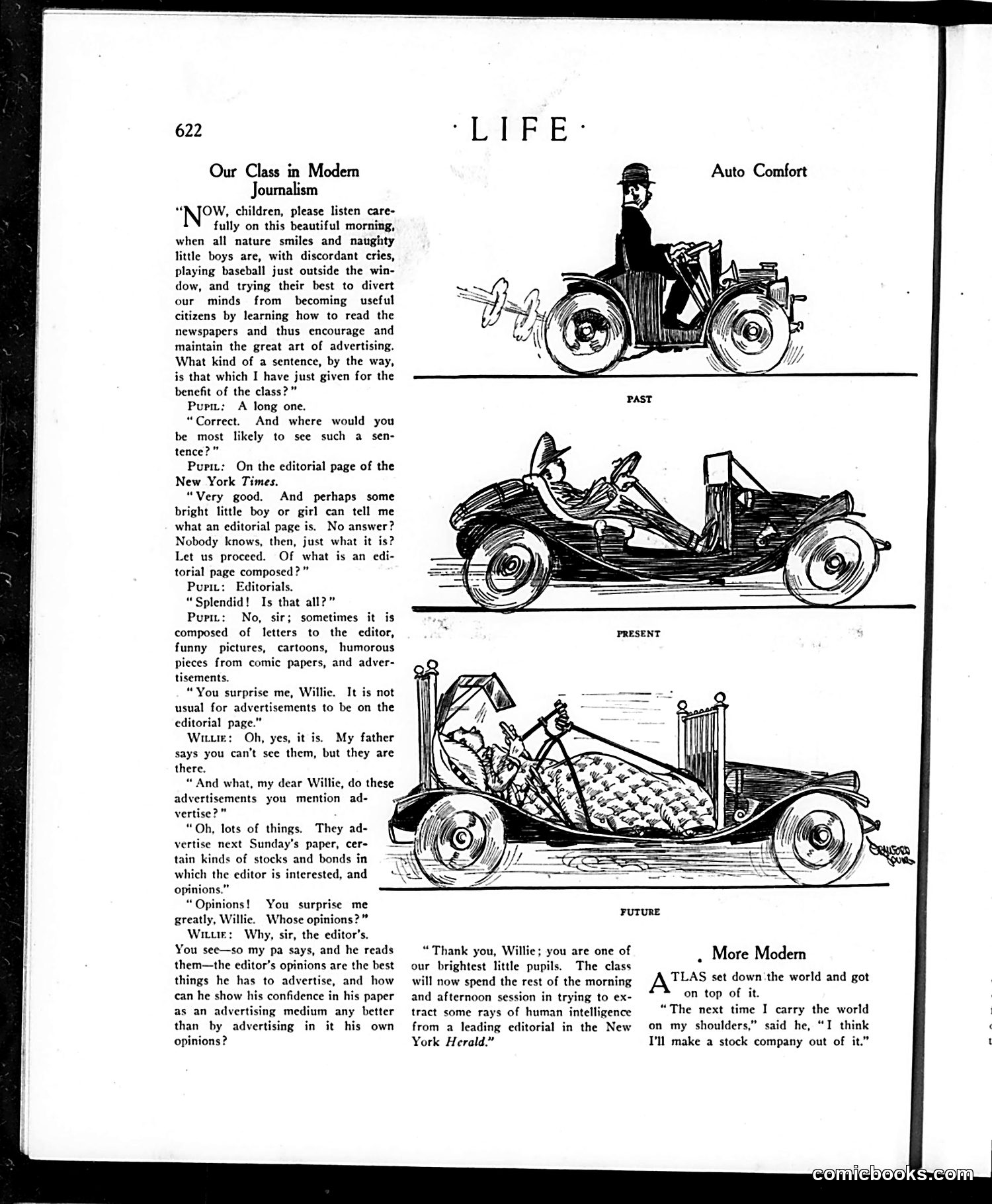
This is a satirical dialogue between a teacher and students about newspaper journalism, specifically critiquing editorial pages and their relationship to advertising. **The joke:** Willie, a precocious student, reveals that newspapers blur the line between editorial content and advertising. He notes that advertisements appear on editorial pages (supposedly reserved for opinion), and more pointedly—his father says the editor's own opinions function as advertising for the paper itself. The editor uses the editorial page to advertise his views, demonstrating "confidence" in his paper as an advertising medium. **The satire:** Life is mocking how newspapers disguise commercial interests as serious editorial content. The editorial page, meant to present reasoned opinion, actually serves the paper's financial interests and the editor's personal agenda. **The "Auto Comfort" cartoon series** shows vehicle evolution (past, present, future), culminating in Atlas carrying the world as a business venture—satirizing capitalist ambitions to monetize everything. The overall message: newspapers claim journalistic integrity while their "opinion" pages are fundamentally commercial enterprises.
📄 Transcribed text from this page (OCR, searchable)
Machine-transcribed from the original scan — historical spelling and the odd misread are preserved.
622 Our Class in Modem Journalism “AJOW, children, please listen care- fully on this beautiful morning, when all nature smiles and naughty little boys are, with discordant cries, playing baseball just outside the win- dow, and trying their best to divert our minds from becoming useful citizens by learning how to read the newspapers and thus encourage and maintain the great art of advertising. What kind of a sentence, by the way, is that which I have just given for the benefit of the class?” Purn: A long one. Correct. And where would you be most likely to see such a sen- tence?” Purit: On the editorial page of the New York Times. “Very good. And perhaps some bright little boy or girl can tell me what an editorial page is. No answer? Nobody knows, then, just what it is? Let us proceed. Of what is an edi- torial page composed?” Purit: Editorials. “Splendid! Is that all?” Purit: No, sir; sometimes it is composed of letters to the editor, funny pictures, cartoons, humorous pieces from comic papers, and adver- tisements. “You surprise me, Willie. It is not usual for advertisements to be on the editorial page.” Witte: Oh, yes, it is. My father says you can’t see them, but they are there. “And what, my dear Willie, do these advertisements you mention ad- vertise?” “Oh, lots of things. They ad- vertise next Sunday's paper, cer- tain kinds of stocks and bonds in which the editor is interested, and You surprise me greatly, Willie. Whose opinions?” Witur: Why, sir, the editor's, You see—so my pa says, and he reads them—the editor’s opinions are the best things he has to advertise, and how can he show his confidence in his paper as an advertising medium any better than by advertising in it his own opinions? “Thank you, Willie; you are one of our brightest little pupils. The class will now spend the rest of the morning and afternoon session in trying to ex- tract some rays of human intelligence from a leading editorial in the New York Herald.” . More Modem TLAS set down the world and got on top of it. “The next time I carry the world on my shoulders,” said he, “I think I'll make a stock company out of it.”