
Life, 1914-10-08 · page 24 of 44
Life — October 8, 1914 — page 24: what you’re looking at
What you’re looking at
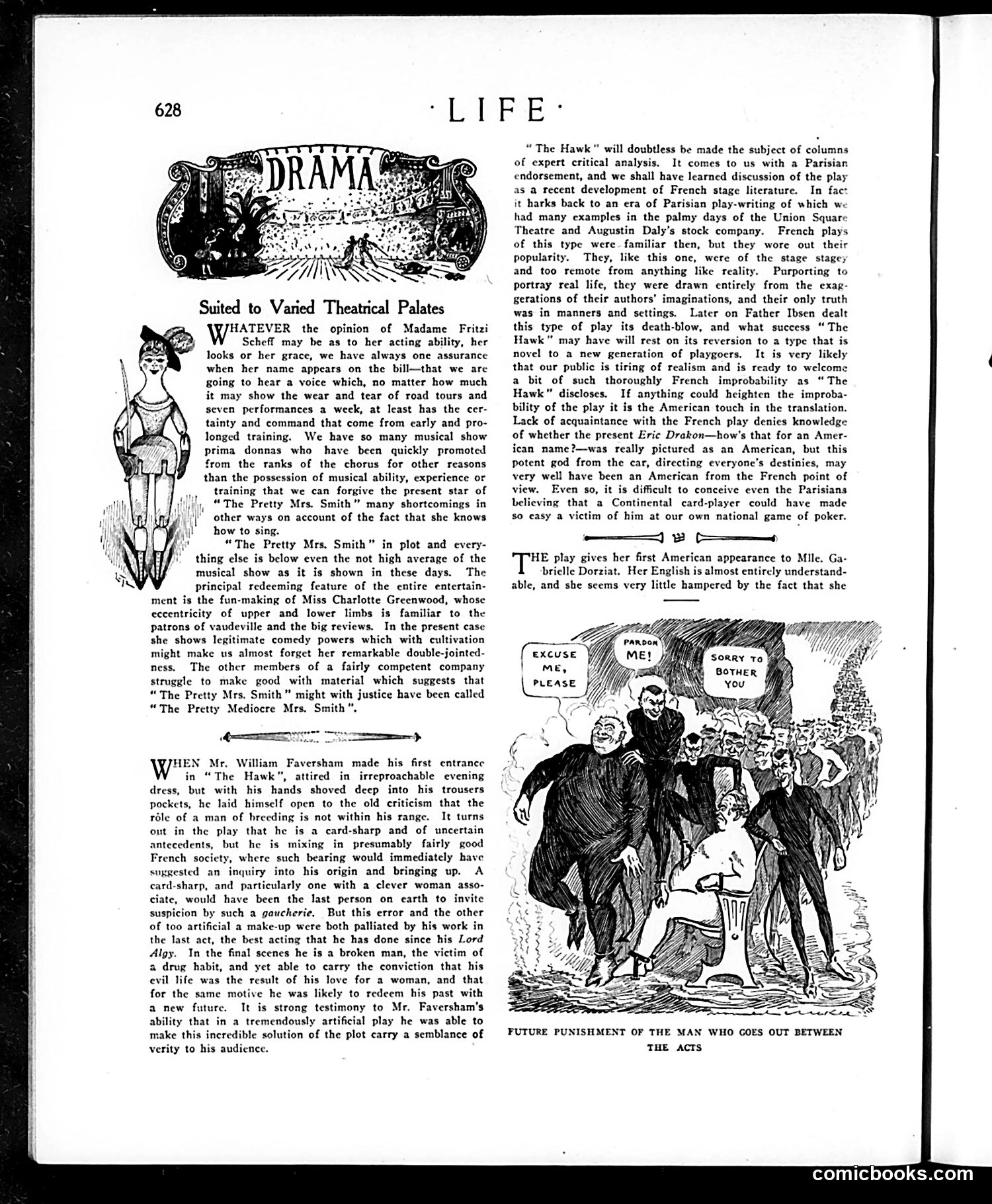
This is a drama criticism page from *Life* magazine reviewing three theatrical productions: "The Pretty Mrs. Smith," "The Hawk," and another play. The **cartoon** (bottom right) depicts a man being ejected between theater acts—satirizing the common practice of audiences leaving during intermission, likely because the entertainment was poor quality. The **text critiques** contemporary theater: 1. **"The Pretty Mrs. Smith"**: Critics praise Fritzi Scheff's trained singing voice but condemn the show itself as mediocre, noting it relies on Charlotte Greenwood's physical comedy rather than quality writing. 2. **"The Hawk"**: While praising actor William Faversham's final-act performance, critics fault his opening posture (hands in pockets) as ungentlemanly and note the play's artificiality. They compare it dismissively to outdated 19th-century French melodramas, contrasting such theatricality unfavorably with Henrik Ibsen's more realistic dramatic approach. The underlying satire suggests Broadway was producing derivative, unrealistic entertainment rather than serious dramatic innovation.
📄 Transcribed text from this page (OCR, searchable)
Machine-transcribed from the original scan — historical spelling and the odd misread are preserved.
“WeAPE Suited to Varied Theatrical Palates HATEVER the opinion of Madame Fritzi Scheff may be as to her acting ability, her looks or her grace, we have always one assurance when her name appears on the bill—that we are going to hear a voice which, no matter how much it may show the wear and tear of road tours and seven performances a week, at least has the cer- tainty and command that come from early and pro- longed training. We have so many musical show prima donnas who have been quickly promoted from the ranks of the chorus for other reasons than the possession of musical ability, experience or raining that we can forgive the present star of “The Pretty Mrs. Smith” many shortcomings in other ways on account of the fact that she knows how to sing. “The Pretty Mrs, Smith” in plot and every- thing else is below even the not high average of the musical show as it is shown in these days. The principal redeeming feature of the entire entertain- the fun-making of Miss Charlotte Greenwood, whose eccentricity of upper and lower limbs is familiar to the patrons of vaudeville and the big reviews. In the present case she shows legitimate comedy powers which with culti might make us almost forget her remarkable double-j. ness. The other members of a fairly competent company struggle to make good with material which suggests that “The Pretty Mrs. Smith” might with justice have been called “The Pretty Mediocre Mrs. Smith”. 2, Tap W' ‘ Mr. William Faversham made his first entrance in “The Hawk”, attired in irreproachable evening dress, but with his hands shoved deep into his trousers pockets, he laid himself open to the old criticism that the réle of a man of breeding is not within his range. It turns out in the play that he is a card-sharp and of uncertain antecedents, but he is mixing in presumably fairly good French society, where such bearing would immediately have suggested an inquiry into his origin and bringing up. A card-sharp, and particularly one with a clever woman asso- ciate, would have been the last person on earth to invite suspicion by such a gaucherie, But this error and the other of too artificial a make-up were both palliated by his work in the last act, the best acting that he has done since his Lord Algy. In the final scenes he is a broken man, the victim of a drug habit, and yet able to carry the conviction that his evil life was the result of his love for a woman, and that for the same motive he was likely to redeem his past with a new future. It is strong testimony to Mr, Faversham’s ability that in a tremendously artificial play he was able to make this incredible solution of the plot carry a semblance of verity to his audience, “The Hawk” will doubtless be made the subject of columns of expert critical analysis. It comes to us with a Parisian endorsement, and we shall have learned discussion of the play as a recent development of French stage literature. In fact it harks back to an era of Parisian play-writing of which we had many examples in the palmy days of the Union Square Theatre and Augustin Daly's stock company. French plays of this type were familiar then, but they wore out their popularity. They, like this one, were of the stage stagey and too remote from anything like reality. Purporting to portray real life, they were drawn entirely from the exag- gerations of their authors’ imaginations, and their only truth was in manners and settings. Later on Father Ibsen dealt this type of play its death-blow, and what success “The Hawk” may have will rest on its reversion to a type that is novel to a new generation of playgoers, It is very likely that our public is tiring of realism and is ready to welcome a bit of such thoroughly French improbability as “The Hawk” discloses. If anything could heighten the improba- bility of the play it is the American touch in the translation. Lack of acquaintance with the French play denies knowledge of whether the present Eric Drakon—how's that for an Amer- ican name?—was really pictured as an American, but this potent god from the car, directing everyone's destinies, may very well have been an American from the French point of view. Even so, it is difficult to conceive even the Parisians believing that a Continental card-player could have made so easy a victim of him at our own national game of poker. —_——— 2» ——— HE play gives her first American appearance to Mile. Ga- brielle Dorziat. Her English is almost entirely understand- able, and she seems very little hampered by the fact that she EXCUSE me, FUTURE PUNISHMENT OF THE MAN WHO GOES OUT BETWEEN THE ACTS comicbooks.com