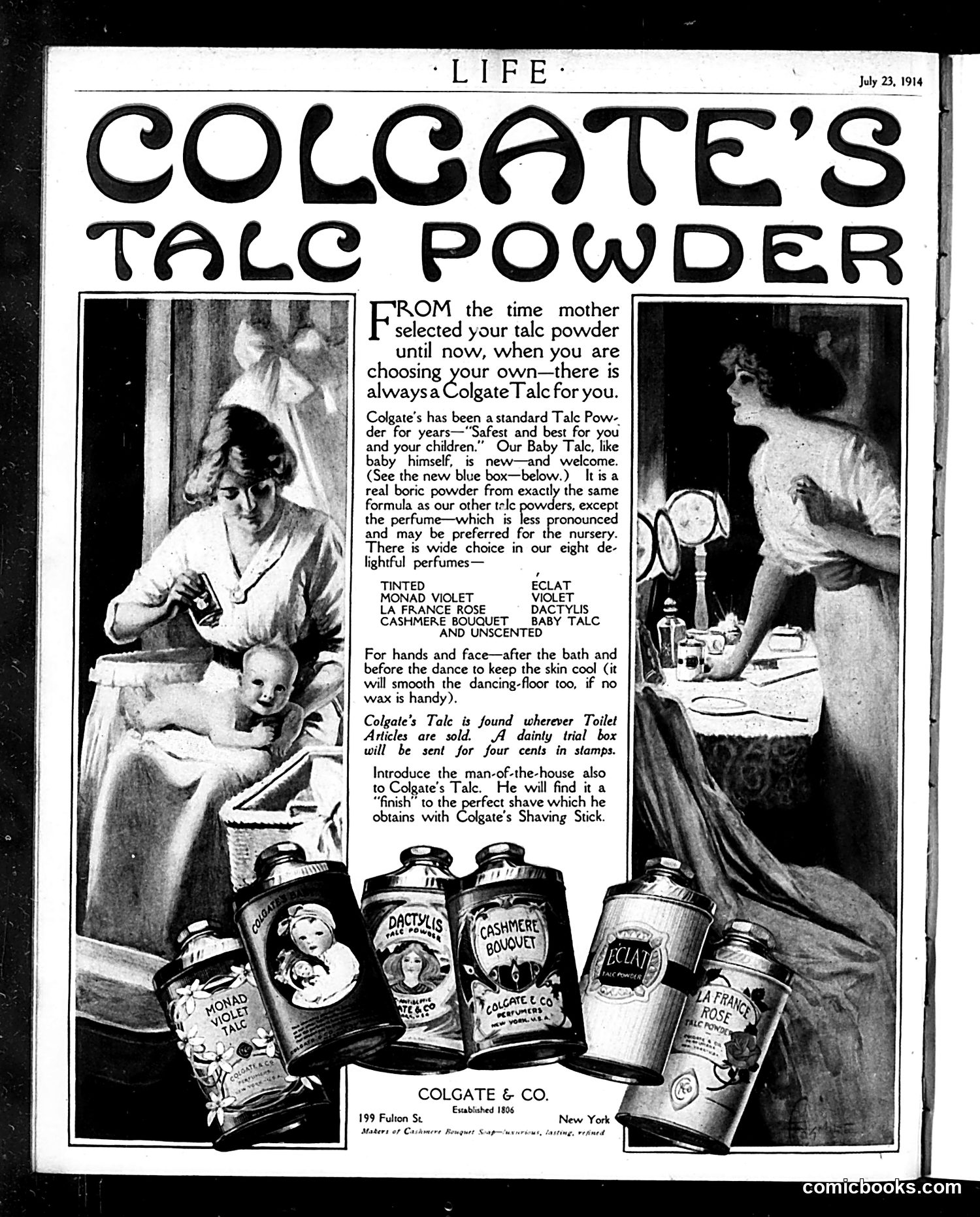
A complete issue · 40 pages · 1914
Life — July 23, 1914
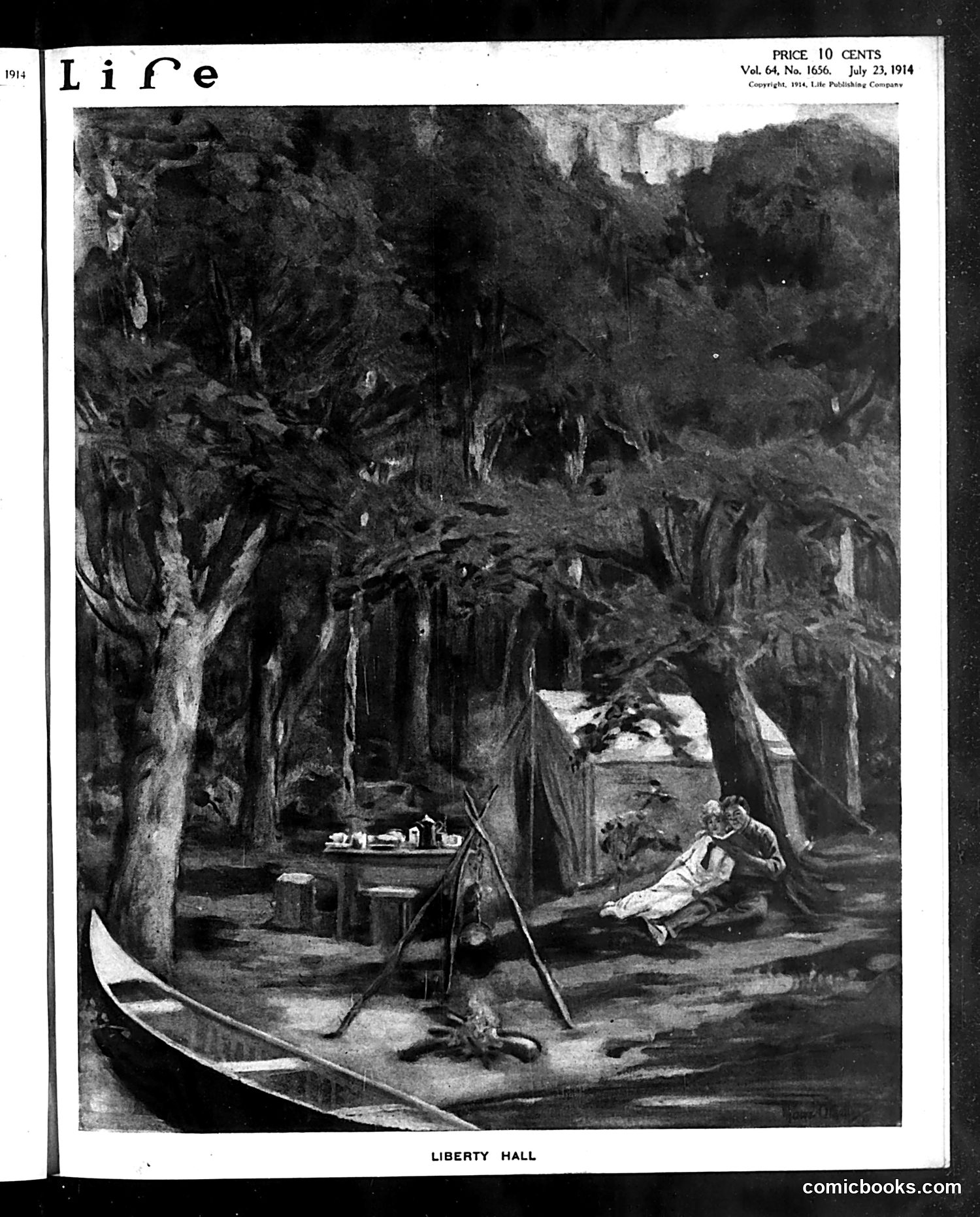
This page from Life magazine appears to be titled "Liberty Hall" and depicts an illustration rather than a political cartoon. The image shows a wilderness camping or outdoor scene with figures relaxing near a tent, canoe, and campfire beneath towering trees, likely representing a remote natural setting. Without accompanying text explaining the satirical point, I cannot definitively identify specific figures or determine what social or political commentary this illustration intends. The title "Liberty Hall" suggests themes of freedom or informal gatherings, but the specific satirical meaning—whether critiquing leisure practices, environmental attitudes, or social behavior of the era—remains unclear from the image alone. Additional context or article text would be needed for accurate interpretation.

This page is **primarily advertising**, not political satire. The dominant content is a Dioxogen advertisement addressing a practical domestic concern: the importance of keeping first aid supplies stocked in home medicine cabinets. The ad uses a rhetorical question ("Where's that Dioxogen?") to prompt anxiety about unpreparedness for minor injuries like insect bites or scratches. The only editorial content is a brief essay titled "Looking Backward," which critiques how modern churches have become entertainment venues rather than spiritual spaces. The author argues this reflects broader cultural decline—suggesting religion, like other institutions, has abandoned moral purpose for commercial comfort. The Biltmore Hotel advertisement fills the remaining space. No political figures or satirical cartoons appear on this page.
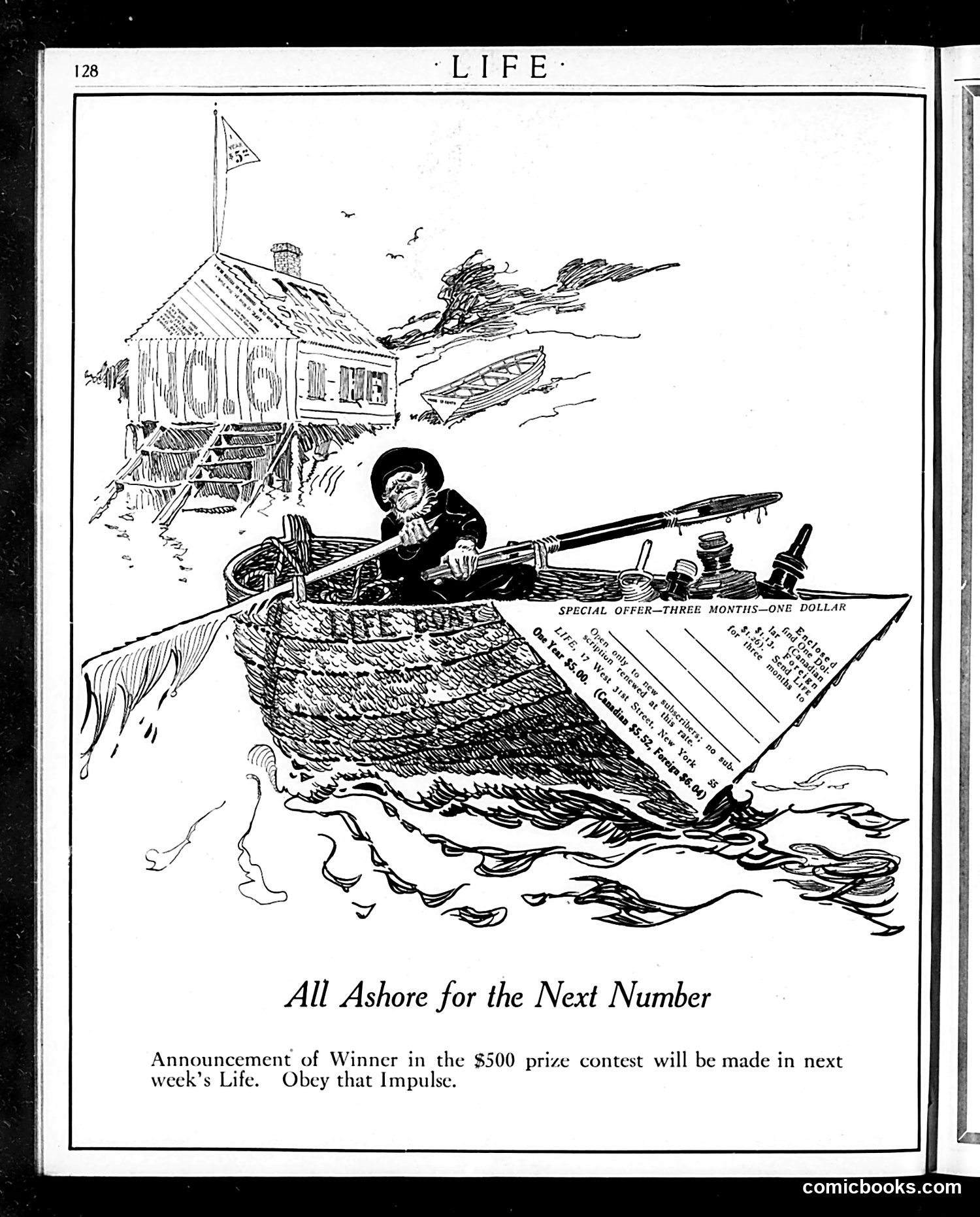
This page is primarily **advertising**, not editorial content. The illustration depicts a figure in a boat made from a giant shoe, wielding a rifle-like implement, with a seaside cottage visible in the background. The text reads "All Ashore for the Next Number" and advertises a "$500 prize contest" with winner announcement promised in the following week's issue. The shoe-boat imagery appears whimsical rather than satirical—typical of early 20th-century magazine advertising aesthetics. The "special offer" banner references a subscription deal (three months for one dollar). This is primarily a promotional page designed to encourage subscriptions and contest participation rather than convey political or social commentary.
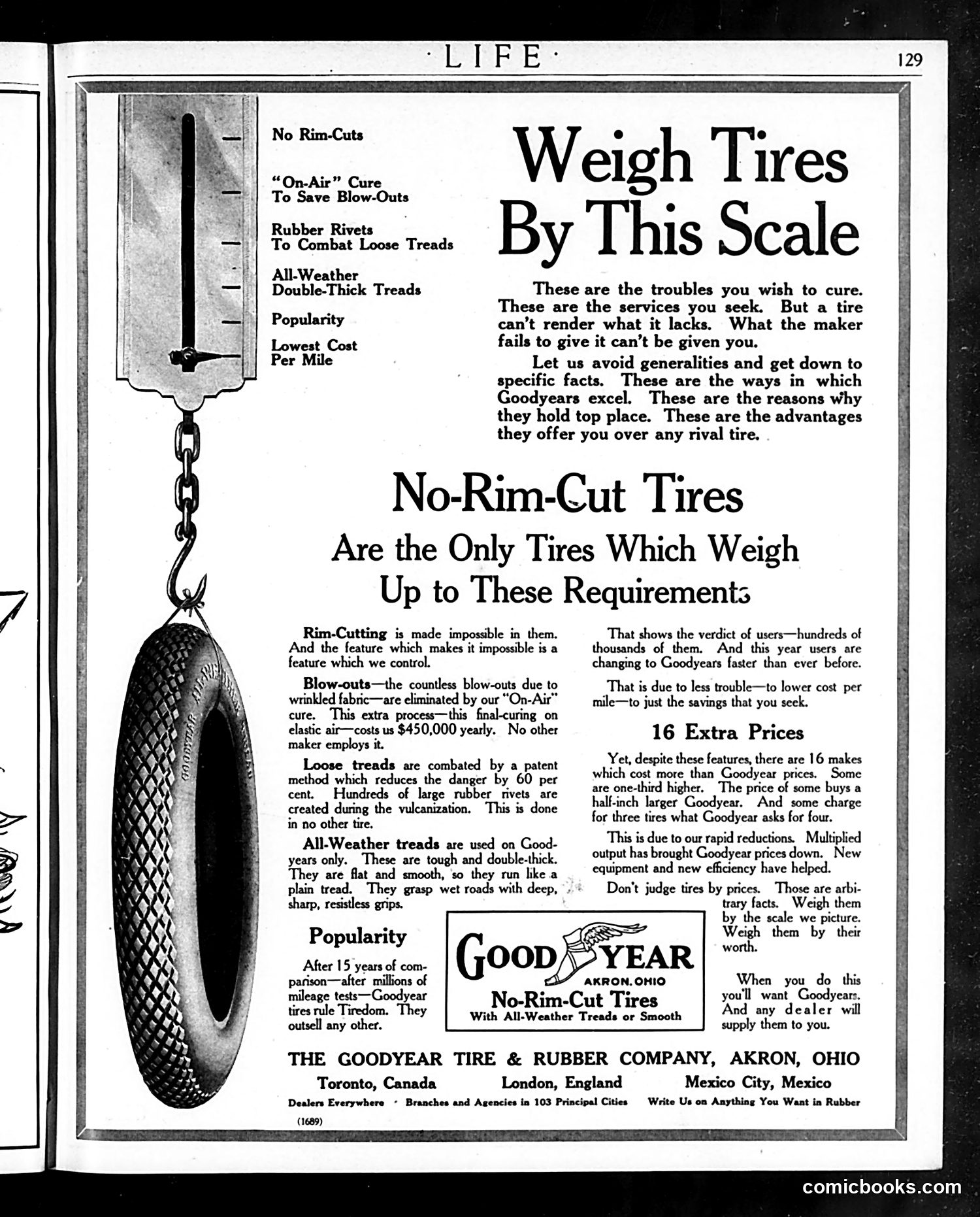
This page is primarily **advertising, not satire or political commentary**. It's a Goodyear tire company advertisement from *Life* magazine promoting their "No-Rim-Cut" tires. The ad uses a scale illustration to visually communicate the tire's weight and durability—the central graphic shows a tire suspended from a balance scale, emphasizing that Goodyear tires "weigh up to" specifications that competitors cannot match. The text argues that Goodyear's construction features (rubber rivets, all-weather treads, air-curing process) prevent common failures like blow-outs and rim damage. The ad positions this as superior engineering justifying the product's cost relative to rivals. There is **no political satire present**—this is straightforward early-20th-century product marketing using technical claims to establish brand superiority.

This page is **not a cartoon or satirical content**—it's a straightforward automobile advertisement for the 1915 Chandler "Six" automobile, priced at $1,595. The ad emphasizes that this six-cylinder car represents exceptional value through "profit-sharing," meaning the manufacturer claims to pass savings directly to consumers. Key selling points include 10% increased power over previous models, a streamlined body design, and features like an aluminum motor base, Bosch magneto ignition, and electric starting—luxuries uncommon in cars at this price point. The advertisement includes vehicle specifications (2,885 lbs, 16 miles per gallon, 3-55 mph) and an image of the open-air touring car. It's addressed to potential customers to visit dealers or request catalogs.
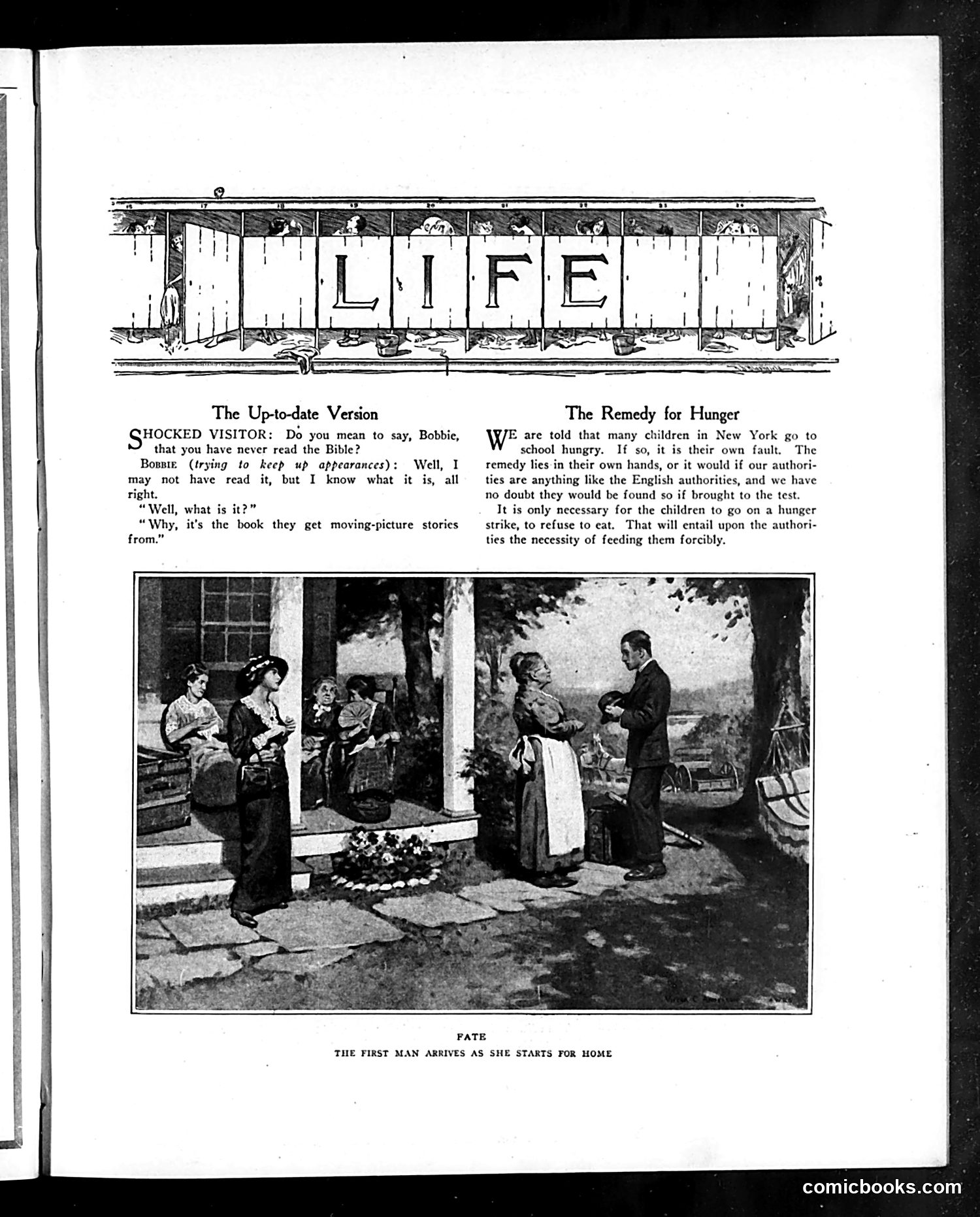
This page satirizes two topics: **"The Up-to-date Version"** mocks a casual visitor who admits never reading the Bible but claims knowledge of it through "moving-picture stories." The joke targets modern audiences substituting cinema for actual reading—a relevant concern when film was still relatively new. **"The Remedy for Hunger"** presents a darker satirical commentary on child poverty in New York. The text sarcastically suggests hungry schoolchildren should simply "go on a hunger strike, to refuse to eat" to pressure authorities into feeding them—positioning starvation as a protest tactic. The accompanying image labeled "FATE" appears to show a domestic scene, likely illustrating the serious consequences of such deprivation. The piece critiques both child poverty and authorities' indifference to it.
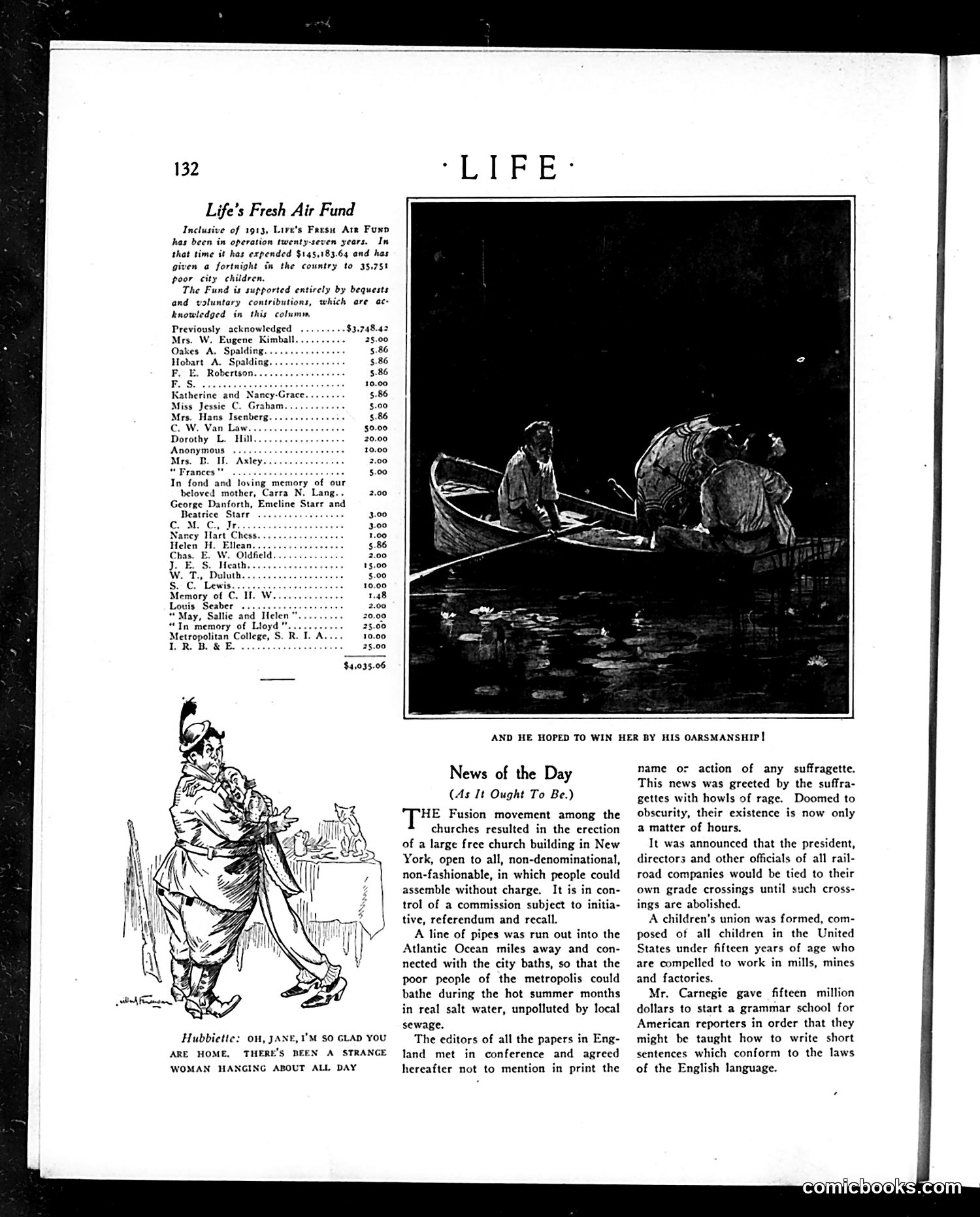
This page contains two distinct elements: **Left side:** A satirical cartoon showing a figure in Victorian dress addressing a woman about domestic matters. The caption reads "HUBBIETIC: OH, JANE, I'M SO GLAD YOU ARE HOME. THERE'S BEEN A STRANGE WOMAN HANGING ABOUT ALL DAY." The cartoon mocks a jealous or paranoid husband reporting suspicious activity—likely satirizing domestic anxieties or masculine insecurity. **Right side:** An illustration captioned "AND HE HOPED TO WIN HER BY HIS OARSMANSHIP!" depicting two figures in a rowboat. This appears to satirize romantic courtship, specifically the notion that a man might impress a woman through boating skills—poking fun at genteel courtship rituals. The page also lists Life's Fresh Air Fund donors and a "News of the Day" column addressing contemporary social issues.
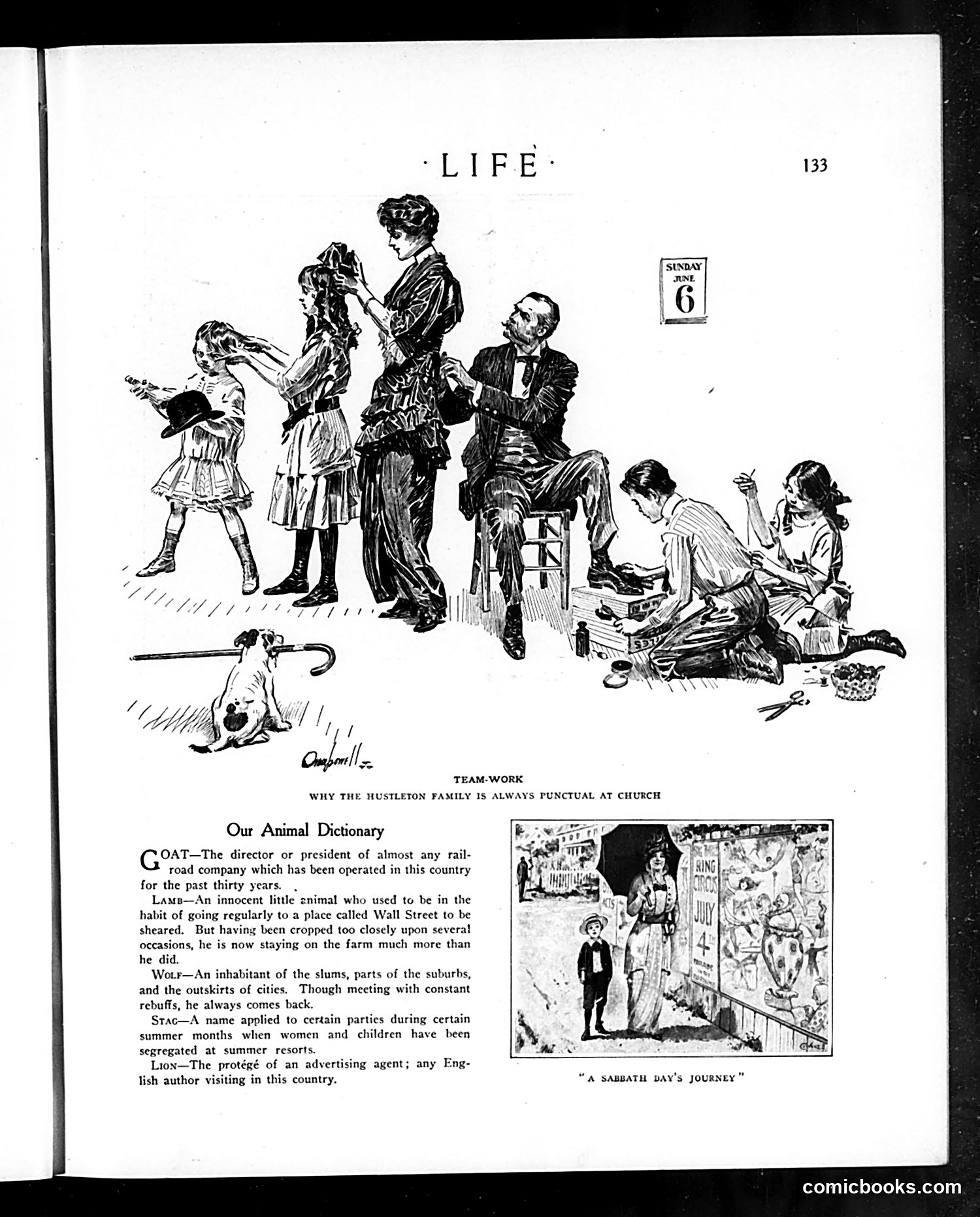
This cartoon satirizes wealthy families who arrive at church with perfect punctuality while their household staff enables the chaos behind the scenes. The well-dressed man and woman stand prominently with their children, appearing pristine and punctual. Below them, a small dog with an umbrella sits abandoned—humorously suggesting even pets are organized into the family's rigid system. The joke targets Victorian-era hypocrisy: respectable appearances mask the coordination required from servants and staff. The title "Why the Hustleton Family is Always Punctual at Church" suggests their virtue is performative rather than genuine. The cartoon mocks both the family's self-satisfaction and the invisible labor maintaining their facade of propriety and reliability.
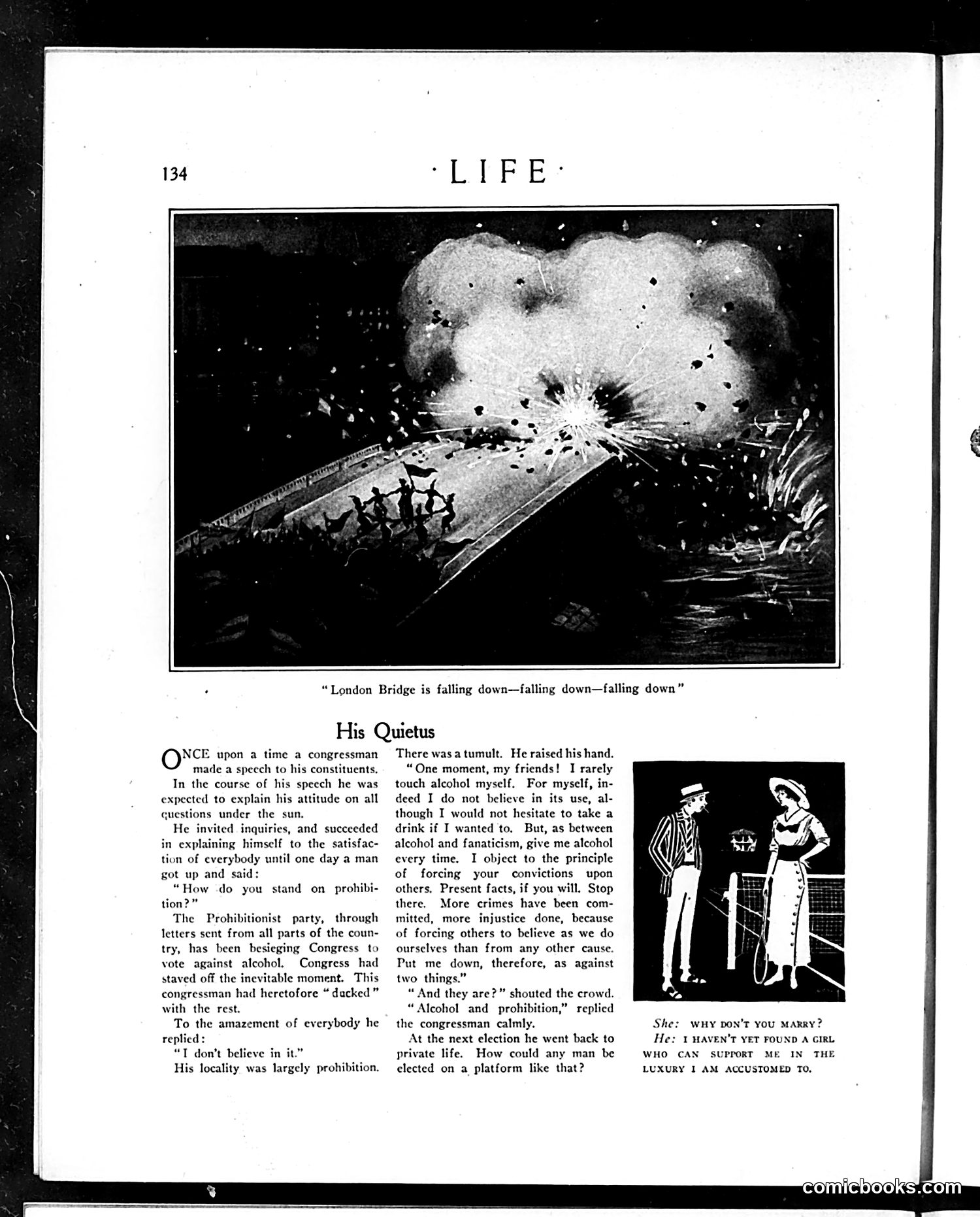
This page satirizes Prohibition and an unnamed congressman's inconsistent stance on alcohol. The main illustration depicts "London Bridge is falling down"—likely referencing the famous nursery rhyme to suggest societal collapse. The text describes a congressman who publicly opposes alcohol but privately admits he drinks and objects to *forcing* beliefs on others. He's elected on a prohibitionist platform yet cannot reconcile his personal behavior with his public position. The cartoon criticizes hypocrisy: politicians advocating strict prohibition while personally indulging. The small illustration showing a man claiming he can't marry due to lack of wealth underscores the era's tensions around personal freedom versus public morality—key issues during Prohibition (1920-1933).
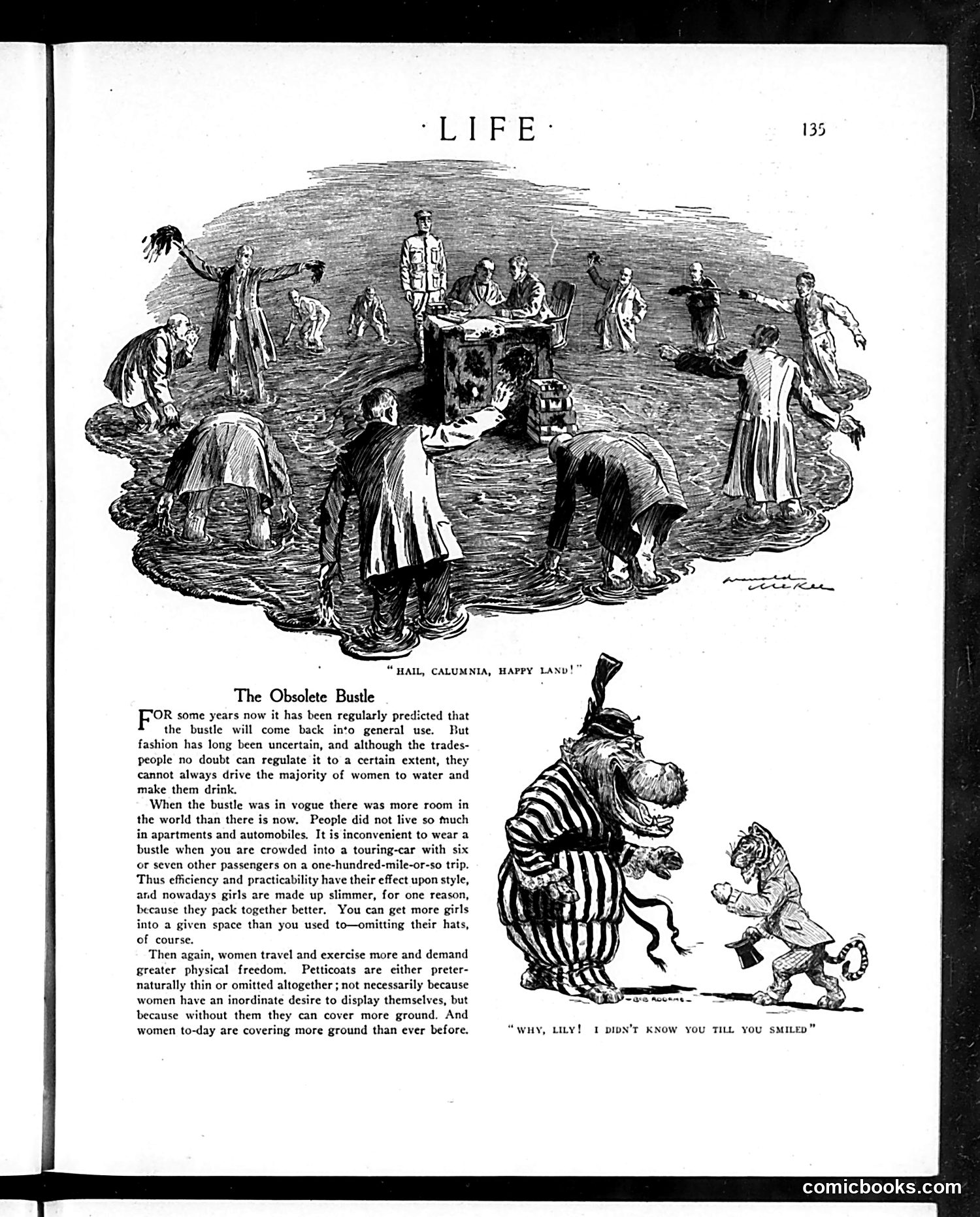
The top cartoon satirizes a political rally or public gathering with the caption "HAIL, COLUMNIA, HAPPY LAND!" The figures appear to be politicians or public speakers at a podium, surrounded by citizens—likely mocking either a political movement or nationalist fervor of the era. The article discusses the bustle (a framework worn under women's skirts to create fullness at the back), predicting its return to fashion. It argues that modern women need less restrictive clothing because they travel more, exercise more, and occupy more physical space in contemporary life. The bottom cartoon shows a zebra encountering small children, with the caption "WHY, LILY! I DIDN'T KNOW YOU TILL YOU SMILED"—likely a joke about unfamiliar acquaintances or mistaken identity, though its specific reference remains unclear without additional context.
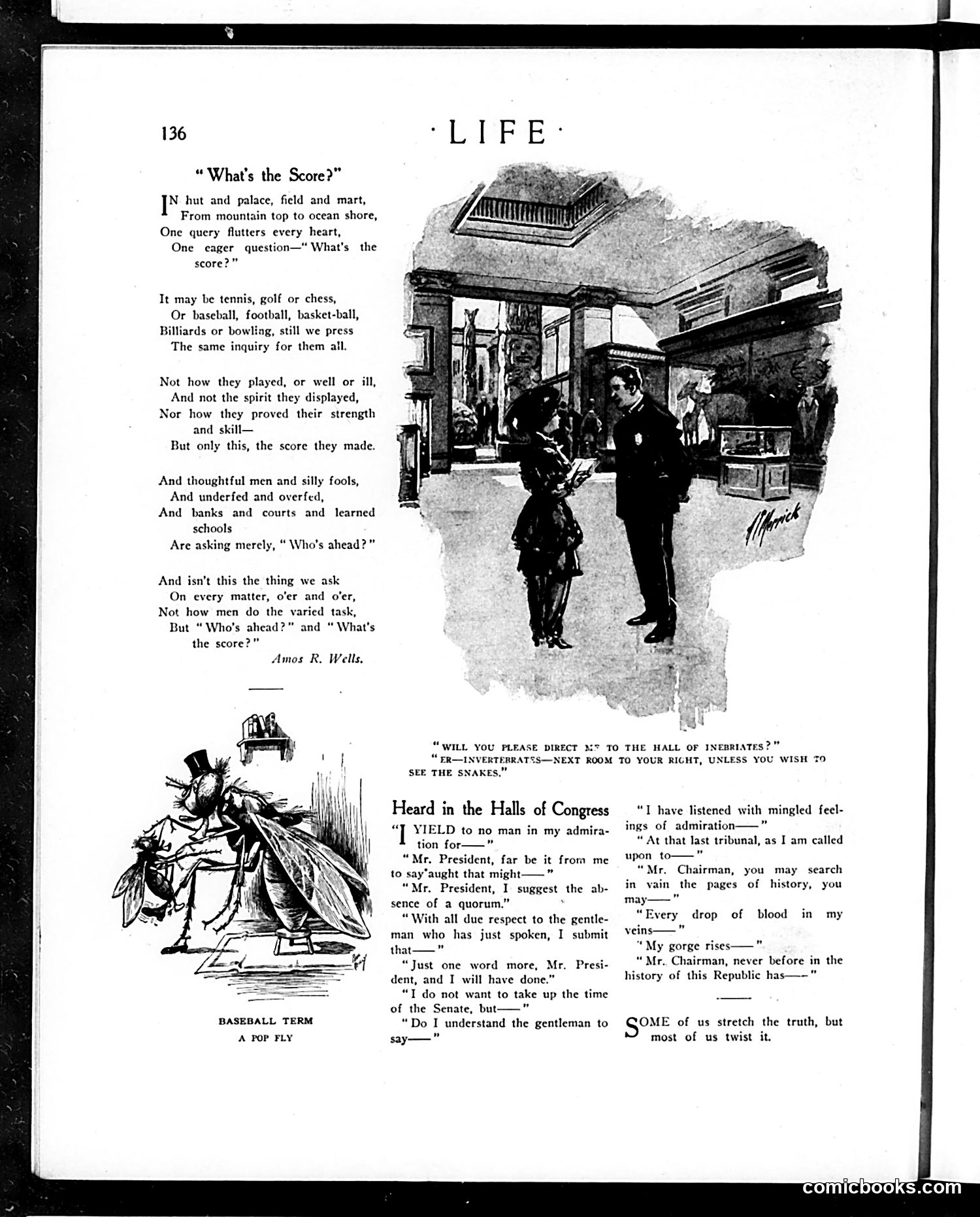
**"What's the Score?" (Poem by Amos R. Wells):** This poem satirizes how people obsess over "the score" in all competitive endeavors—sports, politics, and life—rather than valuing character, spirit, or skill. It critiques both "thoughtful men and silly fools" for constantly asking "Who's ahead?" and "What's the score?" instead of focusing on meaningful conduct. **"Heard in the Halls of Congress":** This section mocks congressional debate through exaggerated rhetoric, with speakers using flowery, evasive language ("I yield to no man in my admiration...") and theatrical outbursts ("Every drop of blood in my veins—"). The satire suggests politicians prioritize dramatic performance and scoring political points over substantive governance. **"Baseball Term: A Pop Fly":** A humorous visual pun using insect imagery, likely connecting baseball terminology to political "hot air."
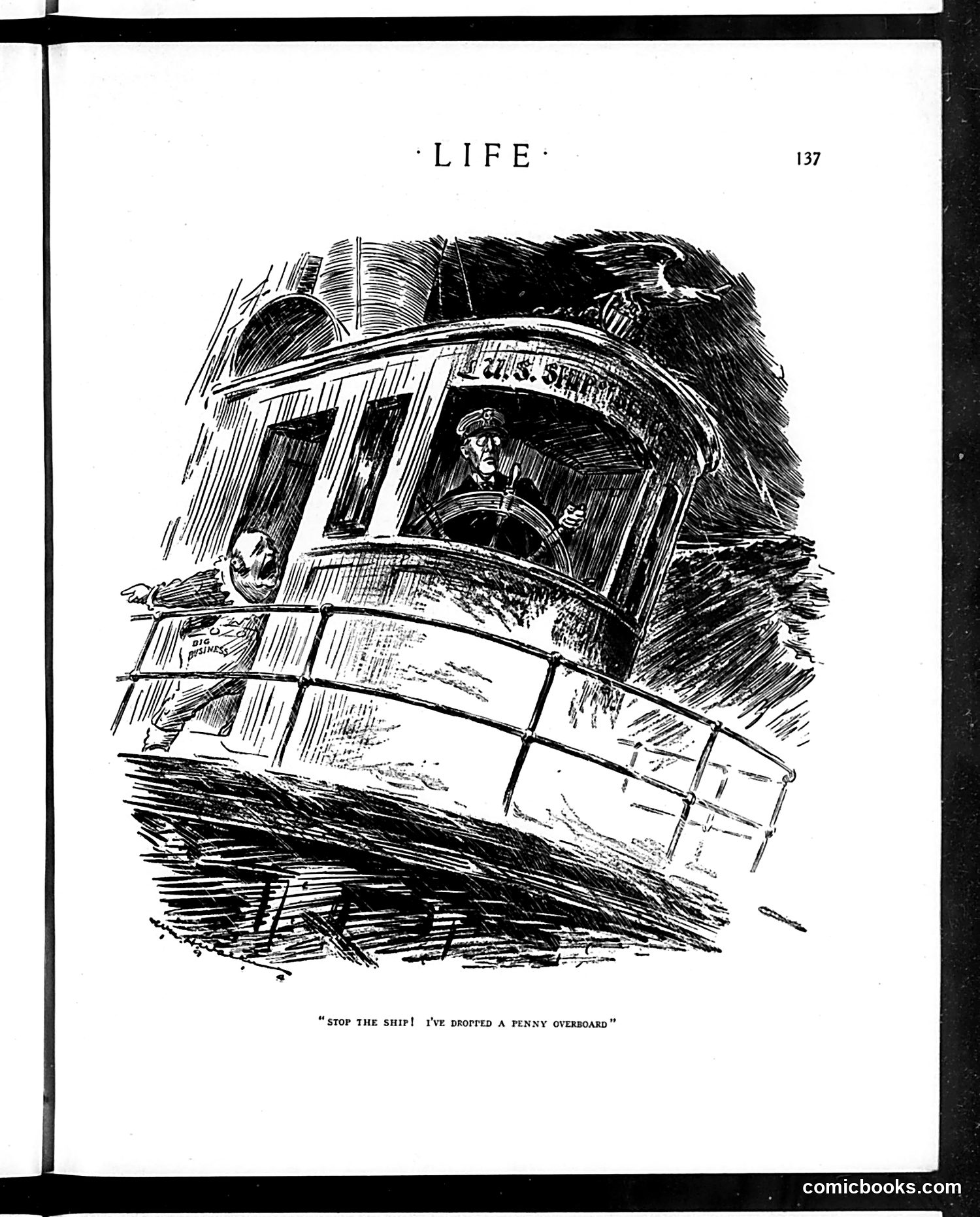
This is a single-panel cartoon showing a ship's captain at the wheel during what appears to be stormy conditions. The captain shouts: "STOP THE SHIP! I'VE DROPPED A PENNY OVERBOARD!" The satire targets extreme penny-pinching or misplaced priorities. The joke hinges on the absurdity of stopping an entire ship to retrieve a single penny—a trivial sum of money. This likely critiques either: 1. Miserly individuals who obsess over minor expenses despite larger financial situations, or 2. Naval/government inefficiency where small concerns override practical operations The nautical setting emphasizes how ridiculous it would be to halt significant operations for such a negligible loss, making the satire's point about disproportionate concern over trifles.
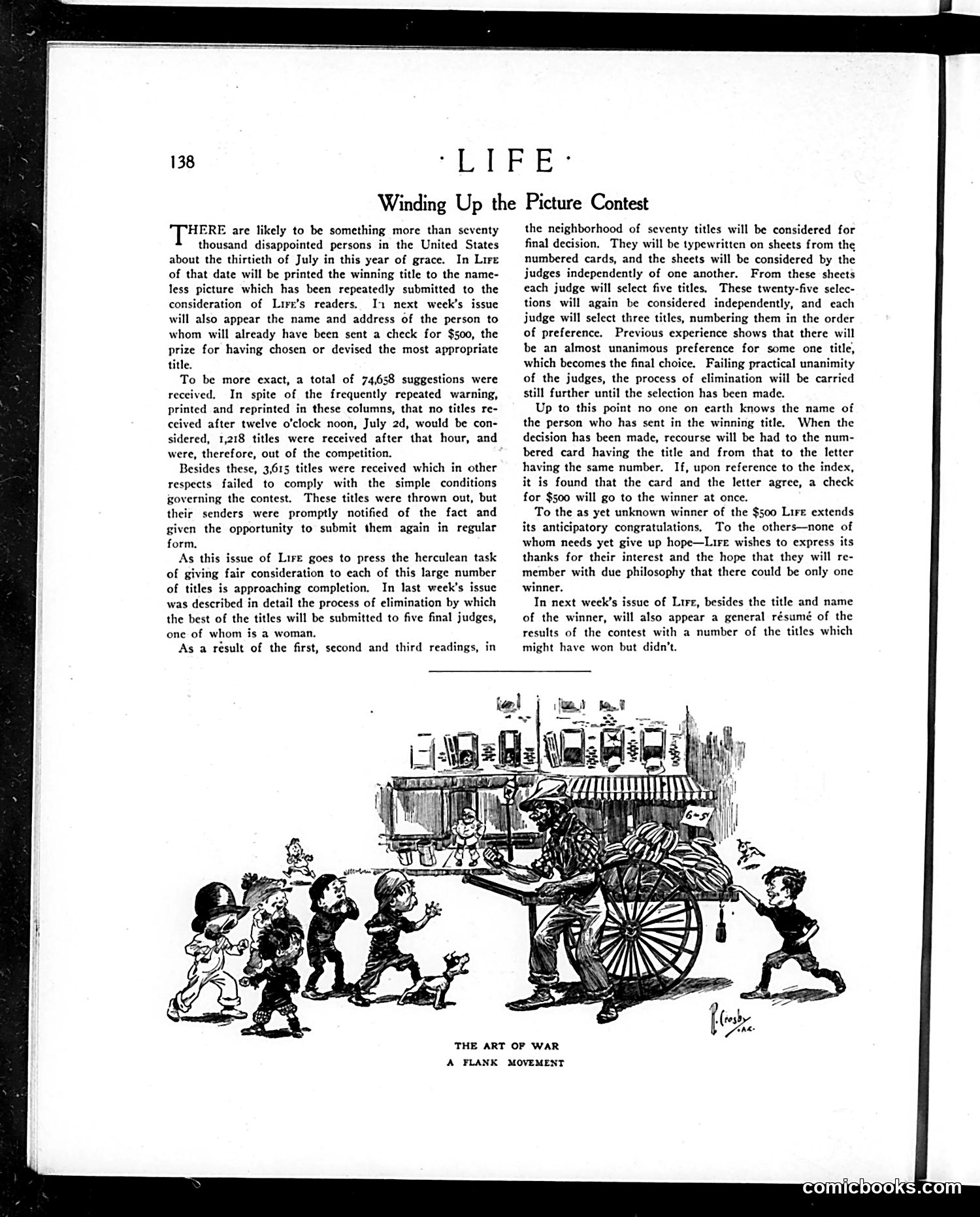
This page concludes Life's major picture-titling contest that received 74,658 submissions. The text describes the judging process: entries were narrowed through multiple rounds, with five final judges (one a woman) selecting the winning title from the remaining candidates. The cartoon below, titled "The Art of War: A Flank Movement," depicts children attacking an ice cream or food vendor's cart from multiple sides—a visual pun on military strategy. The "flank movement" refers both to the tactical maneuver and the children's coordinated assault on the vendor from different angles to obtain refreshments. This playful satire uses children's mischief to humorously illustrate a serious military concept, typical of Life's approach to contemporary subjects.
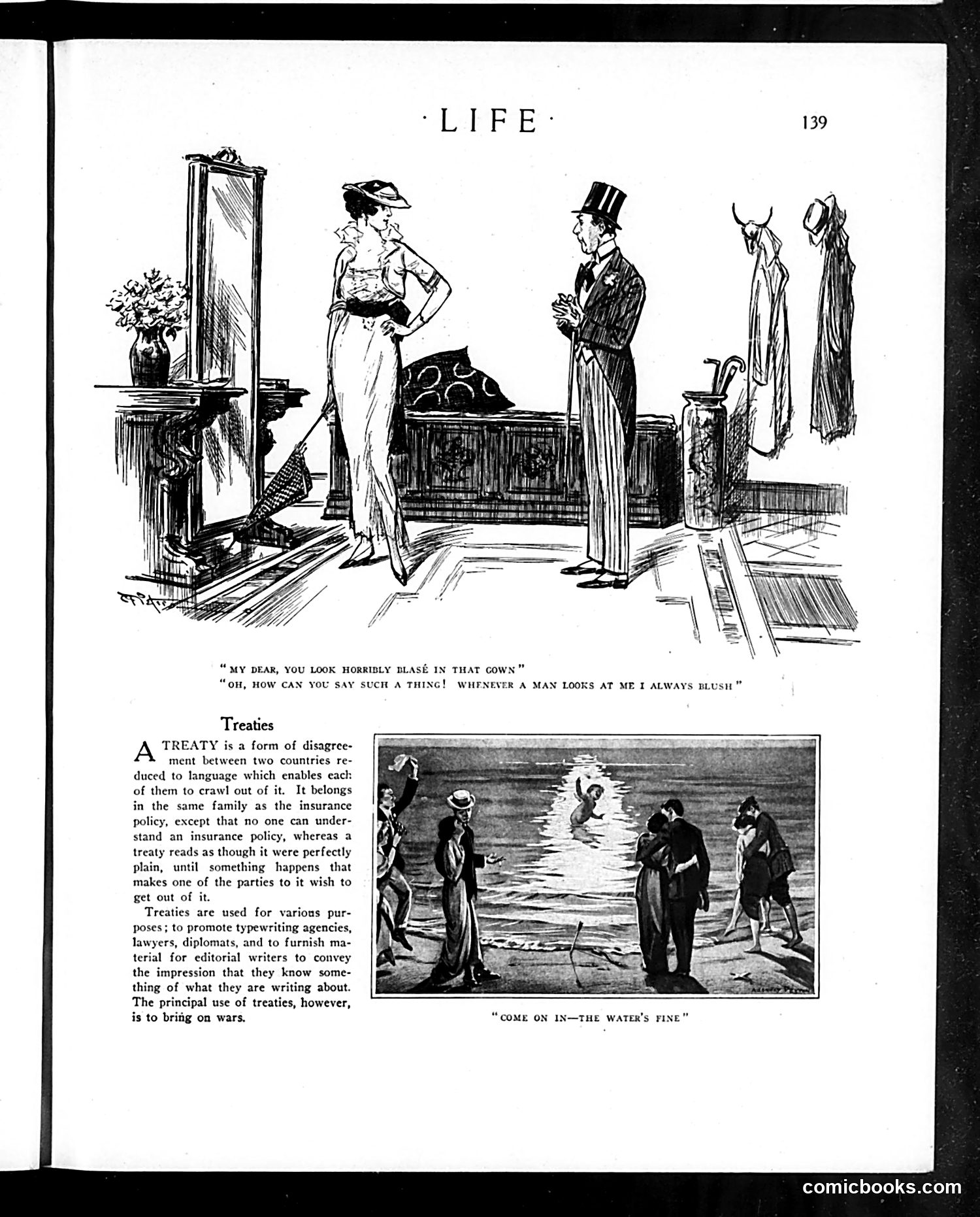
The top cartoon depicts a domestic scene where a man in a top hat confronts a woman about her appearance in an unflattering gown. Her dismissive response—that men always blush when looking at her—represents self-deluded vanity. The main text below offers cynical political satire defining "treaties" as deliberately ambiguous agreements between nations, designed to be misunderstood and easily escaped. Life satirizes treaties as serving primarily to enrich lawyers and diplomats while ultimately leading to war—a darkly humorous critique of diplomatic duplicity. The bottom photograph, captioned "Come on in—the water's fine," shows people at a beach or swimming area, likely illustrating the false reassurance treaties offer, similar to inviting someone into dangerous waters with false promises of safety. The satire reflects early 20th-century American skepticism toward international diplomacy and arms control agreements.
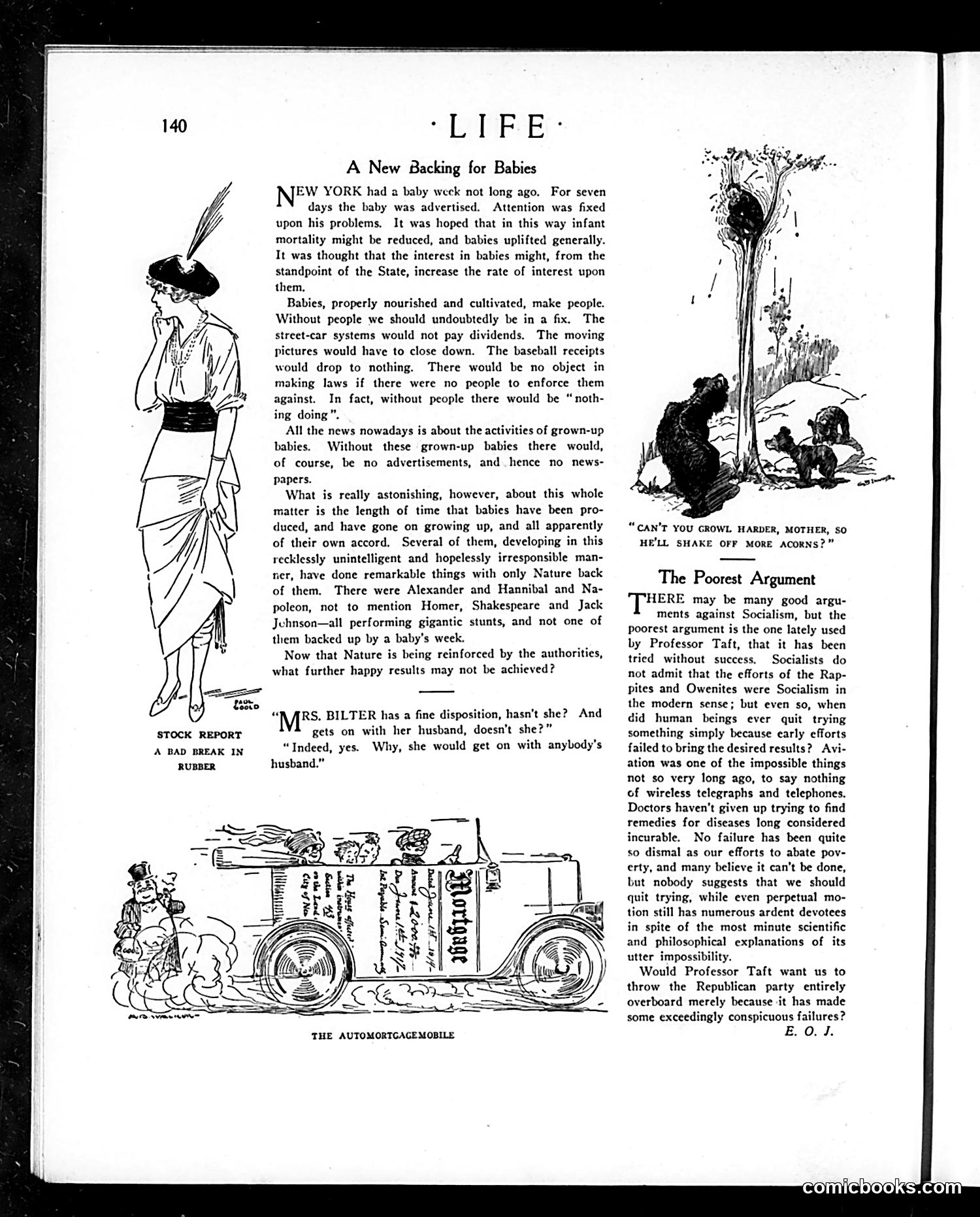
This page contains three distinct satirical pieces: **"A New Backing for Babies"** mocks New York's recent "Baby Week" promotional campaign. The satire suggests that while babies are celebrated as economically essential (they grow into consumers, workers, and law-abiding citizens), society has overlooked that many notable historical figures—Alexander, Hannibal, Napoleon, Shakespeare, Jack Johnson—achieved greatness *without* such organized state backing. The irony: Nature alone has successfully "produced" remarkable people for centuries, yet authorities now claim their intervention will improve results. **"Stock Report: A Bad Break in Rubber"** (bottom cartoon) appears to be a financial joke about rubber stocks, likely referencing market volatility or corporate mismanagement, depicted as an overloaded automobile. **"The Poorest Argument"** rebuts Professor Taft's anti-Socialist position that Socialism failed in past attempts (Rappites, Owenites). The author argues this logic is flawed—humans don't abandon efforts simply because early attempts failed (aviation, medicine, perpetual motion research). By extension, why abandon the Republican party for its failures? All three pieces employ ironic reasoning to deflate conventional wisdom.
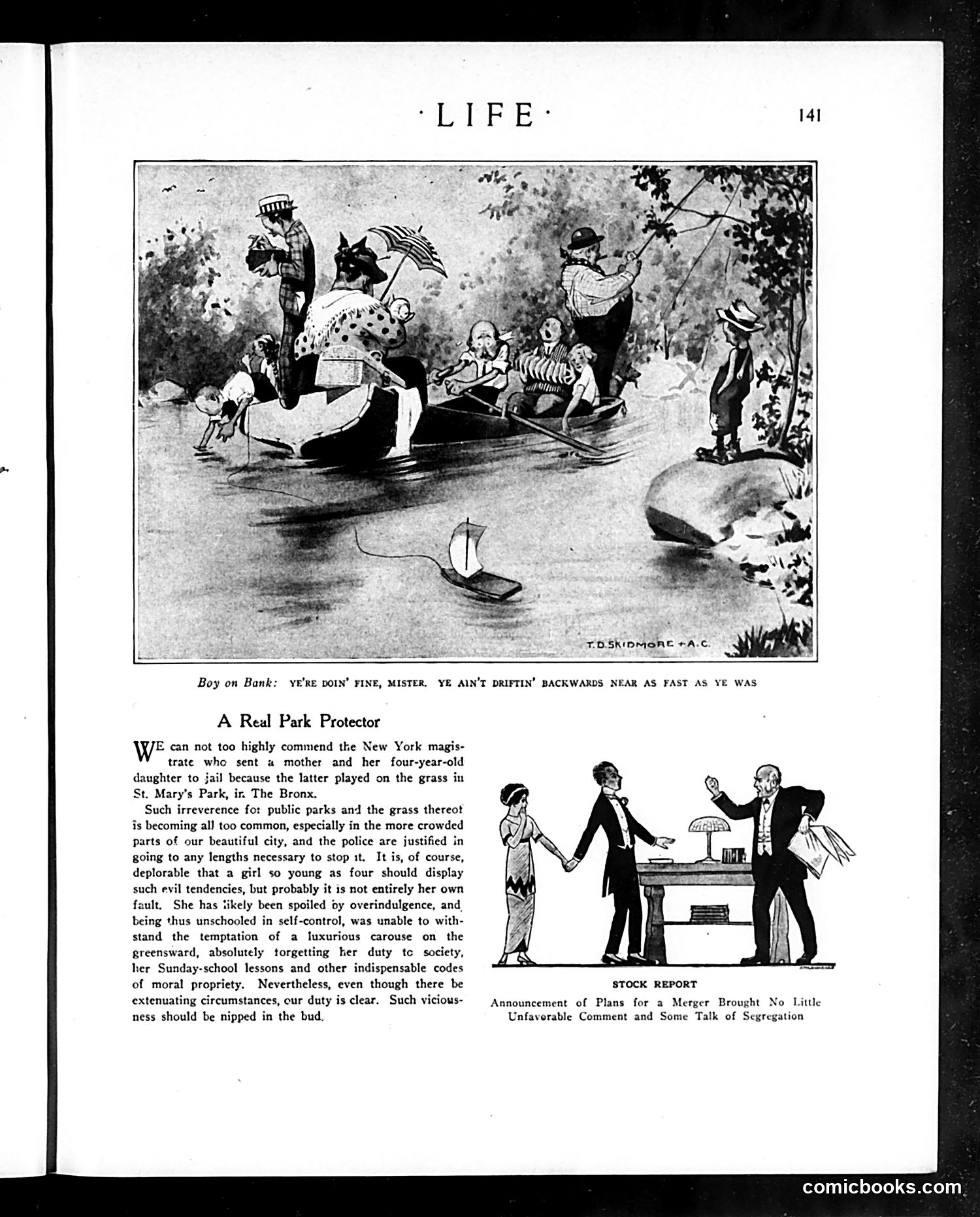
**Top cartoon**: A boy on a riverbank compliments a man drifting in a boat, saying he's not drifting backward as fast as before. This appears to be social commentary on economic stagnation or recession—the man's slow backward drift suggests declining fortunes that were previously worse. **"A Real Park Protector"**: This is heavy sarcasm. Life ridicules a New York magistrate who jailed a mother and her four-year-old daughter for playing on grass in St. Mary's Park, the Bronx. The text sarcastically praises this as protecting public parks while mocking the absurdity of criminalizing a child's innocent play. Life argues the punishment was disproportionate and the "offense" trivial, exposing excessive legal authority and inflexible park enforcement. **Bottom illustration**: Labeled "Stock Report," shows businessmen discussing a corporate merger announcement that generated "unfavorable comment and talk of segregation"—likely commentary on business consolidation concerns of the era.
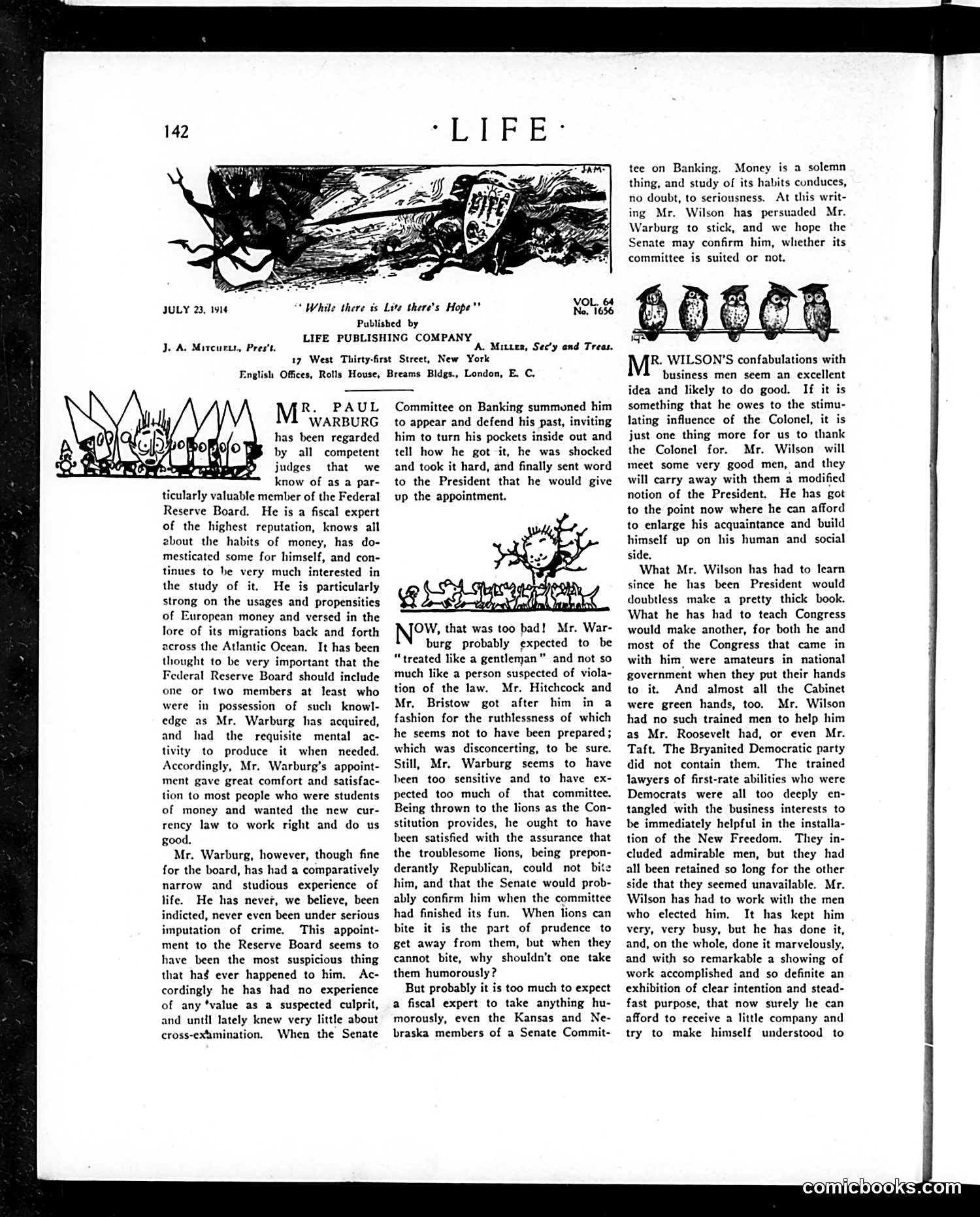
This page satirizes **Paul Warburg's** contentious Senate confirmation hearings for the Federal Reserve Board. Warburg, a respected fiscal expert and banker, was summoned by the Senate Committee on Banking to defend his qualifications and financial background—a process he found humiliating and invasive. The satire's point: Warburg, accustomed to genteel treatment, was shocked at being interrogated "like a person suspected of violation of the law" by senators Hitchcock and Bristow. Life mocks his sensitivity, arguing that if the (Republican-controlled) committee couldn't actually "bite" him—couldn't reject him—he should accept the process humorously rather than threaten resignation. The article notes President Wilson persuaded Warburg to withdraw his resignation and remain committed to the appointment, hoping the Senate would confirm him despite the committee's rough treatment. The cartoon imagery (a dead lion or similar beast) likely visualizes the "thrown to the lions" metaphor used in the text about Senate confirmation ordeal.
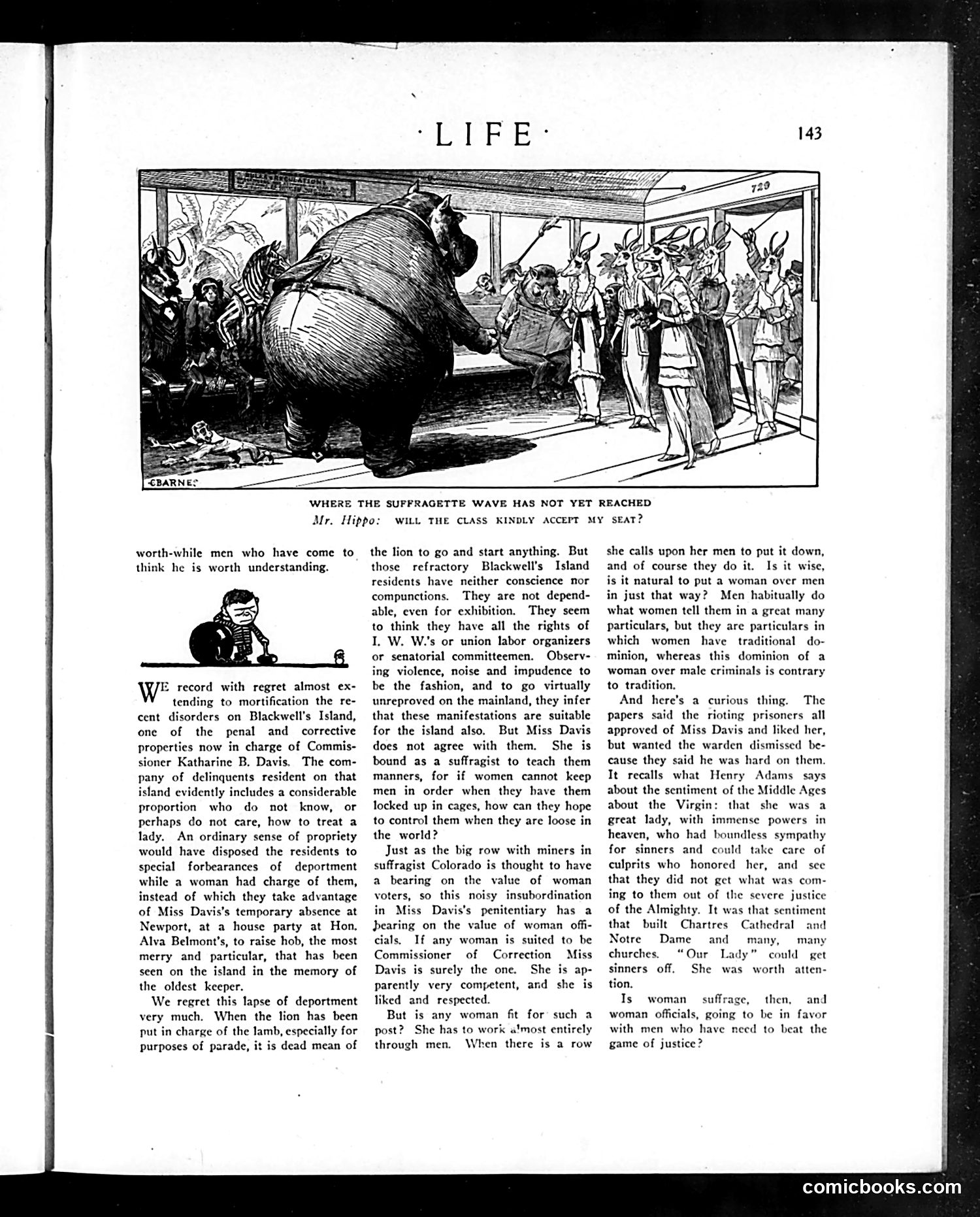
This 1910s *Life* magazine cartoon satirizes doubts about women's fitness for public office, using Commissioner Katharine B. Davis of Blackwell's Island Penitentiary as its target. **The Setup:** Davis, a known suffragist, temporarily leaves her post. Male prisoners riot during her absence, then—oddly—express approval of *her* while demanding the male warden's removal. The cartoon depicts an enormous hippopotamus (representing the unruly prisoners) confronting guards. **The Satire's Point:** The article sarcastically argues that if women can't control male prisoners in locked cages, how can they be trusted to vote or hold office over men in society? It frames women's authority as unnatural and dependent on men's compliance. **The Irony:** The prisoners' preferential treatment of Davis (compared to the strict warden) is compared to medieval reverence for the Virgin Mary—suggesting men will manipulate women in power rather than respect their authority. The piece mocks suffragists by using this incident to question whether women officials can actually exercise independent power or merely exploit traditional male deference.
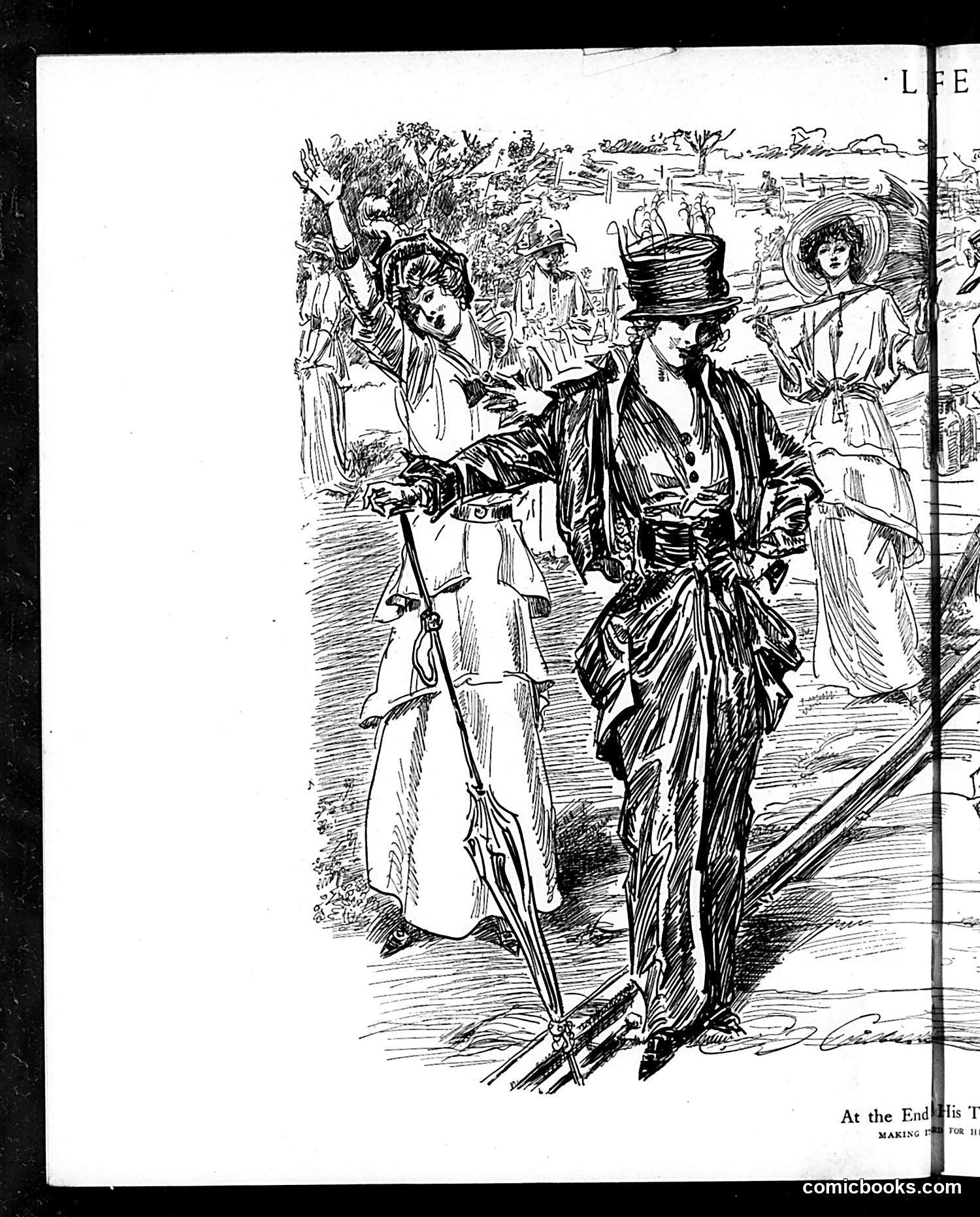
This page shows a satirical illustration from *Life* magazine depicting what appears to be a social gathering or public event. The sketch shows elegantly dressed figures—a woman in a light dress on the left and a man in dark formal wear with a top hat on the right—at what the caption indicates is "At the End" of some event involving "Making" (the OCR text is heavily degraded). The cartoon likely satirizes upper-class social conventions or fashionable society behavior, characteristic of *Life*'s frequent mockery of wealthy elite. The detailed period clothing and the formal gathering suggest commentary on Gilded Age or early 20th-century high society. However, the OCR corruption prevents precise identification of the specific event, figures, or satirical target. Without clearer text, the exact point of the satire remains unclear.
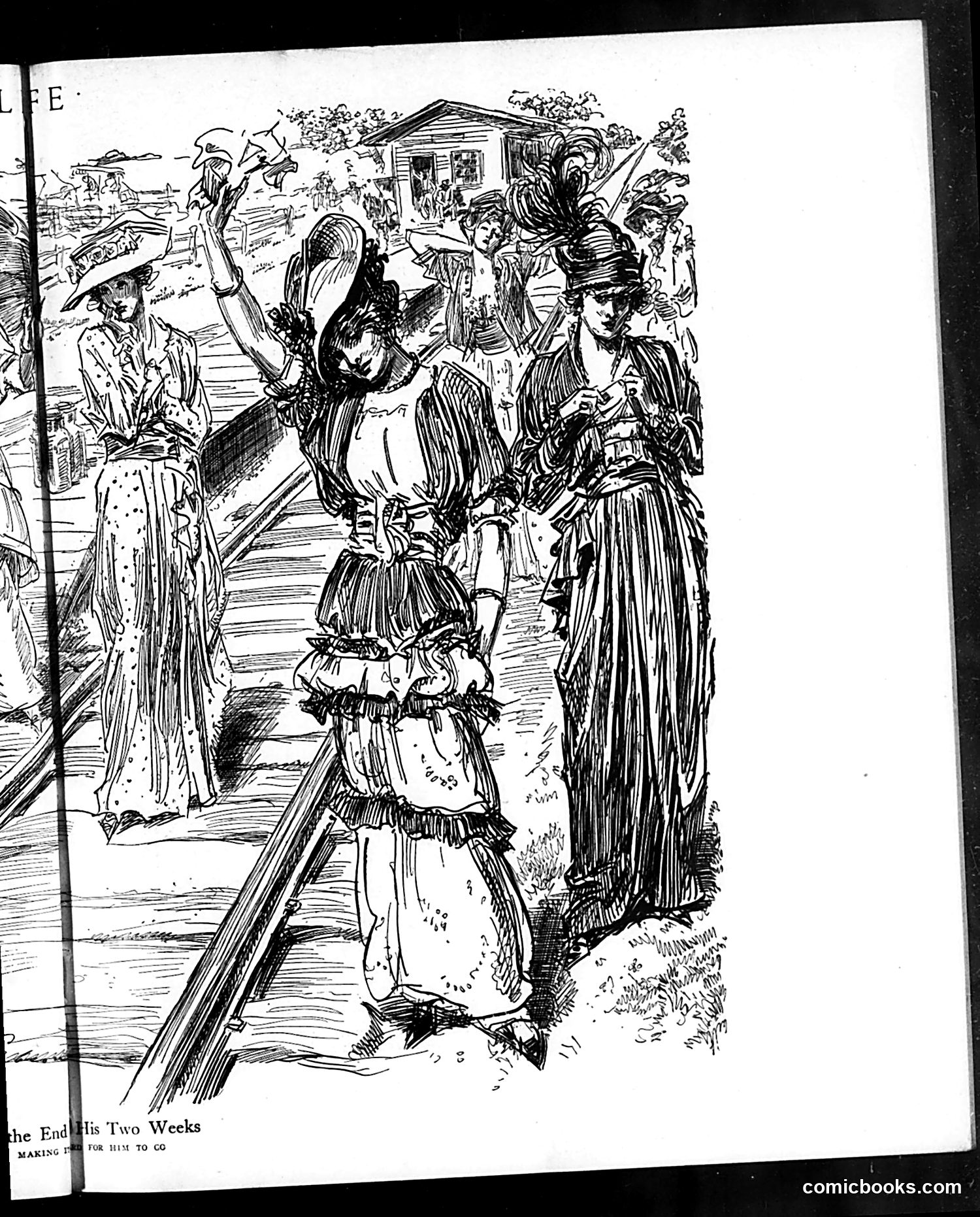
This appears to be an illustration from Life magazine depicting a social scene, likely from the late 19th or early 20th century based on the clothing styles shown. The image shows elegantly dressed women and men in formal attire gathered outdoors near a house. The central figure is a woman in an elaborate dress with decorative elements, surrounded by other well-dressed attendees. The partially visible caption reads "His Two Weeks" and "Making [something] for him to go," suggesting this illustrates a narrative about someone's two-week absence or visit. Without the complete text, the specific satirical point is unclear, though it likely comments on social conventions, courtship rituals, or upper-class behavior typical of Life's satirical approach. The formal gathering and fashionable dress suggest commentary on societal expectations or social pretensions of the era.
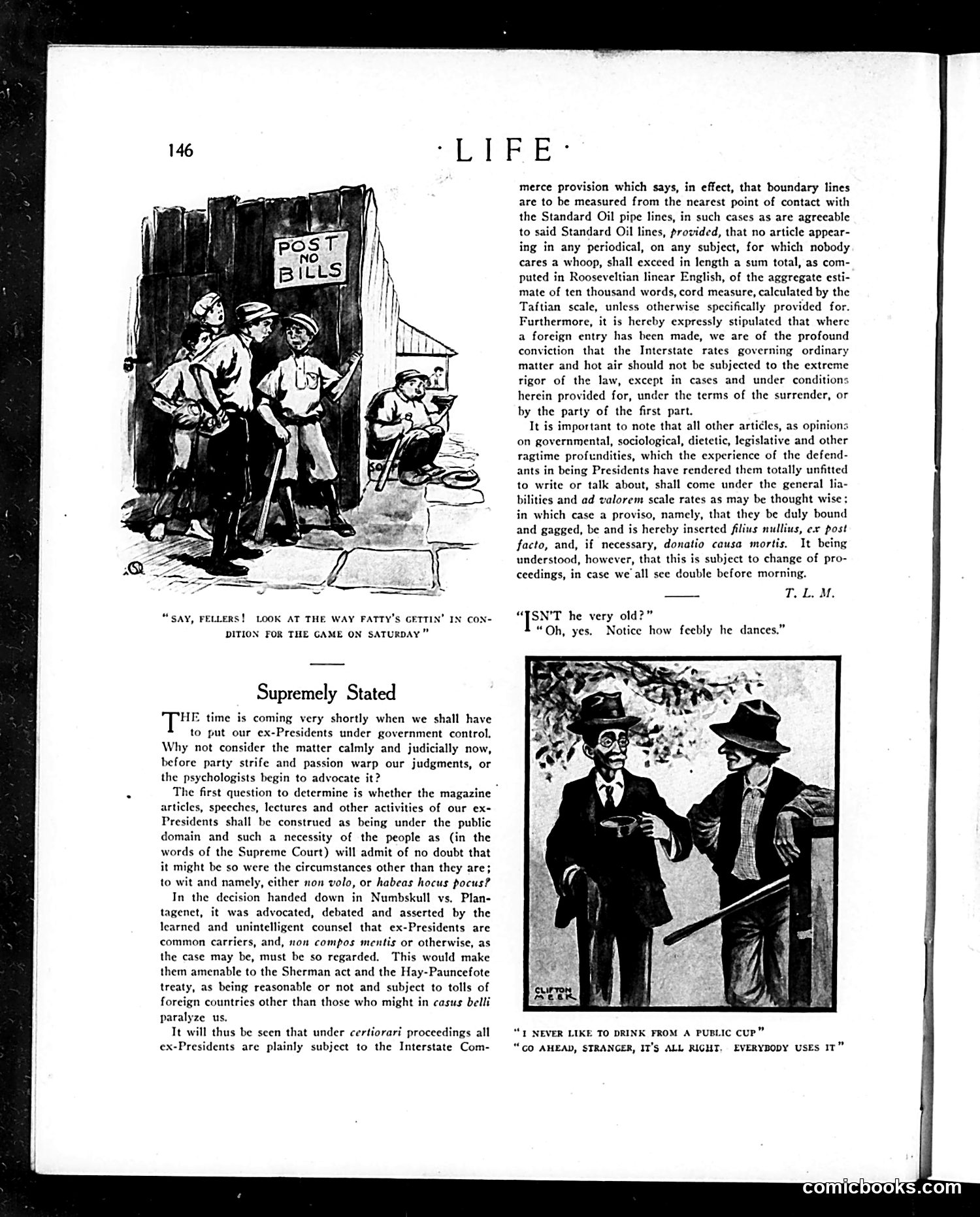
This page contains two distinct satirical pieces: **Top cartoon:** References "Fatty" (likely referring to a public figure of the era, possibly William Howard Taft given the context below) getting into condition for "the game on Saturday"—a jab at someone's physical fitness or appearance using sports language. **Main article "Supremely Stated":** A lengthy mock-legal screed satirizing proposals to regulate ex-Presidents' public activities (speeches, articles, lectures). The author uses deliberately absurd legal jargon and fictional court cases to mock the idea of placing ex-Presidents under government control. References to "Rooseveltian" and "Taftian" measurements suggest this targets Theodore Roosevelt and William Howard Taft specifically. The satire criticizes the notion that ex-Presidents should be restricted like "common carriers" under interstate commerce laws. **Bottom cartoon:** Two men at a public drinking cup; one warns the other it's been used by everyone, implying disease transmission—social commentary on public health and sanitation. The page attacks government overreach and regulatory excess through absurdist humor.
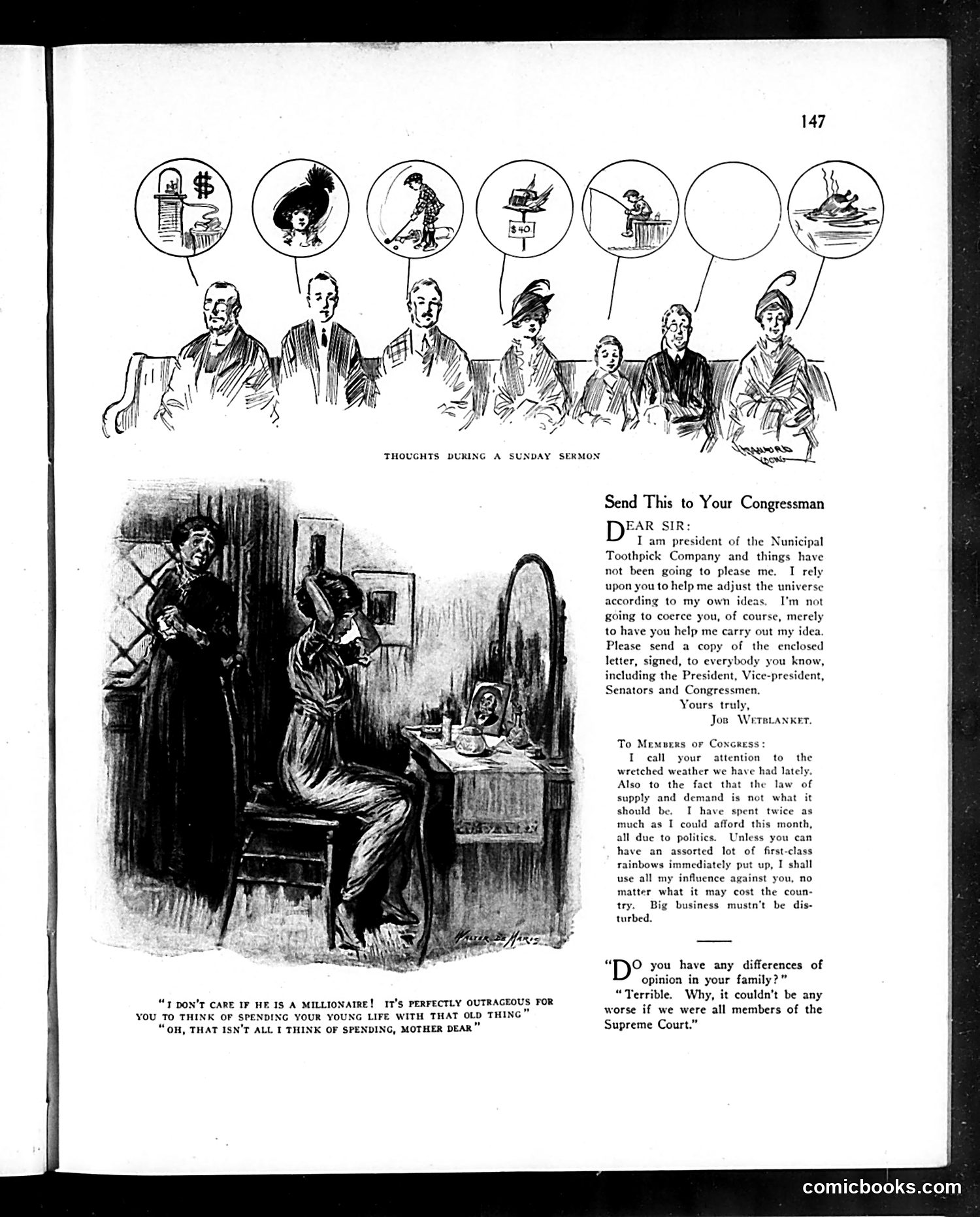
**Top Cartoon - "Thoughts During a Sunday Sermon":** Shows seven congregation members with thought bubbles revealing their preoccupations: money, entertainment, hunting, business, leisure, and boating. The satire mocks churchgoers for mentally wandering to worldly concerns rather than focusing on spiritual matters. **Letters Section:** Two satirical letters mock corporate lobbying and political influence. A toothpick company president demands congressmen help his business regardless of cost to the country, blaming "politics" for weather and market conditions—absurdly holding government responsible for natural phenomena. The satire critiques how business interests pressure elected officials while claiming patriotism. **Bottom Cartoon:** A mother objects to her daughter marrying an old millionaire, calling it "outrageous." The daughter's reply—"that isn't all I think of spending"—suggests she's interested in spending his money, not just marrying him. This satirizes materialistic courtship and women's financial dependence on marriage. **Overall Theme:** The page satirizes American self-interest: religious hypocrisy, corporate greed exploiting democracy, and mercenary marriages.
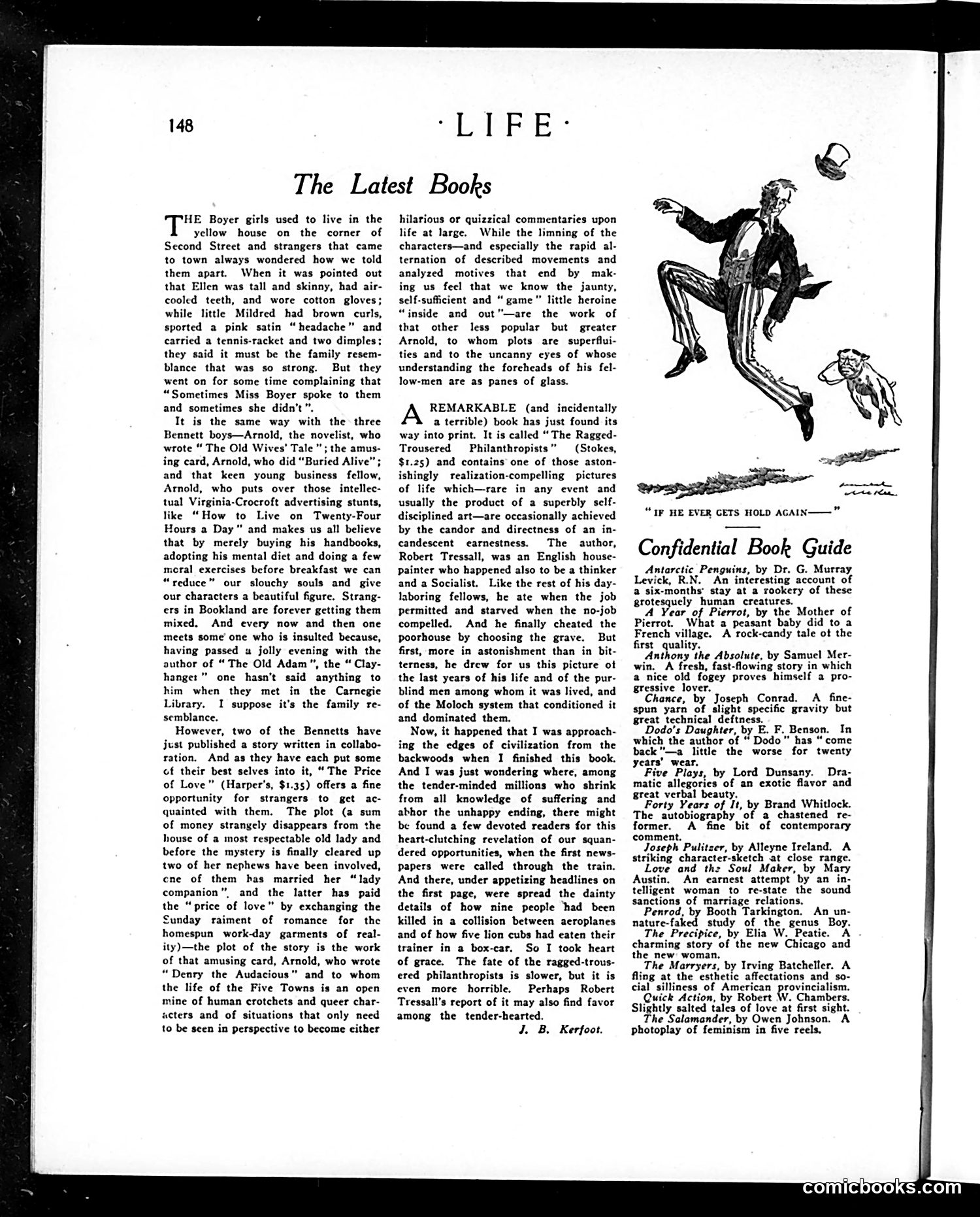
This is a book review section, not a political cartoon. The page discusses recent literary publications, primarily focusing on works by the Bennett brothers (multiple authors sharing the surname Arnold Bennett). The main content reviews "The Price of Love" by Harper's, noting how readers confuse the three Bennett brothers—all named Arnold—who write in different styles. The reviewer humorously compares this to the Boyer sisters, who were similarly difficult to distinguish. The page also previews "The Ragged-Trousered Philanthropists" by Robert Tressall, describing it as a "remarkable (and incidentally terrible) book" that depicts working-class life with unflinching realism. The reviewer notes Tressall was an English housepainter and Socialist who ultimately chose suicide over entering the poorhouse. The small illustrations on the right show figures in motion, likely related to the book advertisements and reviews discussed in the text. This appears to be a standard early 20th-century magazine book review section rather than satirical commentary.
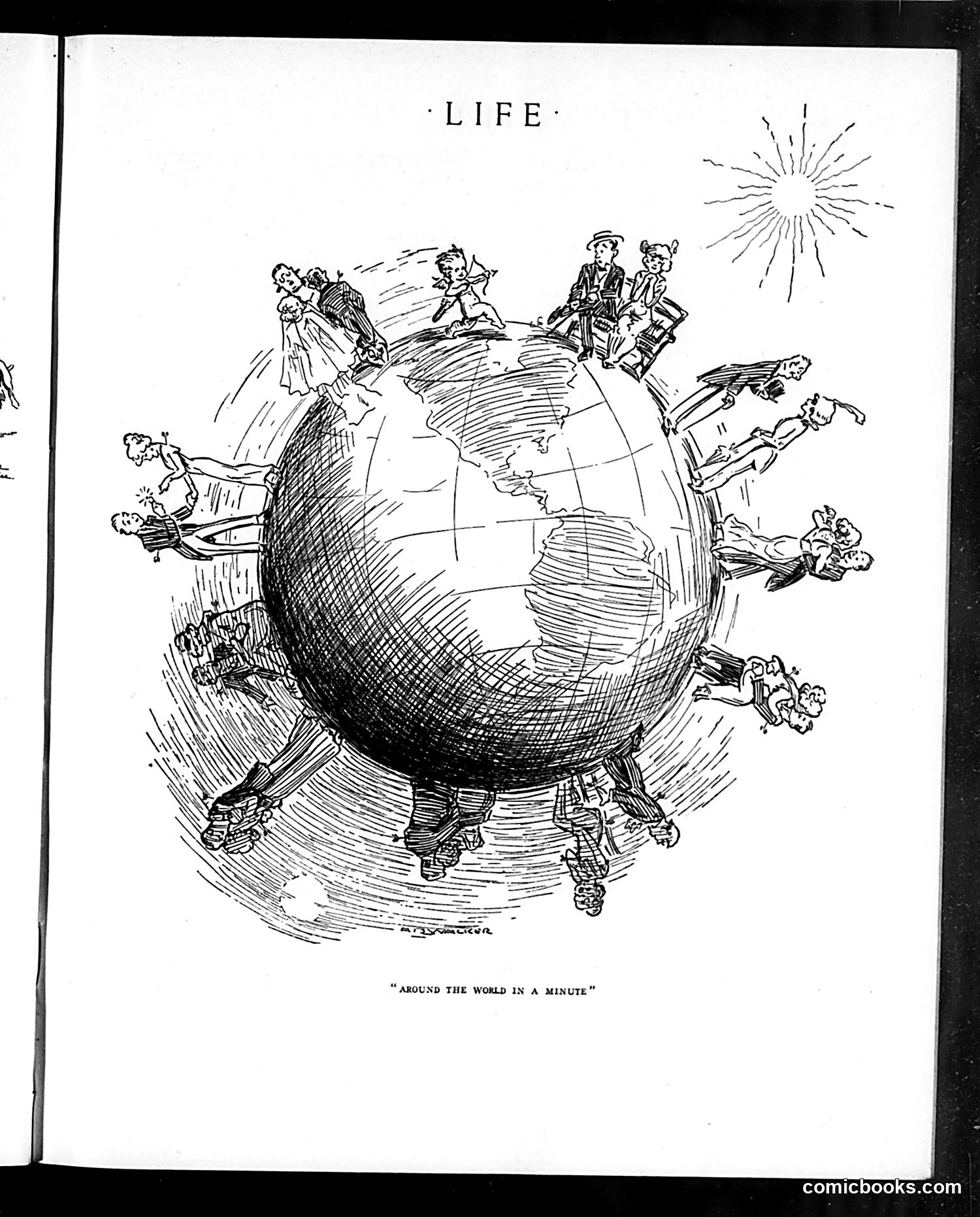
This cartoon depicts a globe surrounded by small figures engaged in various activities and travel modes, with a bright sun above. The caption references Jules Verne's famous novel "Around the World in Eighty Days," but sarcastically compresses the journey to "a minute," suggesting modern life's accelerated pace. The figures around the sphere appear to represent different nationalities or professions scattered globally—some in formal dress, others in various costumes suggesting different regions. The cartoon likely satirizes either: 1. The speed of modern transportation and communication making world travel seem instantaneous, or 2. The frenetic pace of contemporary life where people rush through experiences worldwide The exact political or social critique remains somewhat unclear without additional context about Life magazine's publication date, though it celebrates or mocks technological progress and globalization.
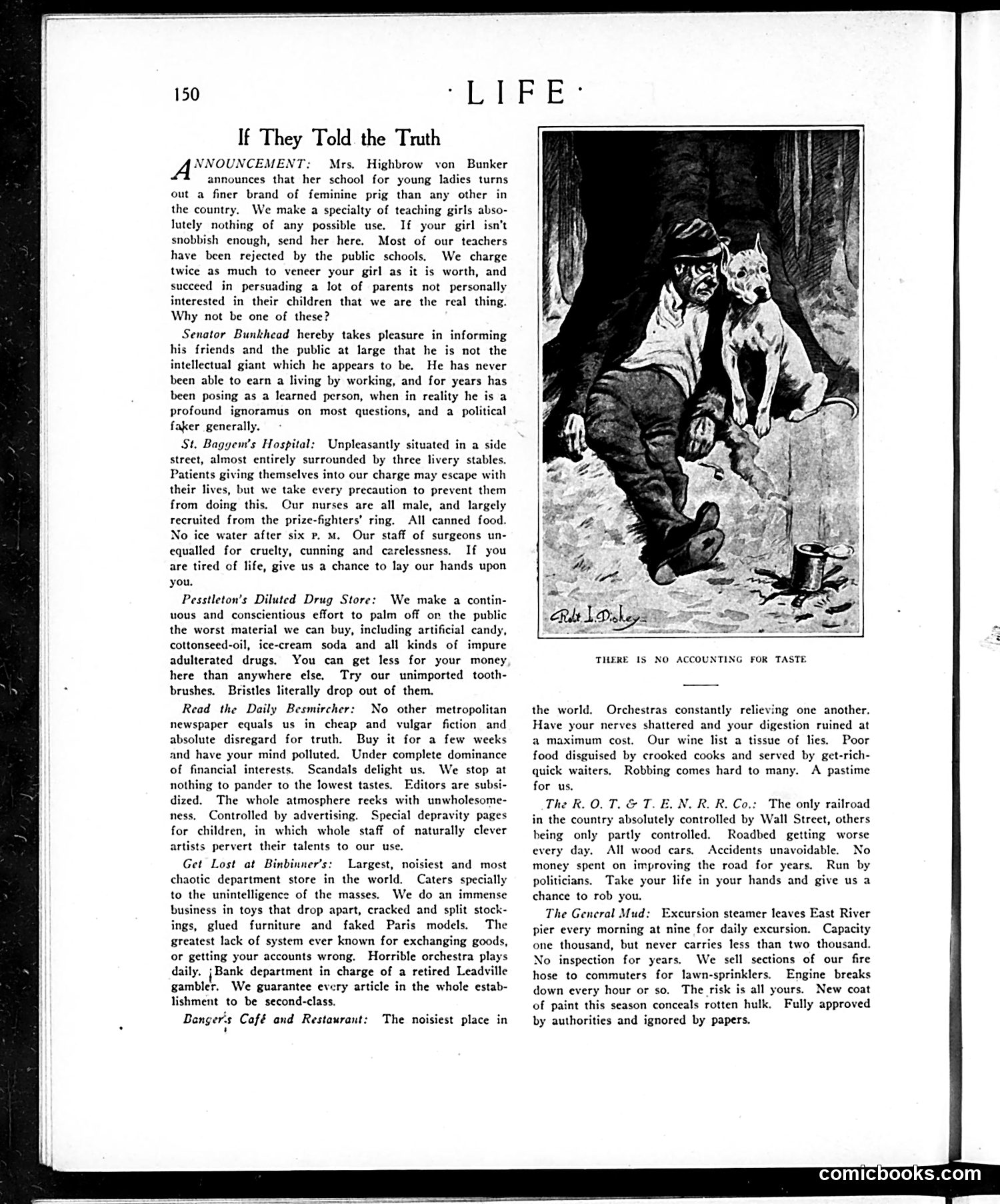
This page presents mock advertisements satirizing American institutions through brutal honesty. Each fictional business or figure represents a real social problem: **The cartoon** (captioned "There is No Accounting for Taste") depicts two figures in what appears to be a casual, undignified moment—likely mocking the pretensions or poor judgment of the wealthy or socially prominent. **The text satirizes:** - Exclusive finishing schools teaching useless snobbery - Corrupt senators posing as intellectuals - Hospitals with dangerous conditions - Fraudulent drugstores selling adulterated products - Sensationalist newspapers prioritizing scandal over truth - Chaotic department stores with inferior merchandise - Poor restaurants with mediocre food - A railroad controlled by Wall Street financiers with deteriorating infrastructure The satire's point: if these institutions advertised honestly rather than hiding their true nature, they'd admit to exploiting the public, prioritizing profit over quality and safety, and operating through corruption or negligence. This reflects Progressive Era criticism of monopolies, yellow journalism, and consumer fraud.
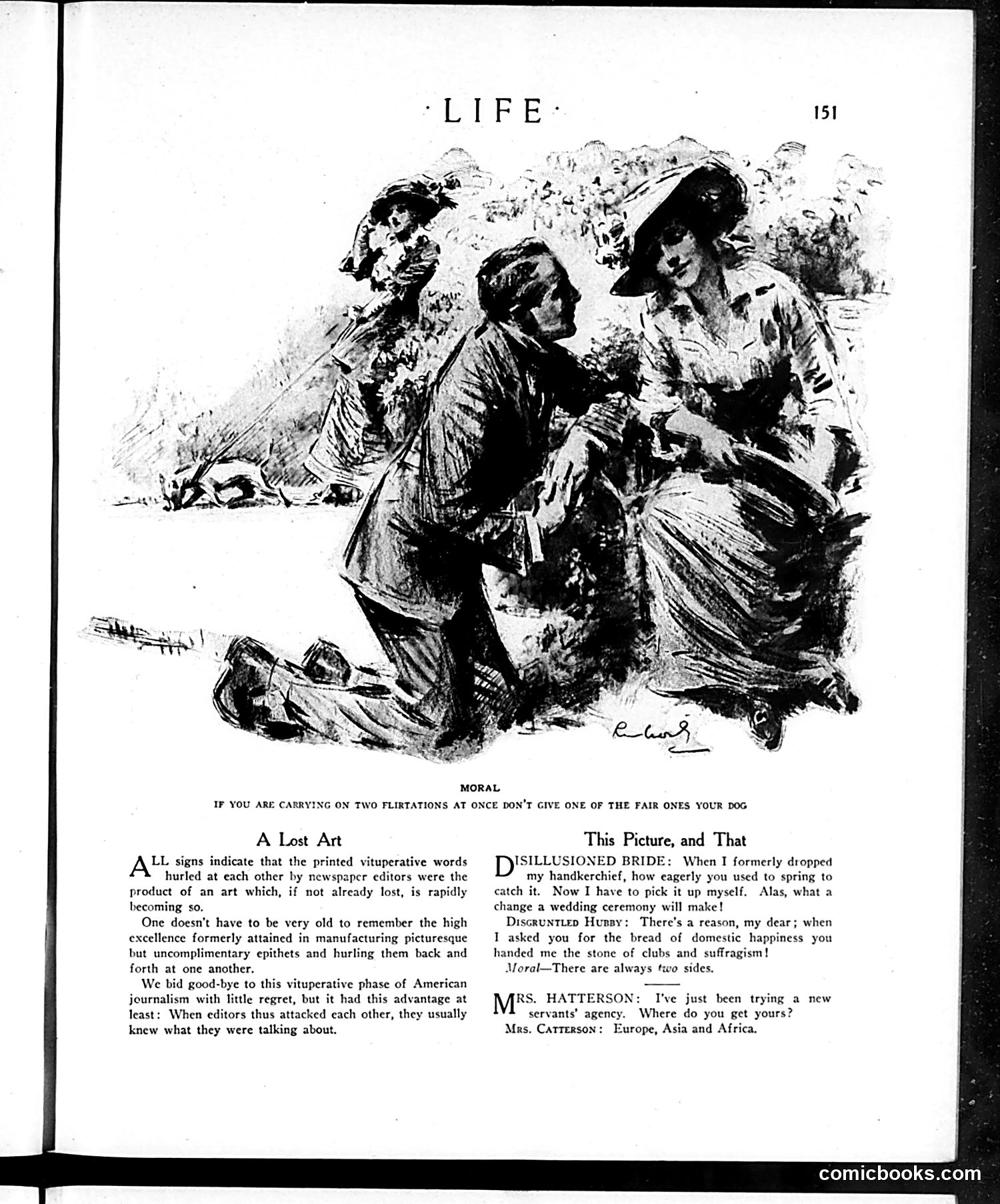
This page contains three distinct satirical pieces: **"A Lost Art"** laments the decline of vituperative newspaper editorials—editors once hurled elaborate insults at each other, but at least understood their subject matter. The piece nostalgia-tinged criticizes modern journalism's loss of this rhetorical tradition. **"This Picture, and That"** depicts marital discord. A disillusioned bride complains her husband no longer eagerly retrieves her dropped handkerchief. His response blames her demands for "clubs and suffragism" (women's voting rights)—suggesting she traded romantic courtship for political assertion. The "moral" acknowledges both perspectives, though the joke satirizes post-marriage disillusionment and the contemporary women's suffrage movement's impact on gender relations. **The servants' dialogue** jokes that one woman sources servants from "Europe, Asia and Africa"—implying global recruitment of immigrant domestic workers, likely satirizing wealthy households' employment practices during an era of heavy immigration. These pieces reflect early-1900s concerns: journalism standards, suffrage debates, and labor migration patterns.
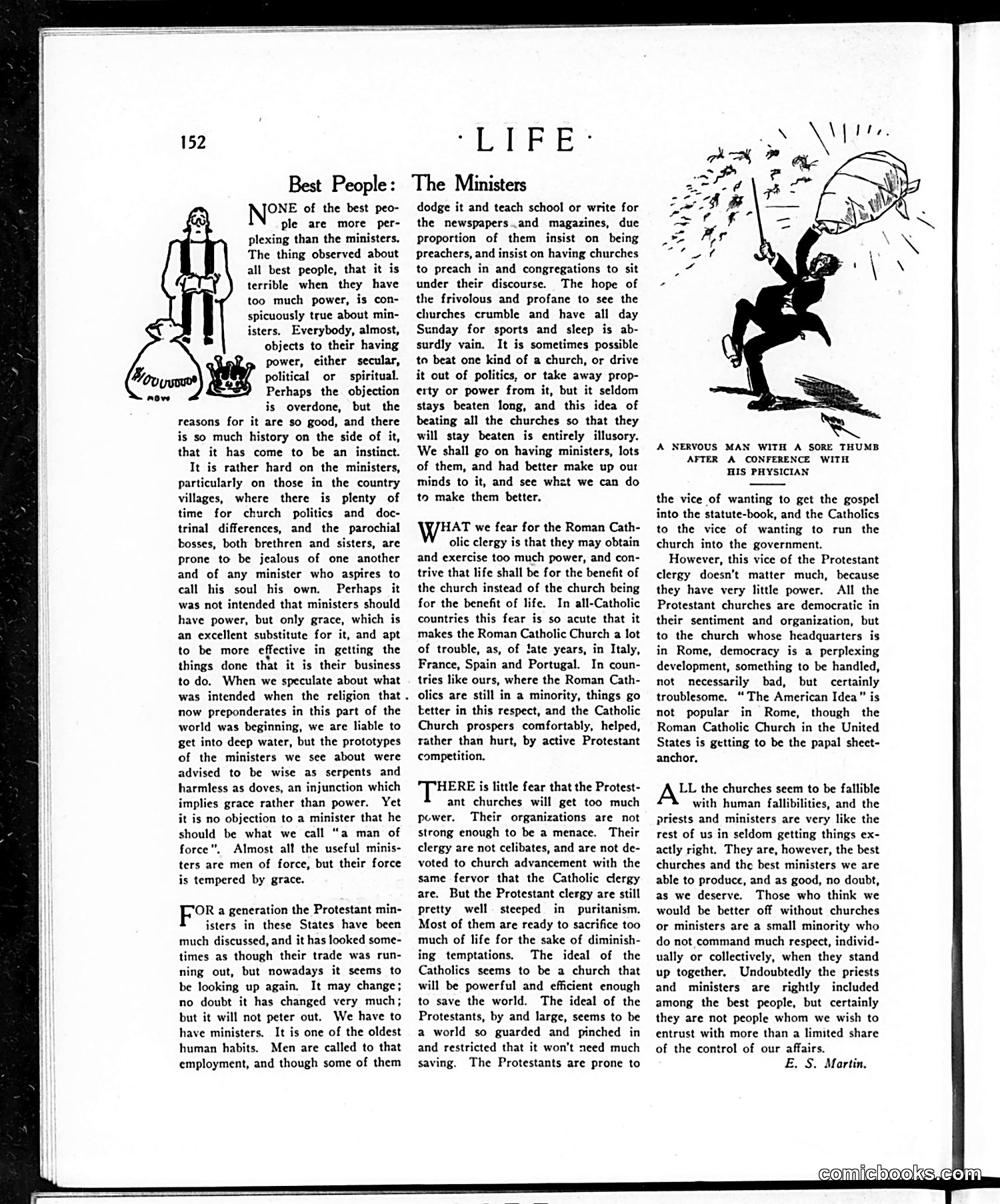
This satirical essay critiques religious leaders' tendency toward excessive power, a recurring concern in American Protestant thought. The article argues that while ministers deserve respect and are necessary, history shows clergy—whether Protestant or Catholic—become problematic when they accumulate secular or political influence. The cartoon illustrates this anxiety: it depicts a figure (likely representing clergy or institutional religion) being violently knocked down or expelled, with objects scattering. This visual reinforces the text's central tension: society needs ministers for spiritual guidance, yet fears their power. The essay distinguishes between American Protestant clergy (relatively weak, non-celibate, less organized) and Catholic clergy abroad (more powerful, particularly in Italy, France, Spain, Portugal—where the church's temporal authority creates political friction). The author advocates accepting ministers' necessity while vigilantly limiting their institutional authority to spiritual rather than worldly domains. The tone is characteristically Life magazine: sophisticated critique dressed in colloquial language, warning against extremes on both sides.
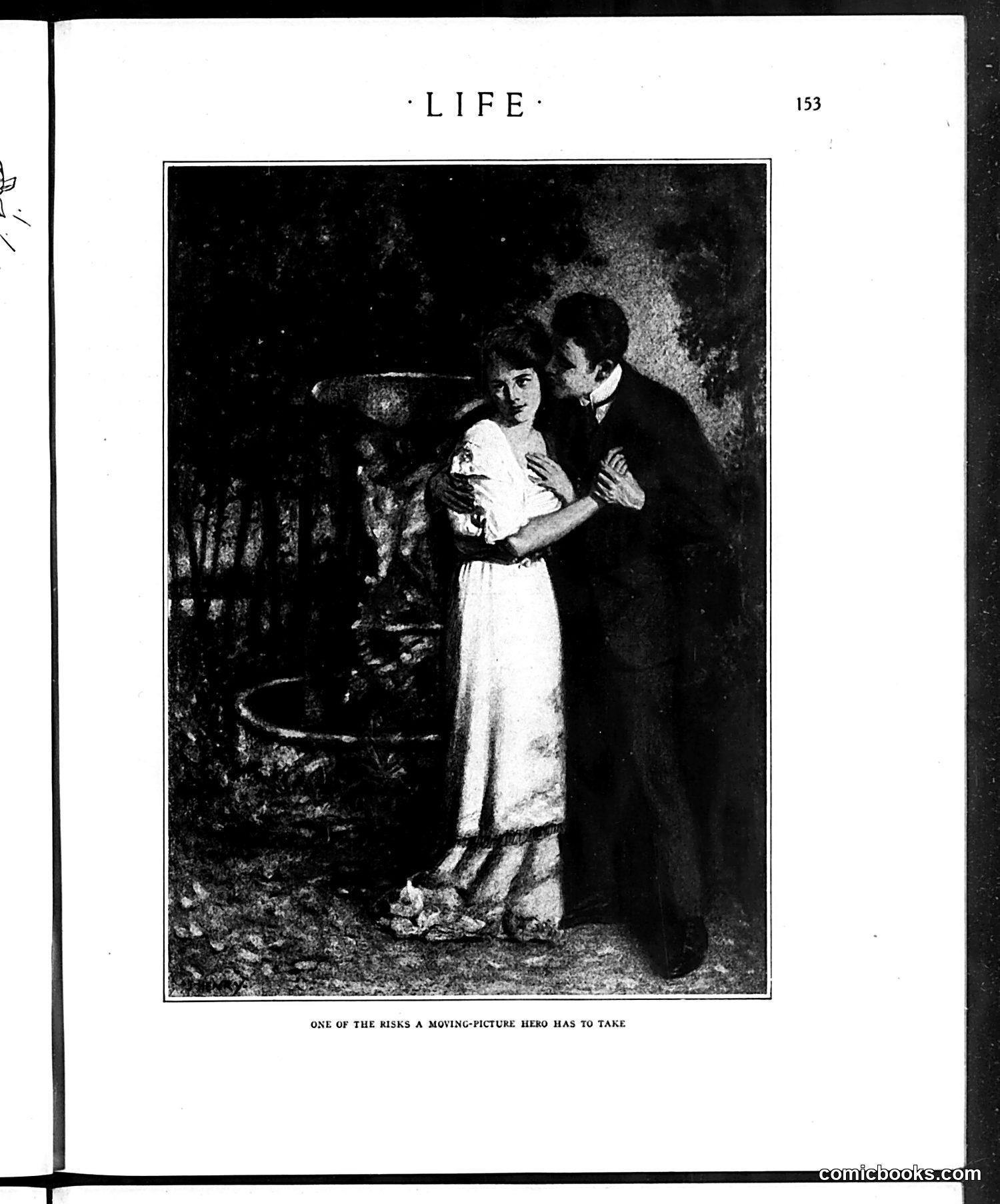
This is a photograph, not a cartoon. It shows two figures in what appears to be a dramatic scene: a man in dark clothing embracing or restraining a woman in a white dress against a dark, shadowy background. The caption, "ONE OF THE RISKS A MOVING-PICTURE HERO HAS TO TAKE," is satirical commentary on early cinema. It suggests that film actors—particularly male "heroes"—must accept physical risks during production, including intimate or potentially dangerous scenes with female actors. The image appears to depict such a moment. The satire likely comments on the demanding, sometimes physically intense nature of silent-film production, where actors performed without modern safety standards or stunt doubles.
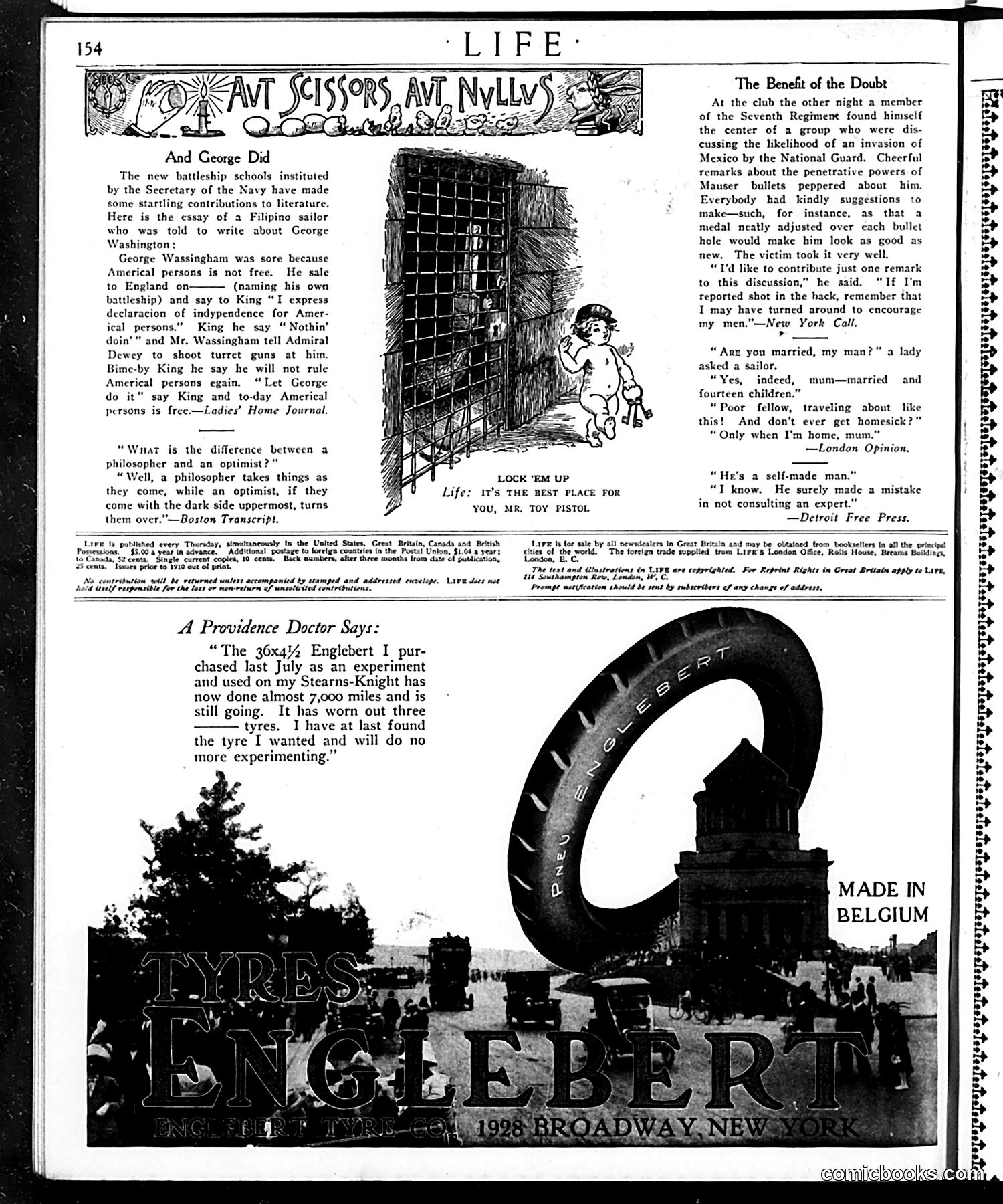
This humor piece mocks the educational writing of Filipino sailors in the Navy's new battleship schools. A Filipino sailor's essay about George Washington is presented with intentionally garbled English and historical confusion—he calls him "George Wassingham," confuses American independence with King George's consent to stop ruling Americans, and conflates Washington with Admiral Dewey (a Spanish-American War hero). The satire targets two things: first, the quality of Navy education programs; second, perhaps, stereotypes about Filipino English-language ability. The piece appears designed to show how poorly the Navy schools functioned, presenting the essay as unintentionally comedic rather than genuinely praising Filipino sailors. The humor relies on the reader recognizing the mangled history and grammar as evidence of failed instruction.
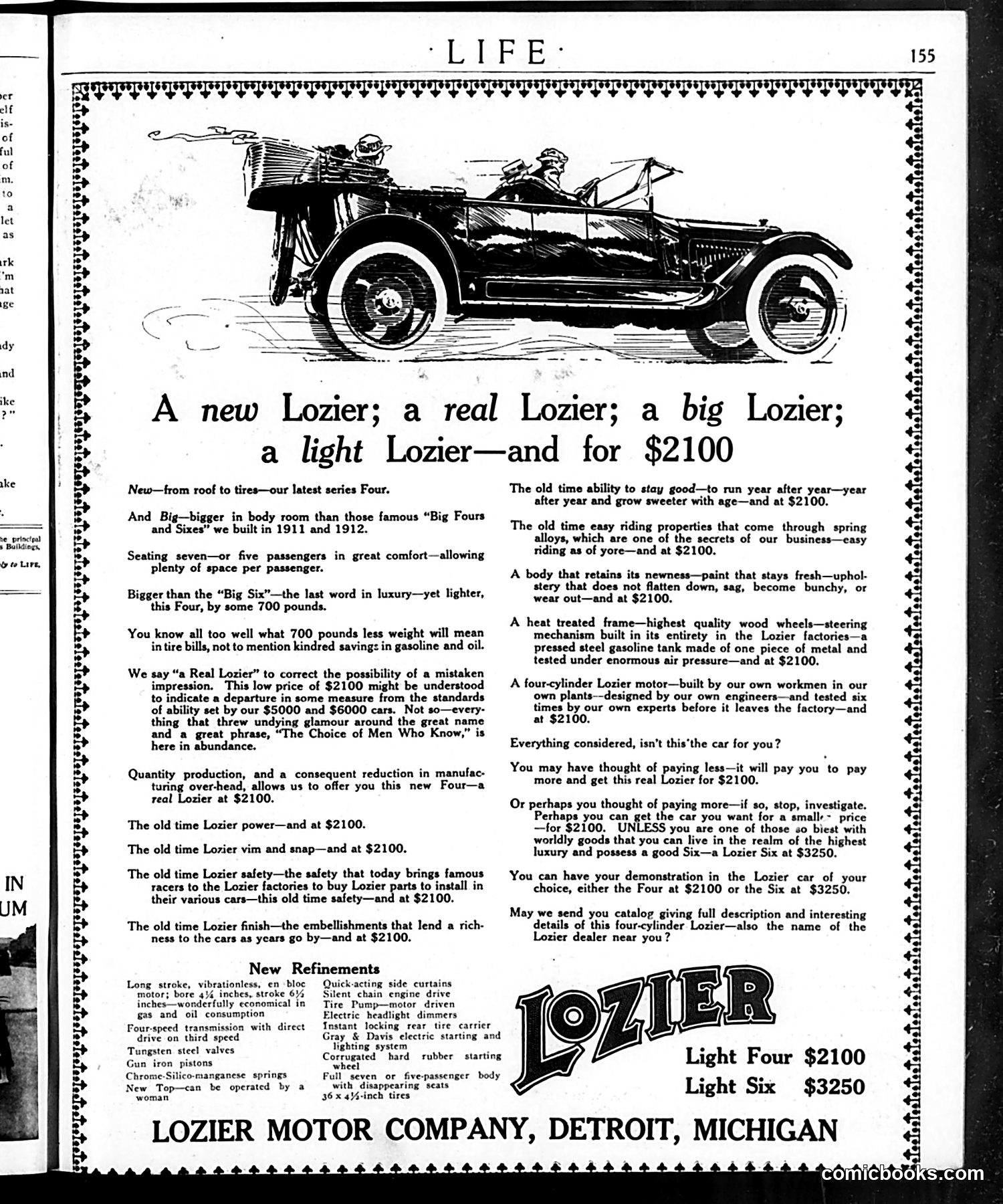
This page is **entirely an advertisement** for the Lozier Motor Company, not satire or editorial content. It promotes their new "Light Four" automobile priced at $2,100. The ad uses marketing rhetoric typical of early 1910s automobile advertising: emphasizing quality, durability, and value despite the low price. Key claims include that this car retains features of their prestigious higher-priced models ($5,000-$6,000) while costing less due to "quantity production." The repetitive phrase structure ("A new Lozier; a real Lozier; a big Lozier; a light Lozier") and the tagline "The Choice of Men Who Know" (their slogan) appeal to masculine prestige and practical judgment. The illustration shows an open-air touring car with passengers, typical of the era. Technical specifications and safety features are highlighted throughout. This is straightforward commercial advertising, not political or social commentary. It appeared in *Life* magazine's advertising section, reflecting the period's emerging consumer automobile market.
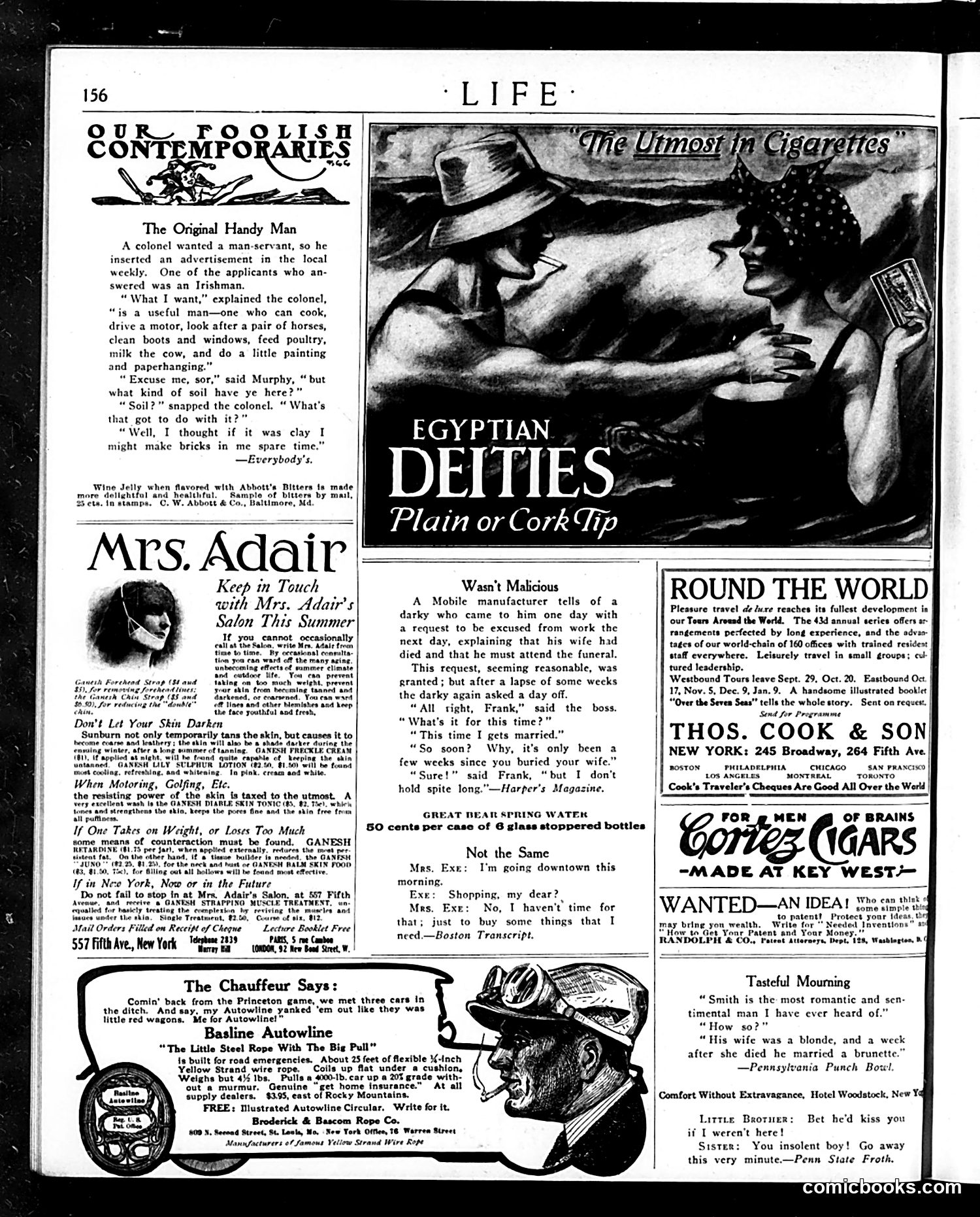
This joke satirizes Irish immigrant laborers and their reputation for resourcefulness and lateral thinking. A colonel seeks a servant capable of multiple tasks (cooking, driving, cleaning, etc.). An Irish applicant, Murphy, asks an unexpected question: what kind of soil the estate has. When pressed, he explains he'd make bricks in his spare time—completely missing the point of the job posting. The humor targets Irish stereotypes: their perceived simplicity, tendency to misunderstand practical matters, and their opportunistic hustle (always looking for a side business). Murphy's non-sequitur response was likely funny to contemporary readers who enjoyed ethnic humor portraying working-class Irish as somewhat dim but cleverly resourceful in absurd ways.

This is a **beer advertisement**, not a cartoon or satirical content. It's a full-page ad for Schlitz beer from Life magazine, appearing on page 157. The ad emphasizes "Purity First" and promotes Schlitz in brown bottles specifically. The imagery shows a detailed illustration of a Schlitz bottle with its distinctive label. The tagline "The Beer That Made Milwaukee Famous" references Schlitz's actual historical status as one of America's largest breweries. The phrase "brown bottles" was a marketing point—breweries believed brown glass better protected beer from light damage during storage and transport. This represents standard early 20th-century beer advertising before Prohibition. There is no satire or political commentary present—it's straightforward product promotion.
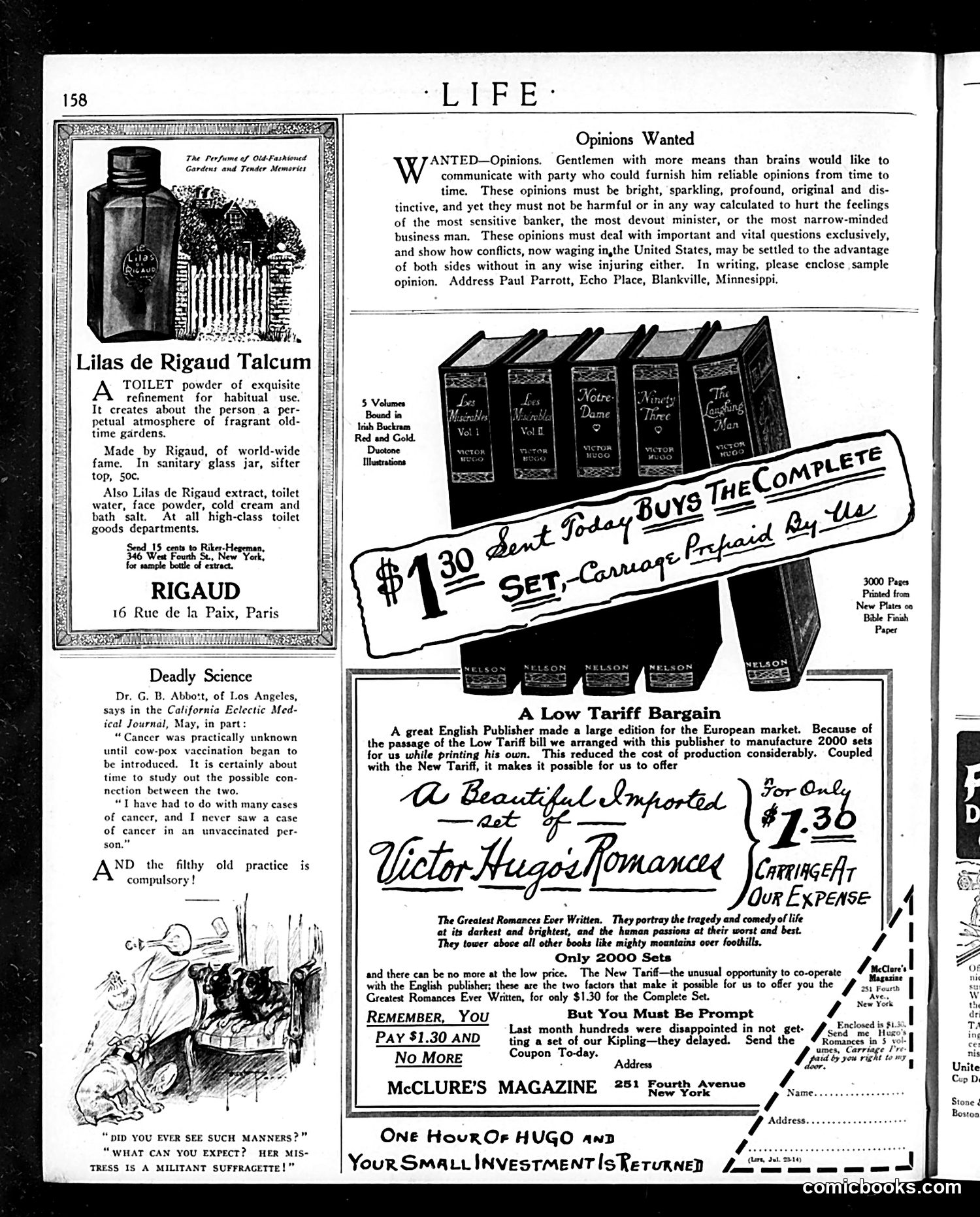
This page primarily contains **advertisements and opinion columns** rather than political satire. The most substantive content is a satirical cartoon captioned "Did you ever see such manners?" which mocks a domestic servant's poor behavior by blaming her employer—"a militant suffragette." This is **anti-suffrage satire**: the joke implies that women advocating for voting rights are so radical and disruptive that they cannot even maintain proper household discipline. It reflects early 20th-century opposition to women's suffrage, portraying suffragettes as destabilizing influences on social order. Below this is an opinion-wanted ad sarcastically soliciting "bright, sparkling, profound" opinions from wealthy men lacking intelligence—social commentary on plutocracy. The remainder comprises product advertisements (Rigaud talcum powder, Victor Hugo book sets) and a section titled "Deadly Science" questioning the safety of cow-pox vaccination, reflecting era-specific vaccine skepticism. The page reflects **pre-WWI American anxieties**: women's rights activism and early vaccine hesitancy.
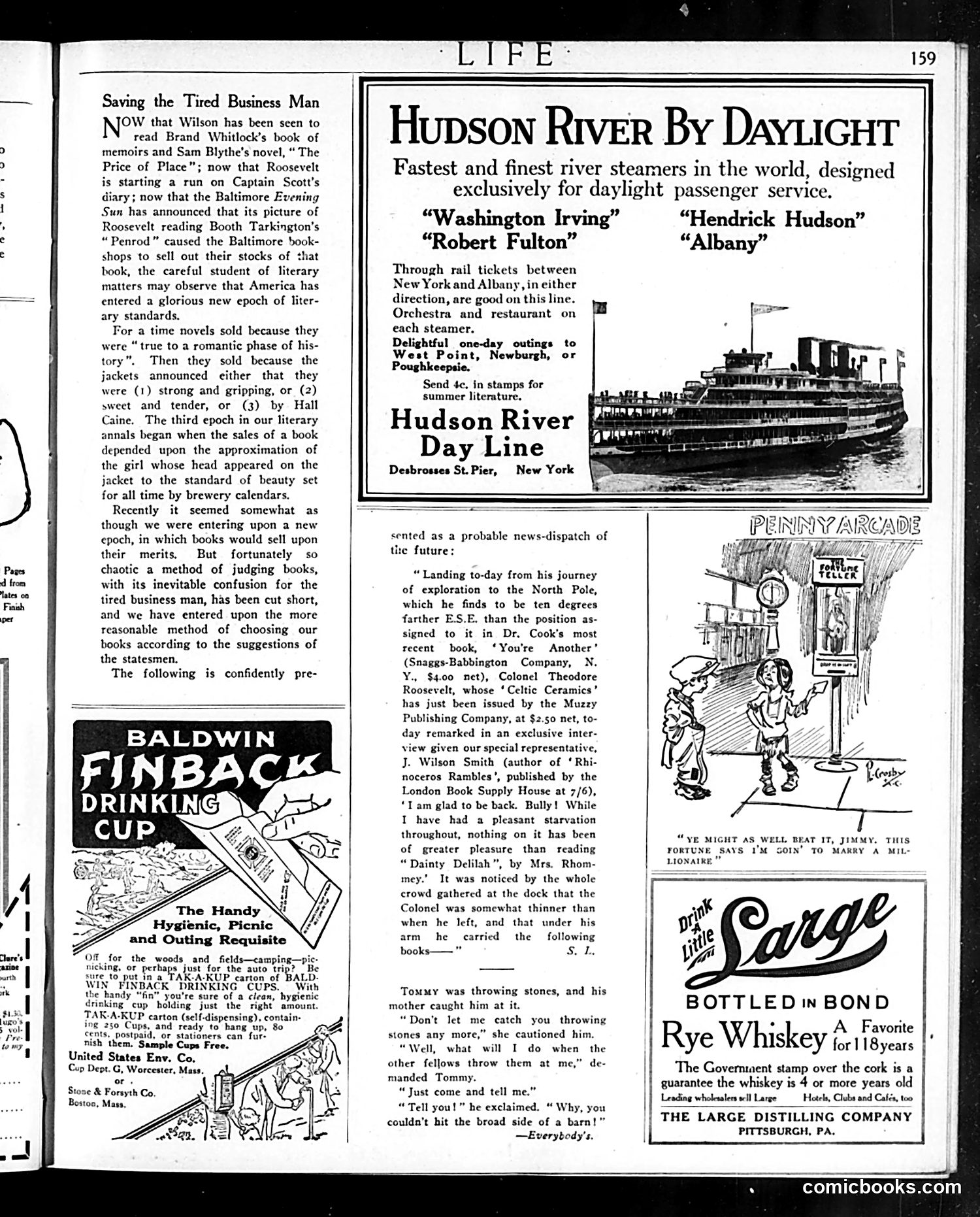
This essay satirizes how American literary taste has become shaped by celebrity endorsements rather than merit. The author notes that books now sell based on which prominent figures (Wilson, Roosevelt) are seen reading them, rather than their actual quality. The satire traces literary marketing epochs: romantic "truth," jacket descriptions ("strong and gripping"), brewery-calendar cover girls, and now—worst of all—*political figures' reading choices*. The accompanying mock news-dispatch parodies this absurdity: it depicts Roosevelt returning from the North Pole, where he supposedly read and praised obscure books, which would instantly drive sales. The joke is that by allowing statesmen to dictate literary taste, Americans have abandoned any reasonable standard—creating chaos for the "tired business man" trying to choose what to read. It's a sharp critique of herd mentality and celebrity culture in publishing, suggesting that letting politicians guide reading habits is comically worse than all previous shallow metrics.
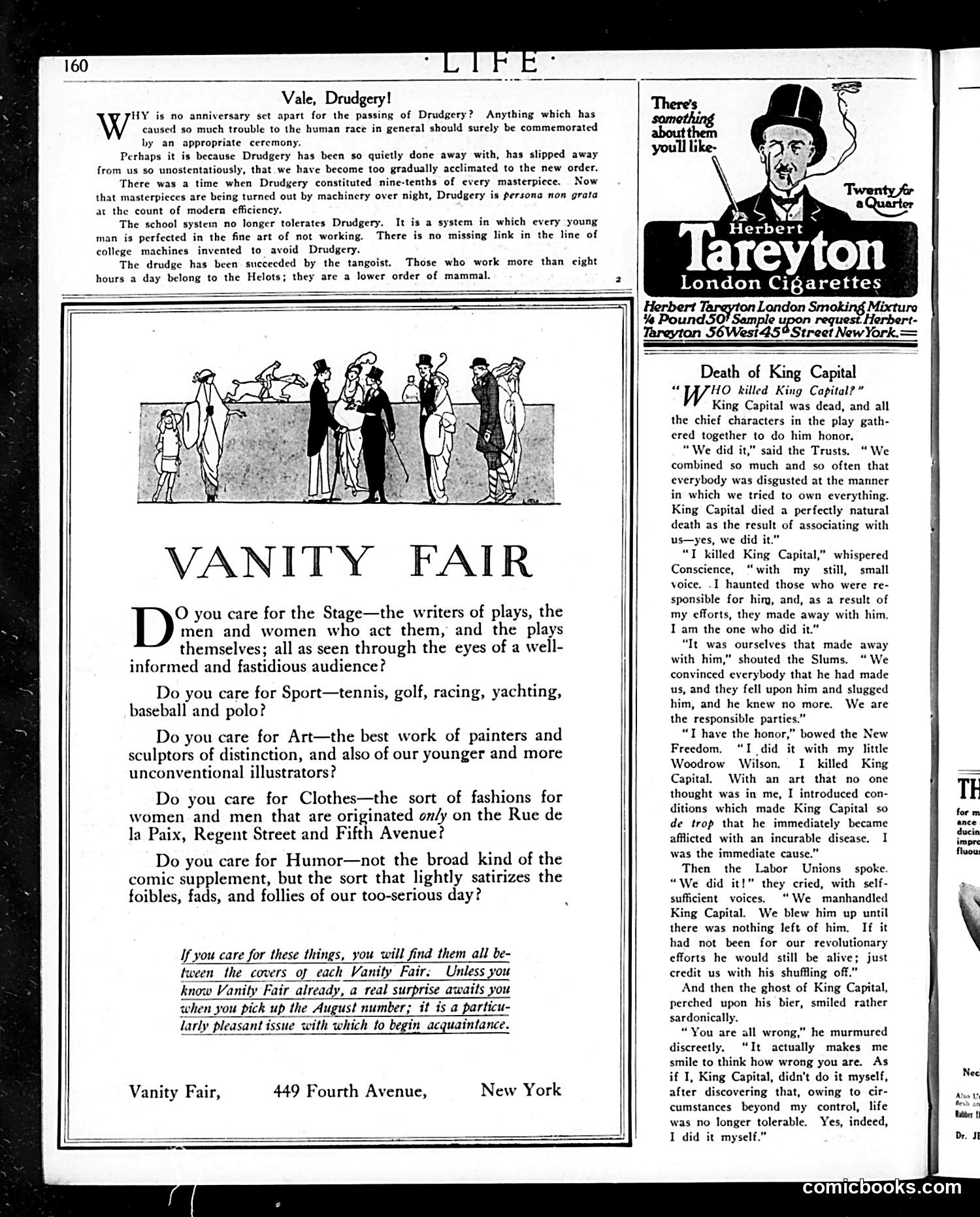
## "Vale, Drudgery!" This essay celebrates the supposed end of manual labor through mechanization and modern efficiency. The satire mocks contemporary enthusiasm for labor-saving devices and educational systems that avoid "drudgery." The author ironically notes that those still doing manual work eight+ hours daily are now treated as a lower class ("Helots"). The piece critiques how modernity has devalued hard work while praising effortless production. ## "Death of King Capital" This allegorical play-within-text satirizes capitalism's decline through multiple "murderers" confessing: Trusts (monopolies), Conscience, Slums (social inequality), the "New Freedom" (Wilson's progressive policies), and Labor Unions. Each claims responsibility for killing "King Capital," suggesting capitalism's death results from its own internal contradictions—corporate greed, moral decay, social unrest, and organized labor—rather than external attack. It's anti-capitalist satire likely from the 1910s-20s progressive era. The page also advertises Herbert Tareyton cigarettes and promotes Vanity Fair magazine's sophisticated content.
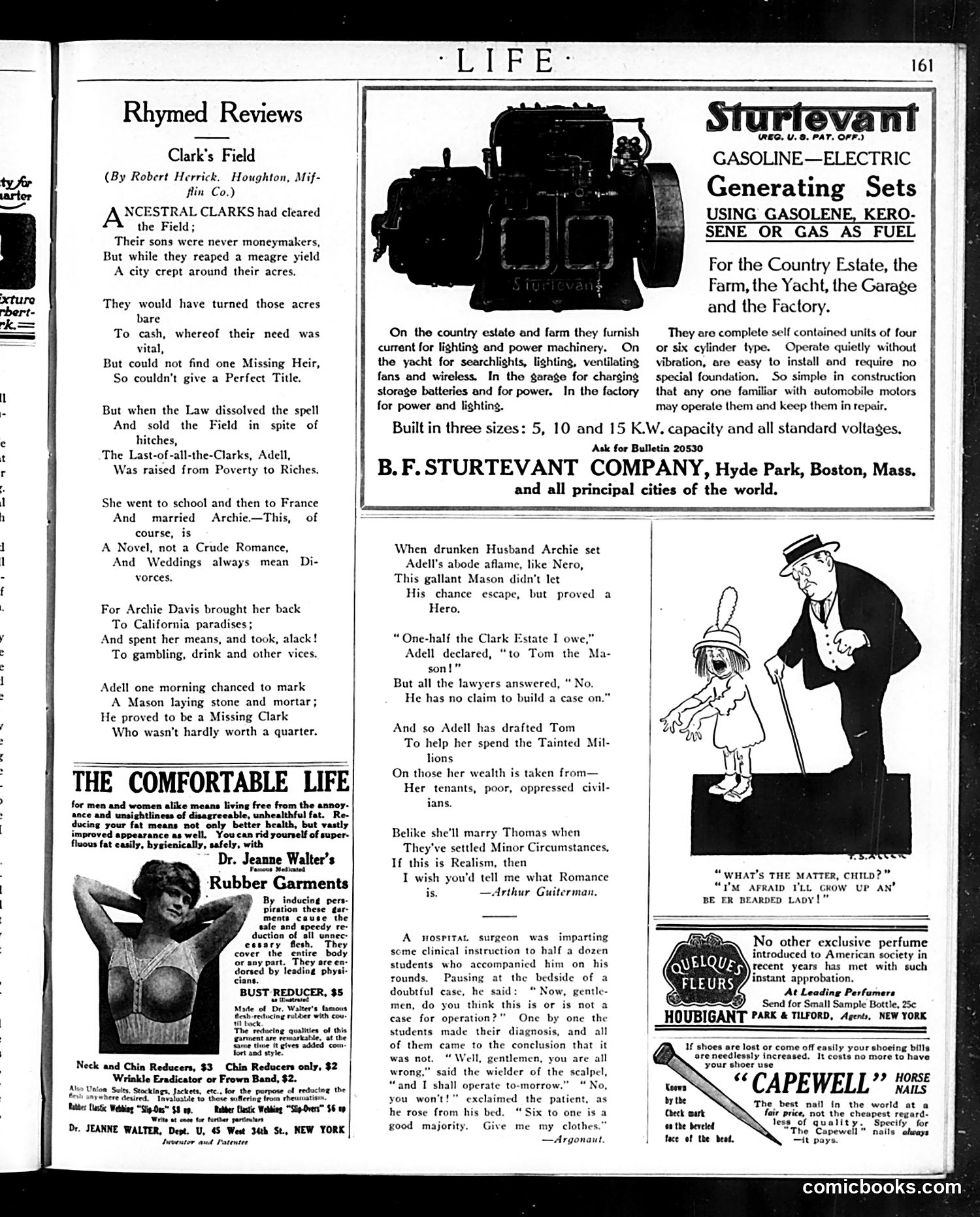
This page contains **book and product advertising with one significant literary review in verse** (not a political cartoon). The "Rhymed Review" critiques Robert Herrick's novel *Clark's Field*. The satirical poem traces Adell Clark's journey from poverty to wealth when her family's ancestral land finally sells. She marries Archie Davis, who squanders her fortune on drinking and gambling in California. A working-class mason saves Adell from a fire Archie causes, but lawyers deny him any claim to her estate despite her moral debt to him. The satire targets **wealth inequality and legal injustice**: Adell rewards the mason by hiring him to help her spend inherited money extracted from her poor tenants—hardly romance or genuine realism. The cartoonist (likely F.S. King, credited on the illustration) ridicules how the wealthy solve moral problems with token gestures while systemic exploitation continues. The page is otherwise dominated by period advertisements: Dr. Jeanne Walter's "reducing" rubber garments (for weight loss), and the Sturtevant gasoline-electric generating sets for estates and factories.
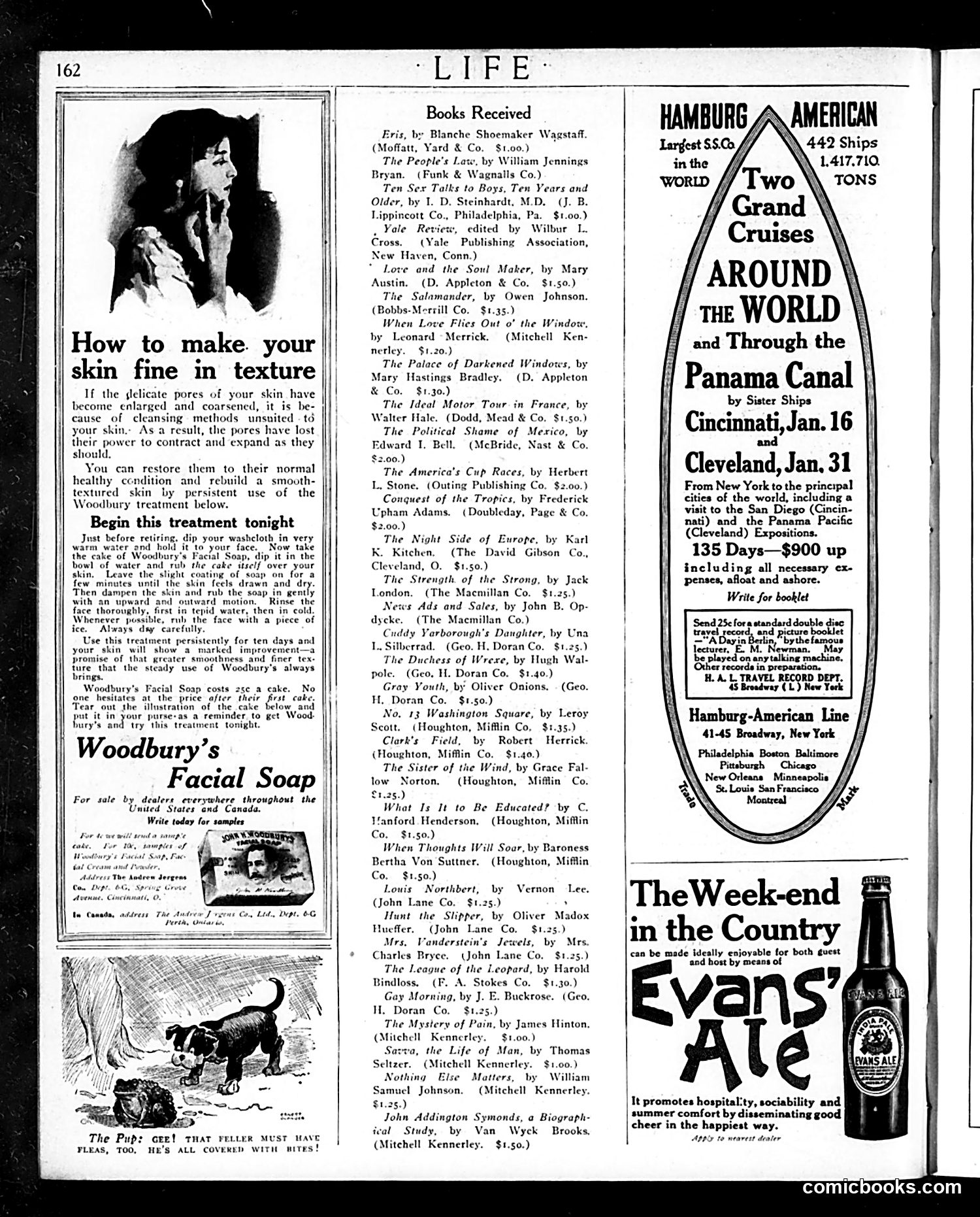
This page is primarily **advertising and book reviews**, not political satire. The main content consists of: **Left side:** A Woodbury's Facial Soap advertisement featuring a woman's profile and instructions for a skincare treatment. The pitch promises to restore enlarged pores to normal texture through nightly use. **Center:** A "Books Received" section listing newly published titles, including works by William Jennings Bryan and other contemporary authors. **Right side:** Travel advertisements—notably Hamburg-American Line promoting luxury cruises "Around the World and Through the Panama Canal" departing from Cincinnati and Cleveland, plus an Evans' Ale advertisement. **Bottom left:** A small cartoon showing a dog covered in fleas with caption "The Pup: 'Gee! That Feller Must Have Fleas, Too. He's All Covered with Bites!'" This is mild humor, not political satire. The page reflects early 20th-century consumer culture, emphasizing personal grooming products and aspirational travel experiences for middle-class readers.
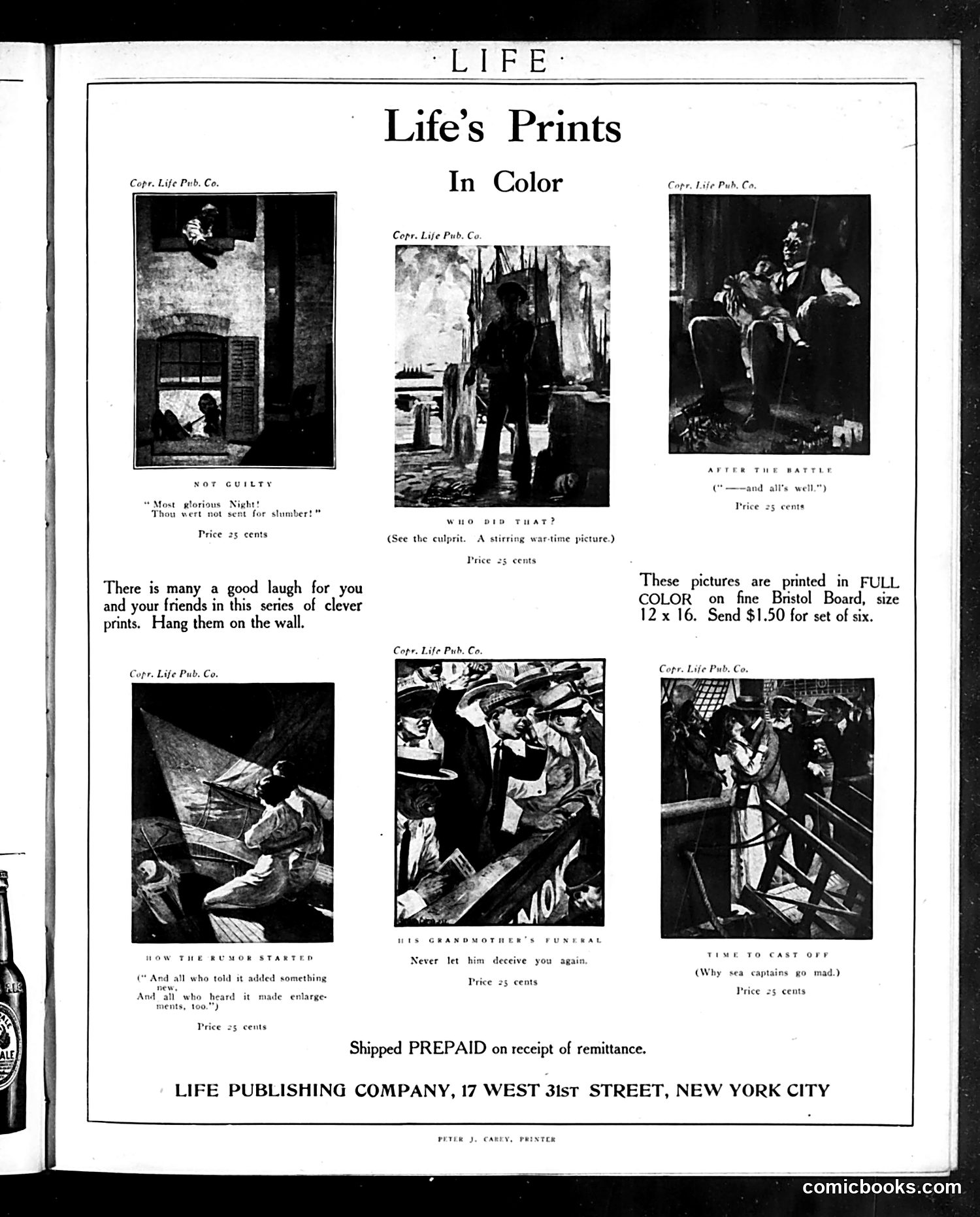
This is an advertisement for colored satirical prints sold by Life Publishing Company. The page displays six cartoon scenes priced at 25 cents each, or $1.50 for a complete set of six, shipped prepaid. The prints appear to be humorous domestic and social situations typical of early 20th-century American satire: "Not Guilty" depicts someone caught in a compromising situation; "Who Did That?" shows a wartime scene; "After the Battle" suggests marital discord; "How the Rumor Started" illustrates gossip spreading; "Grandmother's Funeral" and "Time to Cast Off" appear to depict social awkwardness and relationship comedy. Rather than political satire, these are lighthearted genre scenes meant for home decoration, emphasizing humor about everyday life, relationships, and social embarrassment. The advertisement explicitly invites readers to "hang them on the wall" as decoration and promises "good laugh for you and your friends."