
Life, 1914-07-23 · page 28 of 40
Life — July 23, 1914 — page 28: what you’re looking at
What you’re looking at
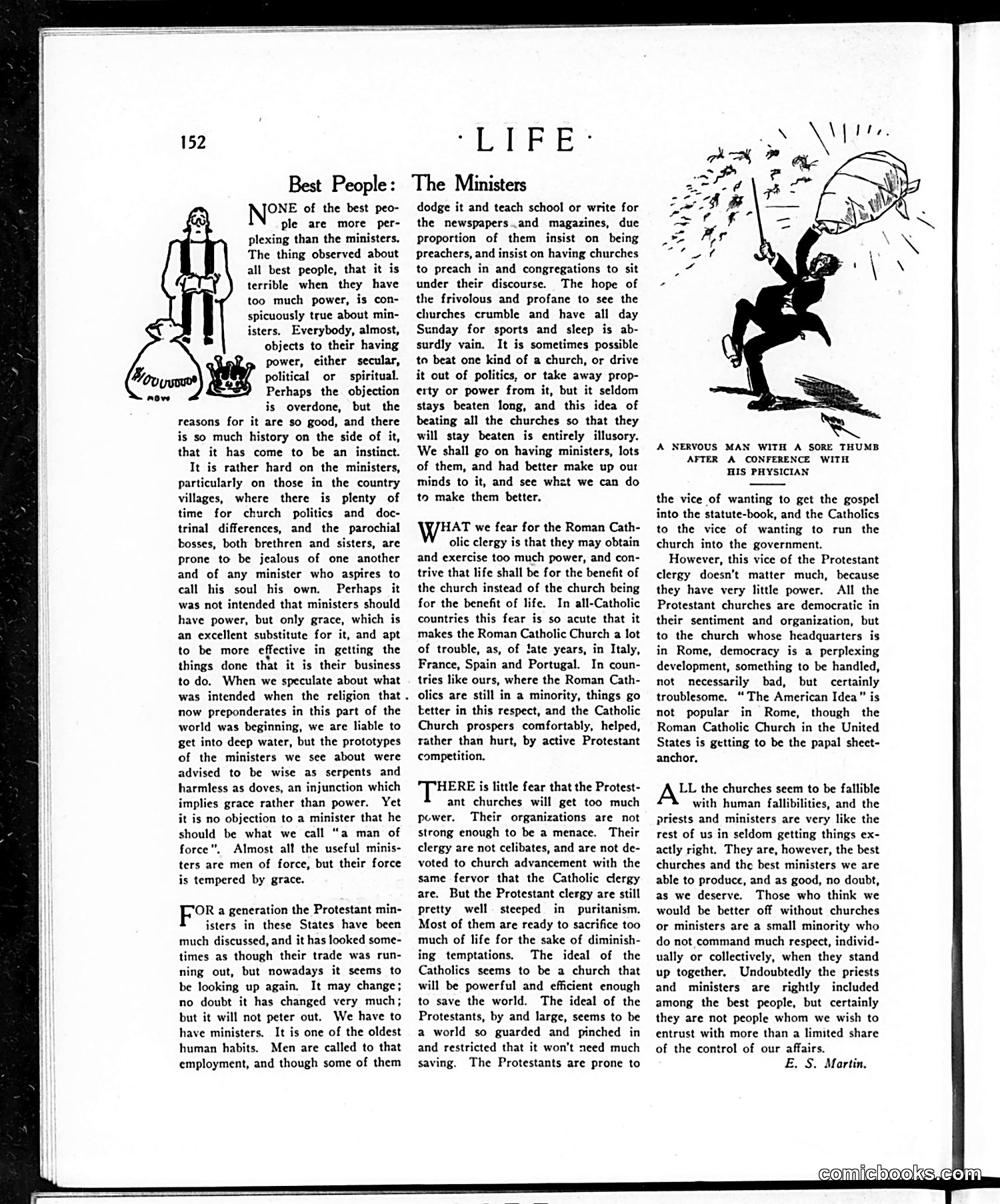
This satirical essay critiques religious leaders' tendency toward excessive power, a recurring concern in American Protestant thought. The article argues that while ministers deserve respect and are necessary, history shows clergy—whether Protestant or Catholic—become problematic when they accumulate secular or political influence. The cartoon illustrates this anxiety: it depicts a figure (likely representing clergy or institutional religion) being violently knocked down or expelled, with objects scattering. This visual reinforces the text's central tension: society needs ministers for spiritual guidance, yet fears their power. The essay distinguishes between American Protestant clergy (relatively weak, non-celibate, less organized) and Catholic clergy abroad (more powerful, particularly in Italy, France, Spain, Portugal—where the church's temporal authority creates political friction). The author advocates accepting ministers' necessity while vigilantly limiting their institutional authority to spiritual rather than worldly domains. The tone is characteristically Life magazine: sophisticated critique dressed in colloquial language, warning against extremes on both sides.
📄 Transcribed text from this page (OCR, searchable)
Machine-transcribed from the original scan — historical spelling and the odd misread are preserved.
Best People: The Ministers ONE of the best peo- ple are more per- plexing than the ministers. The thing observed about all best people, that it is terrible when they have too much power, is con- spicuously true about min- isters. Everybody, almost, objects to their having ly wey power, either secular, soo” political or spiritual. coun Perhaps the objection is overdone, but the reasons for it are so good, and there is so much history on the side of it, that it has come to be an instinct. It is rather hard on the ministers, particularly on those in the country villages, where there is plenty of time for church politics and doc- trinal differences, and the parochial bosses, both brethren and sisters, are prone to be jealous of one another and of any minister who aspires to call his soul his own. Perhaps it was not intended that ministers should have power, but only grace, which is an excellent substitute for it, and apt to be more effective in getting the things done that it is their business to do, When we speculate about what was intended when the religion that now preponderates in this part of the world was beginning, we are liable to get into deep water, but the prototypes of the ministers we see about were advised to be wise as serpents and harmless as doves, an injunction which implies grace rather than power. Yet it is no objection to a minister that he should be what we call “a man of force”. Almost all the useful minis- ters are men of force, but their force is tempered by grace. Foe a generation the Protestant min- isters in these States have been much discussed, and it has looked some- times as though their trade was run- ning out, but nowadays it seems to be looking up again. It may change; no doubt it has changed very much; but it will not peter out. We have to have ministers. It is one of the oldest human habits. Men are called to that employment, and though some of them dodge it and teach school or write for the newspapers..and magazines, due Proportion of them insist on being preachers, and insist on having churches to preach in and congregations to sit under their discourse. The hope of the frivolous and profane to see the churches crumble and have all day Sunday for sports and sleep is ab- surdly vain. It is sometimes possible to beat one kind of a church, or drive it out of politics, or take away prop- erty or power from it, but it seldom stays beaten long, and this idea of beating all the churches so that they will stay beaten is entirely illusory. We shall go on having ministers, lots of them, and had better make up out minds to it, and see whet we can do to make them better. HAT we fear for the Roman Cath- olic clergy is that they may obtain and exercise too much power, and con- trive that life shall be for the benefit of the church instead of the church being for the benefit of life. In all-Catholic countries this fear is so acute that it makes the Roman Catholic Church a lot of trouble, as, of fate years, in Italy, France, Spain and Portugal. In coun- tries like ours, where the Roman Cath- olics are still in a minority, things go etter in this respect, and the Catholic Church prospers comfortably, helped, rather than hurt, by active Protestant competition, HERE is little fear that the Protest- ant churches will get too much power. Their organizations are not strong enough to be a menace. Their clergy are not celibates, and are not de- voted to church advancement with the same fervor that the Catholic clergy are. But the Protestant clergy are still pretty well steeped in puritanism. Most of them are ready to sacrifice too much of life for the sake of diminish- ing temptations. The ideal of the Catholics seems to be a church that will be powerful and efficient enough to save the world. The ideal of the Protestants, by and large, seems to be a world so guarded and pinched in and restricted that it won't need much saving. The Protestants are prone to A NERVOUS MAN WITH A SORE THUMB AFTER A CONFERENCE WITH HIS PHYSICIAN the vice of wanting to get the gospel into the statute-book, and the Catholics to the vice of wanting to run the church into the government. However, this vice of the Protestant clergy doesn’t matter much, because they have very little power. All the Protestant churches are democratic in their sentiment and organization, but to the church whose headquarters is in Rome, democracy is a perplexing development, something to be handled, not necessarily bad, but certainly troublesome. “ The American Idea” i: not popular in Rome, though the Roman Catholic Church in the United States is getting to be the papal sheet- anchor. LL the churches seem to be fallible with human fallibilities, and the priests and ministers are very like the rest of us in seldom getting things ex- actly right. They are, however, the best churches and the best ministers we are able to produce, and as good, no doubt, as we deserve. Those who think we would be better off without churches or ministers are a small minority who do not command much respect, individ- ually or collectively, when they stand up together. Undoubtedly the priests and ministers are rightly included among the best people, but certainly they are not people whom we wish to entrust with more than a limited share of the control of our affairs. E. S. Martin,