
Life, 1914-07-23 · page 36 of 40
Life — July 23, 1914 — page 36: what you’re looking at
What you’re looking at
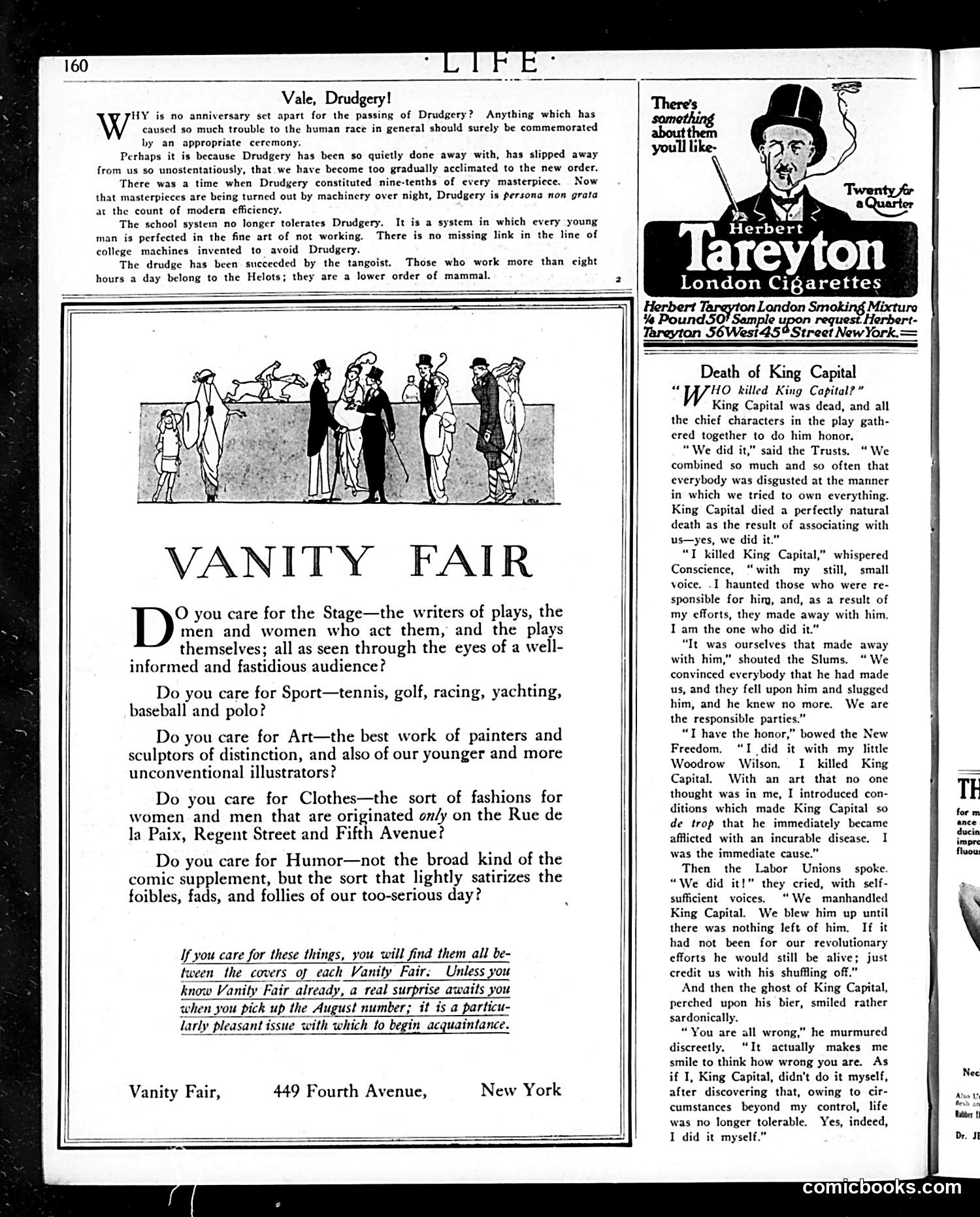
## "Vale, Drudgery!" This essay celebrates the supposed end of manual labor through mechanization and modern efficiency. The satire mocks contemporary enthusiasm for labor-saving devices and educational systems that avoid "drudgery." The author ironically notes that those still doing manual work eight+ hours daily are now treated as a lower class ("Helots"). The piece critiques how modernity has devalued hard work while praising effortless production. ## "Death of King Capital" This allegorical play-within-text satirizes capitalism's decline through multiple "murderers" confessing: Trusts (monopolies), Conscience, Slums (social inequality), the "New Freedom" (Wilson's progressive policies), and Labor Unions. Each claims responsibility for killing "King Capital," suggesting capitalism's death results from its own internal contradictions—corporate greed, moral decay, social unrest, and organized labor—rather than external attack. It's anti-capitalist satire likely from the 1910s-20s progressive era. The page also advertises Herbert Tareyton cigarettes and promotes Vanity Fair magazine's sophisticated content.
📄 Transcribed text from this page (OCR, searchable)
Machine-transcribed from the original scan — historical spelling and the odd misread are preserved.
Vale, Drudgery! HY is no anniversary set apart for the passing of Drudgery? Anything which has caused so much trouble to the human race in general should surely be commemorated by an appropriate ceremony. Perhaps it is because Drudgery has been so quietly done away with, has slipped away from us so unostentatiously, that we have become too gradually acclimated to the new order. There was a time when Drudgery constituted nine-tenths of every masterpiece. Now that masterpieces are being turned out by machinery over night, Drudgery is persona non grata \ at the count of modern efficiency. mS | The school system no longer tolerates Drudgery. It is a system in which every young T: Herbert 2 man is perfected in the fine art of not working. There is no missing link in the line of t < college machines invented to avoid Drudgery. The drudge has been succecded by the tangoist. Those who work more than cight hi day bel the Helots; they are a lower order of mammal. 2 jours a day belong to the Helots; the; a lowe le j London Cigarettes | Herbert Targyton London Smoking Mixture | % Pound50! Sample upon reque: Herbert- | Tareyton S6Wesit45%Street NewYork.—= VANITY FAIR O you care for the Stage—the writers of plays, the D men and women who act them, and the plays themselves; all as seen through the eyes of a well- informed and fastidious audience? Do you care for Sport—tennis, golf, racing, yachting, baseball and polo? Do you care for Art—the best work of painters and sculptors of distinction, and also of our younger and more unconventional illustrators? Do you care for Clothes—the sort of fashions for Death of King Capital i) ‘HO killed King Capital?” King Capital was dead, and all the chief characters in the play gath- ered together to do him honor, “We did it,” said the Trusts. “We combined so much and so often that everybody was disgusted at the manner in which we tried to own everything. King Capital died a perfectly natural death as the result of associating with us—yes, we did it.” “I killed King Capital,” whispered Conscience, “with my still, small voice. -I haunted those who were re- sponsible for hirg, and, as a result of my efforts, they made away with him, I am the one who did it.” “It was ourselves that made away with him,” shouted the Slums. “We convinced everybody that he had made us, and they fell upon him and slugged him, and he knew no more. We are the responsible parties.” “T have the honor,” bowed the New Freedom. “I did it with my little Woodrow Wilson, I killed King Capital. With an art that no one thought was in me, I introduced con- women and men that are originated on/y on the Rue de ditions “which ‘made; King. Capital so for m la Pai R S d Fifth A ? de trop that he immediately became oe a Paix, Regent otreet and Filth Avenue afflicted with an incurable disease. 1 pein Do you care for Humor—not the broad kind of the was the immediate cause,” “en é ‘ aoe Then the Labor Unions spoke comic supplement, but the sort that lightly satirizes the wane’ dias iebeoauaenenta. Gh " ‘ : We did it!” they cried, with self- 2 foibles, fads, and follies of our too-serious day? dufficient: ‘voices. “ We) auantiandled ‘ King Capital. We blew him up until there was nothing left of him. If it . . had not been for our revolutionary Ifyou care for these things, you will find them all be- efforts he would still be alive; just tween the covers of each Vanity Fair: Unless you credit us with his shuffling off.” know Vanity Fair already, a real surprise awaits you And then the ghost of King Capital, when you pick up the August number; it is a particu- pari “pen his bier, smiled rather 7 “int ieee with toh = ; sardonically. larly pleasant issue with which to begin acquaintance. “You are all wrong,” he murmured discreetly. “It actually makes me smile to think how wrong you are. As x ec Vanity Fair, 449 Fourth Avenue, New York if I, King Capital, didn’t do it myself, after discovering that, owing to cir- cumstances beyond my control, life was no longer tolerable. Yes, indeed, I did it myself.” comicbooks.com