
Life, 1914-07-23 · page 19 of 40
Life — July 23, 1914 — page 19: what you’re looking at
What you’re looking at
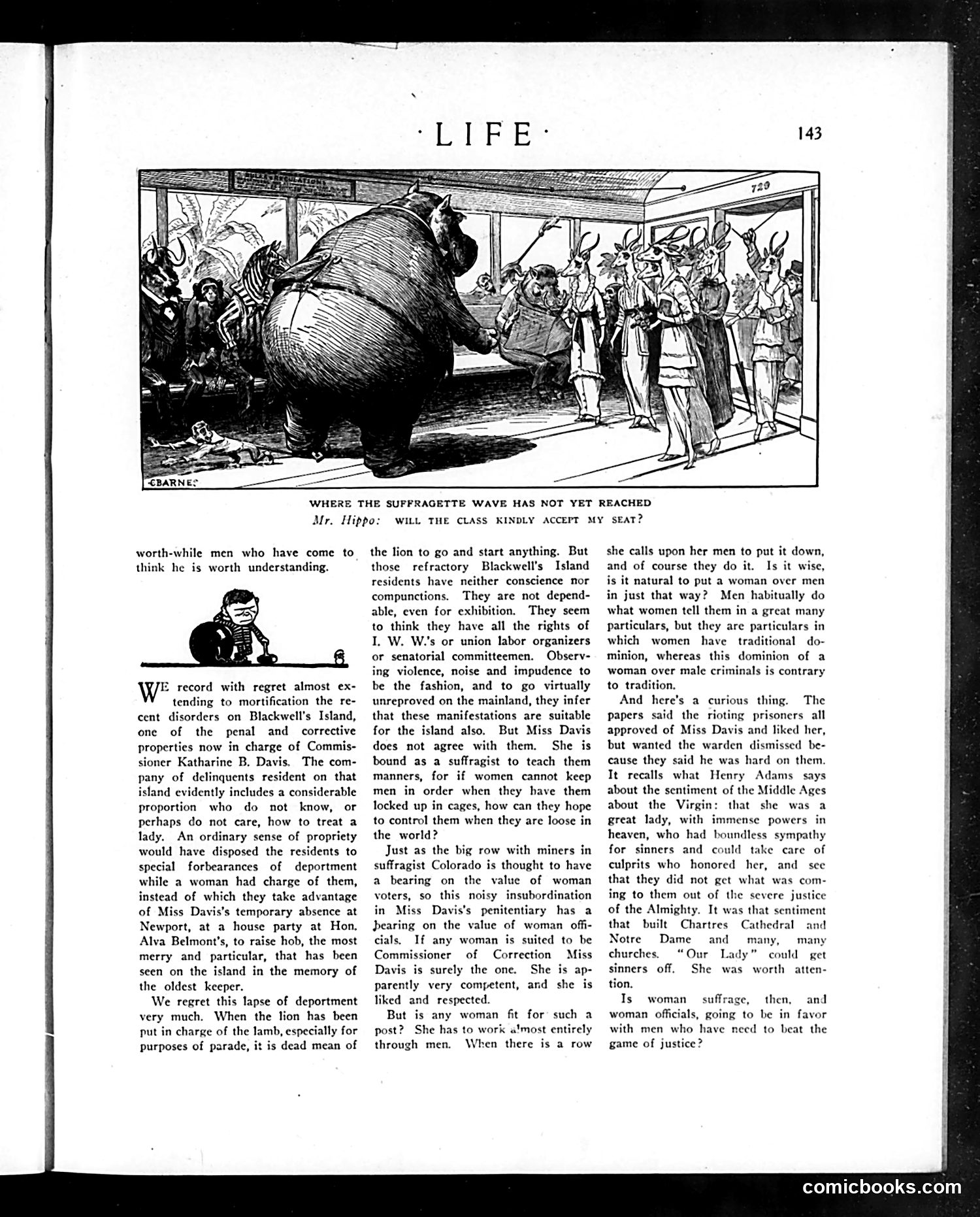
This 1910s *Life* magazine cartoon satirizes doubts about women's fitness for public office, using Commissioner Katharine B. Davis of Blackwell's Island Penitentiary as its target. **The Setup:** Davis, a known suffragist, temporarily leaves her post. Male prisoners riot during her absence, then—oddly—express approval of *her* while demanding the male warden's removal. The cartoon depicts an enormous hippopotamus (representing the unruly prisoners) confronting guards. **The Satire's Point:** The article sarcastically argues that if women can't control male prisoners in locked cages, how can they be trusted to vote or hold office over men in society? It frames women's authority as unnatural and dependent on men's compliance. **The Irony:** The prisoners' preferential treatment of Davis (compared to the strict warden) is compared to medieval reverence for the Virgin Mary—suggesting men will manipulate women in power rather than respect their authority. The piece mocks suffragists by using this incident to question whether women officials can actually exercise independent power or merely exploit traditional male deference.
📄 Transcribed text from this page (OCR, searchable)
Machine-transcribed from the original scan — historical spelling and the odd misread are preserved.
WHERE THE SUFFRAGETTE WAVE HAS NOT YET REACHED Mr. Hippo: worth-while men who have come to think he is worth understanding. W* record with regret almost ex- tending to mortification the re- cent disorders on Blackwell's Island, one of the penal and corrective properties now in charge of Commis- sioner Katharine B, Davis. The com- pany of delinquents resident on that island evidently includes a considerable proportion who do not know, or perhaps do not care, how to treat a lady. An ordinary sense of propriety would have disposed the residents to special forbearances of deportment while a woman had charge of them, instead of which they take advantage of Miss Davis's temporary absence at Newport, at a house party at Hon, Alva Belmont’s, to raise hob, the most merry and particular, that has been seen on the island in the memory of the oldest keeper. We regret this lapse of deportment very much. When the lion has been put in charge of the lamb, especially for purposes of parade, it is dead mean of the lion to go and start anything. But those refractory Blackwell's Island residents have neither conscience nor compunctions. They are not depend- able, even for exhibition. They seem to think they have all the rights of I, W. W's or union labor organizers or senatorial committeemen. Observ- ing violence, noise and impudence to be the fashion, and to go virtually unreproved on the mainland, they infer that these manifestations are suitable for the island also, But Miss Davis does not agree with them. She is bound as a suffragist to teach them manners, for if women cannot keep men in order when they have them locked up in cages, how can they hope to control them when they are loose in the world? Just as the big row with miners in suffragist Colorado is thought to have a bearing on the value of woman voters, so this noisy insubordination in Miss Davis's penitentiary has a pearing on the value of woman offi- cials, If any woman is suited to be Commissioner of Correction Miss Davis is surely the one. She is ap- parently very competent, and she is liked and respected. But is any woman fit for such a post? She has to work a!most entirely through men. When there is a row WILL THE CLASS KINDLY ACCEPT MY SEAT? she calls upon her men to put it dow and of course they do it. Is it wise, is it natural to put a woman over men in just that way? Men habitually do what women tell them in a great many particulars, but they are particulars in which women have traditional do- minion, whereas this dominion of a woman over male criminals is contrary to tradition. And here’s a curious thing. The Papers said the rioting prisoners all approved of Miss Davis and liked her, but wanted the warden dismissed be- cause they said he was hard on them. It recalls what Henry Adams says about the sentiment of the Middle Ages about the Virgin: that she was a great lady, with immense powers in heaven, who had boundless sympathy for sinners and could take care of culprits who honored her, and see that they did not get what was com- ing to them out of the severe justice of the Almighty. It was that sentiment that built Chartres Cathedral Notre Dame and = many, churches. “Our Lady” sinners off. She was tion. Is woman suffrage, then, and woman officials, going to be in favor with men who have need to beat the game of justice? and many could get worth atten- comicbooks.com