
Life, 1914-07-23 · page 18 of 40
Life — July 23, 1914 — page 18: what you’re looking at
What you’re looking at
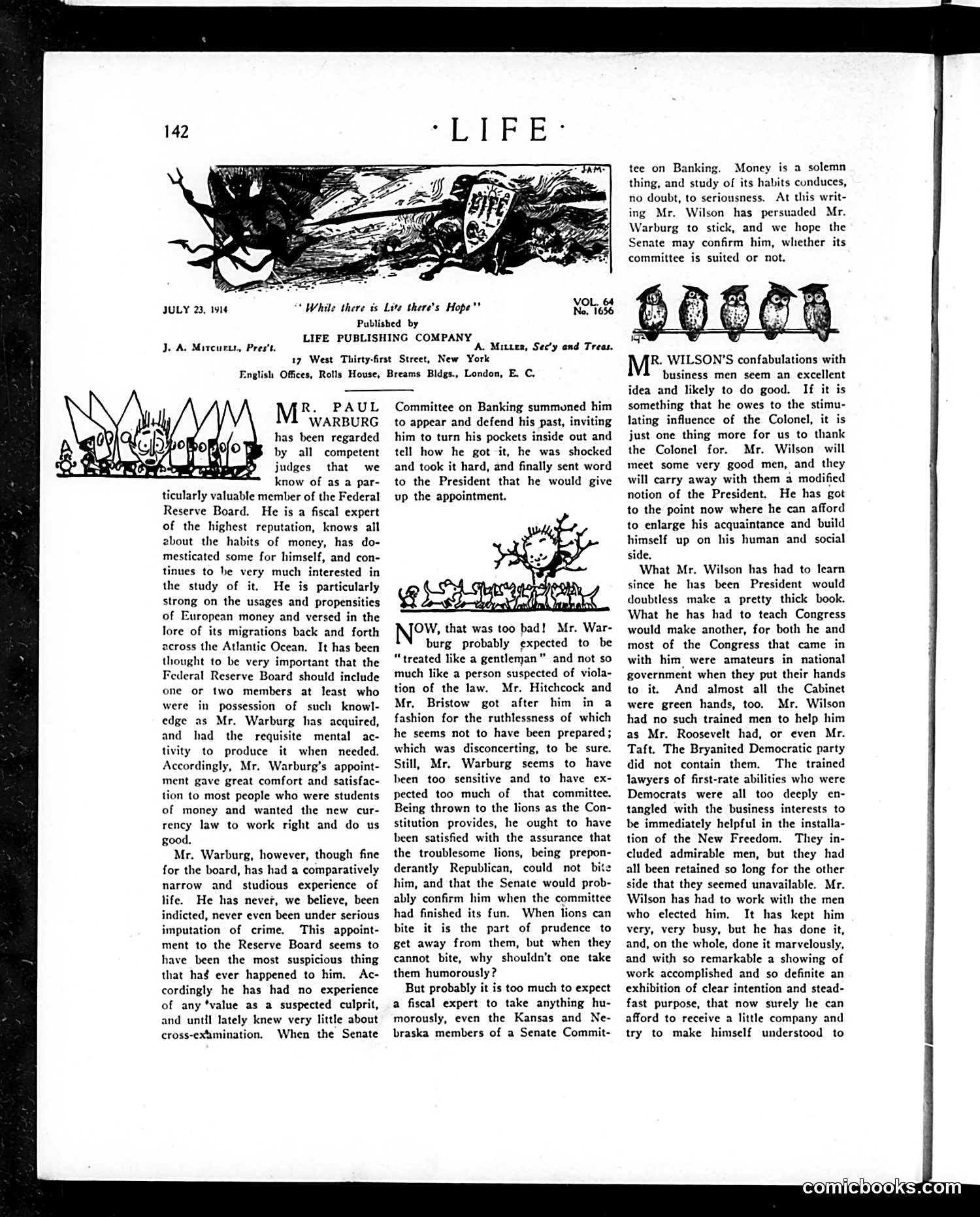
This page satirizes **Paul Warburg's** contentious Senate confirmation hearings for the Federal Reserve Board. Warburg, a respected fiscal expert and banker, was summoned by the Senate Committee on Banking to defend his qualifications and financial background—a process he found humiliating and invasive. The satire's point: Warburg, accustomed to genteel treatment, was shocked at being interrogated "like a person suspected of violation of the law" by senators Hitchcock and Bristow. Life mocks his sensitivity, arguing that if the (Republican-controlled) committee couldn't actually "bite" him—couldn't reject him—he should accept the process humorously rather than threaten resignation. The article notes President Wilson persuaded Warburg to withdraw his resignation and remain committed to the appointment, hoping the Senate would confirm him despite the committee's rough treatment. The cartoon imagery (a dead lion or similar beast) likely visualizes the "thrown to the lions" metaphor used in the text about Senate confirmation ordeal.
📄 Transcribed text from this page (OCR, searchable)
Machine-transcribed from the original scan — historical spelling and the odd misread are preserved.
JULY 23. Wit ‘While there is Lite there’s Hope"’ No, 1656 Published by LIFE PUBLISHING COMPANY J. A. Mircurts, Pres’t, A. Mitten, Sec’y and Treas. 17 West Thirty-first Street, New York English Offices, Rolls House, Breams Bldgs., London, E. C. R. PAUL WARBURG has been regarded by all competent judges that we know of as a par- ticularly valuable member of the Federal Reserve Board. He is a fiscal expert of the highest reputation, knows all 2bout the habits of money, has do- mesticated some for himself, and con- tinues to be very much interested in the study of it. He is particularly strong on the usages and propensities of European money and versed in the lore of its migrations back and forth across the Atlantic Ocean. It has been thought to be very important that the Federal Reserve Board should include one or two members at least who were in possession of such knowl- edge as Mr. Warburg has acquired, and had the requisite mental ac- tivity to produce it when needed. Accordingly, Mr. Warburg’s appoint- ment gave great comfort and satisfac- tion to most people who were students of money and wanted the new cur- rency law to work right and do us good, Mr. Warburg, however, though fine for the board, has had a comparatively narrow and studious experience of life. He has never, we believe, been indicted, never even been under serious imputation of crime. This appoint- ment to the Reserve Board seems to have been the most suspicious thing that hag ever happened to him. Ac- cordingly he has had no experience of any ‘value as a suspected culprit, and until lately knew very little about cross-examination. When the Senate Committee on Banking summoned him to appear and defend his past, inviting him to turn his pockets inside out and tell how he got it, he was shocked and took it hard, and finally sent word to the President that he would give up the appointment. o: (OW, that was too bad! Mr. War- burg probably expected to be “treated like a gentleman” and not so much like a person suspected of viola- tion of the law. Mr. Hitchcock and Mr. Bristow got after him in a fashion for the ruthlessness of which he seems not to have been prepared; which was disconcerting, to be sure. Still, Mr. Warburg seems to have heen too sensitive and to have ex- pected too much of that committee. Being thrown to the lions as the Con- stitution provides, he ought to have been satisfied with the assurance that the troublesome lions, being prepon- derantly Republican, could not bite him, and that the Senate would prob- ably confirm him when the committee had finished its fun. When lions can bite it is the part of prudence to get away from them, but when they cannot bite, why shouldn’t one take them humorously? But probably it is too much to expect a fiscal expert to take anything hu- morously, even the Kansas and Ne- braska members of a Senate Commit- tee on Banking. Money is a solemn thing, and study of its habits conduces, no doubt, to seriousness. At this writ- ing Mr. Wilson has persuaded Mr. Warburg to stick, and we hope the Senate may confirm him, whether its committee is suited or not. 'R. WILSON’S confabulations with business men seem an excellent idea and likely to do good. If it is something that he owes to the stimu- lating influence of the Colonel, it is just one thing more for us to thank the Colonel for. Mr. Wilson will meet some very good men, and they will carry away with them a modified notion of the President. He has got to the point now where he can afford to enlarge his acquaintance and build himself up on his human and social side, What Mr. Wilson has had to learn since he has been President would doubtless make a pretty thick book. What he has had to teach Congress would make another, for both he and most of the Congress that came in with him were amateurs in national government when they put their hands to it. And almost all the Cabinet were green hands, too. Mr. Wilson had no such trained men to help him as Mr. Roosevelt had, or even Mr. Taft. The Bryanited Democratic party did not contain them, The trained lawyers of first-rate abilities who were Democrats were all too deeply en- tangled with the business interests to be immediately helpful in the installa- tion of the New Freedom. They in- cluded admirable men, but they had all been retained so long for the other side that they seemed unavailable. Mr. Wilson has had to work with the men who elected him. It has kept him very, very busy, but he has done it, and, on the whole, done it marvelously, and with so remarkable a showing of work accomplished and so definite an exhibition of clear intention and stead- fast purpose, that now surely he can afford to receive a little company and try to make himself understood to