
Life, 1914-07-23 · page 16 of 40
Life — July 23, 1914 — page 16: what you’re looking at
What you’re looking at
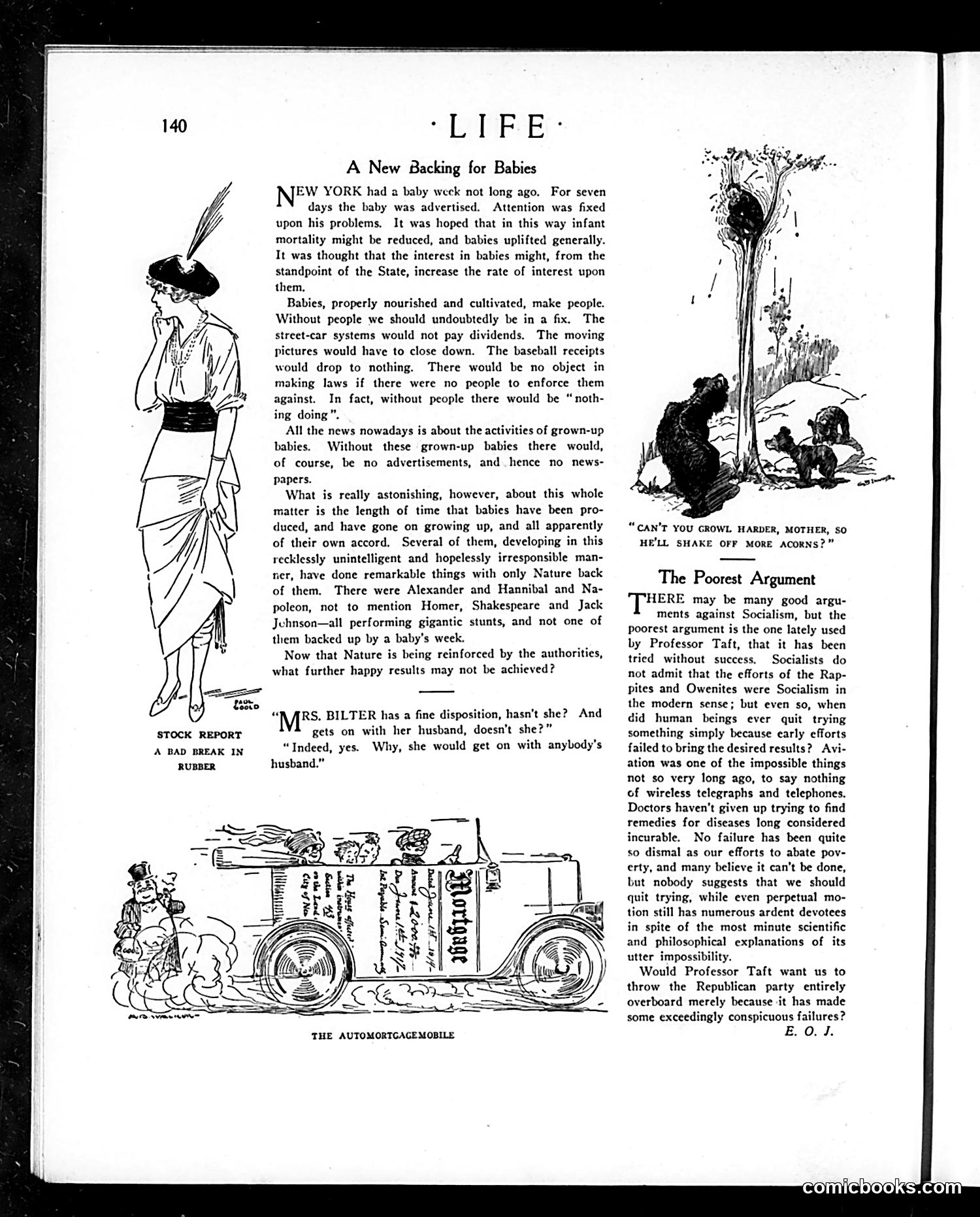
This page contains three distinct satirical pieces: **"A New Backing for Babies"** mocks New York's recent "Baby Week" promotional campaign. The satire suggests that while babies are celebrated as economically essential (they grow into consumers, workers, and law-abiding citizens), society has overlooked that many notable historical figures—Alexander, Hannibal, Napoleon, Shakespeare, Jack Johnson—achieved greatness *without* such organized state backing. The irony: Nature alone has successfully "produced" remarkable people for centuries, yet authorities now claim their intervention will improve results. **"Stock Report: A Bad Break in Rubber"** (bottom cartoon) appears to be a financial joke about rubber stocks, likely referencing market volatility or corporate mismanagement, depicted as an overloaded automobile. **"The Poorest Argument"** rebuts Professor Taft's anti-Socialist position that Socialism failed in past attempts (Rappites, Owenites). The author argues this logic is flawed—humans don't abandon efforts simply because early attempts failed (aviation, medicine, perpetual motion research). By extension, why abandon the Republican party for its failures? All three pieces employ ironic reasoning to deflate conventional wisdom.
📄 Transcribed text from this page (OCR, searchable)
Machine-transcribed from the original scan — historical spelling and the odd misread are preserved.
STOCK REPORT A BAD BREAK IN RUBBER A New Backing for Babies NEW YORK had a baby week not long ago. For seven days the baby was advertised. Attention was fixed upon his problems. It was hoped that in this way infant mortality might be reduced, and babies uplifted generally. It was thought that the interest in babies might, from the standpoint of the State, increase the rate of interest upon them, Babies, properly nourished and cultivated, make people. Without people we should undoubtedly be in a fix. The Street-car systems would not pay dividends. The moving pictures would have to close down. The baseball receipts would drop to nothing. There would be no object in making laws if there were no people to enforce them against. In fact, without people there would be “noth- ing doing”. All the news nowadays is about the activities of grown-up babies. Without these grown-up babies there would, of course, be no advertisements, and hence no news- Papers. What is really astonishing, however, about this whole matter is the length of time that babies have been pro- duced, and have gone on growing up, and all apparently of their own accord, Several of them, developing in this recklessly unintelligent and hopelessly irresponsible man- ner, have done remarkable things with only Nature back of them, There were Alexander and Hannibal and Na- poleon, not to mention Homer, Shakespeare and Jack Jchnson—all performing gigantic stunts, and not one of them backed up by a baby’s week. Now that Nature is being reinforced by the authorities, what further happy results may not be achieved? “MES: BILTER has a fine disposition, hasn’t she? And gets on with her husband, doesn’t she?” “Indeed, yes. Why, she would get on with anybody's husband.” THE AUTOMORTCAGEMOBILE “CAN'T YOU GROWL HARDER, MOTHER, SO HE'LL SHAKE OFF MORE ACORNS?” The Poorest Argument "THERE may be many good argu- ments against Socialism, but the poorest argument is the one lately used Ly Professor Taft, that it has been tried without success. Socialists do not admit that the efforts of the Rap- pites and Owenites were Socialism in the modern sense; but even so, when did human beings ever quit trying something simply because carly efforts failed to bring the desired results? Avi- ation was one of the impossible things not so very long ago, to say nothing of wireless telegraphs and telephones. Doctors haven't given up trying to find remedies for diseases long considered incurable. No failure has been quite so dismal as our efforts to abate pov- erty, and many believe it can’t be done, but nobody suggests that we should quit trying, while even perpetual mo- tion still has numerous ardent devotees in spite of the most minute scientific and philosophical explanations of its utter impossibility. Would Professor Taft want us to throw the Republican party entirely overboard merely because it has made some exceedingly conspicuous failures? E.0.J.