
Life, 1914-07-23 · page 24 of 40
Life — July 23, 1914 — page 24: what you’re looking at
What you’re looking at
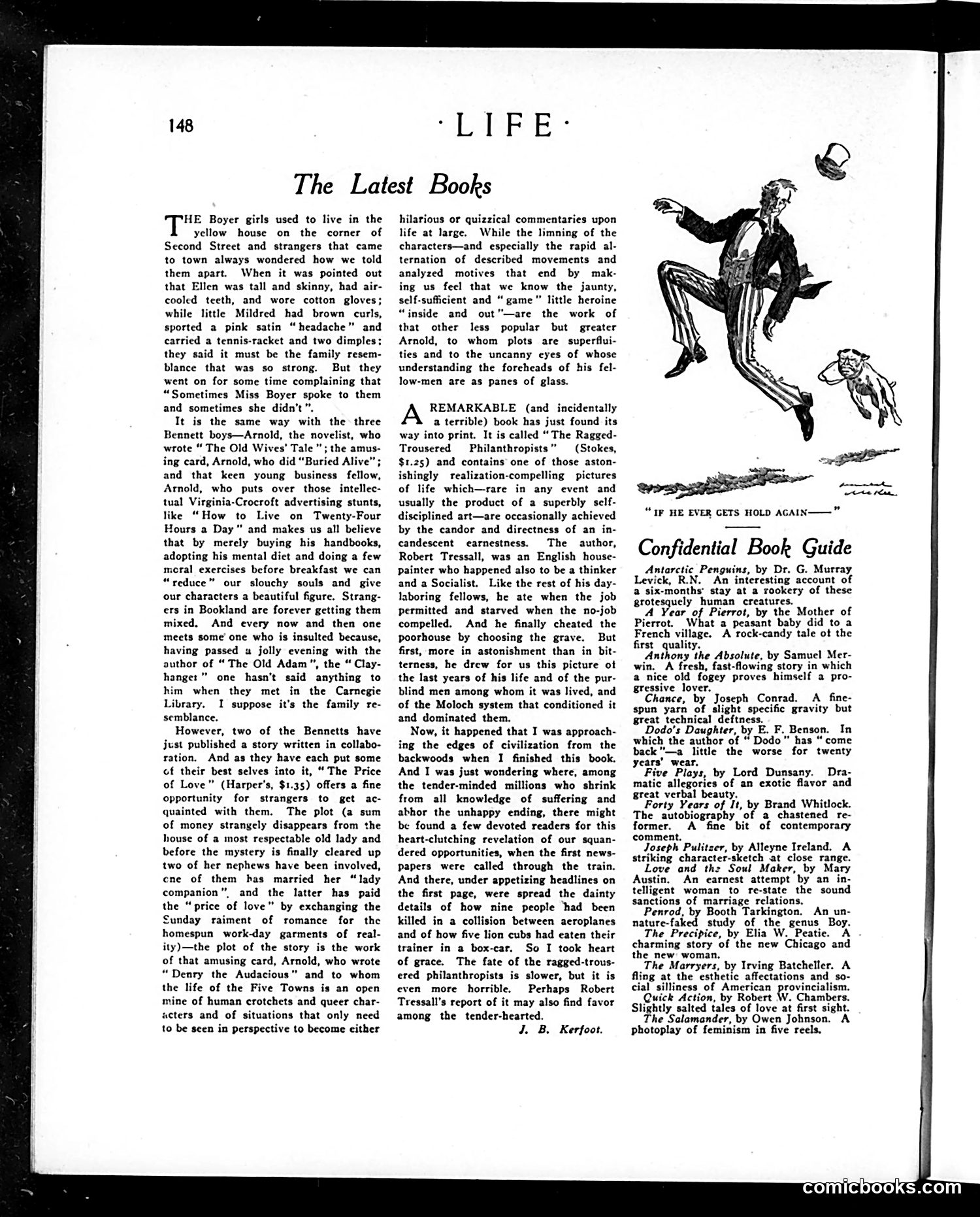
This is a book review section, not a political cartoon. The page discusses recent literary publications, primarily focusing on works by the Bennett brothers (multiple authors sharing the surname Arnold Bennett). The main content reviews "The Price of Love" by Harper's, noting how readers confuse the three Bennett brothers—all named Arnold—who write in different styles. The reviewer humorously compares this to the Boyer sisters, who were similarly difficult to distinguish. The page also previews "The Ragged-Trousered Philanthropists" by Robert Tressall, describing it as a "remarkable (and incidentally terrible) book" that depicts working-class life with unflinching realism. The reviewer notes Tressall was an English housepainter and Socialist who ultimately chose suicide over entering the poorhouse. The small illustrations on the right show figures in motion, likely related to the book advertisements and reviews discussed in the text. This appears to be a standard early 20th-century magazine book review section rather than satirical commentary.
📄 Transcribed text from this page (OCR, searchable)
Machine-transcribed from the original scan — historical spelling and the odd misread are preserved.
TEAIRBAB The Latest Books HE Boyer girls used to live in the yellow house on the corner of Second Street and strangers that came to town always wondered how we told them apart. When it was pointed out that Ellen was tall and skinny, had air- cooled teeth, and wore cotton gloves; while little Mildred had brown curls, sported a pink satin “headache” and carried a tennis-racket and two dimples: they said it must be the family resem- blance that was so strong. But they went on for some time complaining that “Sometimes Miss Boyer spoke to them and sometimes she didn’t”. It is the same way with the three Bennett boys—Arnold, the novelist, who wrote “ The Old Wives’ Tale"; the amus- ing card, Arnold, who did “Buried Alive” ; and that keen young business fellow, Arnold, who puts over those intellec- tual Virginia-Crocroft advertising stunts, like “How to Live on Twenty-Four Hours a Day” and makes us all believe that by merely buying his handbooks, adopting his mental diet and doing a few meral exercises before breakfast we can “reduce” our slouchy souls and give our characters a beautiful figure. Strang- ers in Bookland are forever getting them mixed. And every now and then one meets some’ one who is insulted because, having passed a jolly evening with the author of “The Old Adam”, the “ Clay- hanger” one hasn't said anything to him when they met in the Carnegie Library. I suppose it's the family re- semblance. However, two of the Bennetts have just published a story written in collabo- ration. And as they have each put some of their best selves into it, “ The Price of Love” (Harper's, $1.35) offers a fine opportunity for strangers to get ac- quainted with them. The plot (a sum of money strangely disappears from the house of a most respectable old lady and before the mystery is finally cleared up two of her nephews have been involved, cne of them has married her “lady companion”, and the latter has paid the “price of love” by exchanging the {unday raiment of romance for the homespun work-day garments of real- ity)—the plot of the story is the work of that amusing card, Arnold, who wrote “Denry the Audacious” and to whom the life of the Five Towns is an open mine of human crotchets and queer char- acters and of situations that only need to be seen in perspective to become cither hilarious or quizzical commentaries upon life at large. While the limning of the characters—and especially the rapid al- ternation of described movements and analyzed motives that end by mak- ing us feel that we know the jaunty, self-sufficient and “game” little heroine “inside and out”—are the work of that other less popular but greater Arnold, to whom plots are superflui- ties and to the uncanny eyes of whose understanding the foreheads of his fel- low-men are as panes of glass. REMARKABLE (and incidentally a terrible) book has just found its way into print. It is called “ The Ragged- Trousered Philanthropists” (Stokes, $1.25) and contains one of those aston- ishingly realization-compelling pictures of life which—rare in any event and usually the product of a superbly self- disciplined art—are occasionally achieved by the candor and directness of an in- candescent earnestness. The author, Robert Tressall, was an English house- painter who happened also to be a thinker and a Socialist. Like the rest of his day- laboring fellows, he ate when the job permitted and starved when the no-job compelled. And he finally cheated the poorhouse by choosing the grave. But first, more in astonishment than in bit- terness, he drew for us this picture ot the last years of his life and of the pur- blind men among whom it was lived, and of the Moloch system that conditioned it and dominated them. Now, it happened that I was approach- ing the edges of civilization from the backwoods when I finished this book. And I was just wondering where, among the tender-minded millions who shrink from all knowledge of suffering and abhor the unhappy ending, there might be found a few devoted readers for this heart-clutching revelation of our squan- dered opportunities, when the first news- papers were called through the train. And there, under appetizing headlines on the first page, were spread the dainty details of how nine people had been killed in a collision between aeroplanes and of how five lion cubs had eaten their trainer in a box-car. So I took heart of grace. The fate of the ragged-trous- ered philanthropi: is slower, but it is even more horribli Perhaps Robert Tressall’s report of it may also find favor among the tender-hearted. J. B. Kerfoot. “IP HE EVER GETS HOLD AGAIN——” Confidential Book Guide Antarctic Penguins, by Dr. G. Murray Levick, R.N. An interesting account of a six-months’ stay at a rookery of these grotesquely human creatures. A Year of Pierrot, by the Mother of Pierrot. What a peasant baby did to a French village. A rock-candy tale ot the first quality. Anthony the Absolute, by Samuel Mer- win. A fresh, fast-flowing story in which a nice old fogey proves himself a pro- gressive lover. Chance, by Joseph Conrad. A fine- spun yarn of slight specific gravity but great technical deftness. Dodo's Daughter, by E. F. Benson. In which the author of “ Dodo” has “ come back”—a little the worse for twenty years’ wear. Five Plays, by Lord Dunsany. Dra- matic allegories of an exotic flavor and great verbal beauty. 3 Forty Years of It, by Brand Whitlock. The autobiography ‘of a chastened re- former. A fine bit of contemporary comment. Joseph Pulitzer, by Alleyne Ireland. A striking character-sketch at close range. Love and the Soul Maker, by Mary Au ‘An earnest attempt by an in- it woman to re-state the sound sanctions of marriage relations. Penrod, by Booth Tarkington. An un- naturefaked. study of the genus Boy. The Precipice, by Elia W. Peatie. A charming story of the new Chicago and the new woman, The Marryers, by Irving Batcheller. A fling at the esthetic affectations and _so- cial silliness of American provincialism. Quick Action, by Robert W. Chambers. Slightly salted tales of love at first sight. The Salamander, by Owen Johnson. photoplay of feminism in five reels.