
A complete issue · 44 pages · 1914
Life — June 11, 1914
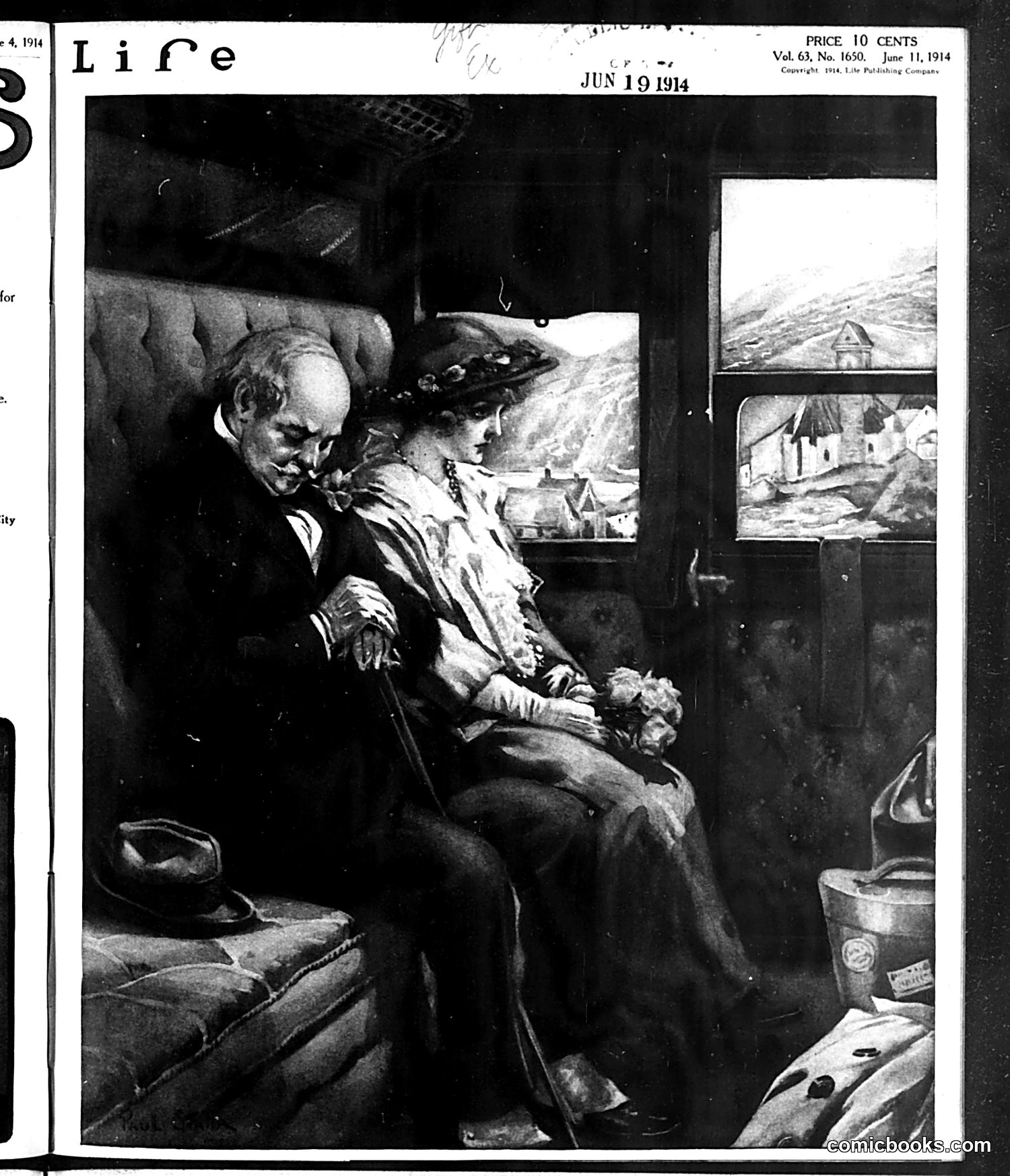
This illustration depicts two well-dressed passengers in what appears to be a train or automobile interior, gazing out at scenic mountain landscapes visible through windows. The man on the left is bald and elderly; the woman wears an ornate hat typical of 1914 fashion. The humor likely satirizes wealthy tourists or travelers of the era, suggesting they're more absorbed in viewing postcard-like scenery than engaging authentically with their surroundings. The interior setting, with its cushioned seating and framed landscape views, implies a comfortable, insulated travel experience—possibly mocking the leisured class's superficial consumption of nature and tourism during this period. Without accompanying text visible on this cropped page, the specific satirical target remains somewhat unclear.
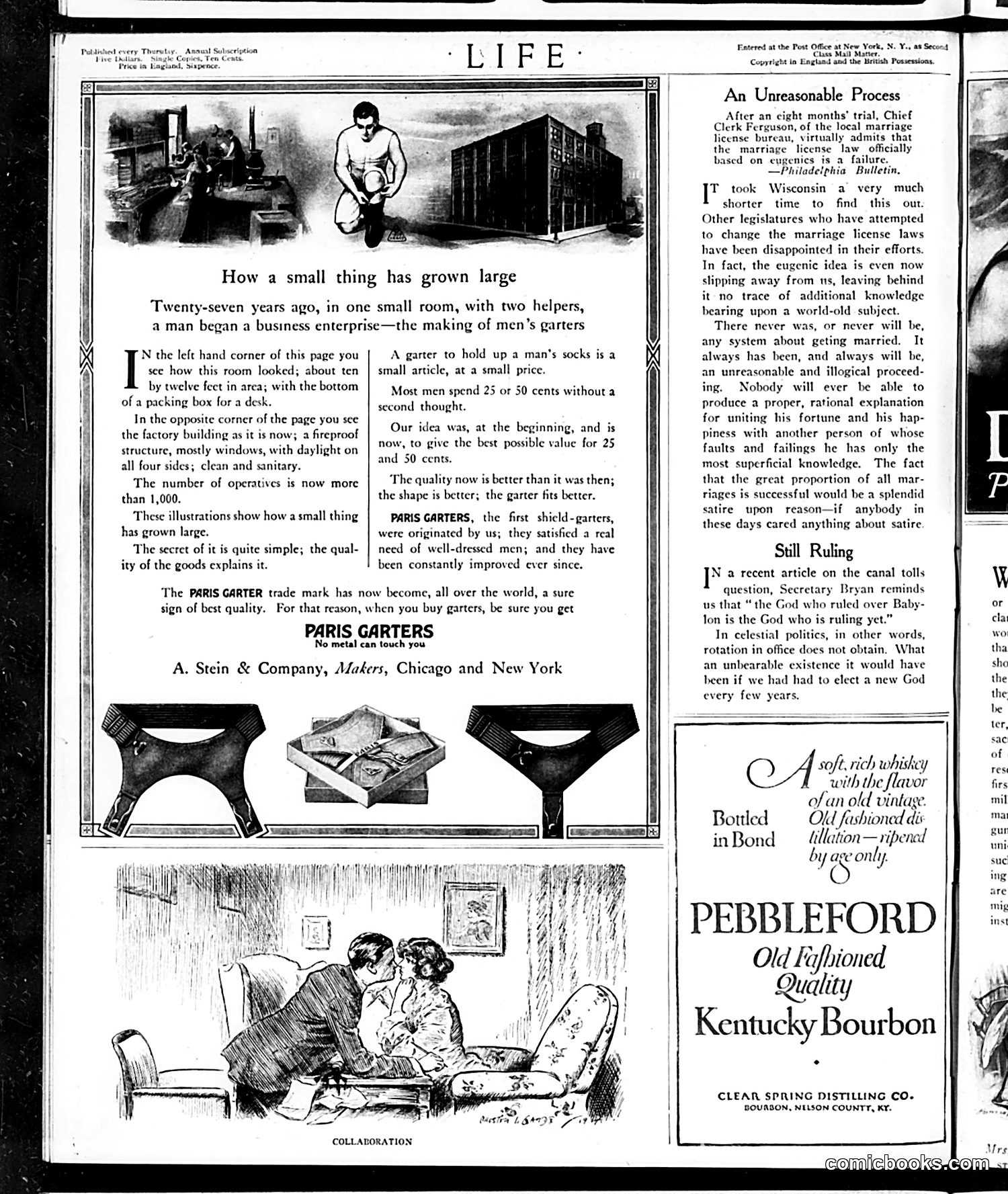
This page contains **mostly advertising and feature content** rather than political satire. The main article "How a Small Thing Has Grown Large" celebrates the **Paris Garters** brand—a sock supporter (garter) product—through before-and-after imagery showing a factory's expansion from a small room to a large industrial building over 27 years. The text emphasizes quality improvement and market success, a straightforward commercial narrative typical of early 20th-century magazine advertising. The bottom cartoon labeled "Collaboration" appears to show a domestic scene of two people together, likely illustrating companionship or intimacy, though its specific satirical point is unclear from the image alone. The right column contains unrelated articles on marriage law and a whiskey advertisement. Overall, this represents standard magazine content blending commerce with light editorial material.
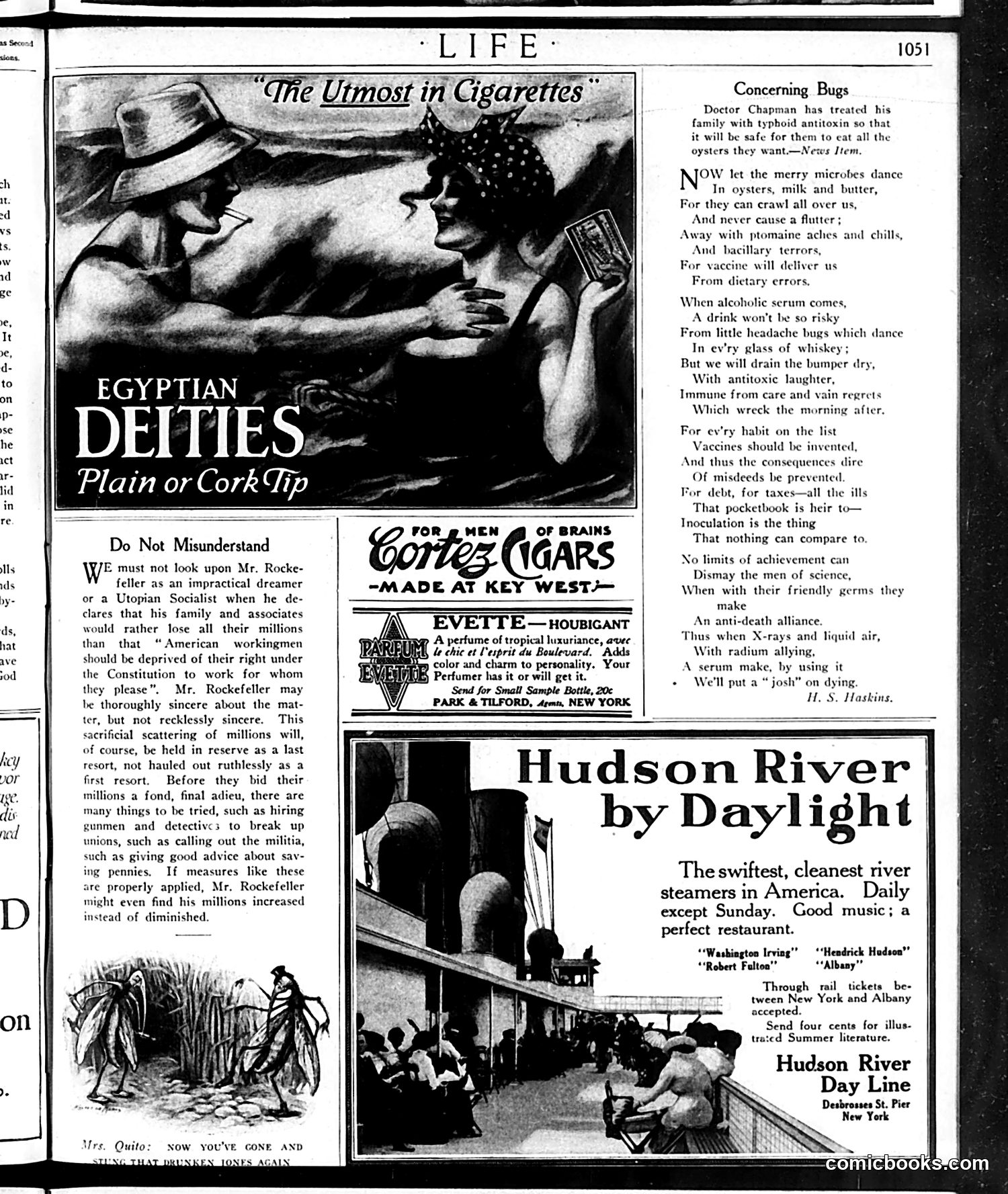
This Life magazine page is primarily **advertising and light content** rather than political satire. The main cartoon depicts an Egyptian figure offering cigarettes to a Western man in a hat, playing on Orientalist stereotypes ("Egyptian Deities"). It's a product advertisement for cigarettes, using exotic imagery to appeal to consumers. The article "Do Not Misunderstand" discusses **John D. Rockefeller's philanthropy**, defending his charitable giving against criticism that he was a "Utopian Socialist." The author argues Rockefeller's millions in reserves represent legitimate wealth management, not radical politics. The remaining content includes advertisements (Cortez Cigars, Evette perfume, Hudson River Day Line steamship service) and a poem "Concerning Bugs" about disease prevention and vaccines. The page reflects early 20th-century consumer culture and public relations messaging.
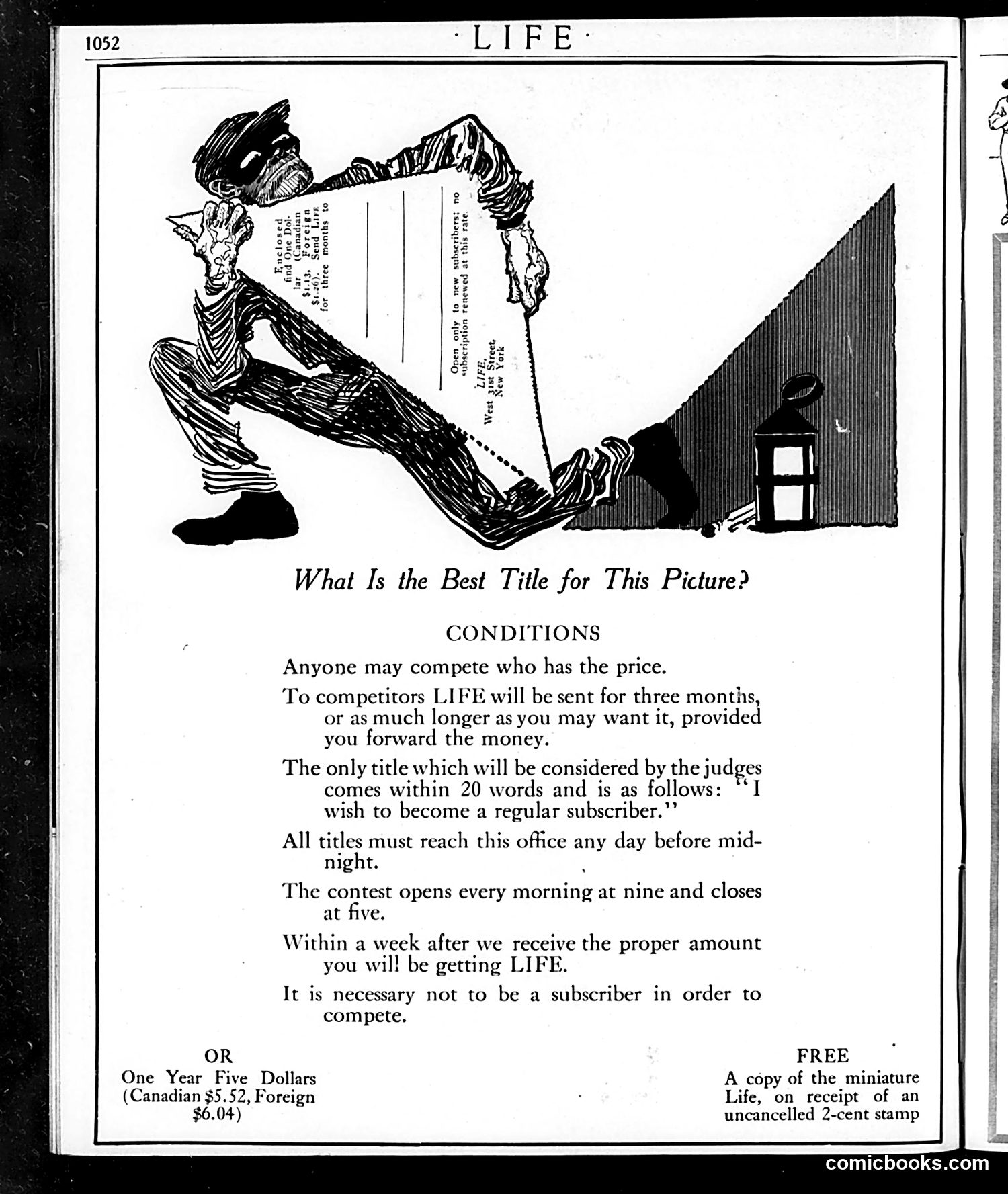
This page is primarily a **contest advertisement** rather than political satire. Life magazine is running a title-naming contest for the cartoon above, which depicts a caricatured figure (appears to be a business or political figure based on the exaggerated features) being pulled or suspended by strings like a puppet, with a small building below. The satirical point seems to be about **manipulation or control**—the puppet imagery suggests someone is being controlled by unseen forces. However, without identifying the specific figure or historical context, the exact target of criticism remains unclear. The contest itself is the main content: entrants must submit titles under 20 words ending with "I wish to become a regular subscriber," pay five dollars, and can win a year's subscription to Life magazine.
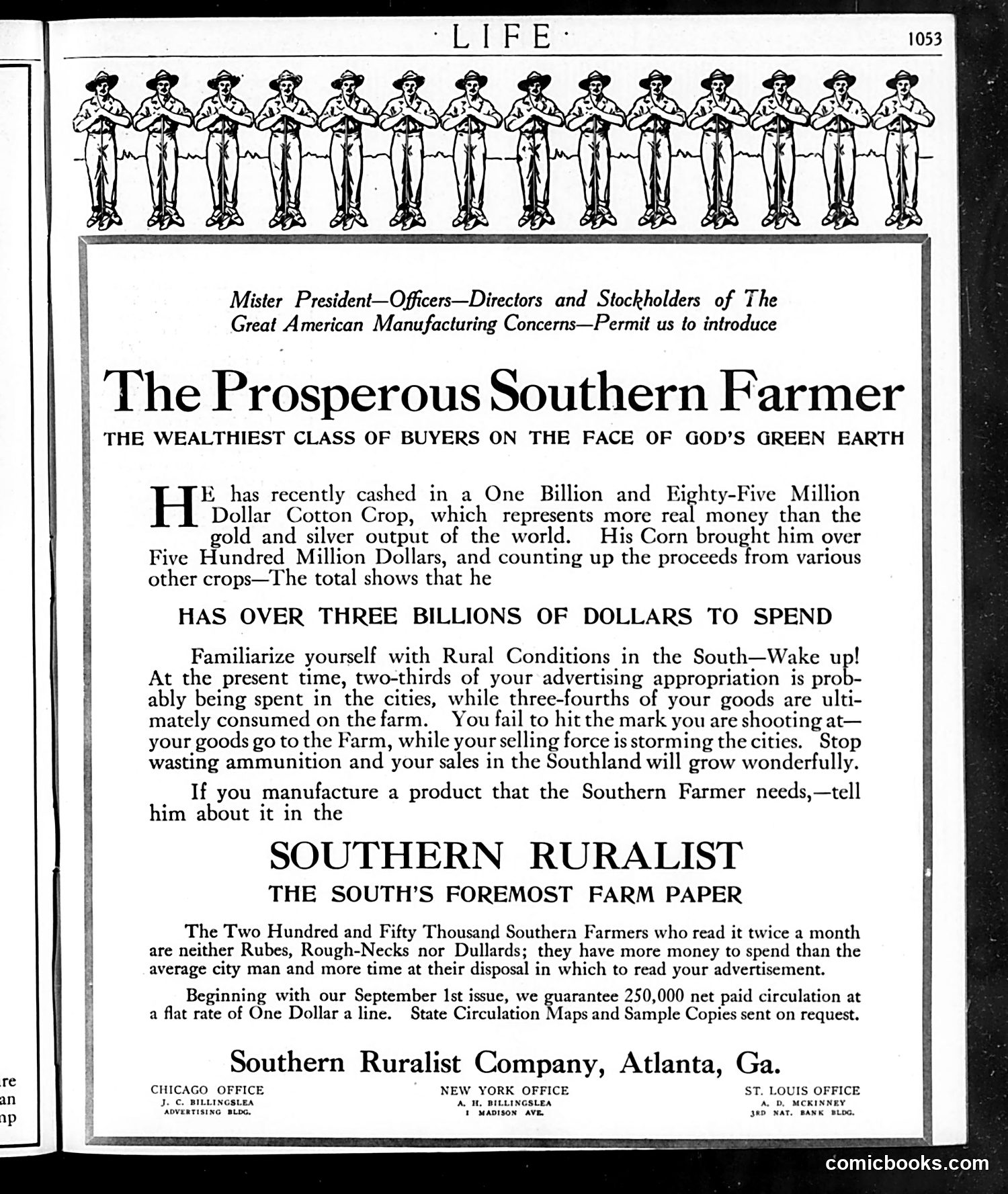
This page is primarily **advertising**, not satire or political commentary. It's a full-page ad from the Southern Ruralist Company (Atlanta, Georgia) promoting their farm publication to manufacturers and business leaders. The decorative header shows repeated cowboy/farmer figures in identical poses—a visual device emphasizing uniformity and mass appeal. The ad's pitch targets industrial manufacturers: Southern farmers allegedly possess "$3 billion to spend," making them "the wealthiest class of buyers." The text claims advertisers waste resources on cities when rural Southern markets remain underpenetrated. This reflects early 20th-century marketing strategy—identifying untapped consumer demographics in agricultural regions. The ad promises 250,000 readers with purchasing power, positioning the publication as an efficient advertising channel to reach prosperous farmers directly.
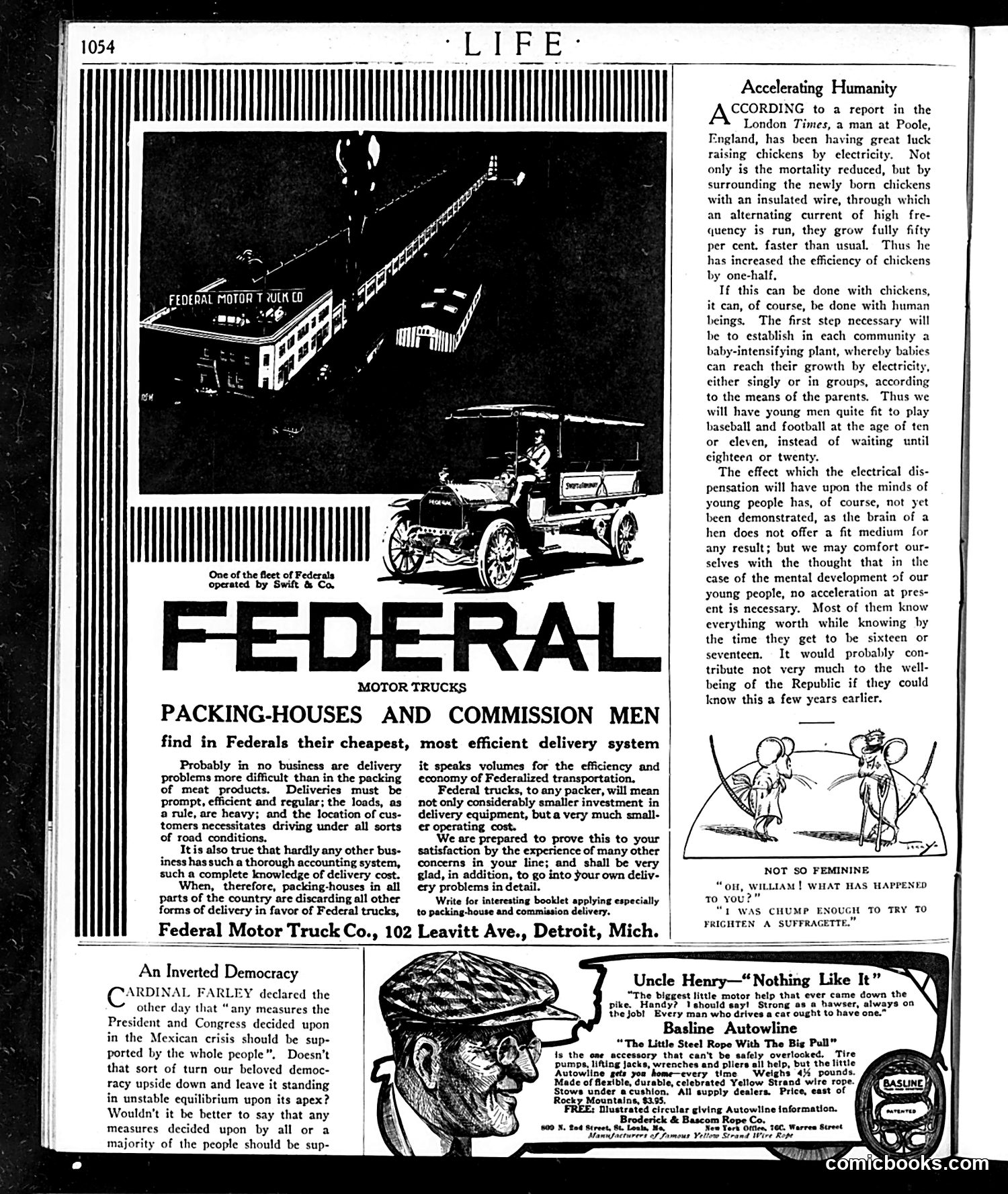
This page is primarily **advertising rather than political satire**. The main content features a Federal Motor Truck Company advertisement showing delivery vehicles, targeting "packing-houses and commission men" with claims about efficient meat product delivery. Below that is a small cartoon labeled "NOT SO FEMININE" depicting a woman saying she was "chump enough to try to frighten a suffragette"—a brief joke about the women's suffrage movement, suggesting suffragettes were known for fearlessness or aggression. The lower section includes an "Uncle Henry" advertisement and a "Basline Autovoline" motor oil ad. The page's top article discusses accelerating child development through electricity, reflecting early-20th-century technological optimism. Overall, this is a commercial rather than satirical page.
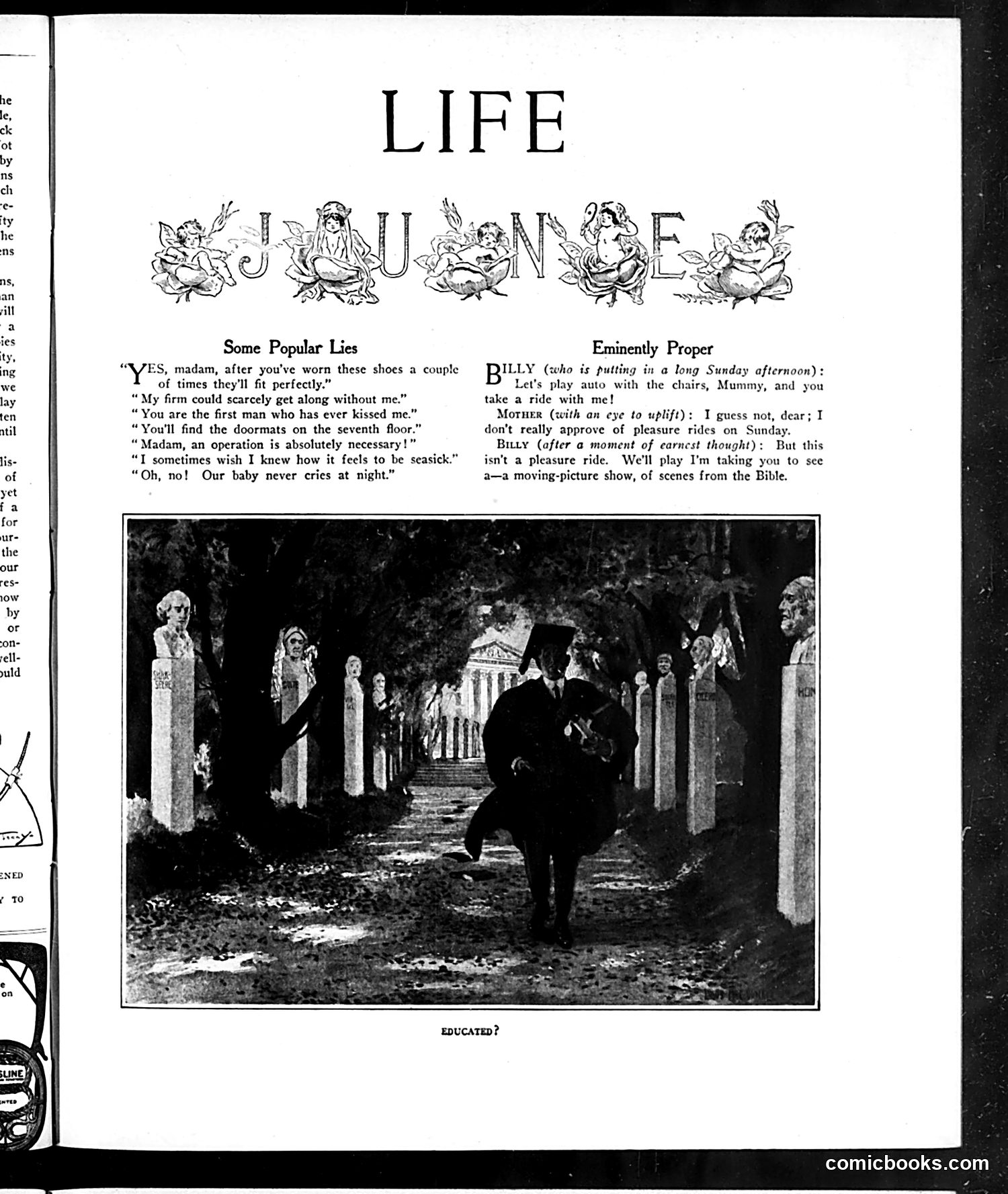
This page from *Life* magazine satirizes Sunday social conventions and parental hypocrisy. The top section presents "Some Popular Lies"—common false reassurances parents give children about worn-out shoes, firm beds, and babies never crying—contrasted with "Eminently Proper" behavior expectations, where Billy is forbidden pleasure rides on Sunday but permitted Bible-themed moving pictures instead. The photograph below, captioned "EDUCATED?", depicts an elegant evening scene with couples in formal dress strolling through what appears to be a classical garden or colonnade. The satire likely mocks the contradiction between strict moral rules imposed on youth and the sophisticated social indulgences adults actually enjoy—questioning whether such restrictive upbringing constitutes genuine education or merely hypocrisy.
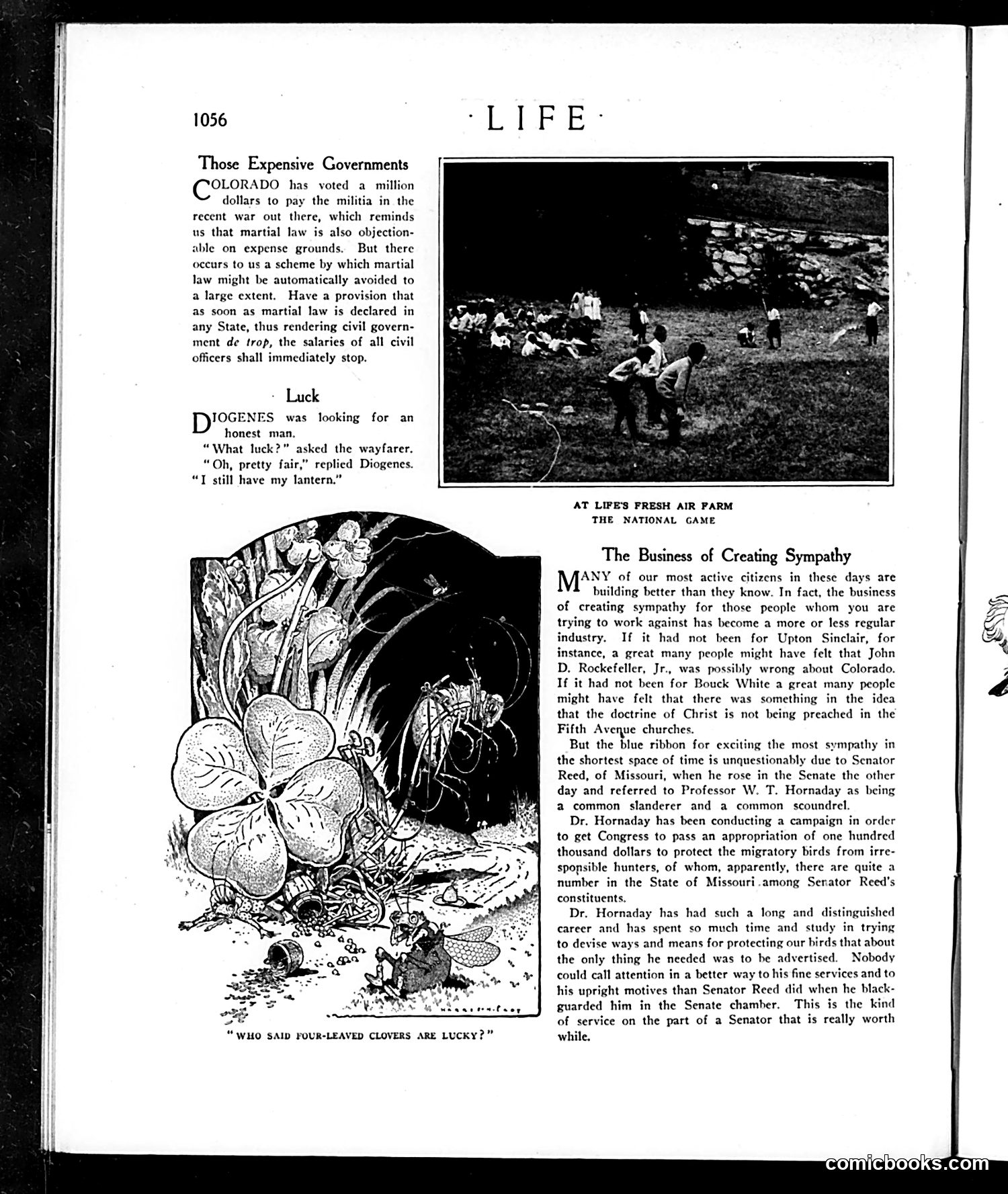
The page contains two separate items: **"Those Expensive Governments"** critiques martial law costs in Colorado, arguing that if civil government automatically ceased during martial law declarations, salaries would stop—potentially making martial law economically self-limiting. **"Luck"** is a brief philosophical joke: Diogenes (the ancient Greek cynic philosopher famous for seeking an honest man) searches for one, dismissing the wayfarer's claim of fairness. Diogenes's punchline—"I still have my lantern"—references his famous lantern used to search for honest people, implying none exist. The illustration of four-leaf clovers accompanies wordplay on luck. The longer article discusses **Dr. Hornaday's bird conservation efforts**, praised by Senator Reed for protecting migratory birds from hunters—presented as exemplary public service and sympathy for a worthy cause.
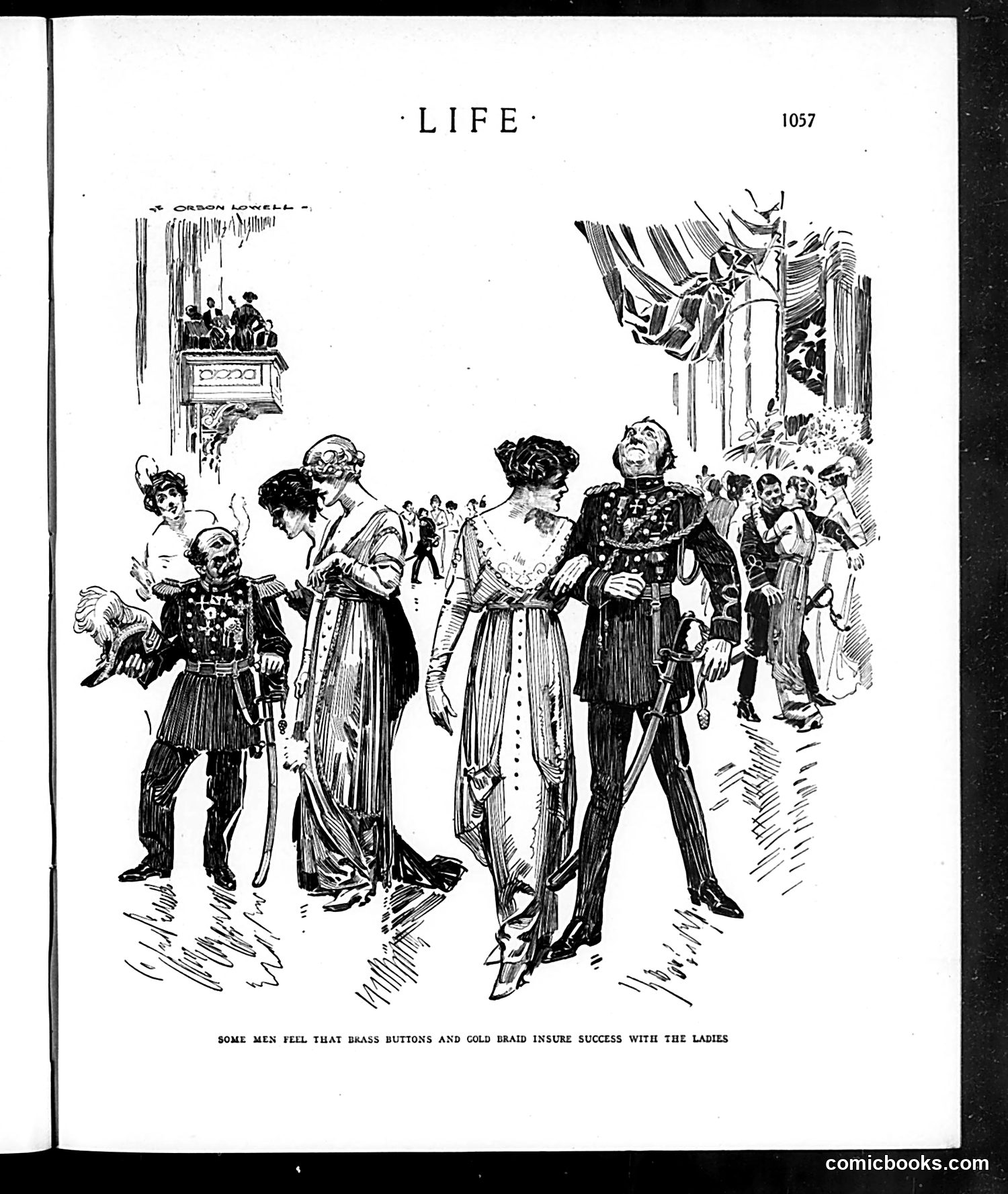
This is a satirical cartoon about military officers and social success. The illustration shows uniformed military men—identifiable by their brass buttons, gold braid, and formal dress uniforms—socializing with well-dressed women at what appears to be a formal event or ball. The caption reads: "SOME MEN FEEL THAT BRASS BUTTONS AND GOLD BRAID INSURE SUCCESS WITH THE LADIES" The satire mocks the assumption that military rank and regalia automatically attract romantic attention from women. The cartoon suggests that some men naively believe their uniforms and military status are sufficient to impress or seduce women, satirizing both male vanity and the cultural prestige attached to military dress during this era. The style and subject matter suggest this is from the early 20th century.
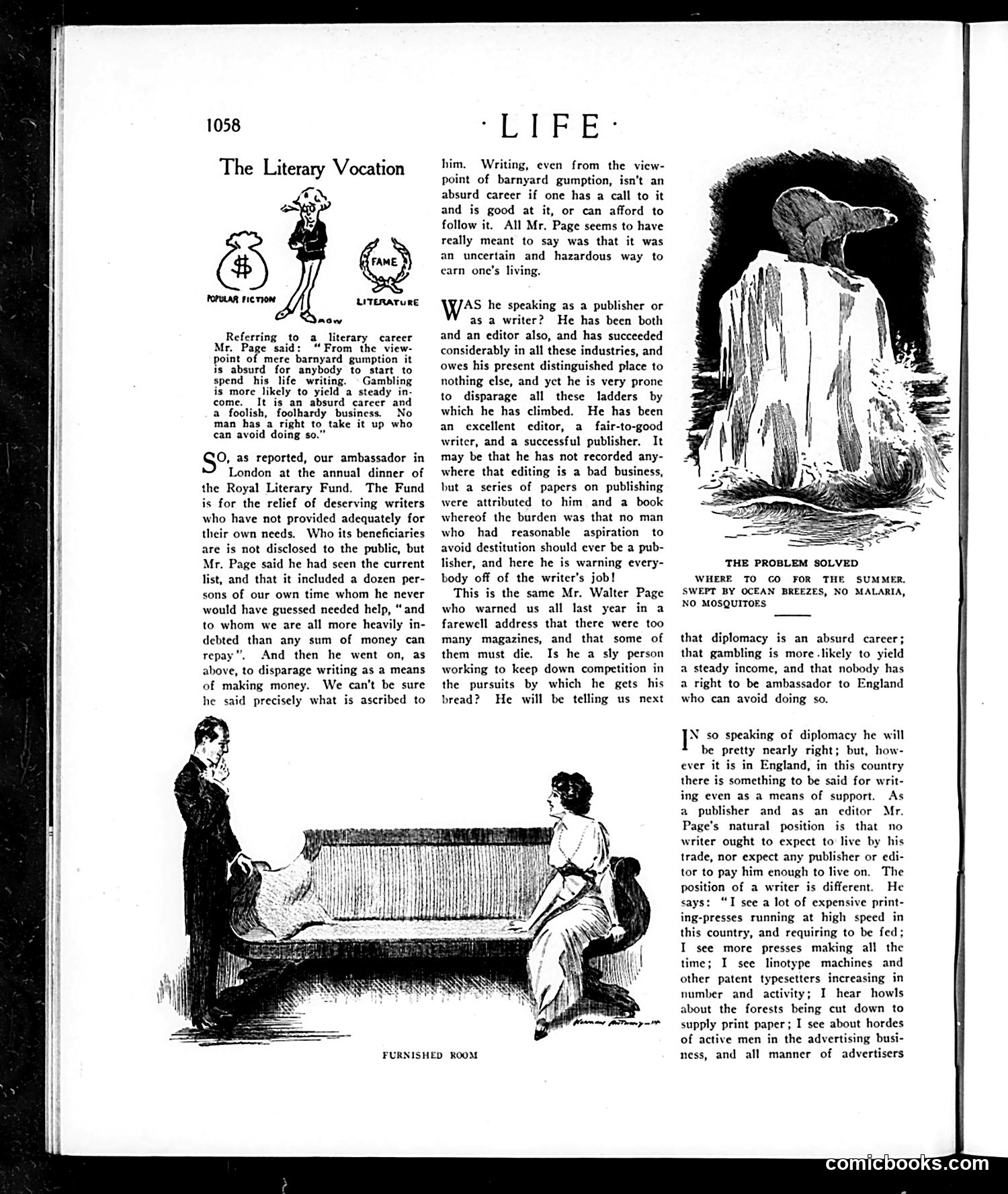
This page critiques the publishing industry and writers' economic struggles. The top cartoon shows three paths: "Popular Fiction" (money bag), a struggling writer, and "Literature" (laurel wreath)—satirizing how commercial writing pays while serious literature offers only prestige. The main text attacks Mr. Walter Page, a prominent publisher-editor, for dismissing writing as an unreliable career while himself profiting from the industry. The article argues Page hypocritically disparages literary pursuits despite his success in publishing, then warns other writers that editing is equally unstable work. The "Furnished Room" illustration depicts a sparse apartment—visualizing the poverty writers actually face—undercutting Page's dismissive attitude toward their financial desperation.
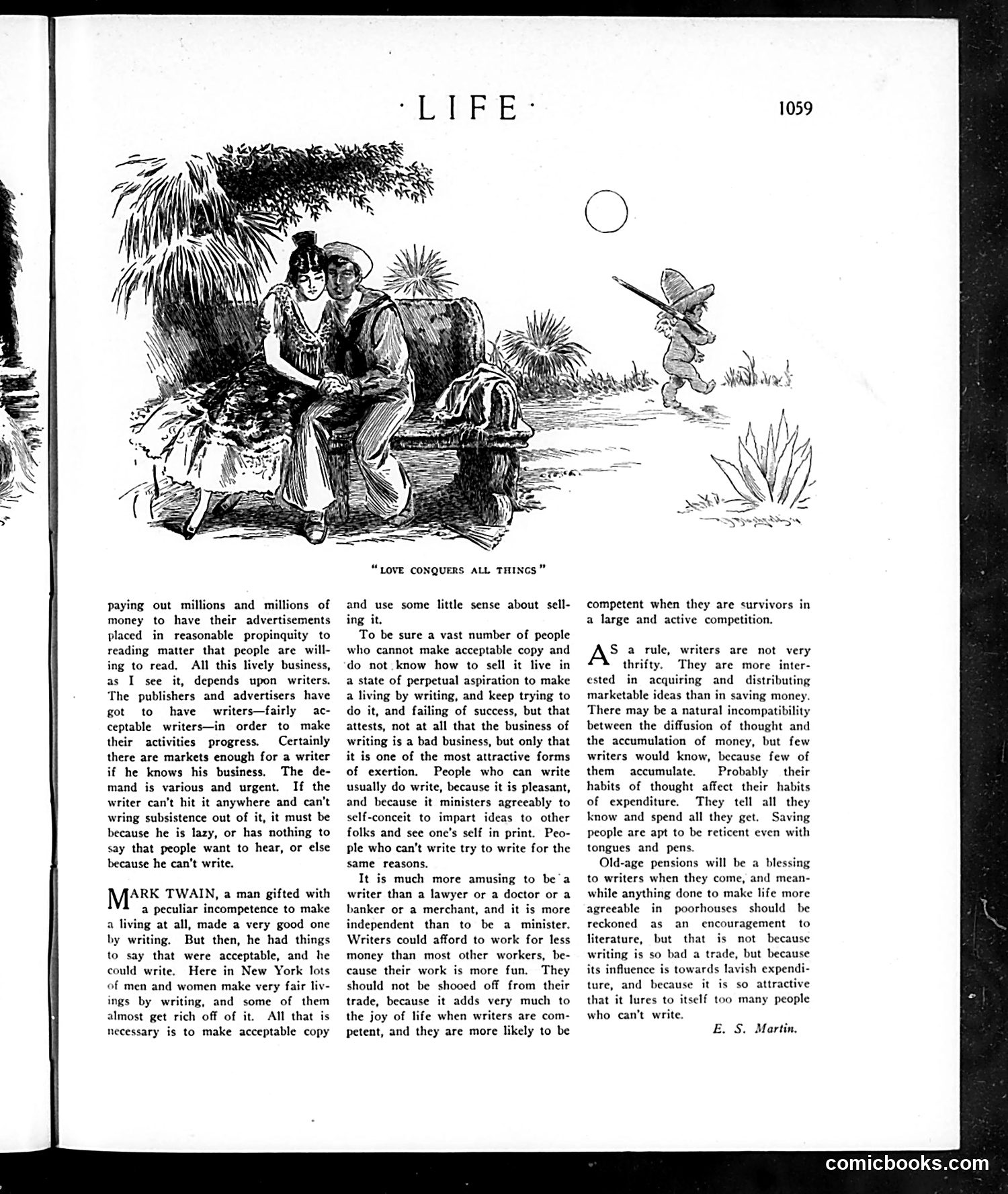
The illustration depicts a couple in romantic repose beneath tropical vegetation while a figure in the distance carries a large cross. The caption "Love Conquers All Things" appears ironic given the religious imagery. The accompanying text discusses writing as a profession, with passages attributed to Mark Twain praising writers' independence and social value compared to lawyers and doctors. The article argues that writing offers both financial and personal rewards, and that competent writers are increasingly valuable in a competitive marketplace. The cartoon likely satirizes romantic idealism by juxtaposing lovers against religious duty or sacrifice—suggesting that love's conquering power conflicts with other life obligations, particularly spiritual commitment. The tropical setting emphasizes escapism from worldly concerns.
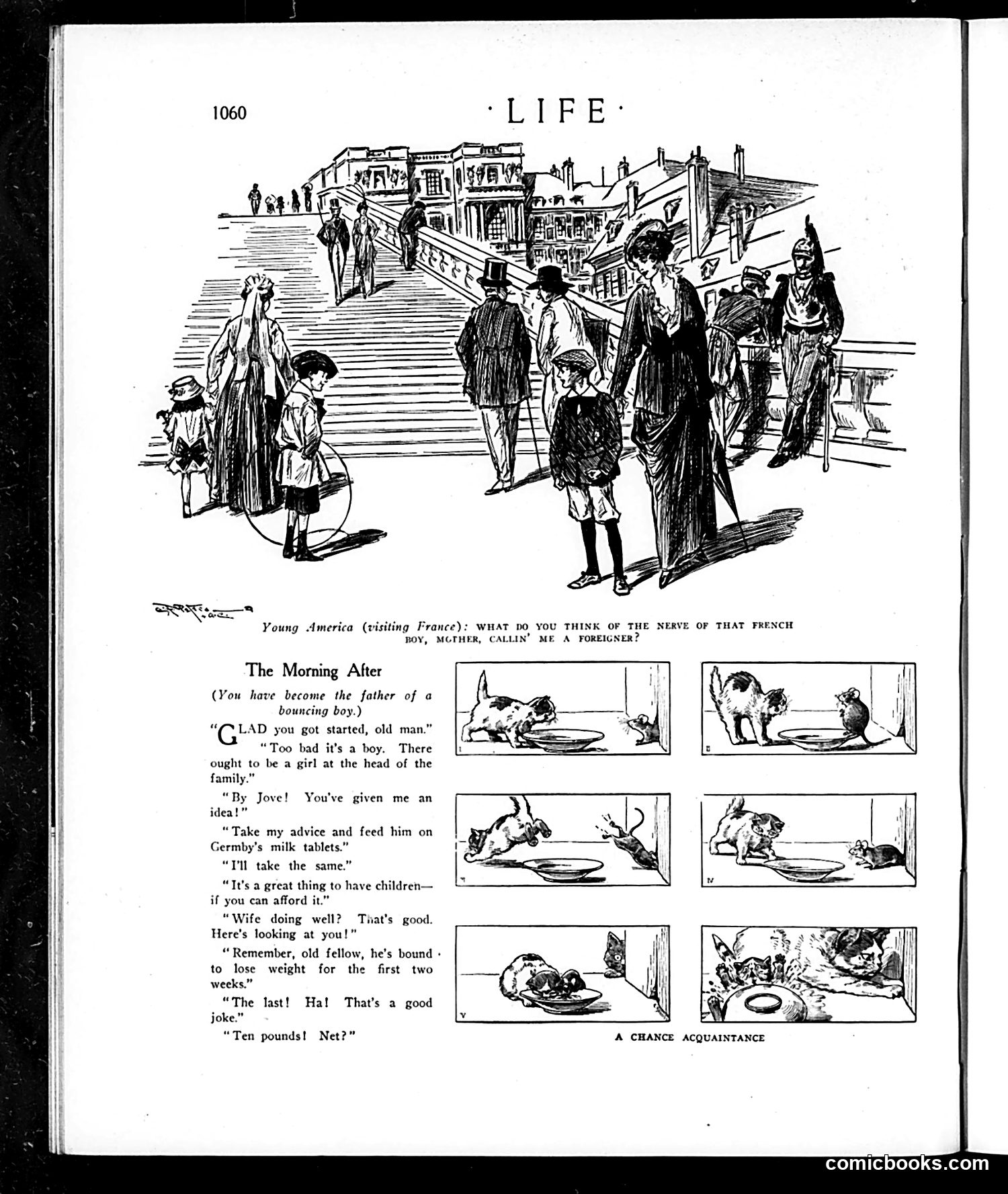
The top illustration depicts a diverse crowd on what appears to be a promenade or public boardwalk, with the caption addressing "Young America (visiting France)" about French attitudes toward foreigners. Below this is a humorous comic strip titled "The Morning After" about a couple's newborn baby boy. The dialogue satirizes parenting anxieties: the father expresses relief the baby isn't a girl, while discussing infant care using "Germy's milk tablets." The joke culminates in concern about the infant losing weight ("ten pounds!"). The strip "A Chance Acquaintance" features six panels depicting dogs and cats interacting, apparently illustrating an unexpected encounter between animals. The overall page appears designed for satirical humor about American tourists abroad and domestic family life of the era.
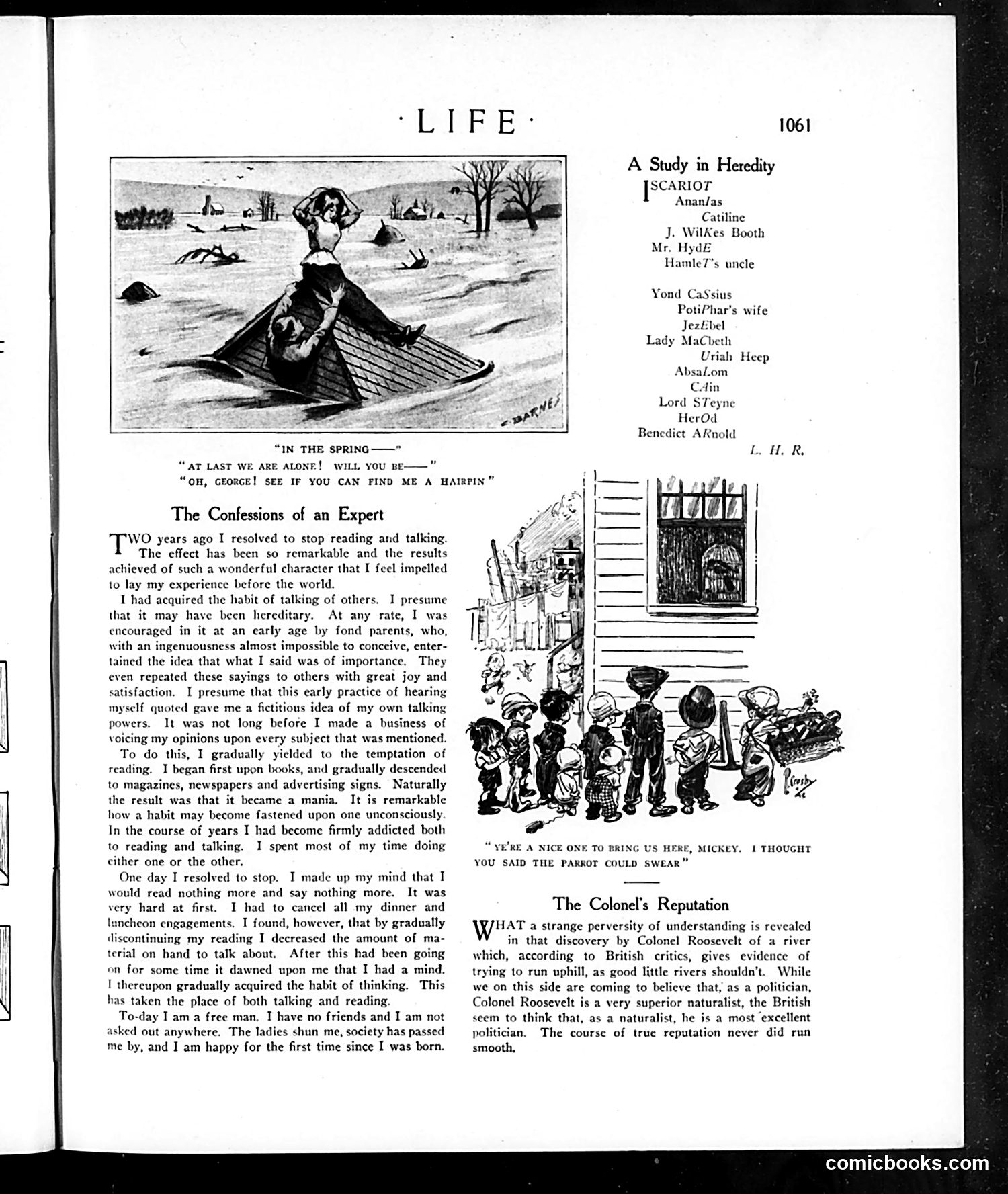
The page contains two distinct pieces: **Top illustration ("In the Spring"):** A woman in a boat calls out to find a harp, with a sparse, desolate landscape. The caption suggests spring as a time of loneliness and isolation—likely satirizing romantic expectations versus reality. **"The Confessions of an Expert":** A lengthy personal essay where the author describes breaking a two-year resolution to stop reading and talking, having become addicted to both habits. The piece humorously confesses how reading led to constant opinion-sharing, though ultimately the author claims to have achieved freedom through thinking instead. **"The Colonel's Reputation":** Brief commentary on Colonel Roosevelt, noting British critics' perception of him as a naturalist rather than politician—with ironic undertones about his actual political prominence versus scientific credentials. The page is primarily text-based satire and social commentary typical of Life's satirical content.
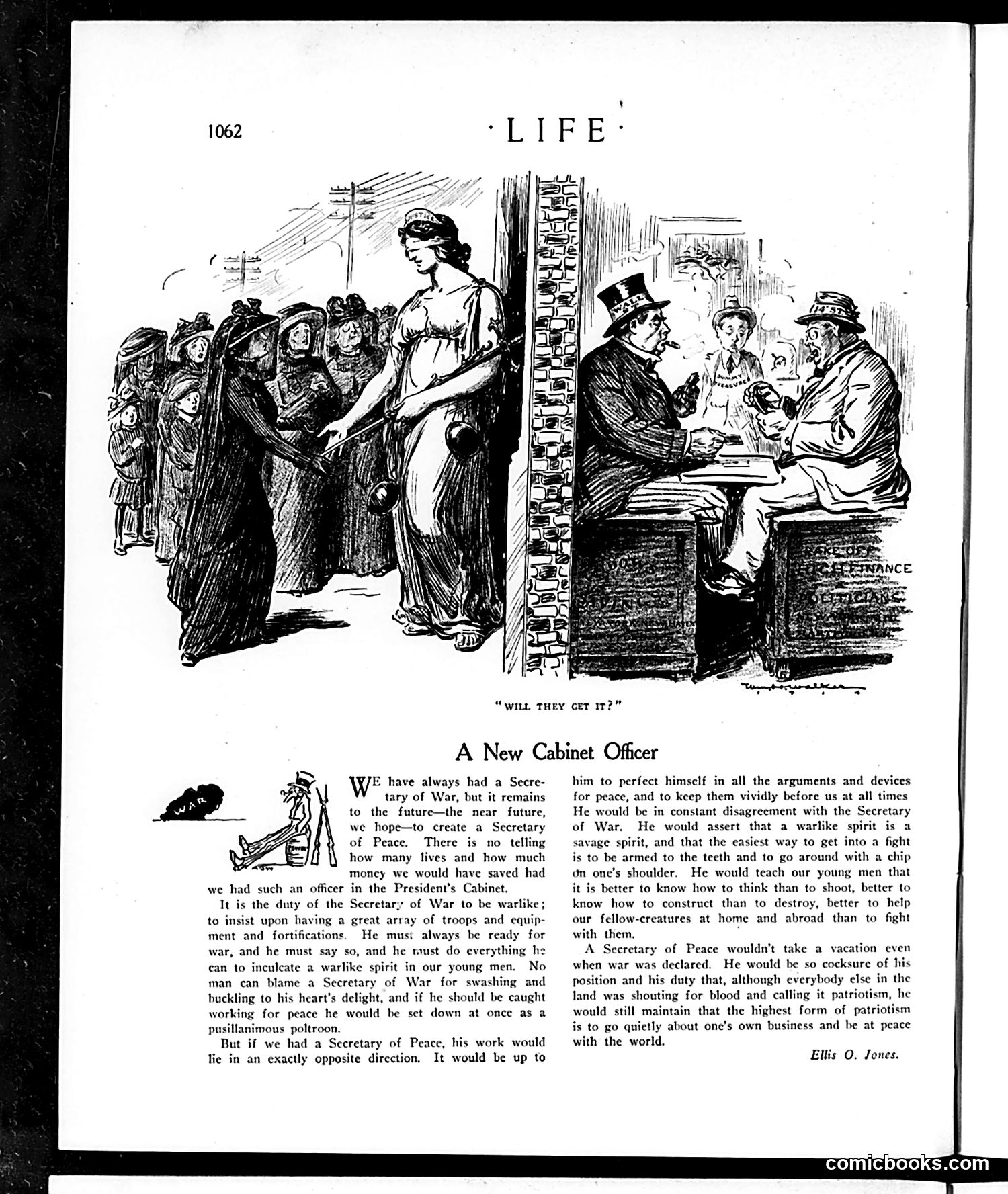
This satirical piece proposes creating a Secretary of Peace to complement the existing Secretary of War. The cartoon shows a woman (representing Peace or Liberty) presenting this idea to officials at what appears to be a government office. The article argues that a Secretary of Peace would pursue the opposite duties of the Secretary of War—promoting disarmament, negotiation, and teaching peaceful conflict resolution rather than military preparation. The satire critiques the imbalance in American governance by highlighting how the government heavily prioritizes military readiness while lacking an equivalent cabinet position dedicated to peace. Author Ellis O. Jones uses this proposal to comment on institutional priorities and militarism, suggesting the U.S. government structure itself reflects a bias toward warfare over diplomacy.
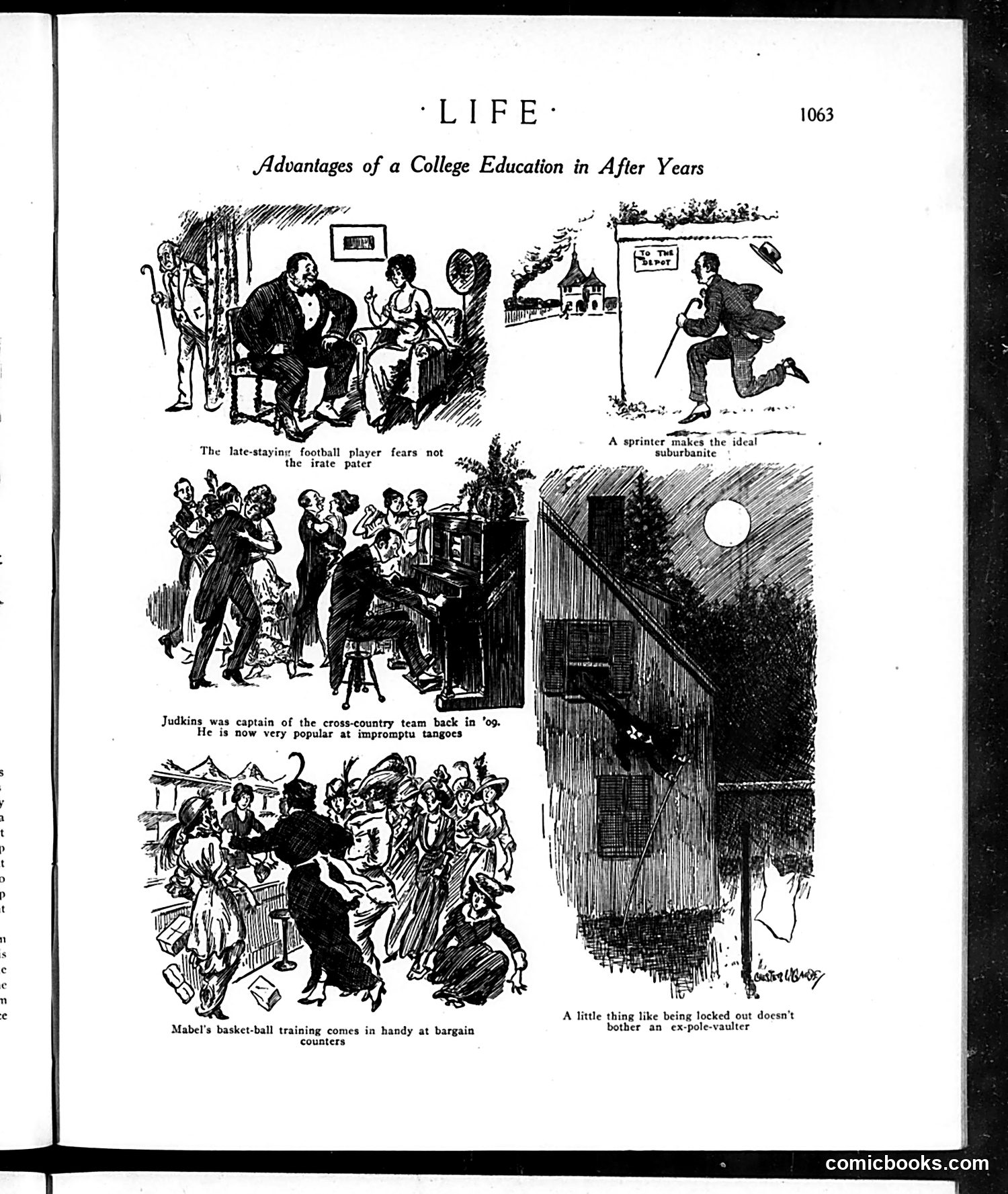
This 1920s satirical page mocks how college athletics prepare students for adult life—but not in serious ways. The humor works through ironic contrast: "Advantages of a College Education" shows college sports teaching impractical skills. Examples: A football player isn't intimidated by his angry father ("irate pater"), a former cross-country captain excels at dancing, a sprinter makes a good servant, a basket-ball player can elbow through bargain counters (physical aggression as shopping skill), and a pole-vaulter can climb back inside a locked house. The satire targets both collegiate athletics culture and upper-class leisure activities (tangoes, bargain shopping). The underlying joke: college football and track produce athletes skilled only at parties and petty theft—useless for real adulthood. It's mocking the perceived frivolity of college sports and the wealthy social world they serve.
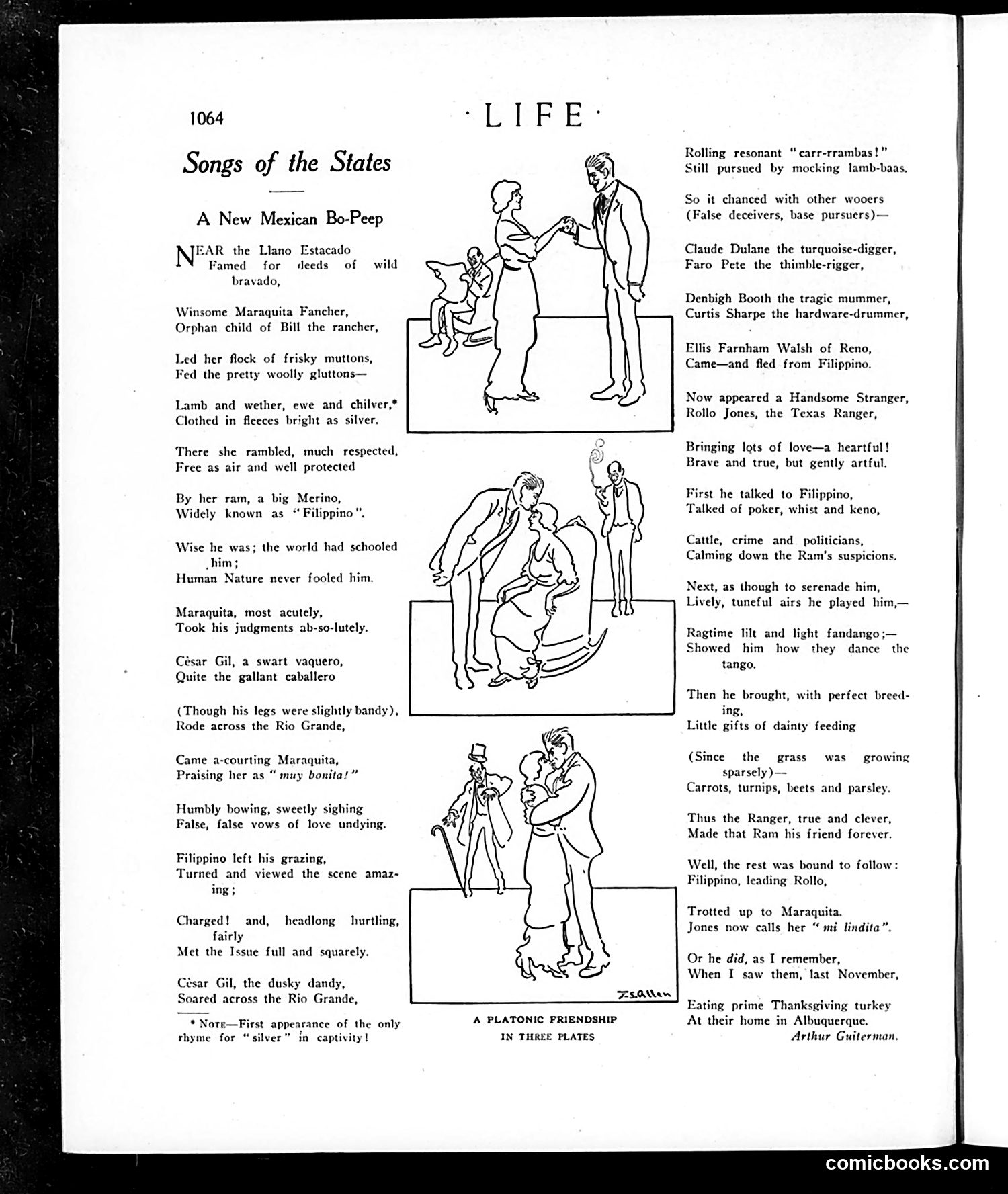
This humorous poem-and-cartoon feature uses an anthropomorphic animal story to satirize romantic competition in the American Southwest. The narrative follows Maraquita, a young shepherdess protected by her wise ram "Filippino," as various suitors attempt to court her. The satire mocks a specific social type: the smooth-talking con man or false lover. Each rejected suitor—César Gil (vaquero), Claude Dulane (turquoise digger), and others—represents stereotypical Western frontier characters, all defeated by Filippino's protective vigilance. The joke's resolution inverts expectations: the "Handsome Stranger" Rollo Jones, a Texas Ranger, succeeds not through deception but by befriending the protective ram—treating it with respect, entertainment, and gifts. The implication satirizes the difference between genuine character and false seduction. The cartoon's three plates illustrate the action humorously. The note about "silver" appearing nowhere else in English suggests self-conscious wordplay typical of *Life* magazine's sophisticated humor.
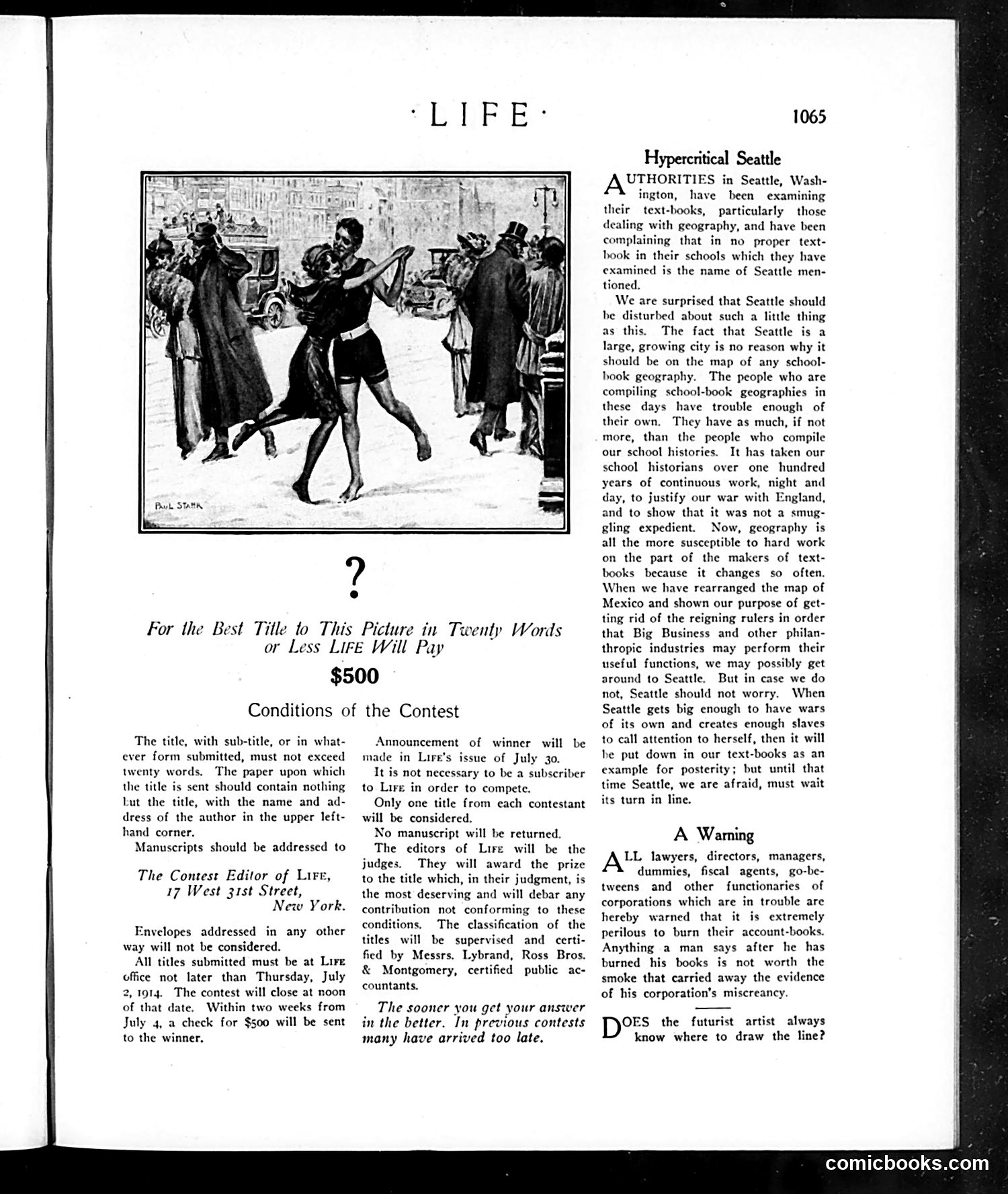
This page contains a **$500 contest** inviting readers to title a political cartoon showing a street brawl. The cartoon depicts what appears to be a violent confrontation between working-class figures and well-dressed men, likely satirizing labor unrest or class conflict—a major concern in 1914 America. Below the contest, **"Hypercritical Seattle"** sarcastically mocks Seattle authorities for complaining that their city isn't mentioned in geography textbooks. Life's editors argue that Seattle hasn't earned such recognition yet—suggesting it needs either industrial importance or military/colonial conquest (the editors reference Mexico and "Big Business"). The satire reflects how Life viewed geographic prominence as tied to economic power and imperial ambition. The final section, **"A Warning,"** cautions corporate executives against destroying account books, implying that such destruction is common among troubled corporations trying to hide misconduct—a jab at corporate malfeasance.
This Life magazine page discusses two contentious legislative battles during President Wilson's administration: **The Clayton Anti-Trust Bill**: The cartoon and text critique business lobbying against the bill. Manufacturing interests sought a "rest from legislation," but Wilson pushed for passage, arguing it better to act now than later with harsher measures. The labor clause proved particularly divisive—labor leaders (represented by former candidate Alton B. Parker) demanded broad exemptions from anti-trust laws, while Wilson's administration resisted language deemed unconstitutional, eventually compromising with ambiguous wording both sides could dispute. **Congressional Fatigue**: The piece sympathetically notes Congress has worked exhaustively under Wilson, wanting to adjourn. Mexico tensions and the tolls repeal debate prolonged the session beyond expectations. The satirical tone suggests frustration with legislative gridlock and competing interests all seeking presidential favor while Congress seeks escape—portraying governance as exhausting theater rather than coherent policymaking.
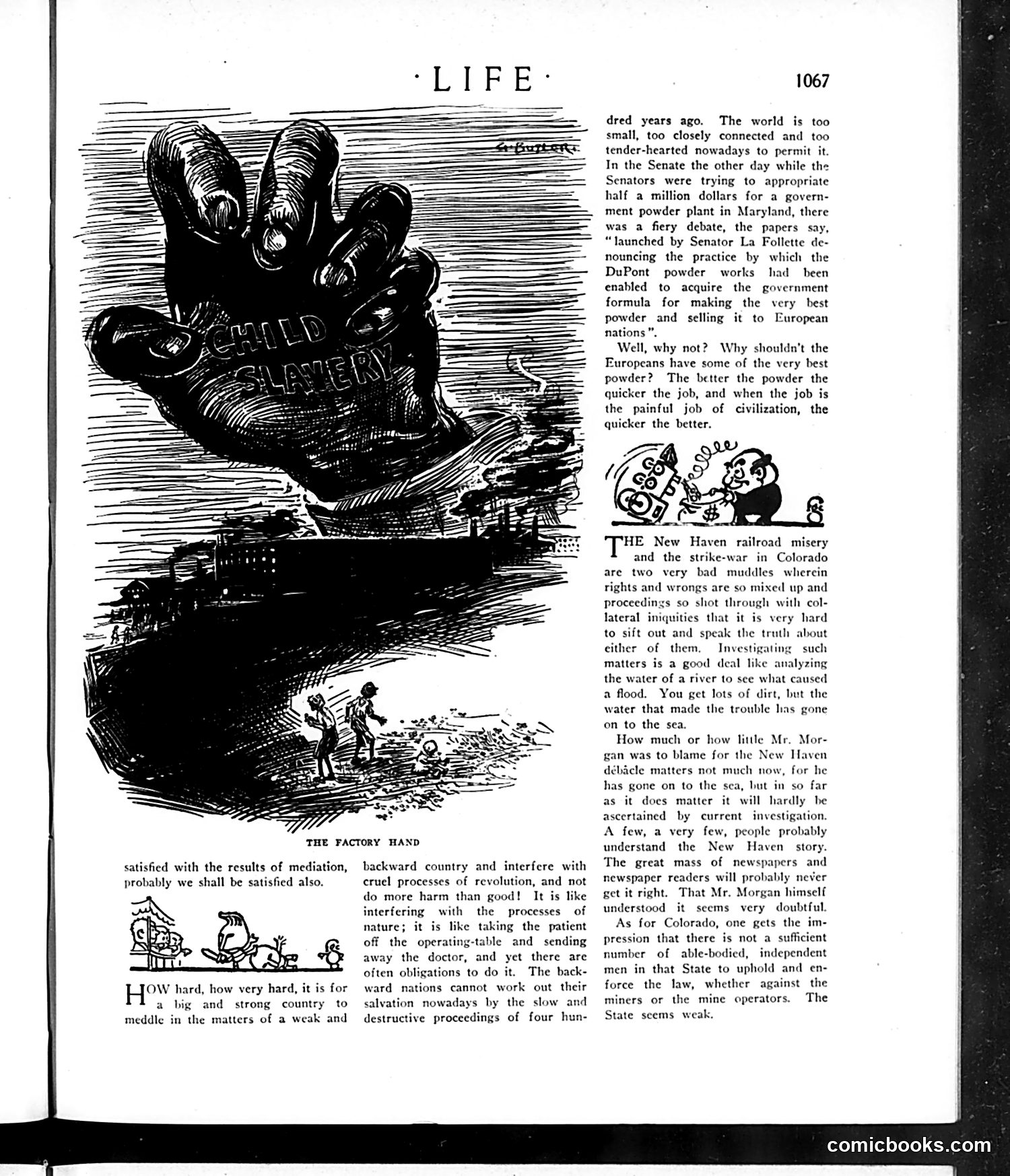
This page satirizes American foreign policy and domestic corruption circa 1910s. The large cartoon depicts a giant hand labeled "SHIELD BATTERY" crushing a factory and workers below—symbolizing how American industrial interests (particularly munitions makers like DuPont) dominate weaker nations. The text mocks the hypocrisy of U.S. interventionism: senators debate appropriating money for a government powder plant while simultaneously allowing DuPont to sell government formulas to European nations. The author sarcastically asks "why not?" sell superior powder to foreigners if Americans claim moral authority to meddle in "backward countries." The piece also references two contemporary scandals: the New Haven Railroad collapse (involving J.P. Morgan) and Colorado labor strikes, framing both as examples where American institutions fail to fairly resolve conflicts between powerful and powerless parties. The satire suggests American moral authority abroad rings hollow given domestic injustices.
This is a satirical piece using Plato's dialogue format to mock contemporary American reformers and Sophists. The author transposes the classical Socratic method into a modern political critique. **The Setup:** Phaedrus questions Socrates about the difference between Sophists (who preach eugenics and new laws as panaceas) and Reformers (who substitute "hot air for regular machines"). Both groups claim future solutions but cannot define what they actually want to fix. **The Satire:** Through Socratic questioning about change and form, the piece suggests that reformers—like those advocating early-20th-century progressive causes—offer vague promises without substance. The olive tree analogy implies constant change makes fixed solutions impossible. **Political Context:** This appears to target Progressive Era reformers broadly, mocking their confidence in legislation and social engineering as superficial rhetoric lacking practical grounding—a conservative critique of 1910s-era reform movements including eugenics advocacy and regulatory schemes.
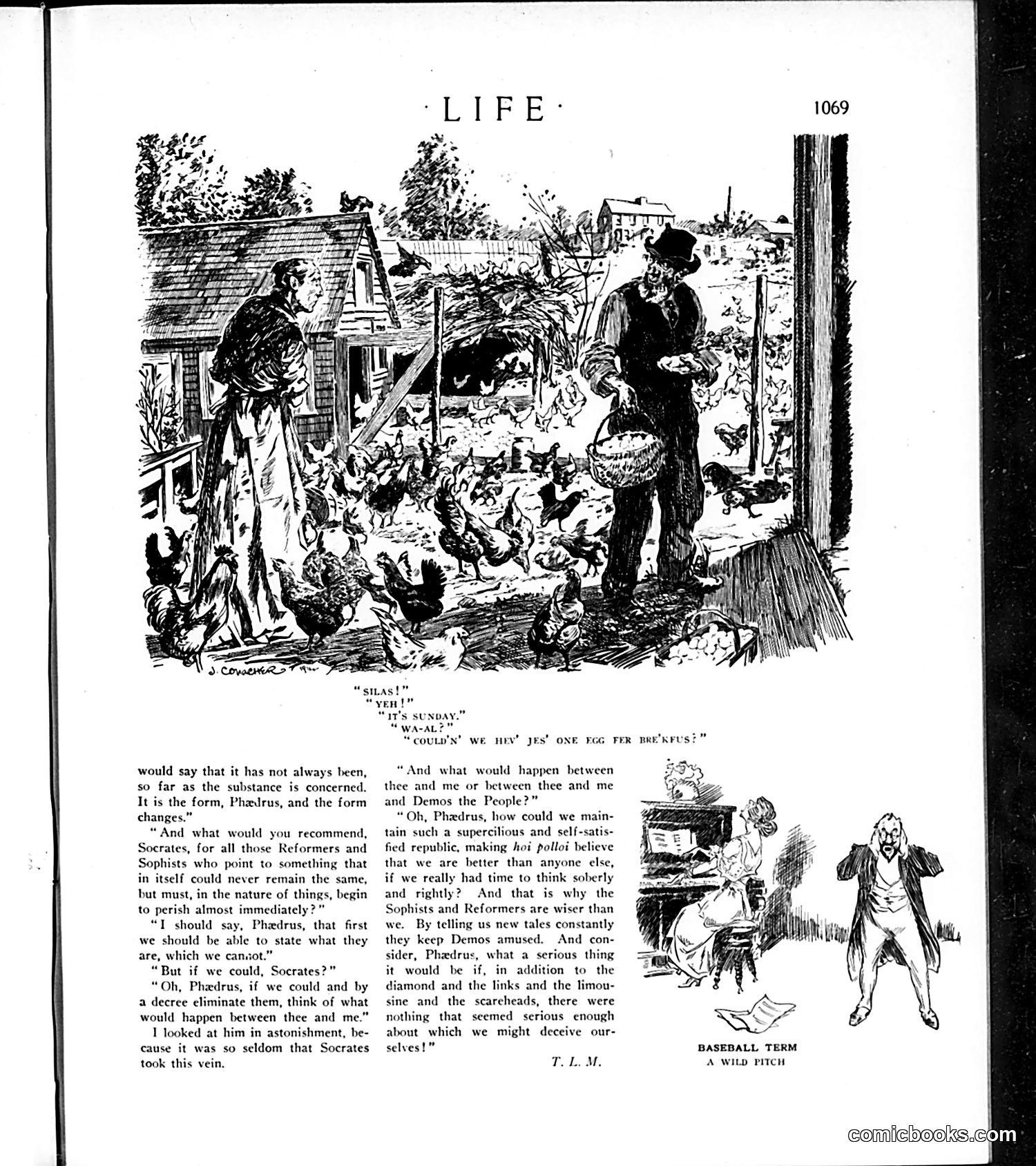
The page presents a philosophical dialogue between Socrates and Phaedrus, apparently satirizing Progressive Era reformers and social critics. **The main cartoon** (top) depicts a rural farmyard scene with two men distributing food to chickens—a mundane, domestic image that contrasts with the classical philosophical discussion below. **The satirical point**: The dialogue mocks reformers and "Sophists" who critique social problems but offer no practical solutions. Through Socrates' voice, the author argues that reformers are actually *useful* to the ruling class because they keep the common people ("Demos") distracted with complaints and "new tales," preventing serious examination of inequality. The satire suggests that maintaining an unjust system requires constant agitation to distract the masses—that eliminating social problems would paradoxically threaten the social order itself by forcing genuine accountability. **The baseball cartoon** (right margin) appears unrelated, illustrating the phrase "a wild pitch." This represents cynical commentary on the futility of reform movements in American democracy.
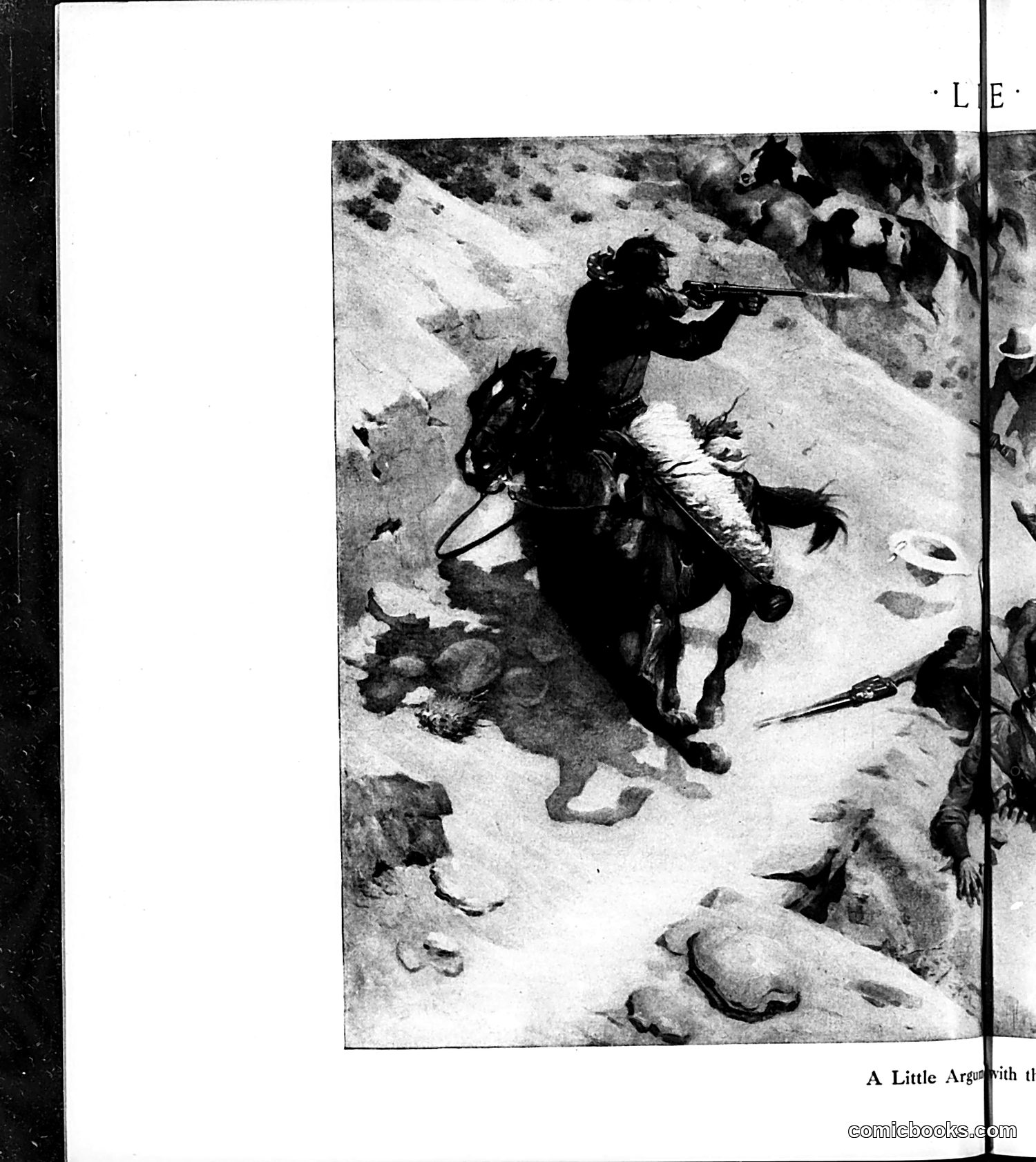
This is a black and white photograph or illustration from *Life* magazine showing a silhouetted figure on horseback aiming a rifle at what appears to be figures or objects in a rocky, desert-like terrain. The partial caption reads "A Little Argu..." (likely "Argument"), suggesting this depicts a conflict or confrontation scene. The composition—a mounted shooter in an arid landscape—evokes Western frontier imagery or military conflict. Without the complete caption and publication date visible, I cannot definitively identify which historical event, political conflict, or satirical point this references. The style suggests early-to-mid 20th century commentary, but determining the specific target of satire requires seeing the full caption and surrounding context.
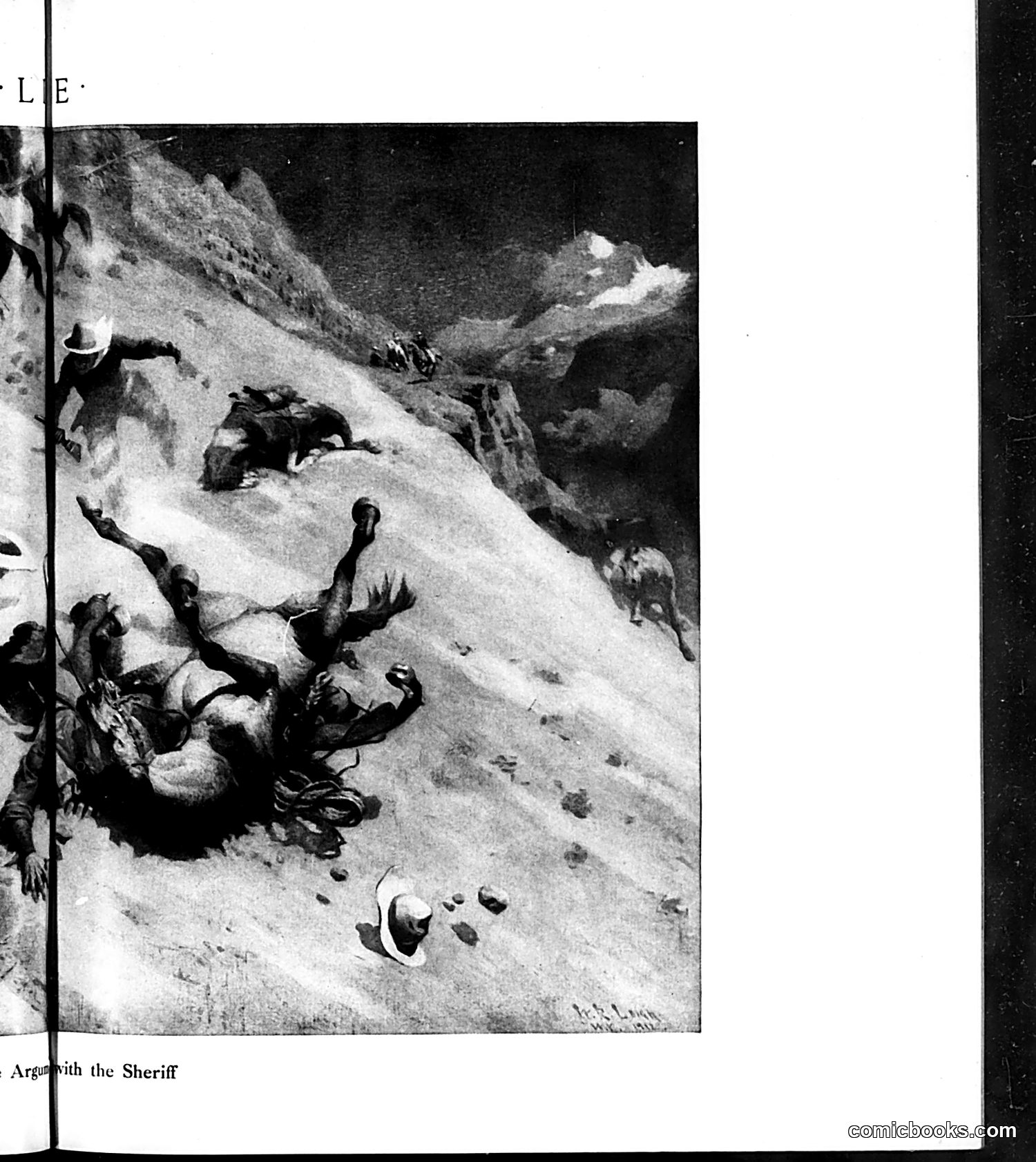
This appears to be a dramatic scene from an early Western film or illustration. The image shows multiple figures on a sandy/desert slope, with what seems to be a confrontation or action sequence in progress. Several people are positioned at different elevations on the terrain, and there's a figure wearing a hat (likely the "Sheriff" referenced in the caption) in the upper portion. The caption "Argue with the Sheriff" suggests this depicts a conflict between characters and a law enforcement figure, a common trope in Western narratives. Without additional context about which specific production this comes from, the exact satirical point remains unclear, though it may be mocking Western film conventions or depicting a humorous dispute with authority.
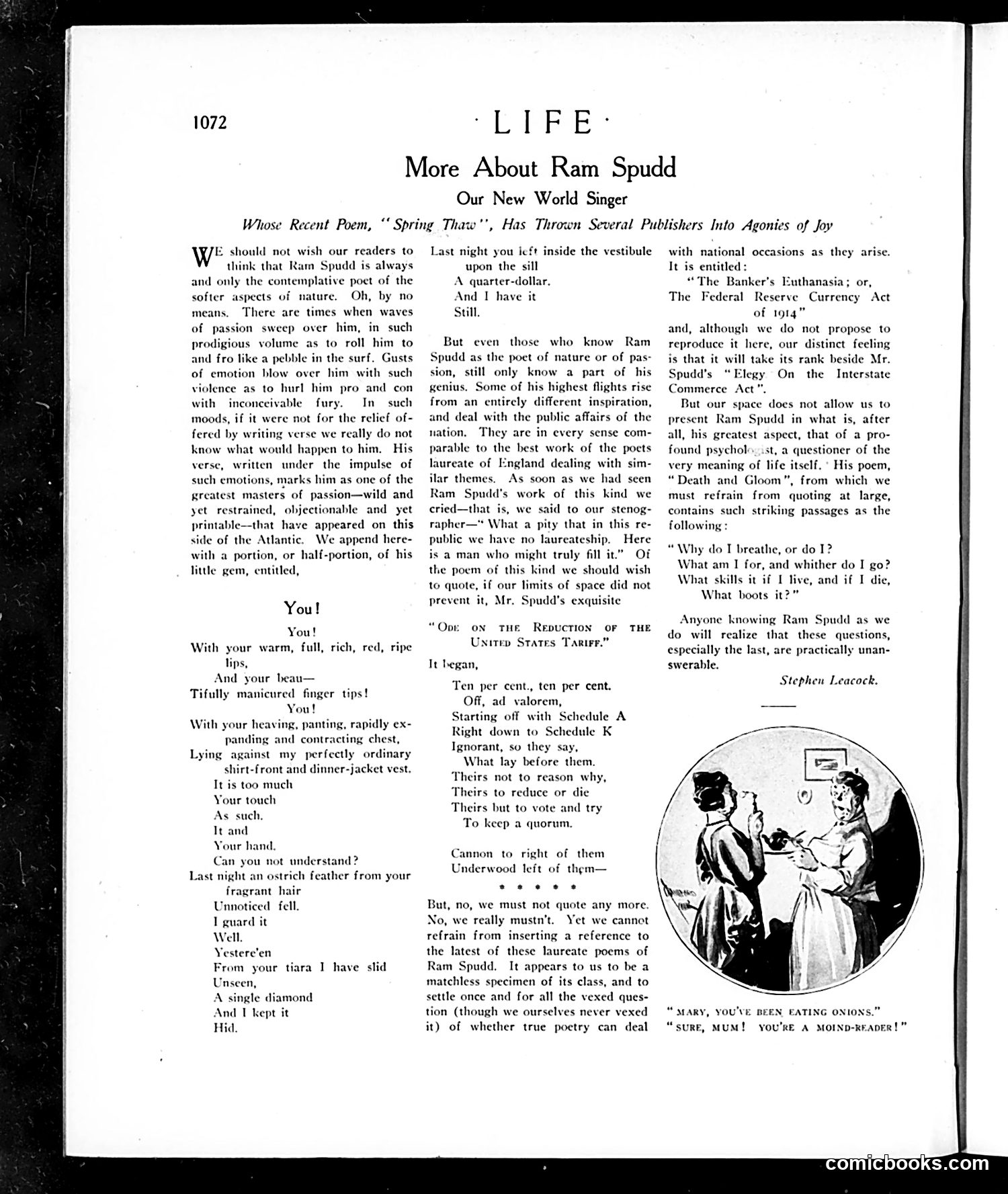
This is a satirical article mocking pretentious literary culture and a fictional poet named Ram Spudd. The piece parodies overwrought Romantic poetry through contrasting examples: Spudd's saccharine love poem "You!" (obsessing over a woman's lips, chest, and a stolen quarter left in a vestibule) juxtaposed with his supposedly serious political verse about tariffs and banking legislation. The satire targets the American literary establishment's tendency to treat any poem about "serious" subjects—even tedious legislative matters like the Federal Reserve Act—as profound art worthy of laureateship, while ignoring sensibility or actual merit. References to Cannon and Underwood (political figures) and 1914 Federal Reserve legislation ground the mockery in contemporary Progressive-era politics. The cartoon (lower right) shows a domestic scene, likely illustrating absurd romantic sentimentality. The joke: Life magazine is mocking how American culture confuses verbosity with profundity.
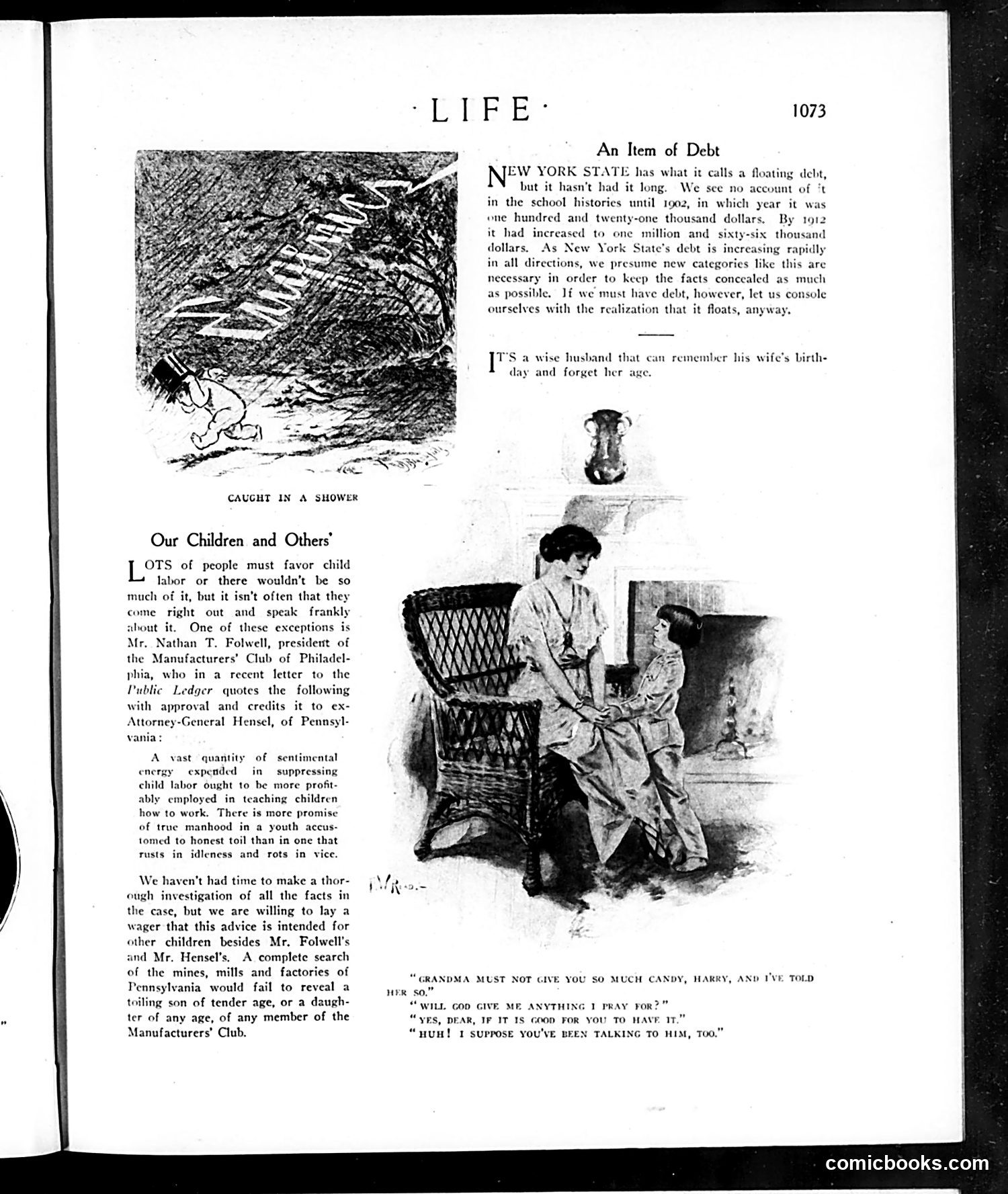
This *Life* magazine page satirizes hypocrisy around child labor in early 1900s America. **"An Item of Debt"** (top) mocks New York State's growing "floating debt"—a euphemism for concealing financial problems through accounting tricks rather than addressing them honestly. **"Our Children and Others'"** (main article) targets the Manufacturers' Club of Philadelphia, whose president Nathan T. Folwell endorsed Attorney General Hensel's argument that child labor teaches "true manhood" and is preferable to "idleness and vice." The satire's bite: *Life* sarcastically notes that while such arguments are offered for poor children, a "complete search of the mines, mills and factories of Pennsylvania would fail to reveal" any actual children of club members working there. The implication is clear—the wealthy preach child labor for others' children while protecting their own from such exploitation. The bottom cartoon reinforces this: a grandmother and parent contradict each other about discipline and prayer, suggesting adults don't actually believe their own moralizing advice.
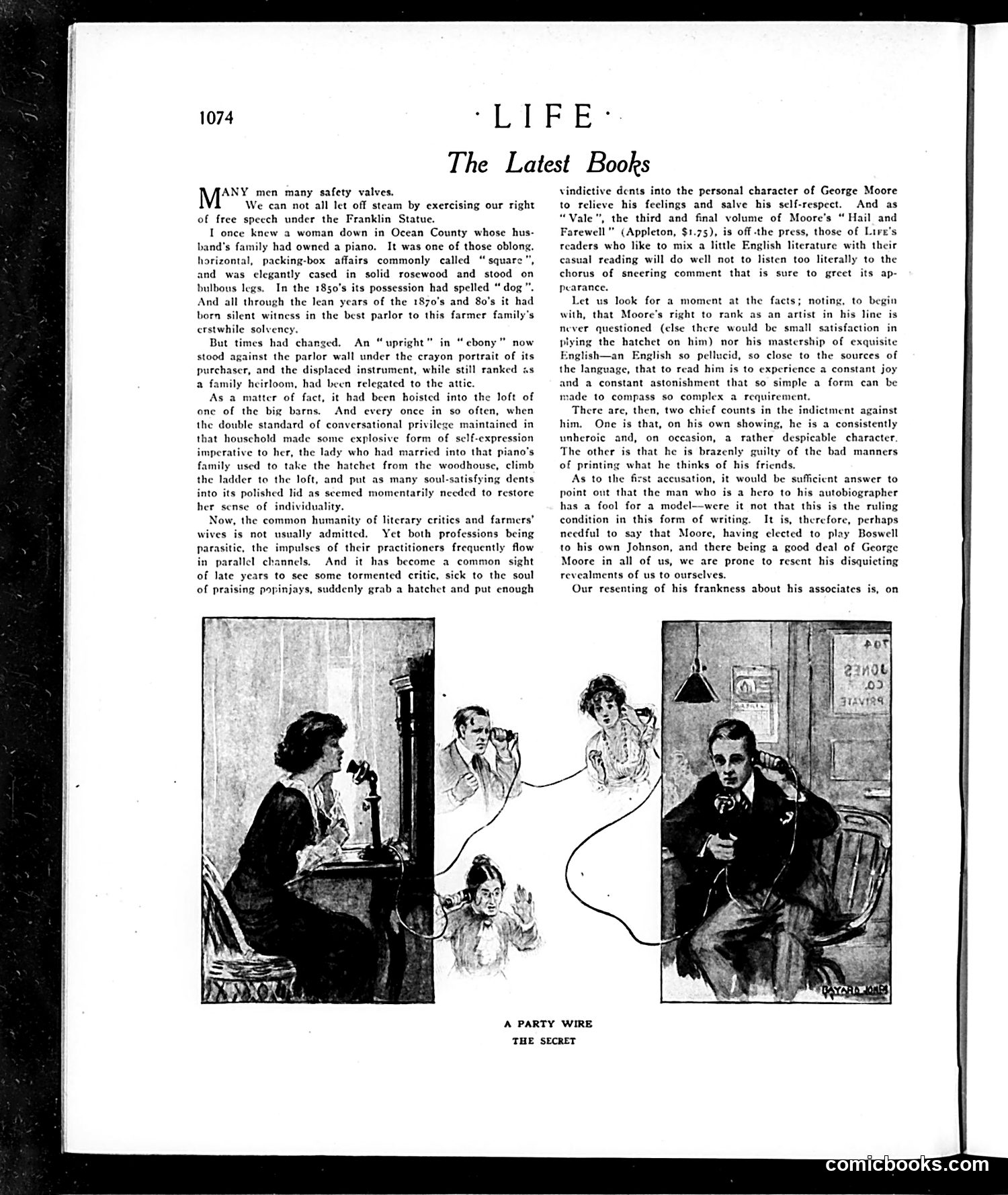
This page reviews George Moore's memoir *Vale*, the final volume of his autobiography *Hail and Farewell*. The accompanying illustrations show a woman at a telephone (left) and a man eavesdropping on an extension (right)—depicting a "party line," a shared telephone system common in the era where multiple households shared one line. The cartoon satirizes Moore's memoir through this metaphor: just as party-line users overhear neighbors' private conversations, Moore publicly reveals unflattering truths about his friends and associates in his writing. The title "The Secret" emphasizes the breach of privacy—Moore treats confidential matters as public gossip. The text acknowledges Moore's literary mastery while criticizing his "bad manners of printing what he thinks of his friends." The cartoon visualizes this indiscretion: intimate secrets meant for one recipient are involuntarily exposed to others listening in.
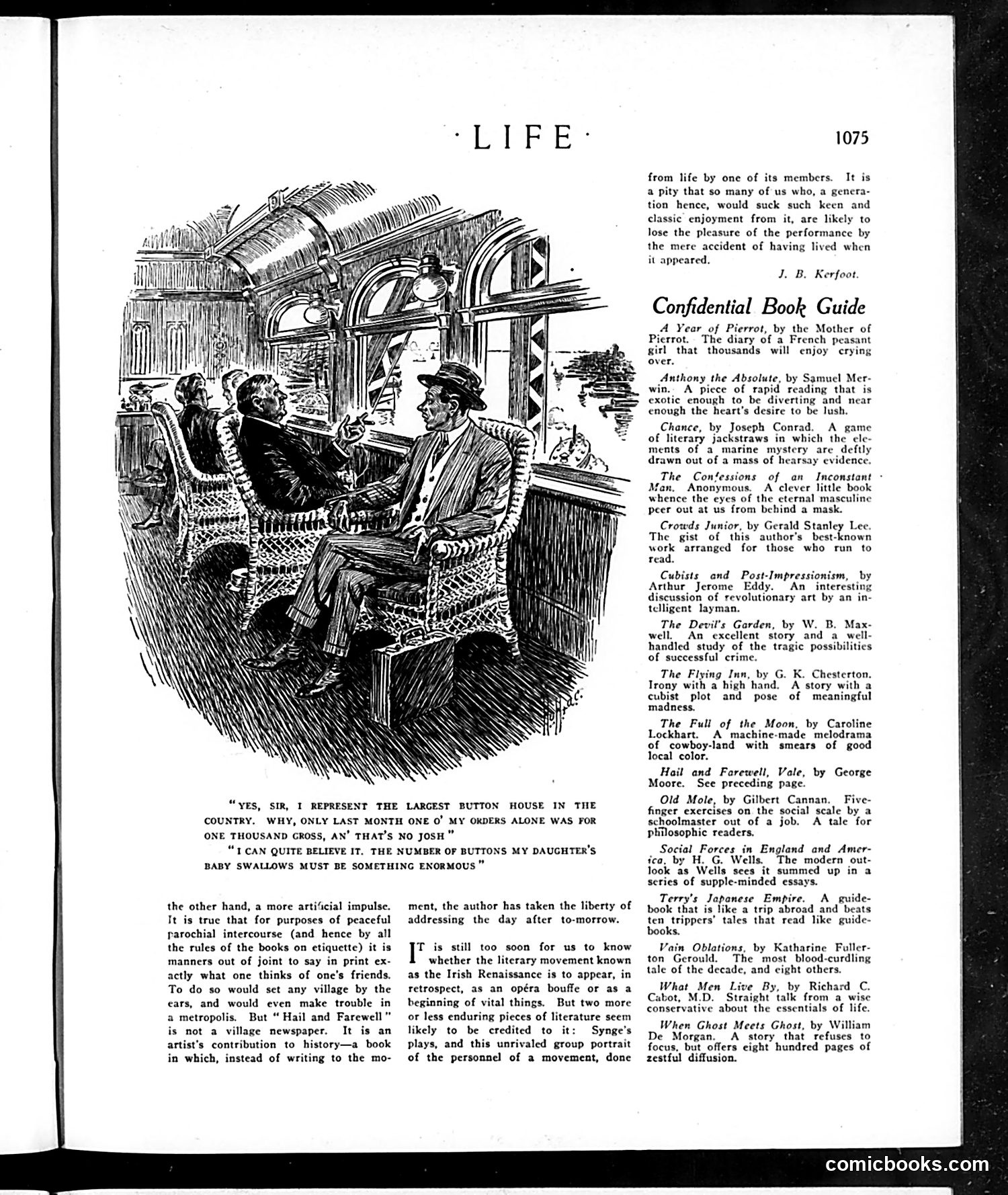
This page contains a single cartoon with accompanying satirical commentary about book reviews. **The Cartoon:** A button salesman boasts to a skeptical listener about massive orders—one thousand gross buttons monthly. The listener responds that he "quite believes it," explaining that his daughter's baby swallows so many buttons it must account for enormous quantities. **The Joke:** This is a classic "tall tale" setup where the salesman's exaggerated business claims are met with absurdist logic. The listener implies the buttons are being consumed by an infant, treating this ridiculous scenario as a reasonable explanation—mocking both the salesman's implausibly inflated numbers and the listener's deadpan acceptance of an obviously false premise. **Context:** The satire targets commercial boasting and the gap between claimed business success and reality. The cartoon reflects early 20th-century American humor conventions favoring dry, understated rejoinders to verbose salesmanship. The page's second section is a "Confidential Book Guide"—witty, sarcastic capsule reviews of contemporary literature.
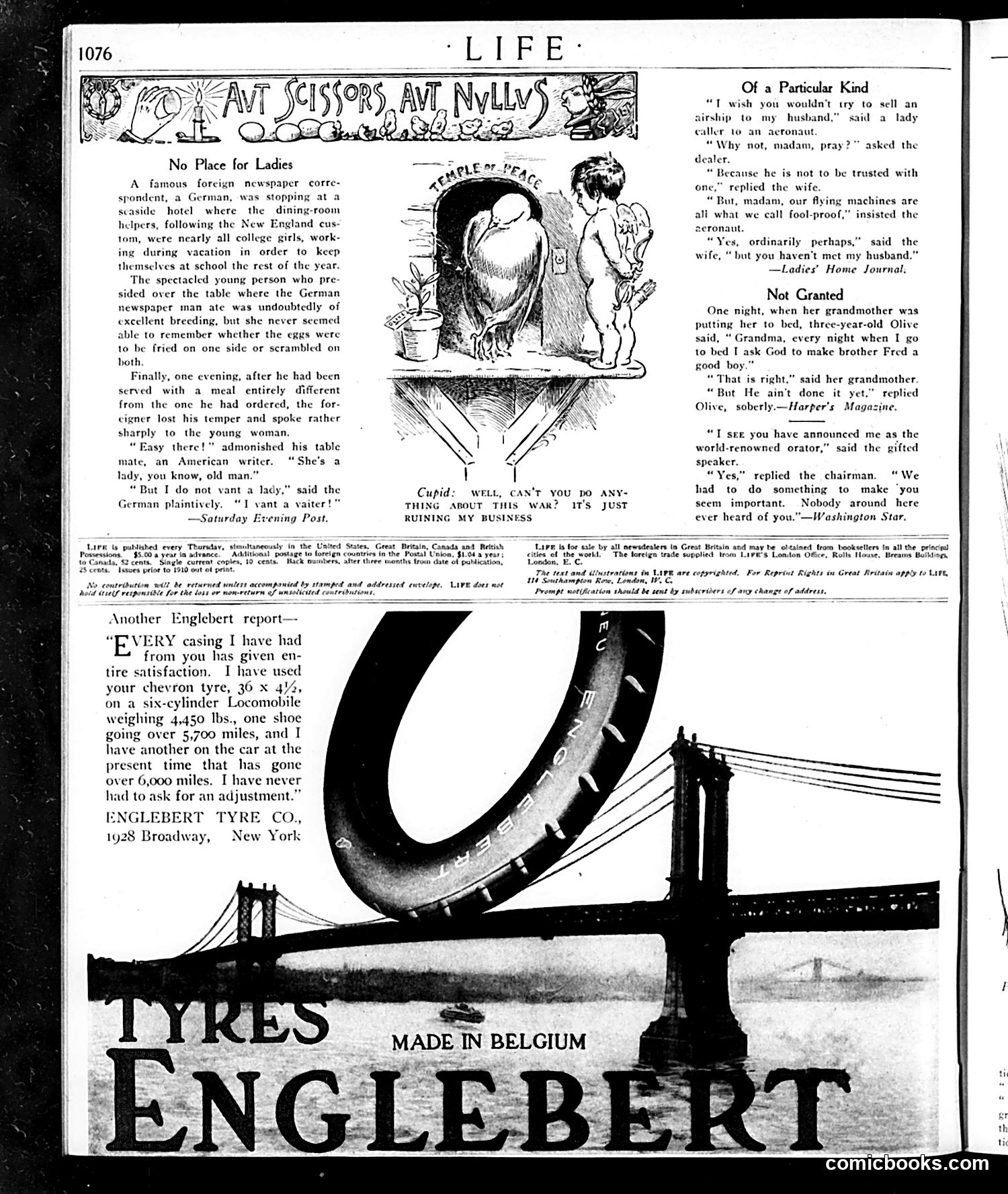
This page contains three satirical pieces typical of early 20th-century American humor: **"No Place for Ladies"**: A German newspaper correspondent staying at a seaside hotel complains about being served by college girls working vacation jobs (following New England custom). After receiving poor service, he demands a male waiter, not a "lady." The satire mocks both the foreigner's rudeness and, implicitly, the era's gender assumptions about service work. **"Of a Particular Kind"**: A wife warns an aeronaut not to sell her husband an airship because he "cannot be trusted with one." The joke plays on marital dynamics and emerging aviation skepticism. **"Not Granted"**: A three-year-old tells her grandmother she prays nightly for her brother Fred to be good, but "He ain't done it yet"—gentle humor about prayer's apparent ineffectiveness. The page also includes an **Englebert Tyre advertisement** (Belgian-made car tires) and what appears to be a wartime Cupid cartoon about disrupted business.
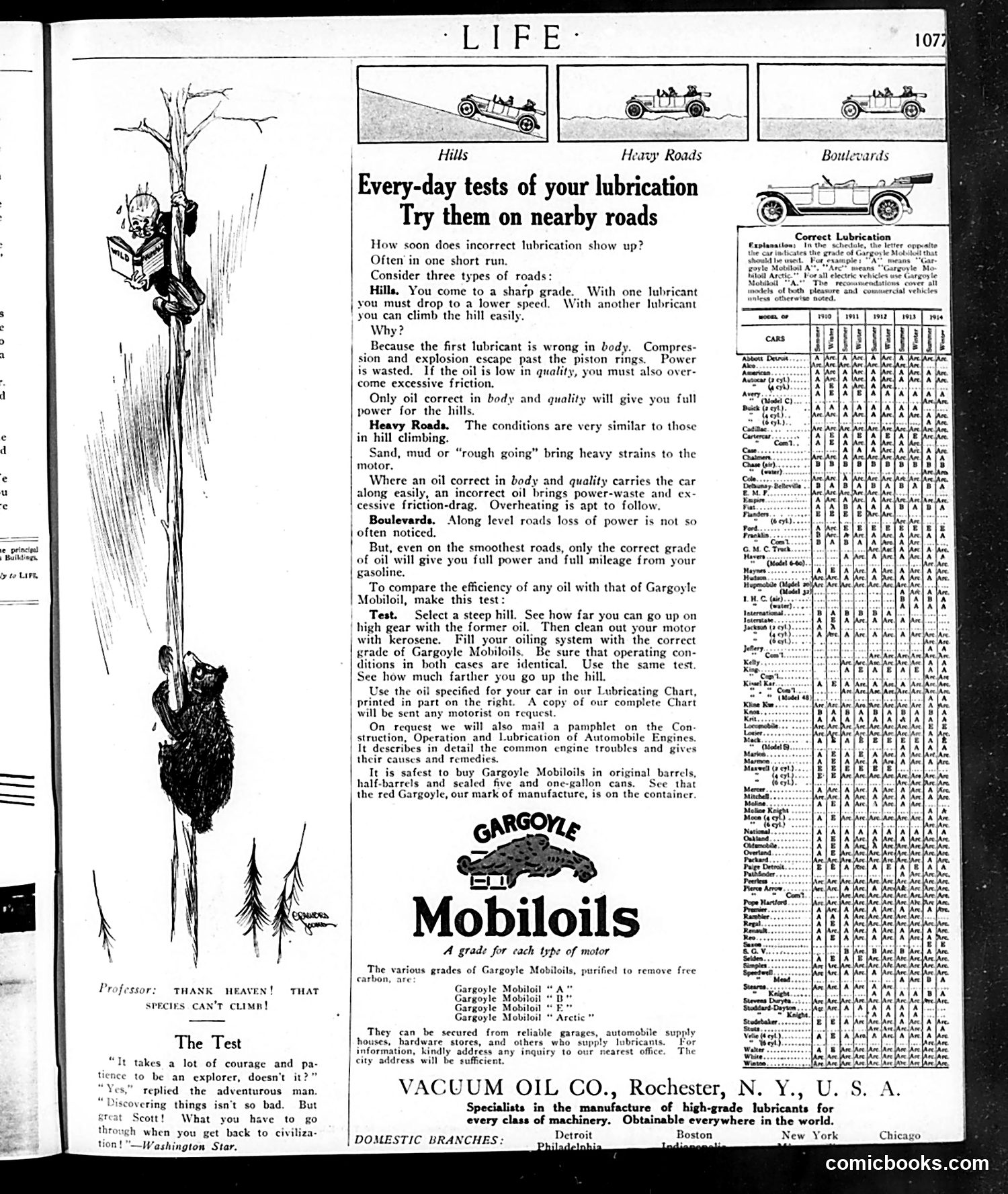
This page combines a satirical cartoon with a full-page automobile lubricant advertisement—typical of early 20th-century magazine layouts. **The Cartoon:** The left side shows a humorous illustration of a disheveled explorer clinging to a tree, with the caption crediting *Washington Star*. The joke plays on the contrast between the romance of exploration and the tedious bureaucratic/social ordeal of returning to civilization. It's a mild satire on explorers' self-importance and society's demands for documentation and debriefing. **The Advertisement:** The bulk of the page promotes Gargoyle Mobiloils motor oil by Vacuum Oil Company (Rochester, N.Y.). It demonstrates lubricant effectiveness through "real-world" driving tests on hills, rough roads, and boulevards—emphasizing that proper oil grade and body prevent power loss and engine damage. The accompanying lubrication chart recommends specific oil grades for various automobile models (1910-1914 era vehicles). This represents early automotive consumer education, when proper lubrication was still a novel concern and motorists needed guidance on engine maintenance.
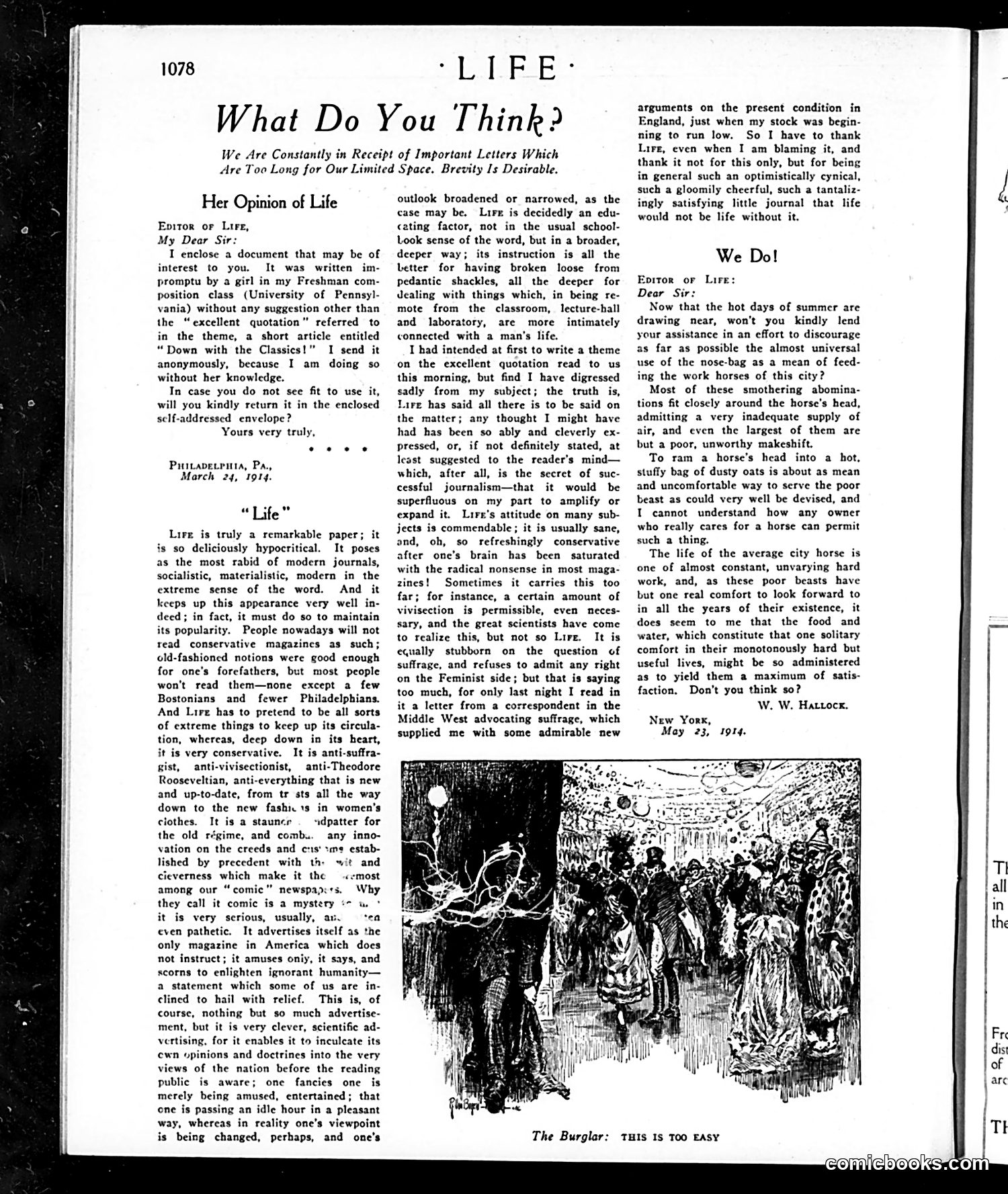
This page presents reader letters debating *Life* magazine's actual nature and influence. A University of Pennsylvania student's anonymous essay argues that *Life*, despite posing as a radical, modern, anti-establishment publication, is secretly deeply conservative—opposing women's suffrage, vivisection reform, and Theodore Roosevelt's progressivism. The writer contends *Life* skillfully disguises conservative messaging as entertainment, thereby subtly reshaping readers' views without their awareness. The accompanying cartoon depicts a burglar easily entering a home, likely illustrating the essay's central metaphor: *Life* magazine infiltrates readers' minds effortlessly, stealing their independent thought while they believe they're merely being entertained. The satire targets *Life*'s self-proclaimed role as purely amusing rather than instructive—exposing this claim as false advertising masking ideological influence.
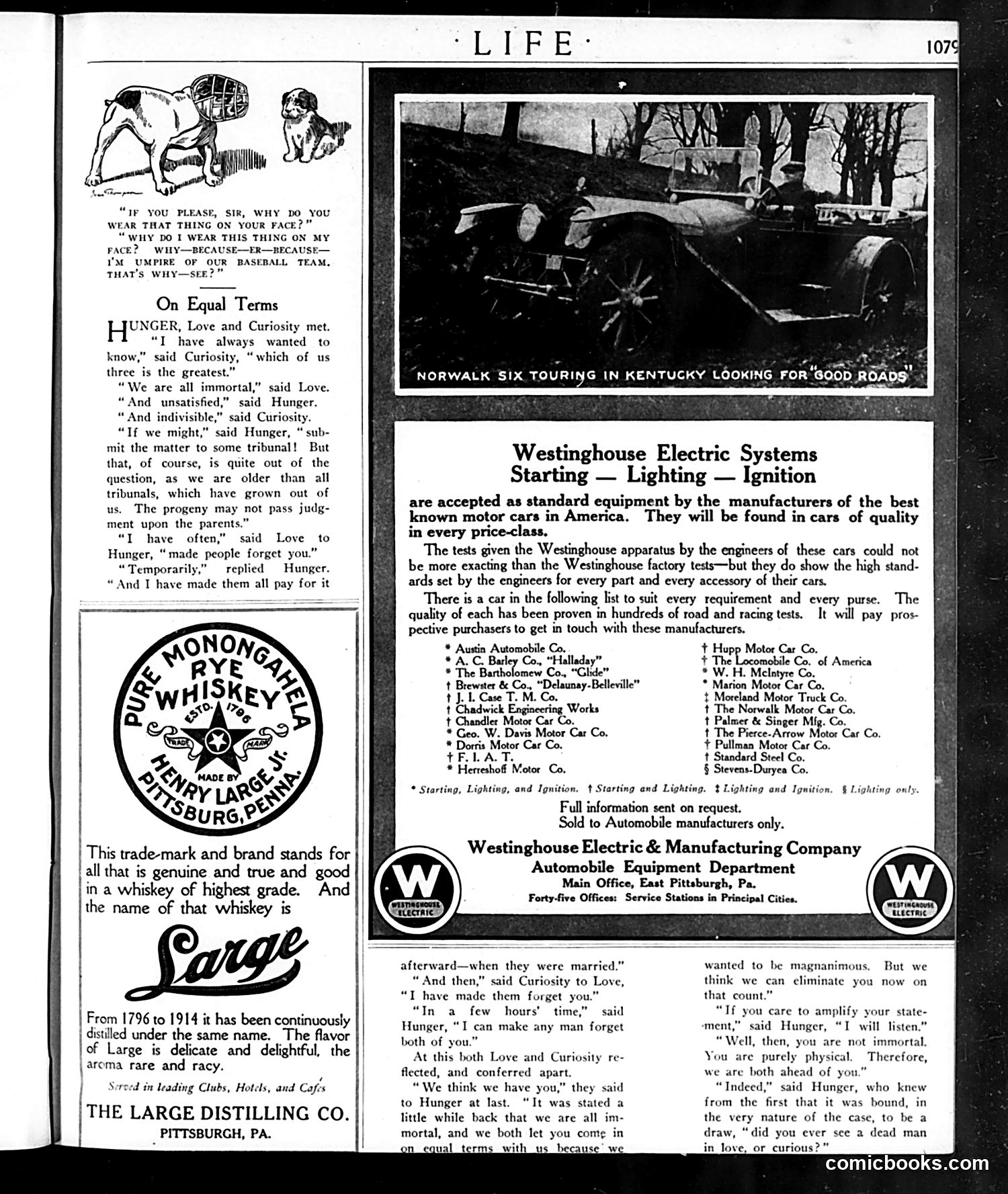
This page contains a philosophical cartoon titled "On Equal Terms" depicting an allegorical debate between three personified concepts: **Hunger, Love, and Curiosity**. Each claims superiority—Love notes it makes people forget Hunger; Hunger counters it makes them "pay for it"; Curiosity suggests both are merely physical urges while it alone is immortal and spiritual. Hunger's final rejoinder—asking if Curiosity ever saw a dead man in love or curious—suggests that human mortality ultimately renders all three forces equally meaningless, making their competition a philosophical draw. The satire appears to mock abstract philosophical debates about human nature and motivation, suggesting such arguments are ultimately circular and unresolvable. The remainder is commercial advertising: whiskey, automobiles, and electrical systems—typical of *Life* magazine's revenue model.
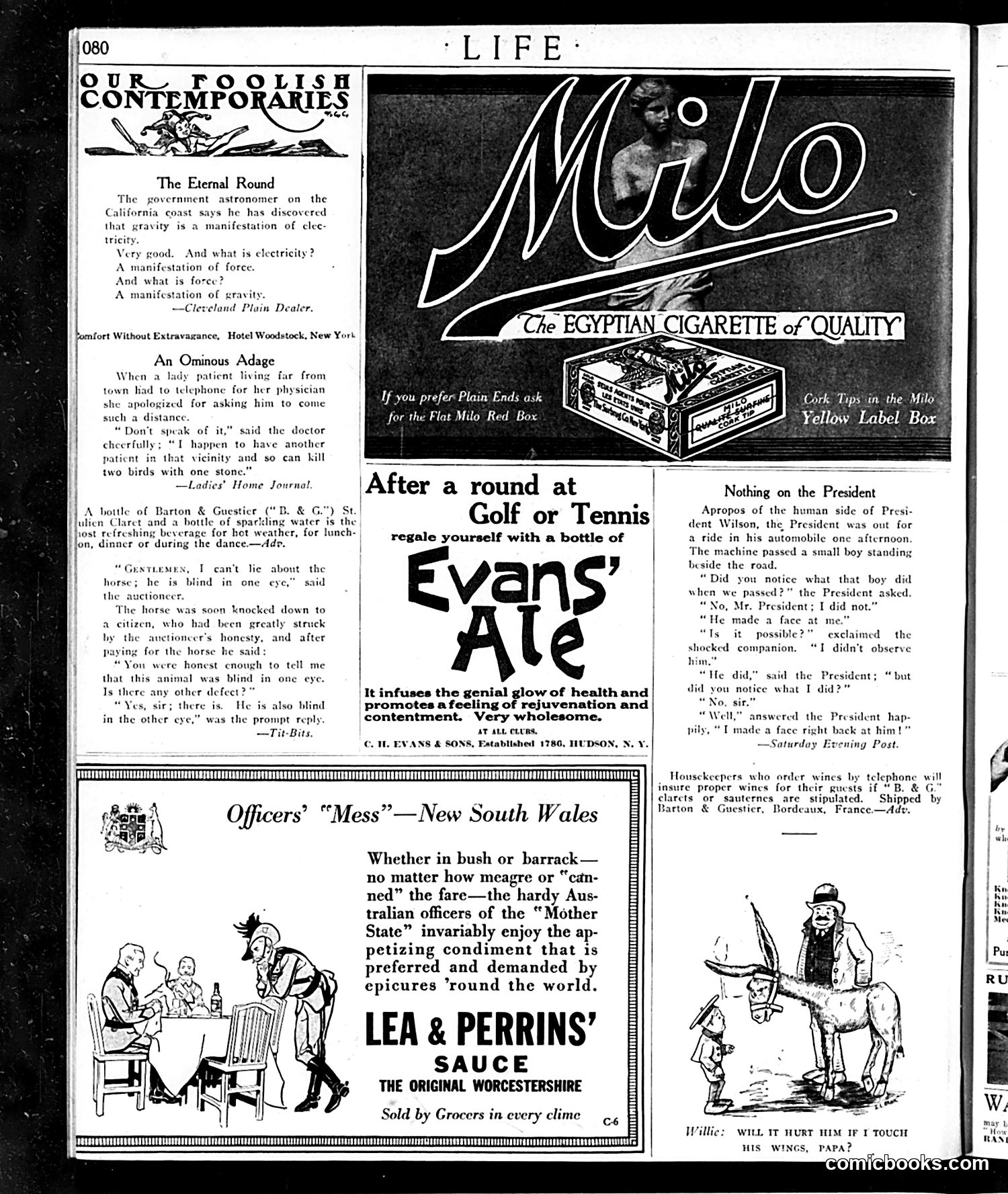
This page is primarily **advertising** with some brief humorous anecdotes. The main content includes: **Advertisements:** - Milo cigarettes ("Egyptian Cigarette of Quality") - Evans' Ale (post-sports refreshment) - Lea & Perrins' Sauce (Worcester sauce favored by Australian military officers) - B&G wines and clarets **Humorous Anecdotes:** The non-advertising text consists of short, unrelated jokes about: - A circular definition of gravity/electricity/force (absurdist logic humor) - A doctor efficiently visiting two patients at once - A blind horse sold at auction with additional defects - President Wilson making faces at a boy who made a face at him **Context for Modern Readers:** The Wilson anecdote is topical—this appears to be from Wilson's presidency (1913-1921). The joke humanizes him through a petty, relatable moment rather than political critique. The page reflects early 20th-century *Life* magazine's mix of satirical content and revenue-generating advertisements, with brief quips rather than extended political cartoons.
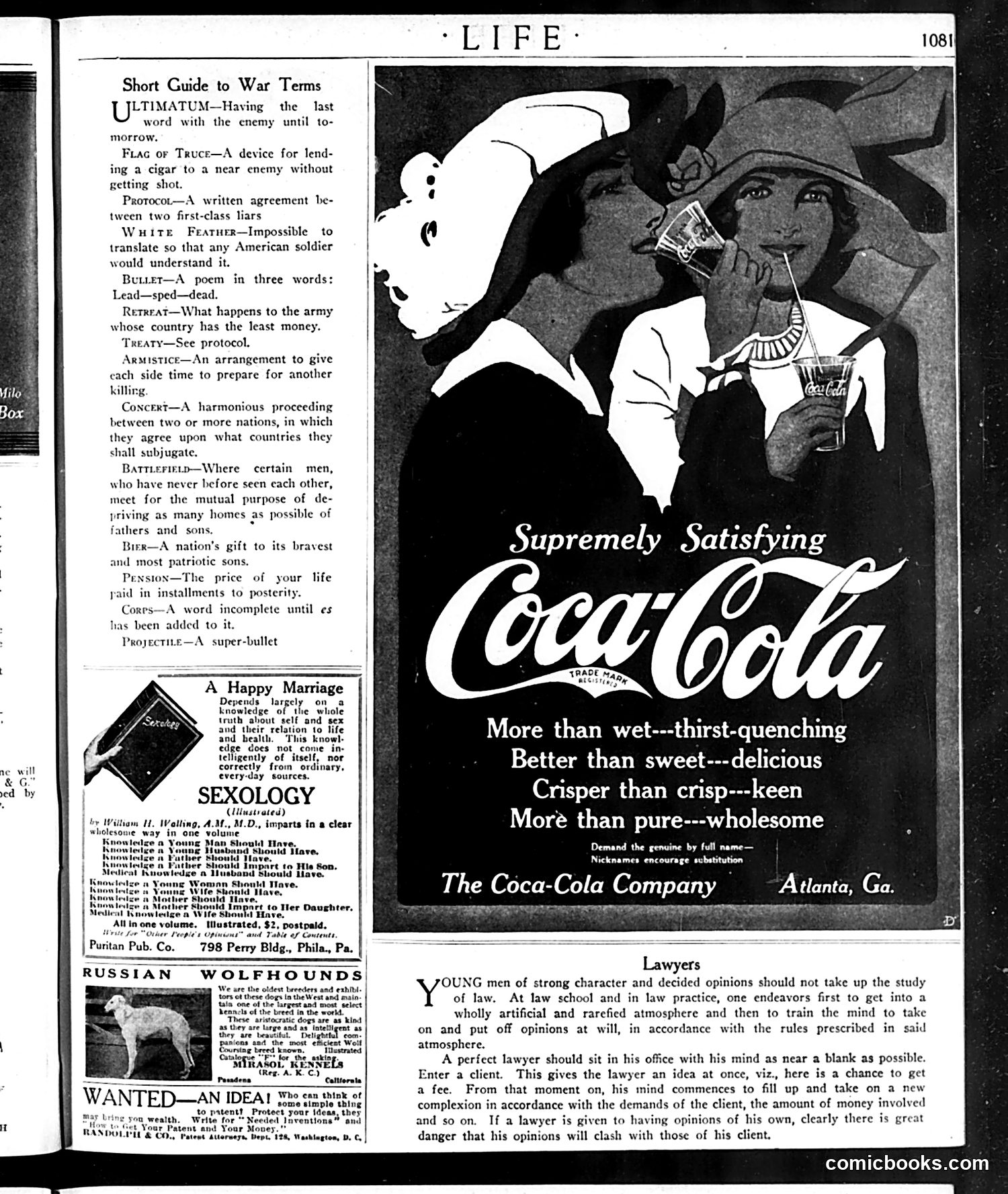
This page combines satirical commentary with advertising, typical of Life's format during the World War I era. **"Short Guide to War Terms"** is a biting satirical glossary mocking military and diplomatic language. Entries like "Bullet—A poem in three words: Lead—sped—dead" and "Battlefield—Where certain men...meet for the mutual purpose of depriving as many homes as possible of fathers and sons" express anti-war sentiment through dark humor. Terms like "Protocol" (liars' agreements) and "Armistice" (time to prepare for more killing) cynically suggest warfare and diplomacy are fundamentally dishonest enterprises focused on death and profit rather than justice. **The Coca-Cola Advertisement** ironically appears amid this pacifist content, promoting consumer comfort during wartime. **The "Lawyers" section** satirizes the legal profession's moral flexibility, suggesting lawyers abandon personal convictions to serve clients' interests and fees—a critique of professional ethics compromised by money. Overall, the page reflects Life's satirical stance criticizing war, diplomacy, and institutional hypocrisy during WWI.
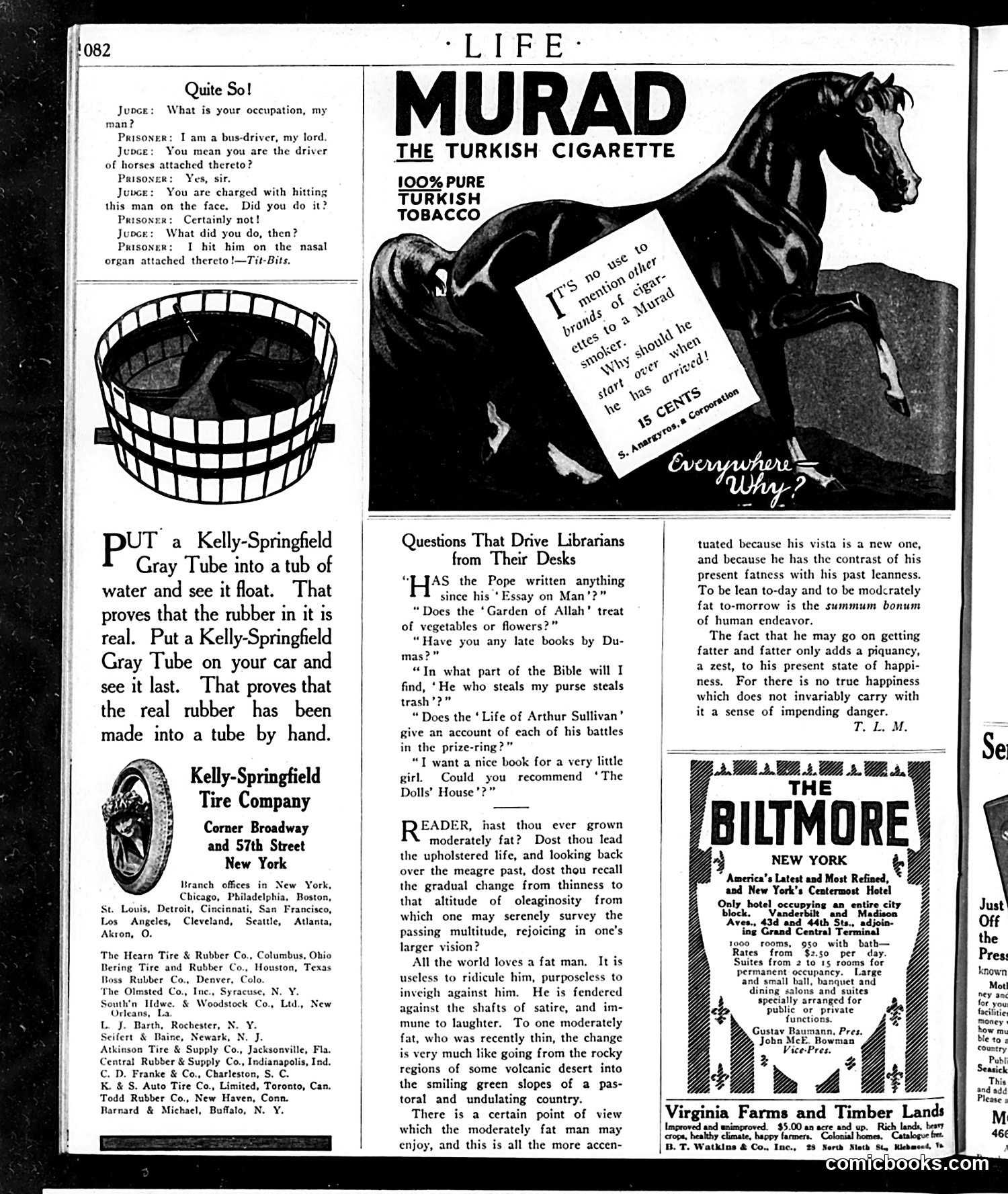
**"Quite So!" Cartoon**: A courtroom joke satirizing overly formal legal language. The judge repeatedly rephrases the prisoner's plain speech into pompous terminology—"nasal organ" instead of "nose"—mocking how the legal system obscures simple facts through deliberate verbosity. The humor exposes the gap between common speech and institutional jargon. **"Questions That Drive Librarians from Their Desks"**: A satire on absurd patron inquiries. Examples include mistaking Pope (the poet) for the religious leader, confusing "Garden of Allah" (a novel) with actual gardens, and misidentifying Arthur Sullivan as a boxer rather than the composer. The piece ridicules public ignorance and the patience required of library staff dealing with confused patrons—a recurring theme in early 20th-century satirical magazines about education and literacy.
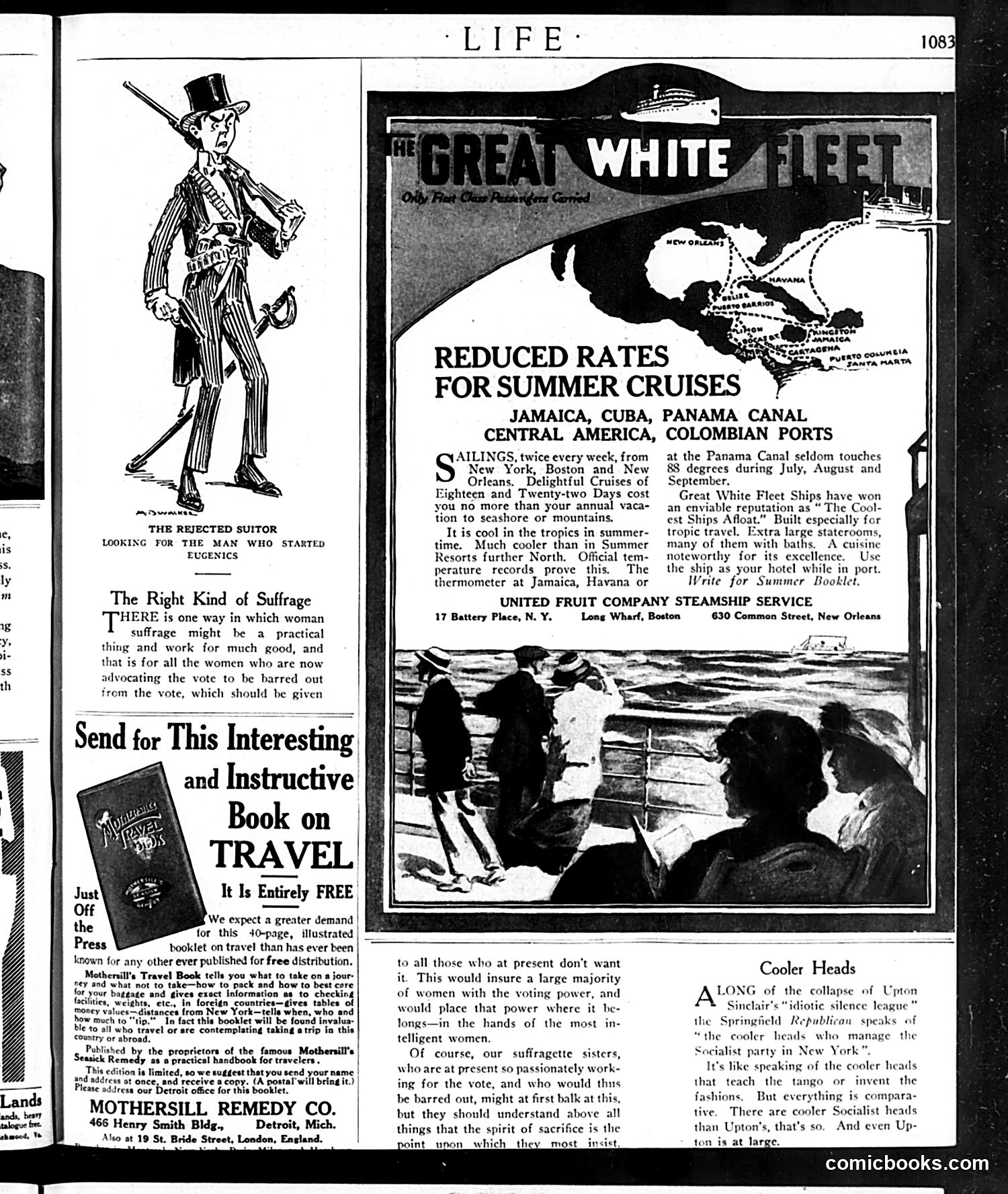
**"The Rejected Suitor"** cartoon depicts a man in formal dress "looking for the man who started eugenics." This references the contemporary eugenics movement—pseudoscientific theories about selective breeding of humans. The "rejected suitor" imagery suggests he's been spurned, likely by a woman, and blames the eugenics advocate (possibly implying social reformers who opposed "unfit" marriages). **"The Right Kind of Suffrage"** is biting satire opposing women's voting rights. It proposes "solving" the suffrage question by barring women *advocating* for the vote from actually receiving it—allowing only women who don't want voting rights to have it. The piece mocks suffragettes by suggesting they should embrace "sacrifice" and accept disenfranchisement, using their own rhetoric against them. **"Cooler Heads"** comments sarcastically on Socialist party infighting in New York, dismissing political activists as less rational than even Upton Sinclair (a prominent Socialist), while grudgingly acknowledging some cooler-headed members exist. The page balances political commentary with shipping and travel advertisements.
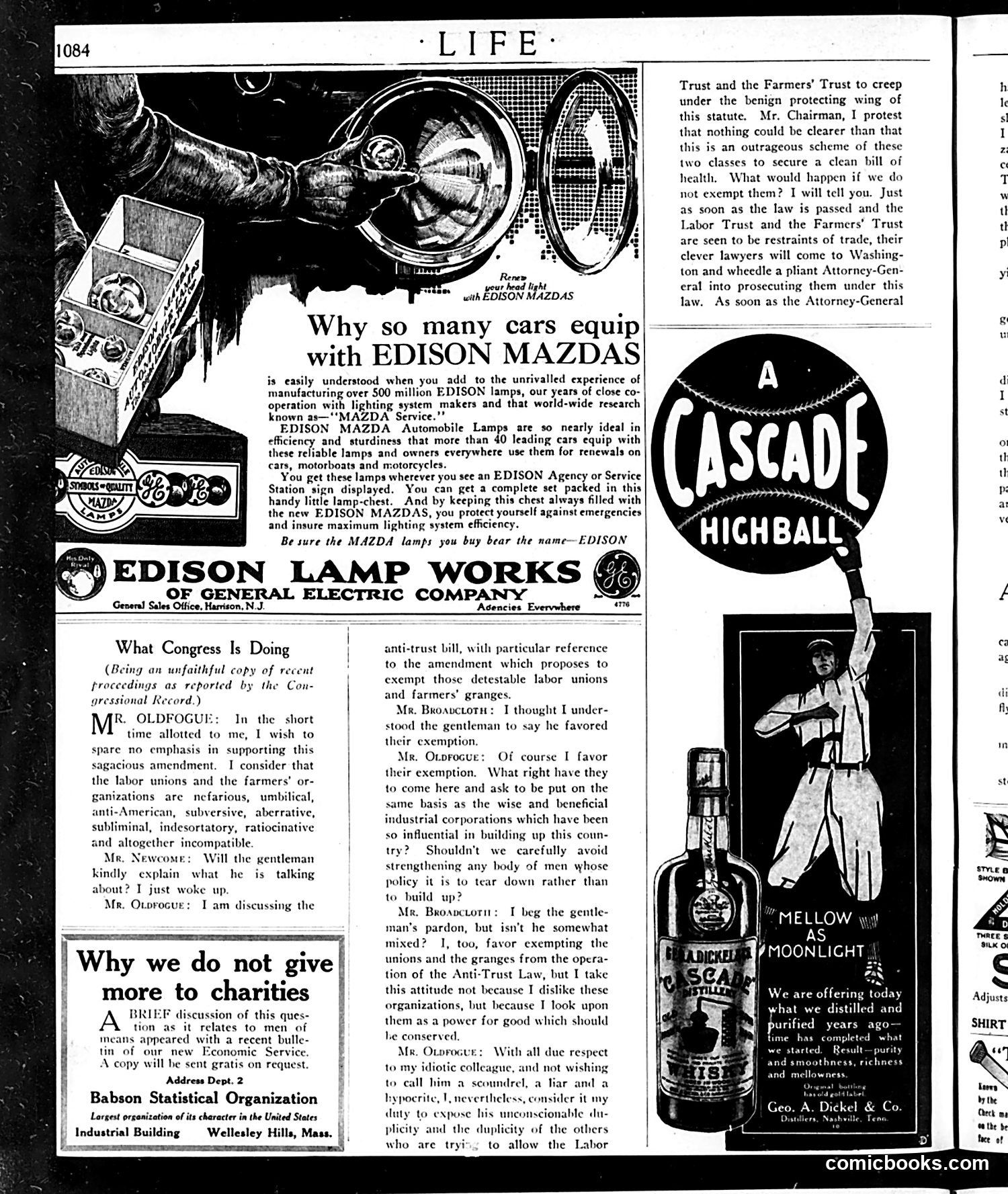
This page satirizes Congressional hypocrisy regarding antitrust legislation. The "What Congress Is Doing" section depicts a debate where Representative Oldfogu supports exempting labor unions and farmers' organizations from anti-trust law—calling these groups beneficial forces—while simultaneously denouncing them with absurdly contradictory language ("nefarious, umbilical, anti-American, subversive"). The satire's point: politicians speak in meaningless jargon to disguise their true intentions. Oldfogu actually wants exemptions for these groups, despite attacking them verbally. His colleague Newcombe's bewildered response ("I just woke up. What are you talking about?") underscores the nonsensical nature of the debate. The page is otherwise dominated by period advertisements (Edison Mazda lamps, Cascade Highball liqueur), typical of Life's format as a satirical publication that relied on advertising revenue.
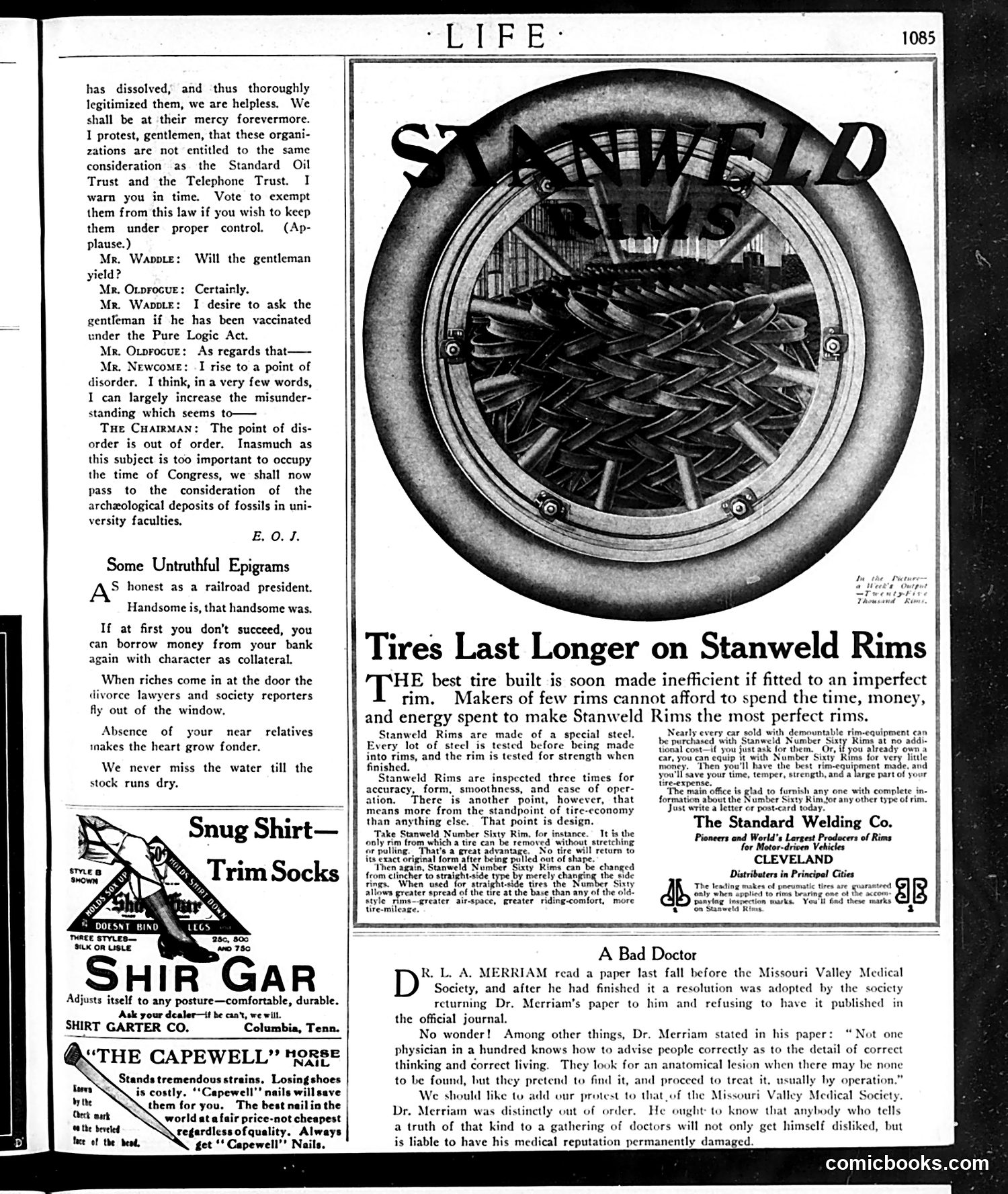
This page mixes political satire with early automotive advertising. The main satirical content is a mock Congressional debate about regulating business organizations. The speakers—with deliberately absurd names like "Mr. Waddle" and "Mr. Newcombe"—engage in nonsensical parliamentary procedure, ultimately deciding to abandon the important discussion entirely to debate "archeological deposits of fossils in university faculties." **The Point:** This ridicules Congress's tendency to avoid substantive regulation of powerful trusts (like Standard Oil and telephone monopolies mentioned in the text) through procedural evasion and deliberate confusion. The satirist suggests legislators use absurdity as a tool to dodge accountability. The page also includes cynical epigrams mocking American institutions—railroad executives, divorce lawyers, and banks—reflecting Progressive Era skepticism toward corporate and social institutions. The remainder comprises period automobile advertisements for tire rims and clothing accessories, typical of *Life*'s revenue model.
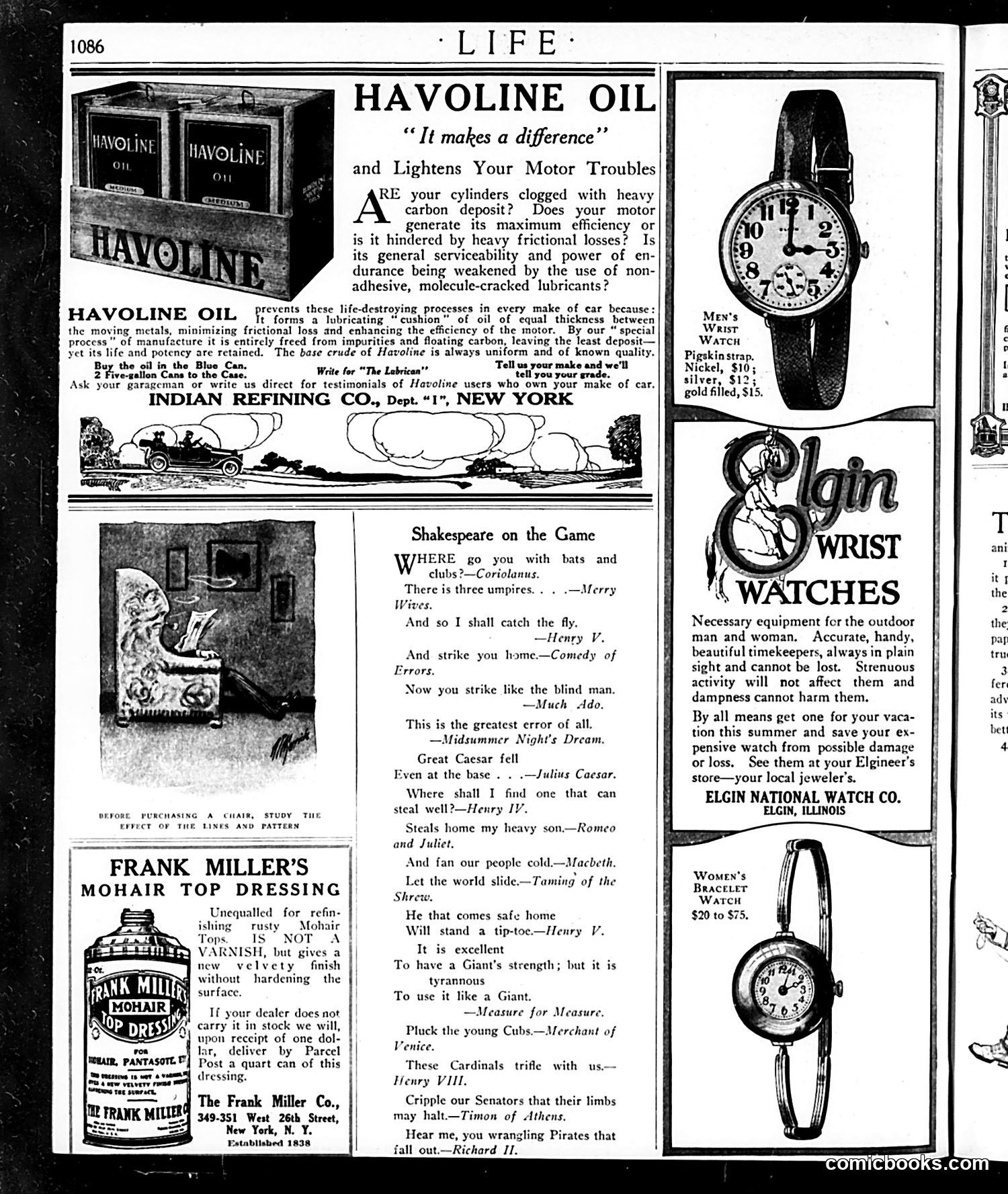
This page contains primarily advertisements for consumer products (motor oil, furniture dressing, watches) and a literary feature, not political satire. The main illustrated content is "Shakespeare on the Game," which pairs baseball references with Shakespeare quotations. The joke is one of clever wordplay: phrases from Shakespeare plays are selected to sound as though they describe baseball action ("And so I shall catch the fly," "And strike you home," "Steals home my heavy son"). This demonstrates Shakespeare's language's versatility and provides light entertainment—a common magazine feature in the early 20th century. It's not satire but rather witty literary amusement, showing how the Bard's words align with America's national pastime. The accompanying illustration depicts what appears to be a period figure, possibly illustrating Shakespearean content generally rather than any specific joke.
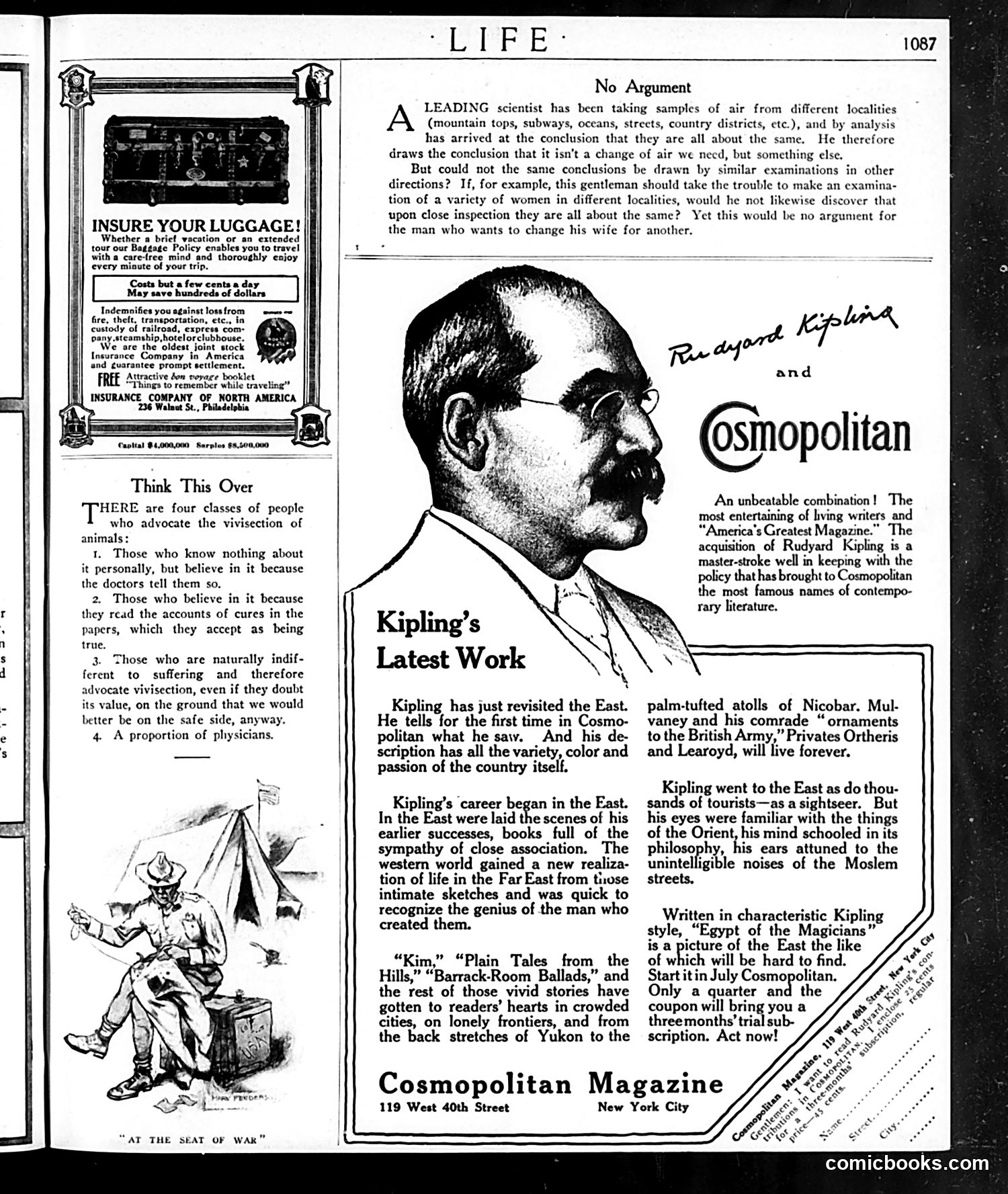
This page combines advertisements with satirical commentary typical of Life magazine's format. **The "No Argument" essay** uses logical comparison to mock a scientist's conclusion that air quality is uniform across locations. The satire suggests that if we applied his methodology to examining women in different places, we'd reach an absurd conclusion—yet this wouldn't convince a man wanting to leave his wife. The point: just because things appear similar on surface examination doesn't mean substitution is justified. This appears to be social commentary on infidelity and the weakness of rationalization. **The vivisection argument** lists four categories of people supporting animal experimentation, presented as a critique of unexamined beliefs—either accepting authority (doctors), media reports, indifference to suffering, or physician bias. **The remaining content** consists of advertisements: luggage insurance (top left) and a Cosmopolitan Magazine promotion featuring author Rudyard Kipling's work about the East. The page reflects early 20th-century concerns: animal welfare, the limits of scientific reasoning, and literary celebrity.
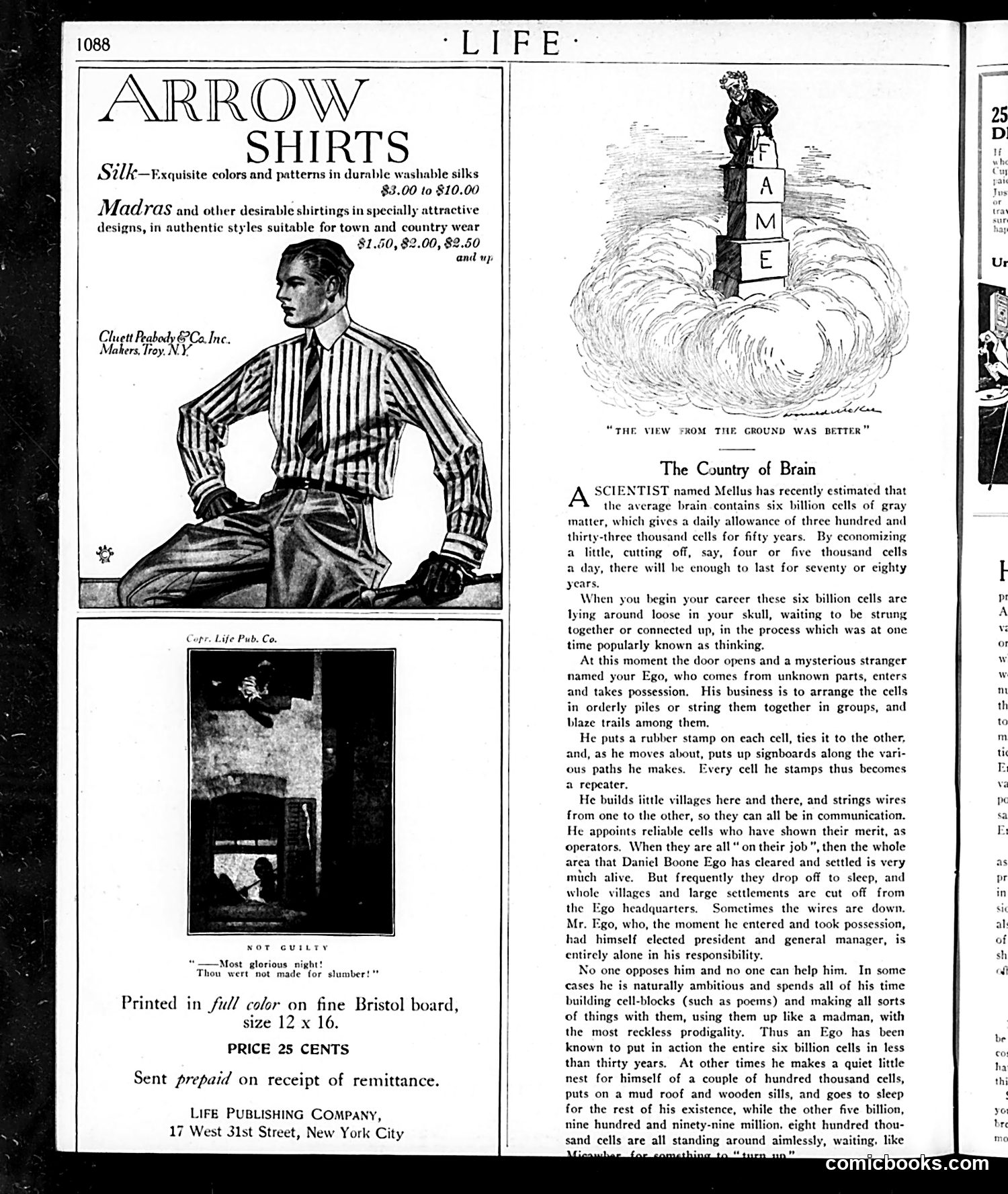
This page is primarily **advertising and editorial content** rather than political satire. The **left side** features Arrow Shirt advertisements showcasing men's formal wear ($1.50–$10.00), with a classical illustration of a well-dressed man and a small "Not Guilty" cartoon captioned with Shakespeare ("Thou wert not made for slumber!"). The **right side** contains "The Country of Brain," a **allegorical essay** (not a cartoon) personifying the human brain as a landscape. It describes the "Ego" as a mysterious ruler who organizes six billion brain cells like a colonizer settling territory—building villages, appointing operators, and managing communication networks. The satire critiques how individuals either squander their mental capacity recklessly or wastefully underutilize it, with the Ego bearing sole responsibility for this management. The illustration shows a figure atop a hill with signs reading "A," "M," "E" (possibly spelling "AME" or referencing memory/associations). This is **self-help satire** rather than political commentary—mocking human productivity and self-management through pseudo-scientific metaphor.
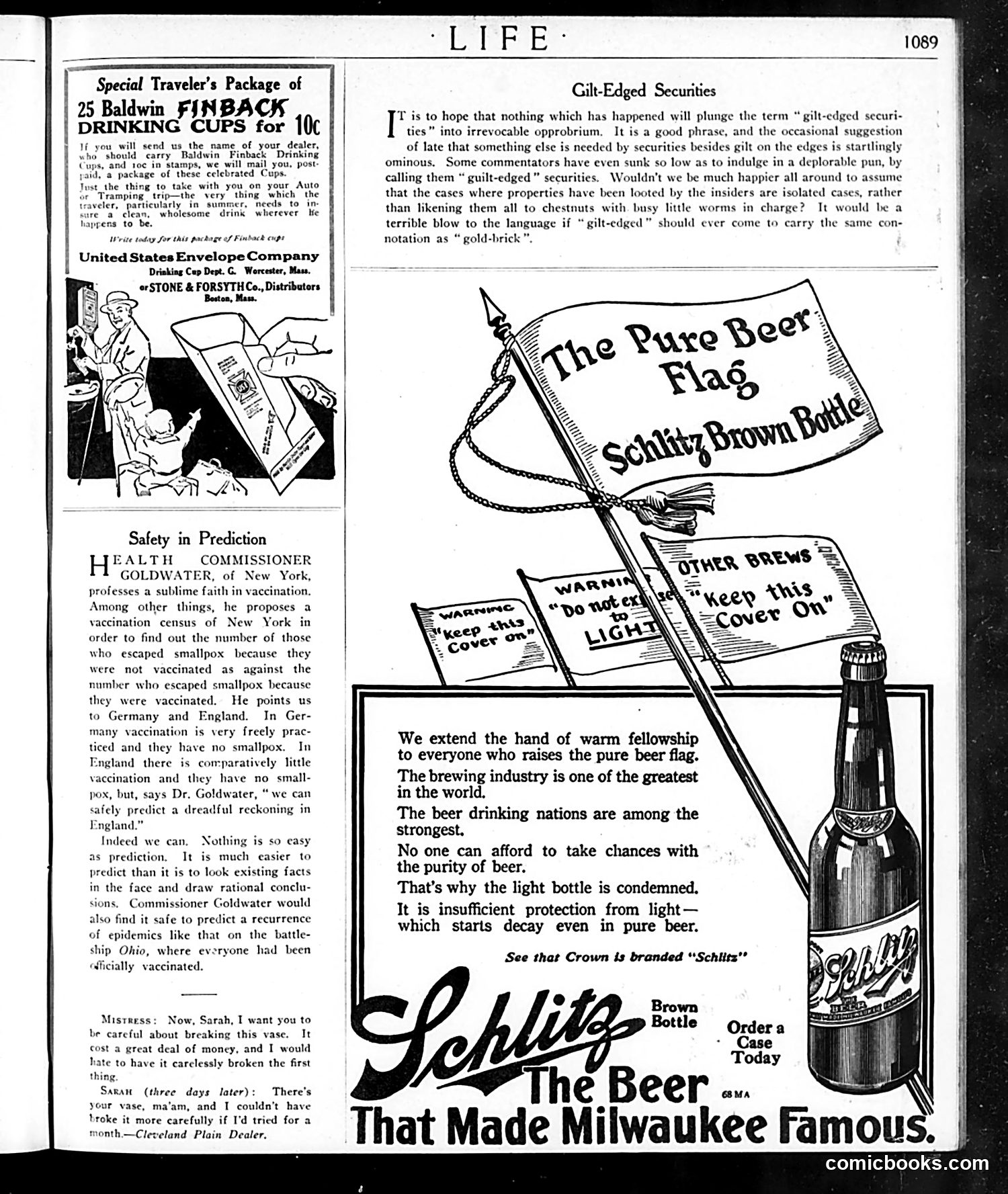
This page contains three distinct sections: **Left column:** Two brief items—a product advertisement for Baldwin Finback drinking cups for travelers, and a satirical piece titled "Safety in Prediction" mocking New York Health Commissioner Goldwater's vaccination advocacy. The satire argues that prediction is easier than examining actual facts: Goldwater claims England will suffer epidemics due to low vaccination rates, yet Germany (heavily vaccinated) and England (lightly vaccinated) both remain smallpox-free. A brief joke about a maid breaking a vase appears below. **Right side:** A large Schlitz beer advertisement featuring "The Pure Beer Flag"—a flag on a bottle symbolizing brown glass protection. The ad argues that light bottles allow decay and emphasizes brewing as a great industry. It promotes ordering Schlitz by the case. **"Gilt-Edged Securities":** A brief satirical note deploring puns linking "gilt-edged" (respectable investments) with "guilt-edged," referencing recent financial scandals where company insiders looted shareholder value. The page is primarily **advertising-driven**, with satirical commentary secondary.
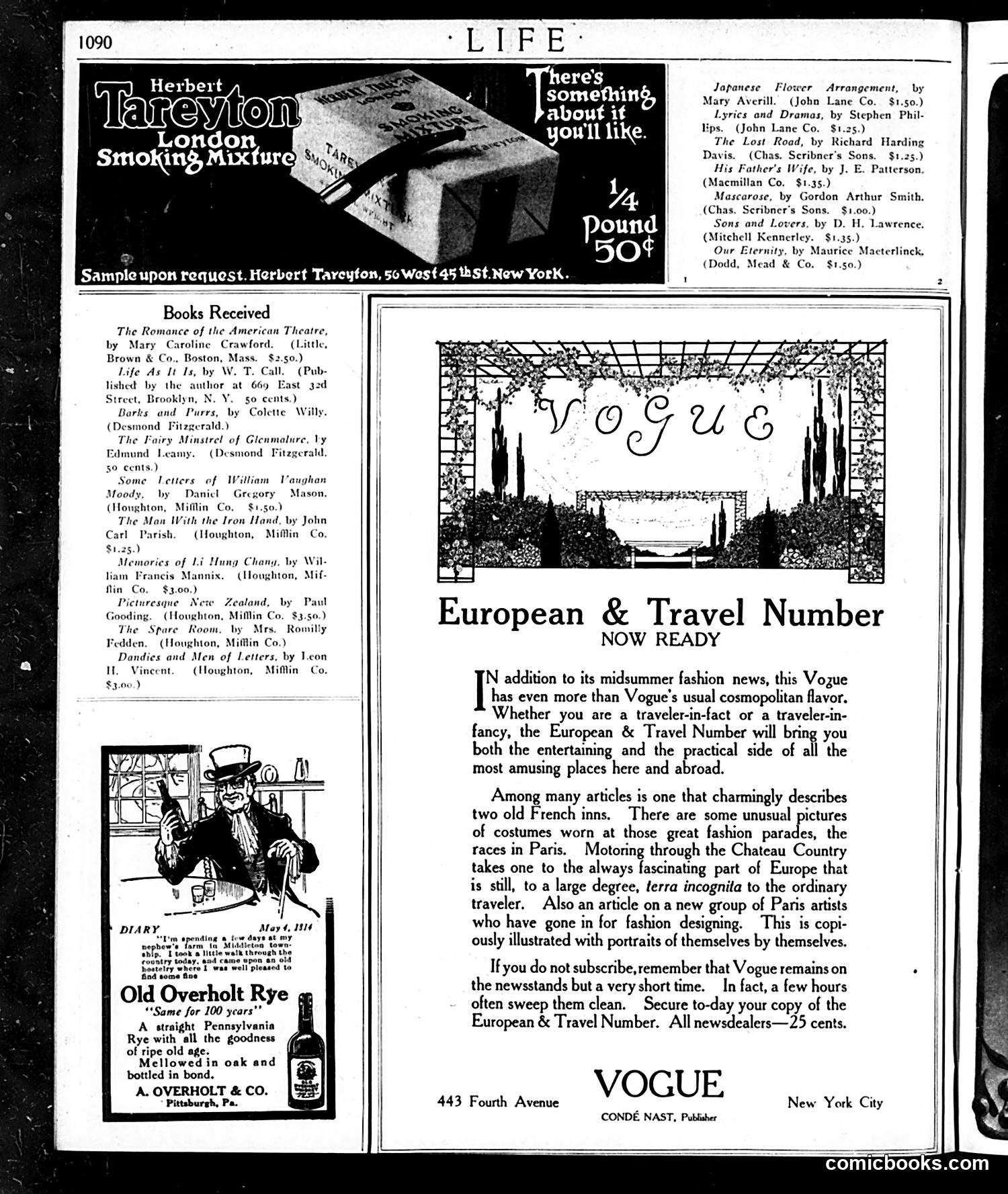
This page is primarily **advertising and book promotion** rather than political satire or editorial cartooning. The main content includes: 1. **Herbert Tareyton cigarette ad** (top): A straightforward product advertisement claiming the smoking mixture has appealing qualities. 2. **Books Received section**: A listing of newly published books with prices, typical of literary magazines of this era. 3. **Old Overholt Rye whiskey ad** (lower left): Features a small cartoon of a man at a bar—a conventional advertising illustration, not political satire. 4. **Vogue magazine advertisement** (right): Announces the "European & Travel Number" of Vogue, emphasizing fashion coverage of Paris races and French destinations. The page reflects **early 20th-century magazine culture**: book reviews, luxury goods advertising (spirits, cigarettes, fashion), and travel-fashion content. There is no discernible political commentary or satirical intent visible here.
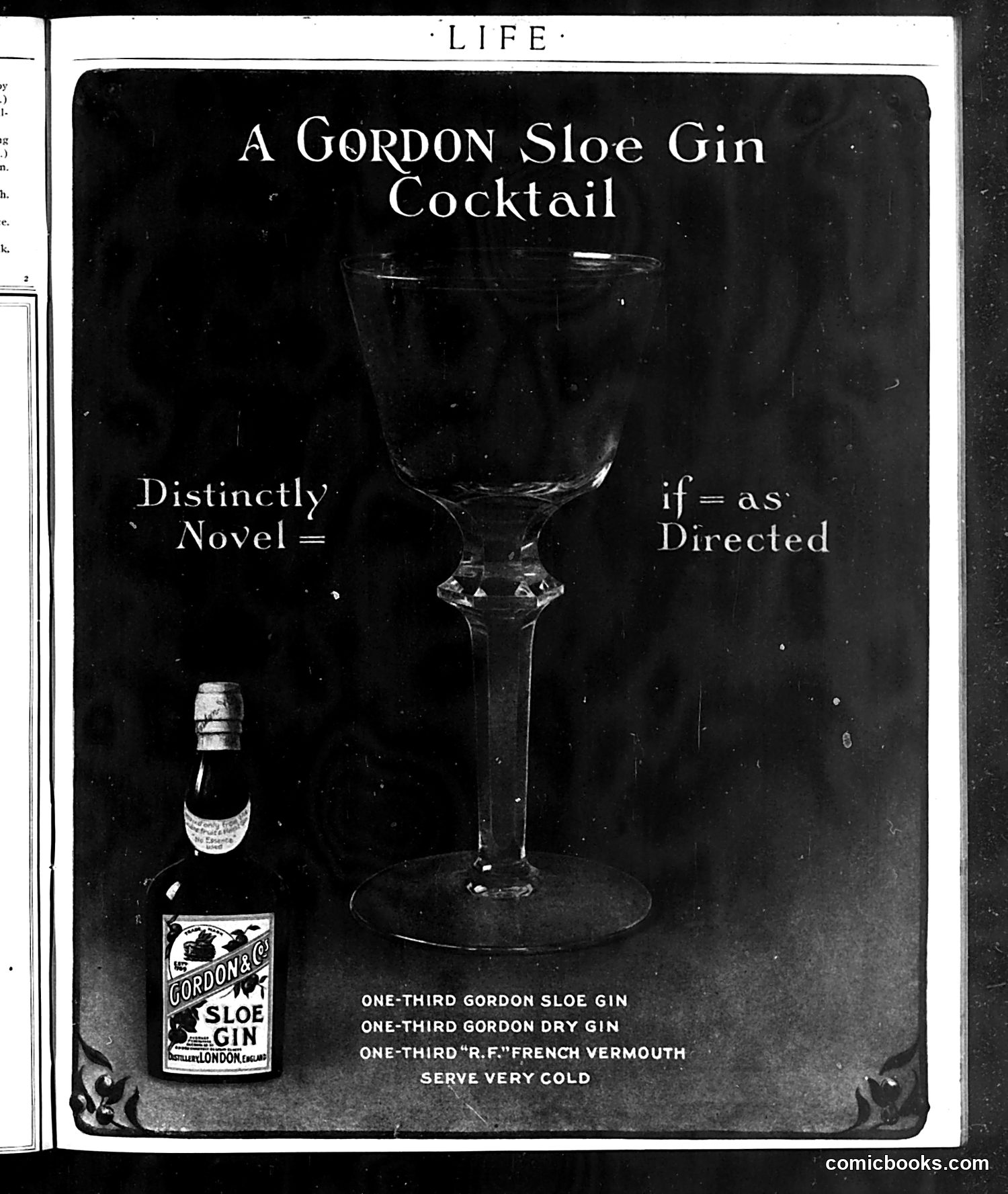
This is a **Gordon's Gin advertisement**, not political satire. The page promotes a cocktail recipe featuring Gordon's spirits, presented as something "Distinctly Novel" yet "if = as Directed"—a playful paradox suggesting the drink is both innovative and simple to make. The ad shows a bottle of Gordon's Sloe Gin alongside an elegant cocktail glass. The recipe calls for equal parts sloe gin, dry gin, and French vermouth, served cold. The humor is mild and self-aware: the ad jokes that following straightforward directions produces a supposedly "novel" result. This reflects the era's cocktail culture and marketing approach—presenting mixed drinks as fashionable and refined. The "R.F." vermouth likely refers to a specific brand variant, though it's unclear without additional context.
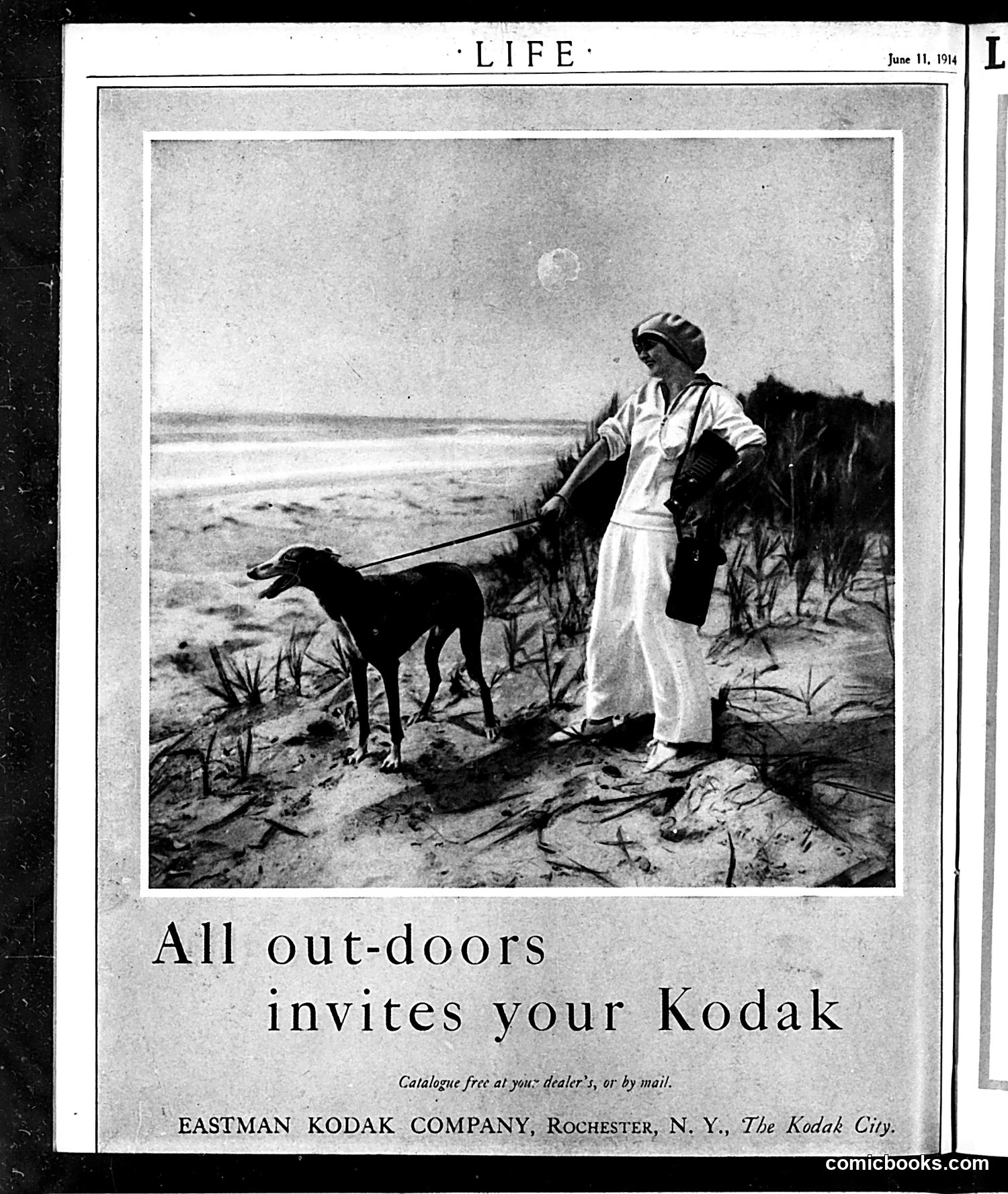
This is a **Kodak advertisement**, not satire or political commentary. The page shows a woman in early 1900s beach attire (white dress, cap) walking with a dog on a leash along a sandy shore with beach grass visible. The ad's message is straightforward: outdoor activities—leisure, recreation, nature—should be documented with a Kodak camera. The slogan "All out-doors invites your Kodak" encourages consumers to bring cameras on outings to capture memories. This reflects the early camera industry's marketing strategy: positioning photography as essential to enjoying modern recreational life. The image exemplifies Edwardian-era leisure culture and the emerging consumer practice of personal photography, promoting Kodak as the company to enable capturing these moments.