
Life, 1914-06-11 · page 30 of 44
Life — June 11, 1914 — page 30: what you’re looking at
What you’re looking at
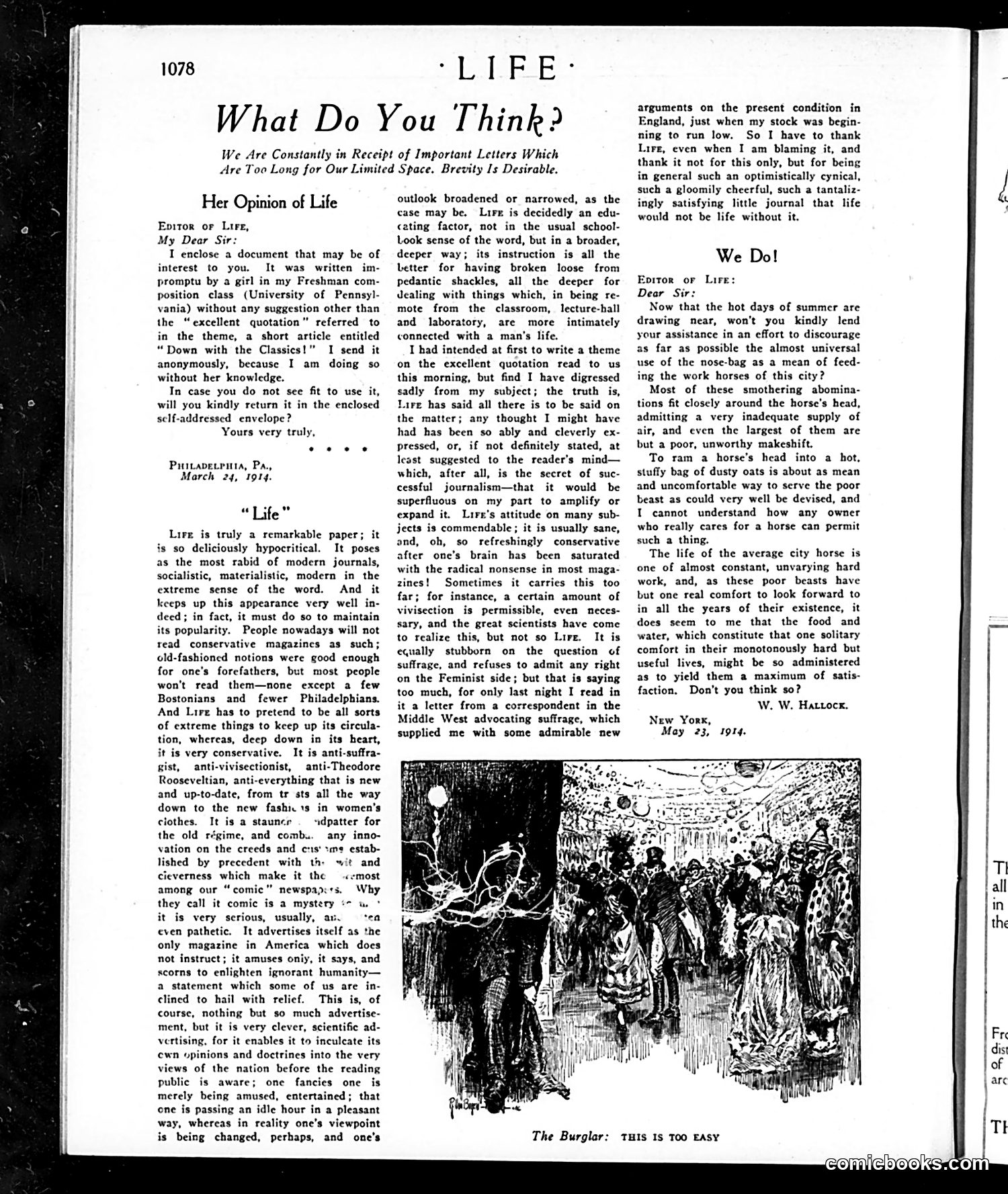
This page presents reader letters debating *Life* magazine's actual nature and influence. A University of Pennsylvania student's anonymous essay argues that *Life*, despite posing as a radical, modern, anti-establishment publication, is secretly deeply conservative—opposing women's suffrage, vivisection reform, and Theodore Roosevelt's progressivism. The writer contends *Life* skillfully disguises conservative messaging as entertainment, thereby subtly reshaping readers' views without their awareness. The accompanying cartoon depicts a burglar easily entering a home, likely illustrating the essay's central metaphor: *Life* magazine infiltrates readers' minds effortlessly, stealing their independent thought while they believe they're merely being entertained. The satire targets *Life*'s self-proclaimed role as purely amusing rather than instructive—exposing this claim as false advertising masking ideological influence.
📄 Transcribed text from this page (OCR, searchable)
Machine-transcribed from the original scan — historical spelling and the odd misread are preserved.
oo) be el el ea What Do You Think? We Are Constantly in Receipt of Important Letters Which Are Too Long for Our Limited Space. Brevity Is Desirable. Her Opinion of Life Epitor or Lire, My Dear Sir: I enclose a document that may be of interest to you. It was written im- promptu by a girl in my Freshman com- position class (University of Pennsyl- vania) without any suggestion other than the “excellent quotation” referred to in the theme, a short article entitled “Down with the Classics!" I send it anonymously, because I am doing so without her knowledge. In case you do not see fit to use it, will you kindly return it in the enclosed self-addressed envelope? Yours very truly, eee Putapecrita, Pa., March 24, 1914. “ Life” Live is truly a remarkable paper; it is so deliciously hypocritical. It poses as the most rabid of modern journals, socialistic, materialistic, modern in the extreme sense of the word. And it keeps up this appearance very well in- deed; in fact, it must do so to maintain its popularity. People nowadays will not read conservative magazines as such; old-fashioned notions were good enough for one’s forefathers, but most people won't read them—none except a few Bostonians and fewer Philadelphians. And Lirz has to pretend to be all sorts of extreme things to keep up its circula- tion, whereas, deep down in its heart, it is very conservative. It is anti-suffra- gist, anti-vivisectionist, anti-Theodore Rooseveltian, anti-everything that is new and up-to-date, from tr sts all the way down to the new fashi 1s in women’s clothes. It is a staunce udpatter for the old régime, and combu. any inno- vation on the creeds and cvs‘ «ms estab- lished by precedent with th: wit and cieverness which make it the «:most among our “comic” newspay: Why they call it comic is a mystery ‘7 wu. * it is very serious, usually, ax. even pathetic. It advertises itself as the only magazine in America which docs not instruct; it amuses oniy, it says, and scorns to enlighten ignorant humanity— a statement which some of us are in- clined to hail with relief. This is, of course, nothing but so much advertise- ment, but it is very clever, scientific ad- vertising, for it enables it to inculcate its cwn opinions and doctrines into the very views of the nation before the reading public is aware; one fancies one is merely being amused, entertained; that one is passing an idle hour in a pleasant way, whereas in reality one’s viewpoint is being changed, perhaps, and one’s outlook broadened or narrowed, as the case may be. Lire is decidedly an edu- cating factor, not in the usual school- Look sense of the word, but in a broader, deeper way; its instruction is all the Letter for having broken loose from pedantic shackles, all the deeper for dealing with things which, in being re- mote from the classroom, lecture-hall and laboratory, are more intimately connected with a man's life. Thad intended at first to write a theme on the excellent quotation read to us this morning, but find I have digressed sadly from my subject; the truth is, Lire has said all there is to be said on the matter; any thought I might have had has been so ably and cleverly ex- pressed, or, if not definitely stated, at least suggested to the reader's mind— which, after all, is the secret of suc- cessful journalism—that it would be superfluous on my part to amplify or expand it. Lirs’s attitude on many sub- jects is commendable; it is usually sane, and, oh, so refreshingly conservative after one’s brain has been saturated with the radical nonsense in most maga- zines! Sometimes it carries this too far; for instance, a certain amount of vivisection is permissible, even neces- sary, and the great scientists have come to realize this, but not so Lire. It is equally stubborn on the question of suffrage, and refuses to admit any right on the Feminist side; but that is saying too much, for only last night I read in it a letter from a correspondent in the Middle West advocating suffrage, which supplied me with some admirable new The Burglar: arguments on the present condition in England, just when my stock was begin- ning to run low. So I have to thank Lire, even when I am blaming it, and thank it not for this only, but for being in general such an optimistically cynical, such a gloomily cheerful, such a tantaliz- ingly satisfying little journal that life would not be life without it. We Do! Epitor or Lire: Dear Sir: Now that the hot days of summer are drawing near, won't you kindly lend your assistance in an effort to discourage as far as possible the almost universal use of the nose-bag as a mean of feed- ing the work horses of this city? Most of these smothering abomina- tions fit closely around the horse's head, admitting a very inadequate supply of air, and even the largest of them are but a poor, unworthy makeshift. To ram a horse's head into a hot, stuffy bag of dusty oats is about as mean and uncomfortable way to serve the poor beast as could very well be devised, and I cannot understand how any owner who really cares for a horse can permit such a thing. The life of the average city horse is one of almost constant, unvarying hard work, and, as these poor beasts have but one real comfort to look forward to in all the years of their existence, it does seem to me that the food and water, which constitute that one solitary comfort in their monotonously hard but useful lives, might be so administered as to yield them a maximum of satis- faction, Don’t you think so? W. W. Hattocx. New York, May 23, 1914. THIS IS TOO EASY