
Life, 1914-06-11 · page 11 of 44
Life — June 11, 1914 — page 11: what you’re looking at
What you’re looking at
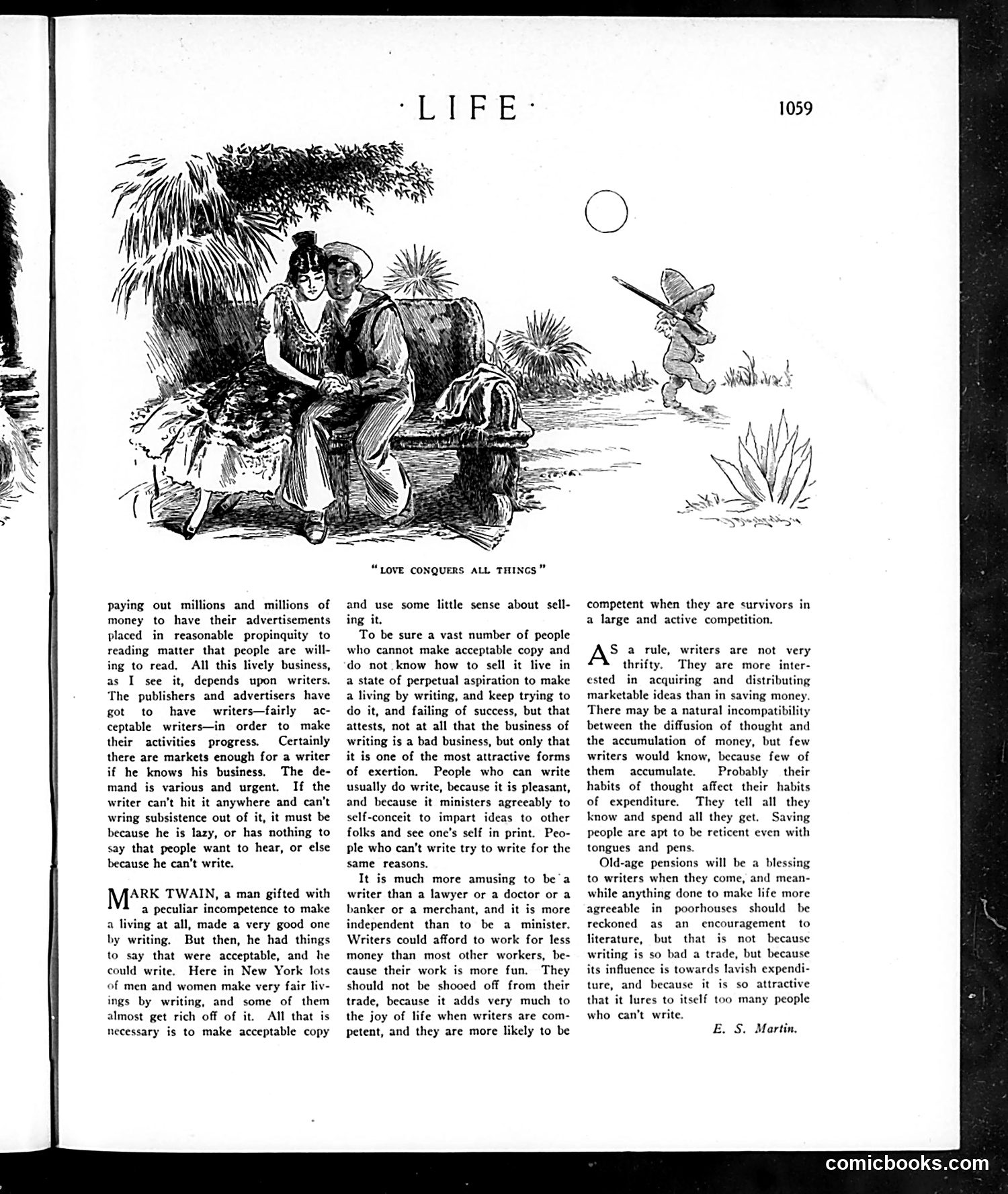
The illustration depicts a couple in romantic repose beneath tropical vegetation while a figure in the distance carries a large cross. The caption "Love Conquers All Things" appears ironic given the religious imagery. The accompanying text discusses writing as a profession, with passages attributed to Mark Twain praising writers' independence and social value compared to lawyers and doctors. The article argues that writing offers both financial and personal rewards, and that competent writers are increasingly valuable in a competitive marketplace. The cartoon likely satirizes romantic idealism by juxtaposing lovers against religious duty or sacrifice—suggesting that love's conquering power conflicts with other life obligations, particularly spiritual commitment. The tropical setting emphasizes escapism from worldly concerns.
📄 Transcribed text from this page (OCR, searchable)
Machine-transcribed from the original scan — historical spelling and the odd misread are preserved.
paying out millions and millions of money to have their advertisements placed in reasonable propinquity to reading matter that people are will- ing to read. All this lively business, as I see it, depends upon writers. The publishers and advertisers have got to have writers—fairly ac- ceptable writers—in order to make their activities progress. Certainly there are markets enough for a writer if he knows his business. The de- mand is various and urgent. If the writer can’t hit it anywhere and can't wring subsistence out of it, it must be because he is lazy, or has nothing to say that people want to hear, or else because he can’t write. Ma8« TWAIN, a man gifted with a peculiar incompetence to make a living at all, made a very good one by writing. But then, he had things to say that were acceptable, and he could write. Here in New York lots of men and women make very fair liv- ings by writing, and some of them almost get rich off of it. All that is necessary is to make acceptable copy “LOVE CONQUERS ALL THINGS” and use some little sense about sell- ing it. To be sure a vast number of people who cannot make acceptable copy and do not know how to sell it live in a state of perpetual aspiration to make a living by writing, and keep trying to do it, and failing of success, but that attests, not at all that the business of ing is a bad business, but only that it is one of the most attractive forms of exertion. People who can write usually do write, because it is pleasant, and because it ministers agreeably to self-conceit to impart ideas to other folks and see one’s self in print. Peo- ple who can’t write try to write for the same reasons. It is much more amusing to be'a writer than a lawyer or a doctor or a banker or a merchant, and it is more independent than to be a minister. Writers could afford to work for less money than most other workers, be- cause their work is more fun. They should not be shooed off from their trade, because it adds very much to the joy of life when writers are com- petent, and they are more likely to be competent when they are survivors in a large and active competition. S a rule, writers are not very thrifty. They are more inter- ested in acquiring and distributing marketable ideas than in saving money. There may be a natural incompatibility between the diffusion of thought and the accumulation of money, but few writers would know, because few of them accumulate. Probably their habits of thought affect their habits of expenditure. They tell all they know and spend all they get. Saving people are apt to be reticent even with tongues and pens. Old-age pensions will be a blessing to writers when they come, and mean- while anything done to make life more agreeable in poorhouses should be reckoned as an encouragement to literature, but that is not because writing is so bad a trade, but because its influence is towards lavish expendi- ture, and because it is so attractive that it lures to itself too many people who can’t write. E. S. Martin, comicbooks.com