
Life, 1914-06-11 · page 27 of 44
Life — June 11, 1914 — page 27: what you’re looking at
What you’re looking at
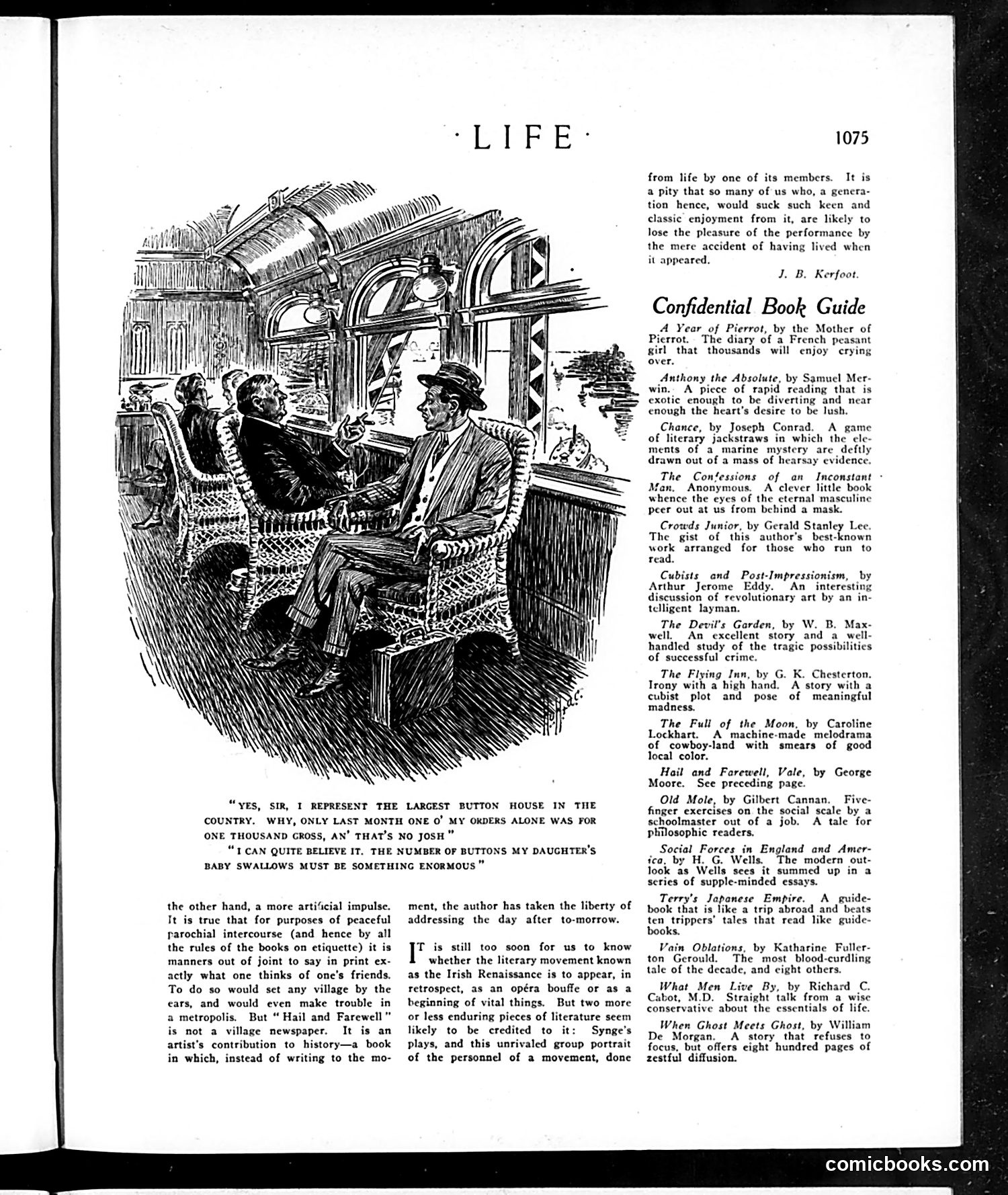
This page contains a single cartoon with accompanying satirical commentary about book reviews. **The Cartoon:** A button salesman boasts to a skeptical listener about massive orders—one thousand gross buttons monthly. The listener responds that he "quite believes it," explaining that his daughter's baby swallows so many buttons it must account for enormous quantities. **The Joke:** This is a classic "tall tale" setup where the salesman's exaggerated business claims are met with absurdist logic. The listener implies the buttons are being consumed by an infant, treating this ridiculous scenario as a reasonable explanation—mocking both the salesman's implausibly inflated numbers and the listener's deadpan acceptance of an obviously false premise. **Context:** The satire targets commercial boasting and the gap between claimed business success and reality. The cartoon reflects early 20th-century American humor conventions favoring dry, understated rejoinders to verbose salesmanship. The page's second section is a "Confidential Book Guide"—witty, sarcastic capsule reviews of contemporary literature.
📄 Transcribed text from this page (OCR, searchable)
Machine-transcribed from the original scan — historical spelling and the odd misread are preserved.
wan) A “YES, SIR, I REPRESENT THE LARGEST BUTTON HOUSE IN THE COUNTRY, WHY, ONLY LAST MONTH ONE 0’ MY OKDERS ALONE WAS FOR ONE THOUSAND GROSS, AN’ THAT’S NO JOSH” “T CAN QUITE BELIEVE IT. THE NUMBER OF BUTTONS MY DAUGHTER'S, BABY SWALLOWS MUST BE SOMETHING ENORMOUS ” the other hand, a more arti‘icial impulse. It is true that for purposes of peaceful parochial intercourse (and hence by all the rules of the books on etiquette) it is manners out of joint to say in print ex- actly what one thinks of one's friends, To do so would set any village by the ears, and would even make trouble in a metropolis, But “ Hail and Farewell” is not a village newspaper. It is an artist's contribution to history—a book in which, instead of writing to the mo- ment, the author has taken the liberty of addressing the day after to-morrow. T is still too soon for us to know whether the literary movement known as the Irish Renaissance is to appear, in retrospect, as an opéra bouffe or as a beginning of vital things. But two more or less enduring pieces of literature seem likely to be credited to it: Synge’s plays, and this unrivaled group portrait of the personnel of a movement, done 1075 from life by one of its members. It is a pity that so many of us who, a genera- tion hence, would suck such keen and classic enjoyment from it, are likely to lose the pleasure of the performance by the mere accident of having lived when it appeared. J. B. Kerfoot. Confidential Book Guide A Year of Pierrot, by the Mother of Pierrot. The diary of a French peasant girl that thousands will enjoy crying over. Anthony the Absolute, by Samucl Mer- win. A picce of rapid reading that is exotic enough to be diverting and near enough the heart's desire to be lush. Chance, by Joseph Conrad. A game of literary jackstraws in which the cle- ments of a marine mystery are deftly drawn out of a mass of hearsay evidence. The Confessions of an Man. Anonymous. A clever little book whence the eyes of the eternal masculine peer out at us from behind a mask. Crowds Junior, by Gerald Stanley Lee. The gist of this author's best-known work arranged for those who run to Tead. Cubists and Post-Impressionism, by Arthur Jerome Eddy. An interesting discussion of revolutionary art by an in- telligent layman. The Devil's Garden, by W. B. Ma: well. An excellent story and a we handled study of the tragic possibilities of successful crime. The Flying Inn, by G. K. Chesterton. Irony with a high hand. A story with a cubist plot. and pose of meaningful madness. The Full of the Moon, by Caroline Lockhart. A machine-made melodrama of cowboy-land with smears of good local color. Hail and Farewell, Vale, by George Moore. See preceding page. Old Mole, by Gilbert Cannan, Five- finger exercises on the social scale by a schoolmaster out of a job. A tale for philosophic readers, Social Forces in England and Amer- ica, by H. G. Wells. The modern out- look as Wells sees it summed up in a scries of supple-minded essays. Terry's Japanese Empire. A guide- book that is like a trip abroad and beats ten trippers’ tales that read like guide- books. Vain Oblations, by Katharine Fuller- ton Gerould. The most blood-curdling tale of the decade, and cight others. What Men Live By, by Richard C. Cabot, M.D. Straight talk from a wise conservative about the essentials of life. When Ghost Meets Ghost, by William De Morgan. A story that refuses to focus, but offers eight hundred pages of zestful diffusion. comicbooks.com Inconstant -