
Life, 1914-06-11 · page 24 of 44
Life — June 11, 1914 — page 24: what you’re looking at
What you’re looking at
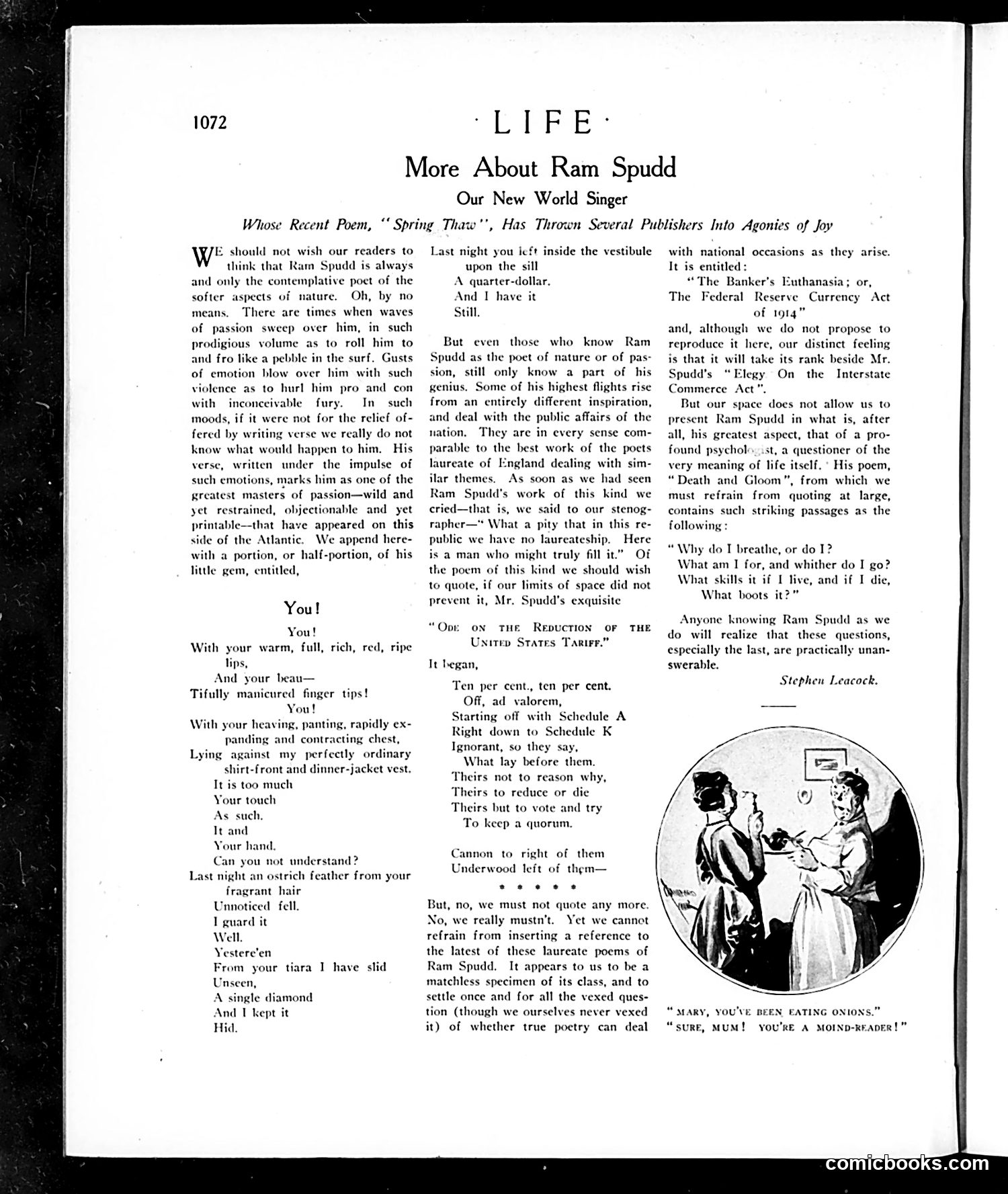
This is a satirical article mocking pretentious literary culture and a fictional poet named Ram Spudd. The piece parodies overwrought Romantic poetry through contrasting examples: Spudd's saccharine love poem "You!" (obsessing over a woman's lips, chest, and a stolen quarter left in a vestibule) juxtaposed with his supposedly serious political verse about tariffs and banking legislation. The satire targets the American literary establishment's tendency to treat any poem about "serious" subjects—even tedious legislative matters like the Federal Reserve Act—as profound art worthy of laureateship, while ignoring sensibility or actual merit. References to Cannon and Underwood (political figures) and 1914 Federal Reserve legislation ground the mockery in contemporary Progressive-era politics. The cartoon (lower right) shows a domestic scene, likely illustrating absurd romantic sentimentality. The joke: Life magazine is mocking how American culture confuses verbosity with profundity.
📄 Transcribed text from this page (OCR, searchable)
Machine-transcribed from the original scan — historical spelling and the odd misread are preserved.
‘UC BPE * More About Ram Spudd Our New World Singer Whose Recent Poem, “‘ Spring Thaw'’, Has Thrown Several Publishers Into Agonies of Joy W should not wish our readers to think that Ram Spudd is always and only the contemplative poet of the softer aspects of nature. Oh, by no means. There are times when waves of passion sweep over him, in such prodigious volume as to roll him to and fro like a pebble in the surf. Gusts of emotion blow over him with such violence as to hurl him pro and con with inconceivable fury. In such moods, if it were not for the relief of- fered by writing verse we really do not now what would happen to him. His. verse, written under the impulse of such emotions, marks him as one of the greatest masters of passion—wild and yet restrained, objectionable and yet printable—that have appeared on this side of the Atlantic. We append here- with a portion, or half-portion, of his little gem, entitled, You! You! our warm, full, rich, red, ripe lips, And your beau— Tifully manicured finger tips! You! With your heaving, panting, rapidly panding and contracting chest, Lying against my perfectly ordinary shirt-front and dinner-jacket vest. Tt is too much Your touch As such, Tt and Your hand. Can you not understand? Last night an ostrich feather from your fragrant hair Unnoticed fell. 1 guard it Well. Yestere’en From your tiara I have slid Unseen, A single diamond And I kept it Hid. With Last night you icft inside the vestibule upon the sill A quarter-dollar. And I have it Still. But even those who know Ram Spudd as the poet of nature or of pas- sion, still only know a part of his genius, Some of his highest flights rise from an entirely different inspiration, and deal with the public affairs of the nation, They are in every sense com- parable to the best work of the poets laureate of England dealing with sim- ilar themes. As soon as we had seen Ram Spudd’s work of this kind we cried—that is, we said to our stenog- rapher—* What a pity that in this re- public we have no laureateship. Here is a man who might truly fill it.” Of the poem of this kind we should wish to quote, if our limits of space did not prevent it, Mr. Spudd's exquisite “Opt on tHe Repuction oF THE Unitep States Tarirr.” It began, Ten per cent., ten per cent. Off, ad valorem, Starting off with Schedule A Right down to Schedule K Ignorant, so they say, What lay before them. ‘Theirs not to reason why, Theirs to reduce or die Theirs but to vote and try To keep a quorum. Cannon to right of them Underwood left of them— cee ee But, no, we must not quote any more. No, we really mustn't. Yet we cannot refrain from inserting a reference to the latest of these laureate poems of Ram Spudd. It appears to us to be a matchless specimen of its class, and to settle once and for all the vexed ques- tion (though we ourselves never vexed it) of whether true poetry can deal with national occasions as they arise. It is entitled: “The Banker's Euthanasia; or, The Federal Reserve Currency Act of 1914” and, although we do not propose to reproduce it here, our distinct feeling is that it will take its rank beside Mr. Spudd’s “Elegy On the Interstate Commerce Act”. But our space does not allow us to present Ram Spudd in what is, after all, his greatest aspect, that of a pro- found psychols.st, a questioner of the very meaning of life itself, ° His poem, “Death and Gloom”, from which we must refrain from quoting at large, contains such striking passages as the following : “Why do T breathe, or do 1? What am I for, and whither do I go? What skills it if I live, and if I die, What boots it?” Anyone knowing Ram Spudd as we do will realize that these questions, especially the last, are practically unan- swerable. Stephen Leacock. “MARY, YOU'VE BEEN EATING ONIONS.” “sure, MUM! YOU'RE A MOIND-READER!” Ccomicbooks.com