
Life, 1914-06-11 · page 19 of 44
Life — June 11, 1914 — page 19: what you’re looking at
What you’re looking at
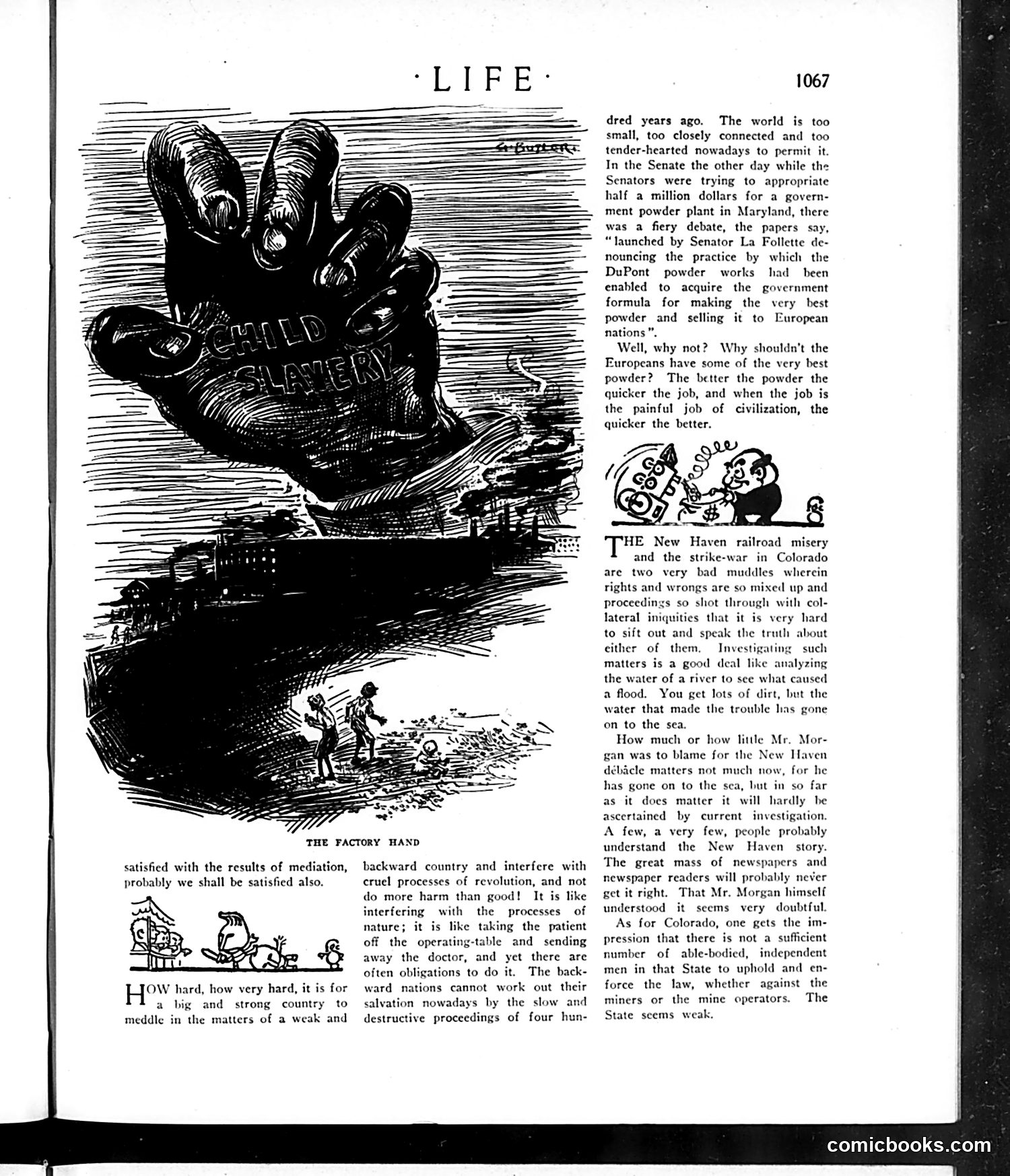
This page satirizes American foreign policy and domestic corruption circa 1910s. The large cartoon depicts a giant hand labeled "SHIELD BATTERY" crushing a factory and workers below—symbolizing how American industrial interests (particularly munitions makers like DuPont) dominate weaker nations. The text mocks the hypocrisy of U.S. interventionism: senators debate appropriating money for a government powder plant while simultaneously allowing DuPont to sell government formulas to European nations. The author sarcastically asks "why not?" sell superior powder to foreigners if Americans claim moral authority to meddle in "backward countries." The piece also references two contemporary scandals: the New Haven Railroad collapse (involving J.P. Morgan) and Colorado labor strikes, framing both as examples where American institutions fail to fairly resolve conflicts between powerful and powerless parties. The satire suggests American moral authority abroad rings hollow given domestic injustices.
📄 Transcribed text from this page (OCR, searchable)
Machine-transcribed from the original scan — historical spelling and the odd misread are preserved.
THE FACTORY HAND satisfied with the results of mediation, probably we shall be satisfied also. Hoe’ hard, how very hard, it is for a big and. strong country to meddle in the matters of a weak and backward country and interfere with cruel processes of revolution, and not do more harm than good! It is like interfering with the processes of nature; it is like taking the patient off the operating-table and sending away the doctor, and yet there are often obligations to do it. The back- ward nations cannot work out their salvation nowadays hy the slow and destructive proceedings of four hun- 1067 dred years ago. The world is too small, too closely connected and too tender-hearted nowadays to permit it. In the Senate the other day while the Senators were trying to appropriate half a million dollars for a govern- ment powder plant in Maryland, there was a fiery debate, the papers say, “launched by Senator La Follette de- nouncing the practice by which the DuPont powder works been enabled to acquire the government formula for making the very best powder and selling it to European nations”. Well, why not?) Why shouldn't the Europeans have some of the very best powder? The better the powder the guicker the job, and when the job is the painful job of civilization, the quicker the better. TH New Haven railroad misery and the strike-war in Colorado are two very bad muddles wherein rights and wrongs are so mixed up and proceedings so shot through with col- lateral iniquities that it is very hard to sift out and speak the truth about either of them, Investigating such matters is a good deal like analyzing the water of a river to sce what caused a flood. You get lots of dirt, but the water that made the trouble has gone on to the sea. How much or how little Mr. Mor- gan was to blame for the New Haven debacle matters not much now, for he has gone on to the sea, but in so far as it does matter it will hardly be ascertained by current investigation A few, a very few, people probably understand the New Haven story. The great mass of newspapers and newspaper readers will probably never get it right. That Mr. Morgan himself understood it seems very doubtful. As for Colorado, one gets the im- pression that there is not a sufficient number of able-bodied, independent men in that State to uphold and en- force the law, whether against the miners or the mine operators. The State seems weak. comicbooks.com