
Life, 1914-06-11 · page 18 of 44
Life — June 11, 1914 — page 18: what you’re looking at
What you’re looking at
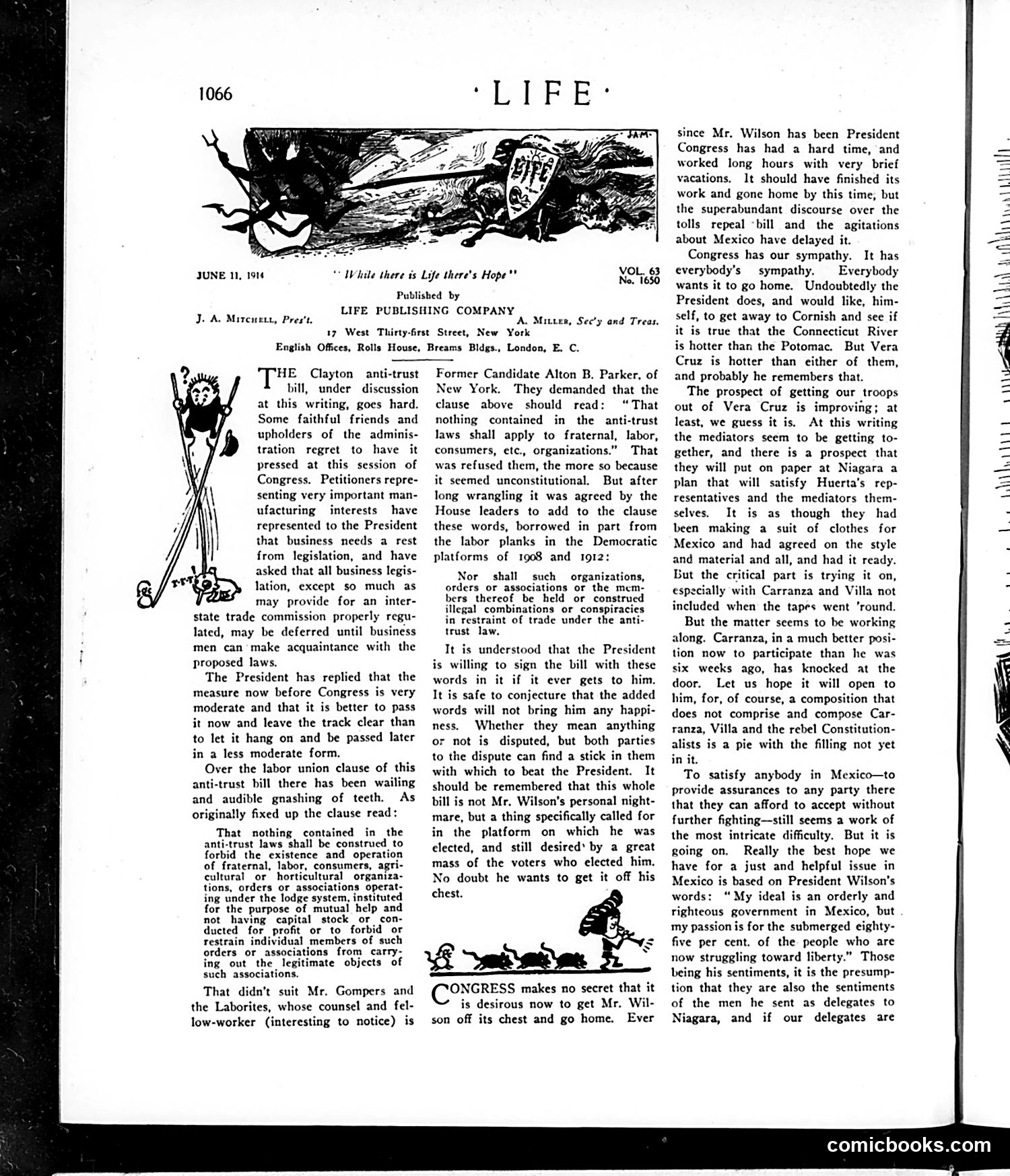
This Life magazine page discusses two contentious legislative battles during President Wilson's administration: **The Clayton Anti-Trust Bill**: The cartoon and text critique business lobbying against the bill. Manufacturing interests sought a "rest from legislation," but Wilson pushed for passage, arguing it better to act now than later with harsher measures. The labor clause proved particularly divisive—labor leaders (represented by former candidate Alton B. Parker) demanded broad exemptions from anti-trust laws, while Wilson's administration resisted language deemed unconstitutional, eventually compromising with ambiguous wording both sides could dispute. **Congressional Fatigue**: The piece sympathetically notes Congress has worked exhaustively under Wilson, wanting to adjourn. Mexico tensions and the tolls repeal debate prolonged the session beyond expectations. The satirical tone suggests frustration with legislative gridlock and competing interests all seeking presidential favor while Congress seeks escape—portraying governance as exhausting theater rather than coherent policymaking.
📄 Transcribed text from this page (OCR, searchable)
Machine-transcribed from the original scan — historical spelling and the odd misread are preserved.
1066 JUNE 11, 1916 “While there ts Life there's Hope" VOL. 63 Ne, 1650 Published by LIFE PUBLISHING COMPANY J. A. Mircnent, Pres't. A. Minter, Sec’y and Treas. 17 West Thirty-first Street, New York English Offices, Rolls House, Breams Bldgs., London, E. C. HE Clayton anti-trust bill, under discussion at this writing, goes hard. Some faithful friends and upholders of the adminis- tration regret to have it pressed at this session of Congress. Petitioners repre- senting very important man- ufacturing interests have represented to the President that business needs a rest from legislation, and have asked that all business legis- lation, except so much as may provide for an inter- state trade commission properly regu- lated, may be deferred until business men can make acquaintance with the Proposed laws. The President has replied that the measure now before Congress is very moderate and that it is better to pass it now and leave the track clear than to let it hang on and be passed later in a less moderate form. Over the labor union clause of this anti-trust bill there has been wailing and audible gnashing of teeth. As originally fixed up the clause read: That nothing contained in the anti-trust laws shall be construed to forbid the existence and operation of fraternal, labor, consumers, agri- cultural or horticultural organiza- tions, orders or associations operat- ing under the lodge system, instituted for the purpose of mutual help and not having capital stock or con- ducted for profit or to forbid or restrain individual members of such orders or associations from carry- ing out the legitimate objects of such associations. That didn’t suit Mr. Gompers and the Laborites, whose counsel and fel- low-worker (interesting to notice) is Former Candidate Alton B. Parker, of New York. They demanded that the clause above should read: “That nothing contained in the anti-trust laws shall apply to fraternal, labor, consumers, etc., organizations.” That was refused them, the more so because it seemed unconstitutional. But after long wrangling it was agreed by the House leaders to add to the clause these words, borrowed in part from the labor planks in the Democratic platforms of 1908 and 1912: Nor shall such organizations, orders or associations or the mcm- bers thereof be held or construed illegal combinations or conspiracies in restraint of trade under the anti- trust law. It is understood that the President is willing to sign the bill with these words in it if it ever gets to him. It is safe to conjecture that the added words will not bring him any happi- ness. Whether they mean anything or not is disputed, but both parties to the dispute can find a stick in them with which to beat the President. It should be remembered that this whole bill is not Mr. Wilson’s personal night- mare, but a thing specifically called for in the platform on which he was elected, and still desired’ by a great mass of the voters who elected him. No doubt he wants to get it off his chest. rg (S ONGRESS makes no secret that it is desirous now to get Mr. Wil- son off its chest and go home. Ever since Mr. Wilson has been President Congress has had a hard time, and worked long hours with very brief vacations. It should have finished its work and gone home by this time, but the superabundant discourse over the tolls repeal “bill and the agitations about Mexico have delayed it. Congress has our sympathy. It has everybody’s sympathy. Everybody wants it to go home. Undoubtedly the President does, and would like, him- self, to get away to Cornish and see if it is true that the Connecticut River is hotter than the Potomac. But Vera Cruz is hotter than either of them, and probably he remembers that. The prospect of getting our troops out of Vera Cruz is improving; at least, we guess it is. At this writing the mediators seem to be getting to- gether, and there is a prospect that they will put on paper at Niagara a plan that will satisfy Huerta’s rep- resentatives and the mediators them- selves. It is as though they had been making a suit of clothes for Mexico and had agreed on the style and material and all, and had it ready. But the critical part is trying it on, especially with Carranza and Villa not included when the tapes went ‘round. But the matter seems to be working along. Carranza, in a much better posi- tion now to participate than he was six weeks ago, has knocked at the door. Let us hope it will open to him, for, of course, a composition that does not comprise and compose Car- ranza, Villa and the rebel Constitution- alists is a pie with the filling not yet in it. To satisfy anybody in Mexico—to provide assurances to any party there that they can afford to accept without further fighting—still seems a work of the most intricate difficulty. But it is going on, Really the best hope we have for a just and helpful issue in Mexico is based on President Wilson’s words: “My ideal is an orderly and righteous government in Mexico, but my passion is for the submerged eighty- five per cent. of the people who are now struggling toward liberty.” Those being his sentiments, it is the presump- tion that they are also the sentiments of the men he sent as delegates to Niagara, and if our delegates are comicbooks.com