
Life, 1914-06-11 · page 20 of 44
Life — June 11, 1914 — page 20: what you’re looking at
What you’re looking at
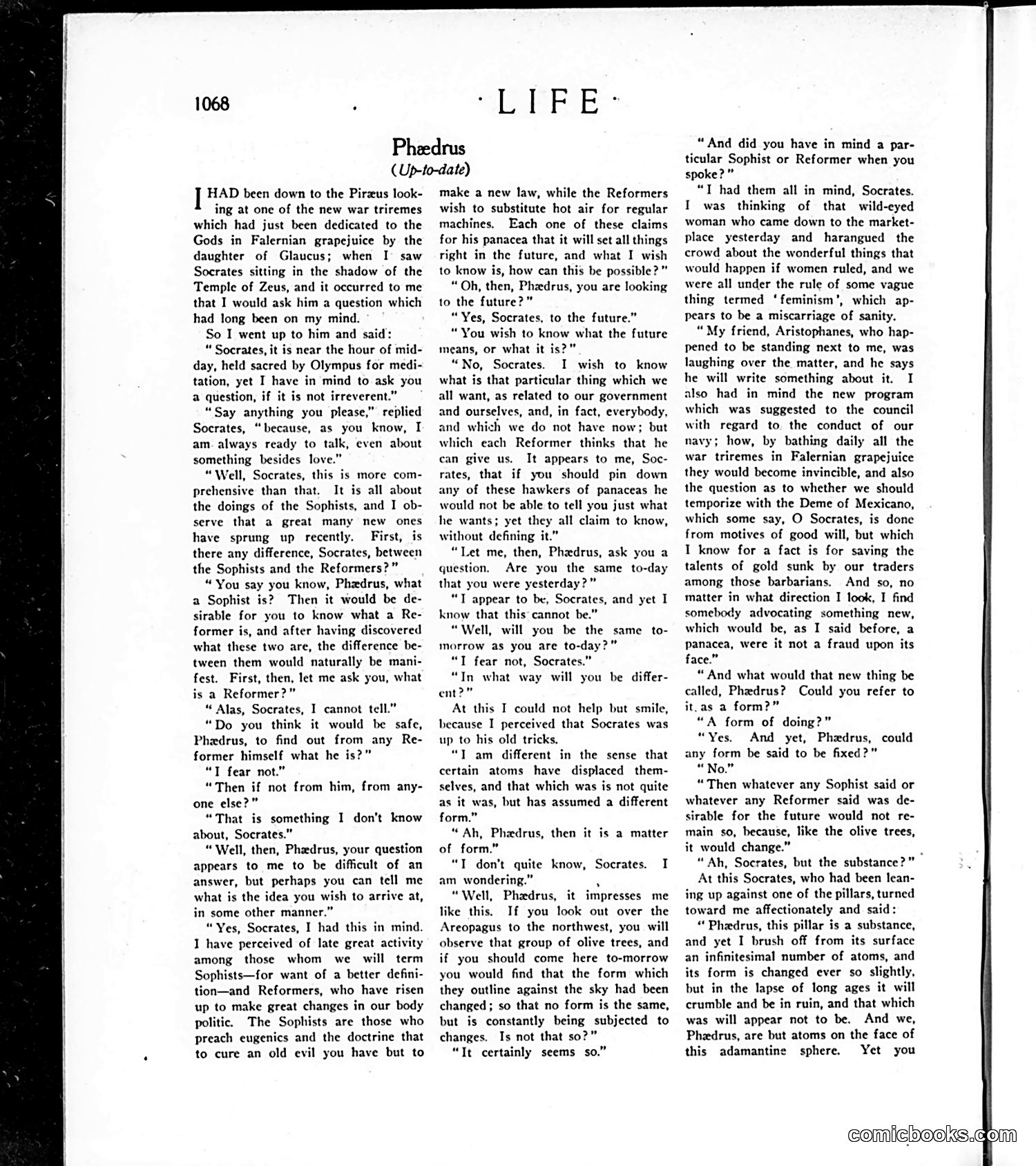
This is a satirical piece using Plato's dialogue format to mock contemporary American reformers and Sophists. The author transposes the classical Socratic method into a modern political critique. **The Setup:** Phaedrus questions Socrates about the difference between Sophists (who preach eugenics and new laws as panaceas) and Reformers (who substitute "hot air for regular machines"). Both groups claim future solutions but cannot define what they actually want to fix. **The Satire:** Through Socratic questioning about change and form, the piece suggests that reformers—like those advocating early-20th-century progressive causes—offer vague promises without substance. The olive tree analogy implies constant change makes fixed solutions impossible. **Political Context:** This appears to target Progressive Era reformers broadly, mocking their confidence in legislation and social engineering as superficial rhetoric lacking practical grounding—a conservative critique of 1910s-era reform movements including eugenics advocacy and regulatory schemes.
📄 Transcribed text from this page (OCR, searchable)
Machine-transcribed from the original scan — historical spelling and the odd misread are preserved.
“GESE= Pheedrus (Up-to-date) HAD been down to the Pirzus look- ing at one of the new war triremes which had just been dedicated to the Gods in Falernian grapejuice by the daughter of Glaucus; when I saw Socrates sitting in the shadow of the Temple of Zeus, and it occurred to me that I would ask him a question which had long been on my mind. So I went up to him and said: “ Socrates, it is near the hour of mid- day, held sacred by Olympus for medi- tation, yet I have in mind to ask you a question, if it is not irreverent.” “Say anything you please,” replied Socrates, “because, as you know, I am. always ready to talk, even about something besides love.” “Well, Socrates, this is more com- prehensive than that. It is all about the doings of the Sophists, and I ob- serve that a great many new ones have sprung up recently. First, is there any difference, Socrates, between the Sophists and the Reformers?” “You say you know, Phadrus, what a Sophist is? Then it would be de- sirable for you to know what a Re- former is, and after having discovered what these two are, the difference be- tween them would naturally be mani- fest. First, then, let me ask you, what is a Reformer?” “ Alas, Socrates, I cannot tell.” “Do you think it would be safe, Phedrus, to find out from any Re- former himself what he is?” “T fear not.” “Then if not from him, from any- one else?” “That is something I don’t know about, Socrates.” “Well, then, Phadrus, your question appears to me to be difficult of an answer, but perhaps you can tell me what is the idea you wish to arrive at, in some other manner.” “Yes, Socrates, I had this in mind. 1 have perceived of late great activity among those whom we will term Sophists—for want of a better defini- tion—and Reformers, who have risen up to make great changes in our body politic. The Sophists are those who preach eugenics and the doctrine that to cure an old evil you have but to make a new law, while the Reformers wish to substitute hot air for regular machines. Each one of these claims for his panacea that it will set all things right in the future, and what I wish to know is, how can this be possible?” “Oh, then, Phzedrus, you are looking to the future?” “Yes, Socrates, to the future.” “You wish to know what the future means, or what it is?” “No, Socrates. I wish to know what is that particular thing which we all want, as related to our government and ourselves, and, in fact, everybody, and which we do not have now; but which each Reformer thinks that he can give us. It appears to me, Soc- rates, that if you should pin down any of these hawkers of panaceas he would not be able to tell you just what he wants; yet they all claim to know, without defining it.” “Let me, then, Phedrus, ask you a question. Are you the same to-day that you were yesterday?” “T appear to be, Socrates, and yet I know that this cannot be.” “Well, will you be the same to- morrow as you are to-day?” “TI fear not, Socrates.” “In what way will you be differ- ent?” At this I could not help but smile, because I perceived that Socrates was up to his old tricks. “I am different in the sense that certain atoms have displaced them- selves, and that which was is not quite as it was, but has assumed a different form.” “Ah, Phedrus, then it is a matter of form.” “T don't quite know, Socrates. I am wondering.” ‘ “Well, Phadrus, it impresses me like this. If you look out over the Areopagus to the northwest, you will observe that group of olive trees, and if you should come here to-morrow you would find that the form which they outline against the sky had been changed; so that no form is the same, but is constantly being subjected to changes. Is not that so?” “It certainly seems so.” “And did you have in mind a par- ticular Sophist or Reformer when you spoke?” “Thad them all in mind, Socrates. I was thinking of that wild-eyed woman who came down to the market- place yesterday and harangued the crowd about the wonderful things that would happen if women ruled, and we were all under the rule of some vague thing termed ‘feminism’, which ap- pears to be a miscarriage of sanity. “My friend, Aristophanes, who hap- pened to be standing next to me, was laughing over the matter, and he says he will write something about it. I also had in mind the new program which was suggested to the council with regard to the conduct of our navy; how, by bathing daily all the war triremes in Falernian grapejuice they would become invincible, and also the question as to whether we should temporize with the Deme of Mexicano, which some say, O Socrates, is done from motives of good will, but which I know for a fact is for saving the talents of gold sunk by our traders among those barbarians. And so, no matter in what direction I look, I find somebody advocating something new, which would be, as I said before, a panacea, were it not a fraud upon its face.” “And what would that new thing be called, Phedrus? Could you refer to it.as a form?” “A form of doing?” “Yes. And yet, Phadrus, could any form be said to be fixed?” “No.” “Then whatever any Sophist said or whatever any Reformer said was de- sirable for the future would not re- main so, because, like the olive trees, it would change.” . “Ah, Socrates, but the substance?” At this Socrates, who had been lean- ing up against one of the pillars, turned toward me affectionately and said: “ Phadrus, this pillar is a substance, and yet I brush off from its surface an infinitesimal number of atoms, and its form is changed ever so slightly, but in the lapse of long ages it will crumble and be in ruin, and that which was will appear not to be. And we, Phadrus, are but atoms on the face of this adamantine sphere. Yet you