
Life, 1914-06-11 · page 10 of 44
Life — June 11, 1914 — page 10: what you’re looking at
What you’re looking at
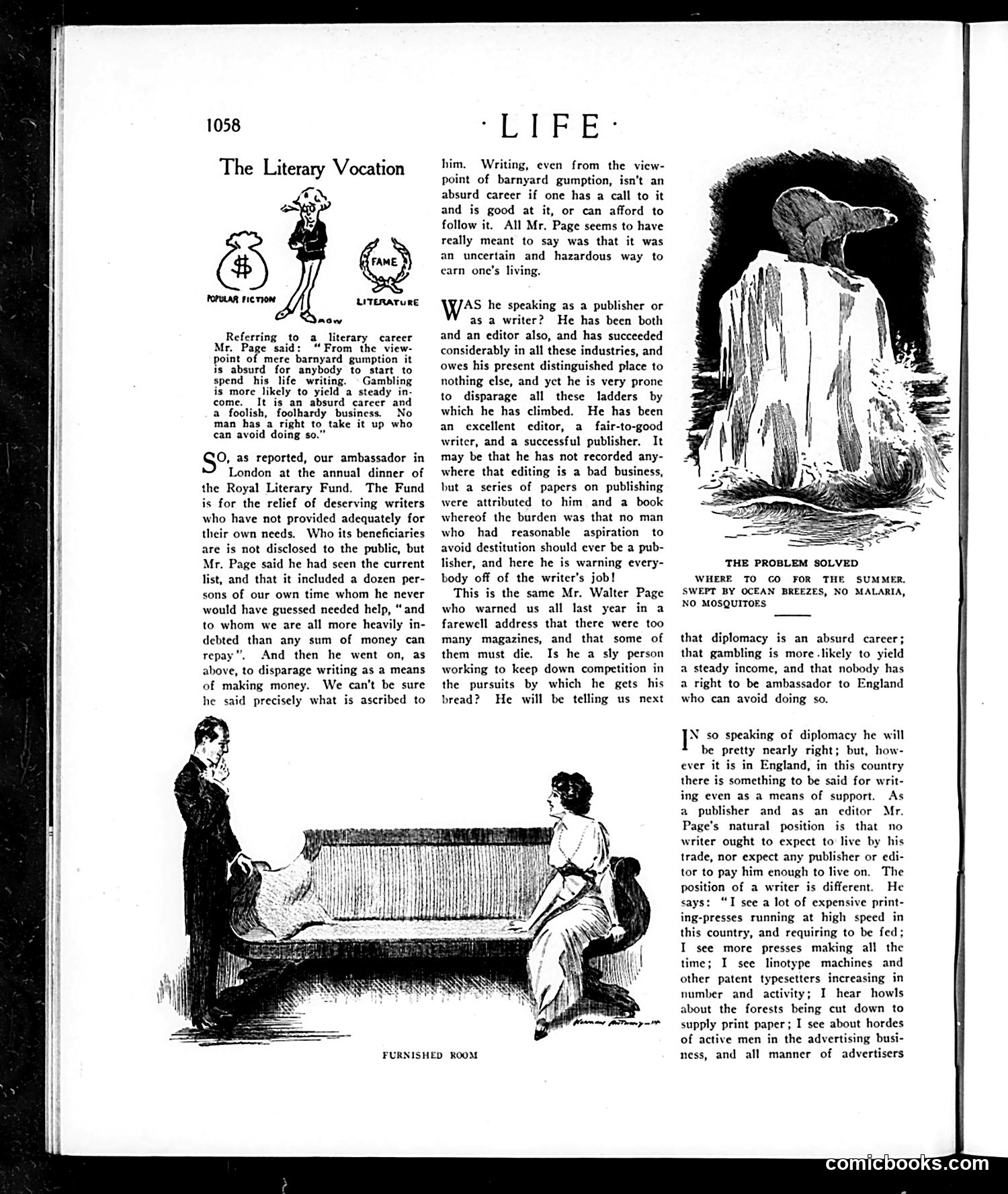
This page critiques the publishing industry and writers' economic struggles. The top cartoon shows three paths: "Popular Fiction" (money bag), a struggling writer, and "Literature" (laurel wreath)—satirizing how commercial writing pays while serious literature offers only prestige. The main text attacks Mr. Walter Page, a prominent publisher-editor, for dismissing writing as an unreliable career while himself profiting from the industry. The article argues Page hypocritically disparages literary pursuits despite his success in publishing, then warns other writers that editing is equally unstable work. The "Furnished Room" illustration depicts a sparse apartment—visualizing the poverty writers actually face—undercutting Page's dismissive attitude toward their financial desperation.
📄 Transcribed text from this page (OCR, searchable)
Machine-transcribed from the original scan — historical spelling and the odd misread are preserved.
1058 The Literary Vocation CoN os 3 POPULAR Fie TION LITERATURE es Referring to a literary career Mr. Page said: “From the view- point of mere barnyard gumption it is absurd for anybody to start to spend his life writi Gambling is more likely to yield a steady in- come. It is an absurd career and a foolish, foolhardy business. No man has ‘a right to take it up who can avoid doing so.” O, as reported, our ambassador in London at the annual dinner of the Royal Literary Fund. The Fund is for the relief of deserving writers who have not provided adequately for their own needs. Who its beneficiaries are is not disclosed to the public, but Mr. Page said he had seen the current list, and that it included a dozen per- sons of our own time whom he never would have guessed needed help, “and to whom we are all more heavily in- debted than any sum of money can repay”. And then he went on, as above, to disparage writing as a means of making money. We can't be sure he said precisely what is ascribed to FURNISHED "ETFE : him. Writing, even from the view- point of barnyard gumption, isn’t an absurd career if one has a call to it and is good at it, or can afford to follow it. All Mr, Page seems to have really meant to say was that it was an uncertain and hazardous way to carn one’s living. Was he speaking as a publisher or as a writer? He has been both and an editor also, and has succeeded considerably in all these industries, and owes his present distinguished place to nothing else, and yct he is very prone to disparage all these ladders by which he has climbed. He has been an excellent editor, a fair-to-good writer, and a successful publisher. It may be that he has not recorded any- where that editing is a bad business, but a series of papers on publishing were attributed to him and a book whereof the burden was that no man who had reasonable aspiration to avoid destitution should ever be a pub- lisher, and here he is warning every- body off of the writer’s job! This is the same Mr. Walter Page who warned us all last year in a farewell address that there were too many magazines, and that some of them must die. Is he a sly person working to keep down competition in the pursuits by which he gets his bread? He will be telling us next ROOM THE PROBLEM SOLVED WHERE TO GO FOR THE SUMMER. SWEPT BY OCEAN BREEZES, NO MALARIA, NO MOSQUITOES that diplomacy is an absurd career; that gambling is more likely to yield a steady income, and that nobody has a right to be ambassador to England who can avoid doing so. ] ‘so speaking of diplomacy he will be pretty nearly right; but, how- ever it is in England, in this country there is something to be said for writ- ing even as a means of support. As a publisher and as an editor Mr. Page’s natural position is that no writer ought to expect to live by his trade, nor expect any publisher or edi- tor to pay him enough to live on. The position of a writer is different. He says: “I see a lot of expensive print- ing-presses running at high speed in this country, and requiring to be fed; I see more presses making all the time; I see linotype machines and other patent typesetters increasing in number and activity; I hear howls about the forests being cut down to supply print paper; I see about hordes of active men in the advertising busi- ness, and all manner of advertisers Ccomicbooks.com