
Life, 1914-06-11 · page 26 of 44
Life — June 11, 1914 — page 26: what you’re looking at
What you’re looking at
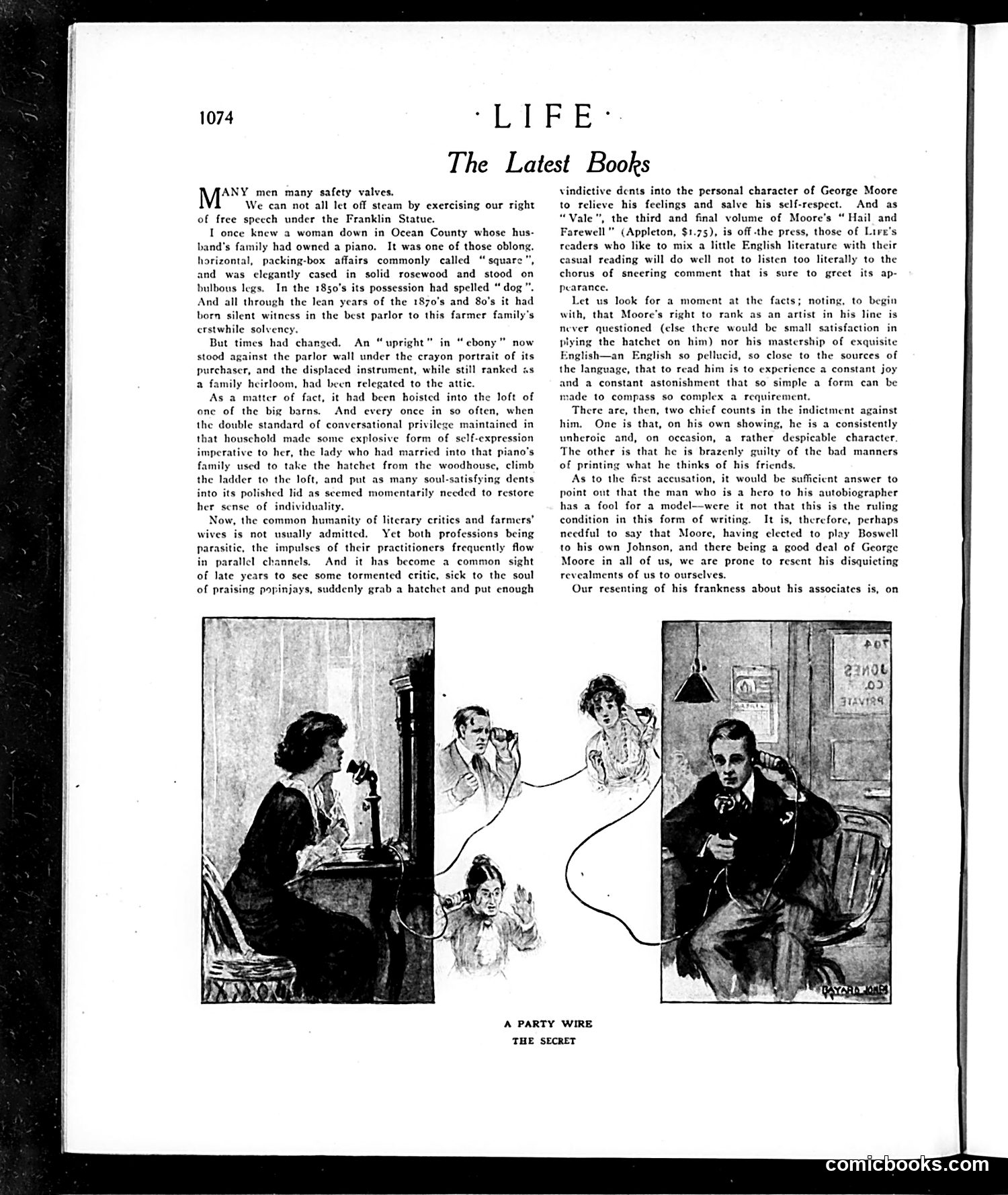
This page reviews George Moore's memoir *Vale*, the final volume of his autobiography *Hail and Farewell*. The accompanying illustrations show a woman at a telephone (left) and a man eavesdropping on an extension (right)—depicting a "party line," a shared telephone system common in the era where multiple households shared one line. The cartoon satirizes Moore's memoir through this metaphor: just as party-line users overhear neighbors' private conversations, Moore publicly reveals unflattering truths about his friends and associates in his writing. The title "The Secret" emphasizes the breach of privacy—Moore treats confidential matters as public gossip. The text acknowledges Moore's literary mastery while criticizing his "bad manners of printing what he thinks of his friends." The cartoon visualizes this indiscretion: intimate secrets meant for one recipient are involuntarily exposed to others listening in.
📄 Transcribed text from this page (OCR, searchable)
Machine-transcribed from the original scan — historical spelling and the odd misread are preserved.
“LIFE: The Latest Books ANY men many safety valves. We can not all let off steam by exercising our right of free specch under the Franklin Statue. I once knew a woman down in Ocean County whose hus- band’s family had owned a piano. It was one of those oblons horizontal, packing-box affairs commonly called “ square", and was elegantly cased in solid rosewood and stood on bulbous legs. In the 1850's its possession had spelled “ dog". And all through the lean years of the 1870's and 80's it had born silent witness in the best parlor to this farmer family’s erstwhile solvency. But times had changed. An “upright” in “ebony” now stood against the parlor wall under the crayon portrait of its purchaser, and the displaced instrument, while still ranked ss a family heirloom, had been relegated to the attic. As a matter of fact, it had been hoisted into the loft of one of the big barns. And every once in so often, when the double standard of conversational privilege maintained in that houschold made some explosive form of self-expression imperative to her, the lady who had married into that piano’s family used to take the hatchet from the woodhouse, climb the ladder to the loft, and put as many soul-satisfying dents into its polished lid as scemed momentarily needed to restore her sense of individuality. Now, the common humanity of literary critics and farmers’ wives is not usually admitted. Yet both professions being parasitic, the impulses of their practitioners frequently flow in parallel channels. And it has become a common sight of late years to see some tormented critic, sick to the soul of praising popinjays, suddenly grab a hatchet and put enough vindictive dents into the personal character of George Moore to relieve his feelings and salve his self-respect. And as “Vale”, the third and final volume of Moore’s “Hail and Farewell” (Appleton, $1.75), is off the press, those of Lire’s readers who like to mix a little English literature with their casual reading will do well not to listen too literally to the chorus of sneering comment that is sure to greet its ap- pearance. Let us look for a moment at the facts; noting, to begin with, that Moore's right to rank as an artist in his line is never questioned (else there would be small satisfaction in plying the hatchet on him) nor his mastership of exquisite English—an English so pellucid, so close to the sources of the language, that to read him is to experience a constant joy and a constant astonishment that so simple a form can be de to compass so complex a requirement. There are, then, two chief counts in the indictment against him, One is that, on his own showing, he is a consistently unheroic and, on occasion, a rather despicable character. The other is that he is brazenly guilty of the bad manners of printing what he thinks of his friends. As to the first accusation, it would be sufficient answer to point out that the man who is a hero to his autobiographer has a fool for a model—were it not that this is the ruling condition in this form of writing. It is, therefore, perhaps necdful to say that Moore, having elected to play Boswell to his own Johnson, and there being a good deal of George Moore in all of us, we are prone to resent his disquicting revealments of us to ourselves. Our resenting of his frankness about his associates is, on A PARTY WIRE THE SECRET comicbooks.com