
Life, 1914-06-11 · page 8 of 44
Life — June 11, 1914 — page 8: what you’re looking at
What you’re looking at
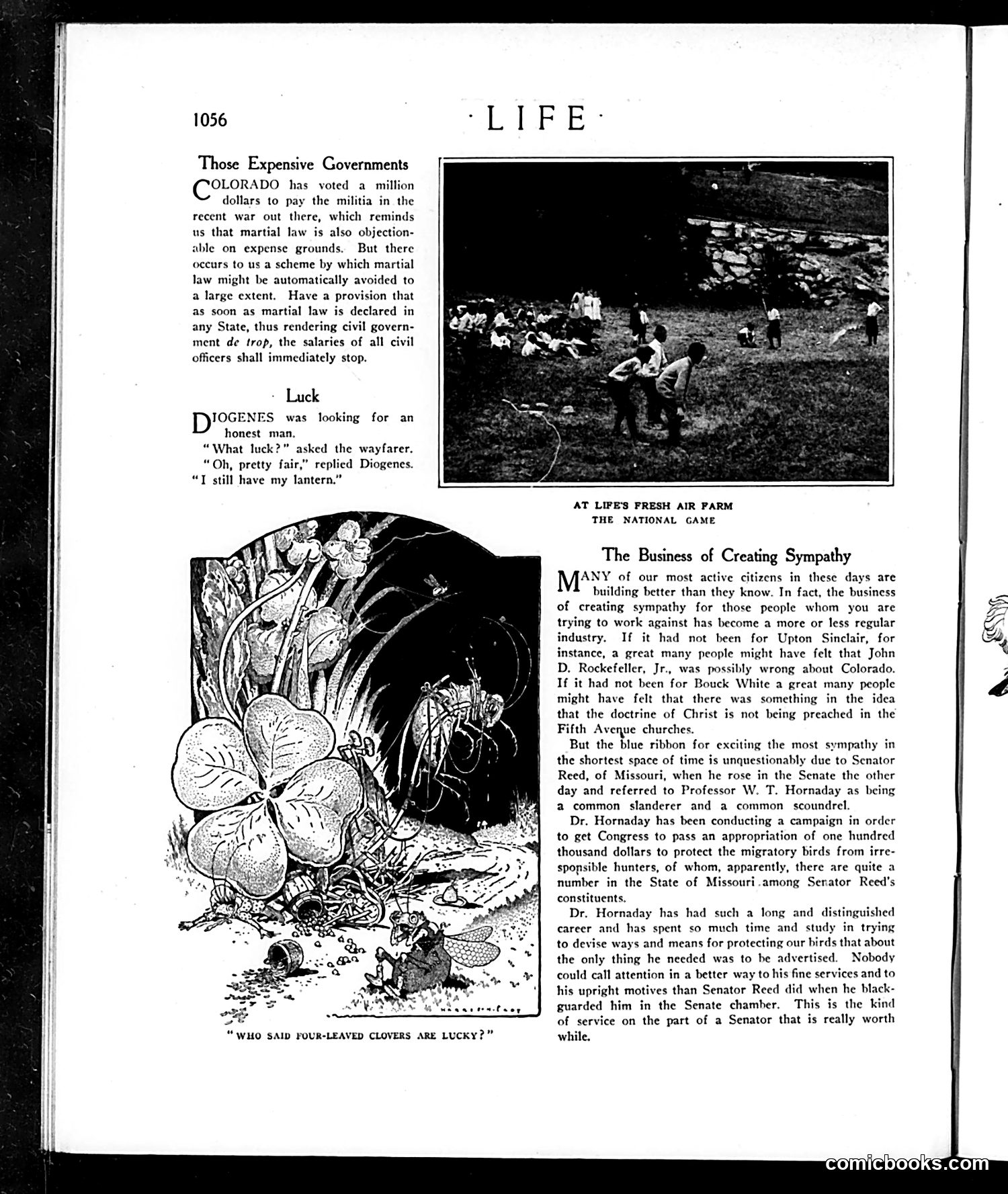
The page contains two separate items: **"Those Expensive Governments"** critiques martial law costs in Colorado, arguing that if civil government automatically ceased during martial law declarations, salaries would stop—potentially making martial law economically self-limiting. **"Luck"** is a brief philosophical joke: Diogenes (the ancient Greek cynic philosopher famous for seeking an honest man) searches for one, dismissing the wayfarer's claim of fairness. Diogenes's punchline—"I still have my lantern"—references his famous lantern used to search for honest people, implying none exist. The illustration of four-leaf clovers accompanies wordplay on luck. The longer article discusses **Dr. Hornaday's bird conservation efforts**, praised by Senator Reed for protecting migratory birds from hunters—presented as exemplary public service and sympathy for a worthy cause.
📄 Transcribed text from this page (OCR, searchable)
Machine-transcribed from the original scan — historical spelling and the odd misread are preserved.
1056 Those Expensive Governments OLORADO has voted a million dollars to pay the militia in the recent war out there, which reminds us that martial law is also objection- able on expense grounds. But there occurs to us a scheme by which martial law might be automatically avoided to a large extent. Have a provision that as soon as martial law is declared in any State, thus rendering civil govern- ment de trop, the salaries of all civil officers shall immediately stop. Luck IOGENES was looking for an honest man. “What luck?” asked the wayfarer. “Oh, pretty fair,” replied Diogenes. “T still have my lantern.” AT LIFE'S FRESH AIR FARM THE NATIONAL GAME The Business of Creating Sympathy MessY of our most active citizens in these days are building better than they know. In fact, the business of creating sympathy for those people whom you are trying to work against has become a more or less regular industry. If it had not been for Upton Sinclair, for instance, a great many people might have felt that John D. Rockefeller, Jr., was possibly wrong about Colorado. If it had not been for Bouck White a great many people might have felt that there was something in the idea that the doctrine of Christ is not being preached in the Fifth Avenue churches. But the blue ribbon for exciting the most sympathy in the shortest space of time is unquestionably due to Senator Reed, of Missouri, when he rose in the Senate the other day and referred to Professor W. T. Hornaday as being a common slanderer and a common scoundrel. Dr. Hornaday has been conducting a campaign in order to get Congress to pass an appropriation of one hundred thousand dollars to protect the migratory birds from irre- sponsible hunters, of whom, apparently, there are quite a number in the State of Missouri.among Senator Reed's constituents, Dr. Hornaday has had such a long and distinguished career and has spent so much time and study in trying to devise ways and means for protecting our birds that about the only thing he needed was to be advertised. Nobody could call attention in a better way to his fine services and to his upright motives than Senator Reed did when he black- guarded him in the Senate chamber. This is the kind of service on the part of a Senator that is really worth “WHO SAID FOUR-LEAVED CLOVERS ARE LUCKY?” while.