
A complete issue · 52 pages · 1914
Life — May 7, 1914
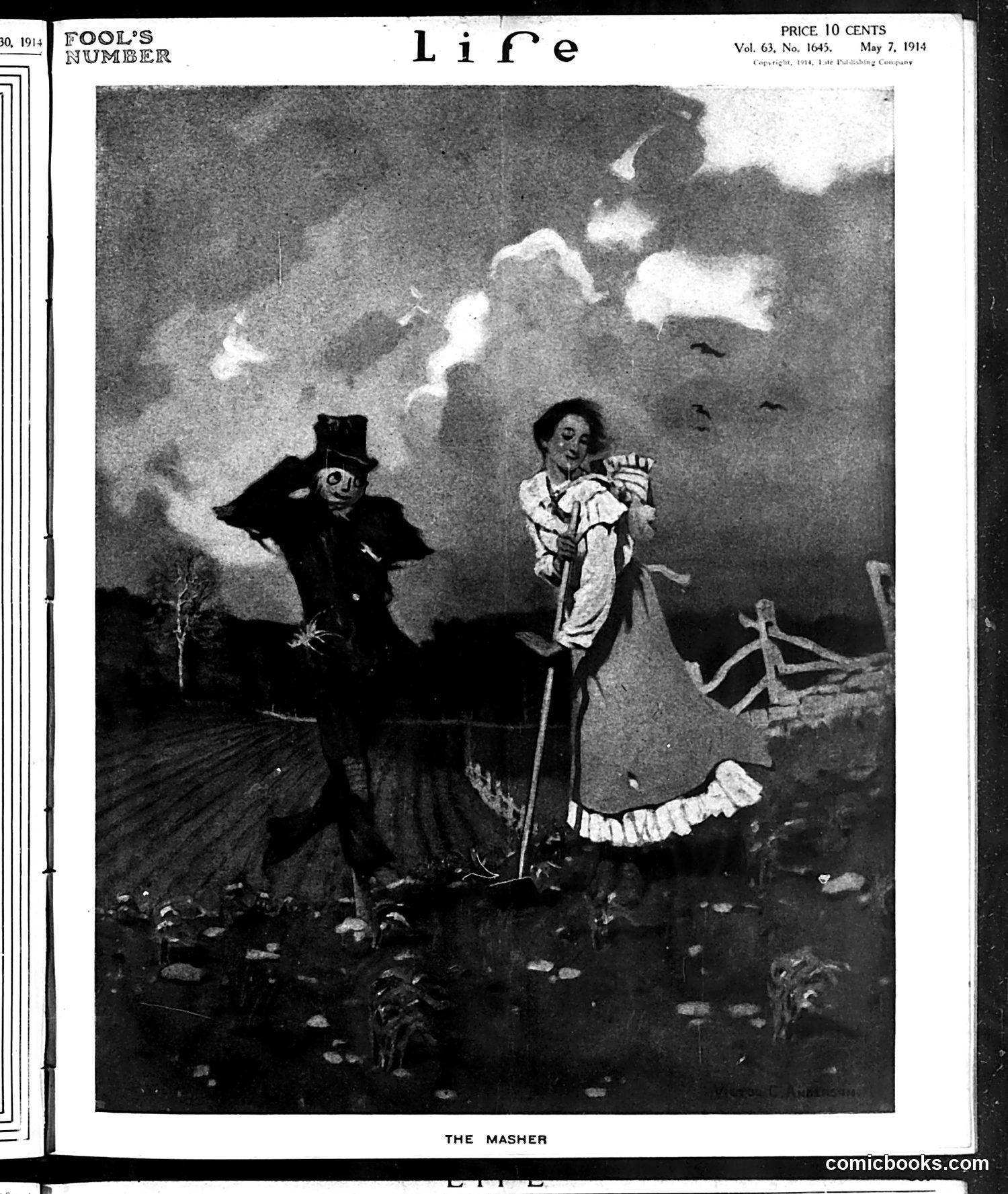
This illustration depicts a classic "masher"—period slang for an aggressive male flirt or street harasser who accosted women in public. The cartoon shows a well-dressed man in a top hat pursuing a fleeing woman, who appears frightened and clutches her belongings. The nighttime setting and her defensive posture emphasize the predatory nature of the behavior. The satire targets this socially tolerated form of harassment. Early 20th-century women faced constant street harassment, yet society often blamed victims rather than perpetrators. By visualizing the "masher" as a pursuing threat rather than treating it as humorous male behavior, this illustration critiques the social problem, suggesting such conduct was neither charming nor acceptable—a relatively progressive stance for 1914.
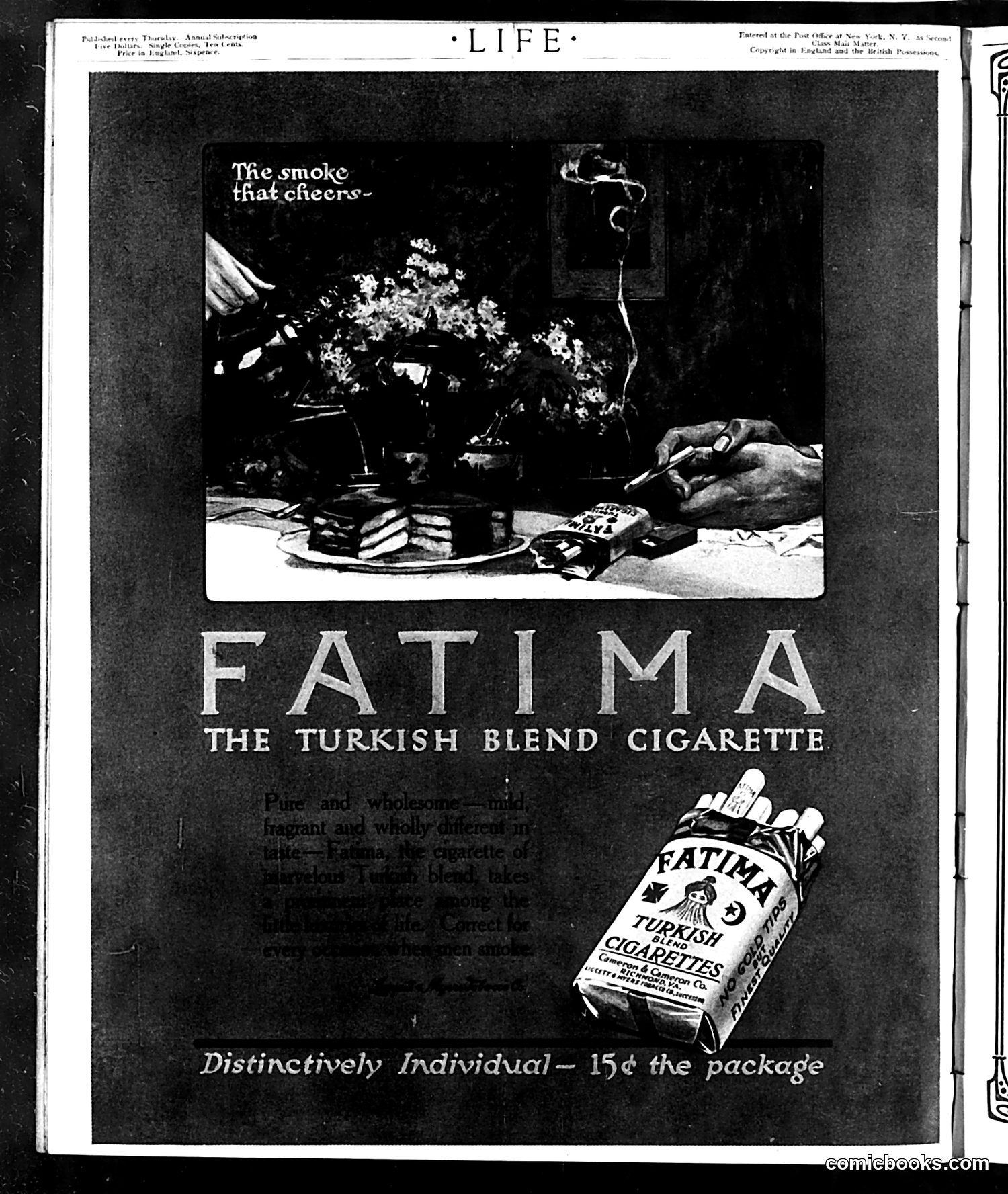
This is a **cigarette advertisement**, not political satire. It promotes "Fatima: The Turkish Blend Cigarette" as "Pure and wholesome" and "fragrant and wholly different in taste." The advertisement features a still-life photograph showing flowers, books, and smoking implements with the caption "The smoke that cheers." The image suggests sophistication and refinement—appealing to educated consumers. A package is displayed prominently, priced at 15¢. The "Turkish blend" reference reflects early 20th-century marketing trends that associated Turkish tobacco with exotic quality and luxury. This represents straightforward product promotion rather than satire—typical of *Life* magazine's advertising content from this era.
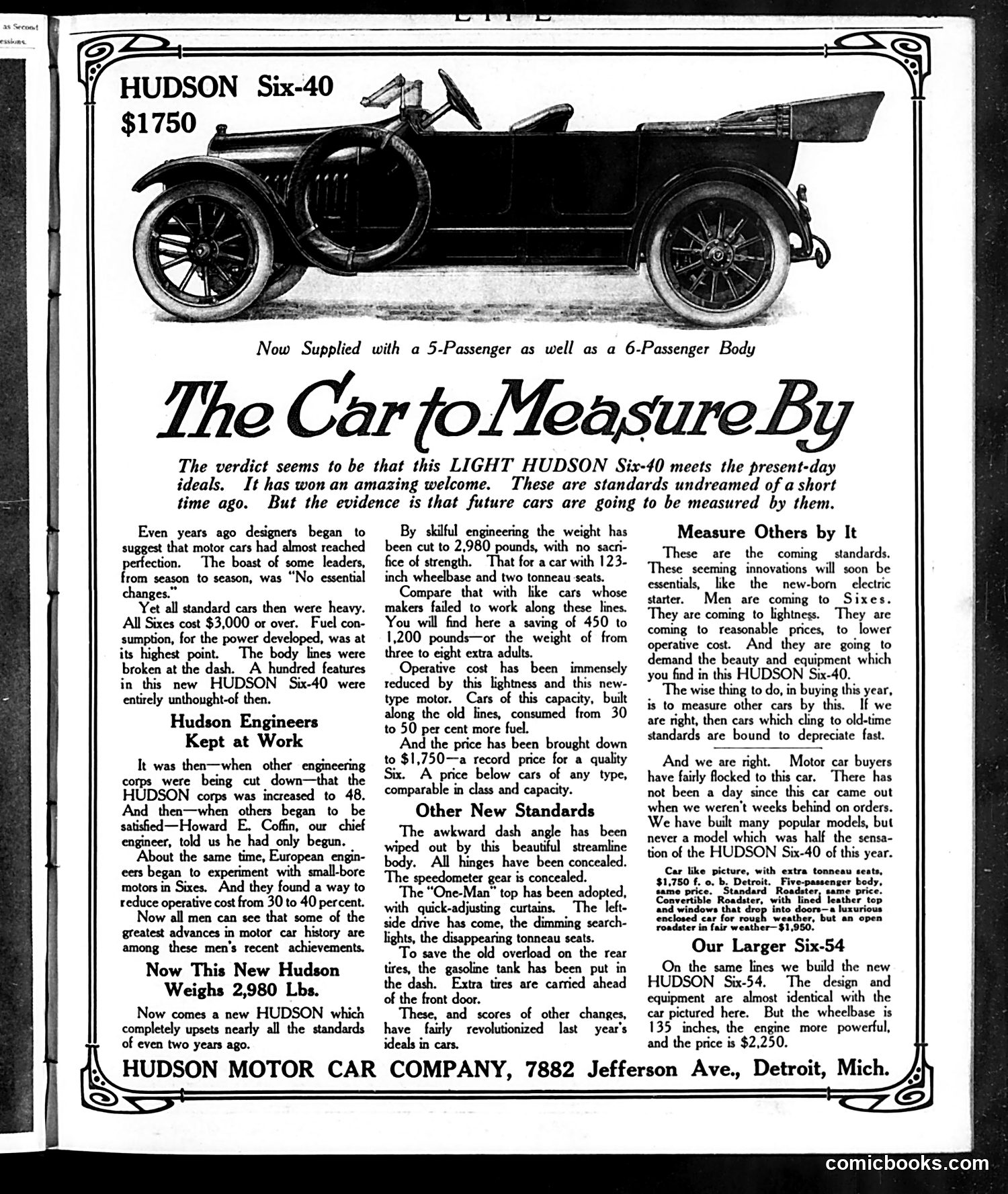
This is **not a cartoon or satire page**, but rather a **straightforward advertisement** for the Hudson Motor Car Company's Six-40 model, priced at $1,750. The ad's central claim—"The Car to Measure By"—argues that the Hudson Six-40 sets new standards for the automotive industry. It emphasizes engineering achievements: lightweight construction (2,980 lbs), fuel efficiency, and affordability compared to competitors. The text uses aspirational language typical of 1920s advertising, positioning the Hudson as the benchmark by which "future cars are going to be measured." It highlights practical features like concealed hinges, streamlined body design, and optional configurations. This represents Life magazine's advertising content rather than its satirical editorial material. The page reflects early automotive industry competition and marketing strategies of the era.
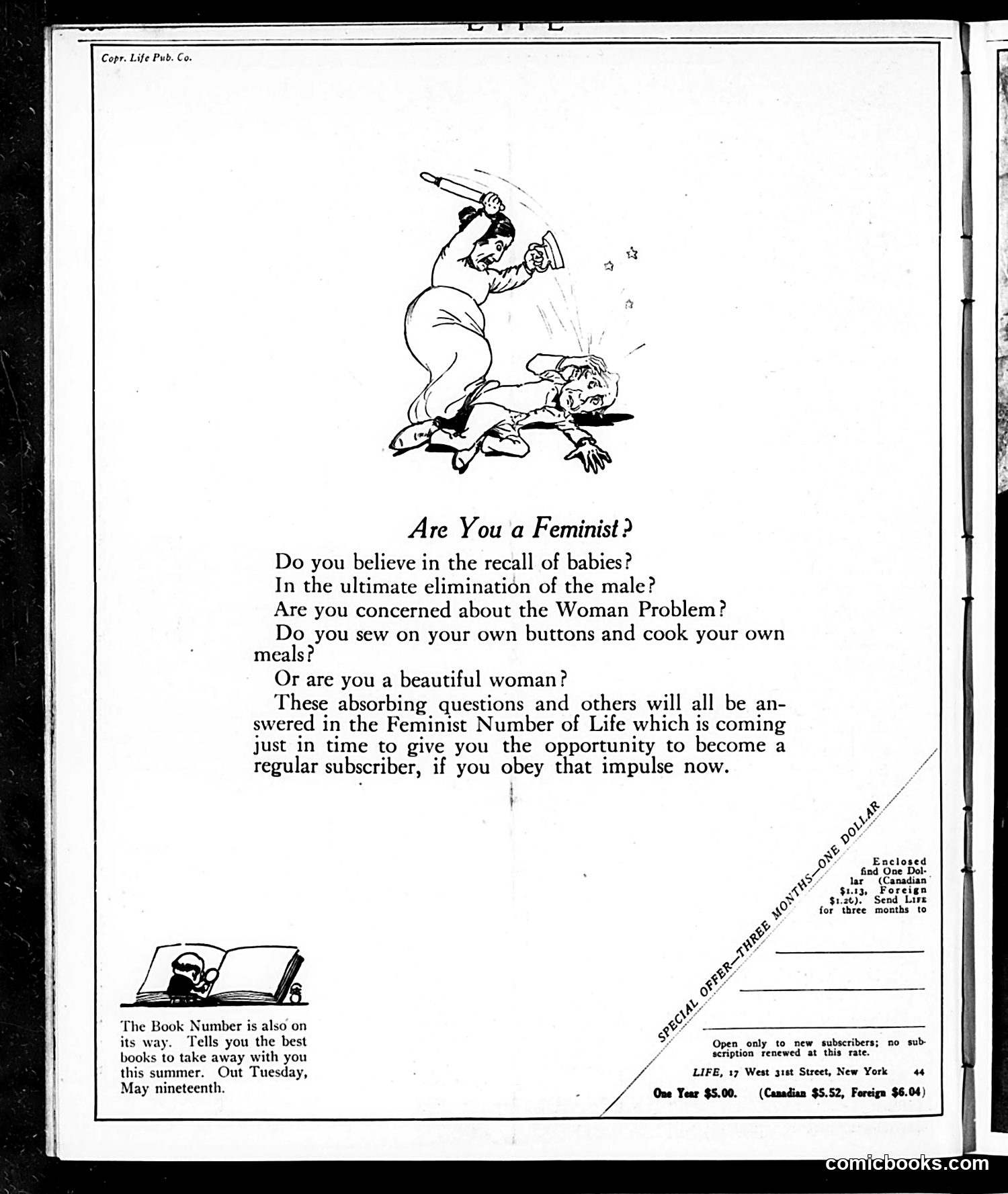
This is a subscription advertisement satirizing early feminism, likely from the 1910s-1920s. The cartoon depicts a woman wielding a large club attacking a man lying on the ground, illustrating hostile stereotypes about feminists. The ad mockingly asks "Are You a Feminist?" and poses provocative questions: belief in "recall of babies," "ultimate elimination of the male," and whether readers sew their own buttons. It contrasts these caricatured feminist positions against being a "beautiful woman." The satire's point: feminism is presented as aggressive, man-hating, and incompatible with traditional femininity. The ad uses this mocking tone to persuade readers to subscribe to Life's "Feminist Number," which would supposedly answer these "absorbing questions." This reflects historical opposition to women's rights movements through ridicule and caricature.
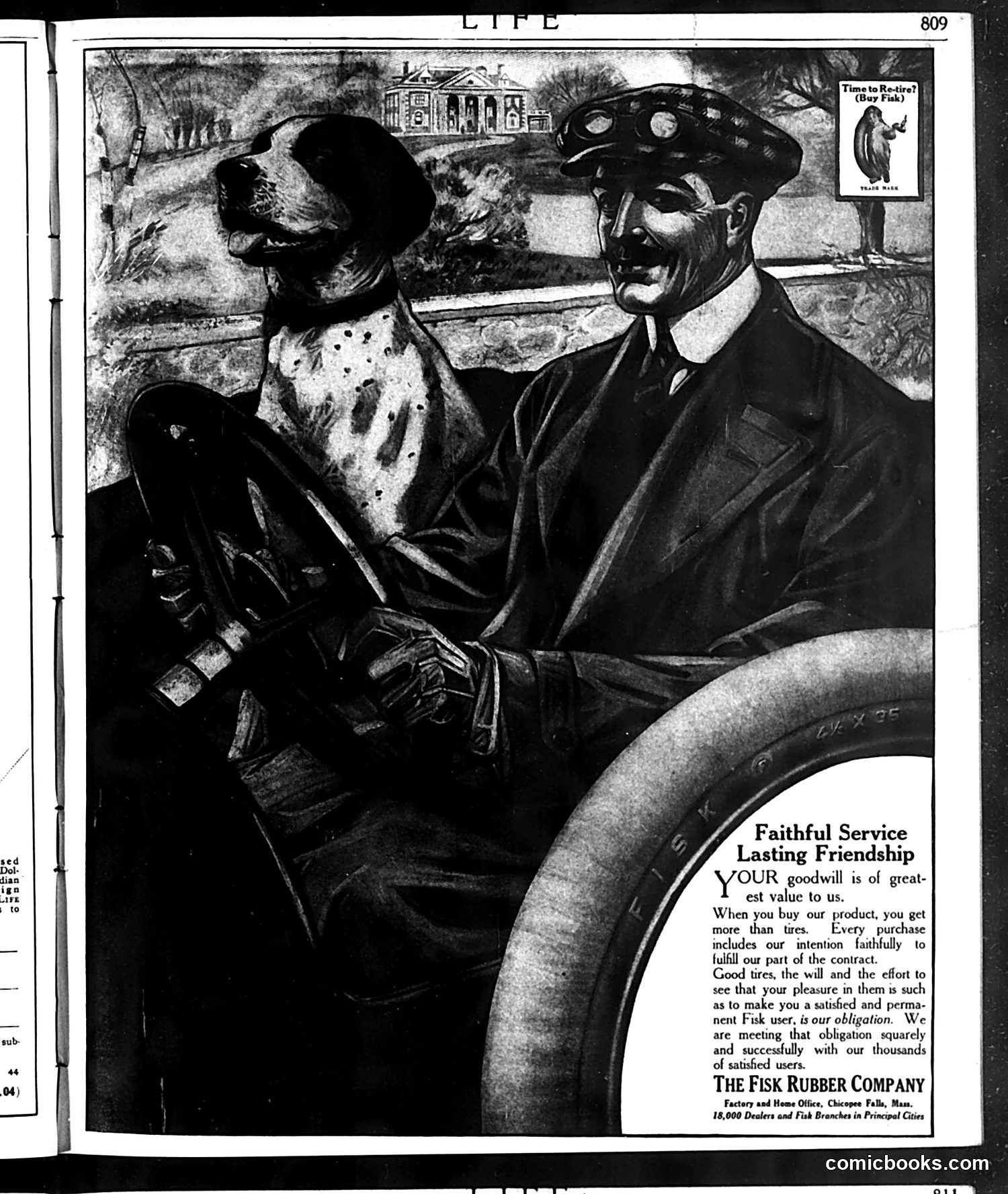
This appears to be primarily a **Fisk Rubber Company advertisement** rather than satirical content. The image shows a man and spotted dog in an early automobile, with the tagline "Faithful Service / Lasting Friendship." The ad uses the dog-and-driver scenario to illustrate the company's reliability message: just as a dog remains a loyal companion, Fisk tires provide dependable service to automobile owners. The small illustration in the upper right showing "Time to Re-tire? (Buy Fisk)" reinforces the product pitch. The text emphasizes that purchasing Fisk tires means receiving not just a product, but the company's commitment to customer satisfaction. This is straightforward commercial messaging typical of early 20th-century Life magazine advertisements, not political satire.
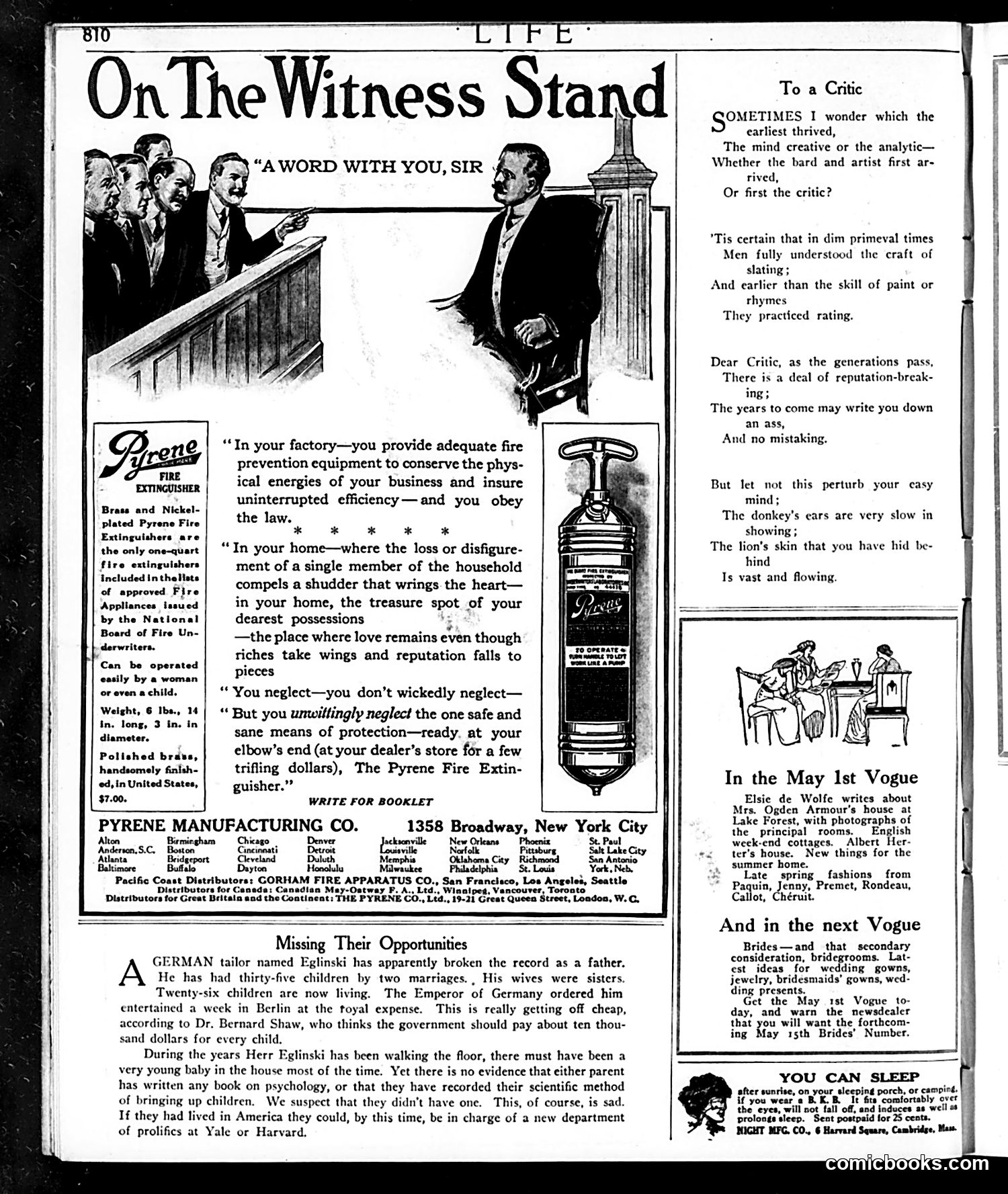
The main cartoon depicts a courtroom scene where a man on the witness stand is being questioned by multiple lawyers. The caption reads "A WORD WITH YOU, SIR," suggesting cross-examination testimony. The satirical point appears to concern **workplace safety regulations**. The accompanying Pyrene Fire Extinguisher advertisement uses the cartoon to make a moral argument: just as witnesses must tell the truth in court, businesses have a duty to honestly acknowledge safety negligence. The ad contrasts factory fire prevention requirements with home safety, arguing that people "unwillingly neglect" proper fire protection at home despite its importance. The cartoon thus frames fire extinguisher sales through a legal/ethical lens—equating honest testimony with honest safety practices.
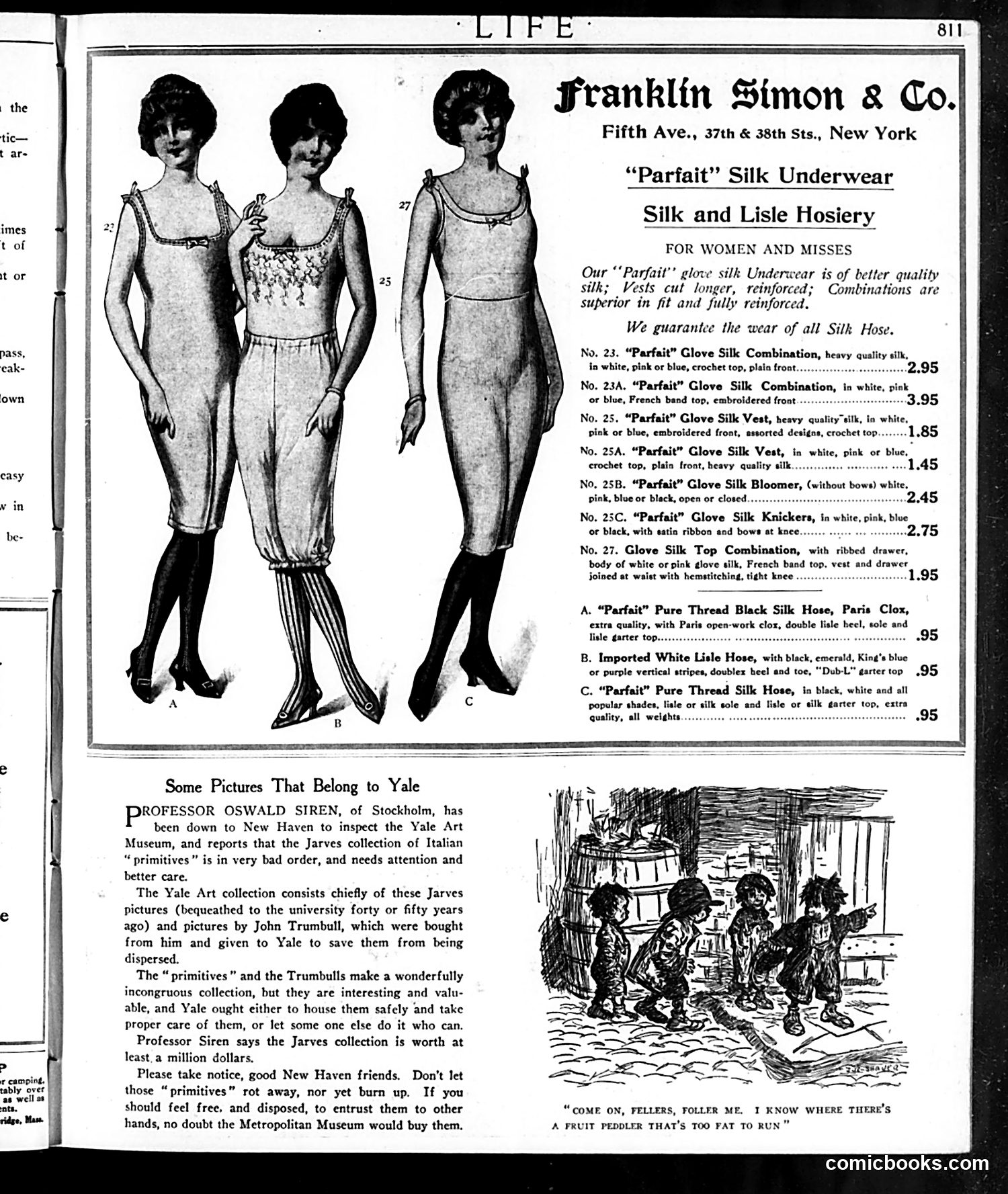
This page is primarily **advertising and editorial content** rather than political satire. The top half features a **Franklin Simon & Co. advertisement** for women's silk underwear and hosiery, showing three models in undergarments with product descriptions and prices (ranging from $1.45 to $3.95). The bottom half contains an editorial piece titled "Some Pictures That Belong to Yale," discussing Professor Oswald Siren's inspection of the Yale Art Museum's Italian "primitive" paintings and John Trumbull collection. The text urges Yale (and other institutions) to properly preserve these valuable artworks rather than let them deteriorate or be dispersed. A single **cartoon illustration** accompanies this article, showing what appears to be street vendors or working-class figures. The caption reads: "COME ON, FELLERS, FOLLER ME. I KNOW WHERE THERE'S A FRUIT PEDDLER THAT'S TOO FAT TO RUN." This cartoon's connection to the Yale art discussion is unclear from context alone.
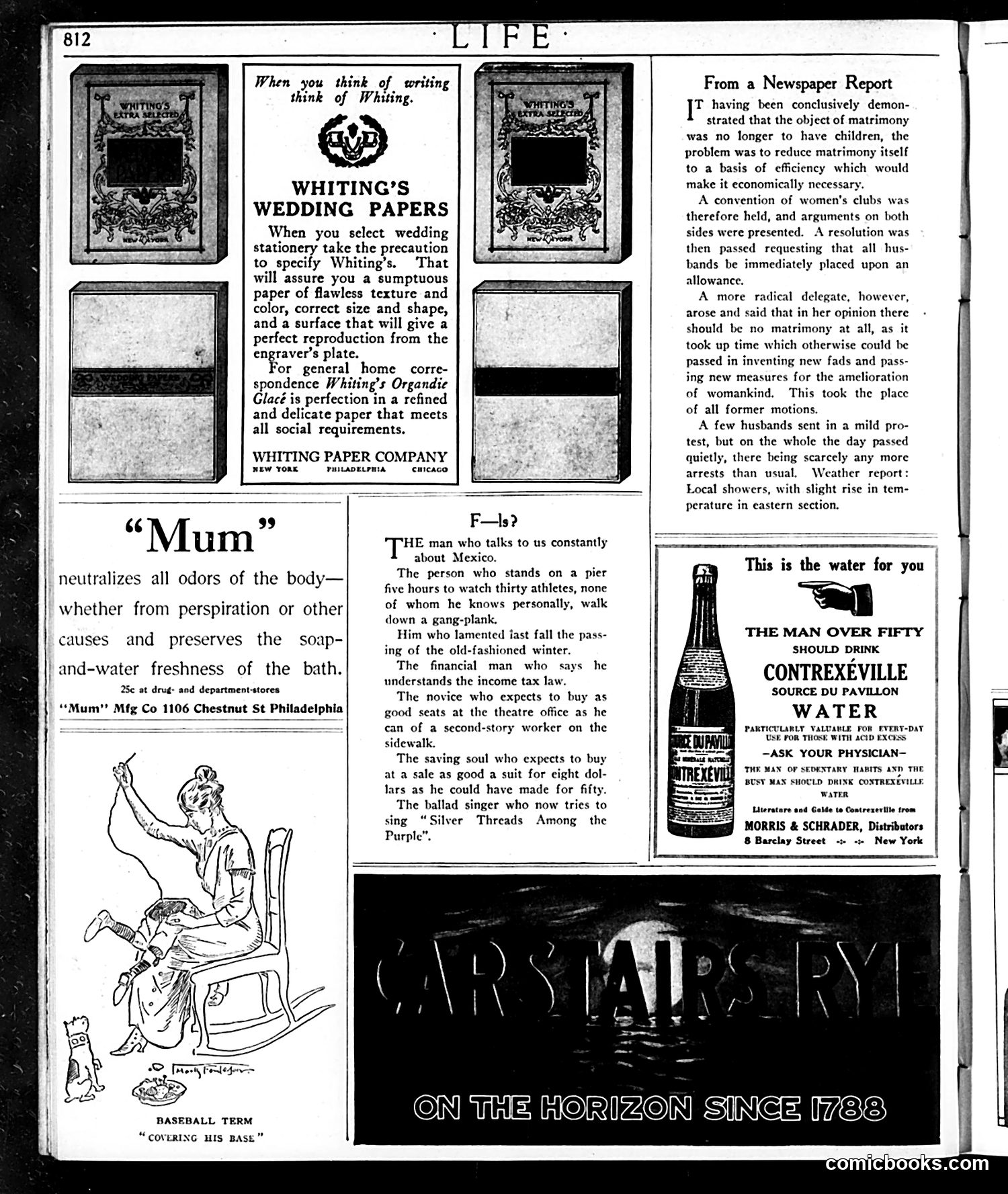
This page is primarily **advertising and miscellaneous content** rather than political satire. The main elements include: 1. **Whiting's Wedding Papers** - a stationery advertisement emphasizing quality paper for formal correspondence 2. **"Mum" deodorant ad** - featuring an illustrated woman, promoting odor neutralization 3. **"F—ls?" section** - humorous character sketches of recognizable types (a Mexico-obsessed bore, a financial analyst, a failed singer), mocking pretentious social archetypes 4. **Contrexeville Water advertisement** - targeting men over fifty, with physician endorsement 5. **Baseball cartoon** - titled "Covering His Base," showing domestic humor The page reflects early 20th-century consumer culture and social commentary through light satire rather than hard political criticism.
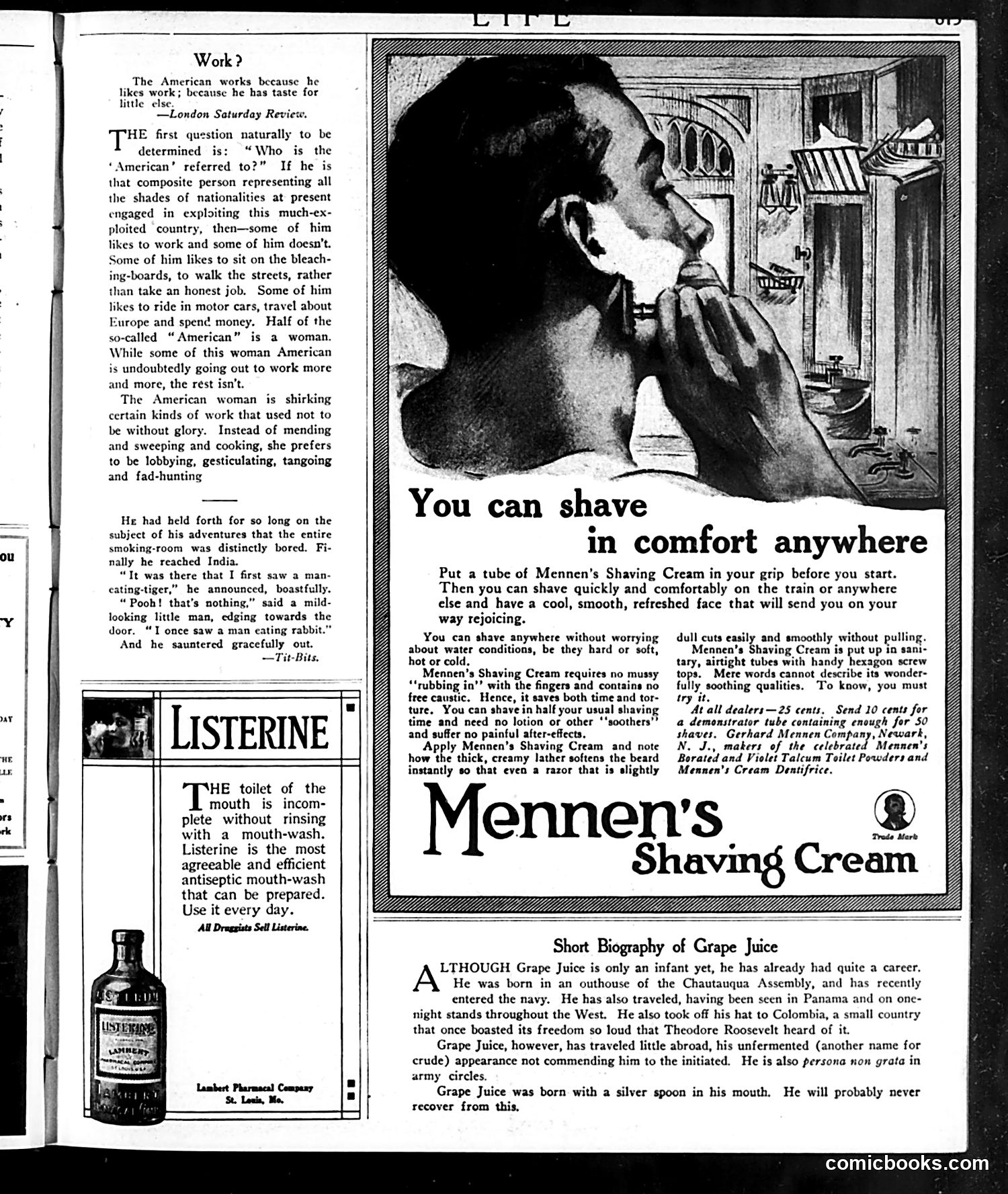
This page is primarily **advertising content** rather than satire or political commentary. The main advertisement is for **Mennen's Shaving Cream**, featuring an illustration of a man shaving on a train. The ad emphasizes convenience and comfort for travelers. The left column contains an article titled "Work?" discussing American attitudes toward labor—noting that "the American" (apparently a composite figure representing various immigrant groups) has mixed views on work, with some preferring leisure activities to honest employment. It's social commentary on American work ethic rather than targeting a specific person. Below that is a **Listerine advertisement** for mouthwash, promoting it as an antiseptic rinse. The page concludes with a brief humorous biography of "Grape Juice," apparently a person or character known for traveling and adventuring, though the context is unclear.
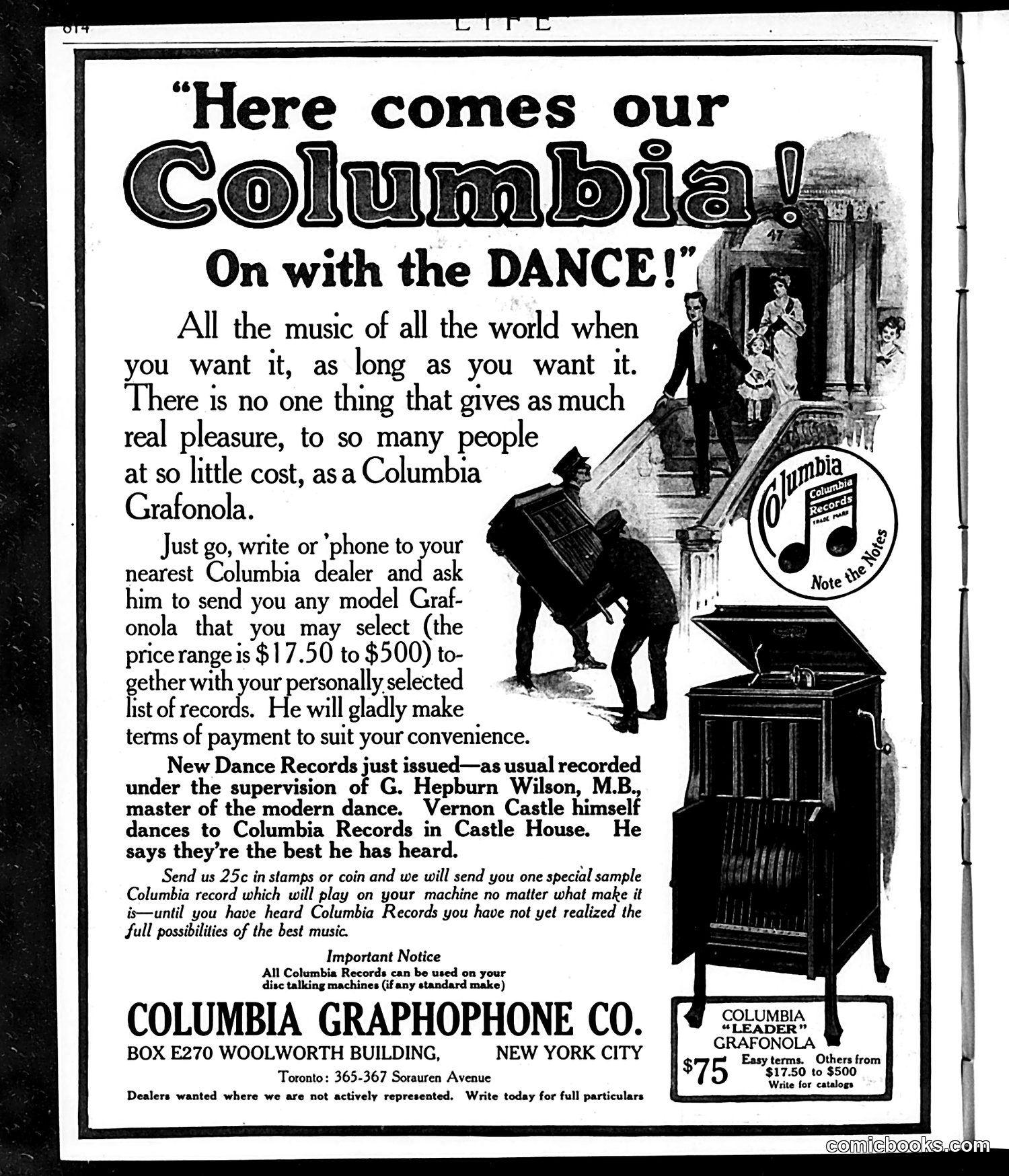
This is a **Columbia Grafonola advertisement**, not political satire. The ad promotes Columbia's gramophone (record player) and dance records, marketing them as affordable entertainment. The illustration shows a man operating a gramophone while elegantly dressed couples dance on a grand staircase—depicting how the device brings "all the music of all the world" into homes for entertainment "at so little cost." The advertisement emphasizes accessibility: models range from $17.50 to $500, with flexible payment terms. It highlights newly issued "Dance Records" supervised by G. Hepburn Wilson, a dance master, and endorses Vernon Castle, a famous dancer of the era. This reflects early 20th-century consumer culture, when gramophones were still luxury items becoming increasingly available to middle-class households.
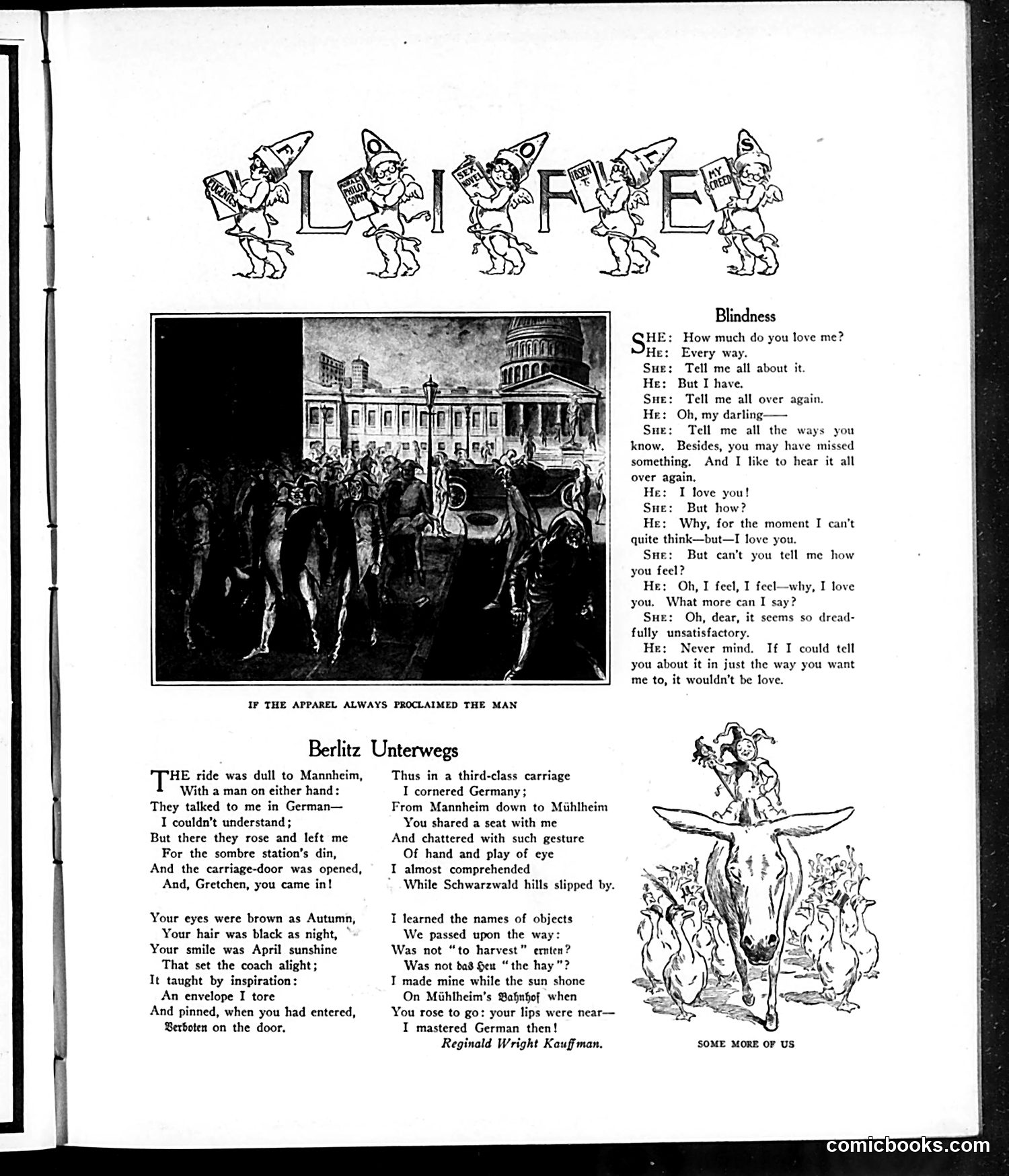
This page contains three distinct pieces: **"Blindness"** (dialogue): A satirical conversation between a couple where the woman repeatedly asks her partner to explain his love in detail, but he cannot articulate specific reasons—only that he loves her. The joke critiques the inadequacy of romantic language and male emotional expression. **"Berlitz Unterwegs"** (poem by Reginald Wright Kaufman): A satirical poem about a train journey through Germany where the narrator picks up German language and culture while traveling with a woman. It mocks both language-learning tourism and romantic encounters abroad. **Decorative header and footer**: Whimsical illustrations of cherubs/cupids frame the "LIFE" title and "SOME MORE OF US" section—typical period design elements for a romantic/social commentary issue. The overarching theme concerns love, communication, and human connection.
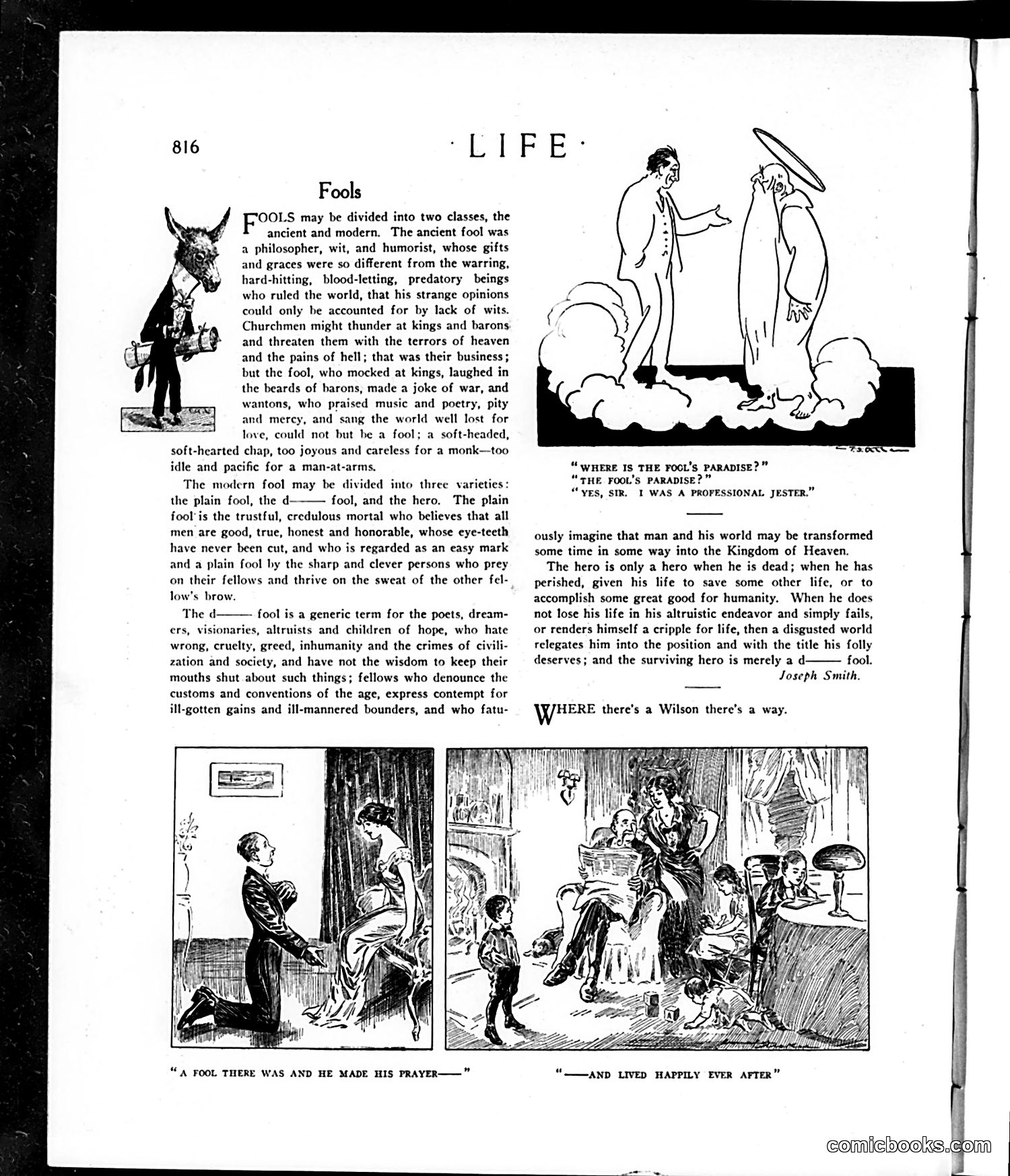
This page presents a satirical essay on human foolishness, dividing fools into ancient and modern categories. The text distinguishes between the "plain fool" (credulous and easily deceived), the "d——fool" (a generic term for poets and visionaries), and implicitly critiques various social types who lack wisdom. The accompanying illustrations show scenes of foolishness in domestic and social settings. One cartoon depicts a jester being asked "Where is the fool's paradise?" - a reference to naive optimism. Another shows "A fool there was and he made his prayer," illustrating the theme that foolishness persists across human experience. The essay concludes with a Joseph Smith quote about heroism and failure, suggesting foolishness can sometimes serve humanity's greater good - a characteristically ambivalent Victorian moral observation.
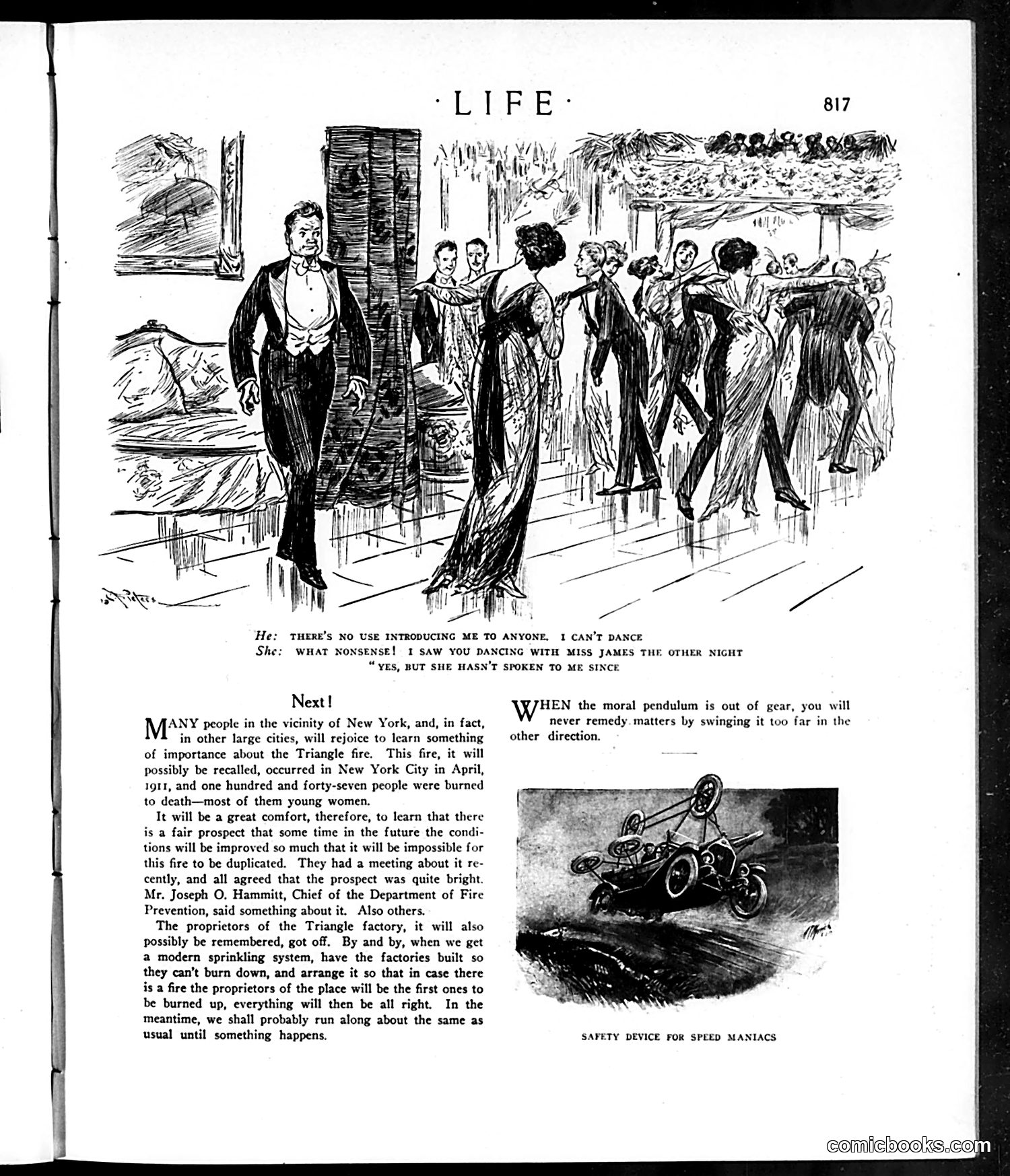
This page contains two distinct pieces: **Top illustration**: A social satire showing a man at a formal dance party making excuses to a woman. He claims he cannot dance because he hasn't been introduced to anyone, yet she observed him dancing with "Miss James the other night." The joke mocks social pretension and transparent dishonesty—the man's obvious lie undercuts his excuse about needing formal introductions. **Bottom section**: Text discusses the 1911 Triangle Shirtwaist Factory fire in New York City (which killed 147 workers, mostly young women). The writer sardonically notes that while safety improvements are promised, conditions will likely remain unchanged "until something happens"—criticizing institutional complacency. The accompanying illustration shows a "Safety Device for Speed Maniacs," humorously depicting a primitive early automobile safety feature.
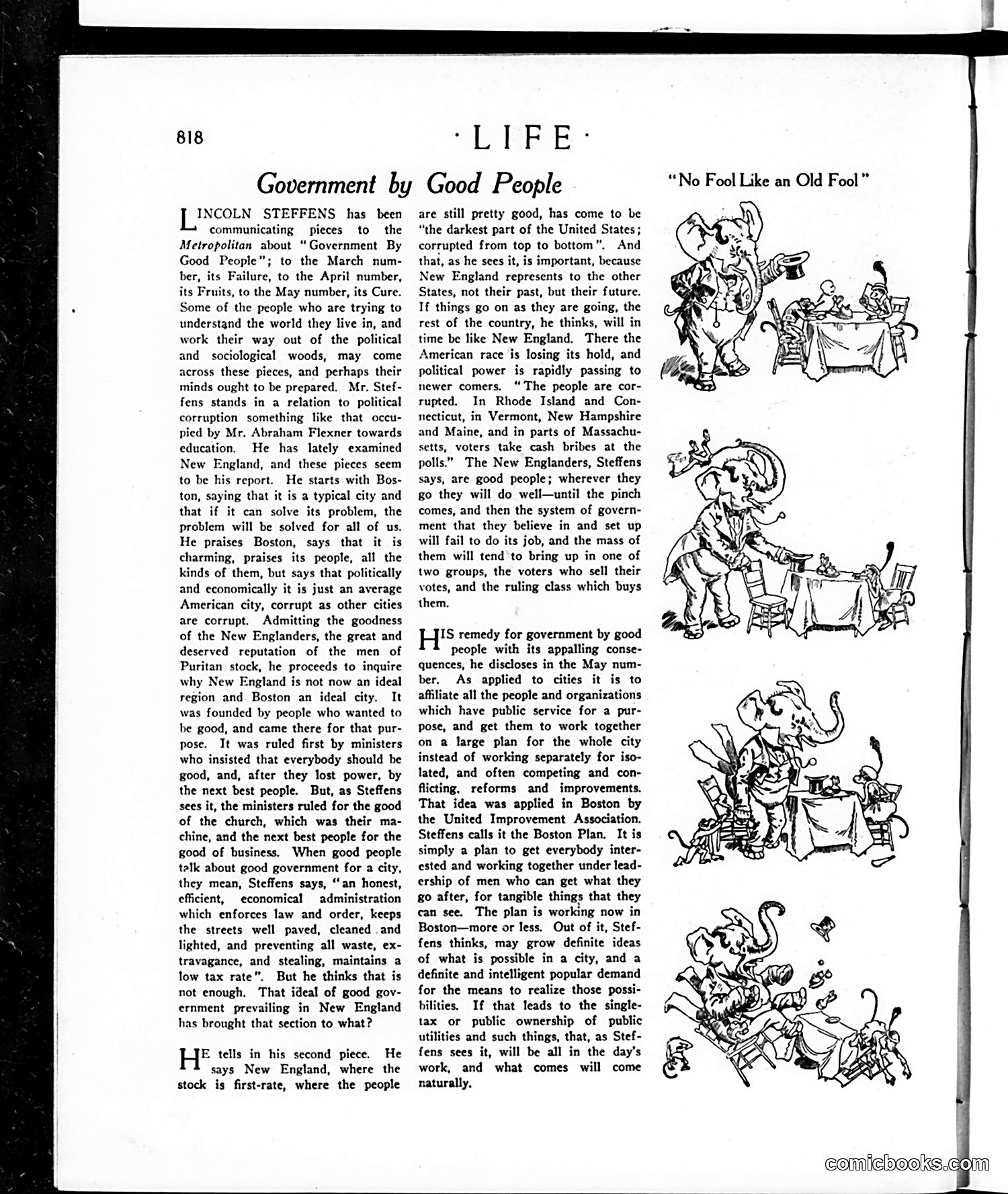
This page discusses Lincoln Steffens' articles on "Government by Good People," satirizing the notion that honest, well-intentioned citizens can solve urban corruption. The cartoon series on the right (titled "No Fool Like an Old Fool") illustrates the satire through exaggerated characters engaged in chaotic civic activities—suggesting that good intentions alone are insufficient for effective governance. Steffens examines New England cities, particularly Boston, arguing that while the region has a reputation for integrity and educated leadership, corruption persists despite these advantages. The cartoons mock the idealistic belief that virtue and goodwill naturally produce good government. Instead, Steffens argues systematic reform—like Boston's "United Improvement Association" plan—requires organized coordination rather than relying on individually decent people. The satire suggests naïveté in assuming moral character automatically translates to administrative competence.
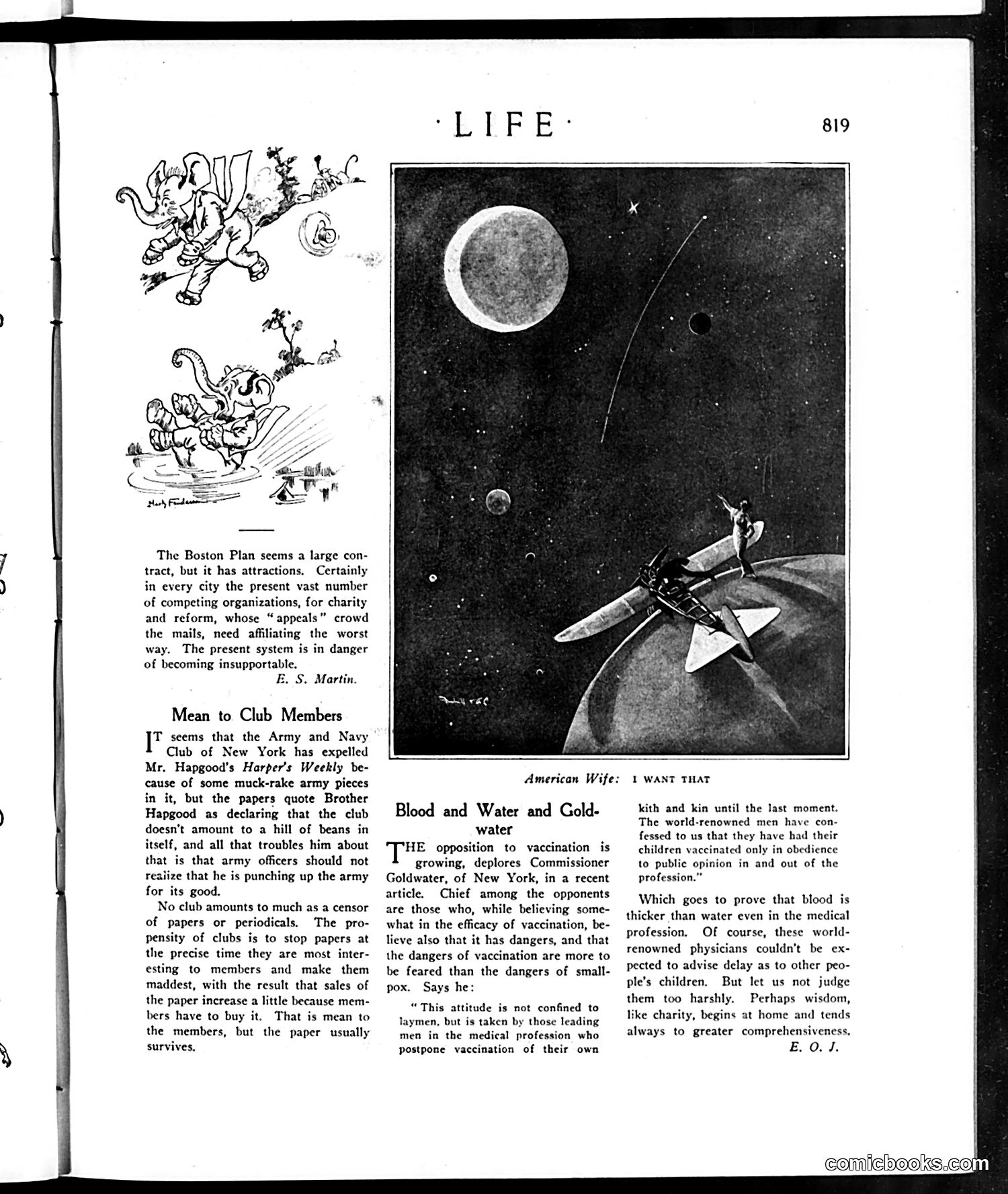
This page contains three separate satirical pieces: **"Mean to Club Members"**: Discusses the Army and Navy Club of New York expelling *Harper's Weekly* for publishing exposés (muckraking) critical of the military. The satire suggests the club's censorship backfires—by banning the paper, they actually increase its sales as members buy it out of curiosity. **"Blood and Water and Goldwater"**: A cartoon titled "American Wife: I Want That" accompanies text satirizing anti-vaccination sentiment. Commissioner Goldwater of New York deplores growing vaccine opposition, particularly among elite physicians who delay vaccinating their own children while publicly endorsing vaccination for the masses. The satire mocks this hypocrisy—suggesting "blood is thicker than water," meaning wealthy doctors prioritize family safety over public health principles they publicly advocate. The cartoon depicts figures in space, likely illustrating the absurdity of such selective logic. Both pieces exemplify *Life*'s trademark Progressive-era criticism of institutional hypocrisy and self-serving elites.
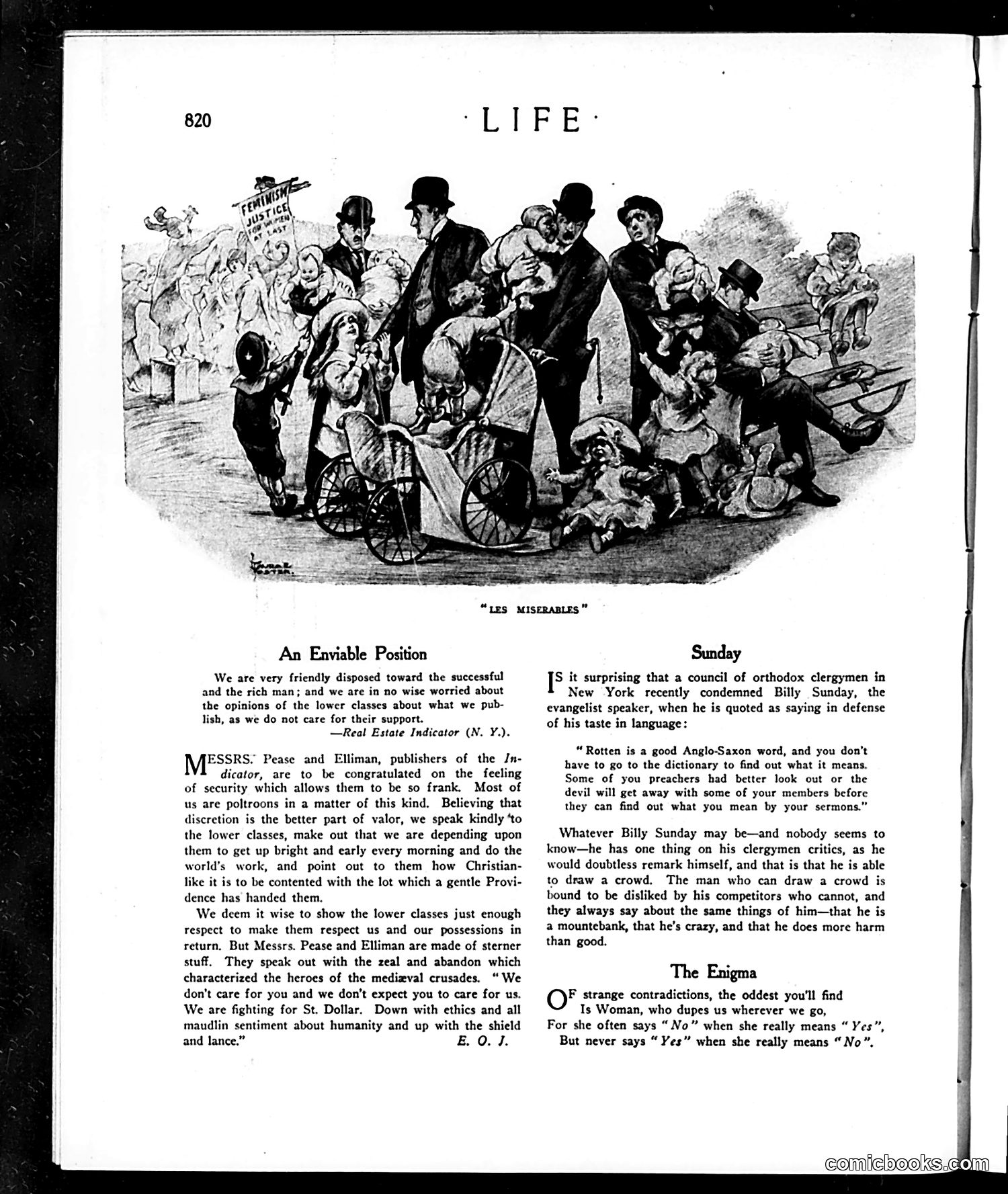
This page contains three distinct pieces of satire: **"Les Misérables" cartoon**: Depicts well-dressed men and women distributing charity to poor children and families, satirizing patronizing attitudes toward the lower classes. **"An Enviable Position"**: Mocks real-estate publishers Pease and Elliman for brazenly admitting they don't care about working-class opinions—only their money. Life criticizes the hypocrisy of most wealthy people who pretend to value the poor while actually despising them. The editors contrast this honesty with the typical duplicitous approach of feigning Christian concern while expecting the poor to remain docile. **"Sunday" section**: Defends evangelist Billy Sunday against clergy criticism of his crude language. Life argues that Sunday's ability to draw crowds proves his effectiveness, while his critics simply envy his success. **"The Enigma"**: A brief humorous poem about female duplicity—women say "no" when meaning "yes" but never say "yes" when meaning "no," suggesting women's inscrutability. The page critiques class hypocrisy, religious jealousy, and includes period-typical stereotypes about women.
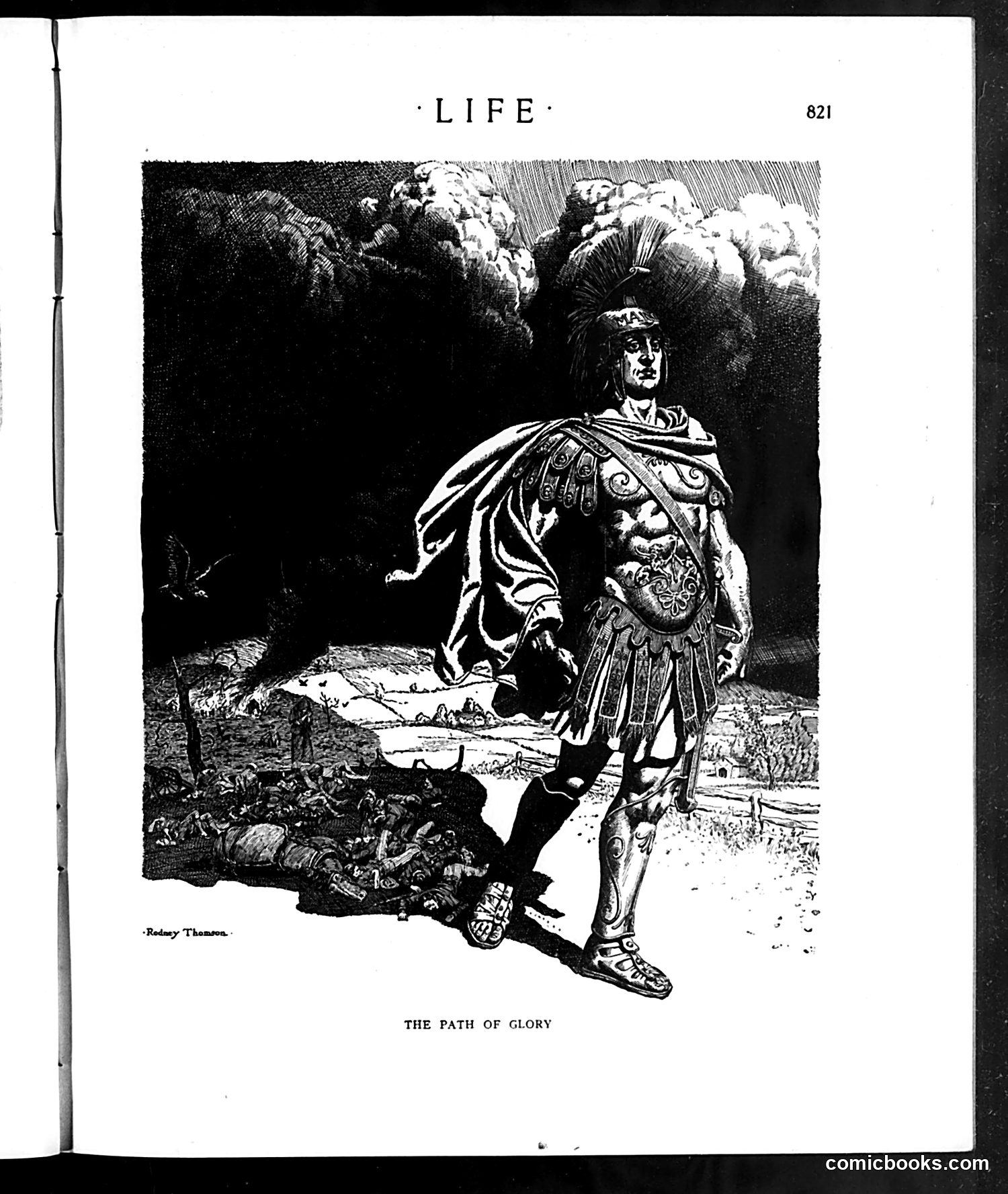
This satirical illustration by Rollin Thorne depicts a military commander in ornate Roman-style armor and regalia, standing amid a battlefield landscape. The title "The Path of Glory" is ironic—a classical phrase suggesting honor and achievement. However, the cartoon critiques militarism by contrasting the commander's elaborate, decorative appearance with the grim reality of warfare visible in the background: casualties, destruction, and suffering. The soldier's proud posture and fine dress armor seem absurd given the human cost surrounding him. This likely reflects early-20th-century anti-war sentiment, satirizing how military leaders are celebrated and glorified while ordinary soldiers pay the price in blood. The classical military imagery underscores how war's brutal realities are romanticized in popular culture.
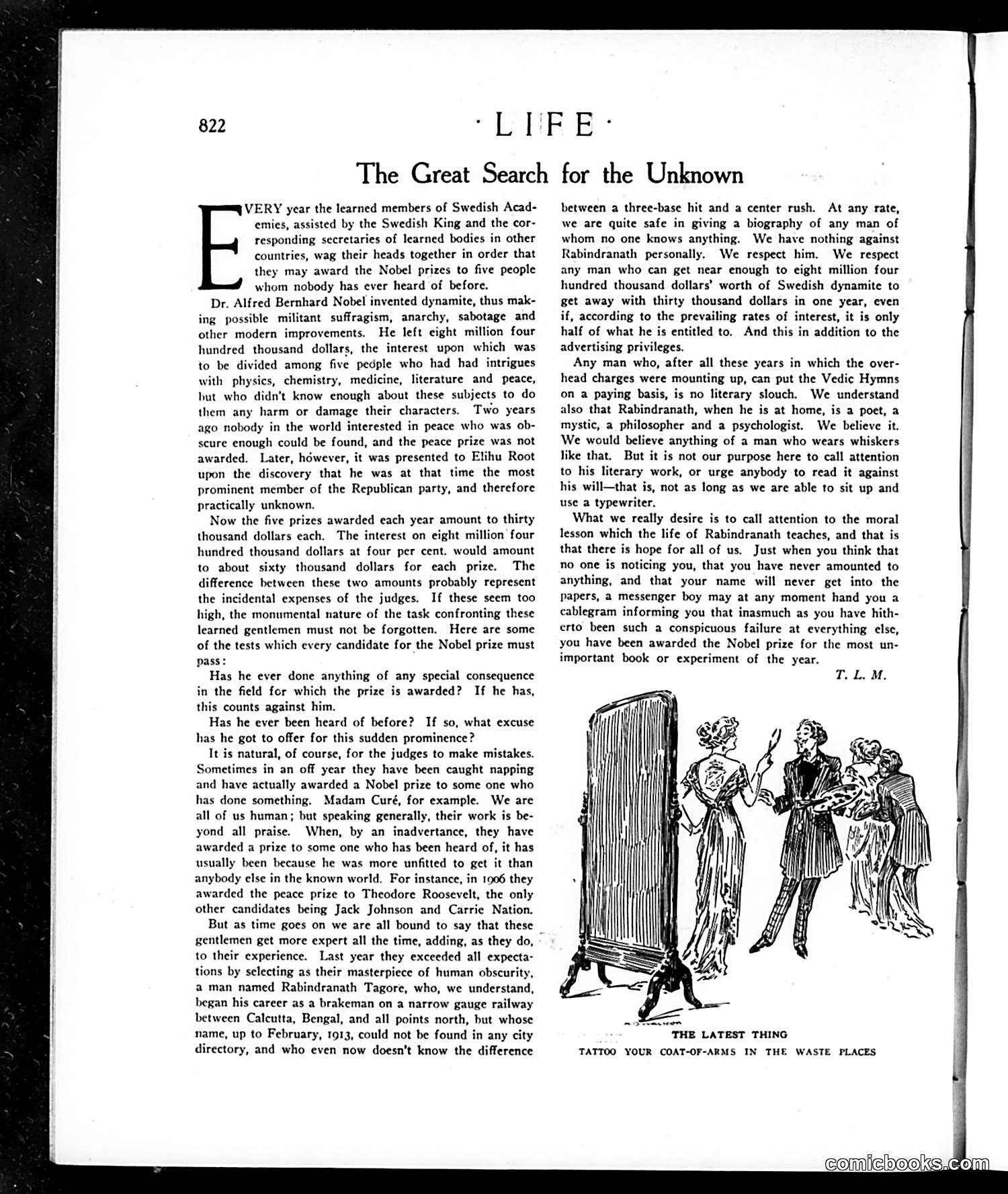
This article satirizes the Nobel Prize selection process, particularly the 1913 award to Indian poet Rabindranath Tagore. Life argues the Nobel judges deliberately choose obscure recipients—their criteria explicitly penalizing actual accomplishment and fame. The satire mocks the Swedish Academy's apparent logic: having "done something" counts *against* a candidate. Life cites examples like Theodore Roosevelt (1906), positioned among unqualified alternatives (boxer Jack Johnson, temperance activist Carrie Nation), suggesting even well-known winners were selected among worse options. The article ridicules Tagore specifically, claiming he was unknown in city directories and ignorant of basic American sports terminology. Life suggests the judges excel at finding "human obscurity" and questions whether Tagore's sudden prominence itself disqualifies him. The accompanying cartoon (bottom) depicts Tagore with admirers, illustrating the absurdity of elevating an unknown figure to fame through the prize itself.
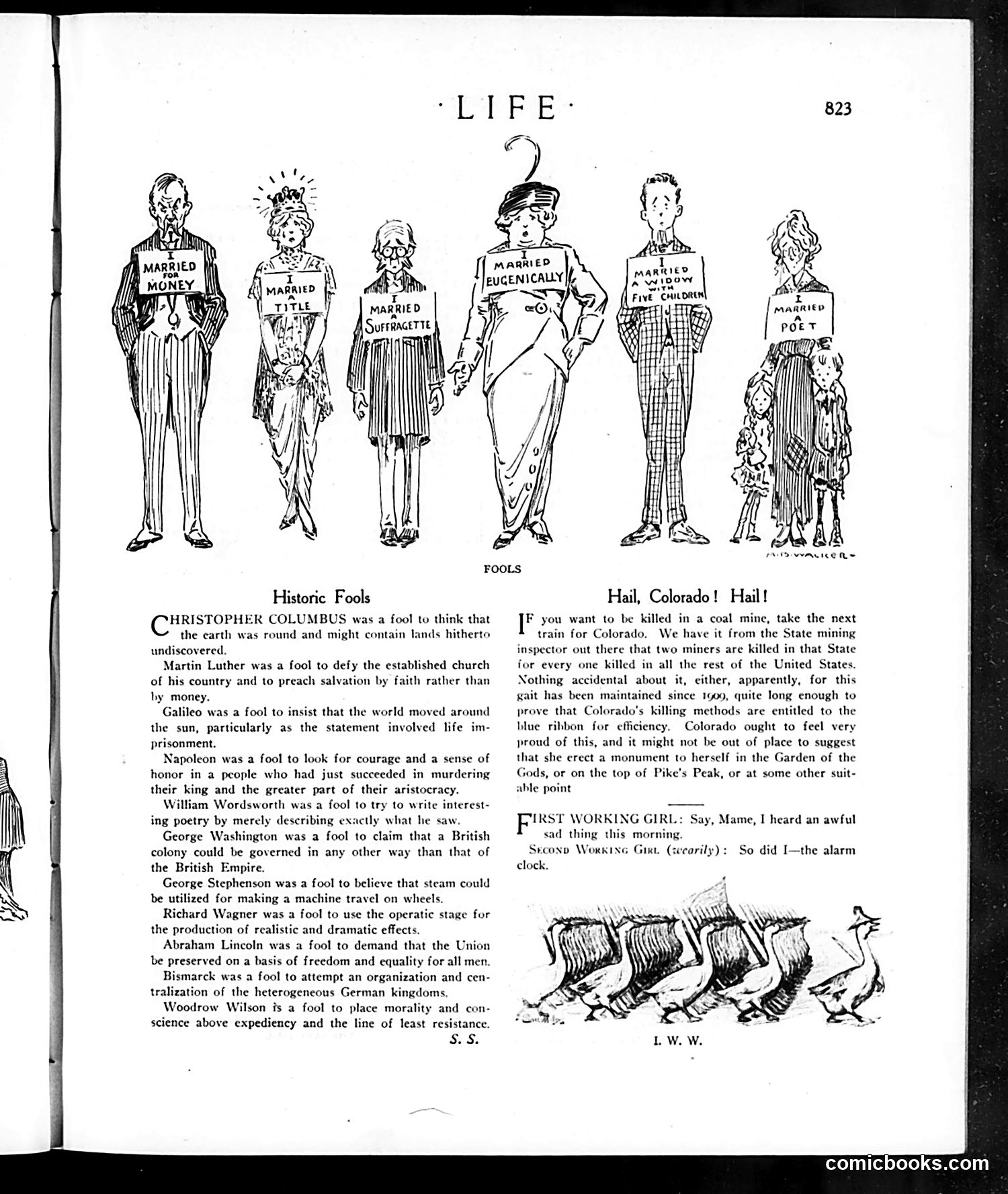
**Top Section: "Historic Fools"** This satirical list celebrates historical figures condemned as fools by their contemporaries—Columbus, Luther, Galileo, Lincoln, and others—who were actually visionaries. The final entry targets **President Woodrow Wilson**, calling him a fool for placing "morality and conscience above expediency." This critiques Wilson's idealistic foreign policy (likely referencing WWI decisions or the League of Nations) as naive compared to pragmatic realpolitik. **Bottom Left: Six caricatured women** labeled with different marriage types ("Married for Money," "Married for Title," etc.), satirizing why women marry—a commentary on gender and economic dependence. **Bottom Right: "Hail, Colorado!"** A scathing exposé of Colorado's coal mining industry, which maintained a horrific fatality rate of two deaths per miner compared to national averages since 1909. The piece sarcastically "congratulates" Colorado for this murderous efficiency, implying systemic negligence and unsafe conditions are intentional. **"First Working Girl" joke:** Two women discuss an alarm clock—minimal humor, likely filler content.
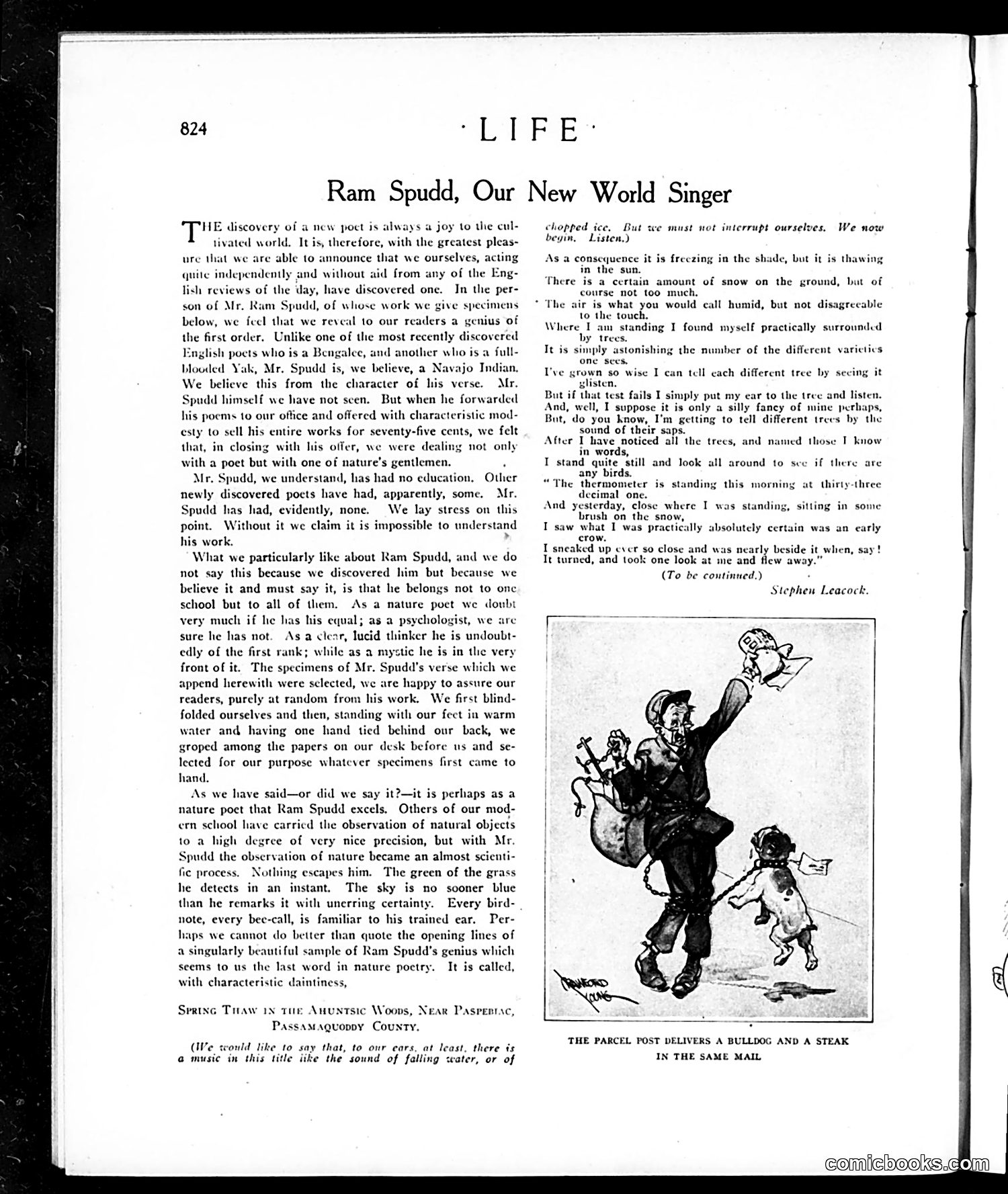
This is satirical commentary on contemporary poetry criticism and the romanticization of "primitive" or "untrained" artists. Life magazine pretends to have discovered Ram Spudd, a Navajo Indian poet, whom they celebrate as a genius precisely *because* he lacks formal education. The satire targets several things: the uncritical enthusiasm of literary establishments for newly "discovered" poets; the exotic appeal of non-European writers; and the absurdity of treating mundane observations as profound nature poetry. Spudd's specimen poem—describing obvious facts like snow being on the ground and trees being surrounded—is presented as profound while being comically banal. The cartoon below shows characters celebrating with a bulldog and steak, suggesting the article's tongue-in-cheek tone. The entire piece mocks fashionable literary taste by demonstrating how easily critics can elevate mediocrity when framed correctly.
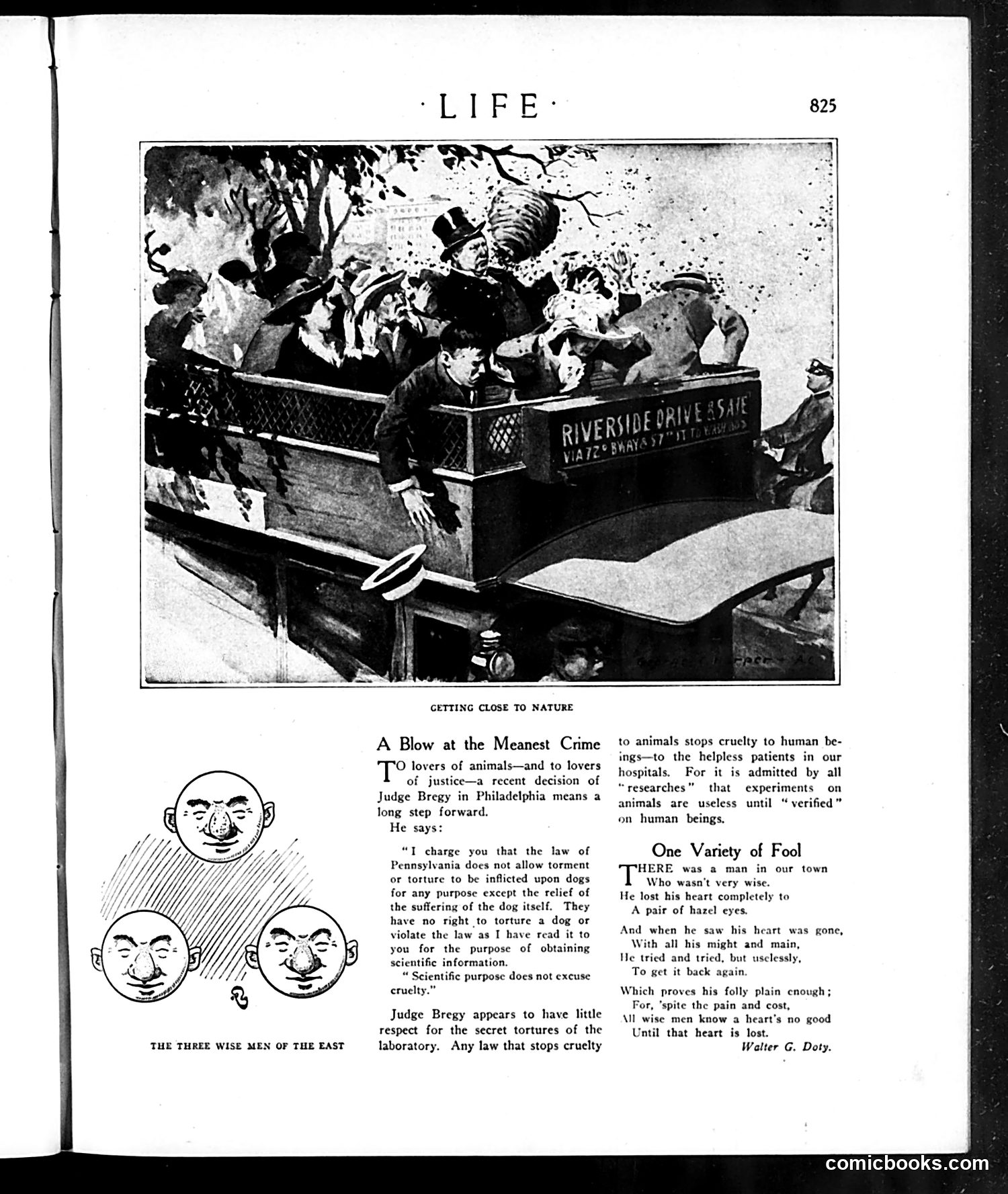
**Top Image:** Shows people in a trolley ride labeled "Riverside Drive" — appears to be a scene of everyday leisure, captioned "Getting Close to Nature." **Left Cartoon:** "The Three Wise Men of the East" depicts three identical caricatured faces with exaggerated features, likely mocking a group or type of person (the specific reference is unclear without additional context). **Main Article:** Celebrates Judge Bregy's Philadelphia court decision prohibiting animal torture for scientific experimentation. The text argues that laws protecting animals from laboratory cruelty indirectly protect humans, since researchers typically test procedures on animals first, then humans. The article sarcastically criticizes scientists who claim "scientific purpose" justifies animal suffering. **Poem:** "One Variety of Fool" is a romantic verse about a foolish man who loses his heart to hazel-eyed woman, struggling unsuccessfully to reclaim it — a lighthearted commentary on love's irrationality. The page combines social commentary (animal cruelty) with humor, reflecting early 20th-century concerns about medical ethics and laboratory practices.
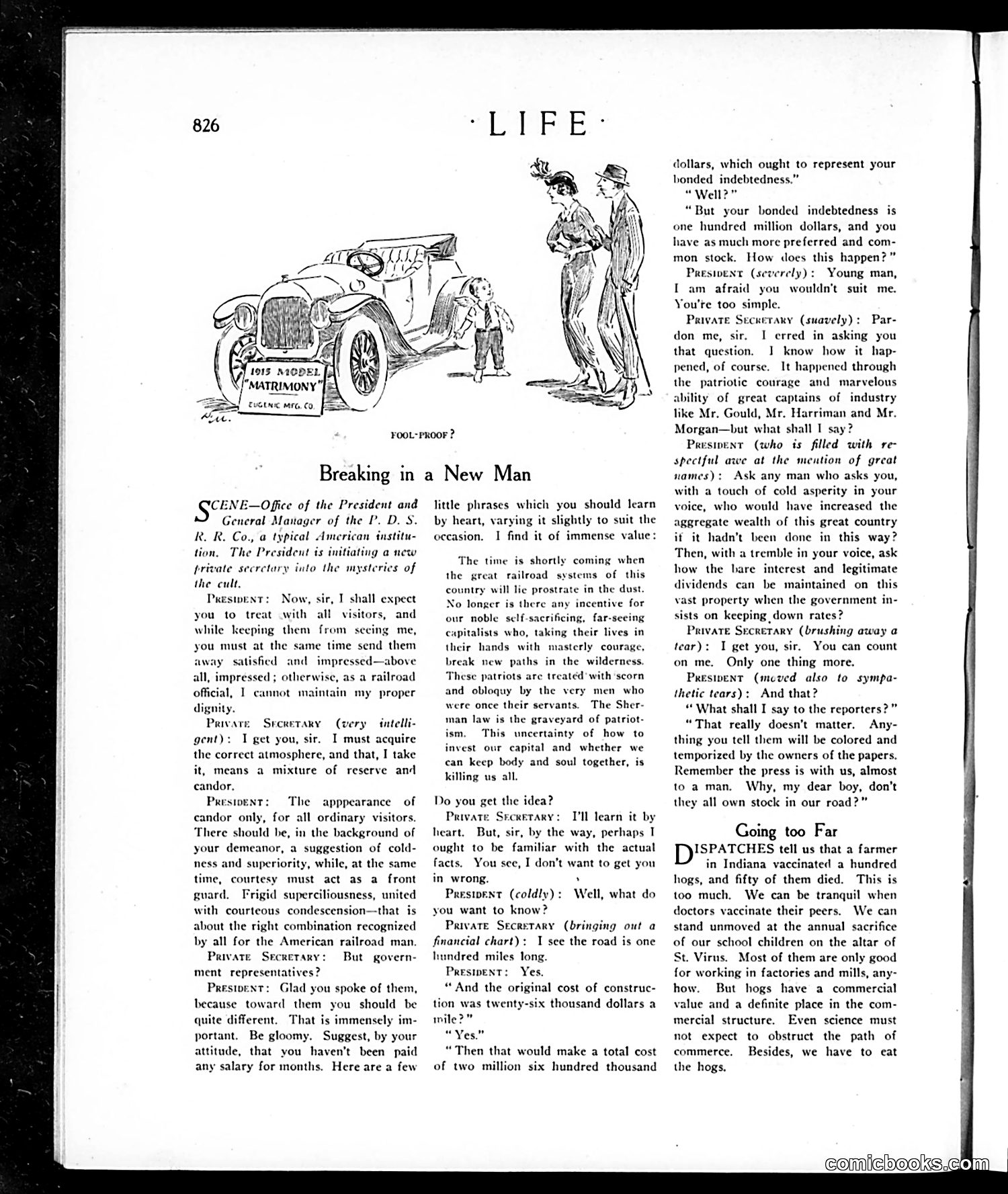
This satirical dialogue mocks railroad executive corruption and their manipulation of government regulators. A railroad president trains his new secretary to deceive visitors—especially government representatives—by appearing gloomy and claiming poverty while the company is actually massively profitable. The joke reveals the con: the railroad cost $2.6 million to build but carries $200+ million in bonds and stock, an obvious financial impossibility justified through vague appeals to the genius of tycoons like Gould, Harriman, and Morgan. When the secretary naively asks how this happened, the president fires him for being "too simple"—meaning he lacks the cynicism to understand or perpetuate corporate fraud. The satire exposes how railroad barons used inflated capitalization and political theater to extract wealth while claiming victimhood before regulators trying to control rates.
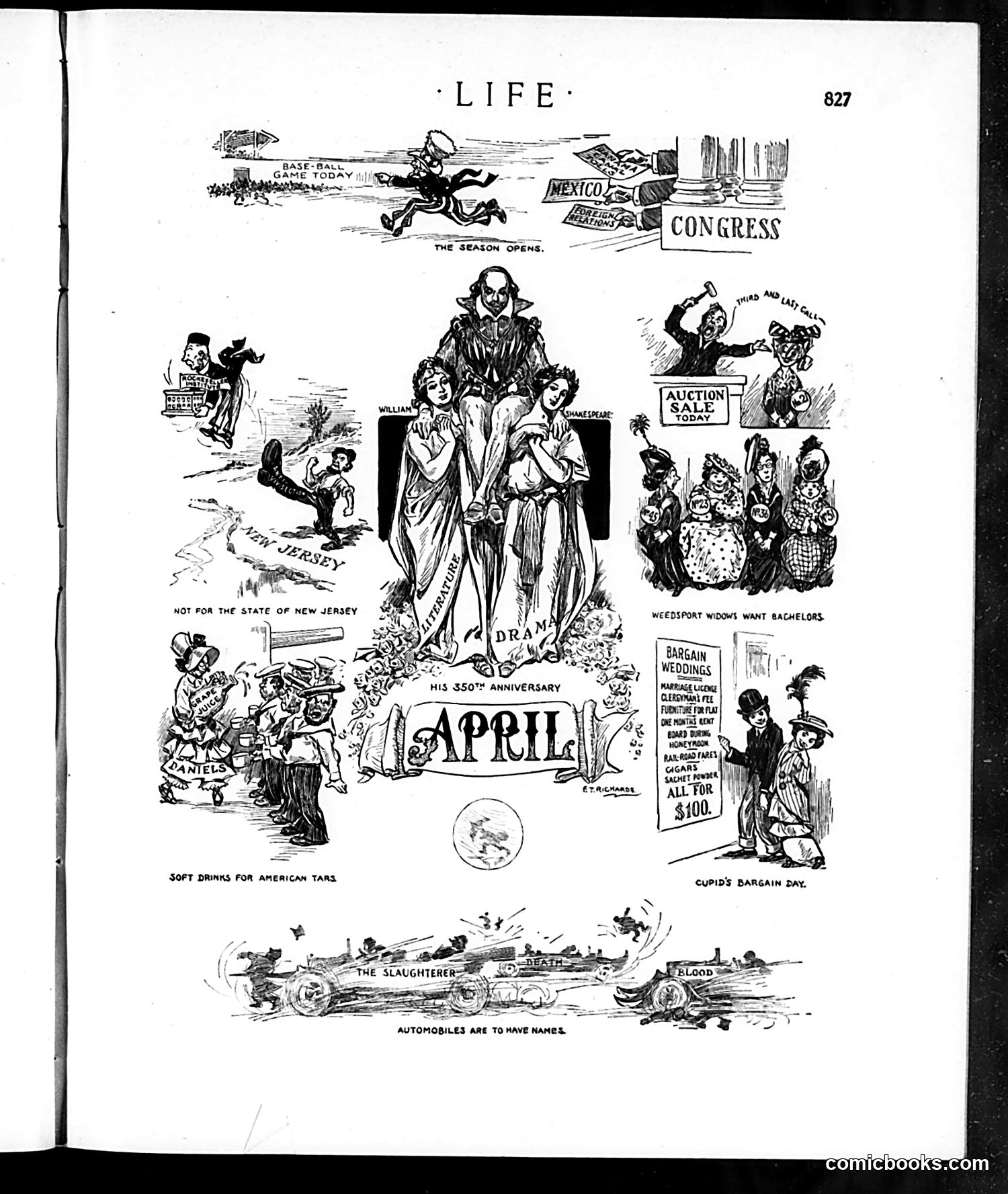
This satirical page mocks various April social trends and absurdities. The central figure appears to be "Drama" personified as Death, surrounded by seasonal follies. The cartoons reference: **"The Season Opens"**: Baseball season arrival amid Congressional chaos and Mexico-related turmoil. **Central drama**: A skeletal figure marking the "350th Anniversary" of April's theatrical/dramatic associations. **Lower cartoons**: "Weedsport Widows Want Bachelors" jokes about marriage desperation; "Bargain Weddings" advertises cut-rate ceremonies; "Soft Drinks for American Tars" likely satirizes temperance or military regulations. **"Automobiles Are to Have Names"**: The bottom panel mockingly depicts early cars as destructive, naming them after violence ("Slaughter," "Death," "Blood"). The overall tone ridicules April's unpredictable weather, social season absurdities, and contemporary anxieties about modernity and social change.
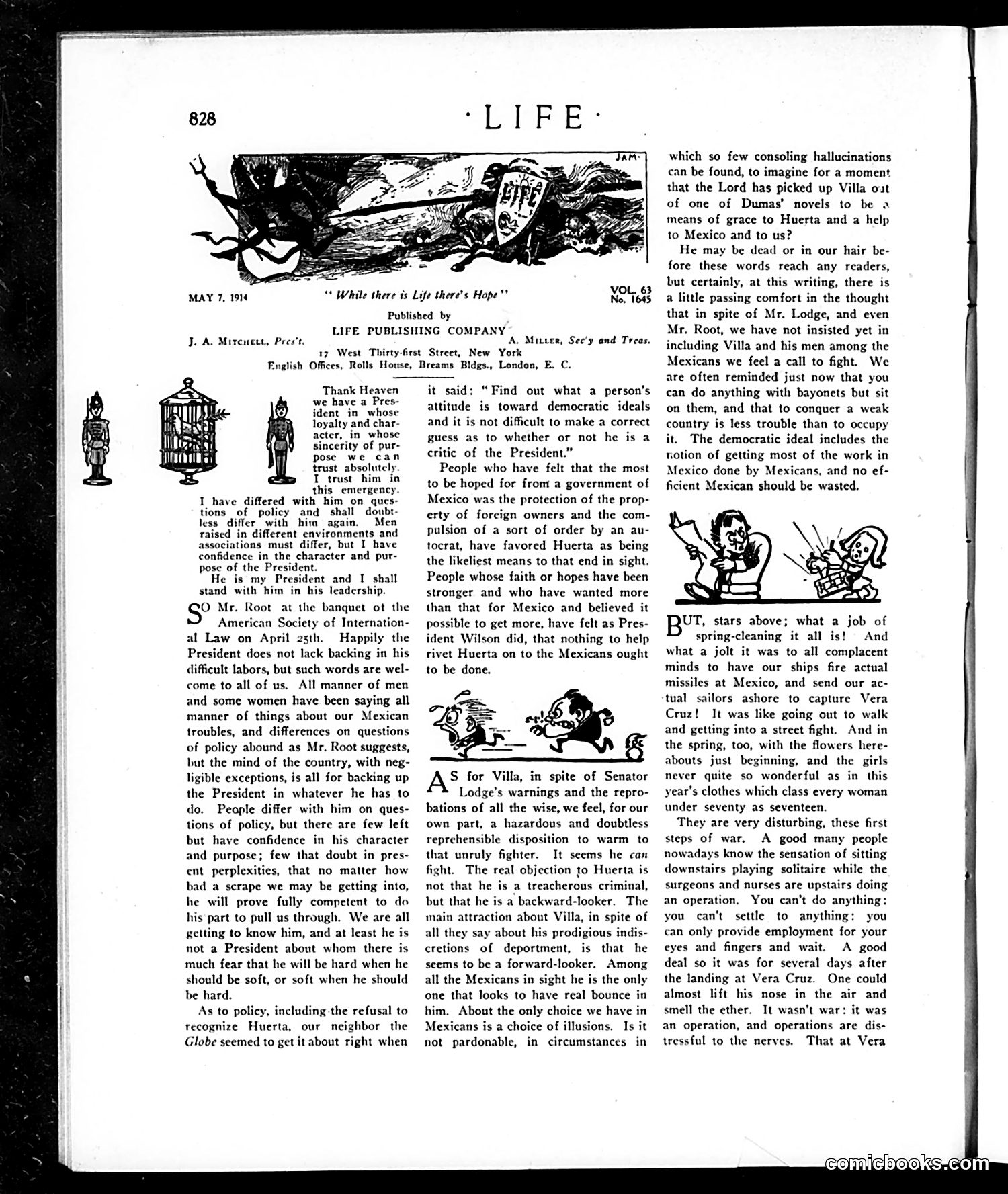
This editorial page addresses the Mexican Revolution during President Woodrow Wilson's administration. The text discusses three key Mexican figures: **Victoriano Huerta**: The military dictator whom Wilson refused to recognize. The piece criticizes him as a "backward-looker" serving foreign property interests and autocratic order. **Pancho Villa**: Despite warnings from Senator Henry Cabot Lodge, the editors express sympathetic fascination with Villa as a "forward-looker" with revolutionary promise—comparing him to a Dumas novel hero. They acknowledge this fondness is "hazardous and doubtless reprehensible" but find comfort in his apparent reformist potential. **President Wilson**: The page supports Wilson's non-recognition policy toward Huerta, praising his character and democratic ideals while acknowledging legitimate policy disagreements exist. The small illustrations (appearing near the text) likely satirize the Mexican conflict, though specific figures are unclear in this reproduction. The overall satire critiques both conservative interventionists favoring Huerta and cautious skeptics like Lodge, while endorsing Wilson's idealistic approach to Mexican self-determination.
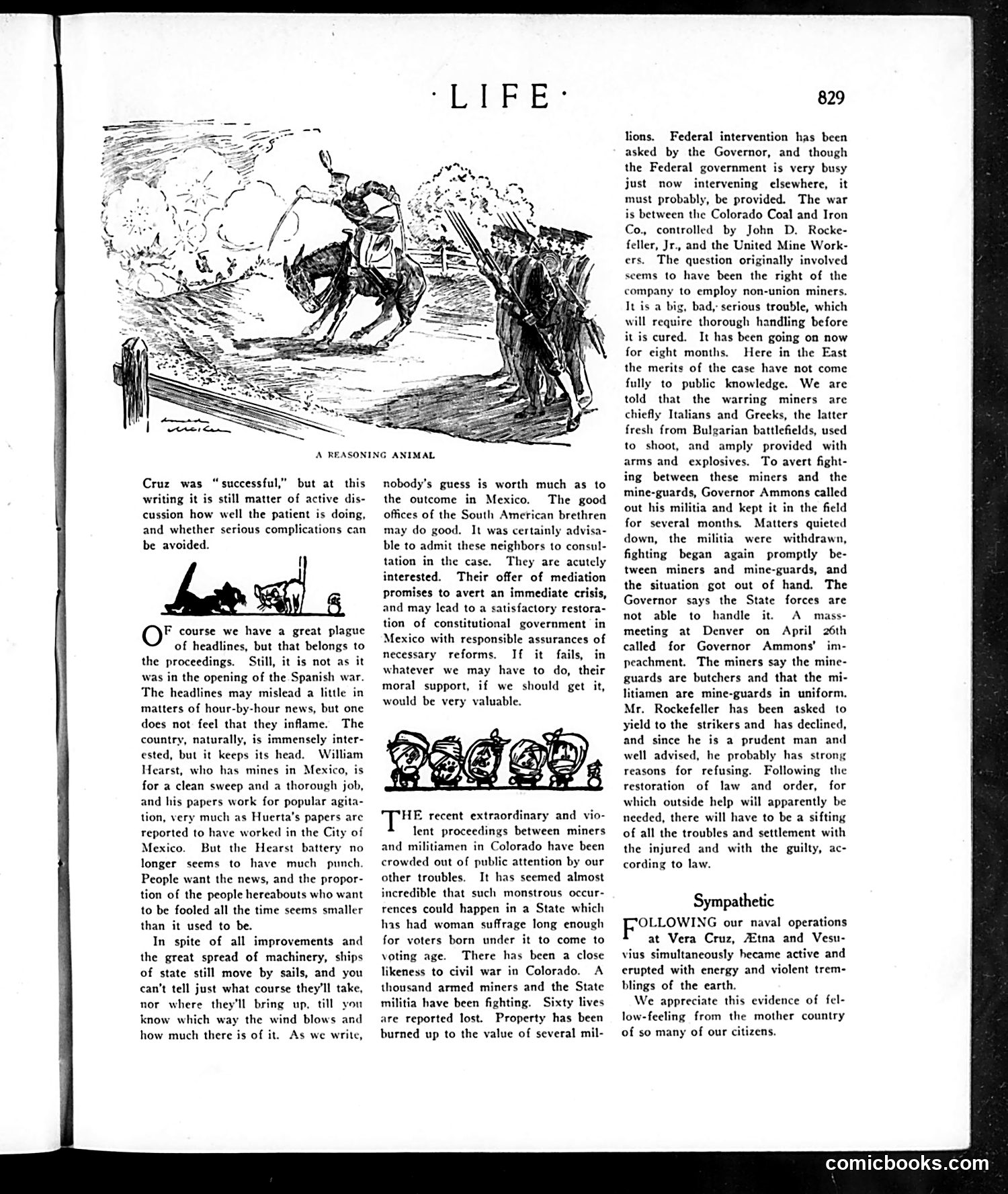
The cartoon depicts a donkey (representing the American public or electorate) being led by a figure on horseback—likely representing a political leader or media manipulator. The "reasoning animal" title is ironic: it questions whether the public actually thinks for itself or merely follows where it's directed. The accompanying text discusses two major crises: the Mexican situation (involving William Randolph Hearst's newspaper influence and intervention proposals) and the Colorado coal miners' strike against Rockefeller's company. The author criticizes Hearst's sensationalism while noting the public has grown more resistant to manipulation. The Colorado violence—involving immigrant workers and state militia—represents a civil-war-like conflict the author finds shocking for an advanced, women's-suffrage state. The cartoon suggests citizens should think independently rather than be passively led by propaganda or inflammatory headlines.
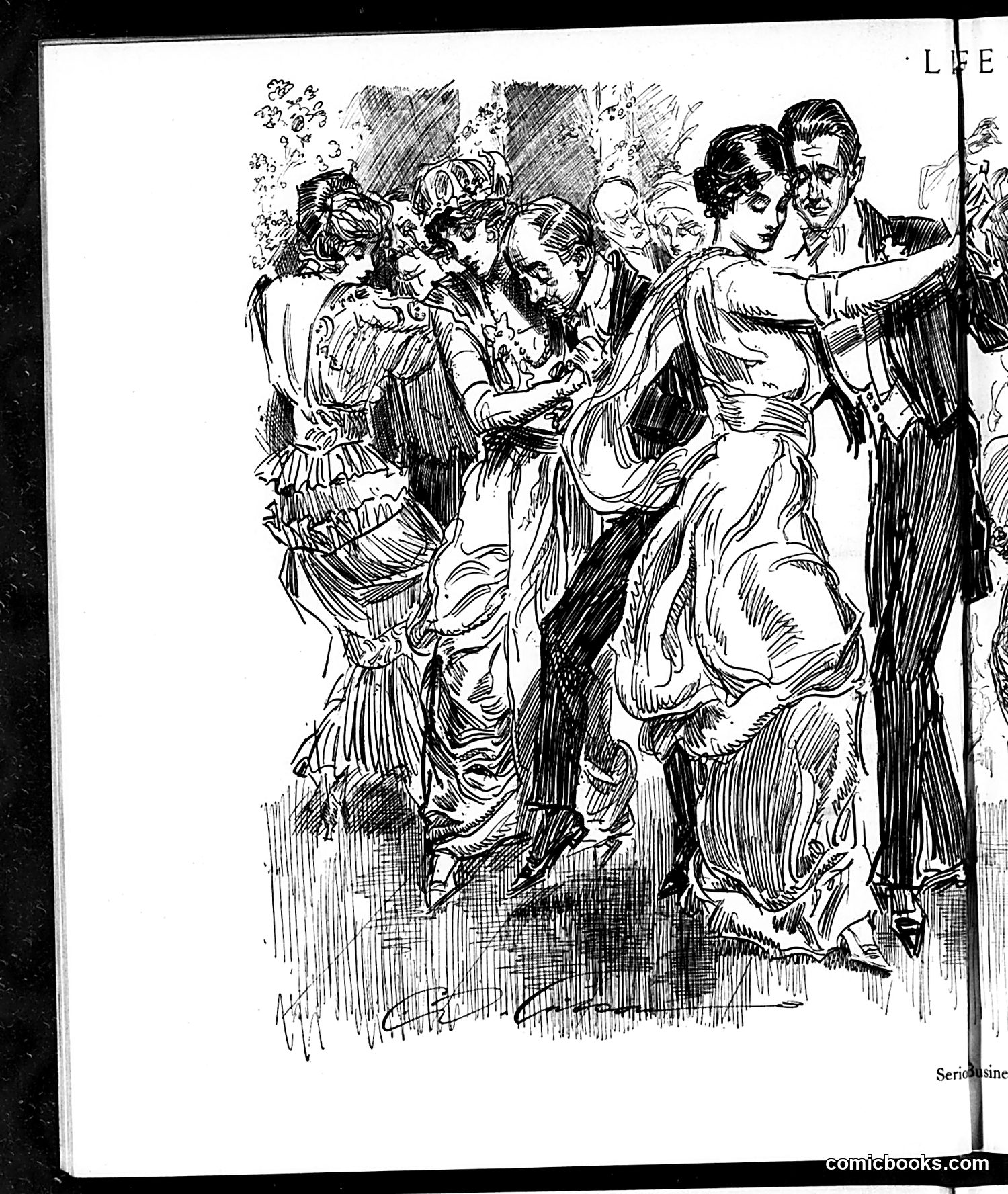
This appears to be a satirical illustration from *Life* magazine depicting a crowded social gathering, likely from the late 19th or early 20th century based on the clothing styles and artistic technique. The sketch shows multiple figures in formal Victorian/Edwardian dress—women in elaborate gowns and men in suits—clustered together in what seems a chaotic social scene. The artist uses exaggerated linework to suggest confusion or disorder within the gathering. Without additional caption text visible, the specific satirical target is unclear. However, the composition suggests commentary on high society gatherings, overcrowding at social events, or possibly the pretension of formal social occasions. The "Seriousine" credit at the bottom likely identifies the artist, though I cannot definitively identify the specific social or political issue being mocked.
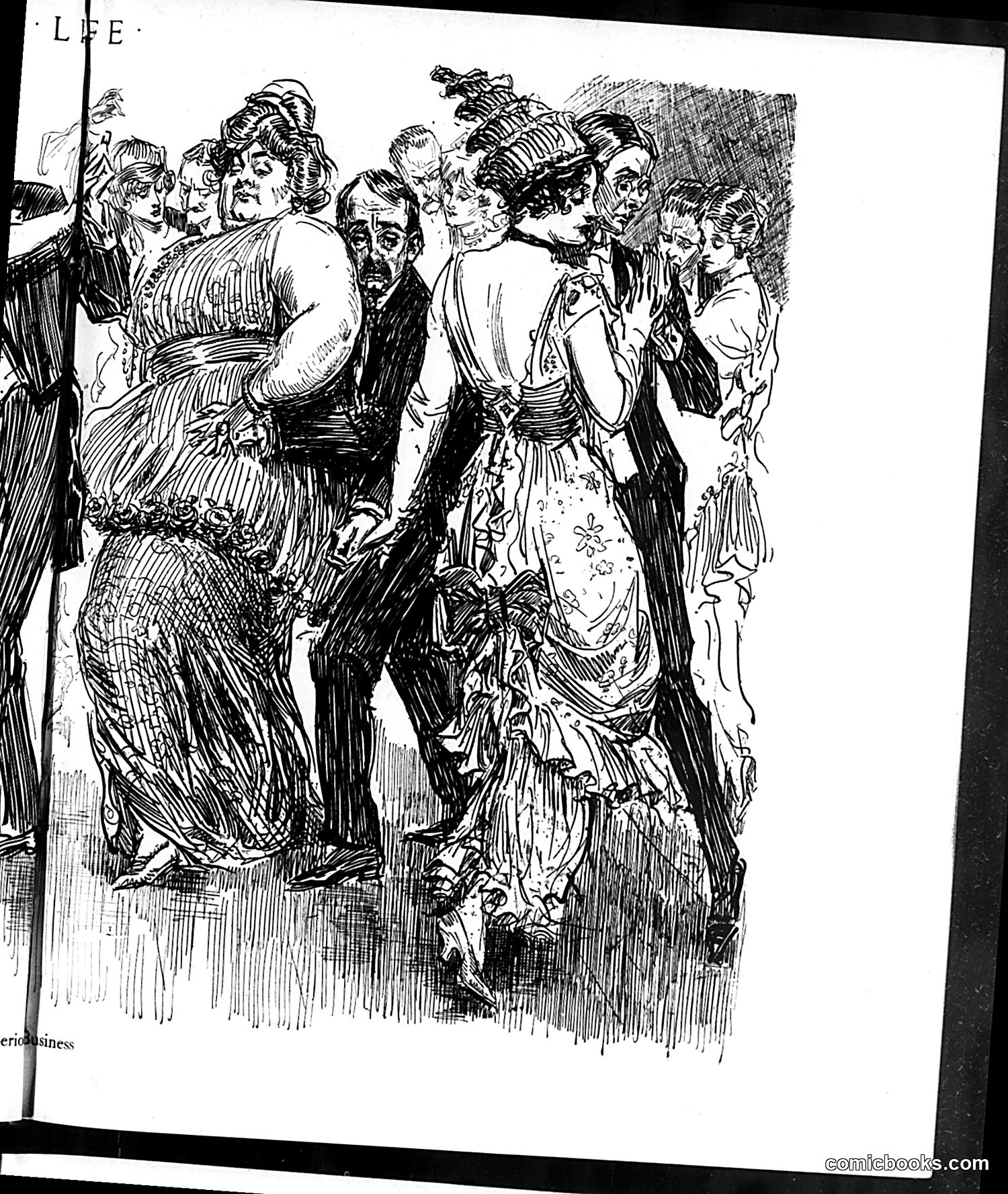
This page appears to be from *Life* magazine and shows a satirical illustration of what seems to be a formal social gathering or reception. The drawing depicts elegantly dressed figures in late 19th or early 20th-century attire—women in elaborate gowns with full skirts and ornate hairstyles, men in formal suits and tails. The partial OCR text "eri Siness" is unclear but may be corrupted. Without complete text or a visible caption, the specific satirical target is difficult to identify with certainty. The illustration likely mocks aspects of high society, fashion pretension, or social rituals of the era, though the exact point of satire remains unclear from this image alone.
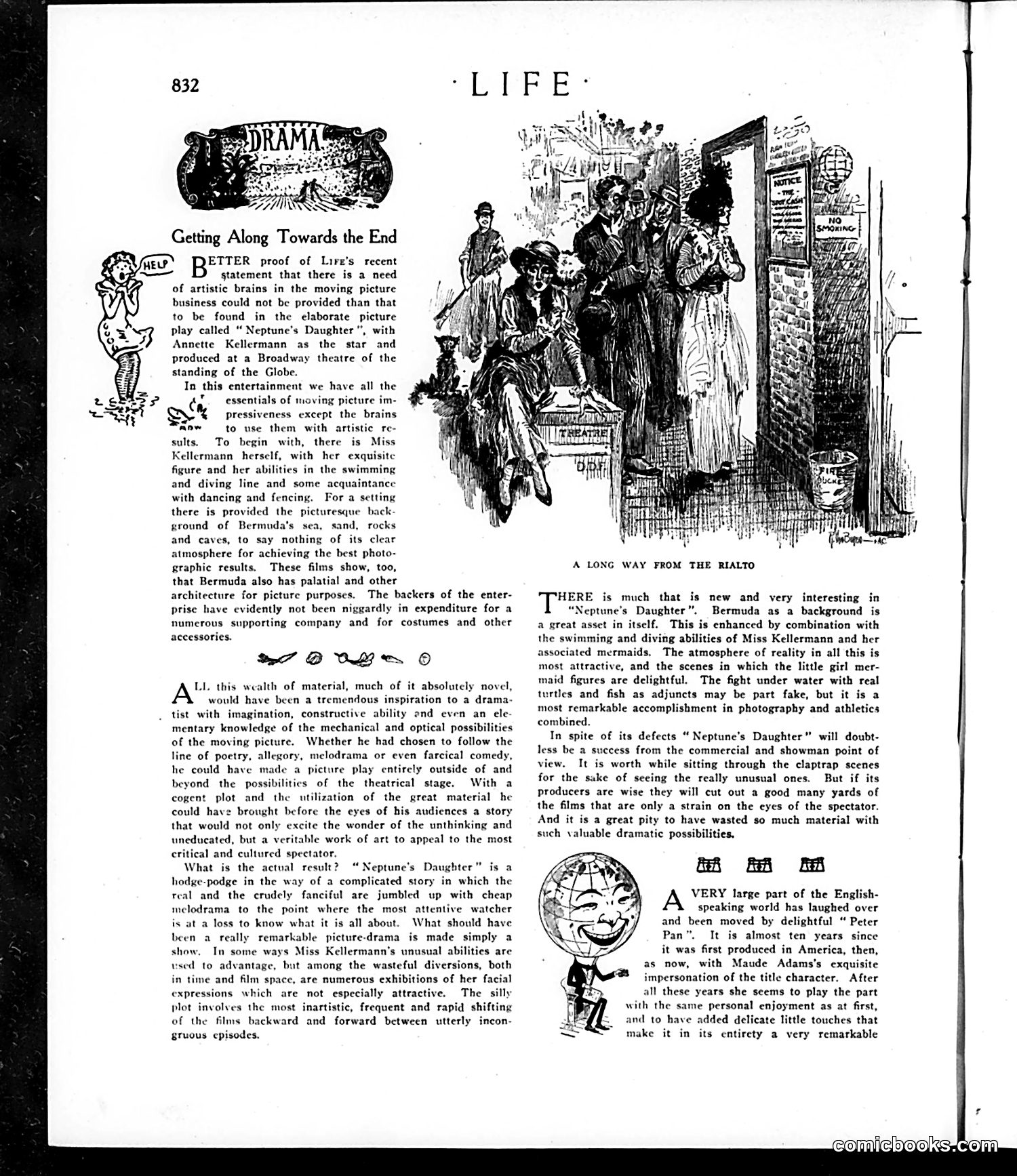
This is a critical review of the film "Neptune's Daughter," starring swimmer Annette Kellermann. The page satirizes Hollywood's wasteful approach to filmmaking. **The Critique:** Life argues the film had exceptional raw materials—Kellermann's athletic talents, Bermuda's exotic scenery, lavish sets, and costumes—yet failed artistically. The review condemns the movie as a "hodge-podge" mixing real scenes with cheap melodrama and poorly plotted story. It critiques excessive, rapid scene-cutting and unflattering close-ups of Kellermann's facial expressions. **The Satire's Point:** Life mocks producers for having money and resources but lacking artistic vision or coherent storytelling. Despite these flaws, the magazine concedes the film will likely succeed commercially—the joke being that spectacle and star power matter more to audiences than actual dramatic quality or cinematic art. The cartoon accompanying the text (showing a woman on what appears to be a bicycle or vehicle) likely reinforces this theme of misguided entertainment priorities.
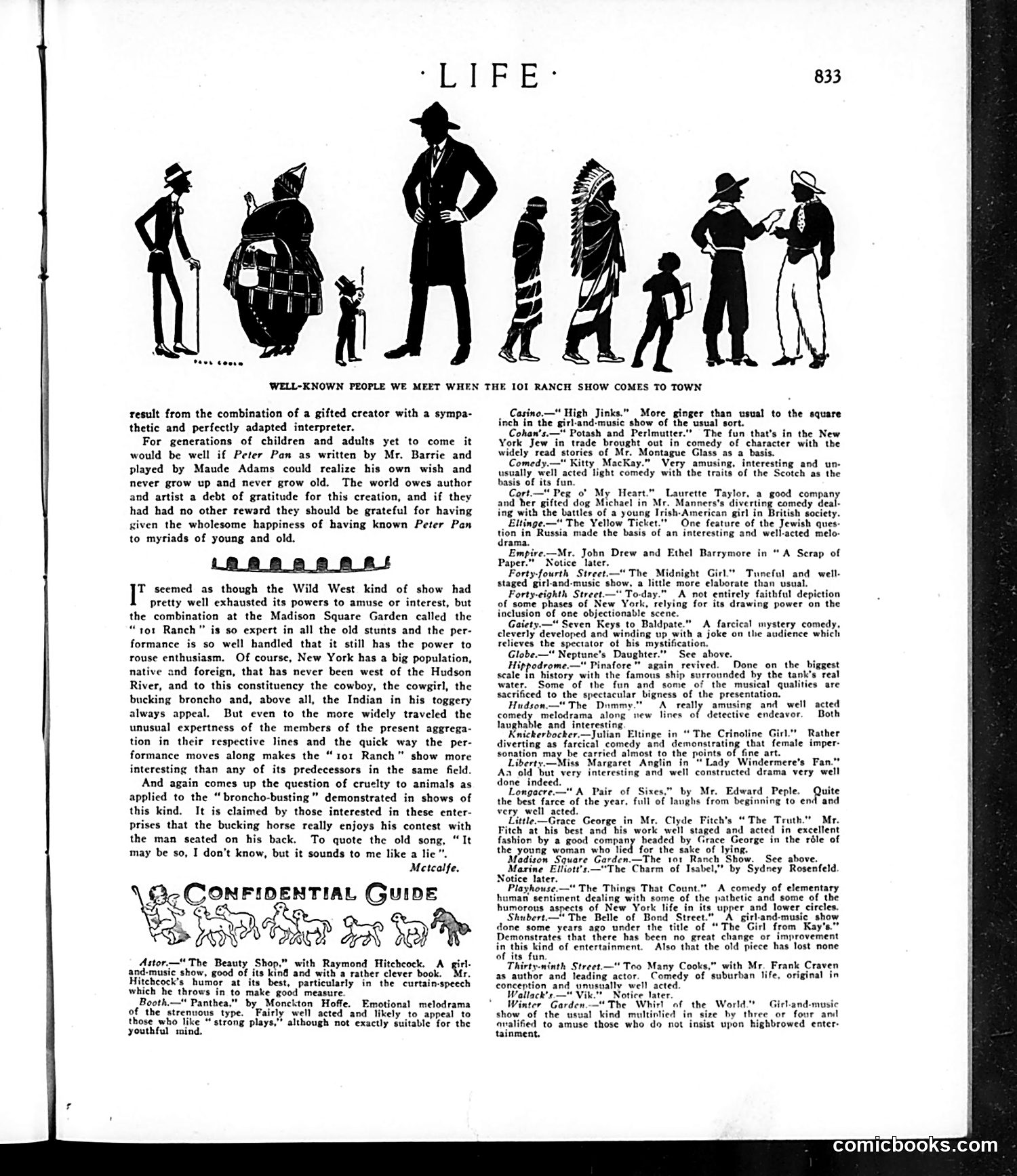
This page features theater reviews ("Confidential Guide") of Broadway shows from the early 1900s, accompanied by a silhouette illustration at the top showing "well-known people we meet" at the 101 Ranch show. The silhouettes depict various character types attending this Wild West exhibition—a society gentleman, a rotund woman in elaborate dress, a tall cowboy figure, children, and performers in Native American and frontier costumes. This visual commentary satirizes the diverse New York audience drawn to such spectacles. The text discusses how the 101 Ranch show, despite being formulaic Wild West entertainment, remains popular because it appeals to urban audiences (native and foreign) unfamiliar with frontier life. Notably, the author raises ethical concerns about animal cruelty in "broncho-busting" demonstrations, skeptically quoting an old song: "It may be so, I don't know, but it sounds to me like a lie." The reviews themselves cover contemporary Broadway productions with typical period-humor assessments of their merits.
This page from *Life* magazine features book reviews, not political cartoons. The content is a literary column discussing recently published works. The opening section uses playful language about "bugaboos" (frightening things) to frame a discussion of horror fiction—a common *Life* trope of mixing highbrow literary criticism with accessible humor. The reviews discuss works by authors including G.K. Chesterton, Caroline Lockhart, and W.B. Maxwell. The Chesterton passage employs characteristic *Life* satire: it describes his mind as operating in reverse, comparing his intellectual impact to a chaotic fish thrashing through a school—a humorous way of saying Chesterton's unconventional thinking disrupts conventional ideas. The reviews praise works for their technical skill and "uncanny effects," suggesting *Life's* audience valued sophisticated literary merit alongside entertainment. The tone is witty and slightly condescending toward both overwrought horror fiction and experimental modern thought.
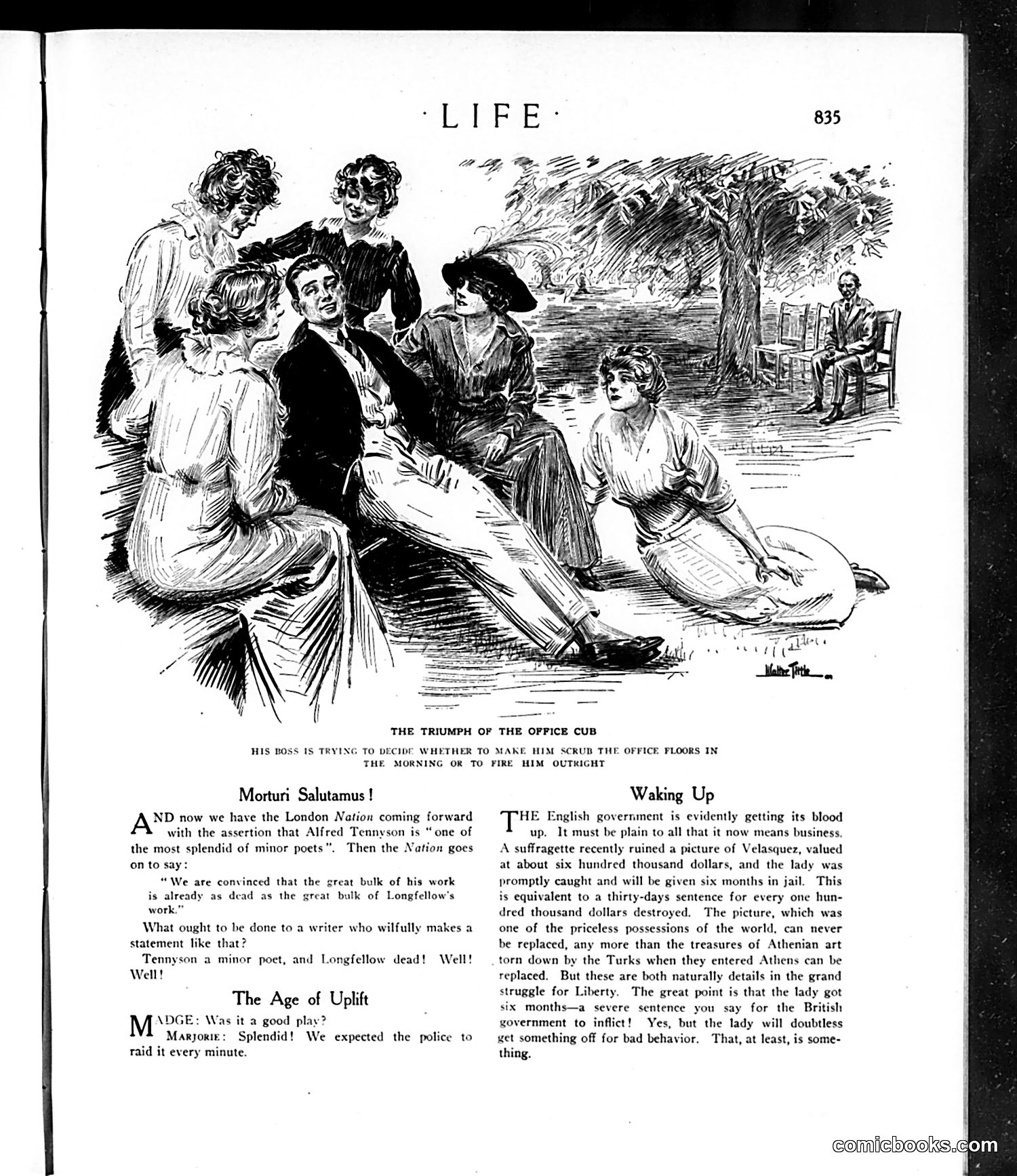
This page contains three satirical pieces: **"The Triumph of the Office Cub"** (cartoon): Shows a young office worker facing his boss's decision whether to fire him or demean him with menial labor—mocking the casual cruelty employers wielded over junior staff. **"Morturi Salutamus!"**: Ridicules the London *Nation* magazine's assertion that Alfred Tennyson was merely a "minor poet" and that his work is as "dead" as Longfellow's. The author expresses outrage at this dismissal of the revered Victorian poet. **"The Age of Uplift"**: A brief joke where a character praises a play because she "expected the police to raid it every minute"—satirizing self-righteous moralism and censorship advocates. **"Waking Up"**: Commentary on British suffragettes, particularly one who damaged a Velasquez painting. The author sarcastically notes the six-month jail sentence while questioning whether property destruction serves the suffrage "struggle for Liberty," implying the tactics undermine their cause. The page reflects early 20th-century American attitudes toward literature, workplace hierarchy, censorship, and women's activism.
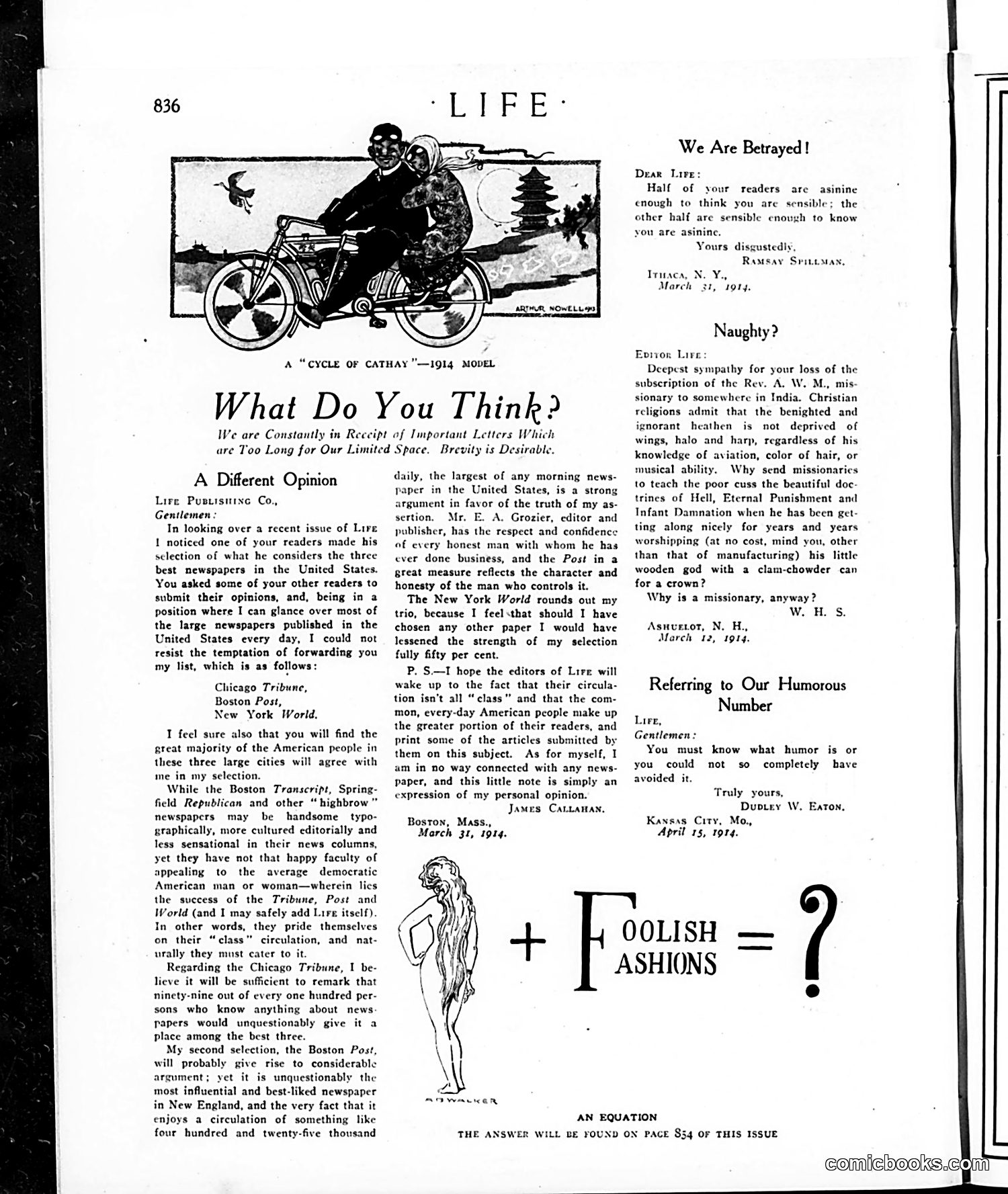
The main cartoon depicts a man and woman on a motorcycle labeled as a "1914 model," traveling past Asian pagodas and landscape. This likely satirizes Western romantic fascination with "the Orient"—a trendy exoticized interest among Americans of that era. The phrase "Cycle of Cathay" (Cathay being an old name for China) appears to mock the fashion for Asian-themed romance and adventure narratives popular in early 20th-century culture. The "What Do You Think?" reader responses below reflect Life's typical editorial format inviting public opinion on contemporary issues. The letters debate which American newspapers represent quality journalism—reflecting debates about mass-market versus "highbrow" publications that divided readers of the era. The final equation "+ Foolish Fashions = ?" advertises a puzzle for readers, suggesting commentary on fashion trends (possibly including the Asian-influenced styles referenced in the cartoon).

This page is primarily a **product advertisement**, not political satire. It promotes Kelly-Springfield tires, emphasizing their quality through a comparison to Swiss watches. The ad's strategy draws a parallel: just as Switzerland is famous for watches because Swiss makers prioritized reputation over mass production, Kelly-Springfield positions itself as a quality tire manufacturer. The company claims to hand-make tires rather than maximize output, suggesting craftsmanship justifies their market position. The image shows a woman's face framed within a tire, creating a clever visual pun on the product. The photograph inside the tire demonstrates the tire's quality and roundness. For modern readers: this reflects early 20th-century marketing that valued perceived artisanal quality and brand reputation—comparing industrial manufacturing to fine craftsmanship to justify premium pricing. The "hand-made" claim would be unusual marketing today.
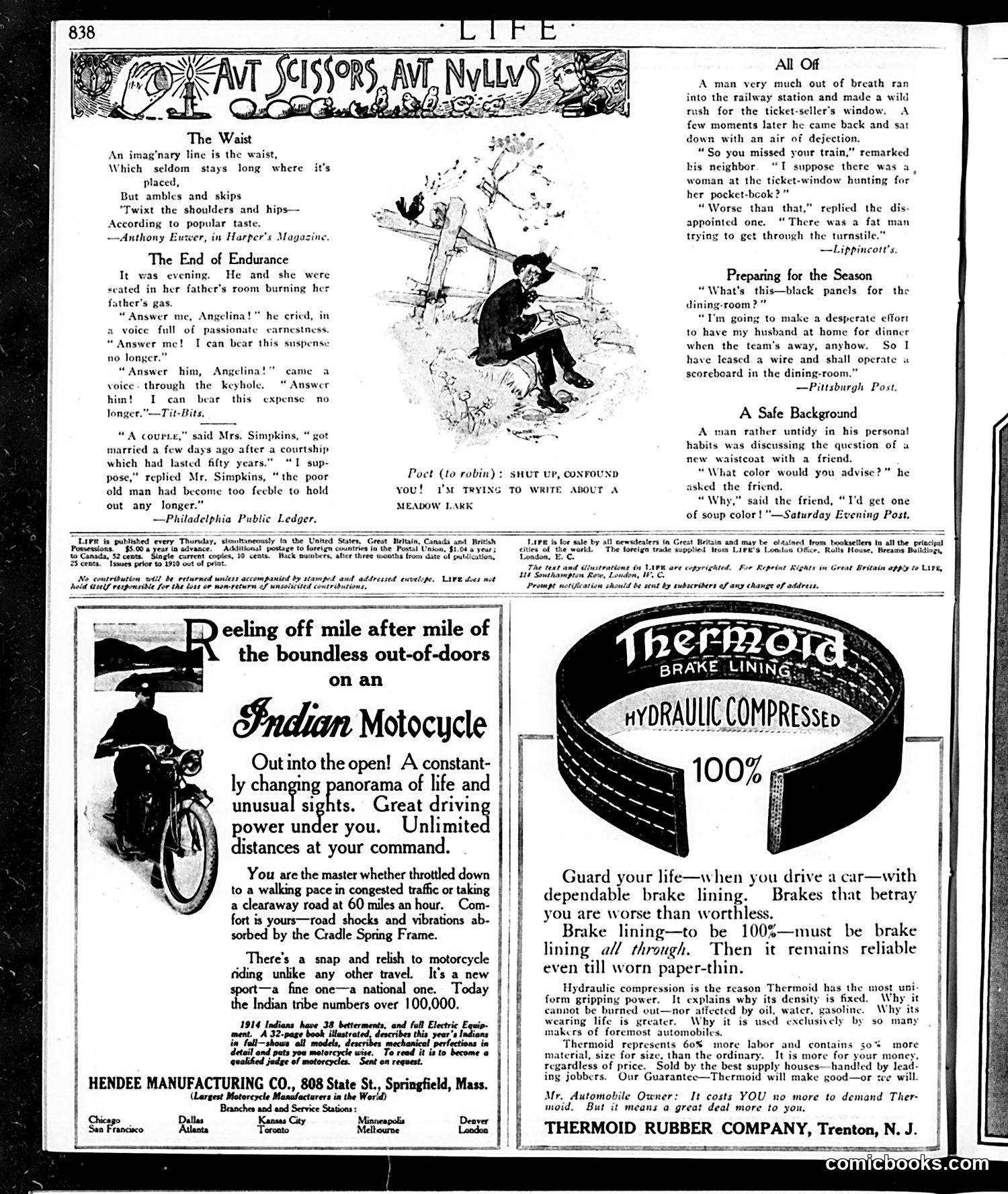
This is a humor and advertising page from Life magazine's "Art Scissors at Nulls" section. The cartoons are brief satirical jokes about everyday life: **"The Waist"** mocks the fashionable female silhouette—women's corsets and clothing created an imaginary waistline that shifted unpredictably between shoulders and hips depending on posture and fashion trends. **"The End of Endurance"** presents domestic humor: a couple's courtship lasted 50 years, and a husband suggests the elderly man "became too feeble to hold out any longer"—a joke about persistence in romance turning to exhaustion. Other brief jokes target missed trains, wives' housekeeping habits, and fashion choices. The page is dominated by period **advertisements**: Indian Motorcycles (promoting outdoor freedom and speed) and Thermoid Brake Lining (emphasizing safety and reliability). These ads reflect early 20th-century consumer culture targeting middle-class buyers. The overall tone is lighthearted domestic and social satire typical of Life's era.
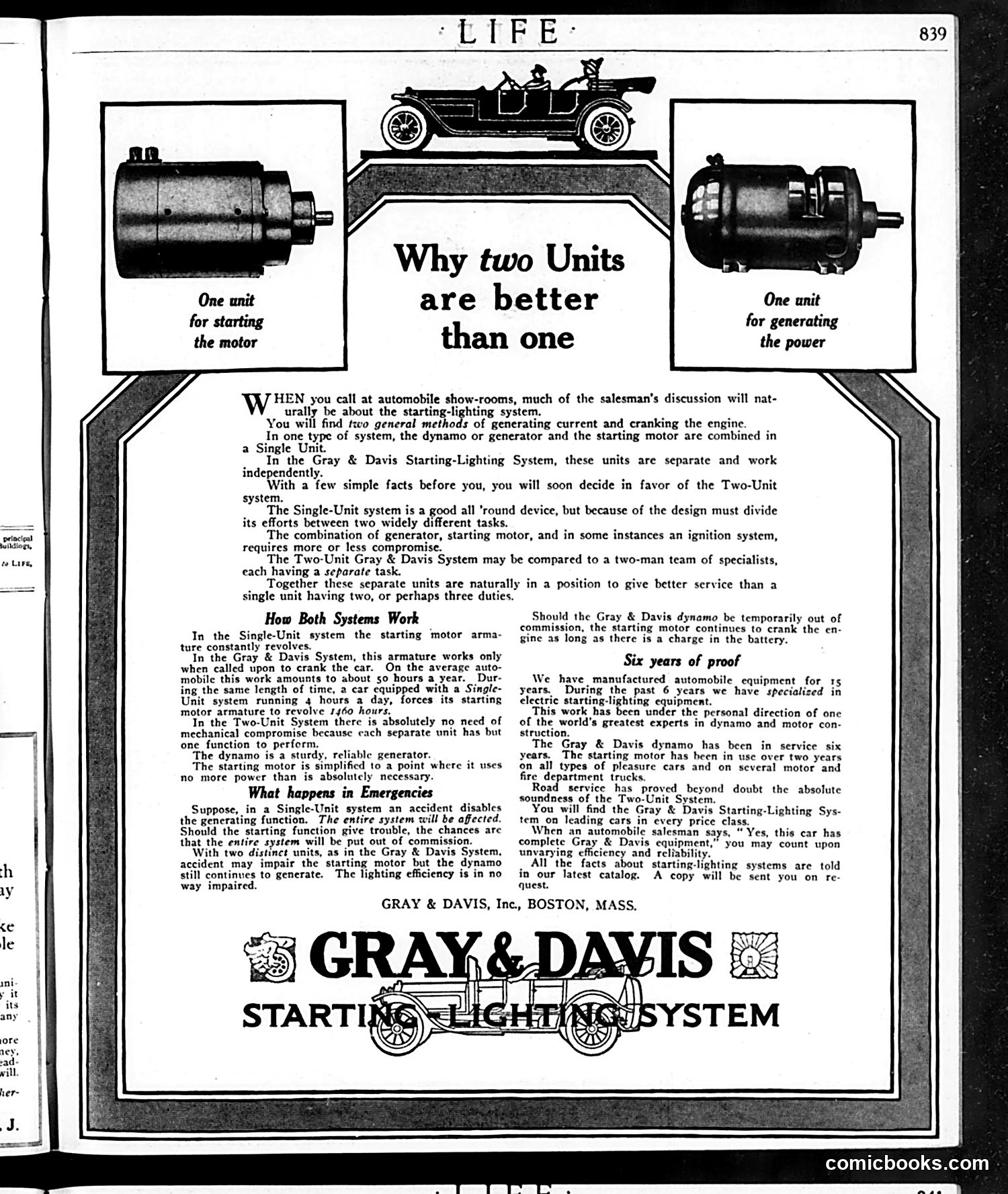
This is **purely an advertisement**, not satire or political content. Gray & Davis, Inc. (Boston) is marketing their automobile electrical system to potential car buyers around 1910-1920. The page argues for their "Two-Unit System"—separate starter motor and generator—versus competitors' "Single-Unit" designs that combined both functions. The three images show the two components side-by-side. The sales pitch emphasizes: - **Specialization works better**: Like "two-man teams of specialists," separate units each do one job well - **Reliability**: If one fails, the other still functions (critical when starting cars was difficult) - **Proof**: Six years of real-world use on various vehicles For modern readers: this reflects early automotive technology debates, when electric starters were still relatively new and manufacturers competed on system design. The "emergency" section illustrates genuine concerns—a car breakdown meant being stranded without modern roadside assistance. The advertisement targets showroom visitors who would actually evaluate such technical specifications before purchase.
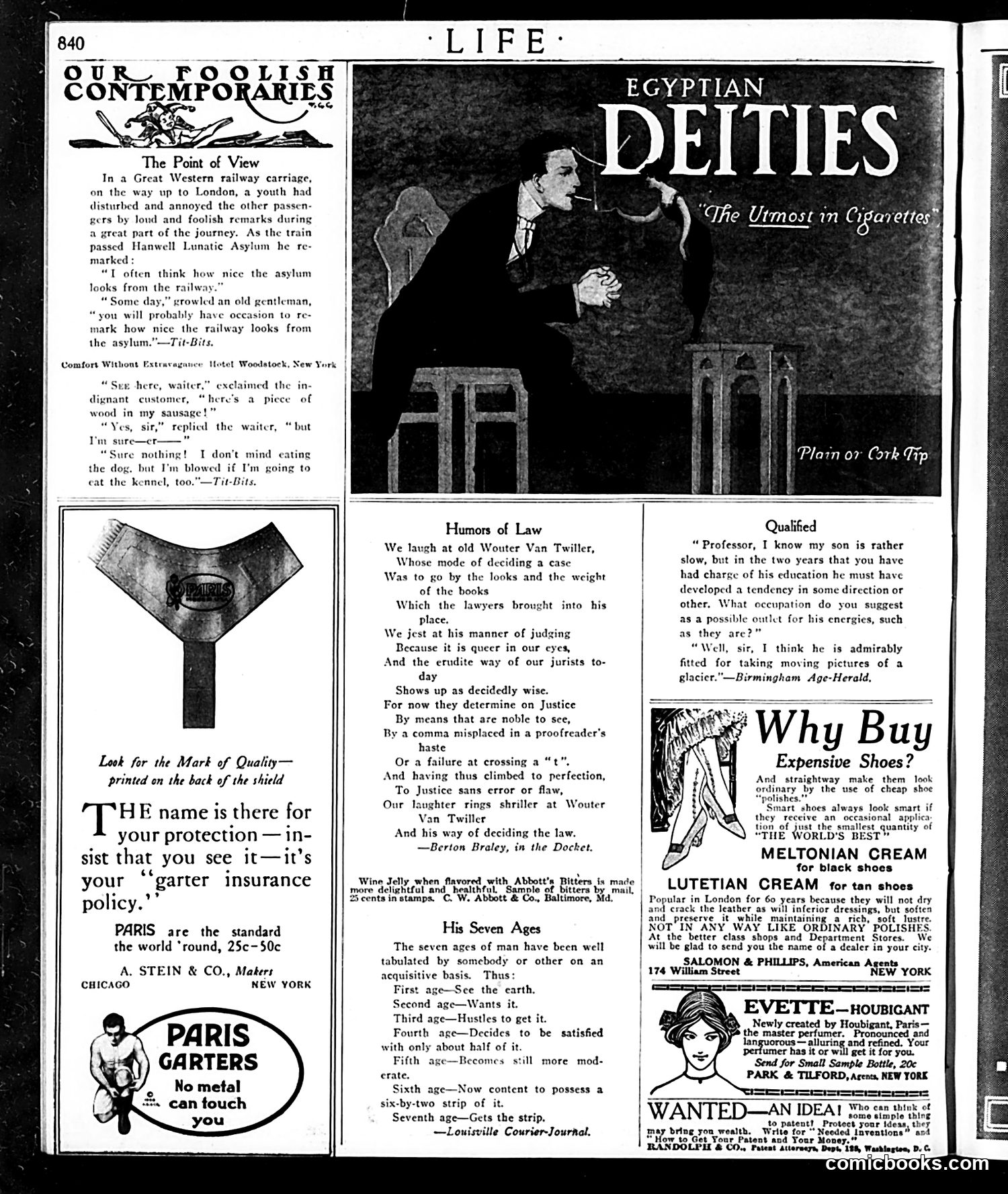
This page combines humorous anecdotes with period advertisements. The cartoons mock social pretension and legal absurdity: **"The Point of View"** satirizes a foolish youth on a train who makes inane remarks; an older passenger quips he'll "probably have occasion to remark how nice the railway looks from the asylum"—suggesting the youth belongs in an insane asylum. **"Humors of Law"** critiques modern jurisprudence through poet Berton Braley, contrasting the seemingly ridiculous judge Wouter Van Twiller (a historical Dutch colonial figure) with contemporary lawyers who achieve "Justice" through trivial technicalities—misplaced commas, improperly crossed t's. The satire inverts expectations: the old judge's straightforward method now seems wiser than modern pedantic legalism. **"His Seven Ages"** presents a cynical progression: man's acquisitiveness peaks then diminishes to accepting a "six-by-two strip" of earth—presumably his grave. The advertisements (Egyptian Deities cigarettes, Paris garters, shoe creams, perfume) fill remaining space, typical of Life's revenue model.
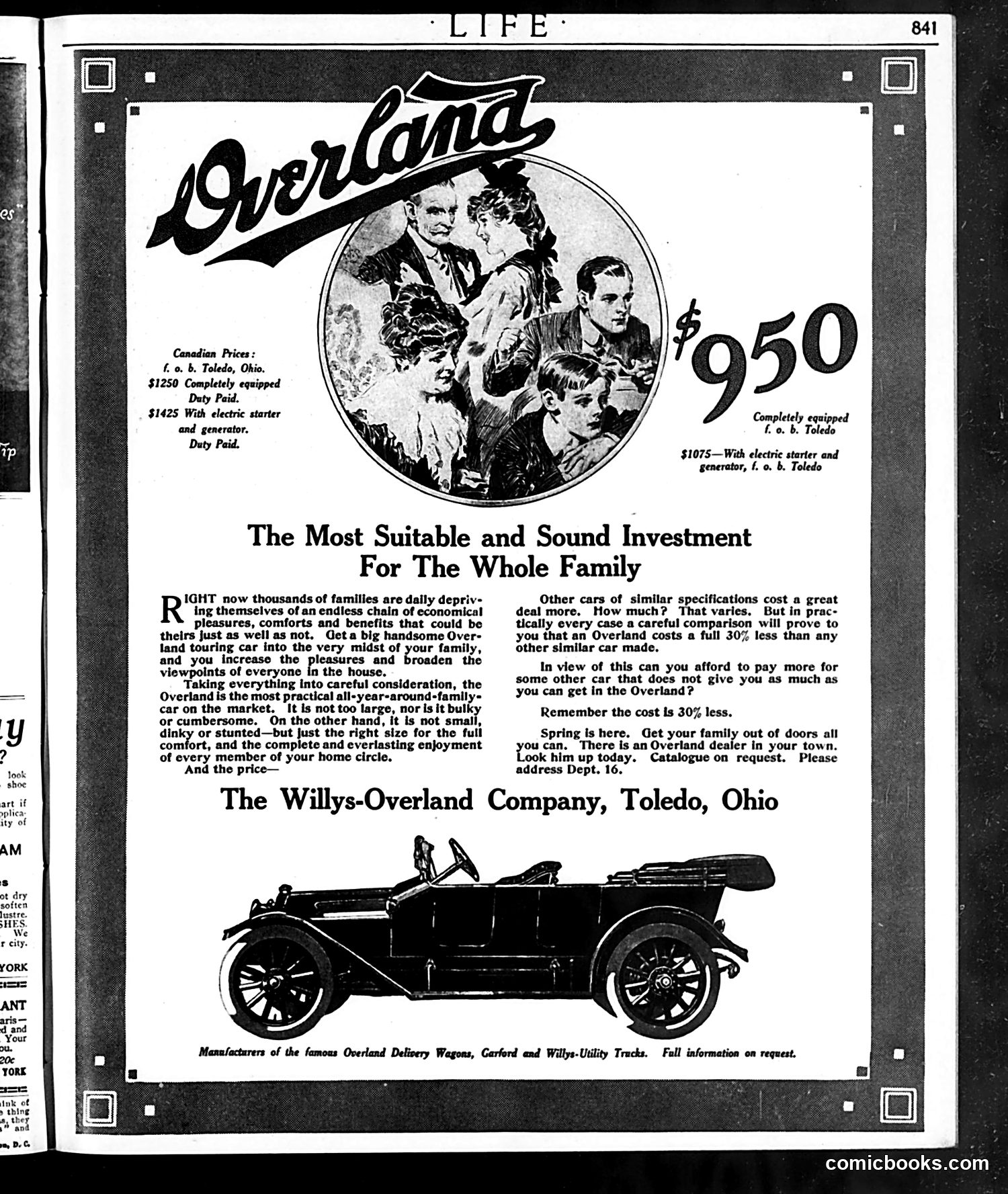
This is **not a cartoon or satire** — it's a straightforward automobile advertisement from Life magazine's advertising section. The page promotes the Overland automobile by the Willys-Overland Company of Toledo, Ohio, priced at $950. The illustration shows a family (parents and children) in a touring car, emphasizing the vehicle as a practical family investment. The ad's argument is purely commercial: the Overland offers practical size ("not too large...not small"), family comfort, and a 30% cost advantage over competitors. The emotional appeal centers on family pleasure and togetherness — "broadening viewpoints" through automobile touring was a genuine selling point of the automotive age. The Canadian pricing information and call to "get your family out of doors" reflect post-WWI prosperity and the automobile's role in expanding leisure activities. There is no political commentary or satire present — this represents straightforward early-20th-century consumer marketing.
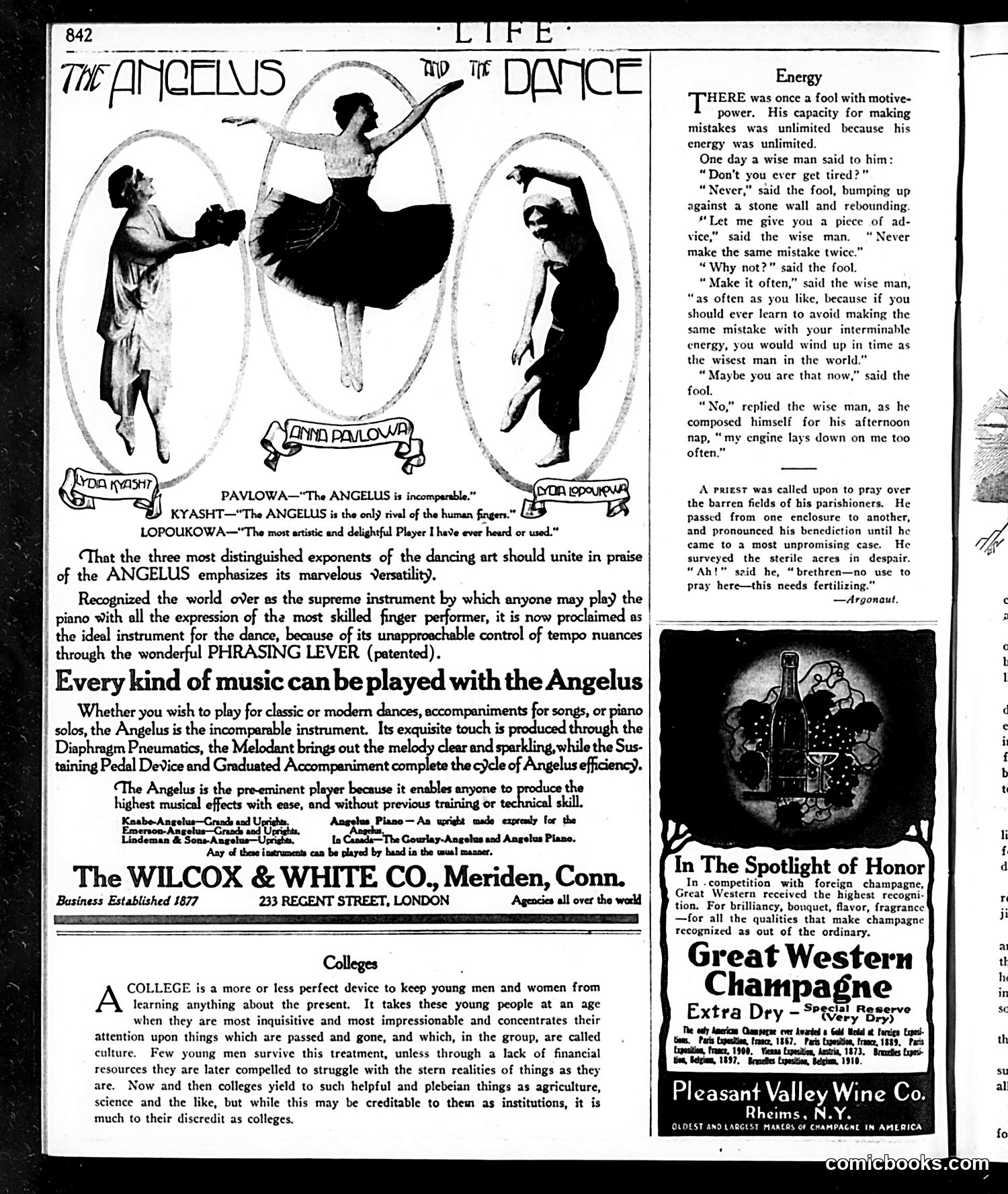
This page is primarily **advertising and light humor**, not political satire. **The Angelus Advertisement** (top) features testimonials from three famous Russian prima ballerinas—Pavlowa, Kyasht, and Lopoukowa—praising the "Angelus," a player piano. The text claims it's the ideal instrument for accompanying dance because its "Phrasing Lever" allows precise tempo control. This is a luxury product advertisement targeting the wealthy. **The "Colleges" Section** (bottom left) is satirical commentary: Life mockingly suggests colleges exist primarily to disconnect young people from the present world, focusing on "culture" and the past rather than practical knowledge like agriculture and science. **The "Energy" Parable** (right) is a humorous short story contrasting a foolish, tireless man with a wise man who conserves his energy—suggesting restraint beats endless, undirected effort. The page also includes advertisements for champagne and wine, typical for Life's upscale readership.
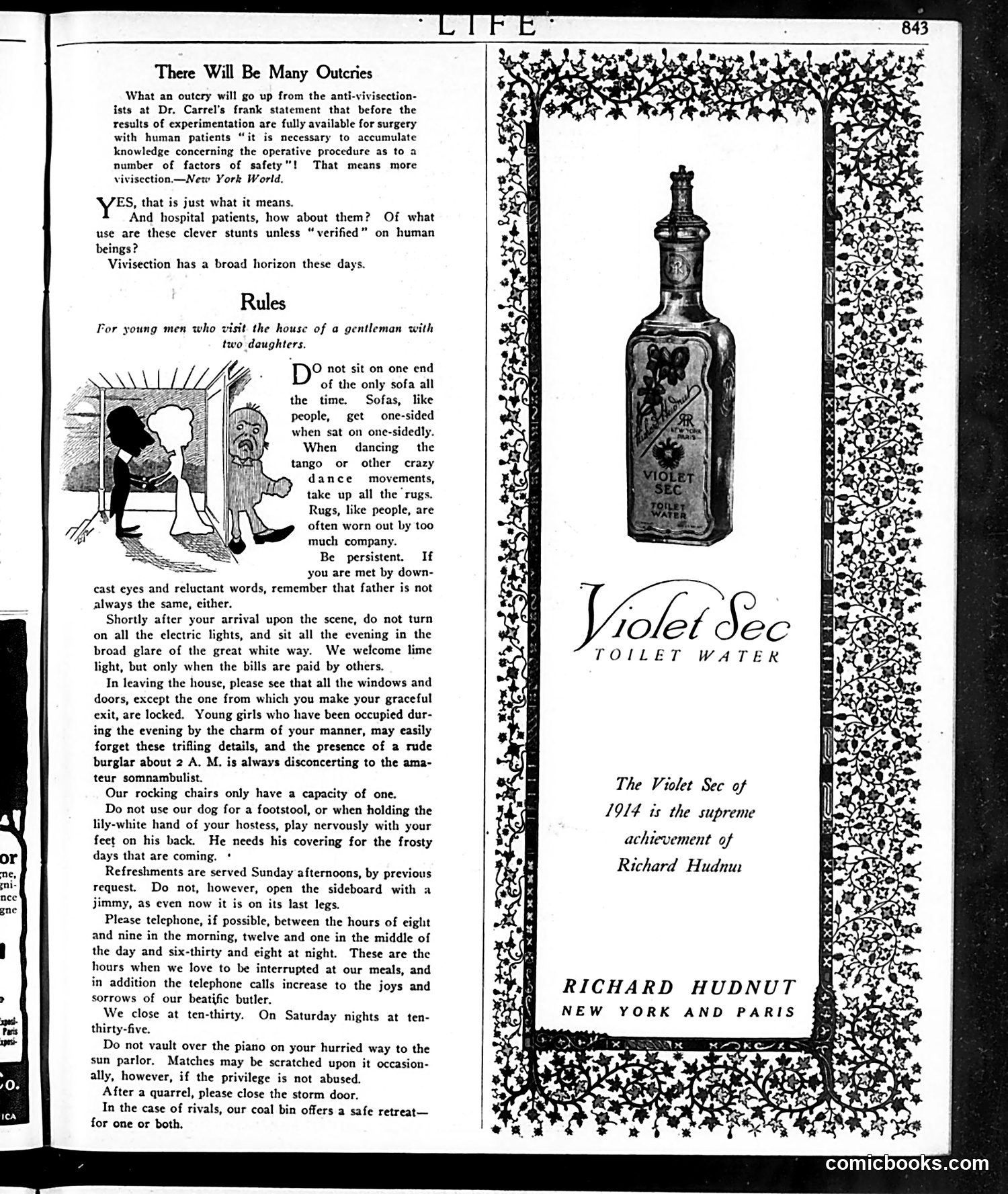
This page contains two distinct sections: **Left side—"Rules for Young Men":** A humorous etiquette guide satirizing courting behavior among the upper class. The cartoon and accompanying text mock overeager suitors visiting homes with eligible daughters, offering absurdist "rules" like not monopolizing the sofa, not using the family dog as a footstool, and respecting restricted calling hours (8-9 AM, noon-1 PM, 6:30-8 PM). The humor targets both the young men's presumption and the rigid social conventions governing courtship—the joke being that these "rules" expose how awkward and controlling such interactions actually are. **Right side—Advertisement:** A full-page ad for Violet Sec toilet water by Richard Hudnut (a real cosmetics manufacturer), featuring an ornate bottle against a decorative floral border. **Context for modern readers:** This reflects early-1900s American middle/upper-class anxiety about courtship rituals and gender relations, when unmarried socializing was heavily chaperoned and regulated.
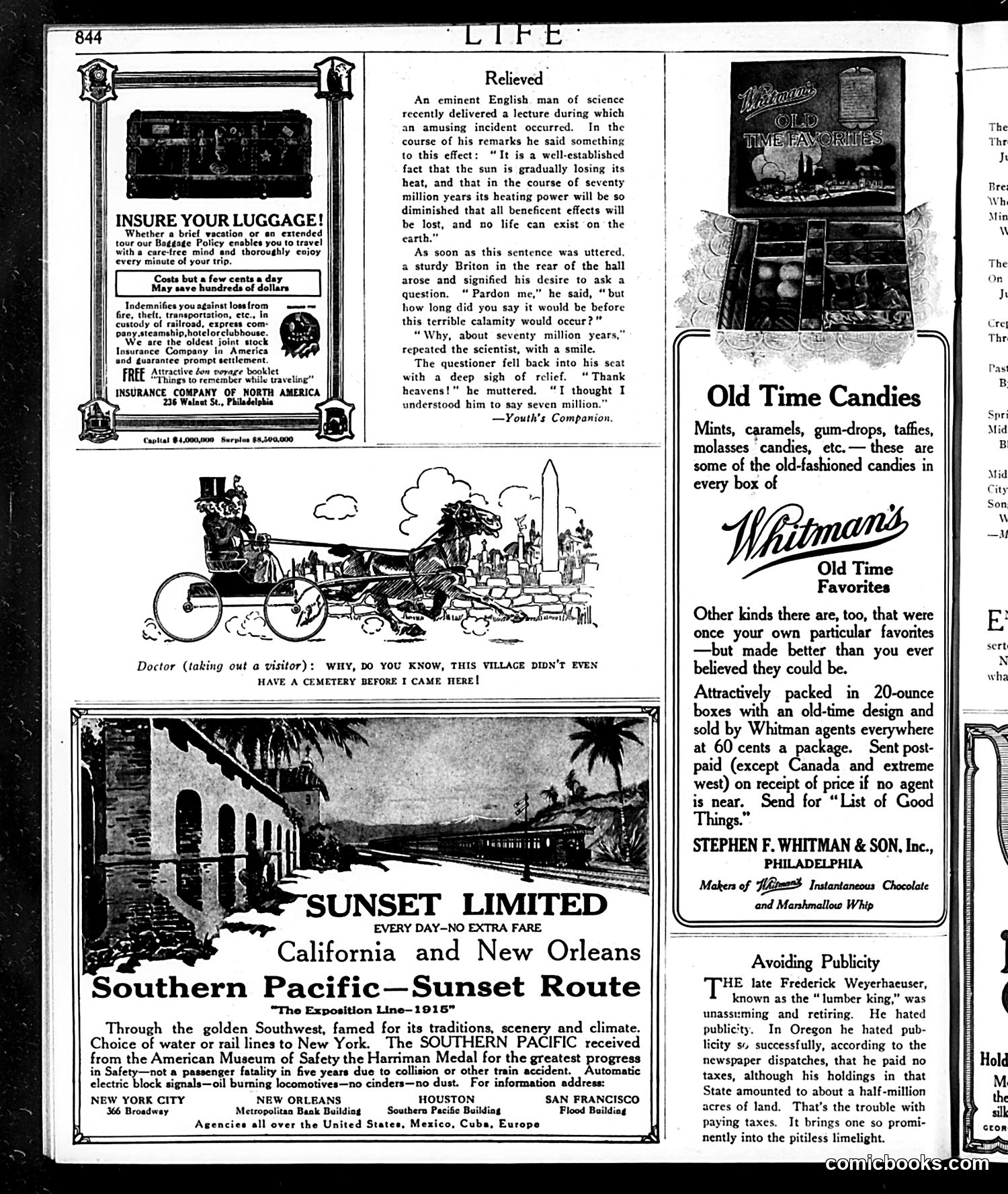
This page contains satirical humor and period advertising from early 20th-century Life magazine. **The "Relieved" Anecdote:** A British scientist lectures that the sun will lose its heat in 70 million years, making Earth uninhabitable. A relieved audience member interrupts—he misheard "seventy million" as "seven million" years and is grateful the catastrophe won't occur in his lifetime. The satire mocks human myopia: we ignore distant existential threats while obsessing over immediate concerns. **The Cemetery Cartoon:** A doctor boasts to a visitor that the village had no cemetery before his arrival—implying his medical practice has been so lethal that one was necessary. Dark humor about incompetent or deadly medical care. **"Avoiding Publicity" Section:** Satirizes lumber magnate Frederick Weyerhaeuser's tax avoidance. He successfully avoided public scrutiny and paid no taxes on half-million acres in Oregon. The ironic conclusion: paying taxes forces unwanted visibility—the real "trouble." The page is otherwise filled with period advertisements for luggage insurance, train travel, and candy.
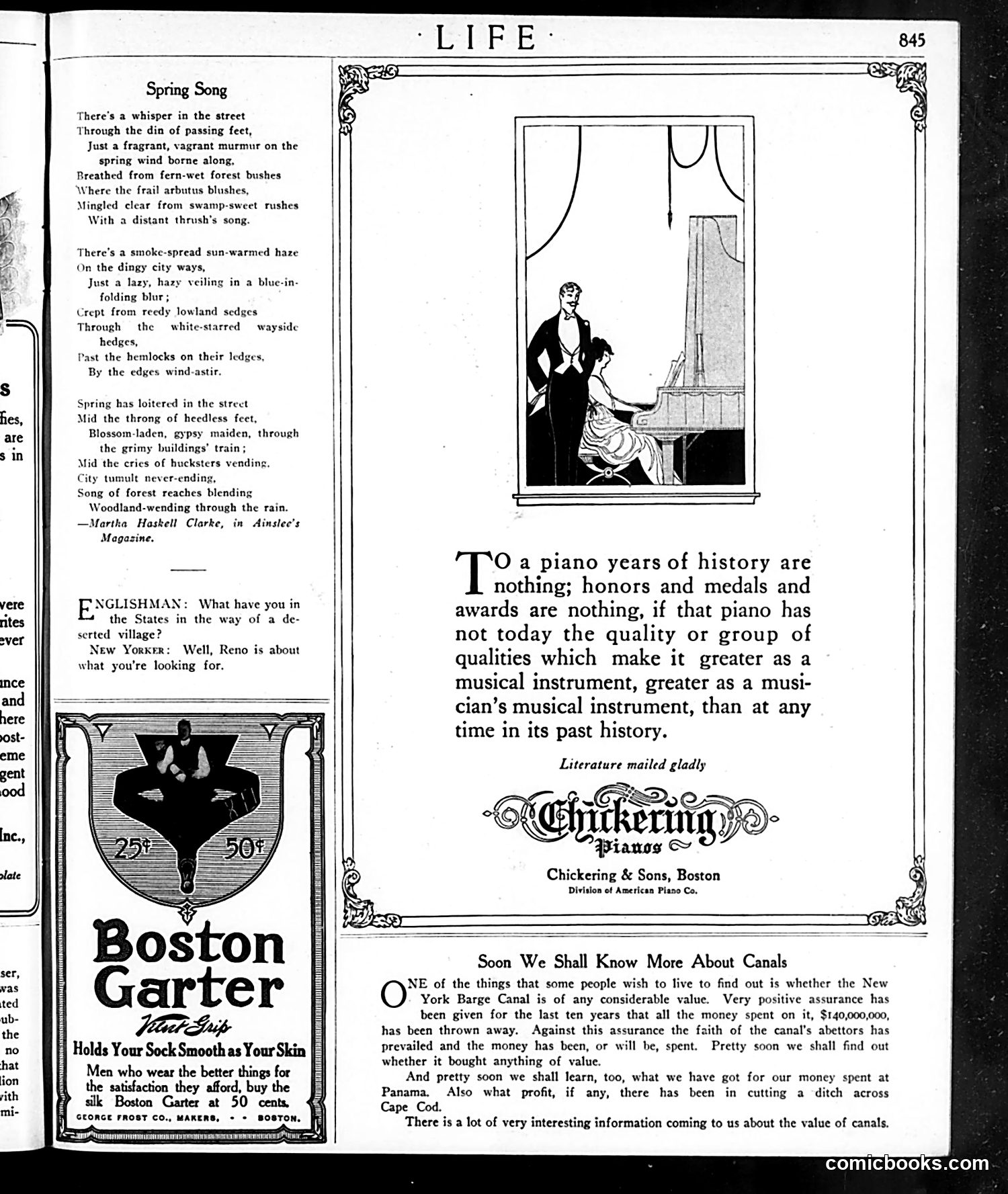
This page contains a poetry contribution ("Spring Song" by Martha Haskell Clarke), advertisements, and satirical commentary typical of Life magazine's format. **The main joke** appears in the Englishman/New Yorker dialogue: When an English visitor asks about "deserted villages" in America, the New Yorker answers "Reno"—a reference to Reno, Nevada's reputation as a divorce destination. The implication is caustic: Reno is characterized as a place people visit and abandon, populated by those obtaining quickie divorces. This is satire on both American divorce culture and the transient nature of certain American towns. **The "Canals" section** critiques government spending on infrastructure projects (the New York Barge Canal and Panama Canal), questioning whether massive expenditures ($140 million mentioned) actually produce value. It's skeptical commentary on ambitious public works undertaken on faith rather than demonstrated utility. The Chickering Pianos advertisement and Boston Garter hosiery ad are standard period marketing.
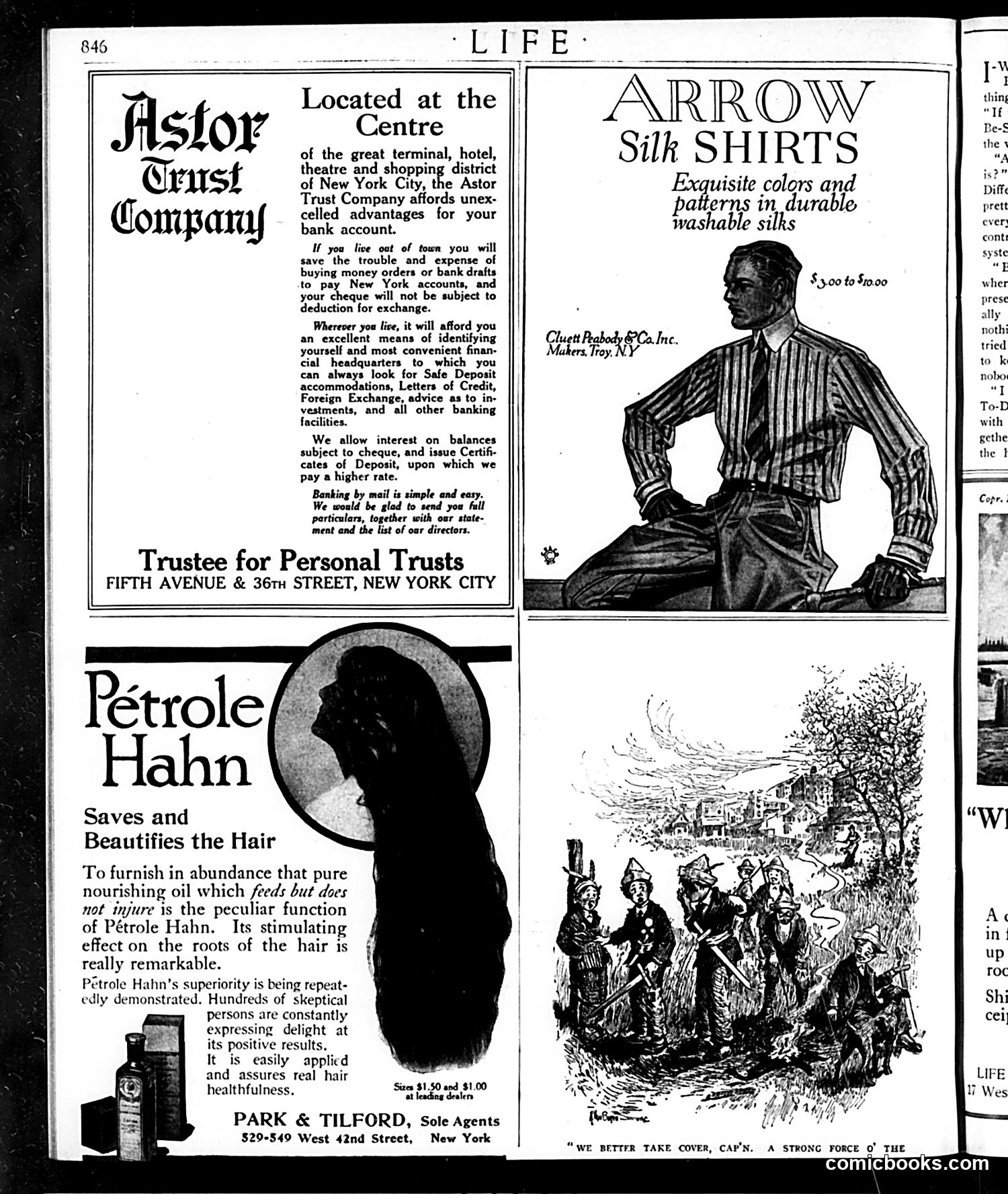
This page consists primarily of **advertisements rather than editorial satire**. The ads include: 1. **Astor Trust Company** (upper left): A banking service advertisement emphasizing convenience for out-of-town customers using New York accounts. 2. **Arrow Silk Shirts** (upper right): A fashion advertisement showcasing men's dress shirts priced $3 to $10, with an illustration of a well-dressed man in pinstriped attire. 3. **Pétrole Hahn** (lower left): A hair care product claiming to nourish and beautify hair through stimulating oil, sold by Park & Tilford. 4. **Untitled illustration** (lower right): An engraved scene showing what appears to be historical or theatrical figures in period costume. The only apparent humor—a caption reading "WE BETTER TAKE COVER, CAP'N. A STRONG FORCE O' THE"—appears cut off at the page bottom, making its full meaning unclear. Overall, this is a typical early 20th-century advertising page with minimal satirical content.
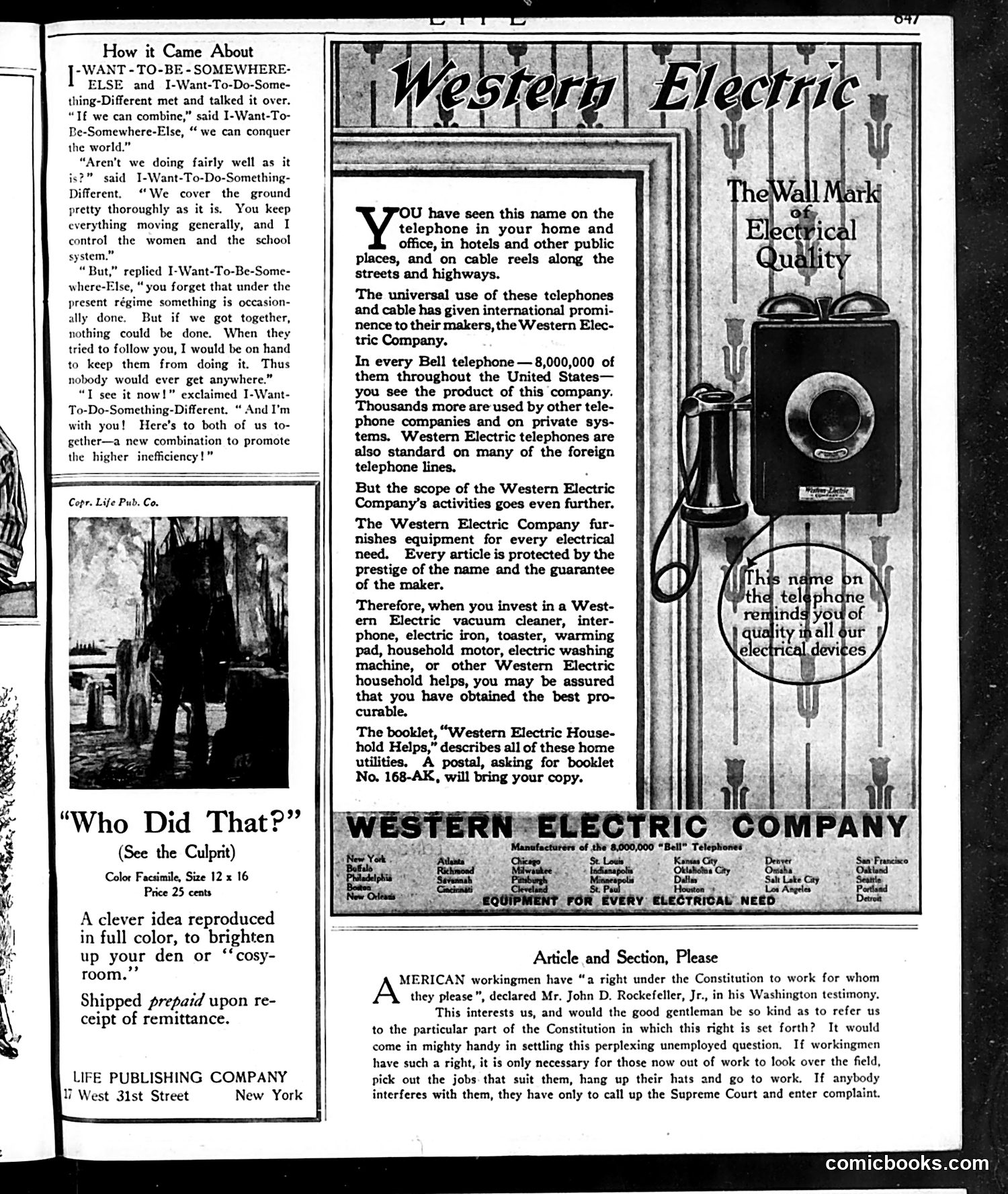
This page contains two distinct sections: **Left side:** A satirical cartoon-dialogue titled "How it Came About" personifies two abstract concepts—"I-Want-To-Be-Somewhere-Else" and "I-Want-To-Do-Something-Different"—as characters plotting to undermine productivity. Their scheme: by working together, they'll ensure "nothing could be done" and achieve "higher inefficiency." This appears to be social satire mocking workplace laziness, restlessness, and the human tendency toward avoidance and procrastination. **Right side:** A full-page Western Electric Company advertisement promoting their telephones and household electrical products (vacuum cleaners, toasters, washing machines). The ad emphasizes their products are "standard" and reliable. **Bottom:** An editorial piece sarcastically responding to John D. Rockefeller Jr.'s testimony that workers have a Constitutional "right to work for whom they please." The editor mockingly suggests unemployed workers simply "look over the field" and assert this supposed right—highlighting the absurdity of claiming legal rights while ignoring economic realities of unemployment.
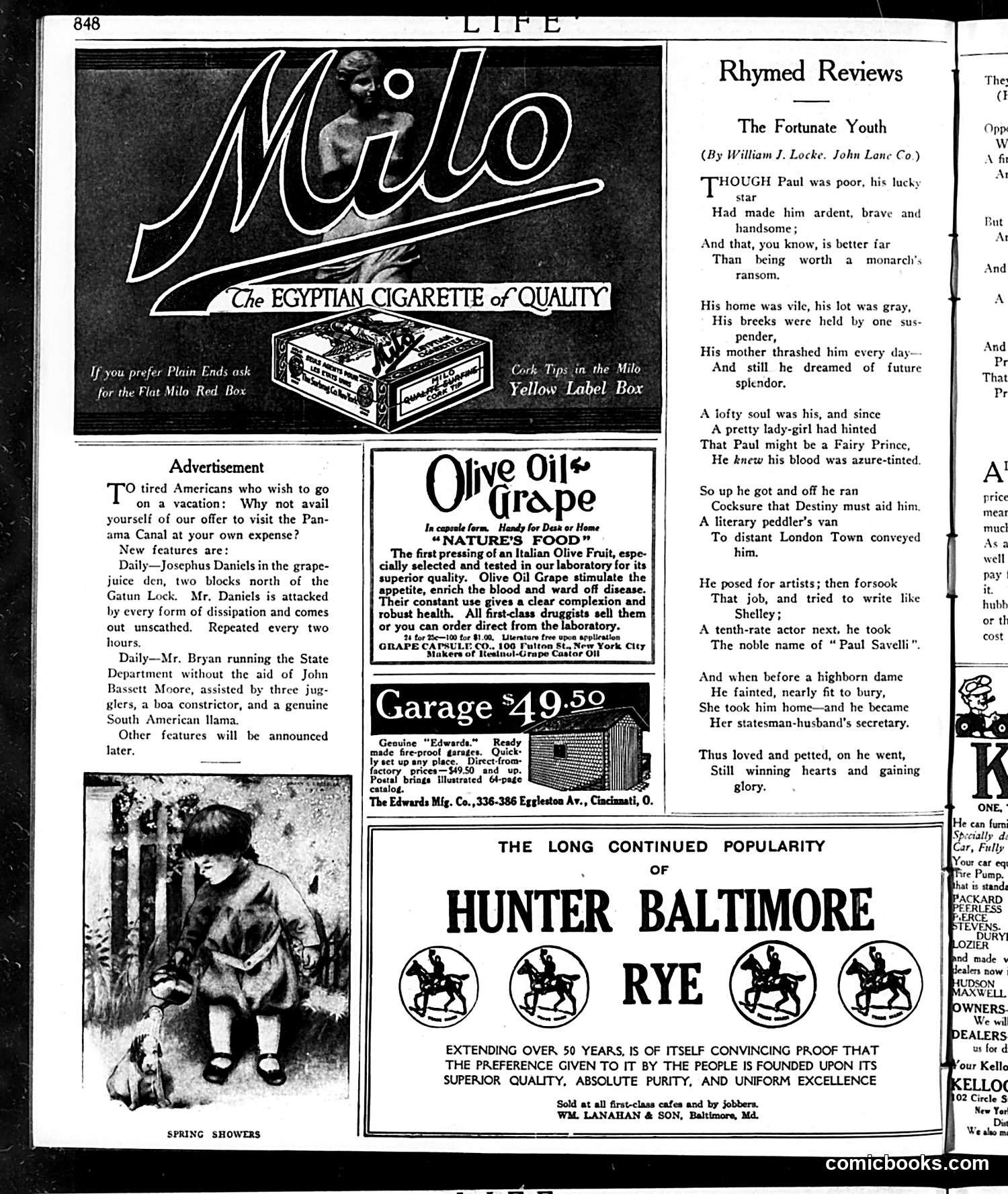
This page mixes advertisements with editorial content typical of early 20th-century Life magazine. **The Advertisement Satire (top):** The Panama Canal vacation ad mocks current political figures. It references **Josephus Daniels** (Secretary of the Navy under Wilson) in a "grape-juice den"—a jab at his well-known temperance stance. The mention of **William Jennings Bryan** running the State Department "without the aid of John Bassett Moore" satirizes the State Department's actual dysfunction during this period, suggesting Bryan needed expert assistance but was incompetently managing affairs alone. **"Spring Showers" Image:** Shows a child with a dog in rain—appears to be a sentimental illustration, likely accompanying a poem or short story. **Rhymed Review:** A book review of "The Fortunate Youth" by William J. Locke, summarizing the plot in verse about a poor boy who becomes successful through charm and luck. **Bottom Advertisement:** Hunter Baltimore Rye whiskey ad emphasizing its 50-year reputation and quality—standard liquor advertising of the era. The page is primarily **advertising-driven**, with minimal satirical content beyond the Panama Canal mock-tour.
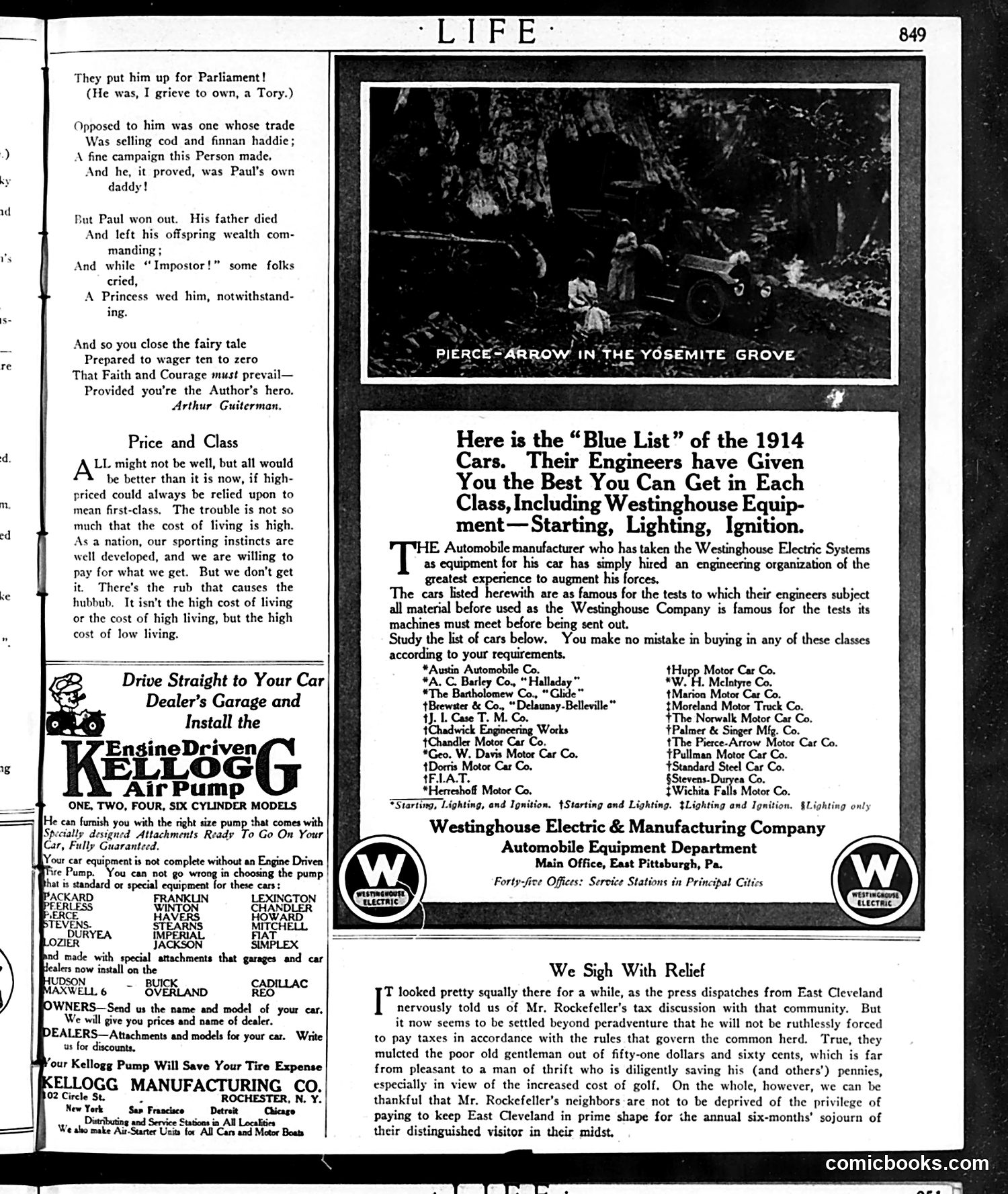
This page combines satirical poetry with automobile advertising typical of 1914 magazines. **The Poem ("Price and Class"):** Arthur Guiterman's verse tells a fairy-tale-like story of "Paul," a Tory candidate for Parliament who defeats an opponent (a fishmonger). Paul inherits wealth after his father's death and marries a Princess despite accusations of being an impostor. Guiterman frames this as a morality tale where "Faith and Courage" triumph—but with ironic commentary that success depends on being "the Author's hero," suggesting that real life doesn't reward virtue as reliably as fiction does. **The Editorial Section ("Price and Class"):** Below the poem, an essay argues that Americans accept high prices *if* they receive quality goods, but complains about "high cost of low living"—paying premium prices for inferior products. **The Advertising:** The page is largely devoted to automobile advertisements (Kellogg Air Pumps, Pierce-Arrow, and Westinghouse Electric) promoting 1914 car models and electrical equipment—standard commercial content for Life magazine of this era. The satirical content critiques both social mobility and consumer expectations in early 20th-century America.
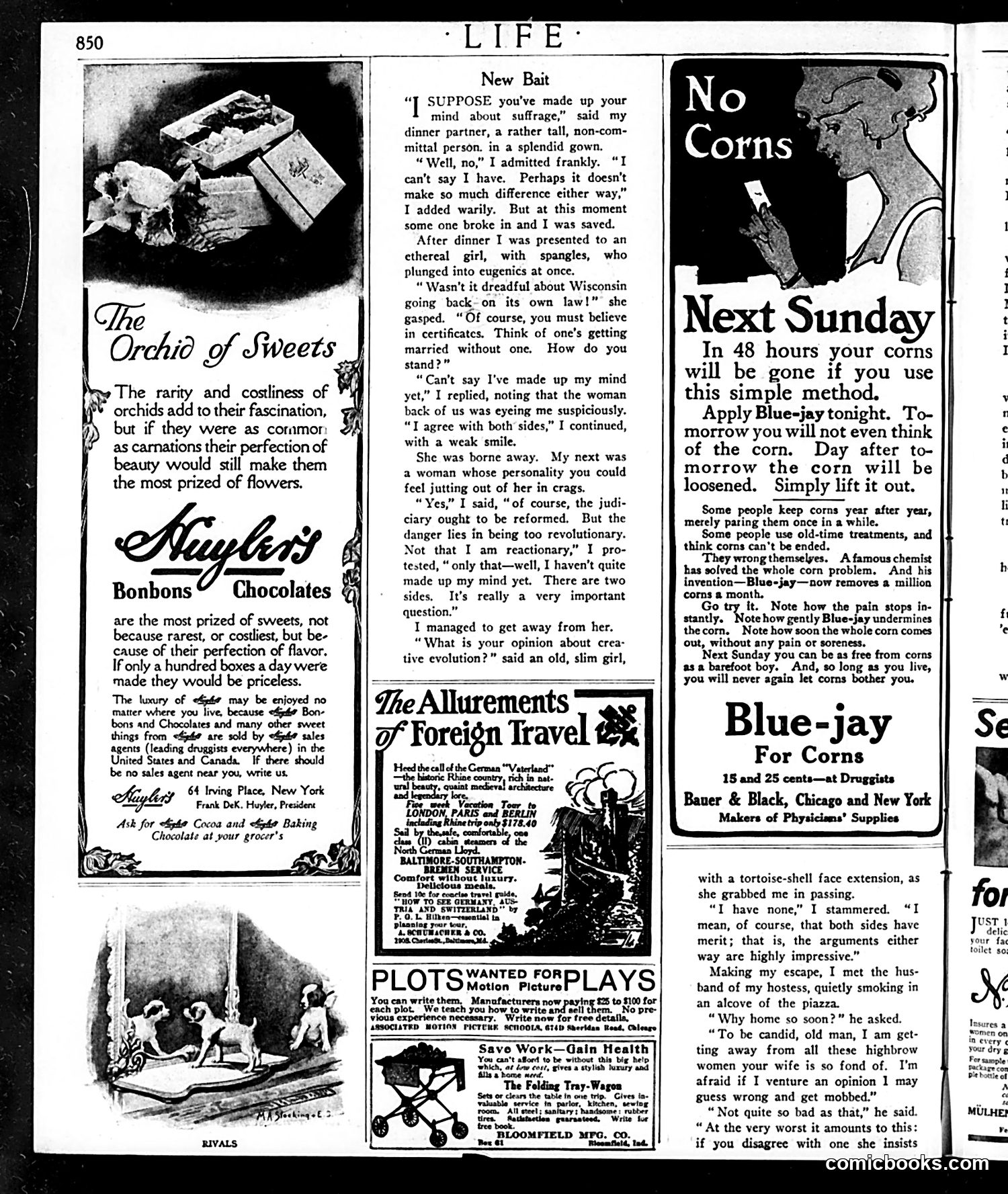
This page is primarily **advertising** with one brief satirical article titled "New Bait." The main content is the "New Bait" narrative, which satirizes dinner-party small talk around 1910s-era progressive causes. The unnamed female narrator describes being cornered by three women at a dinner who demand her opinions on contemporary issues: **women's suffrage, eugenics (specifically Wisconsin's marriage certificate laws), judicial reform, and creative evolution** (Henri Bergson's philosophy). The satire lies in the narrator's evasiveness—she repeatedly claims indecision to avoid committing to any position, noting suspicious reactions from observers. The piece mocks both the earnestness of reform-minded women and the social pressure to perform political engagement, suggesting polite society expected women to adopt positions on these hot-button topics. The surrounding advertisements (Huyler's chocolates, Blue-jay corn remover, travel services) are incidental to the satirical content.
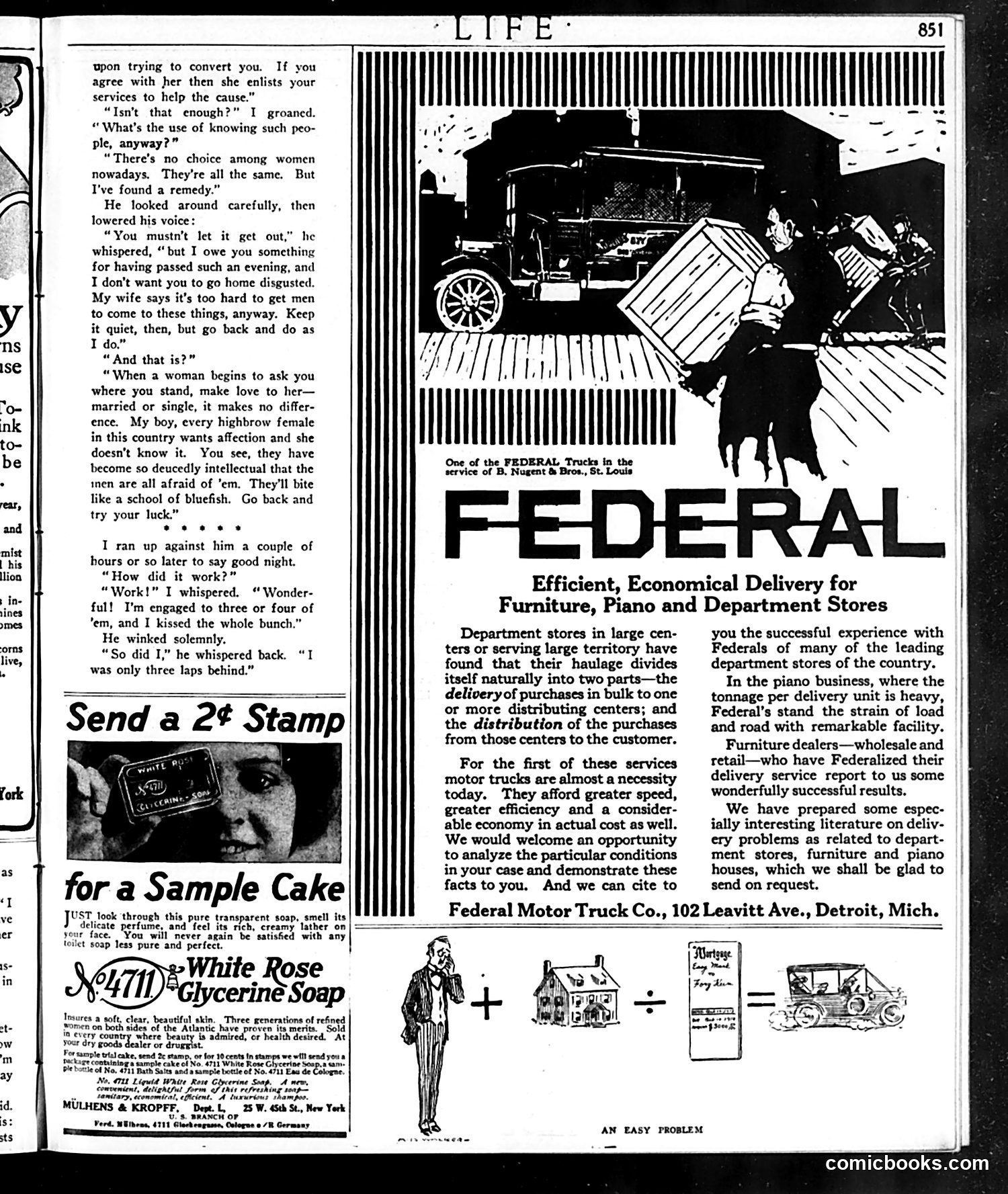
This page contains two distinct elements: a satirical story and commercial advertisements. **The Story (left column):** A humorous narrative about "highbrow" women at a social gathering. The male narrator complains that intellectual women ask probing questions about one's beliefs and try to recruit support for causes. His friend offers cynical advice: when such a woman questions your values, simply flirt with or kiss her instead—the subtext being that these "deucedly intellectual" women are secretly starved for physical affection and lack confidence despite their intellectual pretensions. The joke relies on stereotypes mocking both educated women and the narrator's shallow manipulation strategy. **The Advertisements:** The page features two ads—one for White Rose Glycerine Soap (emphasizing beauty and femininity) and a substantial Federal Motor Truck Company advertisement promoting delivery trucks for department stores, furniture dealers, and piano houses. The satire targets early 20th-century anxieties about educated, independent women, portraying them as emotionally needy beneath their intellectual facades—a common misogynistic trope of the period.
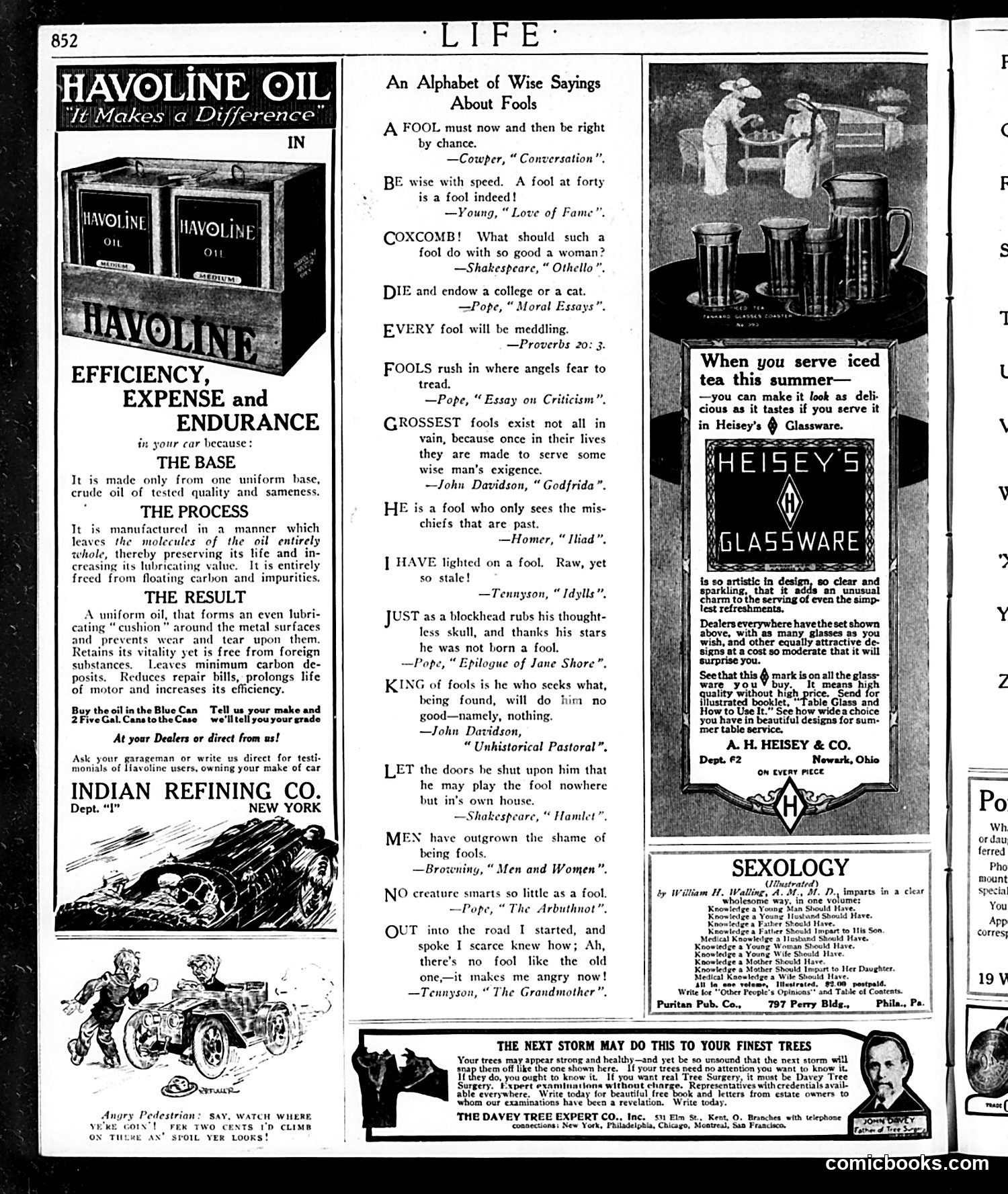
This page is primarily **advertising and filler content** rather than political satire. It contains: 1. **Havoline Oil advertisement** (left): Standard early-20th-century motor oil marketing emphasizing uniform base, manufacturing process, and durability benefits. 2. **"Alphabet of Wise Sayings About Fools"** (center): A collection of literary quotations about foolishness, drawn from classical and contemporary authors (Shakespeare, Pope, Tennyson, etc.). This appears to be humorous filler content—a common magazine feature of the era. 3. **Heisey Glassware advertisement** (right): Promoting elegant glassware for serving iced tea, positioned as a luxury product for summer entertaining. 4. **Small cartoon** (bottom left): Shows an angry pedestrian threatening a careless driver—a light social commentary on reckless driving, a contemporary concern as automobiles became commonplace. The page reflects Life's dual nature as both satirical publication and commercial vehicle, mixing advertisements with literary humor and mild social observation.
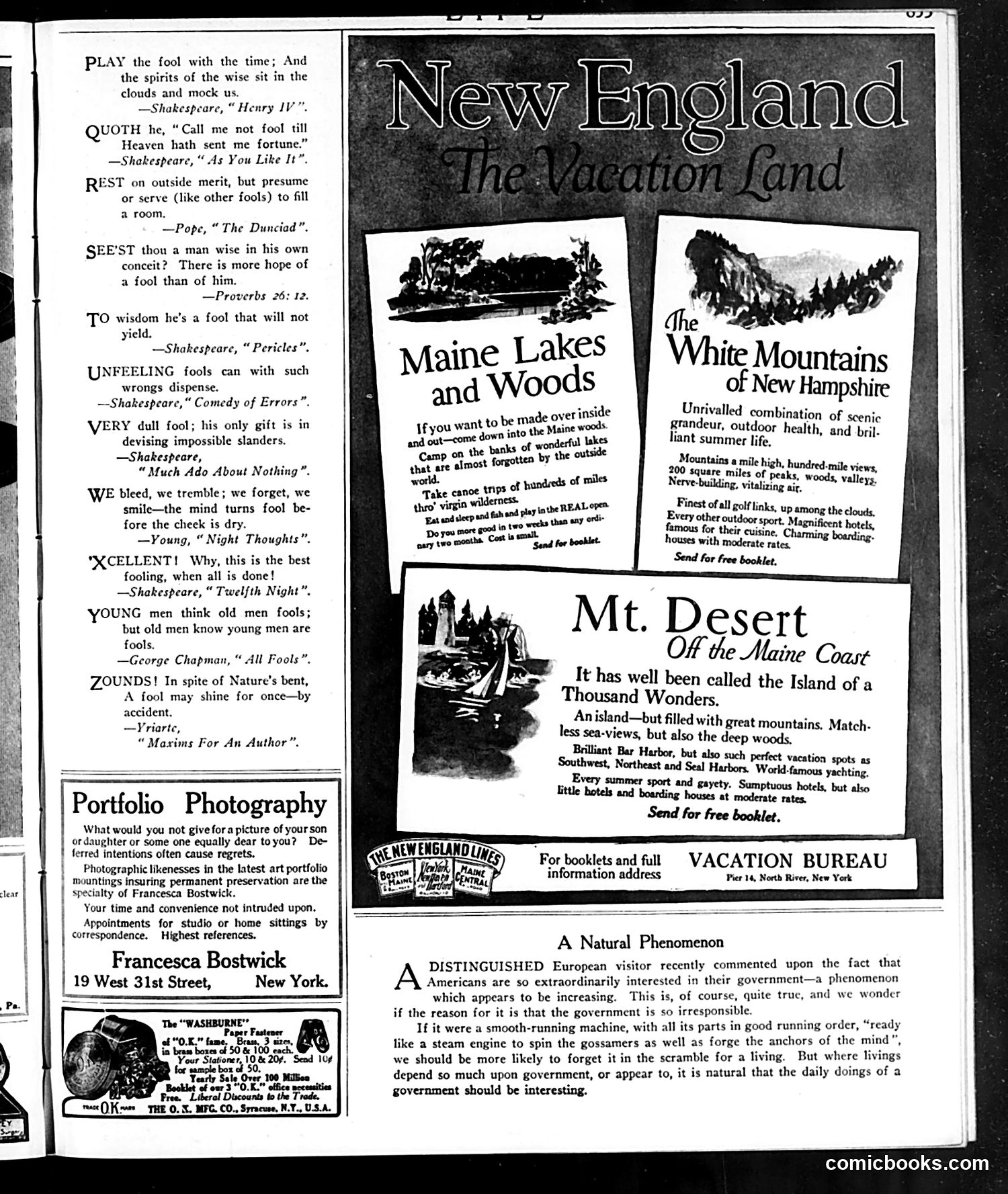
This page is primarily **advertising and filler content** rather than political satire. The left column features literary quotations about foolishness, sourced from Shakespeare, Pope, and classical writers—apparently thematic padding for the issue. Below are advertisements for **portrait photography** (Francesca Bostwick) and office supplies (the "O.K." paper fastener). The right side contains **New England vacation advertisements** promoting Maine Lakes and Woods, White Mountains of New Hampshire, and Mt. Desert as tourist destinations. At the bottom, a brief essay titled "A Natural Phenomenon" observes that Americans show unusual interest in their government, speculatively attributing this to governmental inefficiency—suggesting that if government ran smoothly like a "steam engine," citizens would ignore it. This appears to be mild social commentary on American civic engagement rather than sharp satire. The page overall reflects early 20th-century magazine structure: literary ornament mixed with commercial advertisements and light editorial reflection.
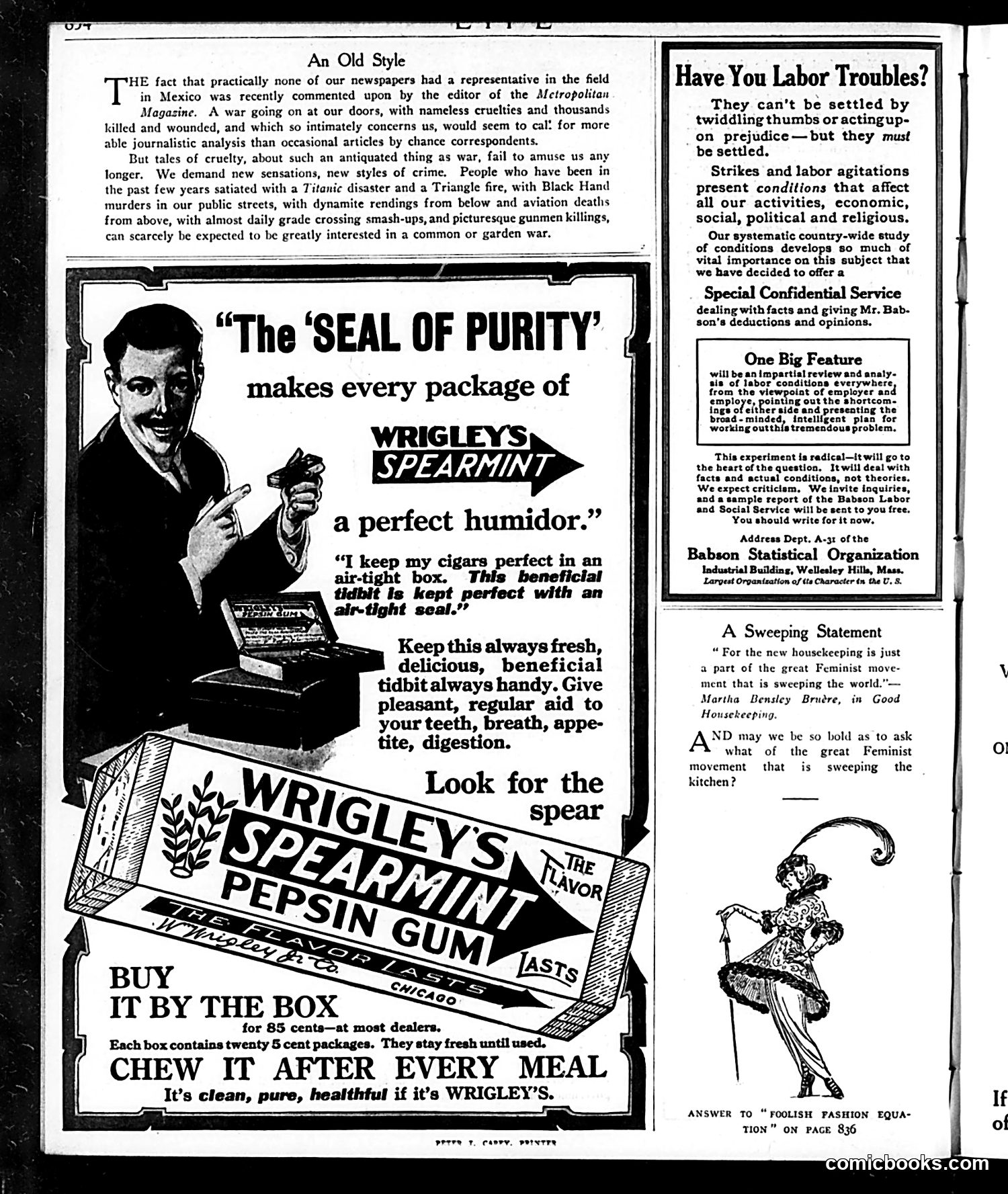
This page from *Life* magazine combines satirical editorial commentary with period advertisements, reflecting early 20th-century American concerns. **"An Old Style"** criticizes American newspapers for inadequate coverage of the Mexican Revolution, arguing that readers have become desensitized to serious news. The editorial laments that spectacular disasters (Titanic, Triangle Factory Fire, Black Hand murders, aviation crashes) have made conventional warfare seem boring—a sharp critique of sensationalism overtaking substantive journalism. **The Wrigley's Spearmint advertisement** is a straightforward commercial promoting gum as a "perfect humidor" and health aid, typical period marketing. **"Have You Labor Troubles?"** advertises the Babson Statistical Organization's labor relations consulting service, positioning itself as providing objective analysis above employer-employee bias—reflecting contemporary Progressive Era interest in "scientific" management of social problems. **"A Sweeping Statement"** offers light satire questioning whether feminist housekeeping reforms represent genuine progress, or merely redirect the movement's energy into domestic labor.
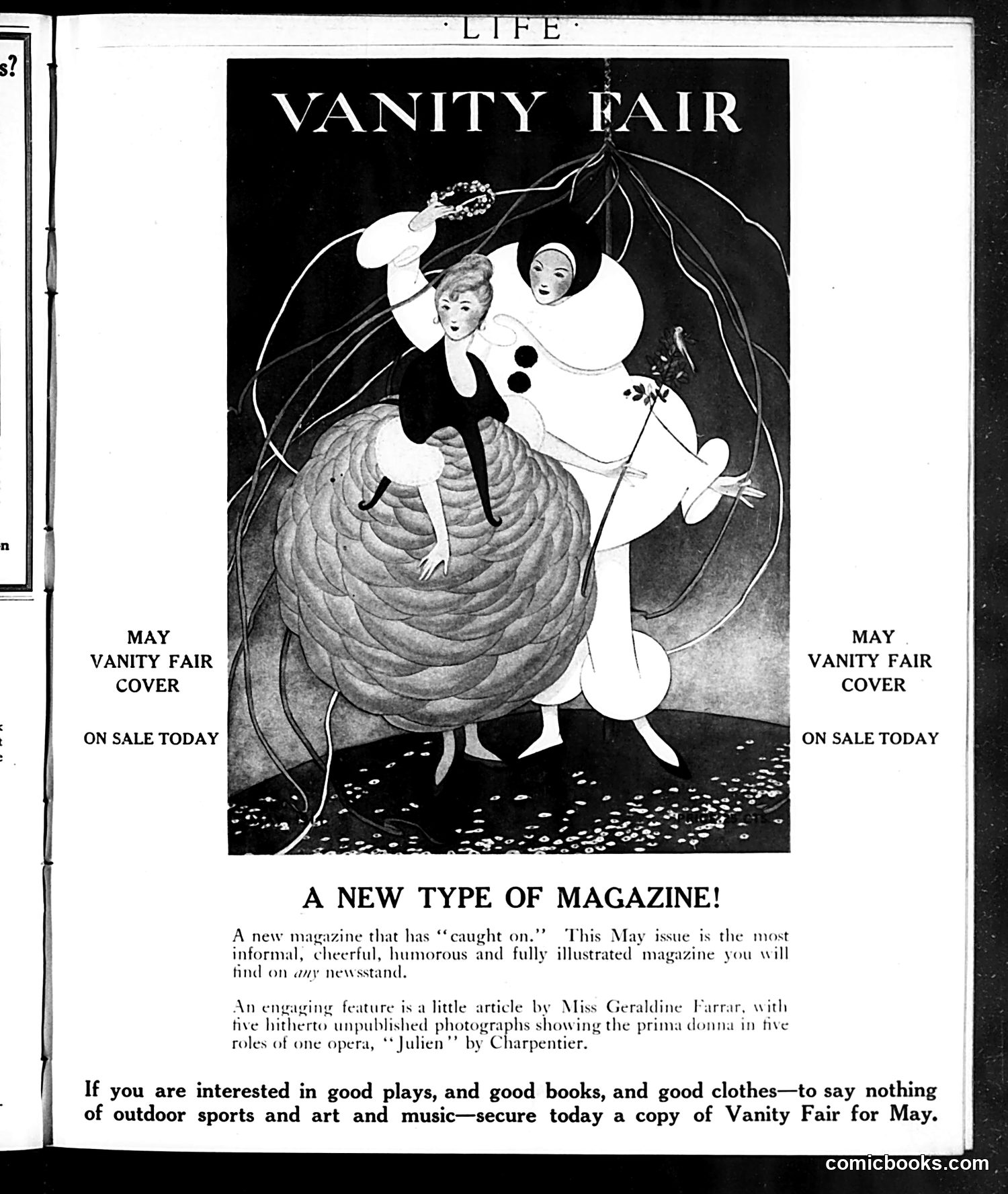
This is a **magazine advertisement**, not political satire. It promotes Vanity Fair's May issue as "a new type of magazine"—informal, cheerful, and heavily illustrated. The central illustration depicts two stylized women in 1920s fashion (cloche hats, loose silhouettes) beneath an ornate umbrella, drawn in an Art Deco style typical of the era's sophisticated magazine aesthetic. The ad highlights a featured article by **Geraldine Farrar**, a famous opera singer, with photographs showing her in five roles from Charpentier's opera "Julien." This celebrity content exemplified how Vanity Fair positioned itself as covering culture, fashion, theater, and the arts for affluent readers. The advertisement targets consumers interested in "good plays, and good books, and good clothes...outdoor sports and art and music"—establishing Vanity Fair as a lifestyle magazine for cultured, leisure-class audiences. The emphasis on being "the most informal" suggests contrast with stuffier publications of the time.
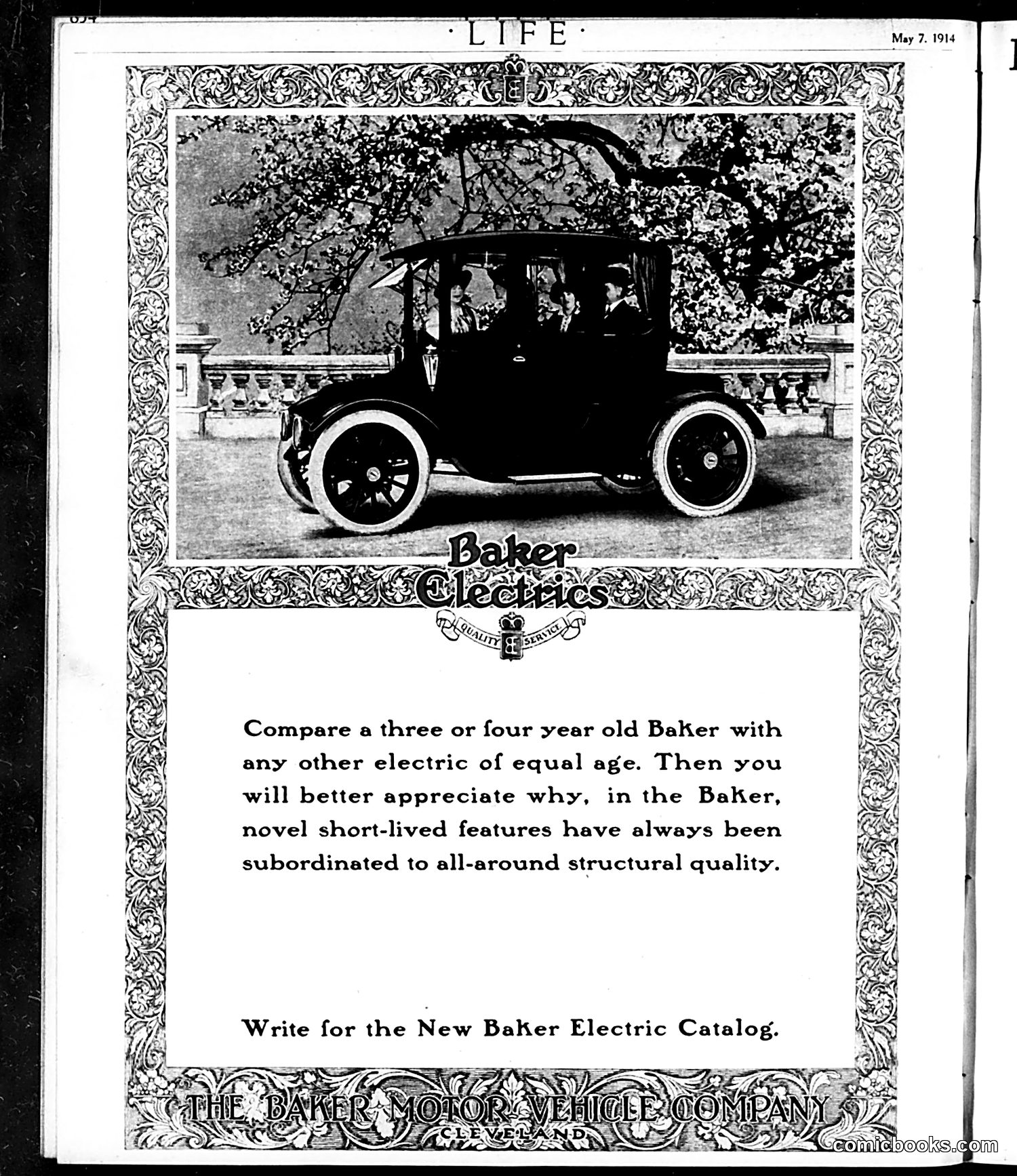
This is a **Baker Electric automobile advertisement**, not a political cartoon. The page from *Life* magazine (May 7, 1914) shows a side-view photograph of a Baker Electric vehicle parked in front of an ornate building with flowering vines. The advertisement's text argues for the Baker's superiority by claiming that, unlike competitors, Baker prioritizes **durability and structural integrity** over trendy but short-lived features. This suggests the electric car market of 1914 was competitive, with manufacturers competing partly on novelty. The ad positions Baker as the sensible, long-lasting choice. There is no satire or political reference—this is straightforward commercial advertising using *Life*'s prestigious editorial platform to reach affluent readers.