
Life, 1914-05-07 · page 24 of 52
Life — May 7, 1914 — page 24: what you’re looking at
What you’re looking at
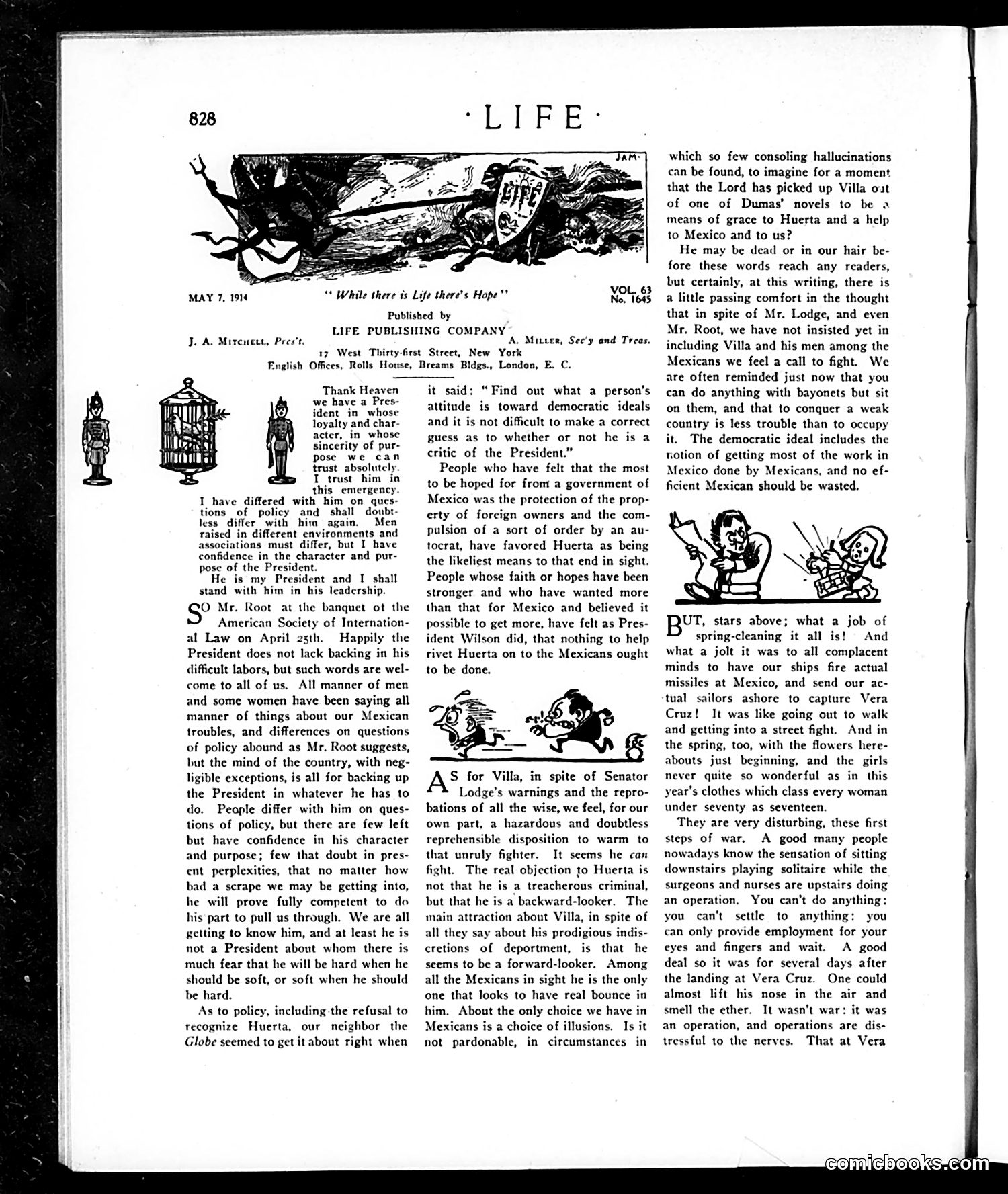
This editorial page addresses the Mexican Revolution during President Woodrow Wilson's administration. The text discusses three key Mexican figures: **Victoriano Huerta**: The military dictator whom Wilson refused to recognize. The piece criticizes him as a "backward-looker" serving foreign property interests and autocratic order. **Pancho Villa**: Despite warnings from Senator Henry Cabot Lodge, the editors express sympathetic fascination with Villa as a "forward-looker" with revolutionary promise—comparing him to a Dumas novel hero. They acknowledge this fondness is "hazardous and doubtless reprehensible" but find comfort in his apparent reformist potential. **President Wilson**: The page supports Wilson's non-recognition policy toward Huerta, praising his character and democratic ideals while acknowledging legitimate policy disagreements exist. The small illustrations (appearing near the text) likely satirize the Mexican conflict, though specific figures are unclear in this reproduction. The overall satire critiques both conservative interventionists favoring Huerta and cautious skeptics like Lodge, while endorsing Wilson's idealistic approach to Mexican self-determination.
📄 Transcribed text from this page (OCR, searchable)
Machine-transcribed from the original scan — historical spelling and the odd misread are preserved.
MAY 7, 1914 “* While there is Life there's Hope" Published by LIFE PUBLISHING COMPANY J. A. Mircuent, Pres’t. Thank Heaven we have a Pres- ident in whose loyalty and char- acter, in whose sincerity of pur- pose we can trust absolutely I trust him in this emergency: I have differed with him on ques- tions of policy and shall doubt less differ with him again. Men raised in different environments and associations must differ, but Ihave confidence in the character and pur- pose of the President. He is my President and I shall stand with him in his leadership. O Mr. Root at the banquet of the American Society of Internation- al Law on April 25th. Happily the President does not lack backing in his difficult labors, but such words are wel- come to all of us. All manner of men and some women have been saying all manner of things about our Mexican troubles, and differences on questions of policy abound as Mr. Root suggests, but the mind of the country, with neg- ligible exceptions, is all for backing up the President in whatever he has to do. People differ with him on ques- tions of policy, but there are few left but have confidence in his character and purpose; few that doubt in pres- ent perplexities, that no matter how bad a scrape we may be getting into, he will prove fully competent to do his part to pull us through. We are all getting to know him, and at least he is not a President about whom there is much fear that he will be hard when he should be soft, or soft when he should be hard. As to policy, including the refusal to recognize Huerta, our neighbor the Globe seemed to get it about right when. A. Mitre, Sec'y and Treas. 17 West Thirty-first Street, New York English Offices, Rolls House, Breams Bldgs., London, E. C. it said: “Find out what a person’s attitude is toward democratic ideals and it is not difficult to make a correct guess as to whether or not he is a critic of the President.” People who have felt that the most to be hoped for from a government of Mexico was the protection of the prop- erty of foreign owners and the com- pulsion of a sort of order by an au- tocrat, have favored Huerta as being the likeliest means to that end in sight. People whose faith or hopes have been stronger and who have wanted more than that for Mexico and believed it possible to get more, have felt as Pres- ident Wilson did, that nothing to help rivet Huerta on to the Mexicans ought to be done. S for Villa, in spite of Senator Lodge's warnings and the repro- bations of all the wise, we feel, for our own part, a hazardous and doubtless reprehensible disposition to warm to that unruly fighter. It seems he can fight. The real objection to Huerta is not that he is a treacherous criminal, but that he is a backward-looker. The main attraction about Villa, in spite of all they say about his prodigious indis- cretions of deportment, is that he seems to be a forward-looker. Among all the Mexicans in sight he is the only one that looks to have real bounce in him. About the only choice we have in Mexicans is a choice of illusions. Is it not pardonable, in circumstances in which so few consoling hallucinations can be found, to imagine for a moment that the Lord has picked up Villa out of one of Dumas’ novels to be a means of grace to Huerta and a help to Mexico and to us? He may be dead or in our hair be- fore these words reach any readers, but certainly, at this writing, there is a little passing comfort in the thought that in spite of Mr. Lodge, and even Mr. Root, we have not insisted yet in including Villa and his men among the Mexicans we feel a call to fight. We are often reminded just now that you can do anything with bayonets but sit on them, and that to conquer a weak country is less trouble than to occupy it. The democratic ideal includes the notion of getting most of the work in Mexico done by Mexicans, and no ef- ficient Mexican should be wasted. UT, stars above; what a job of spring-cleaning it all is! And what a jolt it was to all complacent minds to have our ships fire actual missiles at Mexico, and send our ac- tual sailors ashore to capture Vera Cruz! It was like going out to walk and getting into a street fight. And in the spring, too, with the flowers here- abouts just beginning, and the girls never quite so wonderful as in this year’s clothes which class every woman under seventy as seventeen. They are very disturbing, these first steps of war. A good many people nowadays know the sensation of sitting downstairs playing solitaire while the surgeons and nurses are upstairs doing an operation, You can’t do anything: you can’t settle to anything: you can only provide employment for your eyes and fingers and wait. A good deal so it was for several days after the landing at Vera Cruz. One could almost lift his nose in the air and smell the ether. It wasn’t war: it was an operation, and operations are dis- tressful to the nerves. That at Vera