
Life, 1914-05-07 · page 12 of 52
Life — May 7, 1914 — page 12: what you’re looking at
What you’re looking at
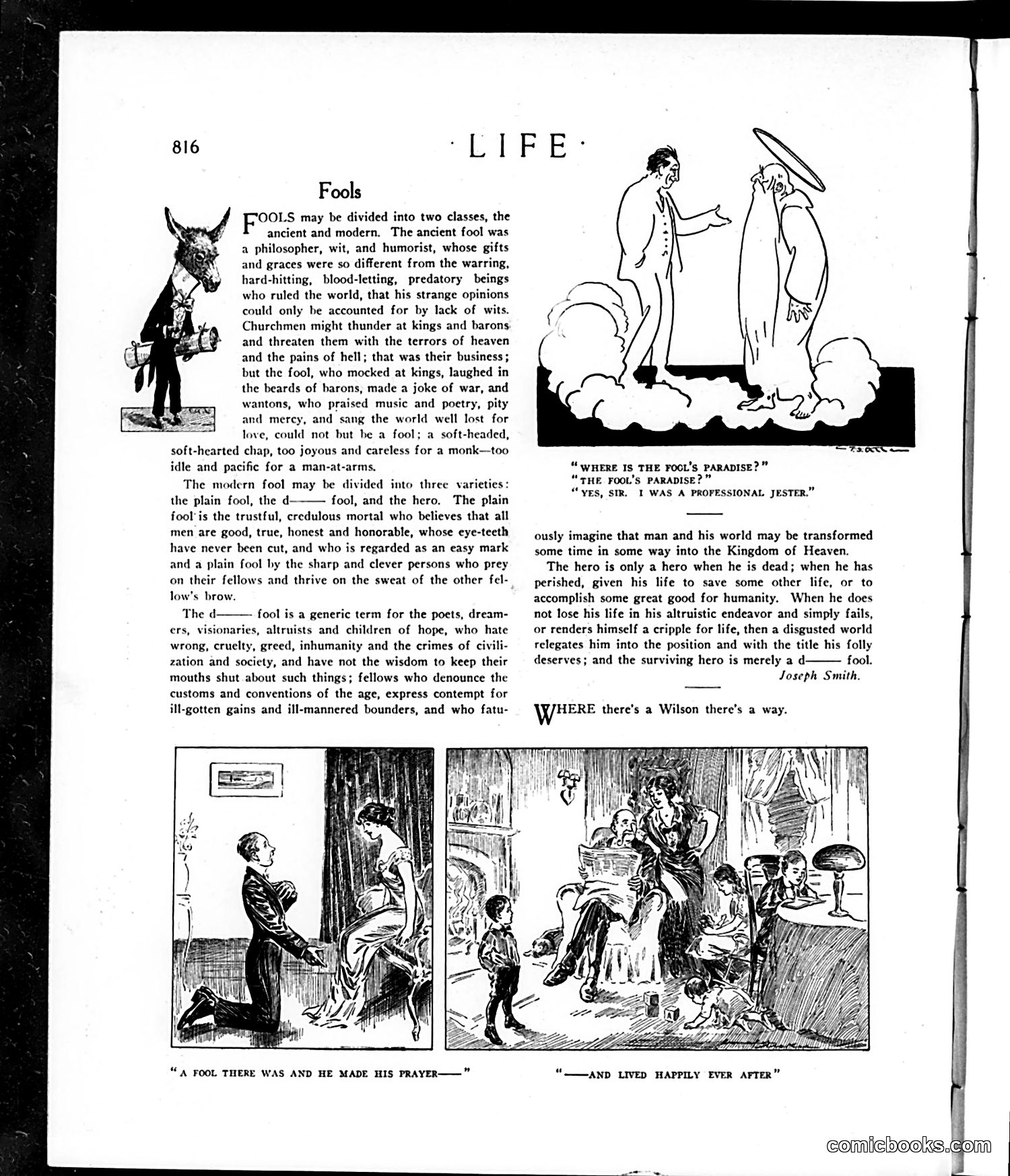
This page presents a satirical essay on human foolishness, dividing fools into ancient and modern categories. The text distinguishes between the "plain fool" (credulous and easily deceived), the "d——fool" (a generic term for poets and visionaries), and implicitly critiques various social types who lack wisdom. The accompanying illustrations show scenes of foolishness in domestic and social settings. One cartoon depicts a jester being asked "Where is the fool's paradise?" - a reference to naive optimism. Another shows "A fool there was and he made his prayer," illustrating the theme that foolishness persists across human experience. The essay concludes with a Joseph Smith quote about heroism and failure, suggesting foolishness can sometimes serve humanity's greater good - a characteristically ambivalent Victorian moral observation.
📄 Transcribed text from this page (OCR, searchable)
Machine-transcribed from the original scan — historical spelling and the odd misread are preserved.
“LTPE~ Fools Foe may be divided into two classes, the ancient and modern. The ancient fool was a philosopher, wit, and humorist, whose gifts and graces were so different from the warring, hard-hitting, blood-letting, predatory beings who ruled the world, that his strange opinions could only be accounted for by lack of wits. Churchmen might thunder at kings and barons. and threaten them with the terrors of heaven and the pains of hell; that was their business; but the fool, who mocked at kings, laughed in the beards of barons, made a joke of war, and wantons, who praised music and poetry, pity and mercy, and sang the world well lost for love, could not but be a fool; a soft-headed, soft-hearted chap, too joyous and careless for a monk—too idle and pacific for a man-at-arms. The modern fool may be divided into three varieties: the plain fool, the d— fool, and the hero. The plain fool’ is the trustful, credulous mortal who believes that all men are good, true, honest and honorable, whose eye-teeth have never been cut, and who is regarded as an easy mark and a plain fool by the sharp and clever persons who prey on their fellows and thrive on the sweat of the other fel- low’s brow. The d. fool is a generic term for the poets, dream- ers, visionaries, altruists and children of hope, who hate wrong, cruelty, greed, inhumanity and the crimes of civili- zation and society, and have not the wisdom to keep their mouths shut about such things; fellows who denounce the customs and conventions of the age, express contempt for ill-gotten gains and ill-mannered bounders, and who fatu- “A FOOL THERE WAS AND HE MADE HIS PRAYER——" “WHERE IS THE FOOL'S PARADISE?” “THE FOOL'S PARADISE?” “YES, SIR. I WAS A PROFESSIONAL JESTER.” ously imagine that man and his world may be transformed some time in some way into the Kingdom of Heaven. The hero is only a hero when he is dead; when he has perished, given his life to save some other life, or to accomplish some great good for humanity. When he does not lose his life in his altruistic endeavor and simply fails, or renders himself a cripple for life, then a disgusted world relegates him into the position and with the title his folly deserves; and the surviving hero is merely a d fool. Joseph Smith. WHERE there’s a Wilson there’s a way. ““——AND LIVED HAPPILY EVER AFTER” comicbookss.gomn