
Life, 1914-05-07 · page 18 of 52
Life — May 7, 1914 — page 18: what you’re looking at
What you’re looking at
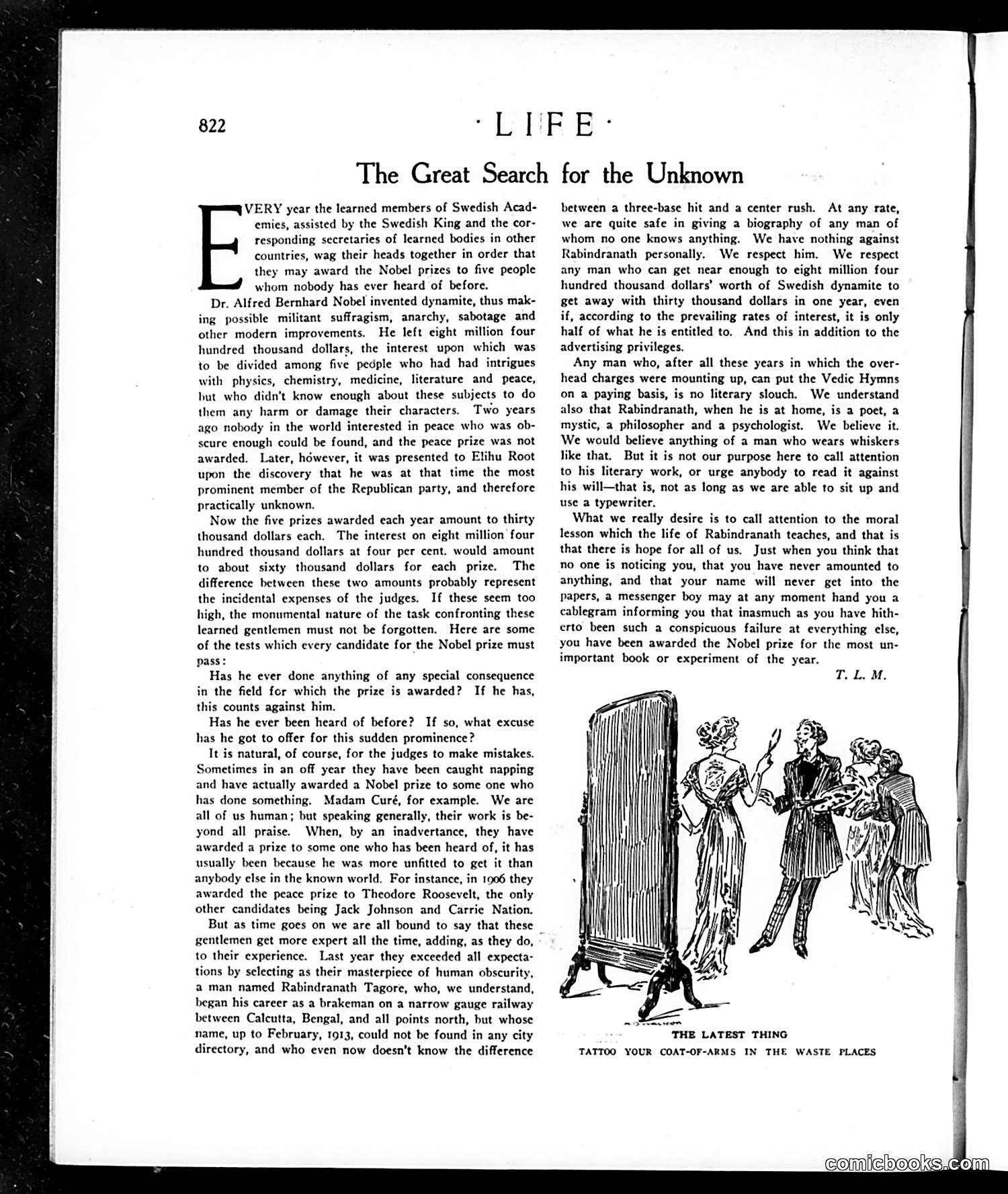
This article satirizes the Nobel Prize selection process, particularly the 1913 award to Indian poet Rabindranath Tagore. Life argues the Nobel judges deliberately choose obscure recipients—their criteria explicitly penalizing actual accomplishment and fame. The satire mocks the Swedish Academy's apparent logic: having "done something" counts *against* a candidate. Life cites examples like Theodore Roosevelt (1906), positioned among unqualified alternatives (boxer Jack Johnson, temperance activist Carrie Nation), suggesting even well-known winners were selected among worse options. The article ridicules Tagore specifically, claiming he was unknown in city directories and ignorant of basic American sports terminology. Life suggests the judges excel at finding "human obscurity" and questions whether Tagore's sudden prominence itself disqualifies him. The accompanying cartoon (bottom) depicts Tagore with admirers, illustrating the absurdity of elevating an unknown figure to fame through the prize itself.
📄 Transcribed text from this page (OCR, searchable)
Machine-transcribed from the original scan — historical spelling and the odd misread are preserved.
*LIFE: The Great Search for the Unknown VERY year the learned members of Swedish Acad- emies, assisted by the Swedish King and the cor- responding secretaries of learned bodies in other countries, wag their heads together in order that they may award the Nobel prizes to five people whom nobody has ever heard of before. Dr. Alfred Bernhard Nobel invented dynamite, thus mak- ing possible militant suffragism, anarchy, sabotage and other modern improvements. He left eight million four hundred thousand dollars, the interest upon which was to be divided among five pedple who had had intrigues with physics, chemistry, medicine, literature and peace, but who didn’t know enough about these subjects to do them any harm or damage their characters. Two years ago nobody in the world interested in peace who was ob- scure enough could be found, and the peace prize was not awarded. Later, however, it was presented to Elihu Root upon the discovery that he was at that time the most prominent member of the Republican party, and therefore practically unknown. Now the five prizes awarded each year amount to thirty thousand dollars each, The interest on eight million four hundred thousand dollars at four per cent. would amount to about sixty thousand dollars for each prize. The difference between these two amounts probably represent If these seem too the incidental expenses of the judges. high, the monumental nature of the task confronting these learned gentlemen must not be forgotten. Here are some of the tests which every candidate for the Nobel prize must pass: Has he ever done anything of any special consequence in the field for which the prize is awarded? If he has, this counts against him. Has he ever been heard of before? If so, what excuse has he got to offer for this sudden prominence? It is natural, of course, for the judges to make mistakes. Sometimes in an off year they have been caught napping and have actually awarded a Nobel prize to some one who has done something. Madam Curé, for example. We are all of us human; but speaking generally, their work is be- yond all praise. When, by an inadvertance, they have awarded a prize to some one who has been heard of, it has usually been because he was more unfitted to get it than anybody else in the known world. For instance, in 1906 they awarded the peace prize to Theodore Roosevelt, the only other candidates being Jack Johnson and Carrie Nation. But as time goes on we are all bound to say that these _ gentlemen get more expert all the time, adding, as they do, to their experience. Last year they exceeded all expecta- tions by selecting as their masterpiece of human obscurity, a man named Rabindranath Tagore, who, we understand, began his career as a brakeman on a narrow gauge railway between Calcutta, Bengal, and all points north, but whose name, up to February, 1913, could not be found in any city directory, and who even now doesn’t know the difference between a three-base hit and a center rush. At any rate, we are quite safe in giving a biography of any man of whom no one knows anything. We have nothing against Rabindranath personally. We respect him. We respect any man who can get near enough to eight million four hundred thousand dollars’ worth of Swedish dynamite to get away with thirty thousand dollars in one year, even if, according to the prevailing rates of interest, it is only half of what he is entitled to. And this in addition to the advertising privileges. Any man who, after all these years in which the over- head charges were mounting up, can put the Vedic Hymns on a paying basis, is no literary slouch. We understand also that Rabindranath, when he is at home, is a poet, a mystic, a philosopher and a psychologist. We believe it. We would believe anything of a man who wears whiskers like that. But it is not our purpose here to call attention to his literary work, or urge anybody to read it against his will—that is, not as long as we are able to sit up and use a typewriter. What we really desire is to call attention to the moral lesson which the life of Rabindranath teaches, and that is that there is hope for all of us. Just when you think that no one is noticing you, that you have never amounted to anything, and that your name will never get into the Papers, a messenger boy may at any moment hand you a cablegram informing you that inasmuch as you have hith- certo been such a conspicuous failure at everything else, you have been awarded the Nobel prize for the most un- important book or experiment of the year. T. L. M. THE LATEST THING TATTOO YOUR COAT-OF-ARMS IN THE WASTE PLACES