
Life, 1914-05-07 · page 29 of 52
Life — May 7, 1914 — page 29: what you’re looking at
What you’re looking at
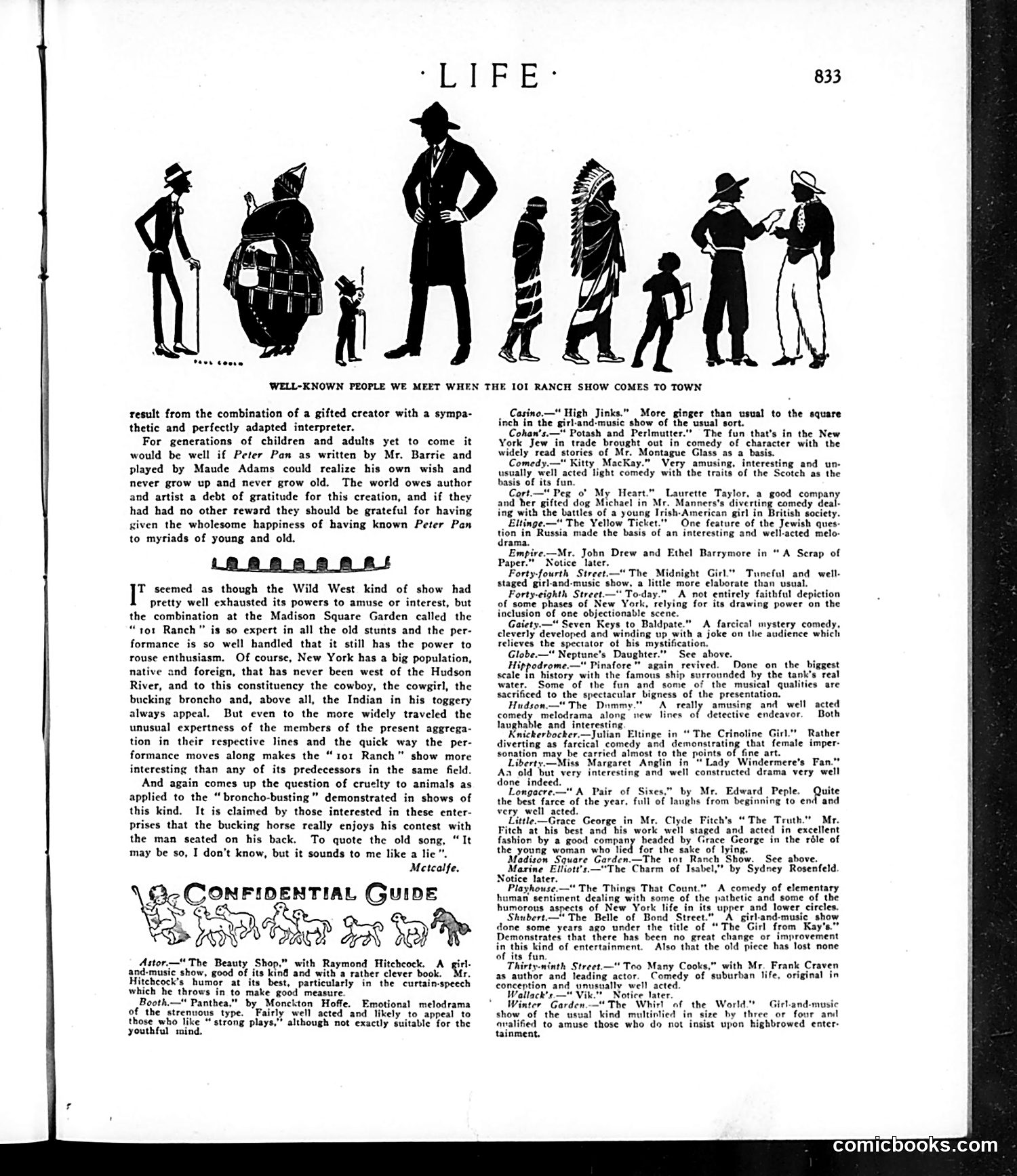
This page features theater reviews ("Confidential Guide") of Broadway shows from the early 1900s, accompanied by a silhouette illustration at the top showing "well-known people we meet" at the 101 Ranch show. The silhouettes depict various character types attending this Wild West exhibition—a society gentleman, a rotund woman in elaborate dress, a tall cowboy figure, children, and performers in Native American and frontier costumes. This visual commentary satirizes the diverse New York audience drawn to such spectacles. The text discusses how the 101 Ranch show, despite being formulaic Wild West entertainment, remains popular because it appeals to urban audiences (native and foreign) unfamiliar with frontier life. Notably, the author raises ethical concerns about animal cruelty in "broncho-busting" demonstrations, skeptically quoting an old song: "It may be so, I don't know, but it sounds to me like a lie." The reviews themselves cover contemporary Broadway productions with typical period-humor assessments of their merits.
📄 Transcribed text from this page (OCR, searchable)
Machine-transcribed from the original scan — historical spelling and the odd misread are preserved.
“LIFE: 833 WELL-KNOWN PEOPLE WE MEET WH result from the combination of a gifted creator with a sympa- thetic and perfectly adapted interpreter. For generations of children and adults yet to come it would be well if Peter Pan as written by Mr. Barrie and played by Maude Adams could realize his own wish and never grow up and never grow old. The world owes author and artist a debt of gratitude for this creation, and if they had had no other reward they should be grateful for having given the wholesome happiness of having known Peter Pan to myriads of young and old. ‘aeeo 6 6 Af T seemed as though the Wild West kind of show had pretty well exhausted its powers to amuse or interest, but the combination at the Madison Square Garden called the “tor Ranch” is so expert in all the old stunts and the per- formance is so well handled that it still has the power to rouse enthusiasm. Of course, New York has a big population, native and foreign, that has never been west of the Hudson River, and to this constituency the cowboy, the cowgirl, the bucking broncho and, above all, the Indian in his toggery always appeal. But even to the more widely traveled the unusual expertness of the members of the present aggrega- tion in their respective lines and the quick way the per- formance moves along makes the “101 Ranch” show more interesting than any of its predecessors in the same field. And again comes up the question of cruelty to animals as applied to the “broncho-busting” demonstrated in shows of this kind. It is claimed by those interested in these enter- prises that the bucking horse really enjoys his contest with the man seated on his back. To quote the old song, “It may be so, I don’t know, but it sounds to me like a lie”. Metcalfe, ->CONFIDENTIAL GuiDE vie S30 Se -—" The Beauty Shop,” with Raymond Hitchcock. A girl- and-music show, good of its kin8 and with a rather clever book. ir. Hitchcock's humor at its best, particularly in the curtain-speech which he throws in to make good measure. Booth.— Panthea," by Monckton Hoffe. Emotional melodrama of the strenuous type. Fairly well acted and likely to appeal to those who like “ strong plays," although not exactly suitable for the youthful mind. THE 101 RANCH SHOW COMES TO TOWN Casino.—" High Jinks.” More ginger than usual to the square inch in the girl-and-music show of the usual sort. Cohan’s.—" Potash and Perlmutter." The fun that's in the New York Jew in trade brought out in comedy of character with the widely read stories of Mr. Montague Glass as a basis. Comedy.—" Kitty MacKay.” Very amusing, interesting and un- usually well acted light comedy with the traits of the Scotch as the basis of its fun. Cort—" Peg o' My Heart." Laurette Taylor, a good compan and her gifted dog Michael in Mr. Manners'’s diverting comedy deal- ing with the battles of a young Irish-American girl in British society. Eltinge.—" The Yellow Ticket.” One feature of the Jewish ques- tion in Russia made the basis of an interesting and well-acted melo- A Scrap of Mr. John Drew and Ethel Barrymore in Notice “later. fourth Street.—" The Midnight Girl." Tuneful and well: staged girl-and-music show, a little more elaborate than usual. Forty-eighth Street—" To-day.” A not entirely faithful depiction of some phases of New York, relying for its drawing power on the inclusion of one objectionable’ scene. Gaiety.—" Seven Keys to Baldpate.” A farcical mystery comedy, cleverly developed and winding up with a joke on the audience which relieves the spectator of his mystification, Globe.—" Neptune's Daughter.” See above. Hippodrome.—" Pinafore” again revived. Done on the biggest scale in history with the famous ship surrounded by the tank's real water. Some of the fun and some of the musical qualities are sacrificed to the spectacular bigness of the presentation. Hudson—" The Dummy." A really amusing and well acted comedy melodrama along new lines of detective endeavor. Both laughable and interesting . Knickerbocker.—Julian Eltinge in “ The Crinoline Gi diverting as farcical comedy and demonstrating that female sonation may be carried almost to the points of fine art. Liberty.—Miss Margaret Anglin in “Lady Windermere’s Fan.” Aa old but very interesting and well constructed drama very well done indeed. : Longacre.— A Pair of Sixes,” by Mr. Edward Peple. Quite the best farce of the year, full of laughs from beginning to end and very well acted. ; Little-—Grace George in Mr. Clyde Fitch's “The Truth.” Mr. Fitch at his best and his work well staged and acted in excellent fashion by a good company headed by Grace George in the réle of the young woman who lied for the sake of lying. Madison Square Garden.—The tor Ranch Show. See above. Marine Elliott’s—"The Charm of Isabel," by Sydney Rosenfeld. Notice later. Playhouse.—" The Things That Count.” A comedy of elementary human sentiment dealing with some of the pathetic and some of the humorous aspects of New York life in its upper and lower circles. Shubert.—" The Belle of Bond Street.” A girl-and-music show done some years ago under the title of “The Girl from Kay's.” Demonstrates that there has been no. great change or improvement i kind of entertainment. Also that the old piece has lost none un. Thirty-ninth Street—" Too Many Cooks,” with Mr. Frank Craven as author and leading actor. Comedy of suburban life, origi conception and unusually well acted. Waltack's —" Vik." Notice later. Winter Garden." The Whirl of the World” Girl-and. show of the u 1 kind multintied in size by three of four and avalified to amuse those who do not insist upon highbrowed enter- tainment. comicbooks.com