
Life, 1914-05-07 · page 30 of 52
Life — May 7, 1914 — page 30: what you’re looking at
What you’re looking at
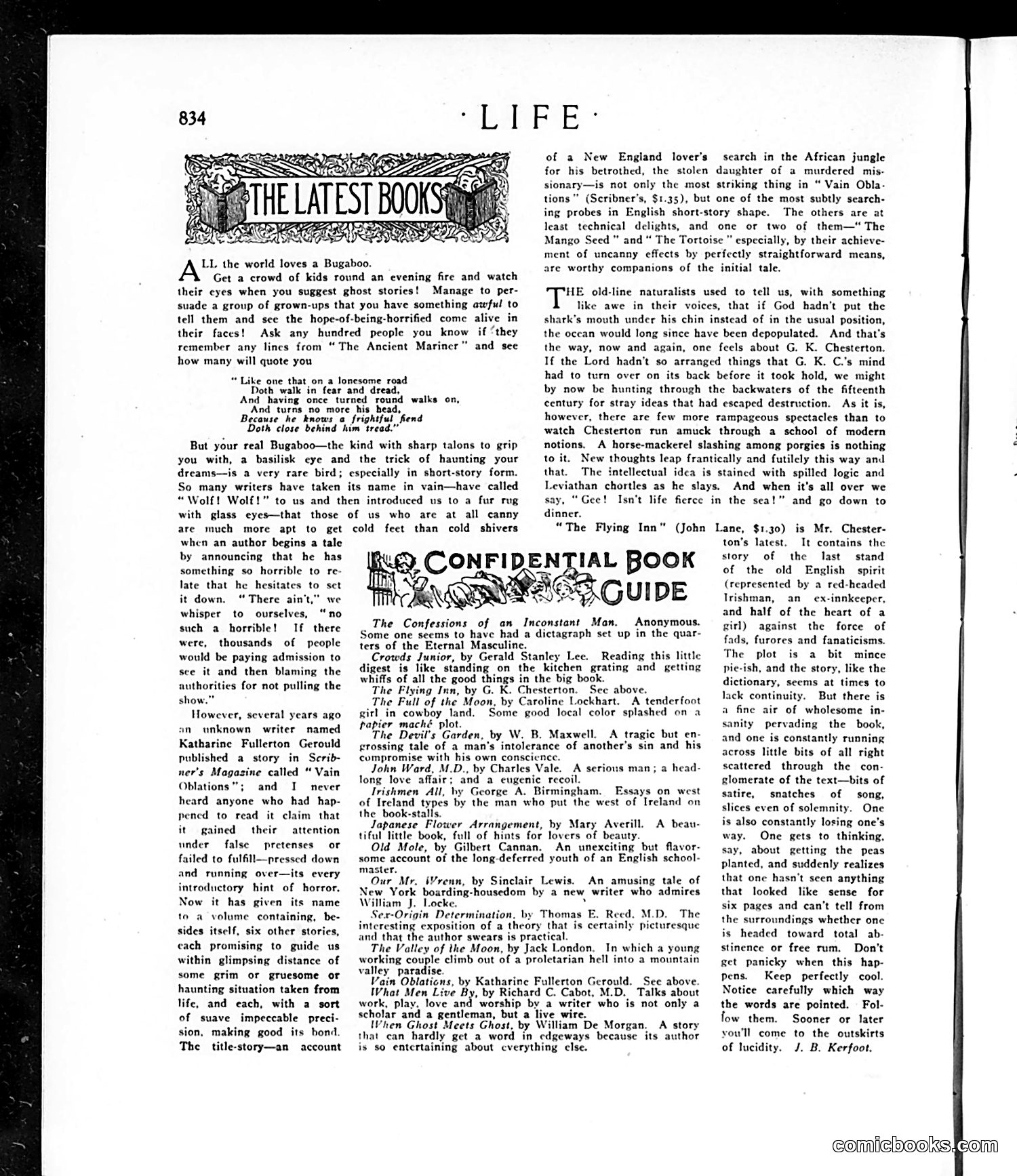
This page from *Life* magazine features book reviews, not political cartoons. The content is a literary column discussing recently published works. The opening section uses playful language about "bugaboos" (frightening things) to frame a discussion of horror fiction—a common *Life* trope of mixing highbrow literary criticism with accessible humor. The reviews discuss works by authors including G.K. Chesterton, Caroline Lockhart, and W.B. Maxwell. The Chesterton passage employs characteristic *Life* satire: it describes his mind as operating in reverse, comparing his intellectual impact to a chaotic fish thrashing through a school—a humorous way of saying Chesterton's unconventional thinking disrupts conventional ideas. The reviews praise works for their technical skill and "uncanny effects," suggesting *Life's* audience valued sophisticated literary merit alongside entertainment. The tone is witty and slightly condescending toward both overwrought horror fiction and experimental modern thought.
📄 Transcribed text from this page (OCR, searchable)
Machine-transcribed from the original scan — historical spelling and the odd misread are preserved.
SEE. LL the world loves a Bugaboo. Get a crowd of kids round an evening fire and watch their eyes when you suggest ghost stories! Manage to per- suade a group of grown-ups that you have something awful to tell them and see the hope-of-being-horrified come alive in their faces! Ask any hundred people you know if ‘they remember any lines from “The Ancient Mariner” and see how many will quote you “ Like one that on a lonesome road Doth walk in fear and dread, And having once turned round wall And turns no more his head, Because he knows a frightful, fend Doth close behind him tread.” But your real Bugaboo—the kind with sharp talons to grip you with, a basilisk eye and the trick of haunting your dreams—is a very rare bird; especially in short-story form. So many writers have taken its name in vain—have called “Wolf! Wolf!” to us and then introduced us to a fur rug with glass eyes—that those of us who are at all canny are much more apt to get cold fect than cold shivers when an author begins a tale by announcing that he has something so horrible to re late that he hesitates to set it down. “There ain't,” we whisper to ourselves, “no such a horrible! If there were, thousands of people would be paying admission to sce it and then blaming the authorities for not pulling the show.” However, several years ago an unknown writer named Katharine Fullerton Gerould girl in cowboy land. papier maché plot. The Confessions of an Inconstant Man. A Some one seems to have had a dictagraph set up in the quar- ters of the Eternal Masculine. Crowds Junior, by Gerald Stanley Lee. digest is like standing on the kitchen grating and getting pie whiffs of all the good things in the big book. The Flying Inn, by G. K. Chesterton. The Full of the Moon, by Caroline Lockhart. Some good local color splashed on a The Devil's Garden, by W. B. Maxwell. of a New England lover's scarch in the African jungle for his betrothed, the stolen daughter of a murdered mis- sionary—is not only the most striking thing in “ Vain Obla- tions" (Scribner's, $1.35), but one of the most subtly search- ing probes in English short-story shape. The others are at least technical delights, and one or two of them—“ The Mango Seed" and“ The Tortoise " especially, by their achieve- ment of uncanny effects by perfectly straightforward means, are worthy companions of the initial tale. HE. old-line naturalists used to tell us, with something like awe in their voices, that if God hadn't put the shark’s mouth under his chin instead of in the usual position, the ocean would long since have been depopulated. And that's the way, now and again, one fcels about G. K. Chesterton. If the Lord hadn't so arranged things that G. K. C.'s mind had to turn over on its back before it took hold, we might by now be hunting through the backwaters of the fifteenth century for stray ideas that had escaped destruction. As it is, however, there are few more rampageous spectacles than to watch Chesterton run amuck through a school of modern notions, A horse-mackerel slashing among porgies is nothing to it. New thoughts leap frantically and futilely this way and that. The intellectual idea is stained with spilled logic and Leviathan chortles as he slays. And when it's all over we say, “Gee! Isn't life fierce in the sea!” and go down to dinner. “The Flying Inn” (John Lane, $1.30) is Mr. Chester- ton’s latest. It contains the story of the last stand of the old English spirit (represented by a red-headed Irishman, an ex-innkeeper, and half of the heart of a girl) against the force of fads, furores and fanaticisms. Reading this little The plot is a bit mince h, and the story, like the dictionary, seems at times to lack continuity. But there a fine air of wholesome in- sanity pervading the book, and one is constantly running Anonymous. See above. A tenderfoot A tragic but en- published a story in Serib- ner’s Magazine called “ Vain Oblations”; and T heard anyone who had hap- pened to read it claim that it gained their attention under false pretenses or failed to fulfill—pressed down and running over—its every introductory hint of horror. Now it has given its name to a volume containing, be- sides itself, six other stories, cach promising to guide us within glimpsing distance of some grim or gruesome or haunting situation taken from life, and each, with a sort of suave impeccable preci- sion, making good its bond The title-story—an account never grossing tale of a man’s intolerance of another's sin and his compromise with his own conscience. John Ward, M.D., by Charles Vale. A serious man; a head- long love affair; and a eugenic recoil. Irishmen All, by George A. Birmingham. Essays on west of Ireland types by the man who put the west of Ireland on the book-stalls. Japanese Flower Arrangement, by Mary Averill. tiful little book, full of hints for lovers of beauty. Old Mole, Gilbert Cannan. An unexciting but flavor- some account of the long-deferred youth of an English school- master. Our Mr. iVrenn, by Sinclair Lewis. An amusing tale of New York boarding-housedom by a new writer who admires William J. Locke. . ‘ex-Origin Determination. by Thomas Reed. M.D. The interesting exposition of a theory that is certainly picturesque and that the author swears is practical. The Valley of the Moon, by Jack London. In which a young working couple climb out of a proletarian hell into a mountain valley paradise. Vain Oblaticns, by Katharine Fullerton Gerould. See above. What Men Live By, by Richard C. Cabot, M.D. Talks about work, play, love and worship by a writer who is not only a scholar and a gentleman, but a live wire. When Ghost Meets Ghost, by William De Morgan. A story that can hardly get a word in cdgeways because its author is so entertaining about cverything else. A beau- across little bits of all right scattered through the con- glomerate of the text—bits of satire, snatches of song, slices even of solemnity. One is also constantly losing one’s way. One gets to thinking, say, about getting the peas planted, and suddenly realizes that one hasn't seen anything that looked like sense for six pages and can't tell from the surroundings whether one is headed toward total ab- stinence or free rum. Don't get panicky when this hap- pens. Keep perfectly cool. Notice carefully which way the words are pointed. Fol- fow them. Sooner or later you'll come to the outskirts of lucidity. J. B. Kerfoot.