
Life, 1914-05-07 · page 16 of 52
Life — May 7, 1914 — page 16: what you’re looking at
What you’re looking at
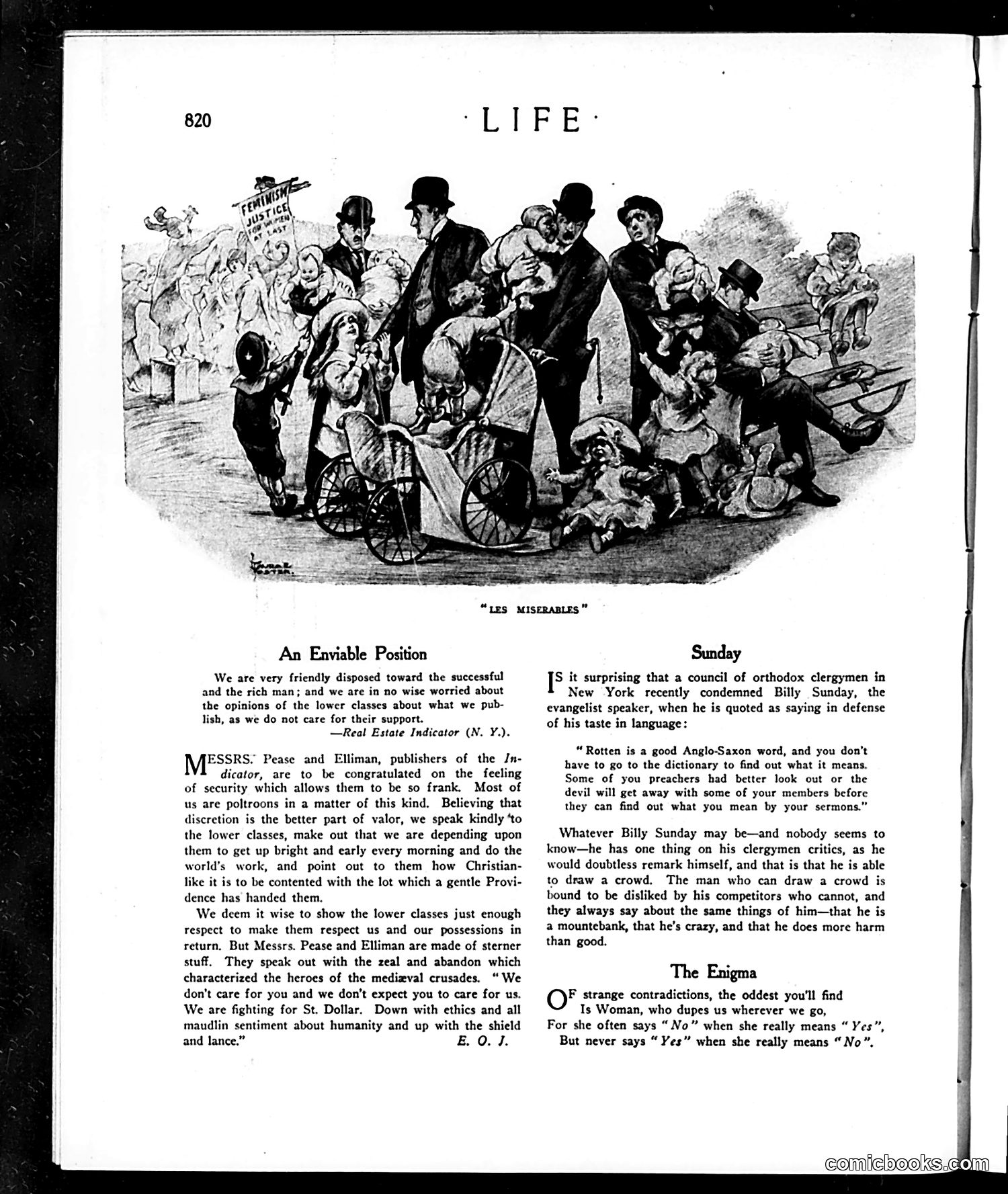
This page contains three distinct pieces of satire: **"Les Misérables" cartoon**: Depicts well-dressed men and women distributing charity to poor children and families, satirizing patronizing attitudes toward the lower classes. **"An Enviable Position"**: Mocks real-estate publishers Pease and Elliman for brazenly admitting they don't care about working-class opinions—only their money. Life criticizes the hypocrisy of most wealthy people who pretend to value the poor while actually despising them. The editors contrast this honesty with the typical duplicitous approach of feigning Christian concern while expecting the poor to remain docile. **"Sunday" section**: Defends evangelist Billy Sunday against clergy criticism of his crude language. Life argues that Sunday's ability to draw crowds proves his effectiveness, while his critics simply envy his success. **"The Enigma"**: A brief humorous poem about female duplicity—women say "no" when meaning "yes" but never say "yes" when meaning "no," suggesting women's inscrutability. The page critiques class hypocrisy, religious jealousy, and includes period-typical stereotypes about women.
📄 Transcribed text from this page (OCR, searchable)
Machine-transcribed from the original scan — historical spelling and the odd misread are preserved.
“LES MISERABLES” An Enviable Position We are very friendly disposed toward the successful and the rich man; and we are in no wise worried about the opinions of the lower classes about what we pub- lish, as we do not care for their support. —Real Estate Indicator (N. Y.). ESSRS. Pease and Elliman, publishers of the Jn- dicator, are to be congratulated on the feeling of security which allows them to be so frank. Most of us are poltroons in a matter of this kind. Believing that discretion is the better part of valor, we speak kindly ‘to the lower classes, make out that we are depending upon them to get up bright and early every morning and do the world’s work, and point out to them how Christian- like it is to be contented with the lot which a gentle Provi- dence has handed them. We deem it wise to show the lower classes just enough respect to make them respect us and our possessions in return. But Messrs. Pease and Elliman are made of sterner stuff. They speak out with the zeal and abandon which characterized the heroes of the medizval crusades. “We don’t care for you and we don’t expect you to care for us. We are fighting for St. Dollar. Down with ethics and all maudlin sentiment about humanity and up with the shield and lance.” £. 0. J. S it surprising that a council of orthodox clergymen in New York recently condemned Billy Sunday, the evangelist speaker, when he is quoted as saying in defense of his taste in language: “Rotten is a good Anglo-Saxon word, and you don’t have to go to the dictionary to find out what it means. Some of you preachers had better look out or the devil will get away with some of your members before they can find out what you mean by your sermons.” Whatever Billy Sunday may be—and nobody seems to know—he has one thing on his clergymen critics, as he would doubtless remark himself, and that is that he is able to draw a crowd. The man who can draw a crowd is bound to be disliked by his competitors who cannot, and they always say about the same things of him—that he is a mountebank, that he’s crazy, and that he does more harm than good. The Enigma OF strange contradictions, the oddest you'll find Is Woman, who dupes us wherever we go, For she often says “No” when she really means “ Yes”, But never says “ Yes” when she really means “No”. comichooks.g