
Life, 1914-05-07 · page 14 of 52
Life — May 7, 1914 — page 14: what you’re looking at
What you’re looking at
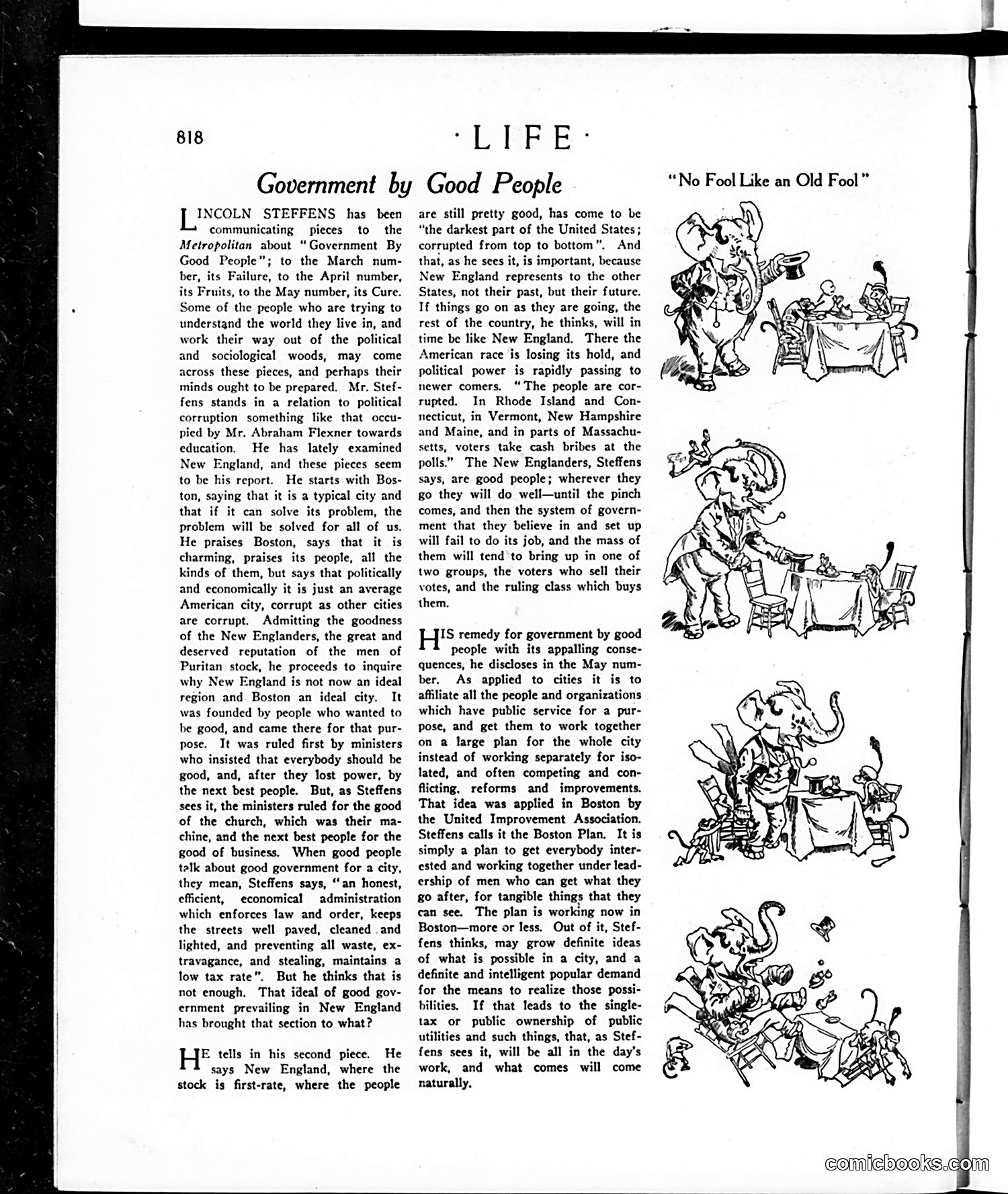
This page discusses Lincoln Steffens' articles on "Government by Good People," satirizing the notion that honest, well-intentioned citizens can solve urban corruption. The cartoon series on the right (titled "No Fool Like an Old Fool") illustrates the satire through exaggerated characters engaged in chaotic civic activities—suggesting that good intentions alone are insufficient for effective governance. Steffens examines New England cities, particularly Boston, arguing that while the region has a reputation for integrity and educated leadership, corruption persists despite these advantages. The cartoons mock the idealistic belief that virtue and goodwill naturally produce good government. Instead, Steffens argues systematic reform—like Boston's "United Improvement Association" plan—requires organized coordination rather than relying on individually decent people. The satire suggests naïveté in assuming moral character automatically translates to administrative competence.
📄 Transcribed text from this page (OCR, searchable)
Machine-transcribed from the original scan — historical spelling and the odd misread are preserved.
te RAE * Government by Good People INCOLN STEFFENS has been communicating pieces to the Metropolitan about “Government By Good People”; to the March num- ber, its Failure, to the April number, its Fruits, to the May number, its Cure. Some of the people who are trying to understand the world they live in, and work their way out of the political and sociological woods, may come across these pieces, and perhaps their minds ought to be prepared. Mr. Stef- fens stands in a relation to political corruption something like that occu- pied by Mr. Abraham Flexner towards education. He has lately examined New England, and these pieces seem to be his report. He starts with Bos- ton, saying that it is a typical city and that if it can solve its problem, the problem will be solved for all of us. He praises Boston, says that it is charming, praises its people, all the kinds of them, but says that politically and economically it is just an average American city, corrupt as other cities are corrupt. Admitting the goodness of the New Englanders, the great and deserved reputation of the men of Puritan stock, he proceeds to inquire why New England is not now an ideal region and Boston an ideal city. It was founded by people who wanted to be good, and came there for that pur- pose. It was ruled first by ministers who insisted that everybody should be good, and, after they lost power, by the next best people. But, as Steffens sees it, the ministers ruled for the good of the church, which was their ma- chine, and the next best people for the good of business. When good people talk about good government for a city, they mean, Steffens says, ‘an honest, efficient, economical administration which enforces law and order, keeps the streets well paved, cleaned and lighted, and preventing all waste, ex- travagance, and stealing, maintains a low tax rate". But he thinks that is not enough. That ideal of good gov- ernment prevailing in New England has brought that section to what? E tells in his second piece. He says New England, where the stock is first-rate, where the people are still pretty good, has come to be “the darkest part of the United States; corrupted from top to bottom”. And that, as he sees it, is important, because New England represents to the other States, not their past, but their future. If things go on as they are going, the rest of the country, he thinks, will in time be like New England. There the American race is losing its hold, and political power is rapidly passing to newer comers. “The people are cor- rupted. In Rhode Island and Con- necticut, in Vermont, New Hampshire and Maine, and in parts of Massachu- setts, voters take cash bribes at the polls.” The New Englanders, Steffens says, are good people; wherever they go they will do well—until the pinch comes, and then the system of govern- ment that they believe in and set up will fail to do its job, and the mass of them will tend to bring up in one of two groups, the voters who sell their votes, and the ruling class which buys them. H's remedy for government by good people with its appalling conse- quences, he discloses in the May num- ber. As applied to cities it is to affiliate all the people and organizations which have public service for a pur- pose, and get them to work together on a large plan for the whole city instead of working separately for iso- lated, and often competing and con- flicting, reforms and improvements. That idea was applied in Boston by the United Improvement Association. Steffens calls it the Boston Plan. It is simply a plan to get everybody inter- ested and working together under lead- ership of men who can get what they go after, for tangible things that they can see. The plan is working now in Boston—more or less. Out of it, Stef- fens thinks, may grow definite ideas of what is possible in a city, and a definite and intelligent popular demand for the means to realize those possi- bilities. If that leads to the single- tax or public ownership of public utilities and such things, that, as Stef- fens sees it, will be all in the day’s work, and what comes will come naturally, “No Fool Like an Old Fool” comichooks.