
Life, 1914-05-07 · page 20 of 52
Life — May 7, 1914 — page 20: what you’re looking at
What you’re looking at
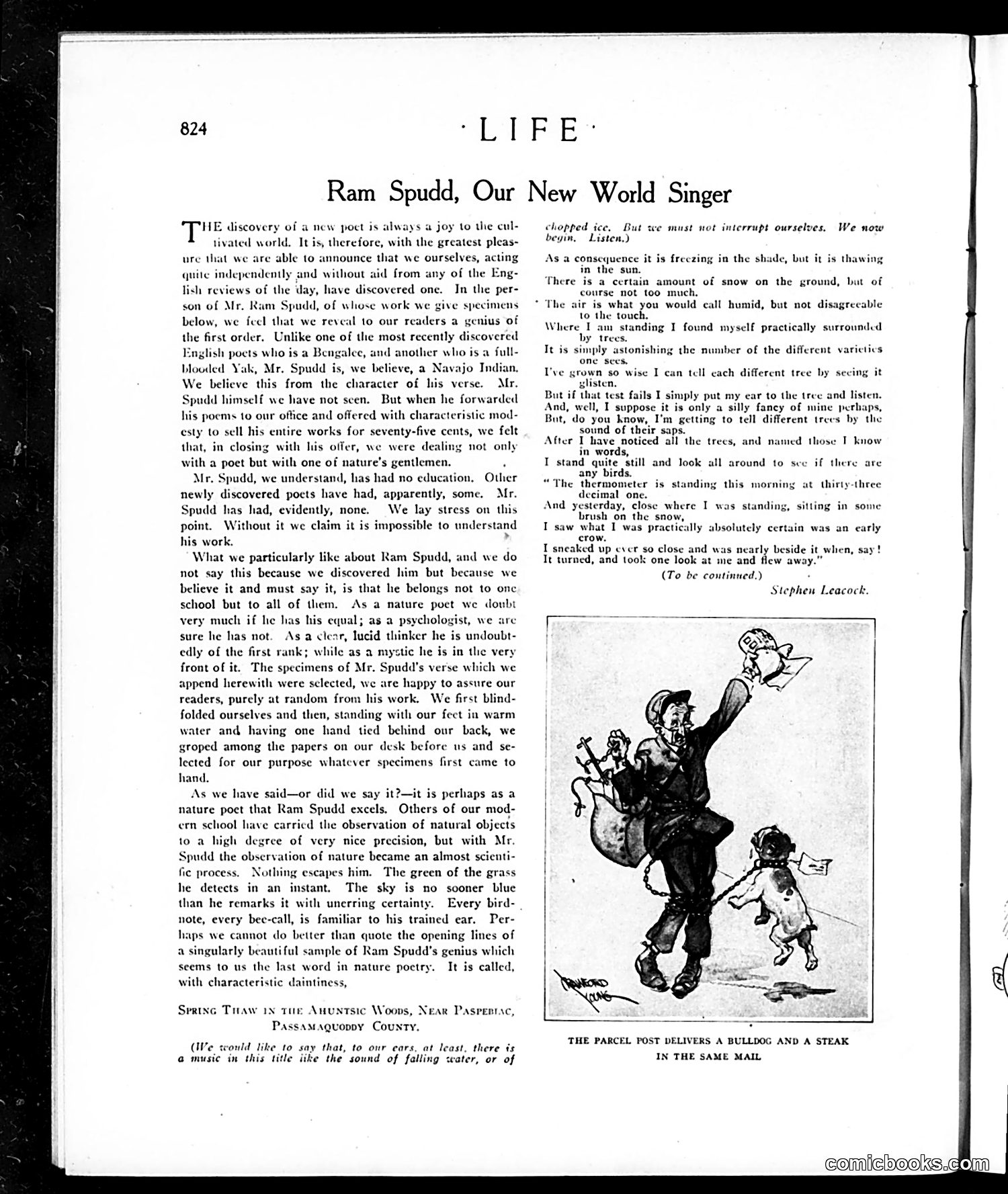
This is satirical commentary on contemporary poetry criticism and the romanticization of "primitive" or "untrained" artists. Life magazine pretends to have discovered Ram Spudd, a Navajo Indian poet, whom they celebrate as a genius precisely *because* he lacks formal education. The satire targets several things: the uncritical enthusiasm of literary establishments for newly "discovered" poets; the exotic appeal of non-European writers; and the absurdity of treating mundane observations as profound nature poetry. Spudd's specimen poem—describing obvious facts like snow being on the ground and trees being surrounded—is presented as profound while being comically banal. The cartoon below shows characters celebrating with a bulldog and steak, suggesting the article's tongue-in-cheek tone. The entire piece mocks fashionable literary taste by demonstrating how easily critics can elevate mediocrity when framed correctly.
📄 Transcribed text from this page (OCR, searchable)
Machine-transcribed from the original scan — historical spelling and the odd misread are preserved.
Ram Spudd, Our New World Singer ee discovery of a new poet is always a joy to the cul- tivated world. It is, therefore, with the greatest pleas- ure that we are able to announce that we ourselves, acting quite independently and without aid from any of the Eng- lish reviews of the day, have discovered one. In the per- son of Mr, Ram Spudd, of whose work we give specimens below, we fecl that we reveal to our readers a genius of the first order. Unlike one of the most recently discovered. a Bengalce, and another who is a full- is, we believe, a Navajo Indian, English pocts who Dlooded Yak, Mr. Spudd We believe this from the character of his verse. Mr. Spudd himself we have not scen. But when he forwarded his poems to our office and offered with characteristic mod- esty to sell his entire works for seventy-five cent: that, in closing with his offer, we were dealing not only we felt with a poet but with one of nature's gentlemen. m Mr. Spudd, we understand, has had no education. Other newly discovered pocts have had, apparently, some. Mr. Spudd has had, evidently, none. We lay stress on this point. Without it we claim it is impossible to understand his work. » What we particularly like about Ram Spudd, and we do not say this because we discovered him but because we believe it and must say it, is that he belongs not to onc school but to all of them. As a nature poet we doubt very much if he has his equal; as a psychologist, we are sure he has not. As a clear, lucid thinker he is undoubt- edly of the first rank; while as a mystic he is in the very front of it. The specimens of Mr. Spudd's verse which we append herewith were sclected, we are happy to assure our readers, purely at random from his work. We first blind- folded ourselves and then, standing with our fect in warm water and having one hand tied behind our back, we groped among the papers on our desk before us and se- lected for our purpose whatever specimens first came to hand. As we have said—or did we say it?—it is perhaps as a nature poct that Ram Spudd excels. Others of our mod- ern school have carricd the observation of natural objects to a high degree of very nice precision, but with Mr. Spudd the observation of nature became an almost scienti- Nothing escapes him. The green of the grass he detects in an instant. The sky is no sooner blue than he remarks it with unerring certainty. Every bird- note, every bee-call, is familiar to his trained ear. Per- haps we cannot do better than quote the opening lines of a singularly beautiful sample of Ram Spudd’s genius which Tt is called, fic process. seems to us the last word in nature poetry. with characteristic daintiness, Srartnc Taw ix tue Anuntsic Woops, Near Pasrentac, Passamaguoppy County. (We would like to say that, to our ears, at least, there is a music in this title iike the sound of falling water, or of chopped ice, But we must not interrupt ourselves, We now begin, Listen.) As a consequence it is freezing in the shade, but it is thawing in the sun. There is a certain amount of snow on the ground, but of course not too much. The air is what you would call humid, but not disagreeable to the touch. Where Tam standing I found myself practically surrounded by trees. It is simply astonishing the number of the different varictics one sees. I've grown so wise I can tell cach different tree by secing it glisten. But if that test fails I simply put my ear to the tree and listen. And, well, I suppose it is only a silly fancy of mine perhaps, But, do you know, I'm getting to tell different trees by the sound of their saps. Aftce I have noticed all the trees, and named those T know in words, I stand quite still and look all around to sce if there are any birds. “The thermometer is standing this morning at thirty-three decimal one. And yesterday, close where I was standing, sitting in some brush on the snow, T saw what I was practically crow. I sneaked up ever so close and was nearly beside it when, say ! It turned, and took one look at me and flew away. (To be continued.) Stephen Leacock. bsolutely certain was an early THE PARCEL POST DELIVERS A BULLDOG AND A STEAK IN THE SAME MAIL comichooks.com