
Life, 1914-05-07 · page 22 of 52
Life — May 7, 1914 — page 22: what you’re looking at
What you’re looking at
This satirical dialogue mocks railroad executive corruption and their manipulation of government regulators. A railroad president trains his new secretary to deceive visitors—especially government representatives—by appearing gloomy and claiming poverty while the company is actually massively profitable. The joke reveals the con: the railroad cost $2.6 million to build but carries $200+ million in bonds and stock, an obvious financial impossibility justified through vague appeals to the genius of tycoons like Gould, Harriman, and Morgan. When the secretary naively asks how this happened, the president fires him for being "too simple"—meaning he lacks the cynicism to understand or perpetuate corporate fraud. The satire exposes how railroad barons used inflated capitalization and political theater to extract wealth while claiming victimhood before regulators trying to control rates.
📄 Transcribed text from this page (OCR, searchable)
Machine-transcribed from the original scan — historical spelling and the odd misread are preserved.
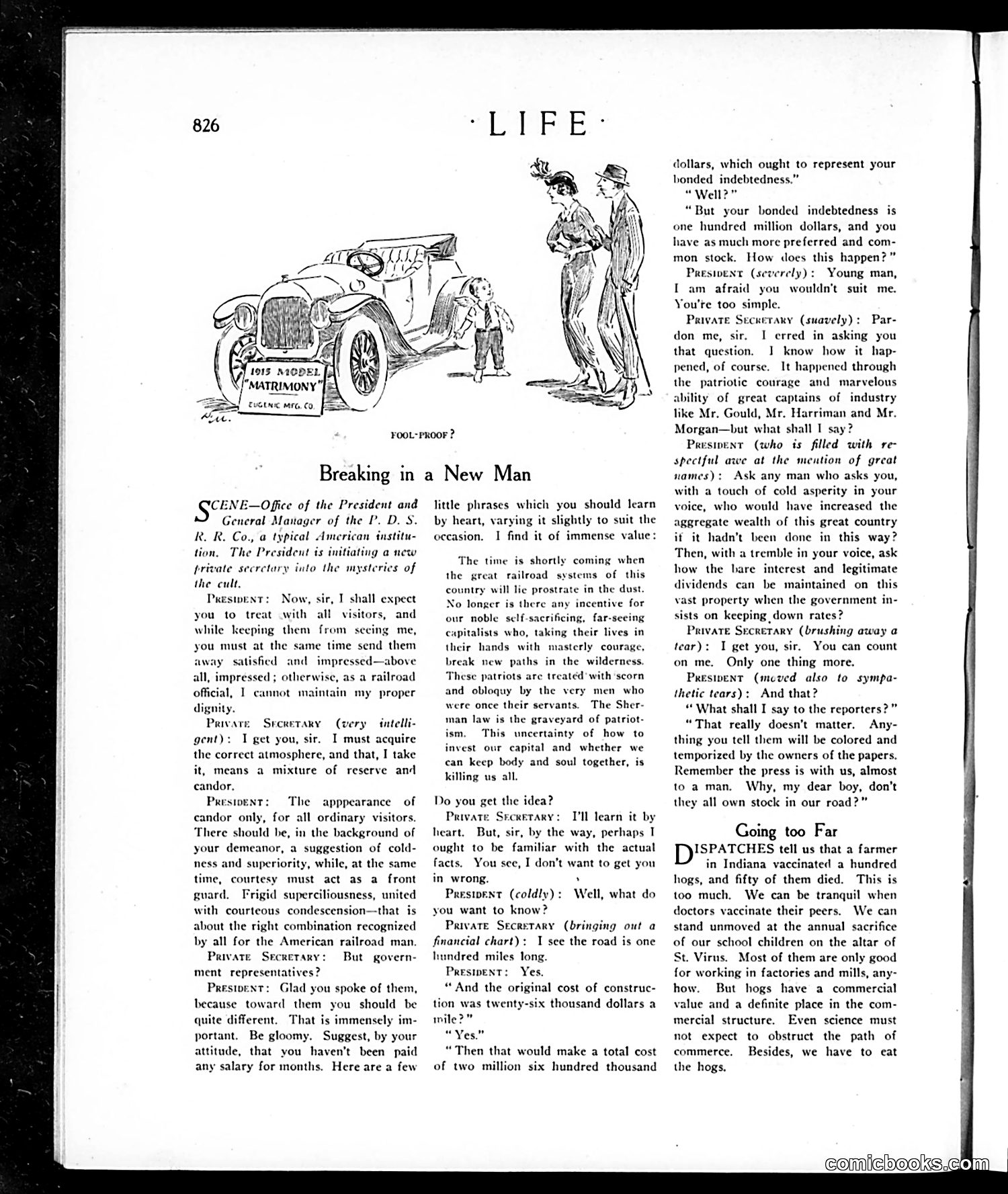
FOOL-PROOF ? Breaking in a New Man VE—Office of the President and General Manager of the P, D. S. R.R. Co., a typical American tnstitu- The President ts initiating a new private secretary into the mysteries of the cult, Preswnt Now, sir, I shall expect you to treat with all visitors, and while keeping them from seeing me, you must at the ne time send them away satisfied and) impressed—above all, impressed ; otherwise, as a railroad official, I cannot maintain my proper dignity. Private Secretary (very intelli- gent): I get you, sir. I must acquire the correct atmosphere, and that, I take it, means a mixture of reserve and candor, Presioent: The apppearance of candor only, for all ordinary visitors. There should be, in the background of your demeanor, a suggestion of cold- ness and superiority, while, at the same time, courtesy must act as a front guard. Frigid superciliousness, united with courteous condescension—that is about the right combination recognized by all for the American railroad man. Private Secretary: But govern- ment representatives? Prestvent: Glad you spoke of them, because toward them you should be quite different. That is immensely im- portant. Be gloomy. Suggest, by your attitude, that you haven't been paid any salary for months. Here are a few little phrases which you should learn by heart, varying it slightly to suit the occasion. I find it of immense value: The time the great railroad systems of country will lie prostrate in the dust. No longer is there any incentive for our noble sclf-sacrificing, far-seeing capitalists who, taking their lives in their hands with masterly courage, break new paths in the wilderness. These patriots are treated with ‘scorn and obloquy by the very men who were once their servants. The Sher- man law is the graveyard of patriot- ism. This uncertainty of how to invest our capital and whether we can keep body and soul together, is killing us all. is shortly coming when this Do you get the idea? Private Secretary: I'll learn it by heart. But, sir, by the way, perhaps I ought to be familiar with the actual facts. You see, I don’t want to get you in wrong. Present (coldly) : you want to know? Private Secretary (bringing out a financial chart): 1 see the road is one hundred miles long. Present: Yes, “And the original cost of construc- tion was twenty-six thousand dollars a nile?” Yeu? “Then that would make a total cost of two million six hundred thousand Well, what do dollars, which ought to represent your bonded indebtedness.” “Well?” “But your bonded indebtedness is one hundred million dollars, and you have as much more preferred and com- mon stock. How does this happen?” Present (severely): Young man, I am afraid you wouldn't suit me. You're too simple. Private Secnerany (suavely): Par- don me, sir. I erred in asking you that question. J] know how it hap- pened, of course. It happened through the patriotic courage and marvelous ability of great captains of industry like Mr. Gould, Mr. Harriman and Mr. Morgan—but what shall I say? Presinentr (who is filled with re~ spectful awe at the mention of great names): Ask any man who asks you, with a touch of cold asperity in your voice, who would have increased the aggregate wealth of this great country it it hadn’t been done in this way? Then, with a tremble in your voice, ask how the bare interest and legitimate dividends can be maintained on this vast property when the government in- sists on keeping down rates? Private Secretary (brushing away a tear): I get you, sir. You can count on me. Only one thing more. Preswent (mcved also to sympa- thetic tears): And that? “What shall I say to the reporters “That really doesn’t matter. Any- thing you tell them will be colored and temporized by the owners of the papers. Remember the press is with us, almost to a man. Why, my dear boy, don't they all own stock in our road?” Going too Far ISPATCHES tell us that a farmer in Indiana vaccinated a hundred hogs, and fifty of them died. Thi: too much. We can be tranquil when doctors vaccinate their peers. We can stand unmoved at the annual sacrifice of our school children on the altar of St. Virus. Most of them are only good for working in factories and mills, any- how. But hogs have a commercial value and a definite place in the com- mercial structure. Even science must not expect to obstruct the path of commerce. Besides, we have to eat the hogs. comichooks.celm