
A complete issue · 44 pages · 1914
Life — April 23, 1914
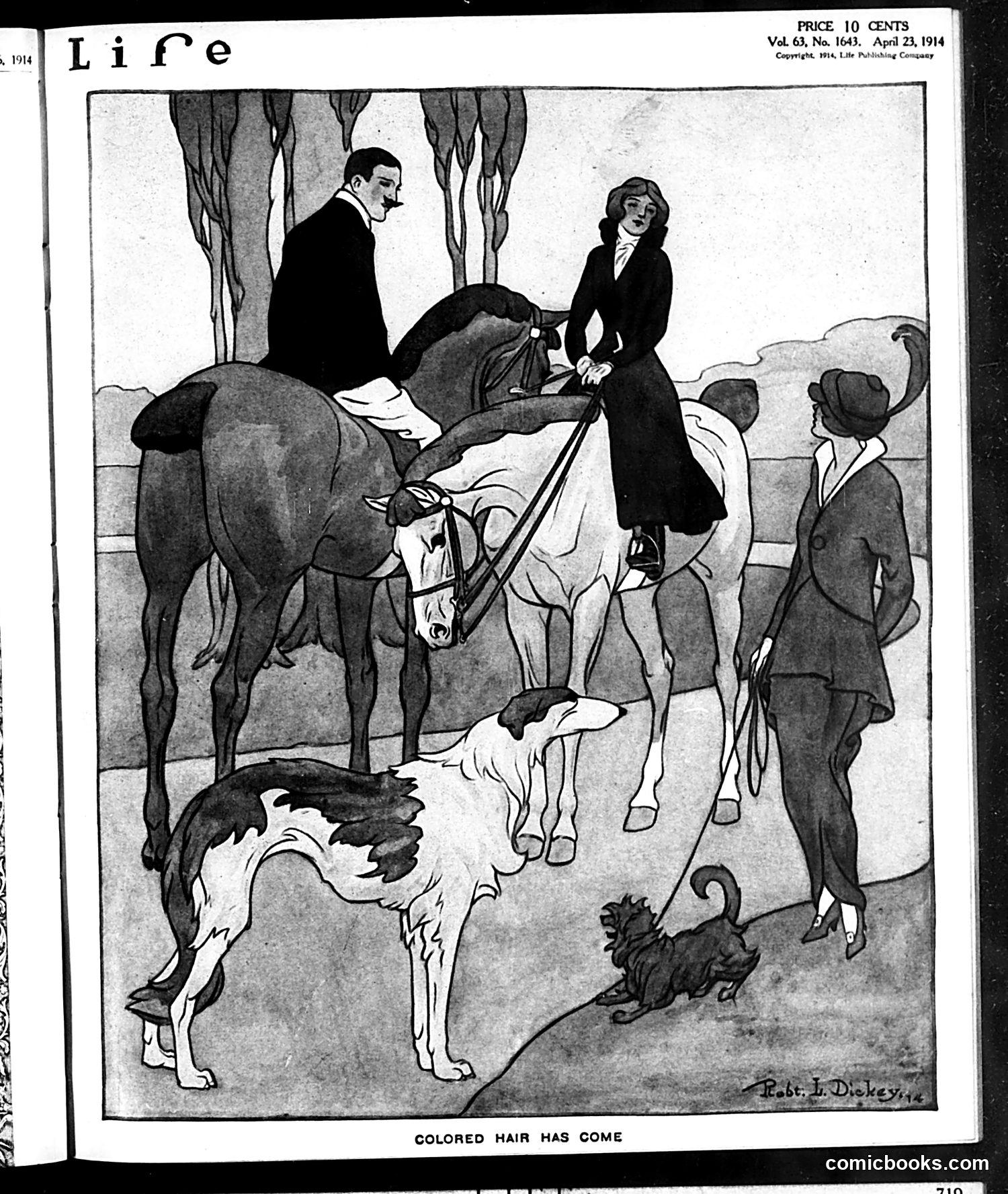
**Title:** "Colored Hair Has Come" This cartoon satirizes a fashion trend among upper-class women of the era—dyeing or tinting hair. The scene depicts a fashionable lady on horseback with noticeably altered hair color, observed by well-dressed onlookers including a man in formal attire and other women. The humor targets the vanity and social pretension of wealthy women adopting this cosmetic practice. The presence of dogs and the equestrian setting emphasize the upper-class context. The title's double meaning—"colored hair has come" as both a fashion statement and social phenomenon—suggests satirical commentary on how this trend has become widespread among society's elite. The cartoon mocks the conspicuous adoption of artificial beauty enhancements as a status marker.
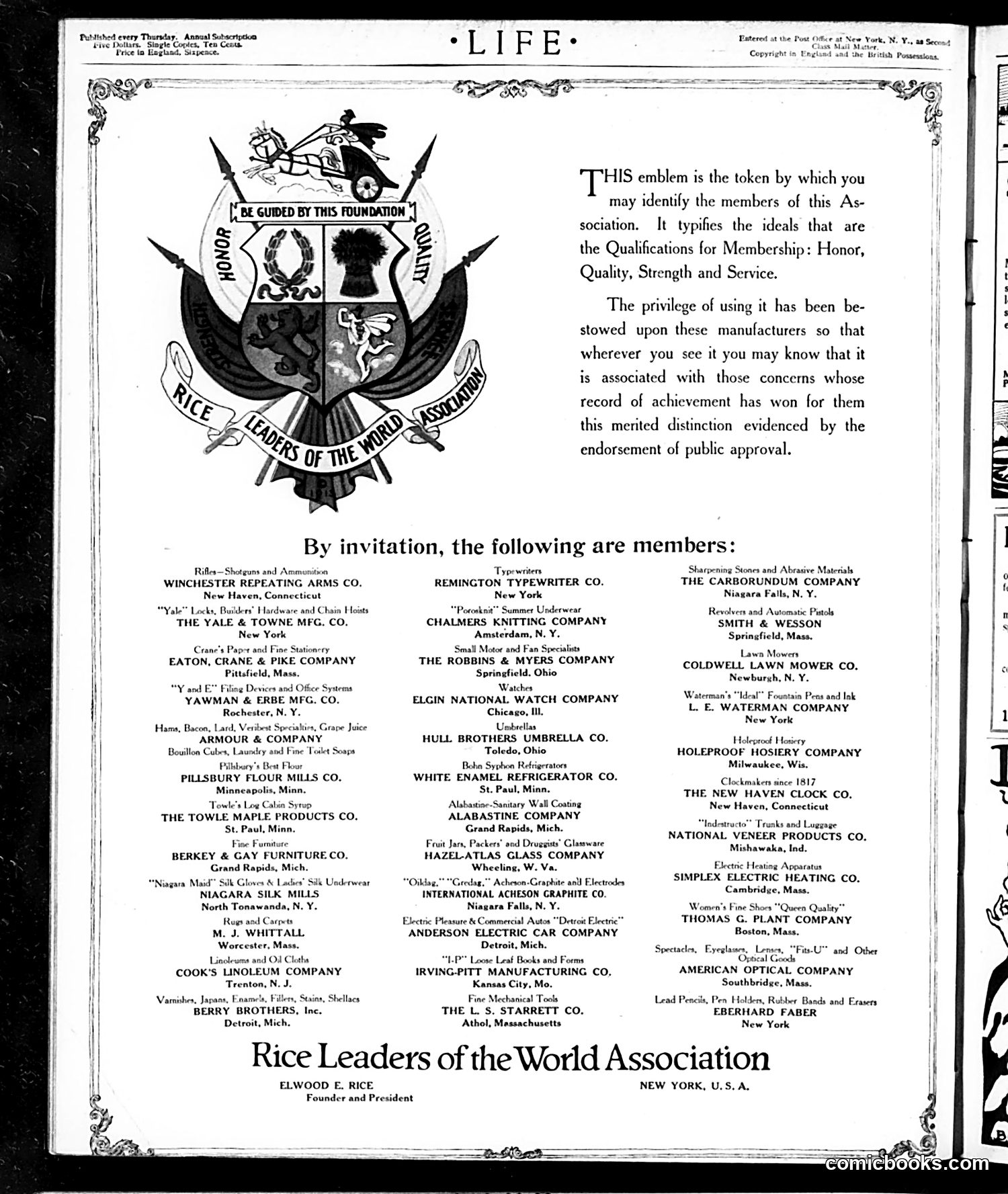
This page is primarily **organizational/promotional rather than satirical**. It presents the emblem and membership roster of the "Rice Leaders of the World Association," founded by Elwood E. Rice. The emblem features a shield with the motto "Be Guided by This Foundation" and lists membership qualifications: Honor, Quality, Strength, and Service. The shield imagery suggests aspirational ideals of leadership. The bulk of the page lists dozens of member companies across various industries—typewriters, ammunition, silk mills, furniture, automobiles, and more—representing major American manufacturers of the early 20th century. Rather than satire, this appears to be a **business prestige advertisement**, leveraging Life magazine's reach to showcase corporate membership in what Rice positioned as an elite association of industrial leaders.
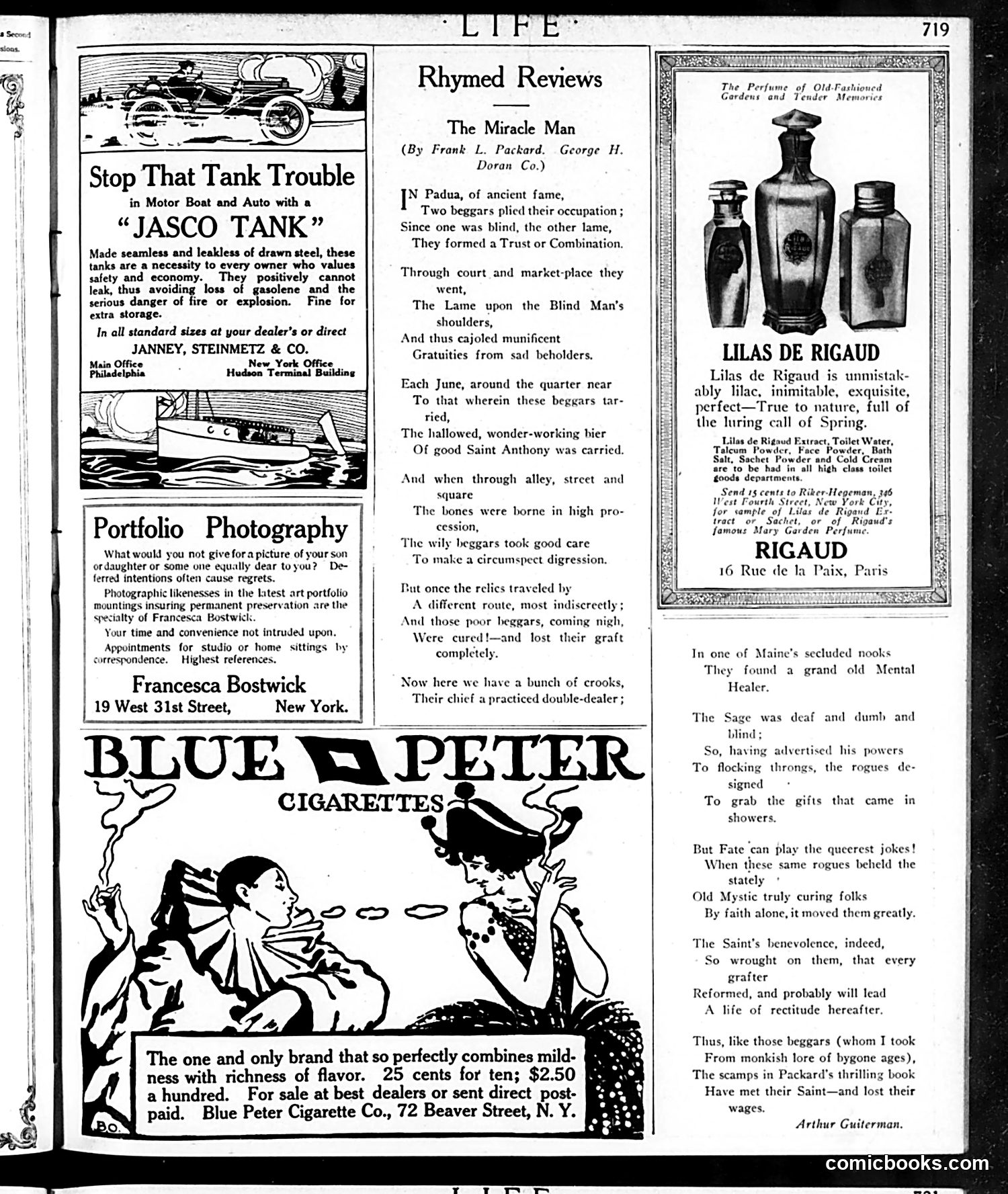
This page is **primarily advertisements and literary content** rather than political satire. The main elements are: 1. **Advertisements**: JASCO Tank (auto/boat equipment), Portfolio Photography services, and Blue Peter Cigarettes with an Art Deco-style illustration of a fashionable woman and man. 2. **"Rhymed Reviews" section**: A poem by Frank L. Packard reviewing "The Miracle Man," a book about beggars in Padua who encounter religious healing. The verse tells how blind and lame beggars are cured by Saint Anthony's relics, then later encounter rogues posing as healers. 3. **Lilas de Rigaud advertisement**: Perfume from Paris. The cigarette ad's illustration reflects 1920s-era fashion and lifestyle marketing rather than political commentary. No political satire is evident on this page.
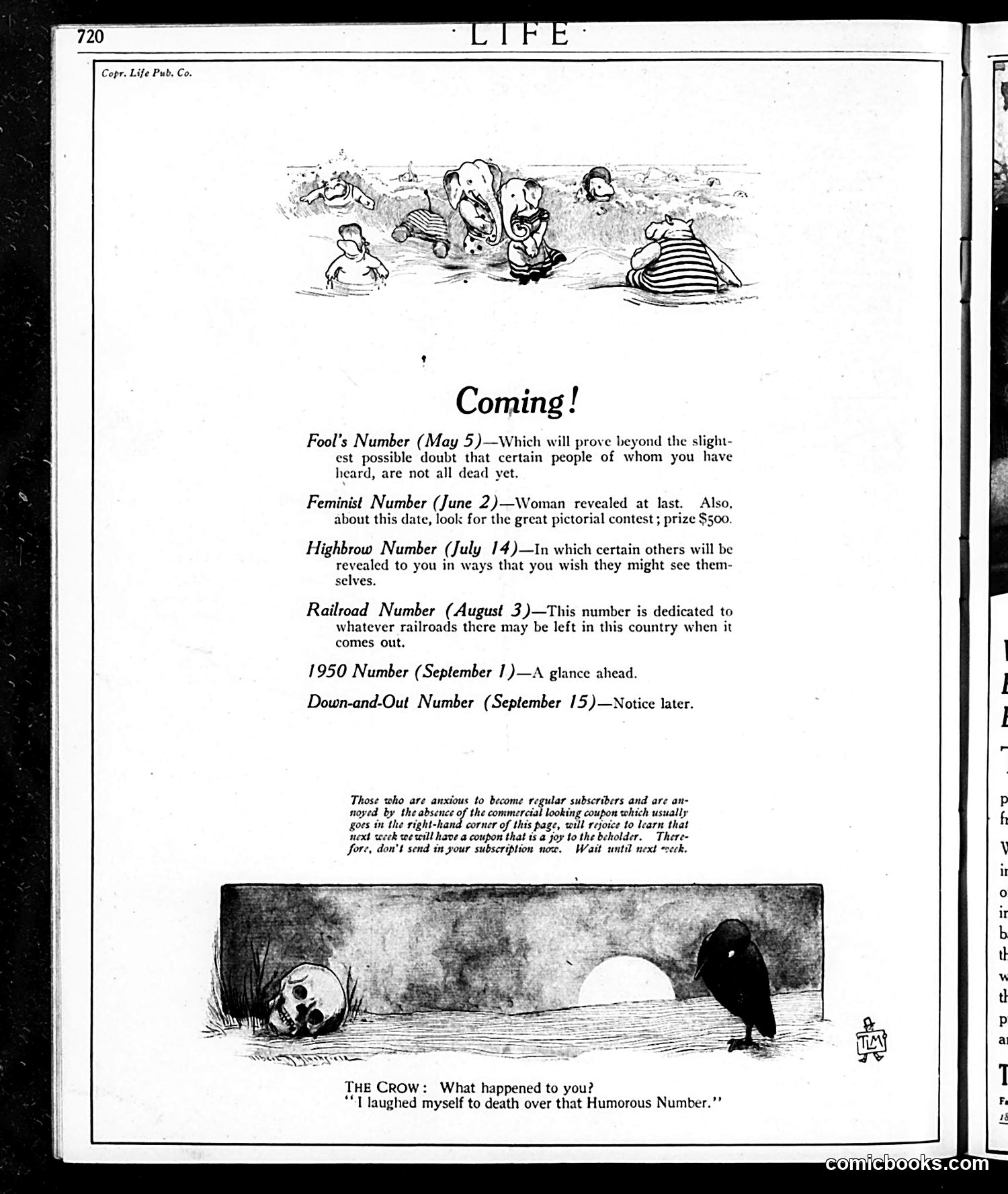
This page announces upcoming "Life" magazine issues with satirical themes. The top illustration shows people in a beach/water setting, introducing various numbered issues: - **Fool's Number** (May 5): Satirizes certain people "not all dead yet" — likely political figures or public personalities the magazine deemed foolish - **Feminist Number** (June 2): References women's rights discourse of the era, mentioning a pictorial contest with a $500 prize - **Highbrow Number** (July 14): Mocks pretentious intellectuals - **Railroad Number** (August 3): Commentary on the railroad industry's decline ("whatever railroads there may be left") - **1950 Number** (September 1): Forward-looking prediction The bottom cartoon shows a crow laughing at a skull, captioned about finding a "Humorous Number" darkly funny — a self-aware joke about Life's satirical approach.
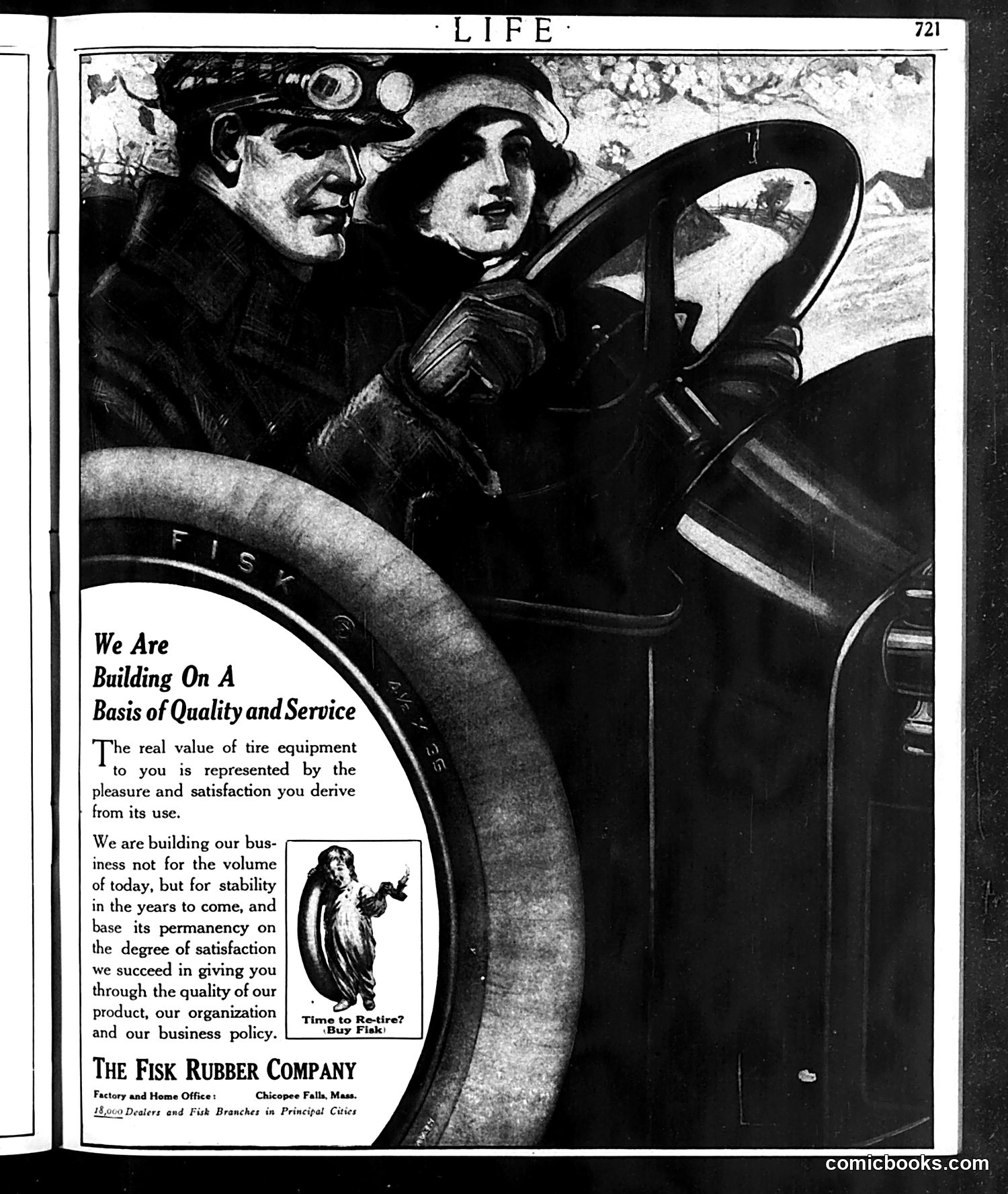
This is primarily a **product advertisement** rather than political satire. The image shows two people in an early automobile wearing goggles and driving attire, emphasizing the excitement and adventure of motorcar travel. The accompanying text promotes Fisk Rubber Company's tire equipment, claiming quality and service as their business foundation. A small inset cartoon features a fisherman character with the caption "Time to Re-tire? Buy Fisk" — a pun linking tire replacement to fishing (the company mascot appears to be a fish). For modern readers: this reflects the 1920s automotive boom when reliable tires were significant selling points, and when tire companies actively advertised in magazines like *Life*.
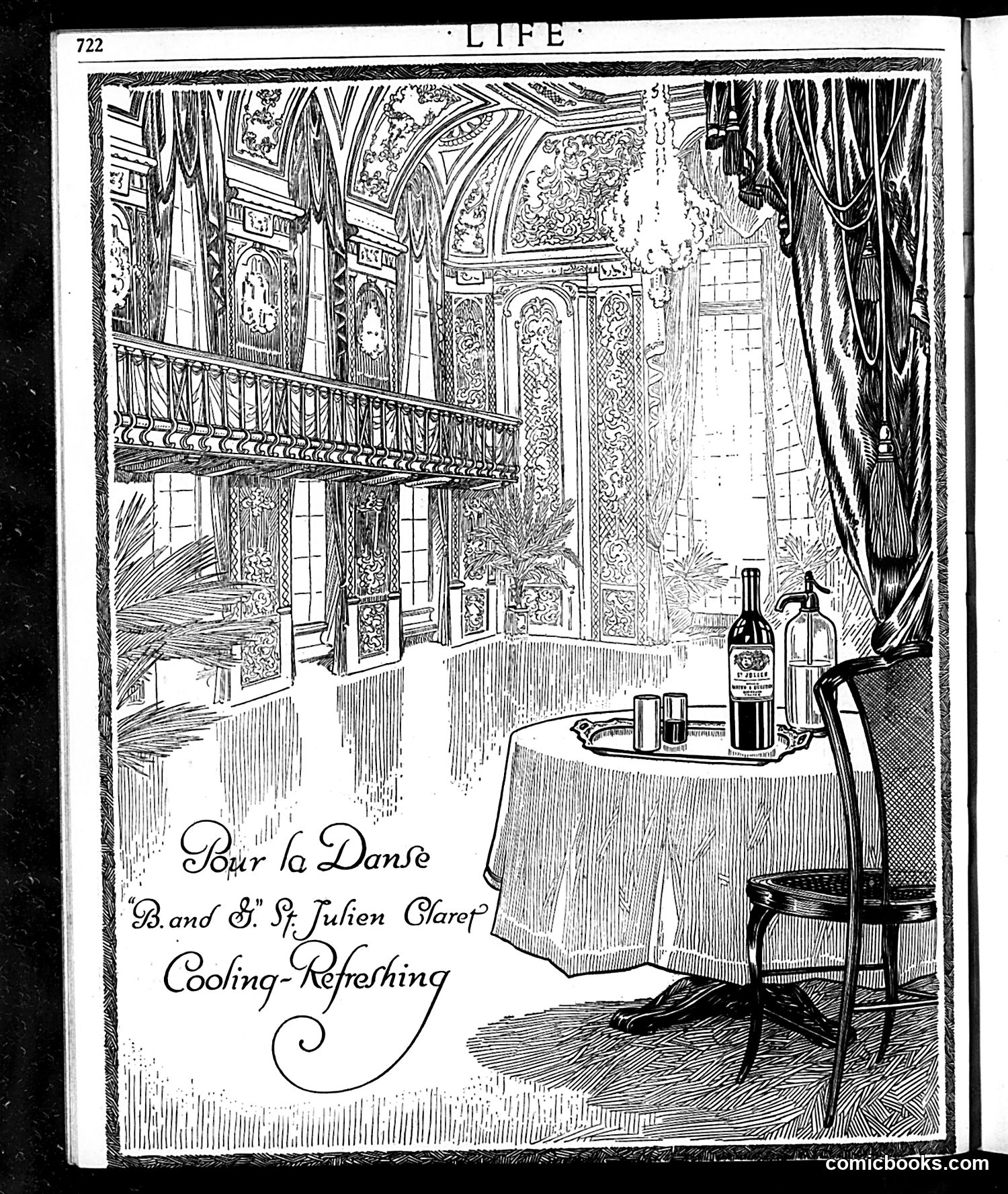
This page is primarily **advertising, not political commentary**. It depicts an elegant interior scene—a luxurious ballroom or salon with ornate ceiling, chandeliers, draped curtains, and classical architectural details. In the foreground sits a small table with bottles and glasses. The text reads "Pour la Danse" (For the Dance) and references "B. and S. St. Julien Claret" with the tagline "Cooling-Refreshing." This is a **wine advertisement** for a French claret wine, marketed as an appropriate beverage for social dancing occasions. The sophisticated interior setting and refined aesthetic aim to associate the product with elegance and leisure-class entertainment. No political satire or caricature appears to be present—this is commercial promotion typical of Life magazine's advertising content.
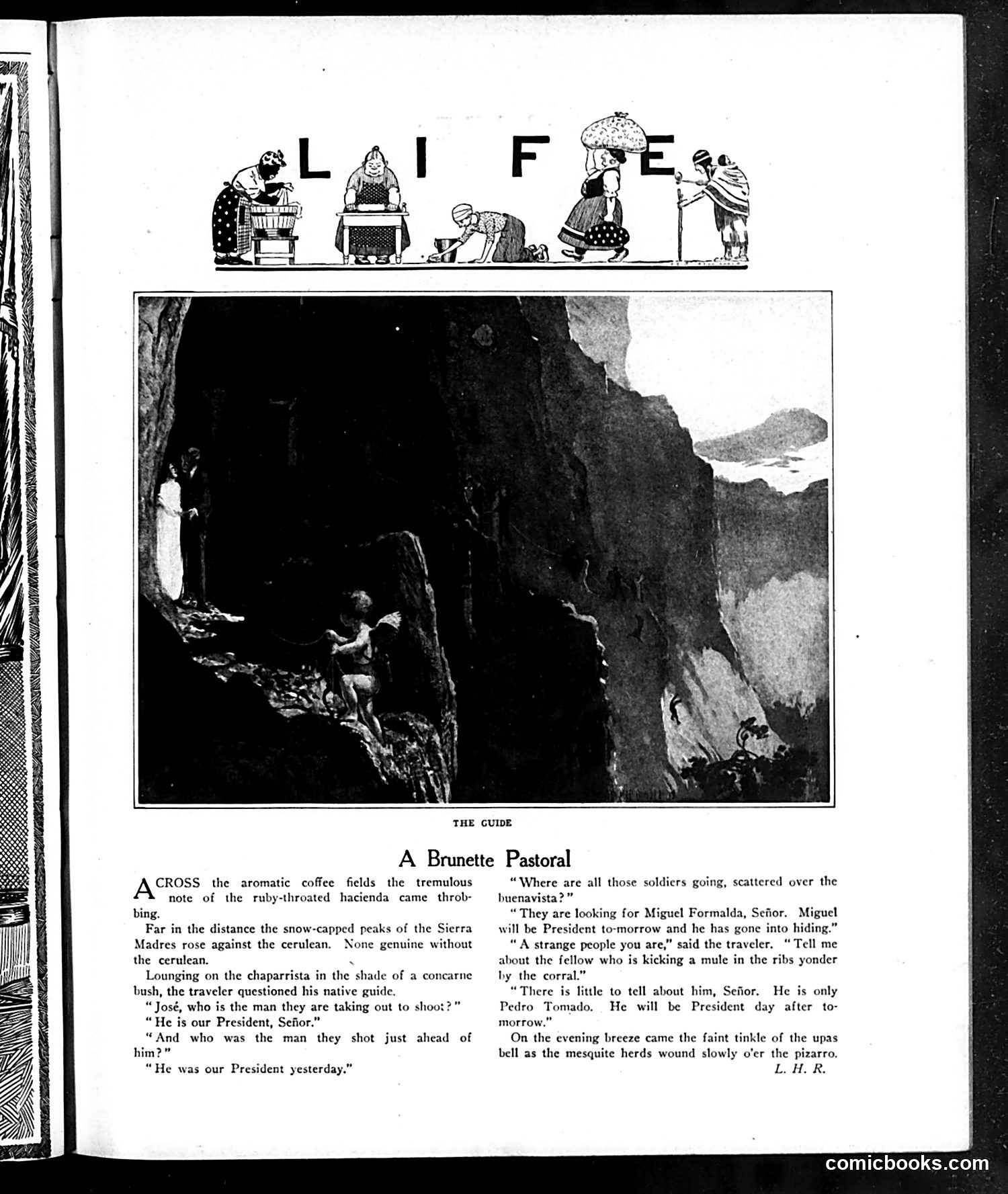
This page presents a short story titled "A Brunette Pastoral" by L.H.R., illustrated with a dramatic photograph of a cave or rocky gorge overlooking water. The narrative describes a traveler in what appears to be Latin America (references to Sierra Madres, coffee fields, hacienda) questioning a native guide about soldiers and executions. The dialogue reveals dark political commentary: they discuss a "President" who has been shot, another named Miguel Formaldi who will be "President to-morrow," and mention of "Pedro Tomado" as the next successor. The story satirizes the instability of Latin American politics through rapid presidential succession and violence, presenting it as absurdly routine. The guide's matter-of-fact responses ("He was our President yesterday") underscore the satirical point about political chaos and upheaval in the region.
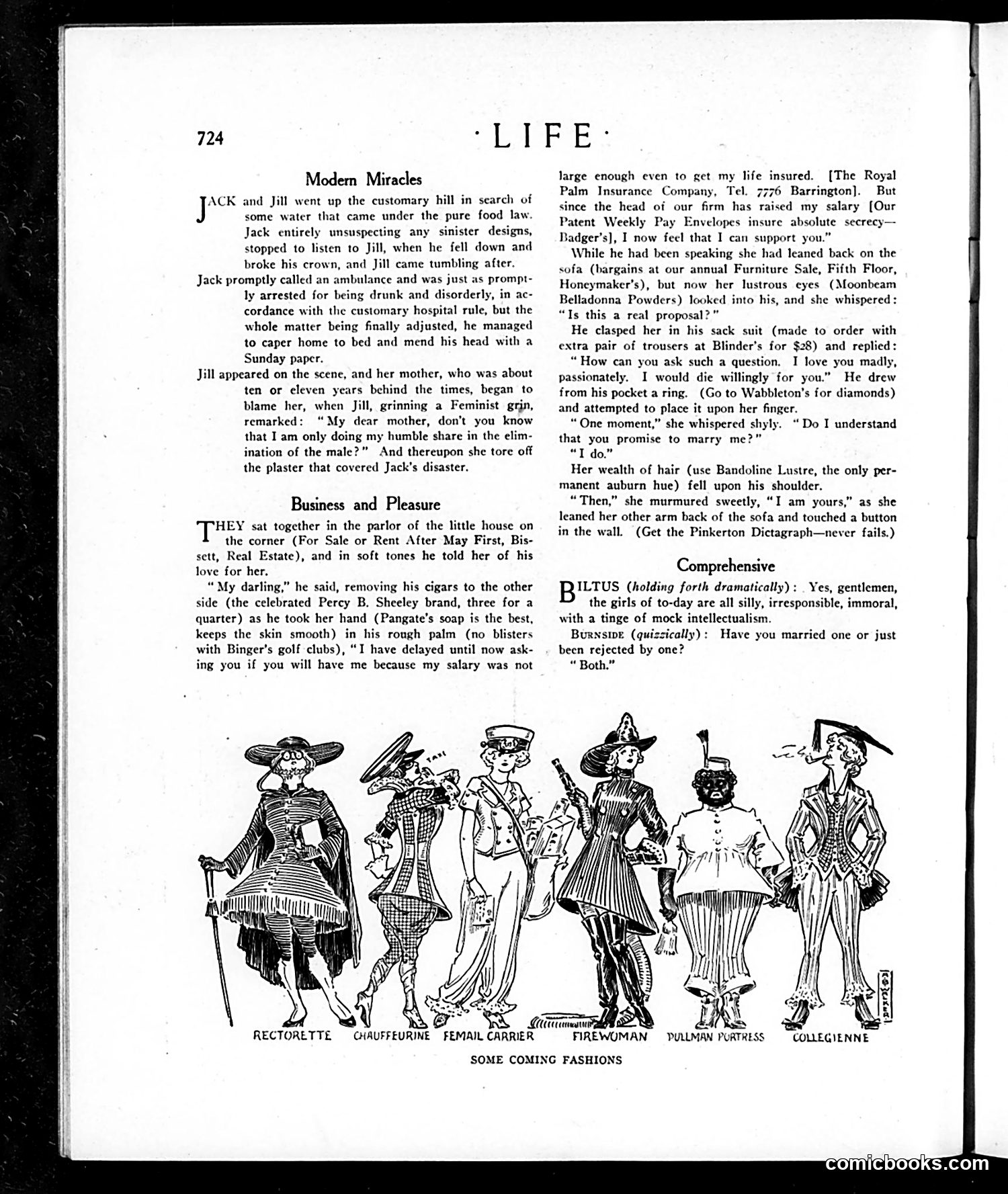
This page contains satirical short stories and a fashion illustration. The bottom illustration mocks emerging women's fashion trends through absurdist job-based costumes: "Rectorette," "Chauffeuse," "Female Carrier," "Firewoman," "Pullman Portress," and "Collegienne." The satire targets women entering traditionally male-dominated professions—suggesting their fashion would awkwardly combine feminine dress with job-specific attire. This reflects early 20th-century anxieties about women's expanding roles beyond homemaking. The stories above ("Modern Miracles" and "Business and Pleasure") use humor to comment on marriage, romance, and gender relations. The overall tone is light mockery of social change, typical of Life's satirical approach to contemporary issues.
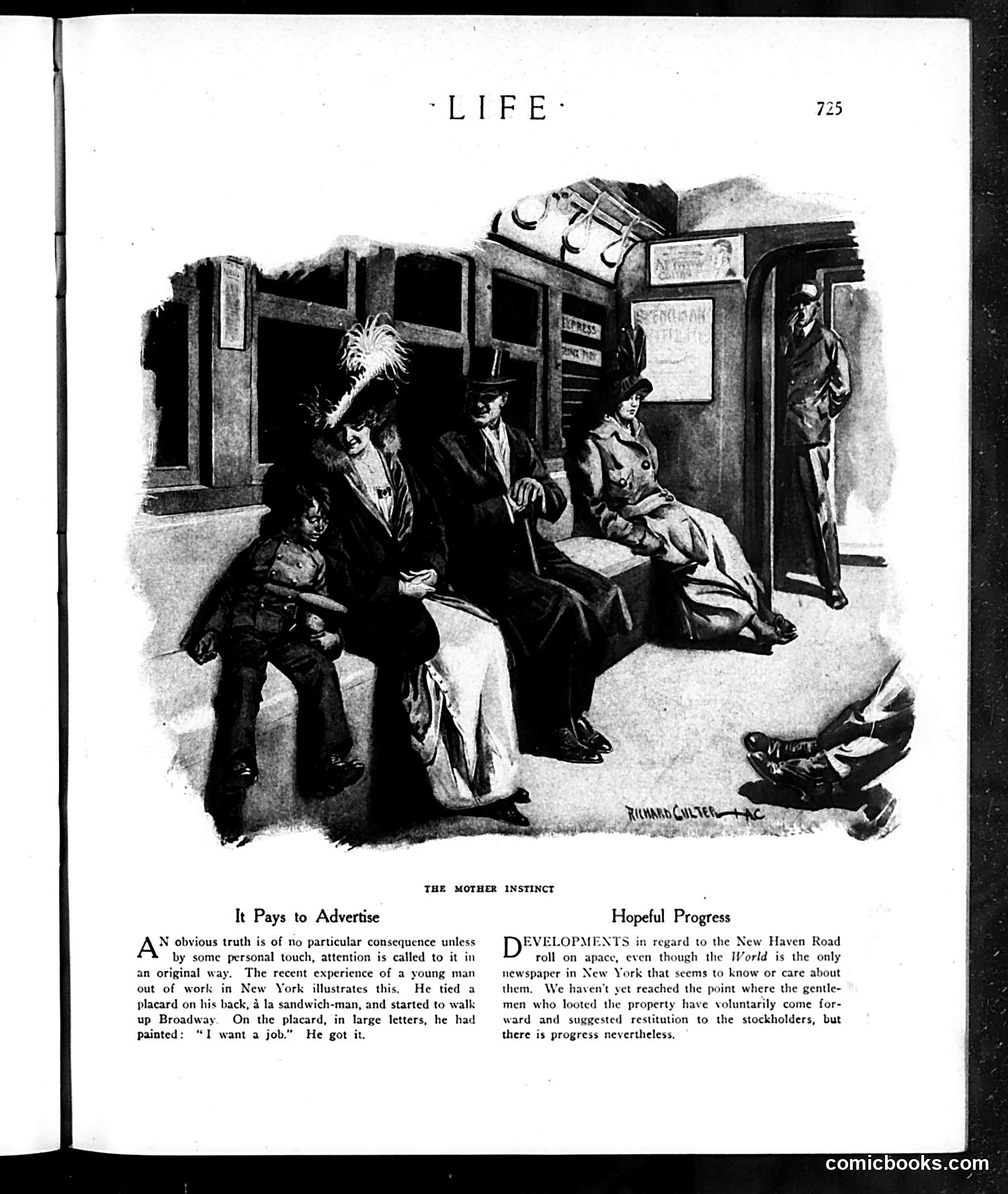
This is a satirical cartoon titled "The Mother Instinct" by Richard Culter, addressing social issues in early 20th-century New York. **The Scene:** A crowded tenement or public space shows working-class figures, including a small child. **The Satire:** The accompanying text describes a young unemployed man who literally advertised for work by wearing a sandwich board on Broadway reading "I want a job"—and successfully found employment. The cartoon illustrates this "obvious truth" that personal attention and direct appeal work better than conventional job-seeking. **The Social Commentary:** The "Mother Instinct" title suggests that someone (possibly a woman or maternal figure) responded to this direct appeal with compassion. The piece critiques how economic desperation forces such humiliating public displays while celebrating that human kindness—the "mother instinct"—can still intervene to help.
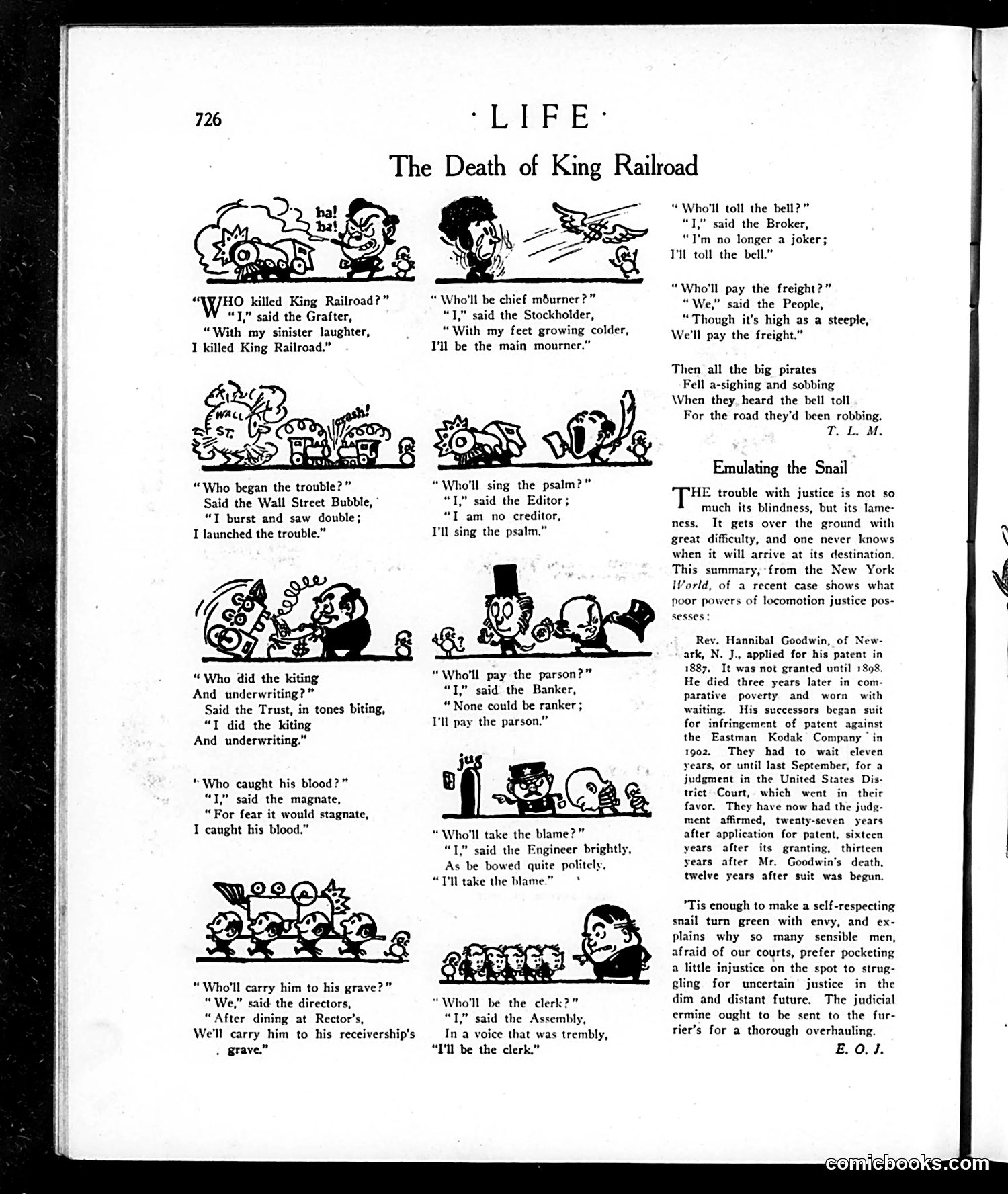
This is a satirical poem-and-cartoon sequence mocking corporate responsibility in early 20th-century American business. "King Railroad" represents the railroad industry itself, which the cartoon depicts as having caused harm (the "death"). Various figures—the Grafter, Stockholder, Wall Street Bubble, Editor, Trust, Magnate, Engineer, and others—all deflect blame for the railroad's problems. Each claims someone else bears responsibility: the Grafter blames his sister's laughter, the Stockholder blames his growing debts, the Engineer takes the blame reluctantly. The satire targets how corporate wrongdoing gets diffused across multiple parties, with no one accepting genuine responsibility. The accompanying article "Emulating the Snail" reinforces this critique through a legal case about patent justice delayed for twenty-seven years.
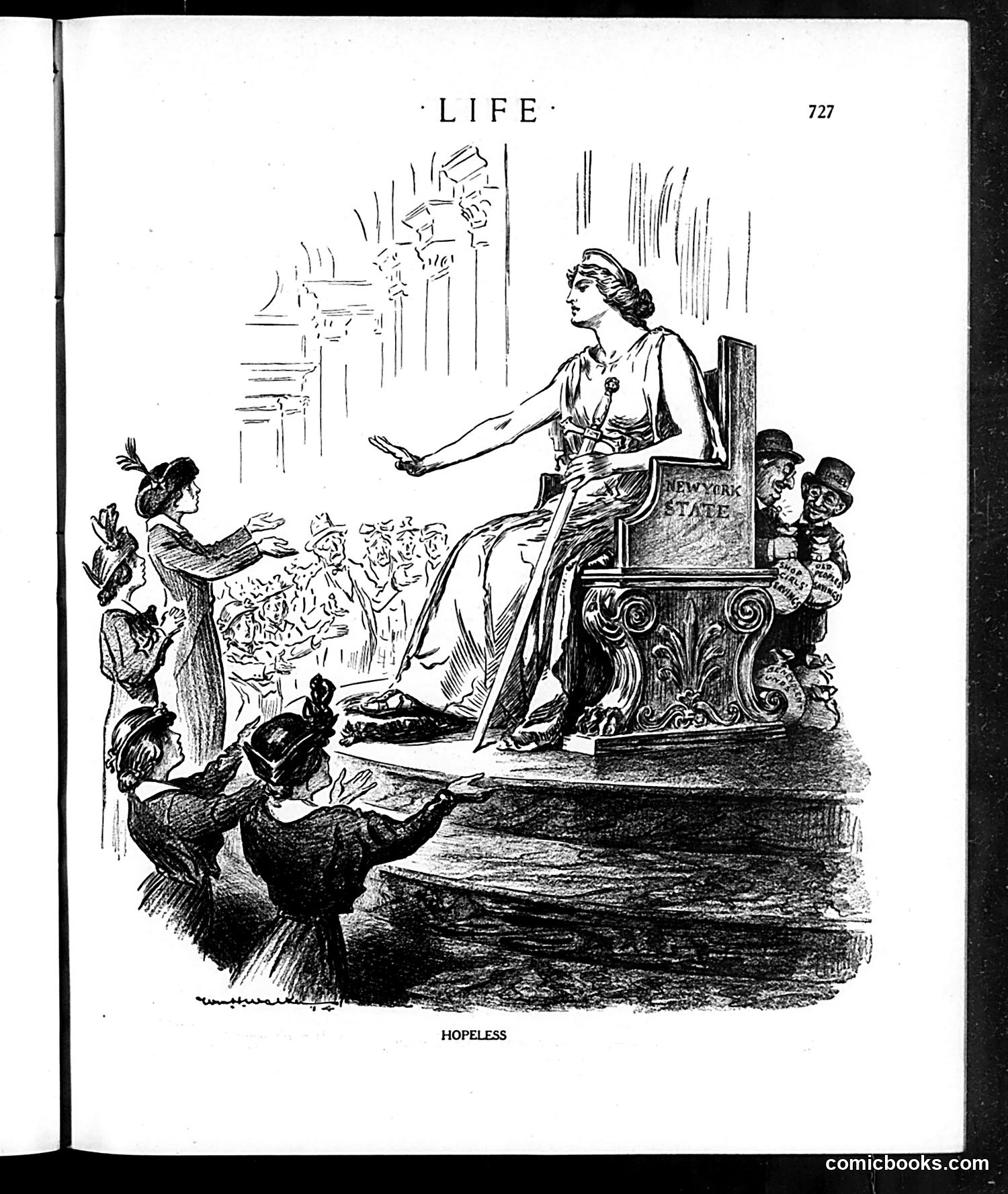
This satirical cartoon depicts a woman (likely representing New York State, as indicated by text on the throne) seated majestically on an ornate chair, gesturing dismissively to a crowd of petitioners below her. The title "Hopeless" suggests the cartoon critiques the state government's indifference to citizens' pleas or demands. The supplicants—appearing to include working-class figures and possibly political figures—seem to be appeals or requests that go unheeded. The contrast between the elevated, imperious woman on her throne and the desperate figures below emphasizes governmental unresponsiveness or corruption. The cartoon satirizes New York State politics as deaf to public needs, portraying state authority as arrogant and dismissive toward its constituents' legitimate concerns.
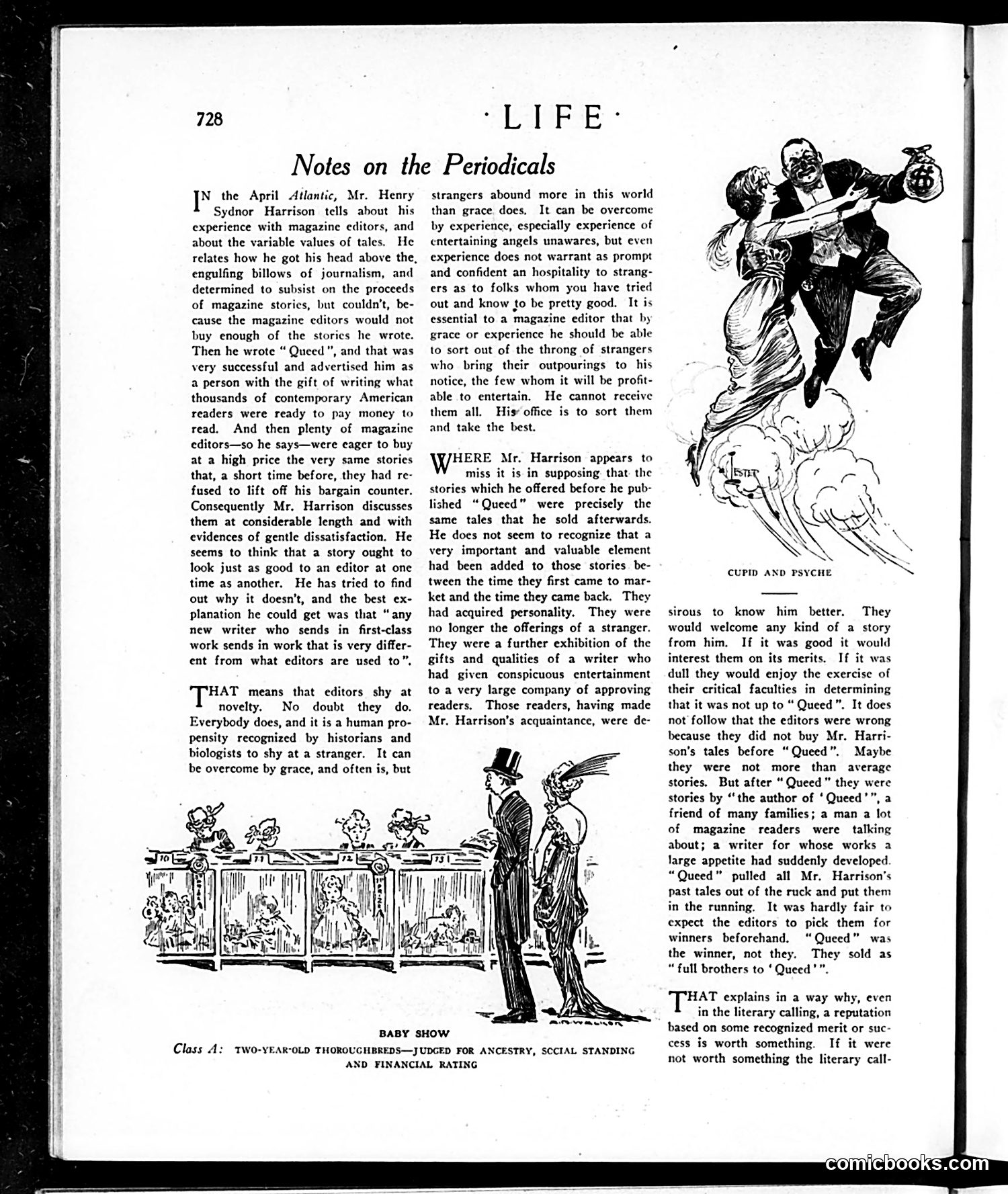
This page discusses magazine editorial practices, specifically referencing Henry Sydnor Harrison's experiences with editors. The text critiques editors who reject stories based on novelty rather than quality, noting that Harrison's previously rejected tales later became successful after he published "Queed" (his breakthrough work). The two illustrations satirize editorial gatekeeping: the top cartoon shows Cupid and Psyche (classical figures representing love and the soul), while the bottom depicts a "Baby Show" where figures in formal dress judge infants—a clear metaphor for editors judging literary submissions based on superficial criteria like pedigree and social standing rather than merit. The article argues that editors should evaluate work on quality alone, not reject stories simply because they're unfamiliar with the author.
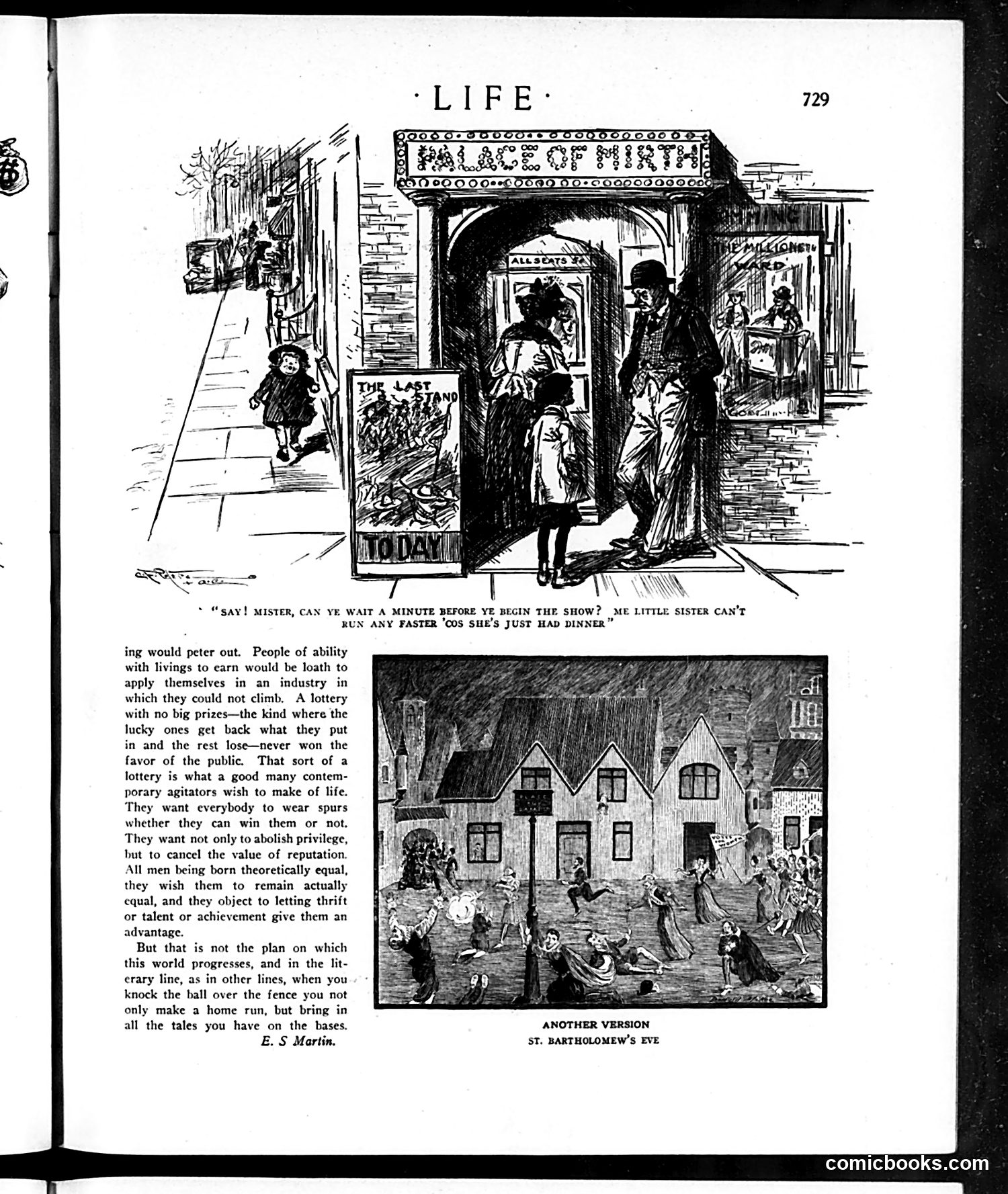
The top cartoon depicts a "Palace of Mirth" theater entrance where a man attempts to delay the show's start, explaining his sister cannot hurry because "she's just had dinner." This is a domestic humor joke about women's digestive processes and the social awkwardness of attending public entertainment with family members. The bottom illustration, titled "Another Version: St. Bartholomew's Eve," shows a village scene with numerous figures gathered outside a cottage. This appears to reference the historical St. Bartholomew's Day Massacre, though the image presents it as a gentler community gathering, likely creating ironic contrast between the historical event's violence and this peaceful domestic scene. The accompanying text discusses social equality and merit versus inherited privilege.
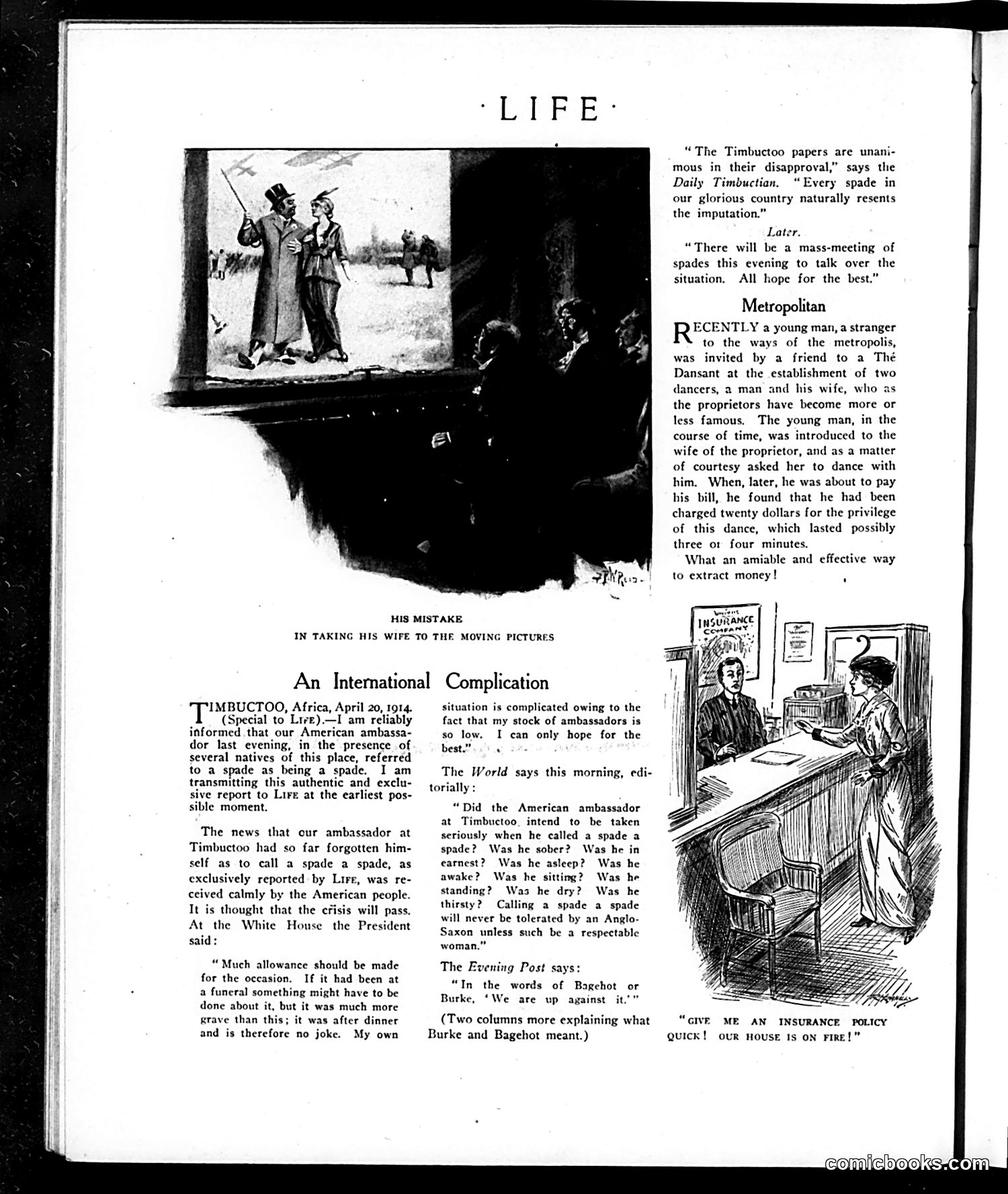
This page contains two satirical pieces about American diplomatic embarrassment in colonial Africa (1914). **"An International Complication"** mocks an American ambassador in Timbuctoo who called a native person a "spade" (a direct racial slur), creating international scandal. The satire targets American ignorance of diplomatic protocol and racist language abroad. Anglo-Saxon nations condemned the gaffe as intolerable even from "a respectable woman." **"His Mistake"** (top cartoon) shows a man taking his wife to a moving picture show, then being charged $20 for a brief dance with the proprietor's wife—a con-artist setup. It illustrates naive tourist exploitation. Both pieces satirize American foolishness: diplomatic insensitivity and gullible vulnerability to scams.
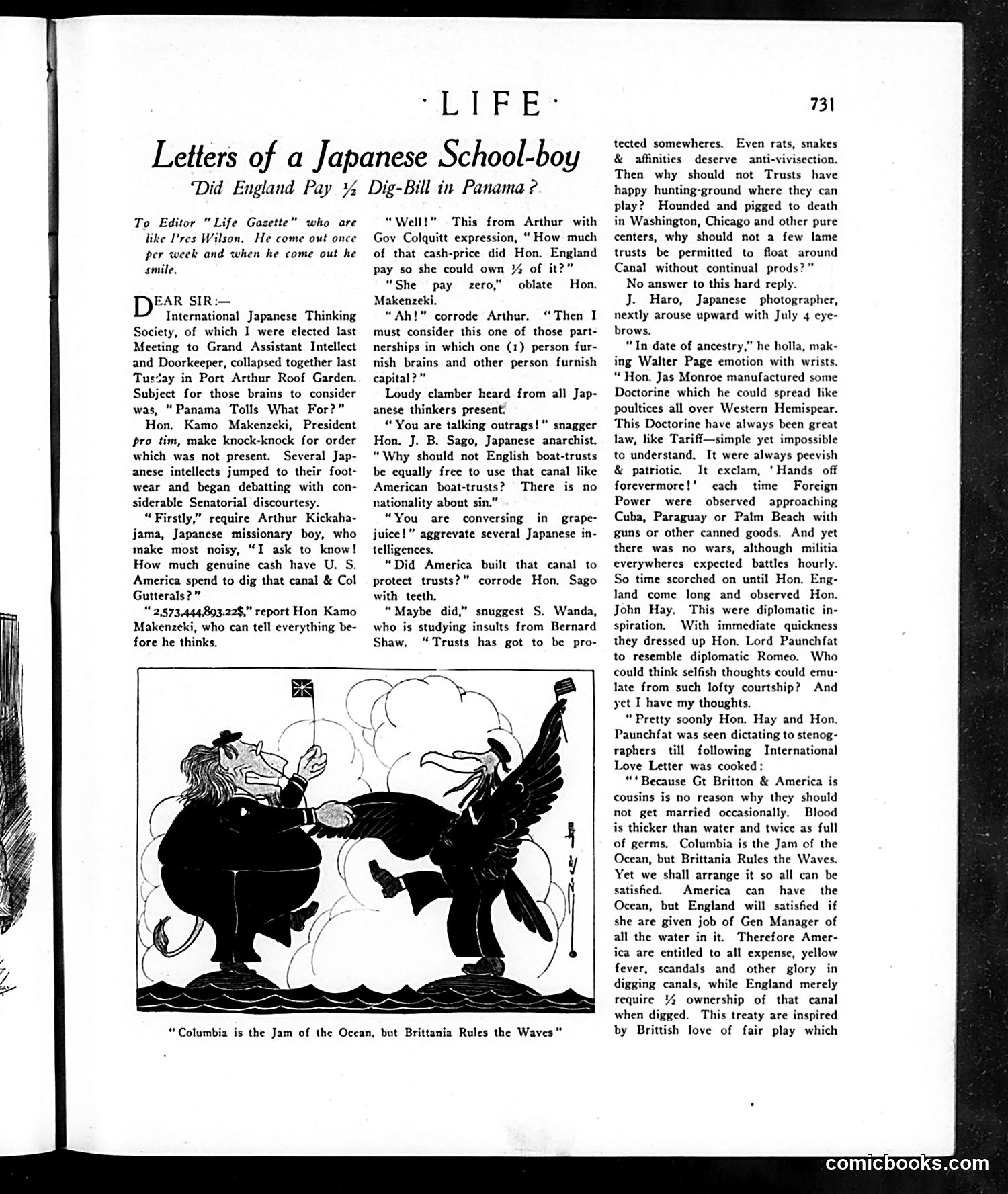
This piece satirizes American foreign policy through deliberately broken English attributed to Japanese observers. The framing device—a Japanese thinking society debating the Panama Canal—allows the magazine to critique U.S. expansionism and corporate interests indirectly. The central target is the Panama Canal tolls controversy: America spent $2.5 billion building it but charged British ships tolls, contradicting earlier agreements. The satirists highlight the hypocrisy: America claims neutrality while protecting its own business "trusts" (monopolies). References to Monroe Doctrine and Secretary of State John Hay mock America's self-righteous "moral" foreign policy as mere cover for imperial ambitions. The cartoon's caption ("Columbia is the Jam of the Ocean, but Britannia Rules the Waves") inverts the famous British patriotic song, suggesting America now dominates while Britain retreats. The satire suggests American idealism about protecting smaller nations masks naked commercial self-interest.
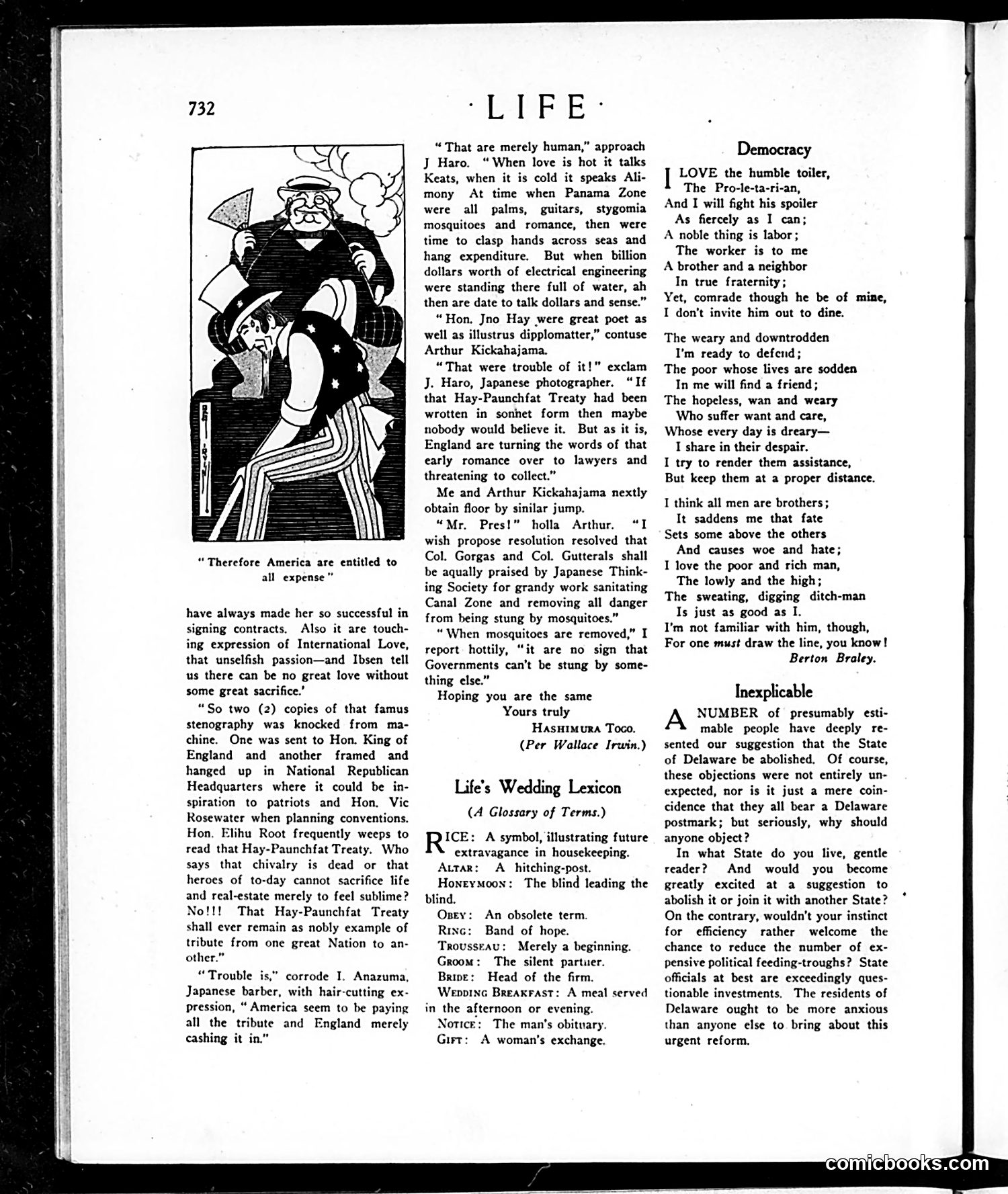
This page contains two distinct satirical pieces: **Left section:** A humorous dialogue (likely by Wallace Irwin, credited at bottom) mocking the Hay-Paunchfot Treaty between America and England. Japanese characters discuss how America gained the Panama Canal Zone through diplomatic romance-language, while England secured financial benefits. The satire suggests America made a poor deal—investing billions in engineering while England merely "cashed in." The crude dialect and caricature reflect period stereotypes. **Right section:** A poem titled "Democracy" that satirizes hypocritical progressive politics. The speaker claims deep solidarity with working-class laborers and the poor—yet refuses to actually associate with them socially. Each stanza contradicts itself, exposing the gap between professed ideals and actual conduct. The repeated refrain "but keep them at a proper distance" reveals the joke: performative compassion without genuine equality. Both pieces target political dishonesty through exaggerated contradiction.
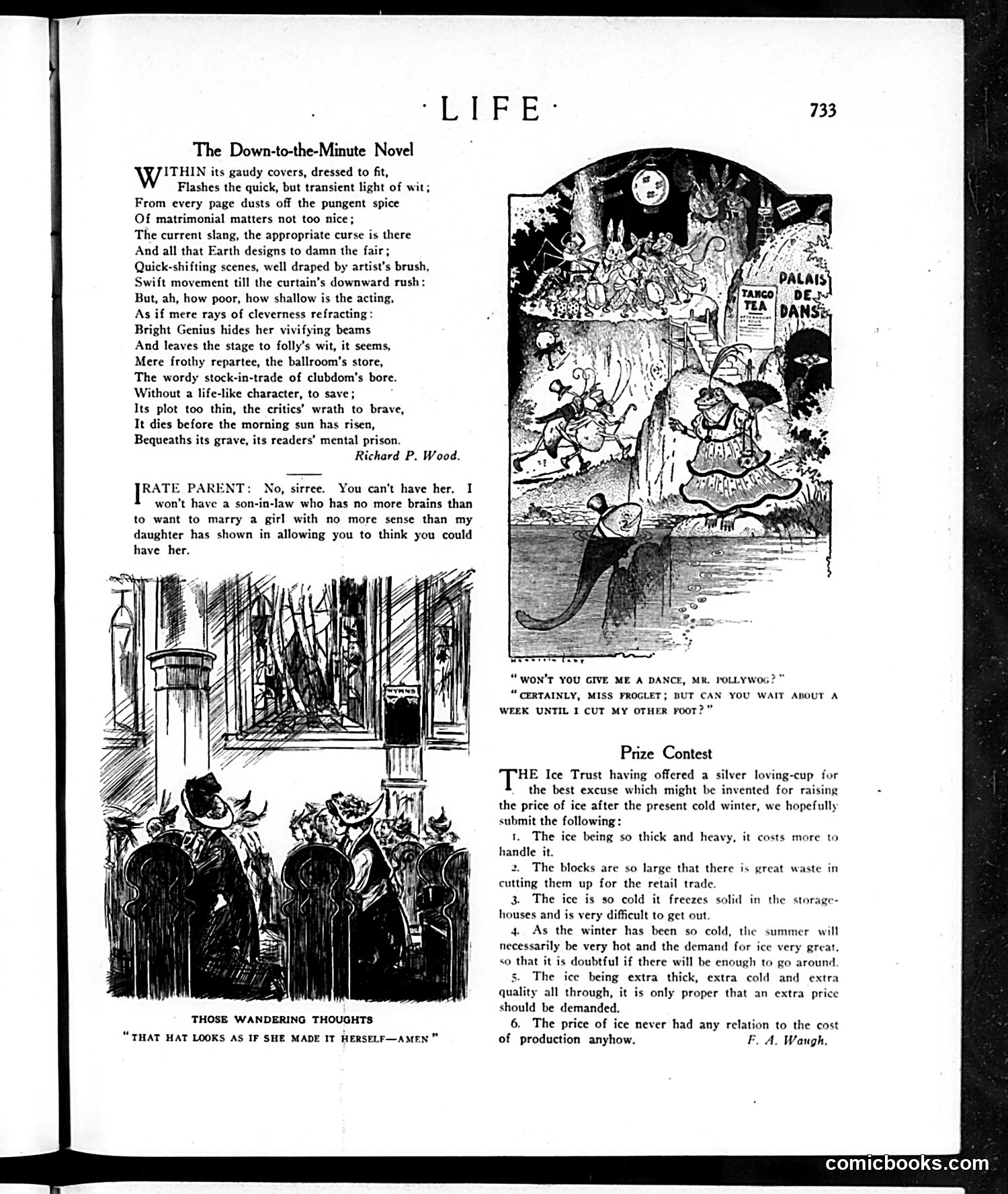
**Top Section - "The Down-to-the-Minute Novel":** Richard P. Wood's poem critiques contemporary pulp fiction—shallow, sensational novels with quick plots, trendy slang, and marital scandals. The satirical point: modern commercial fiction prioritizes flash over substance, lacking genuine characters or literary merit. It's disposable entertainment that dies quickly. **Middle Cartoon - "Those Wandering Thoughts":** A father refuses his daughter's suitor, declaring him unintelligent. The humor plays on the father's own apparent vanity, suggesting his daughter inherited her lack of sense from him. **Bottom - "Prize Contest" (The Ice Trust Satire):** The most pointed satire: Life mockingly lists absurd excuses the Ice Trust might use to justify raising prices after an unusually cold winter (which should lower costs). Points like "the ice is too cold to remove" or "extra-cold ice deserves extra price" expose corporate pricing manipulation as cynical and nonsensical. This satirizes monopolistic business practices of the era.
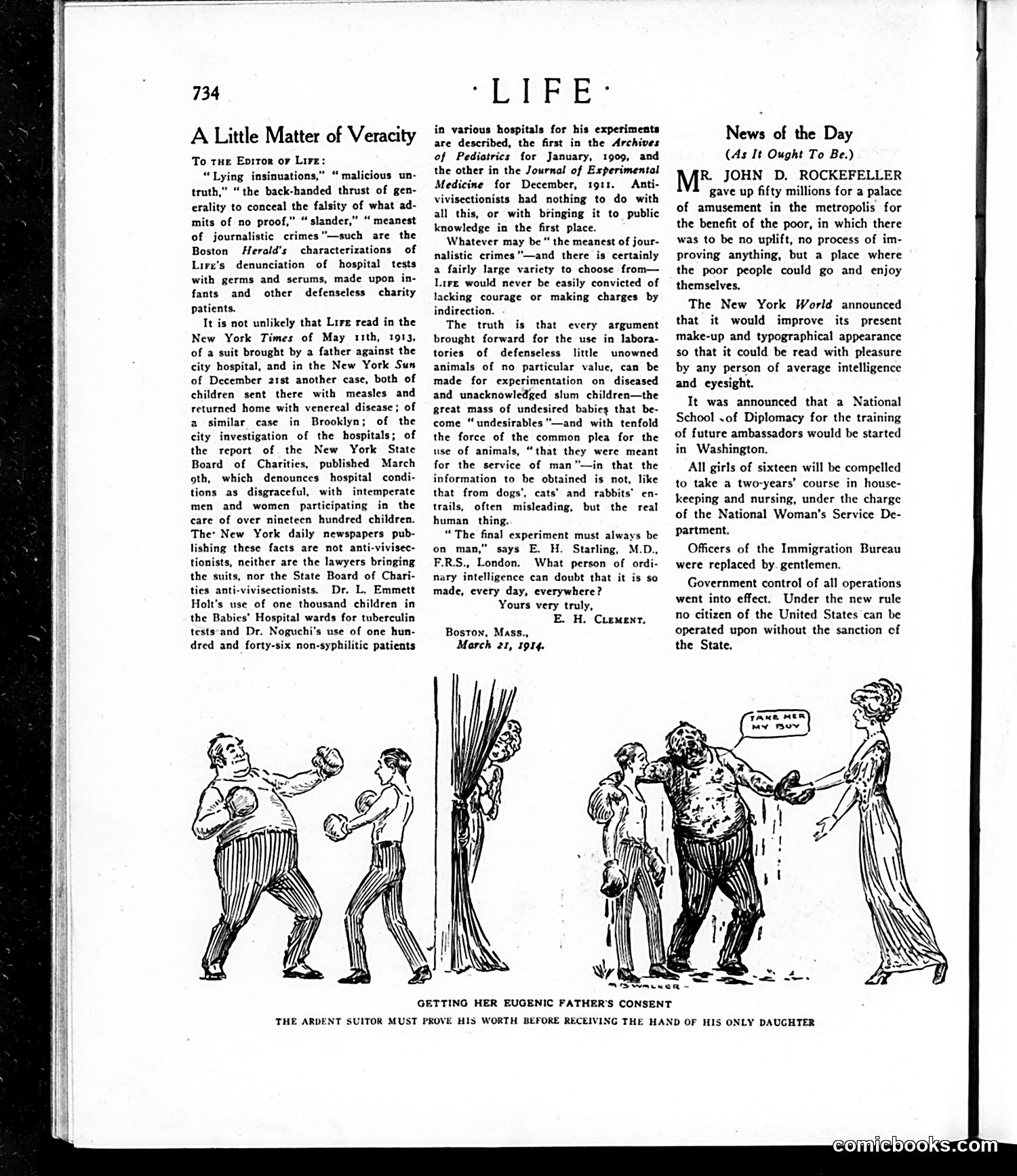
This page contains satirical commentary on medical ethics and eugenic policy. The main letter criticizes attacks on *Life* magazine for exposing unethical hospital experiments on poor children, defending *Life*'s investigative journalism against charges of "lying insinuations." The writer documents actual cases where children sent to hospitals with measles contracted venereal disease, citing legitimate newspaper reports and state investigations. The letter argues that experiments on vulnerable slum children are morally indefensible, using the same logic applied to animal testing. It references Dr. L. Emmett Holt and Dr. Noguchi's documented experiments on hospital patients. The cartoon below satirizes eugenic marriage requirements, showing a suitor needing to prove his "worth" to an "eugenic father" before winning his daughter's hand—mocking contemporary eugenic ideology's pretensions. The "News of the Day" section offers ironic commentary on Rockefeller's amusement palace and compulsory nursing training for sixteen-year-old girls.
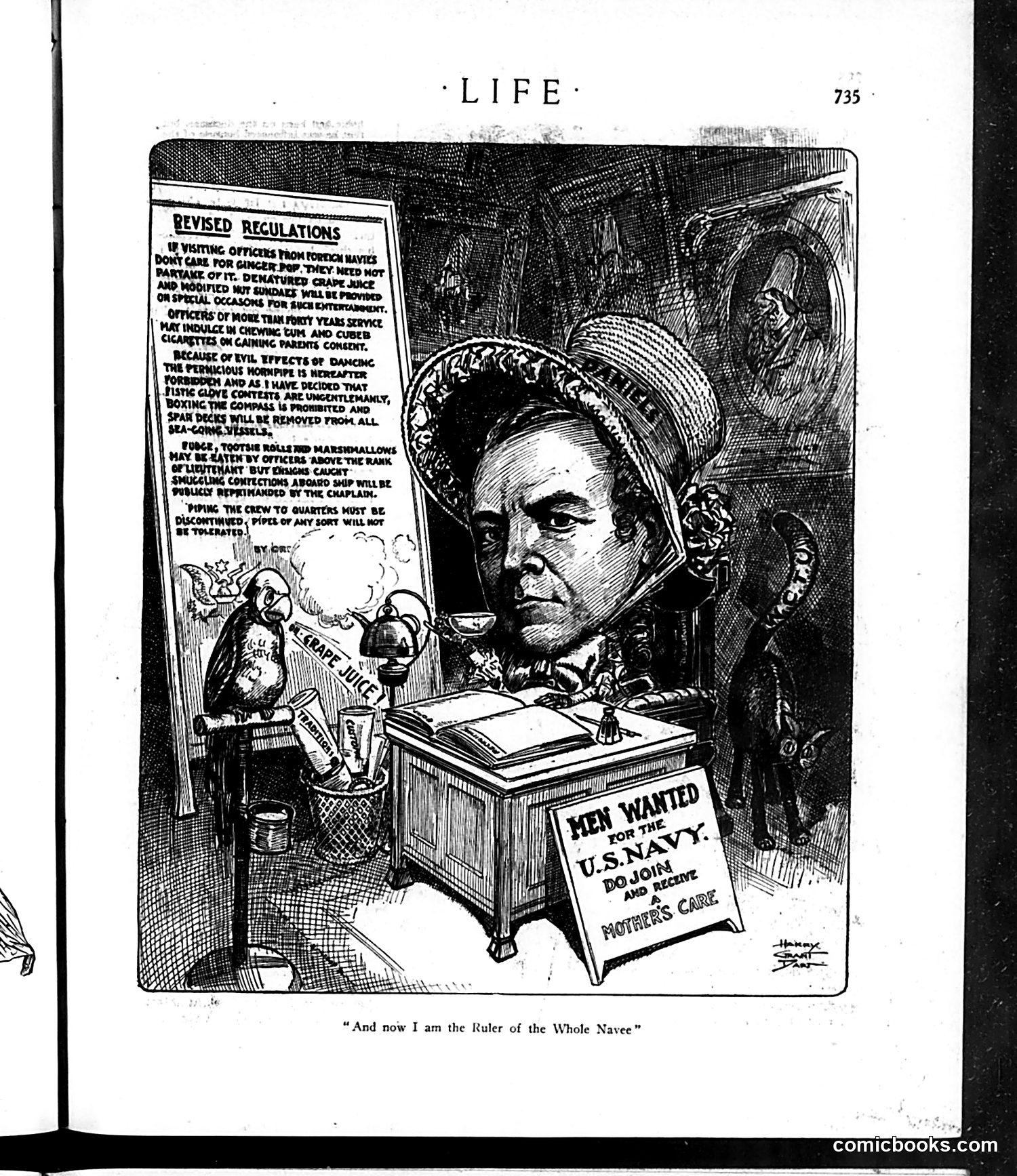
This satirical cartoon mocks Navy regulations through a caricatured figure seated at a desk, labeled "Men Wanted for the U.S. Navy. Do Join and Receive Mother's Care." The figure appears to be a stern authority imposing strict rules, ironically contrasted with the "Mother's Care" recruitment message. The "Revised Regulations" poster behind him lists absurd prohibitions: officers cannot care for ginger ale or grape juice, no chewing gum or cigarettes permitted, static glove contests banned, boxing prohibited, and various crew restrictions. The caption—"And now I am the Ruler of the Whole Navee"—suggests pompous, overreaching authority figures micromanaging sailors' lives. The satire critiques excessive naval regulations and paternalistic discipline, mocking how recruitment promises of care contrast sharply with the actual restrictive, rule-heavy Navy experience.
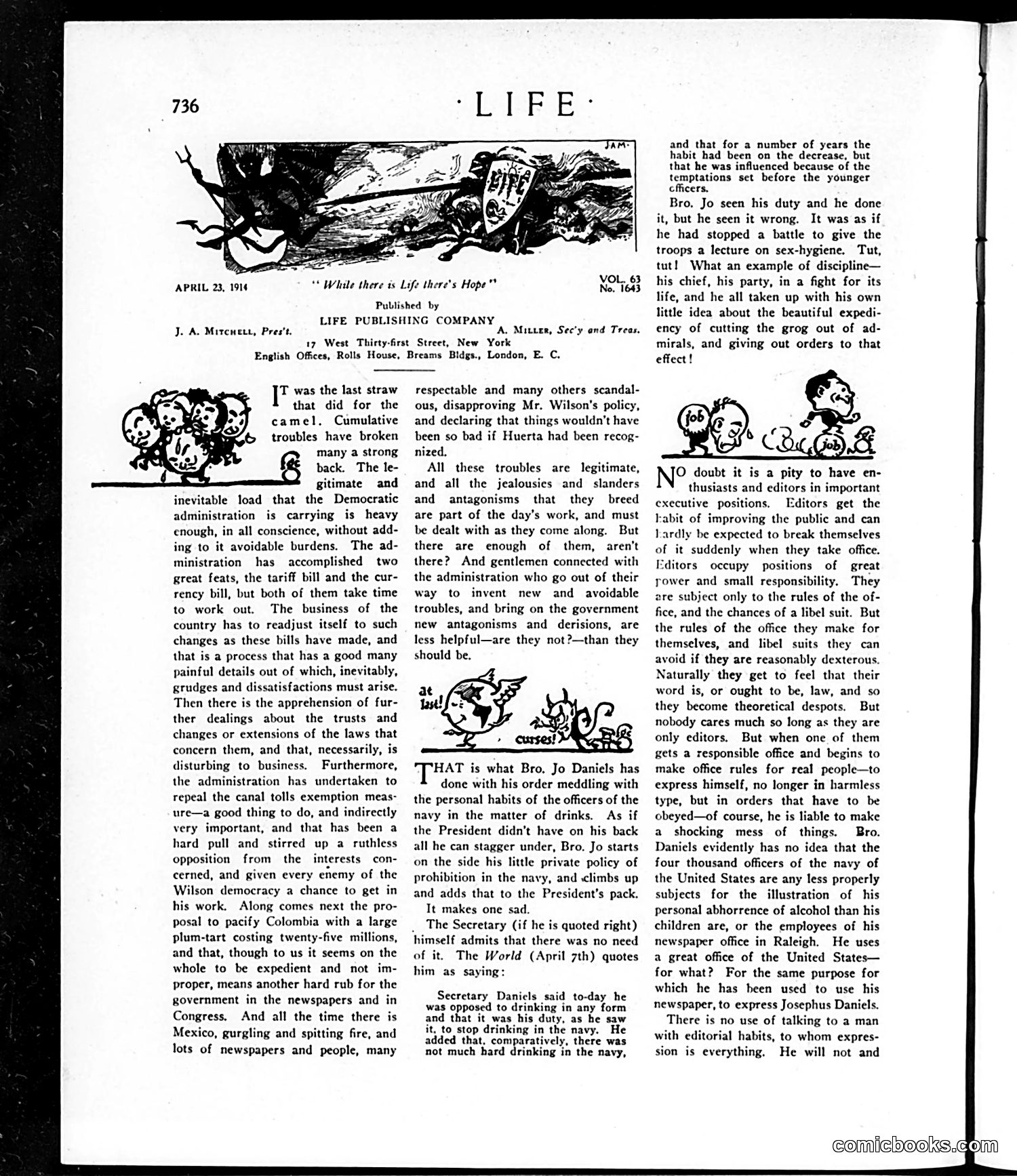
This page satirizes Secretary of the Navy Josephus Daniels for issuing an order restricting alcohol consumption among naval officers. The cartoon's central complaint: Daniels created an *unnecessary* problem during an already crisis-laden Wilson administration. The article catalogs legitimate challenges facing President Wilson—tariff reform, currency legislation, Colombia relations, and Mexico's instability—arguing the government has enough burdens without self-inflicted ones. Daniels admitted drinking in the navy was already declining and relatively minor, yet pursued prohibition anyway based on personal conviction. Life's satire is scathing: Daniels resembles a commander stopping a battle to lecture troops on hygiene—prioritizing his moral crusade over the administration's survival needs. The point: even well-intentioned reforms become harmful when they distract leadership from genuine crises. Daniels' private policy undermined his president's political position unnecessarily.
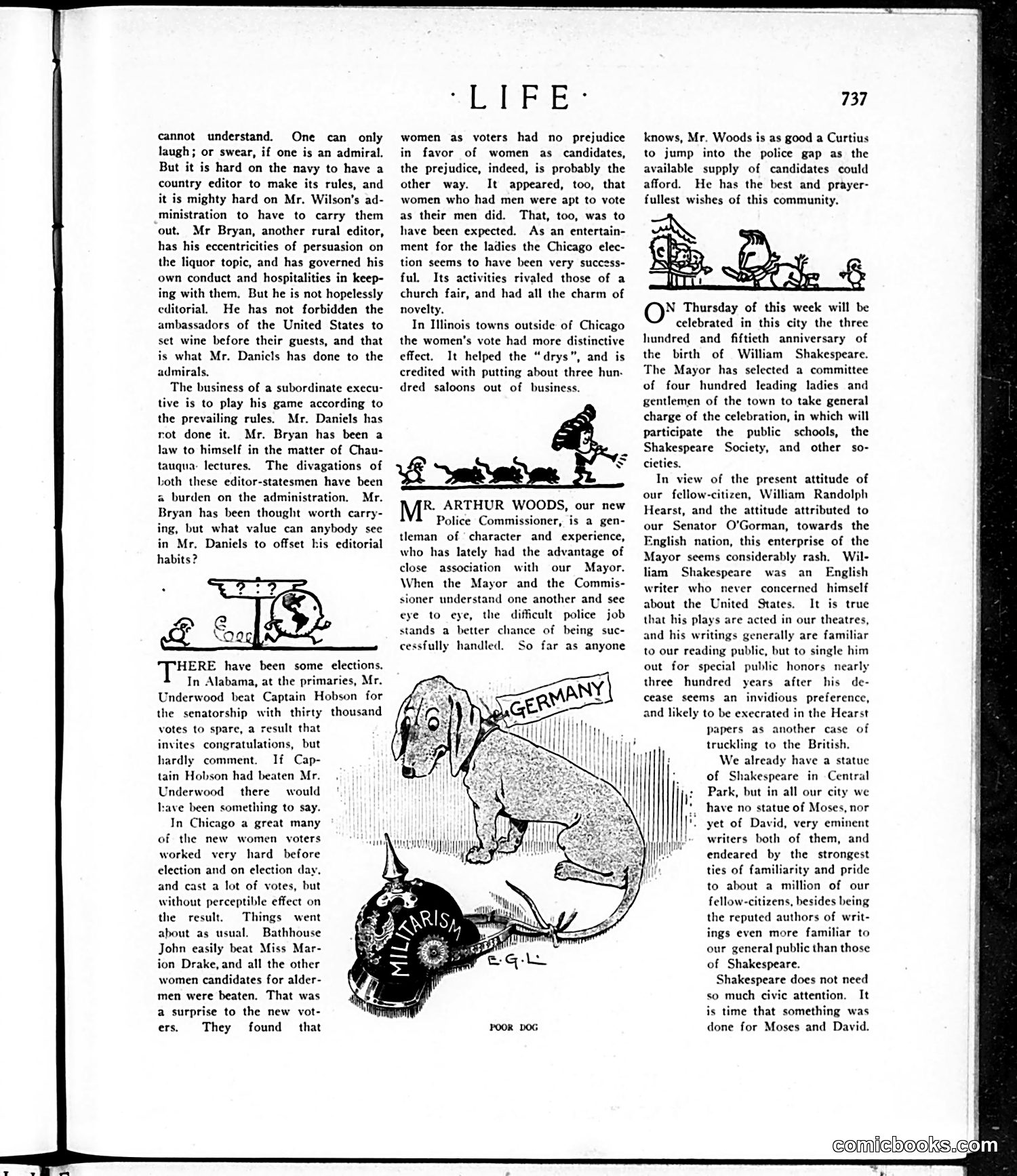
This page contains political commentary on Wilson administration officials and New York civic matters. **Main cartoon**: A dachshund labeled "Germany" and a bulldog labeled "Militarism" fight over a bone marked "Poor Dog." This satirizes European militarism and the arms race, likely reflecting American concerns about pre-WWI tensions. **Text satire**: The article criticizes Secretary of the Navy Josephus Daniels for imposing his editorial views (particularly a ban on alcohol at naval functions) on the military establishment, comparing him unfavorably to William Jennings Bryan. The writer argues subordinate executives should follow prevailing rules, not impose personal ideology. **Chicago elections commentary**: Women's newly gained voting rights are mocked—female candidates lost to male incumbents like "Bathhouse John," and women largely voted as their husbands did. The piece suggests women's suffrage was entertainment rather than transformative, though acknowledging women voters did help prohibition efforts. **Shakespeare celebration**: The final section expresses skepticism about New York celebrating Shakespeare given anti-British sentiment from William Randolph Hearst and Senator O'Gorman.
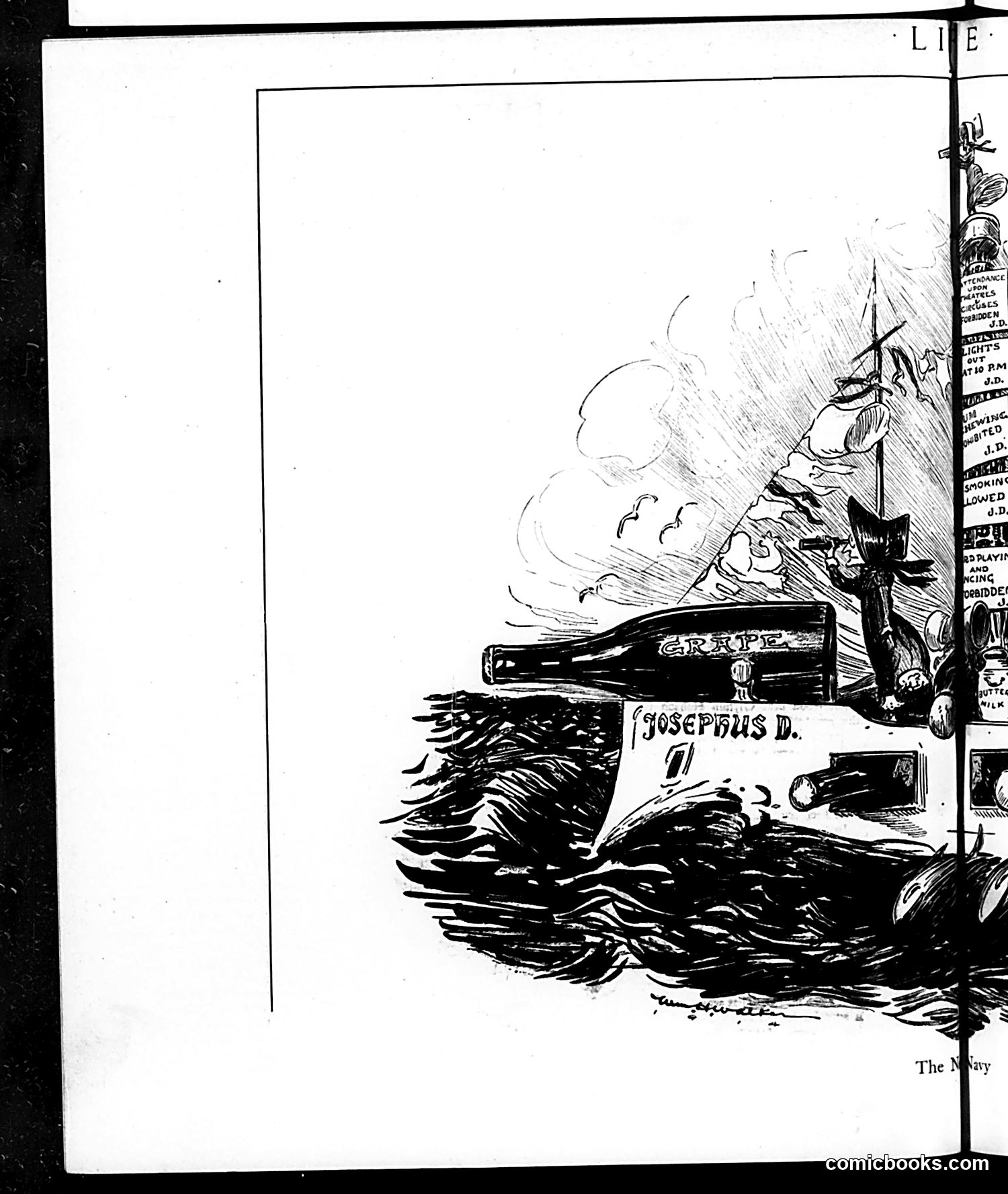
This page features a political cartoon labeled "The Navy," depicting what appears to be a coffin labeled "JOSEPHUS D." surrounded by grape vines or similar vegetation, with smoke rising above it. A naval vessel or ship structure is visible in the composition. The reference to "Josephus D." likely refers to **Josephus Daniels**, Secretary of the Navy under President Woodrow Wilson. The coffin imagery suggests satirical criticism of naval policy under his administration—possibly addressing concerns about military readiness, budget cuts, or administrative decisions perceived as harmful to naval strength. The cartoon's dark tone and use of a coffin as the central symbol indicates this was pointed political criticism of Daniels' tenure, though the specific policy being critiqued requires additional historical context.
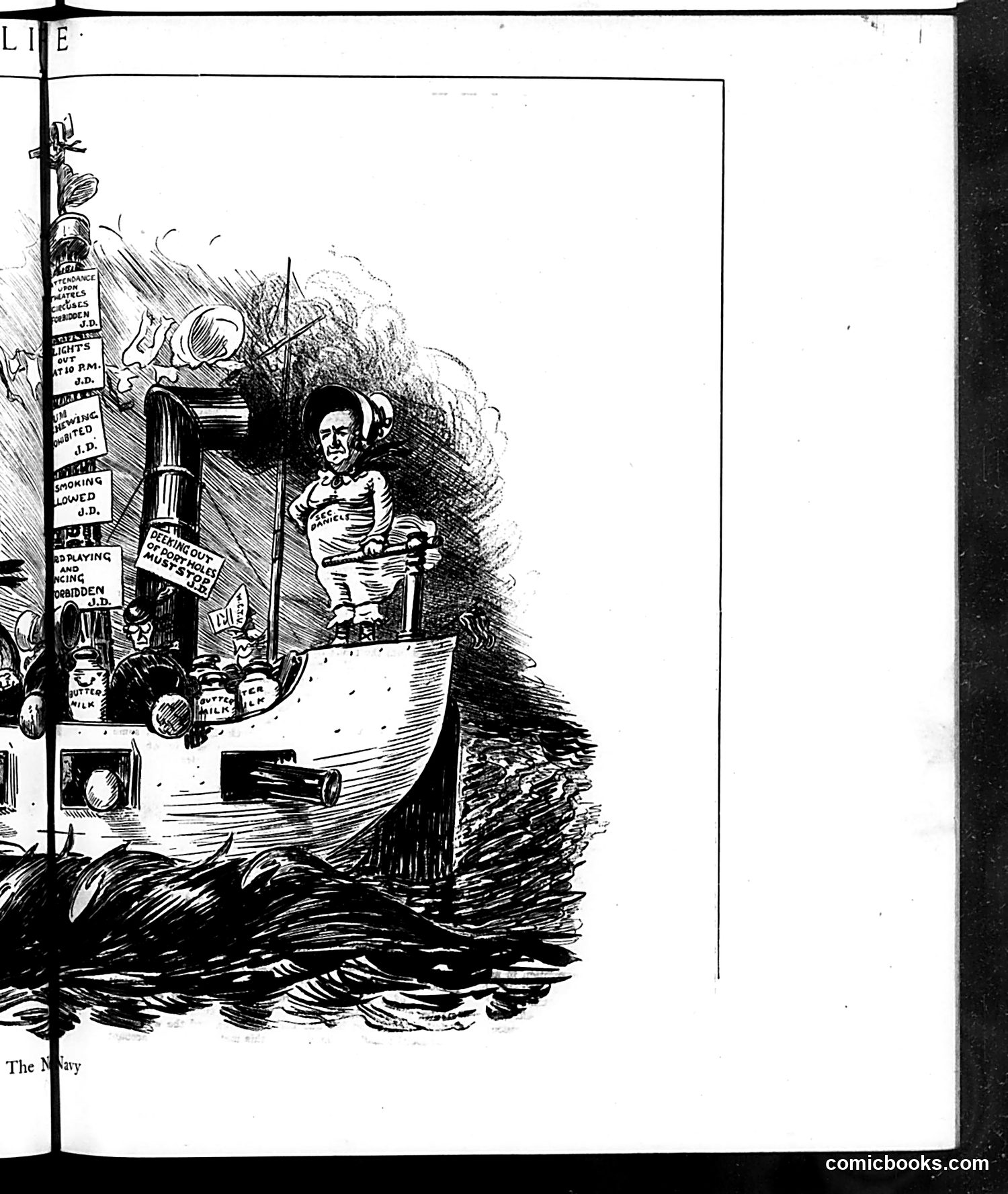
This political cartoon depicts a naval vessel as a lighthouse or tower stacked with various regulations and prohibitions. A sailor stands on the vessel's arm/gun, surrounded by signage listing rules: "SMOKING FORBIDDEN," "DRINKING FORBIDDEN," "LIGHTS OUT AT 10 P.M.," and other restrictions. The satire critiques the Navy's extensive regulations and rigid discipline—the joke being that the sailor is so constrained by rules that he can barely function. The tower of regulations literally overshadows the vessel itself, suggesting the institution prioritizes rules over practical naval operations. This likely reflects early 20th-century criticism of military bureaucracy and the tension between strict military discipline and sailors' personal freedoms. The cartoon uses visual stacking to emphasize how oppressive and all-encompassing these regulations felt.
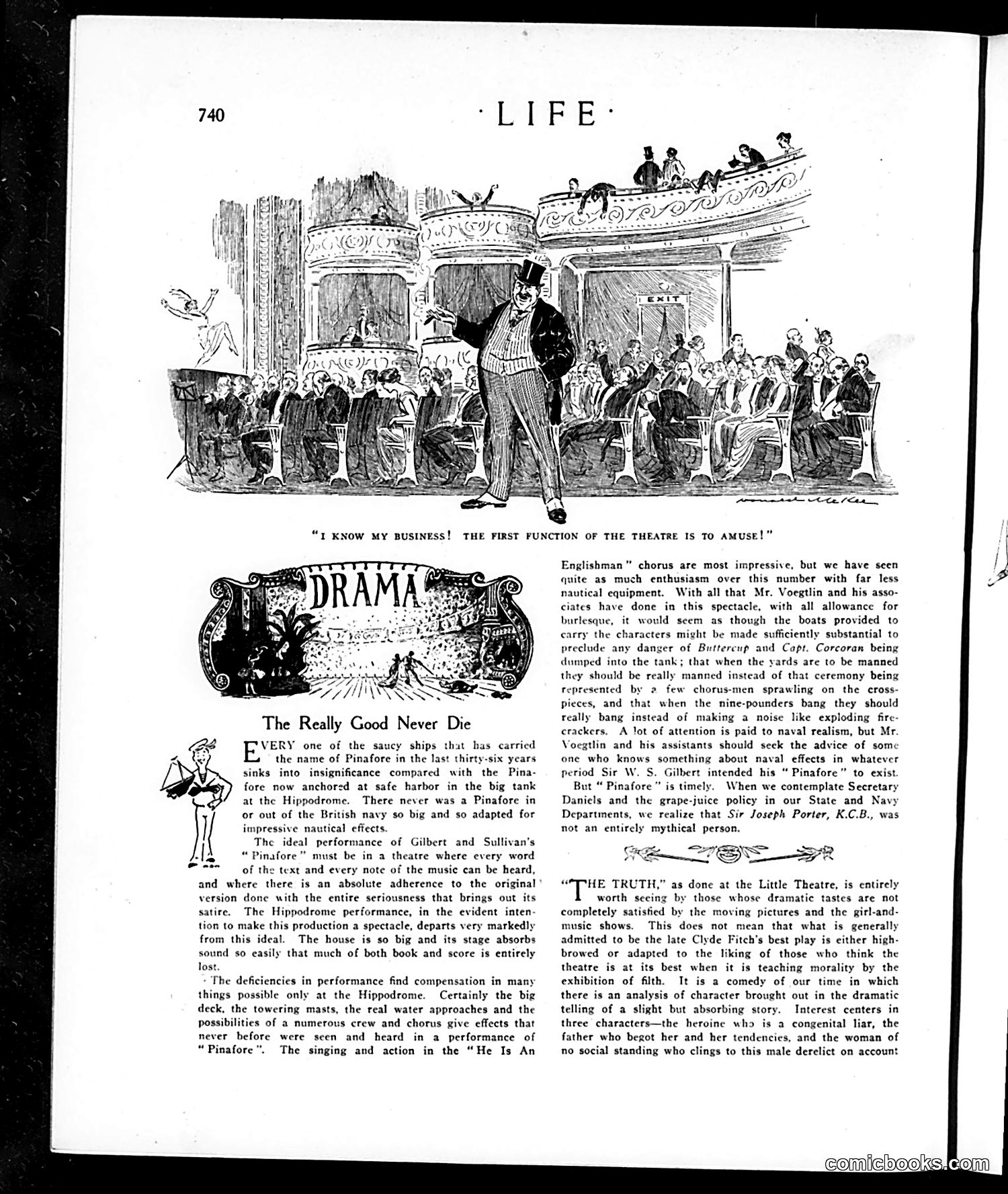
This page reviews theatrical productions, primarily focusing on a lavish Hippodrome staging of Gilbert and Sullivan's *H.M.S. Pinafore*. **The Cartoon:** The top illustration depicts a theater manager or producer (likely representing the Hippodrome's production team) standing before an audience in an ornate theater, gesturing confidently. The caption "'I Know My Business!' The First Function of the Theatre Is to Amuse!" appears to satirize the producer's confidence in prioritizing spectacle over artistic fidelity. **The Satire:** The review critiques the production's emphasis on massive naval sets and visual effects at the expense of the original work's satirical intent. The critic argues that *Pinafore's* "entire seriousness" and word clarity get lost in the Hippodrome's enormous auditorium and elaborate staging—sound is absorbed, performances diluted. **Social Reference:** A footnote references Secretary Daniels and the Navy Department's "grape-juice policy" (Prohibition), suggesting *Pinafore's* satire of bureaucratic incompetence remains timely. The page essentially argues that bigger production values don't guarantee better theater.
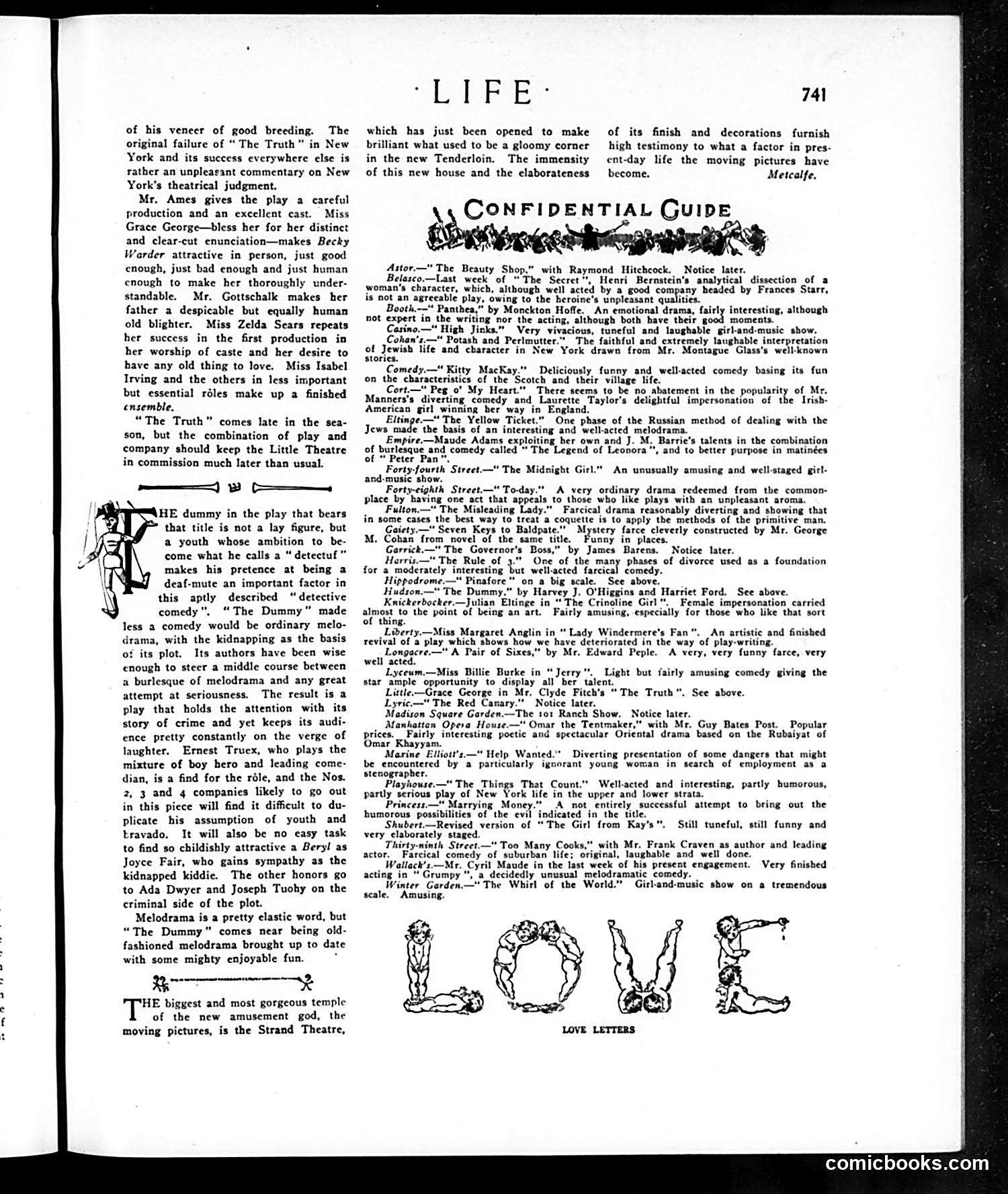
This page is primarily **theater reviews** rather than political satire. It discusses Broadway productions from the early 20th century, including "The Truth," "The Dummy," and various other plays. The only cartoon element is the decorative **"LOVE LETTERS"** illustration at the bottom—cherubic figures forming letters spelling that phrase. This appears to be a humorous advertisement or section header rather than political commentary. The substantive content reviews contemporary theatrical productions, praising or critiquing actors like Grace George, Ernest Truex, and others. There's also notice of the newly-opened Strand Theatre, described as a grand "temple" to the emerging entertainment medium of motion pictures—reflecting early cinema's cultural significance. The tone is critical but theatrical rather than political. No identifiable political figures or satirical targets appear. This is essentially **entertainment journalism** with light decorative art, typical of Life's mixed content format.
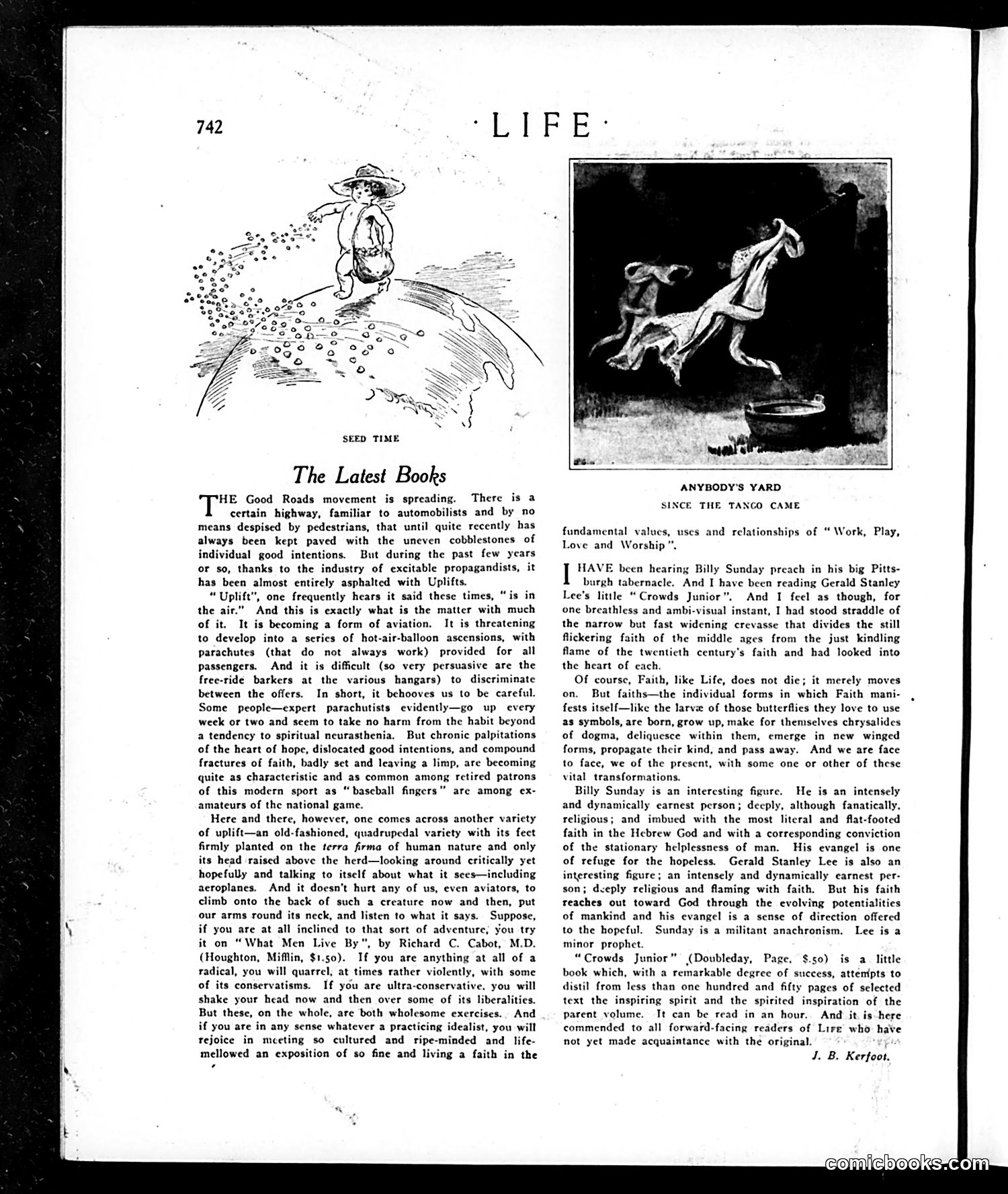
The left illustration satirizes the "Good Roads movement" and the broader "Uplift" craze of the era. A farmer sows seeds from atop a pig—visual metaphor for how modern uplift movements (social reform initiatives) are becoming ungrounded and frivolous. The text explains that "Uplift" has become fashionable but increasingly detached from reality, "becoming a form of aviation" with "hot-air-balloon ascensions." The cartoon mocks this disconnect: true reform should be grounded in practical human nature ("terra firma"), not abstract idealism. The right photograph titled "Anybody's Yard Since the Tango Came" shows people dancing the tango—a contemporary dance scandal. This likely references moral panic over the tango's perceived lewdness and threat to traditional values, connecting thematically to the page's broader critique of modern fads undermining stable institutions.
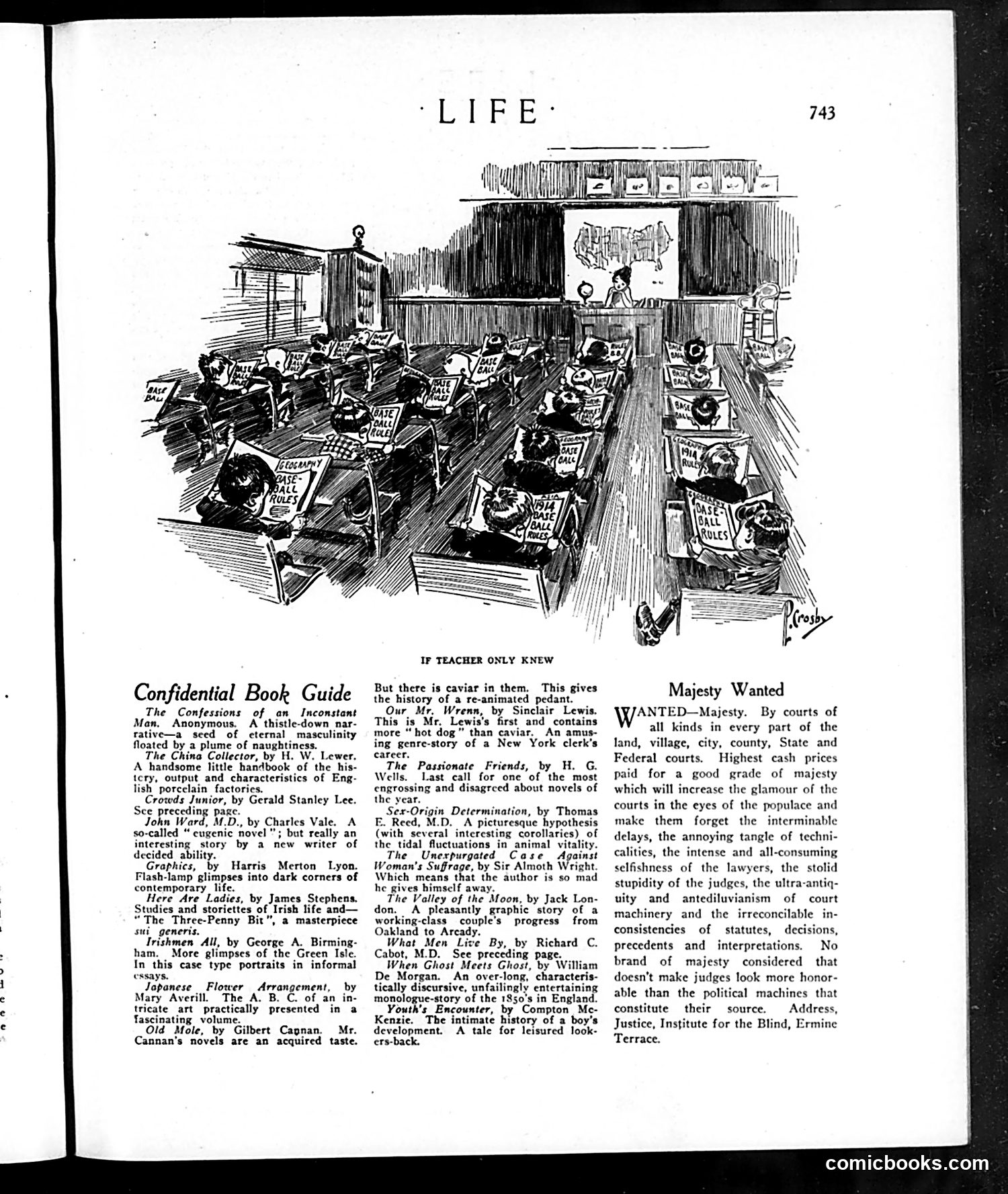
The main cartoon, titled "IF TEACHER ONLY KNEW," depicts a classroom where students sit at desks holding signs reading "MAKE PALE RULES" (or similar phrases). The satire mocks the disconnect between idealized educational authority and actual classroom behavior—suggesting that if teachers truly understood what students think or do when unsupervised, the facade of classroom order would collapse. The page also includes "Majesty Wanted," a classified-ad style satirical piece criticizing the judicial system. It mock-advertises for "majesty"—dignity and grandeur—to restore public faith in courts. The satire attacks judges as tools of "political machines," court proceedings as inefficient ("interminable delays"), and the legal system as outdated ("antediluvian"), arguing that courts lack the genuine authority they project. The joke: majesty is being *sold* as a commodity to mask systemic corruption and incompetence.
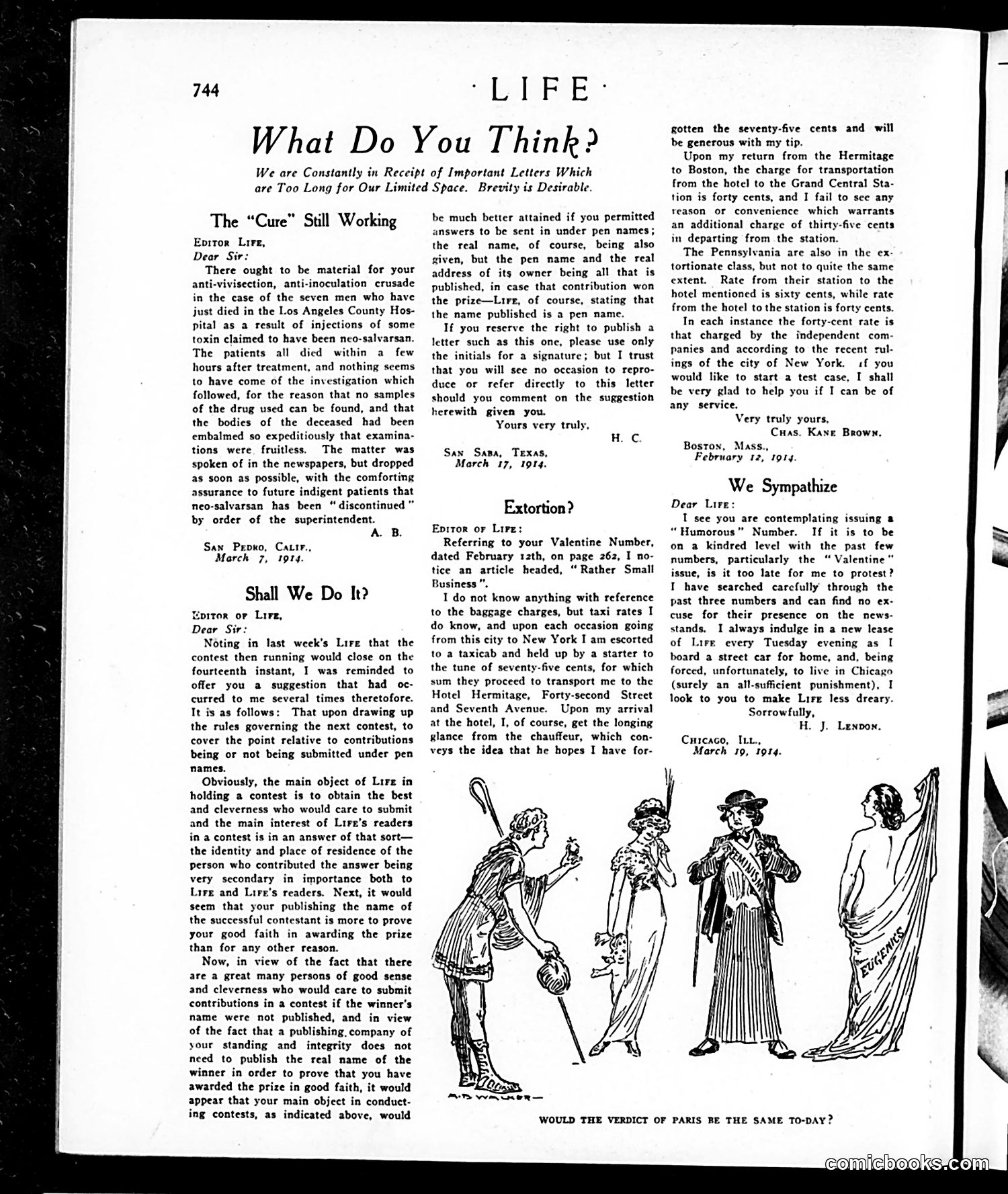
This page is a **reader letters section** titled "What Do You Think?" — essentially the magazine's opinion column. The content reflects early 20th-century social concerns: **Letter 1** discusses deaths from neo-salvarsan injections at a Los Angeles hospital, critiquing the medical establishment's lack of accountability and swift dismissal of the incident. **Letter 2** proposes Life magazine allow contest submissions under pen names while verifying winner identity privately — arguing this would encourage participation without requiring public identity disclosure. **Letter 3** complains about NYC taxi and hotel surcharges, describing them as extortionate "holding up" of travelers. The **political cartoon** at bottom shows classical figures (appearing to reference the Judgment of Paris from Greek mythology) with the caption "Would the verdict of Paris be the same to-day?" — likely satirizing how modern commercialism or standards have corrupted classical ideals. The page overall reflects turn-of-the-century anxieties: medical ethics, editorial fairness, and consumer exploitation.
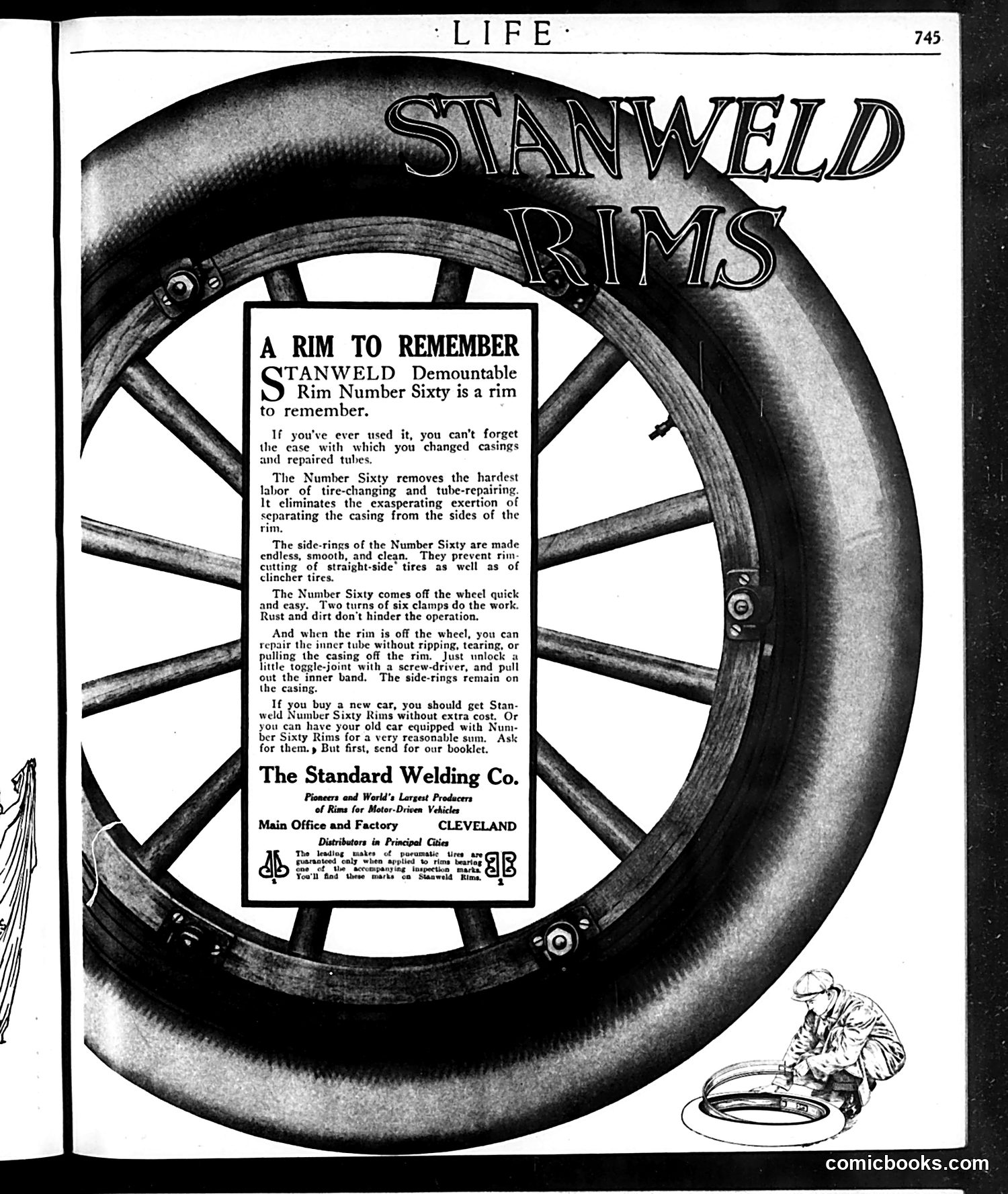
This is **not a cartoon or satire**—it's a straightforward advertisement masquerading as editorial content, a common practice in early 20th-century magazines like Life. The page advertises the Stanweld Number Sixty demountable rim, a automobile wheel rim innovation. The "joke" or appeal is purely commercial: the headline "A Rim to Remember" uses wordplay to market a practical product that simplified tire changing and tube repair—genuinely difficult tasks in the early automobile era. The illustration shows the rim's design with its removable side-rings and clamps. A small illustration at bottom right depicts a mechanic using the product, emphasizing ease of use. This reflects the historical context: Life magazine mixed satire with advertisements. Modern readers would recognize this as promotional content, not editorial commentary. The appeal is to car owners frustrated by labor-intensive maintenance—a real consumer problem when automobiles were new and reliability concerns were significant.
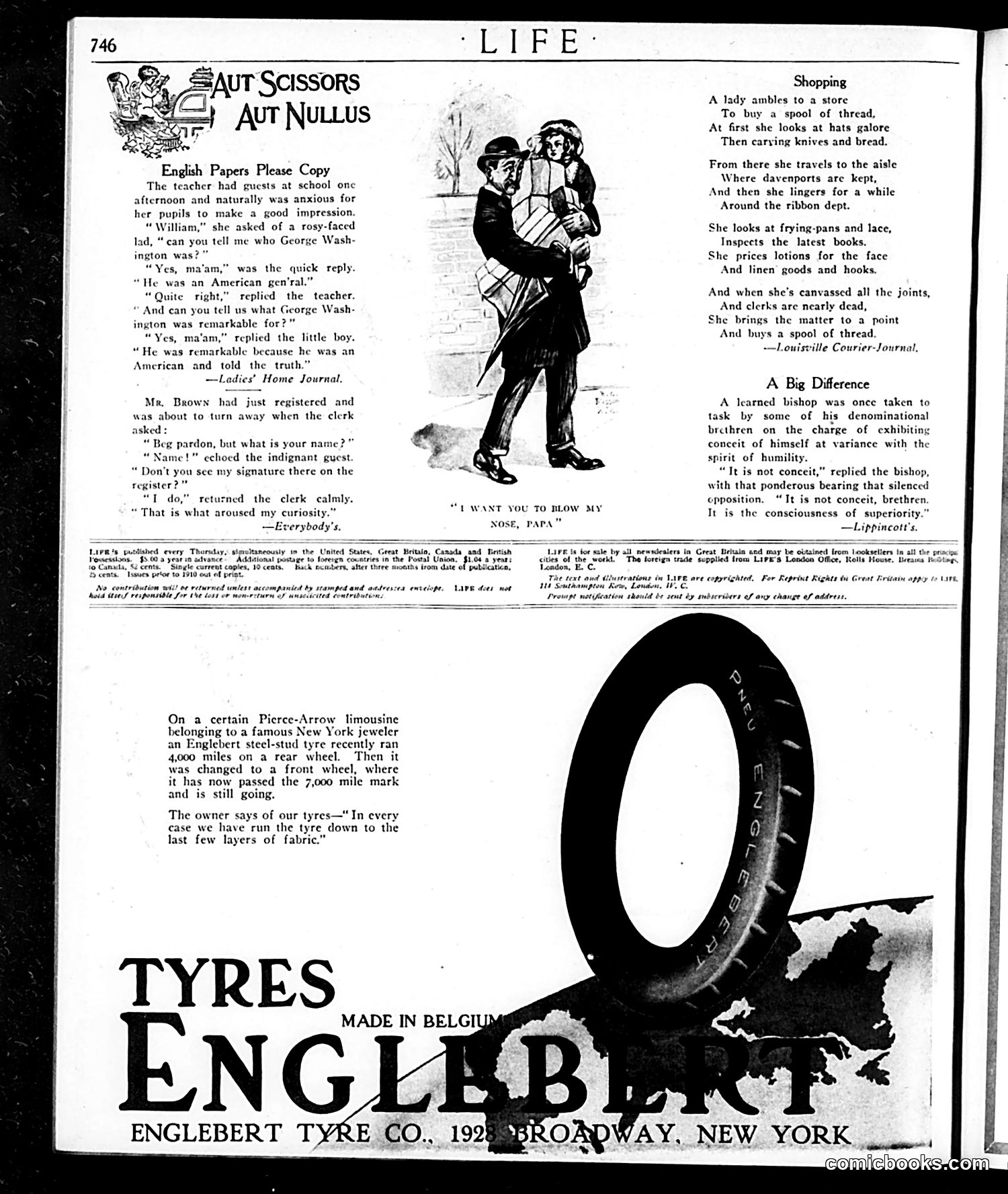
This page from *Life* magazine contains several short humorous pieces typical of early 20th-century American satire, plus an advertisement. The main cartoons mock social awkwardness and pretension: 1. **"English Papers Please Copy"** presents anecdotes about honesty and bureaucracy—a boy's innocent observation that George Washington was "an American and told the truth," and a hotel clerk's reasonable request for a guest's name despite an illegible signature. The humor targets both childish directness and adult pomposity. 2. **"Shopping"** satirizes women's consumer behavior, depicting a shopper who meanders through a department store examining countless items (hats, furniture, cosmetics) before purchasing only her original intended item: thread. This stereotypes women as distractible and indecisive. 3. **"A Big Difference"** mocks ecclesiastical hypocrisy—a bishop denies conceit while displaying obvious arrogance, reframing superiority as mere "consciousness." The page concludes with an **Englebert tire advertisement** emphasizing durability through a testimonial from a jeweler's Pierce-Arrow limousine that logged 7,000 miles on a single tire.
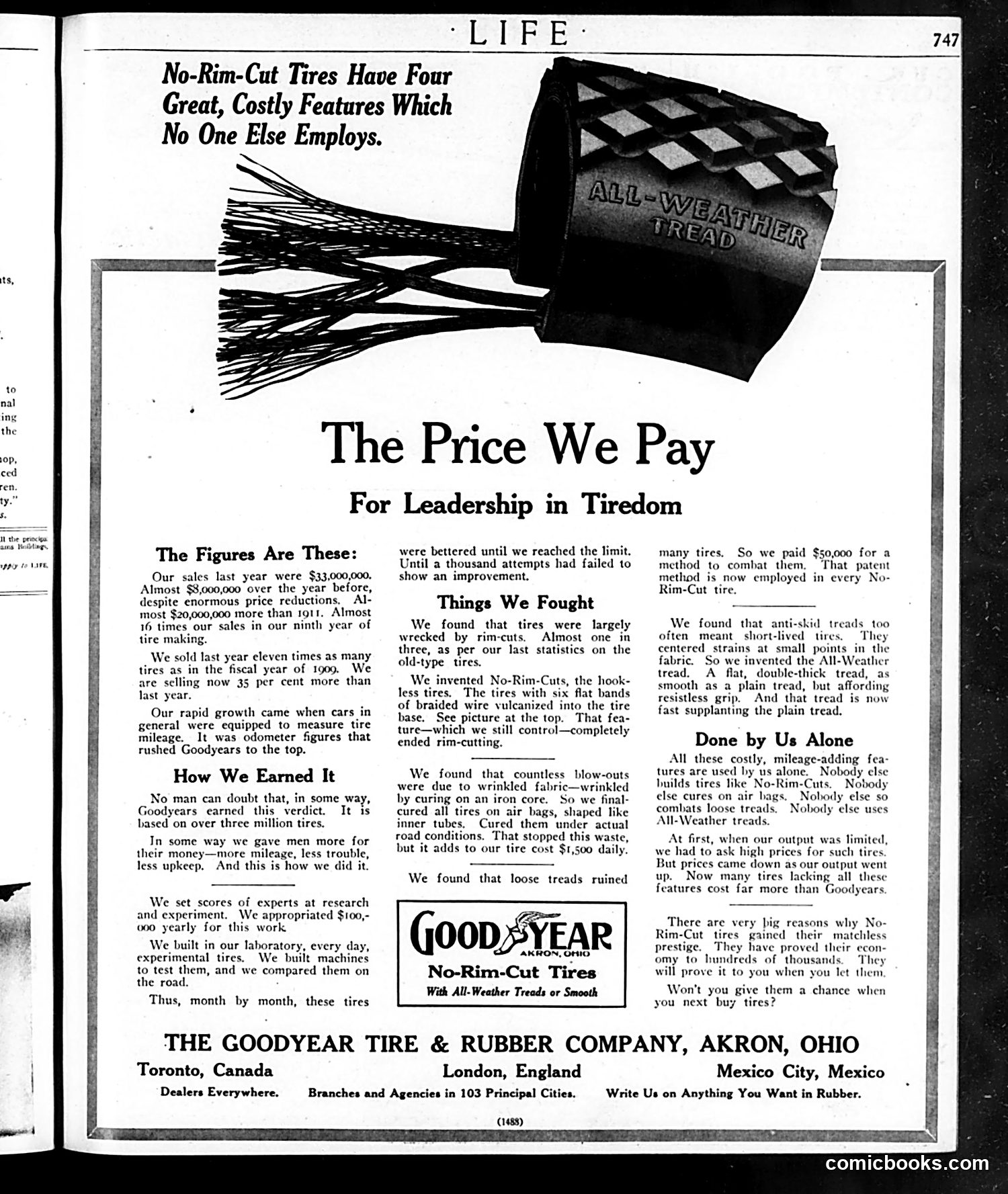
This is **not a political cartoon or satire**, but rather a **corporate advertisement** for Goodyear Tires published in *Life* magazine (appears to be circa 1912-1913, based on referenced sales figures from 1911). The page showcases Goodyear's sales success and advertises their "No-Rim-Cut" tire technology. The headline claims four exclusive features competitors don't employ: hookless tire design, air-bag curing, loose-tread prevention, and the "All-Weather" tread. The text uses boastful language typical of early 20th-century advertising—citing $33 million in sales, research investments of $100,000 yearly, and claims that competitors' inferior tires cost "far more." The tire image shown at top displays the "All-Weather Tread" pattern and braided wire construction. The phrase "The Price We Pay For Leadership in Tiredom" frames expensive R&D as justified by market dominance. This represents **pure corporate marketing**, not editorial commentary or humor—though modern readers might find the breathless self-promotion amusing.
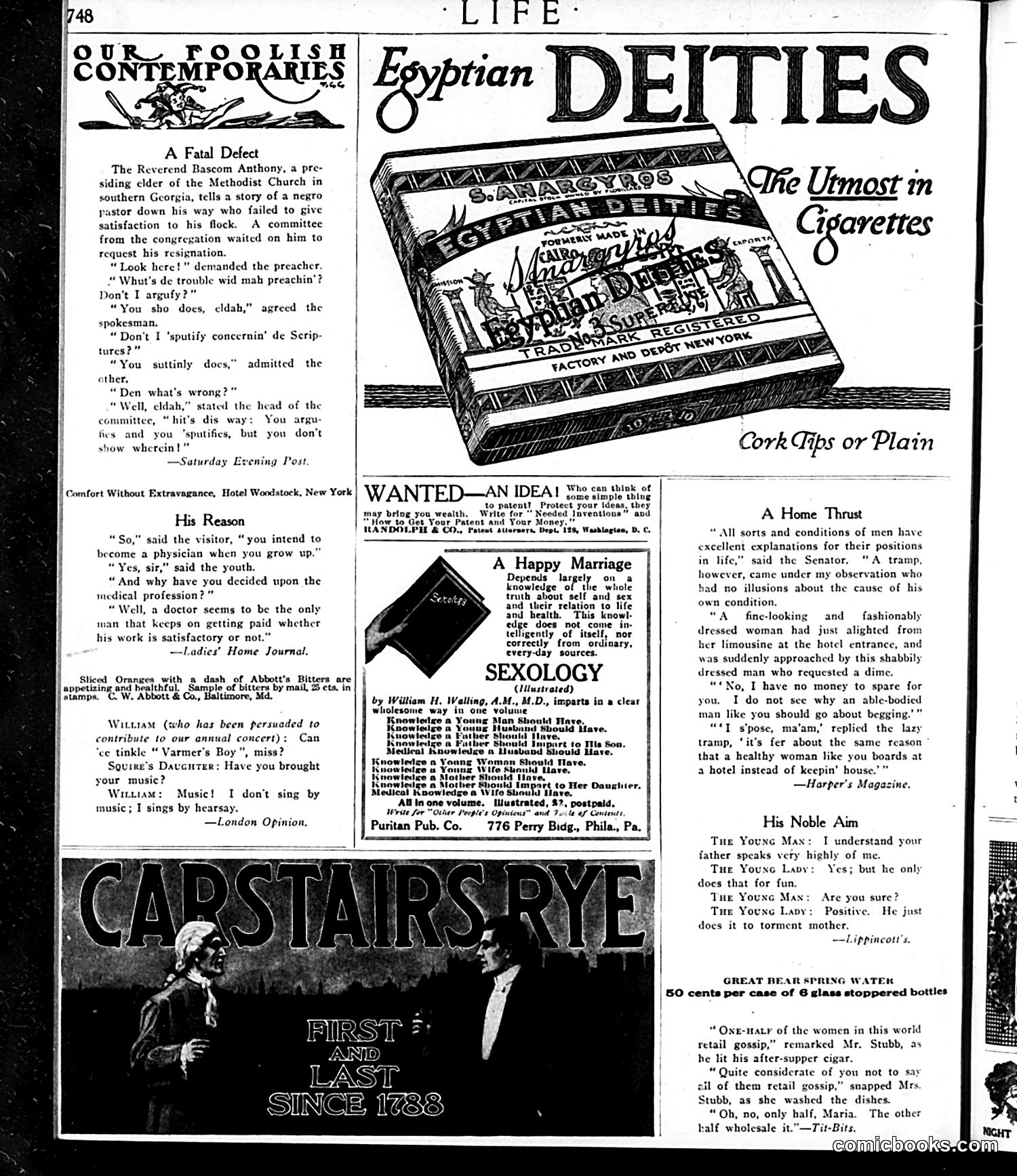
This page contains several short humorous anecdotes typical of early-20th-century American magazines, plus advertisements. **Main Content:** The pieces are brief satirical jokes on social themes. "A Fatal Defect" mocks a Black preacher through dialect humor—a congregation complains he argues and disputes scripture but fails to demonstrate his points' practical application. "His Reason" jokes that doctors profit regardless of competence. "A Home Thrust" presents a tramp justifying his idleness by comparing himself to a wealthy woman who avoids housework—social commentary on hypocrisy across class lines. **Advertisements:** Include Egyptian Deities cigarettes, a "Sexology" medical book promising marital knowledge, and patent-invention solicitations—typical period marketing. **Historical Context:** The page reflects early-1900s attitudes: casual use of racial dialect humor, medical/sexual ignorance as comedic fodder, and class-based social observation presented as wit rather than critique. The advertisements and jokes collectively reveal what *Life* considered entertaining to its contemporary readers—and what standards have substantially shifted since.
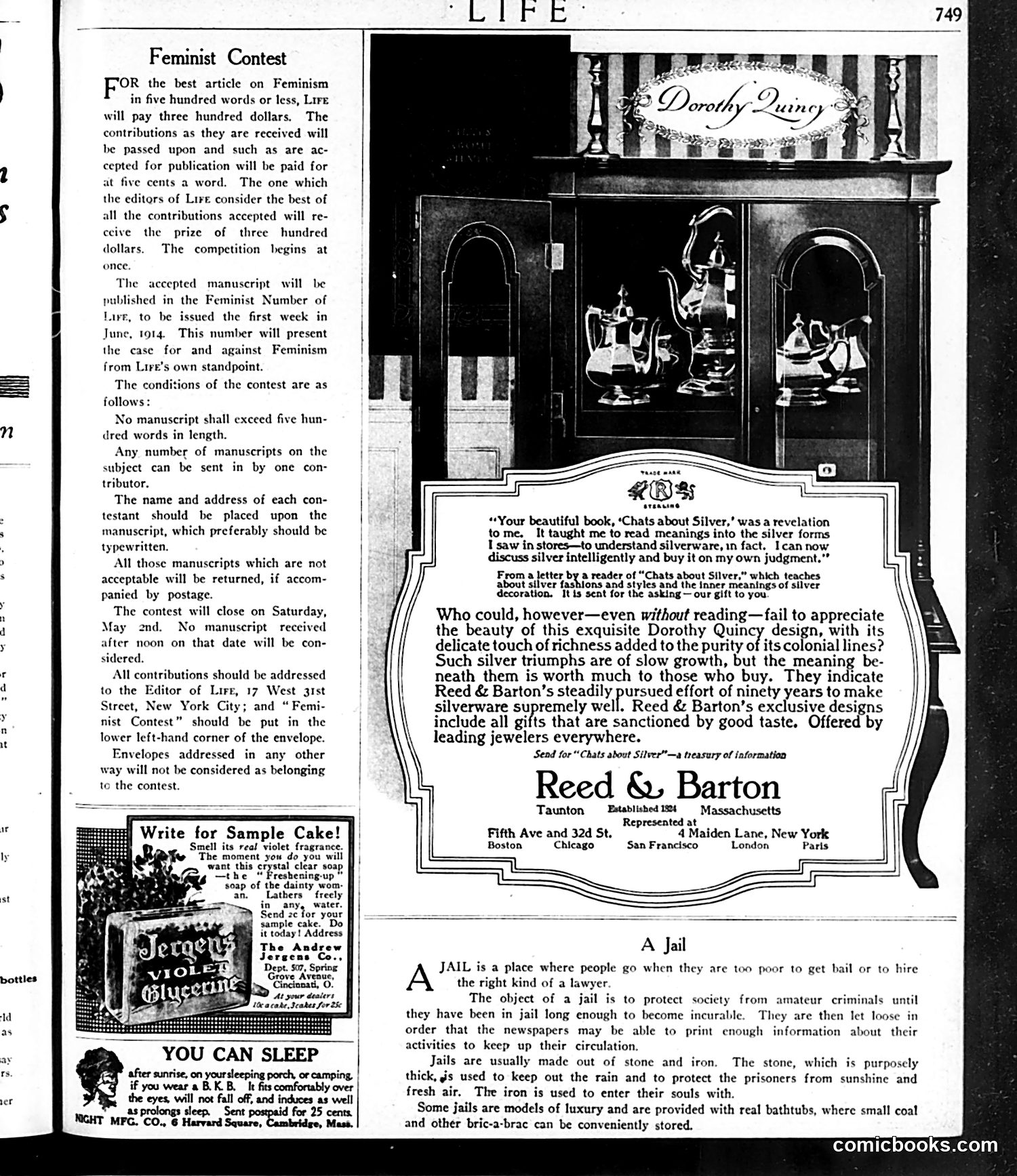
This page mixes editorial content with advertising, reflecting early 1900s magazine culture. **Main Content:** A "Feminist Contest" announcement offering $300 for the best 500-word article on feminism, to be published in Life's June 1914 "Feminist Number." The magazine positions itself as presenting "the case for and against Feminism from Life's own standpoint"—suggesting balanced but skeptical coverage typical of satirical publications toward the emerging women's suffrage movement. **Advertisements:** The page features luxury silverware (Reed & Barton), soap, and cake ads—products marketed to middle-class women. The silverware ad ironically emphasizes how women can now "discuss silver intelligently and buy it on my own judgment," subtly nodding to contemporary debates about women's autonomy and consumer power. **"A Jail" Definition:** A brief satirical piece defining jail as where the poor go who can't afford bail or lawyers—commentary on class-based justice. The page reflects 1914 anxieties about feminism coexisting with assumptions about women's domestic consumer roles.
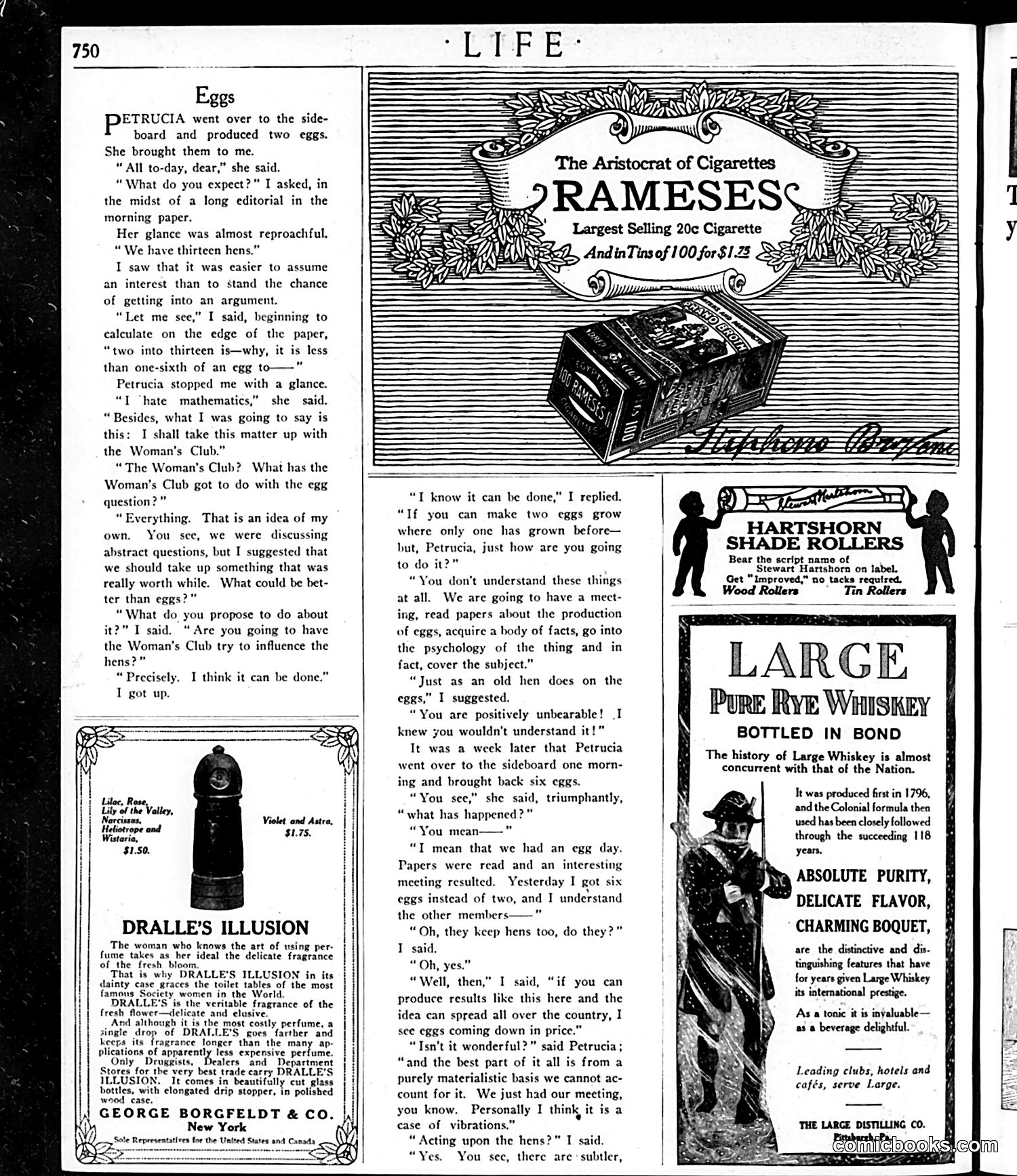
This humorous domestic narrative mocks the earnest but misguided activism of early 20th-century women's clubs. The unnamed narrator's wife, Petrucia, proposes that her Woman's Club tackle egg production—not through practical farming methods, but by studying "abstract questions," reading papers, and understanding "psychology" and "vibrations." The satire works on two levels: first, it ridicules women's clubs as ineffectual debating societies prone to intellectual pretension; second, it gently mocks the era's fascination with pseudo-scientific concepts like "vibrations" to explain ordinary phenomena. When egg production mysteriously doubles after the club's meeting, Petrucia attributes it to mysterious psychic forces rather than coincidence or actual improved care—the joke being her willingness to accept magical thinking over common sense. The piece reflects period anxiety about organized women's groups while also poking fun at how people invoke vague scientific language to justify beliefs.
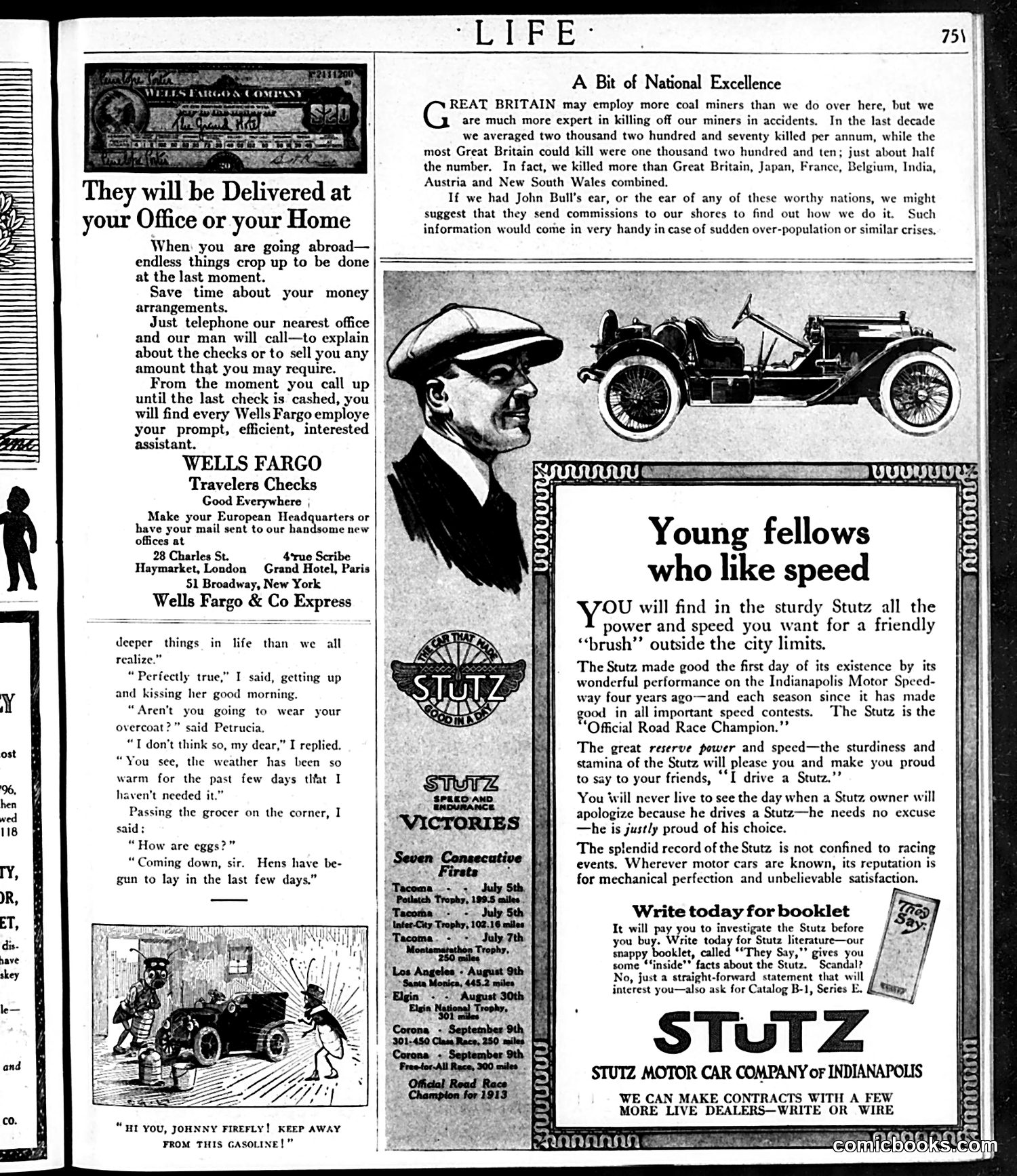
This page mixes advertisements with satirical commentary. The main editorial piece, "A Bit of National Excellence," uses dark humor to critique American industrial safety practices. The author sarcastically praises American expertise at accidentally killing coal miners—averaging 2,200+ deaths annually compared to Great Britain's 1,210. The satire's bite comes from reversing "excellence": the U.S. isn't better at mining; it's dangerously worse at protecting workers. The joke's sting lies in suggesting that if other nations wanted to reduce "over-population," they could study America's deadly methods. The remainder consists of period advertisements: Wells Fargo traveler's checks and the Stutz automobile, marketed toward young, speed-loving men. The small cartoon at bottom ("Hi you, Johnny Firefly!") appears unrelated—likely a humorous filler about a child and gasoline danger. The page reflects early 20th-century attitudes: industrial deaths treated as national statistics suitable for satirical commentary rather than urgent policy reform.
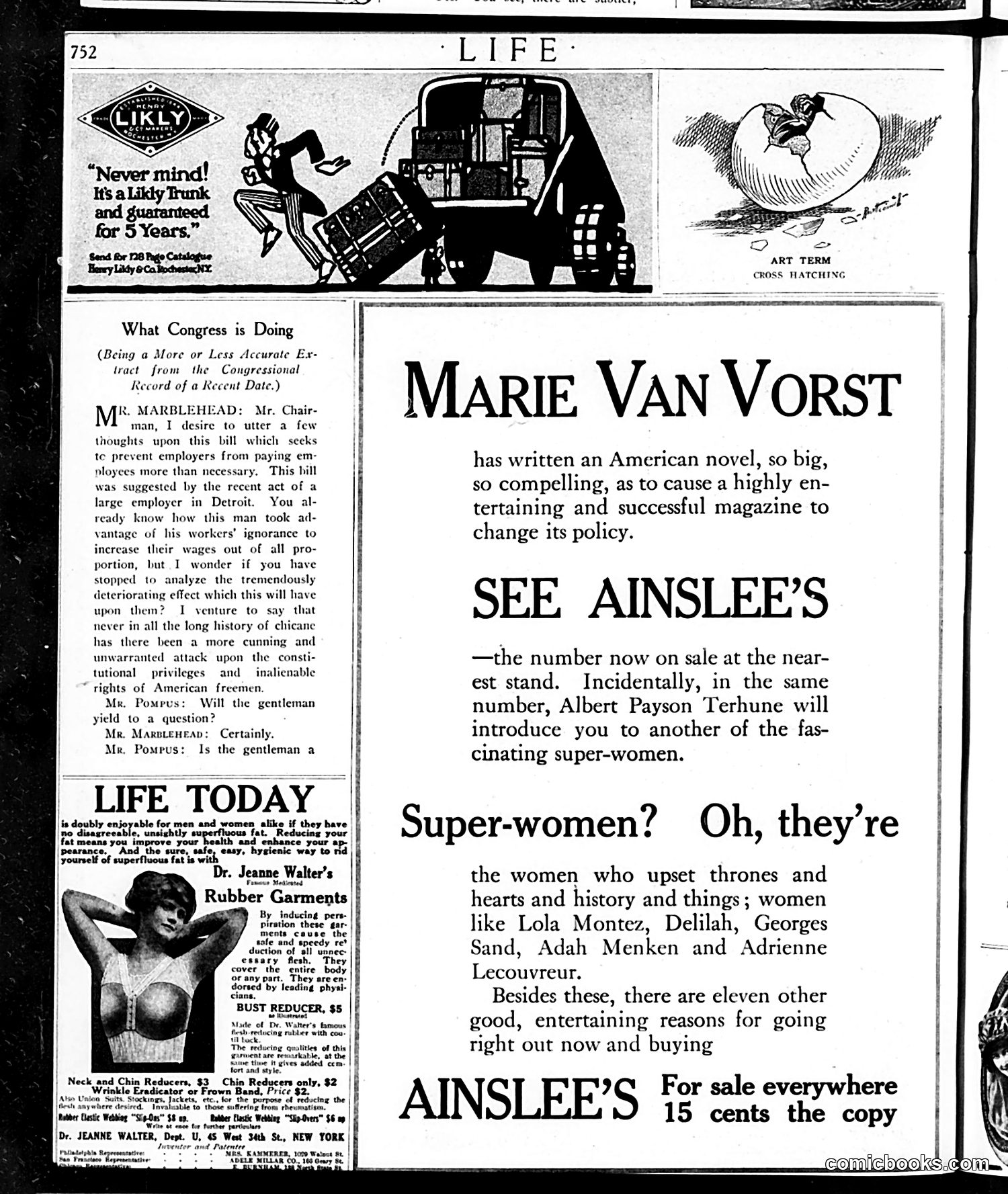
The "What Congress is Doing" section satirizes congressional hypocrisy. Mr. Marblehead opposes a bill preventing employers from underpaying workers, ironically framing wage increases as a threat to "constitutional privileges" and "rights of American freemen." The joke: he's defending employers' right to exploit workers while using patriotic language. This likely references a real Detroit labor dispute where an employer was pressured to raise wages. The satire mocks politicians who twist rhetoric to defend corporate interests against workers' welfare. The page also contains period medical advertisements (rubber garments for "reducing" body fat) and promotional content for *Ainslee's* magazine, featuring Marie Van Vorst's novel about "super-women"—famous historical female figures like Lola Montez and Delilah who wielded influence through relationships with powerful men. The juxtaposition reflects early 20th-century attitudes about women's agency and power.
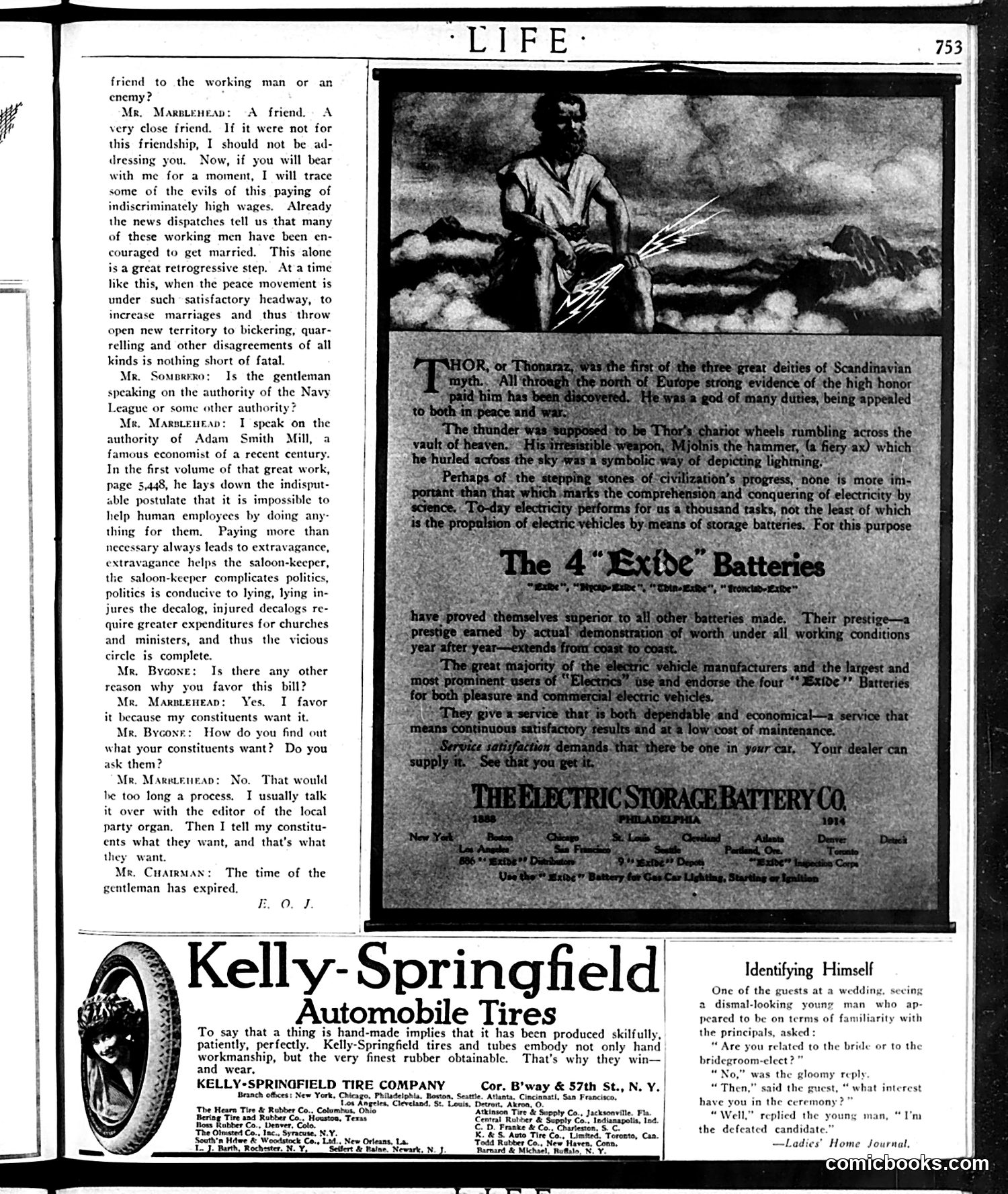
This page features a satirical debate between a politician named Mr. Marblehead and colleagues like Mr. Sombrero and Mr. Bygone. Marblehead argues *against* paying workers higher wages, claiming such payments cause moral decay: workers get married (disrupting peace efforts), spend extravagantly, support saloons, corrupt politics, and ultimately weaken churches and morality—a vicious cycle. The satire's targets are: - **Laissez-faire economics**: Marblehead cites Adam Smith to oppose worker assistance, a common anti-labor argument - **Political hypocrisy**: He doesn't actually consult constituents; he decides what they want through the local party newspaper - **Class contempt**: The wealthy/powerful dismiss workers' welfare improvements as inherently corrupting The joke exposes how industrialists and politicians rationalized opposing worker benefits by falsely moralizing about wages causing social collapse—revealing the self-serving logic beneath "anti-labor" rhetoric during the Progressive Era labor movement.
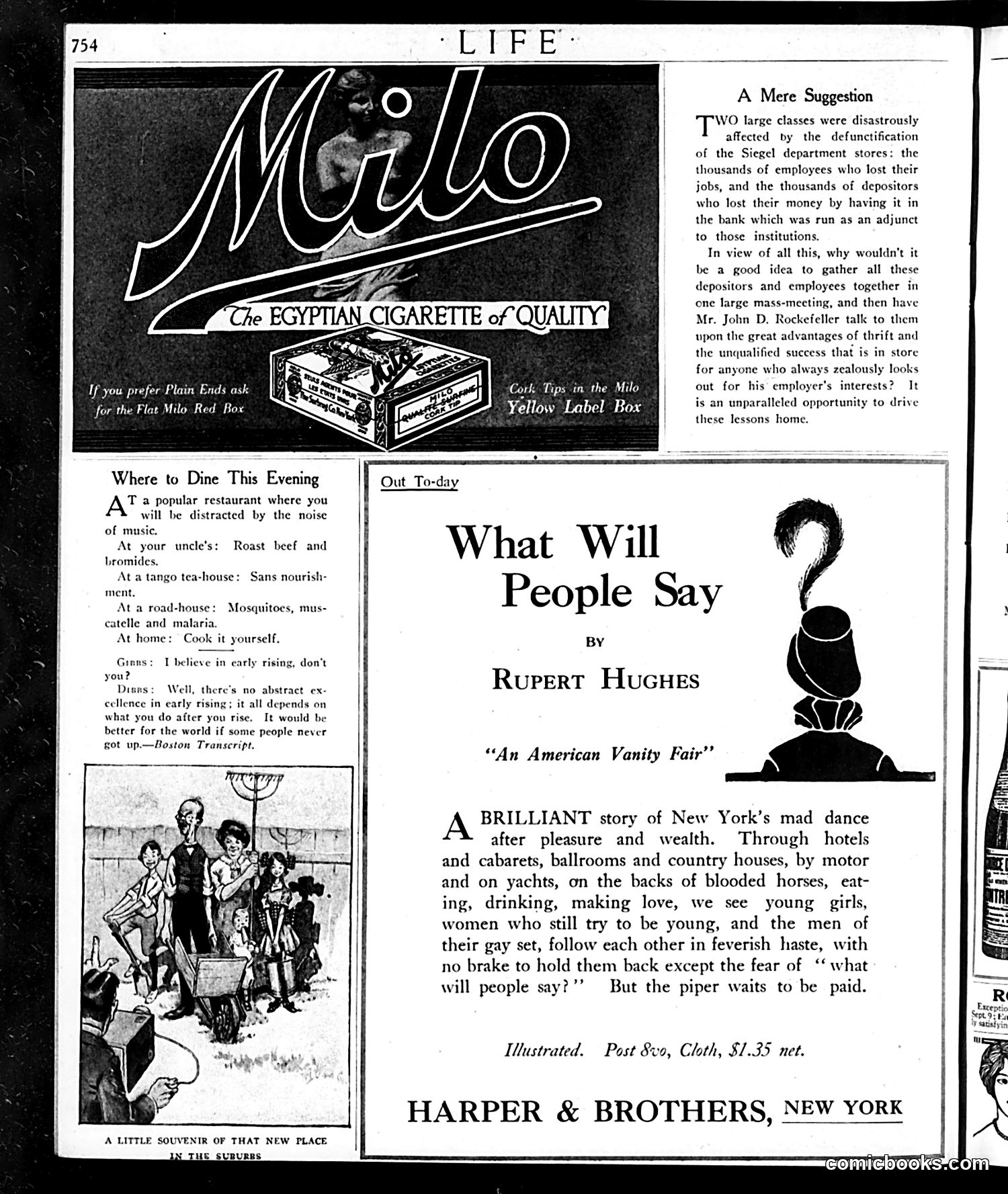
This page combines advertising with satirical social commentary from early 20th-century America. **"A Mere Suggestion"** sarcastically proposes that John D. Rockefeller address victims of the failed Siegel department stores—thousands of employees who lost jobs and depositors who lost savings. The bitter irony: having the wealthy industrialist lecture the dispossessed about "thrift" and "success" while they suffer financial ruin from the bank collapse. The satire targets the disconnect between wealthy philanthropists' sermons on self-improvement and the economic realities facing ordinary workers. **"Where to Dine This Evening"** offers humorous dining suggestions with a cynical undertone about social anxiety and class distinctions. **Book Advertisement**: Rupert Hughes's novel "What Will People Say?" depicts New York's wealthy elite pursuing pleasure through hotels, cabarets, and yachts, constrained only by social reputation. The concluding line—"the piper waits to be paid"—suggests inevitable consequences for such excess. The page reflects 1910s-20s anxieties about wealth inequality, financial instability, and upper-class excess.
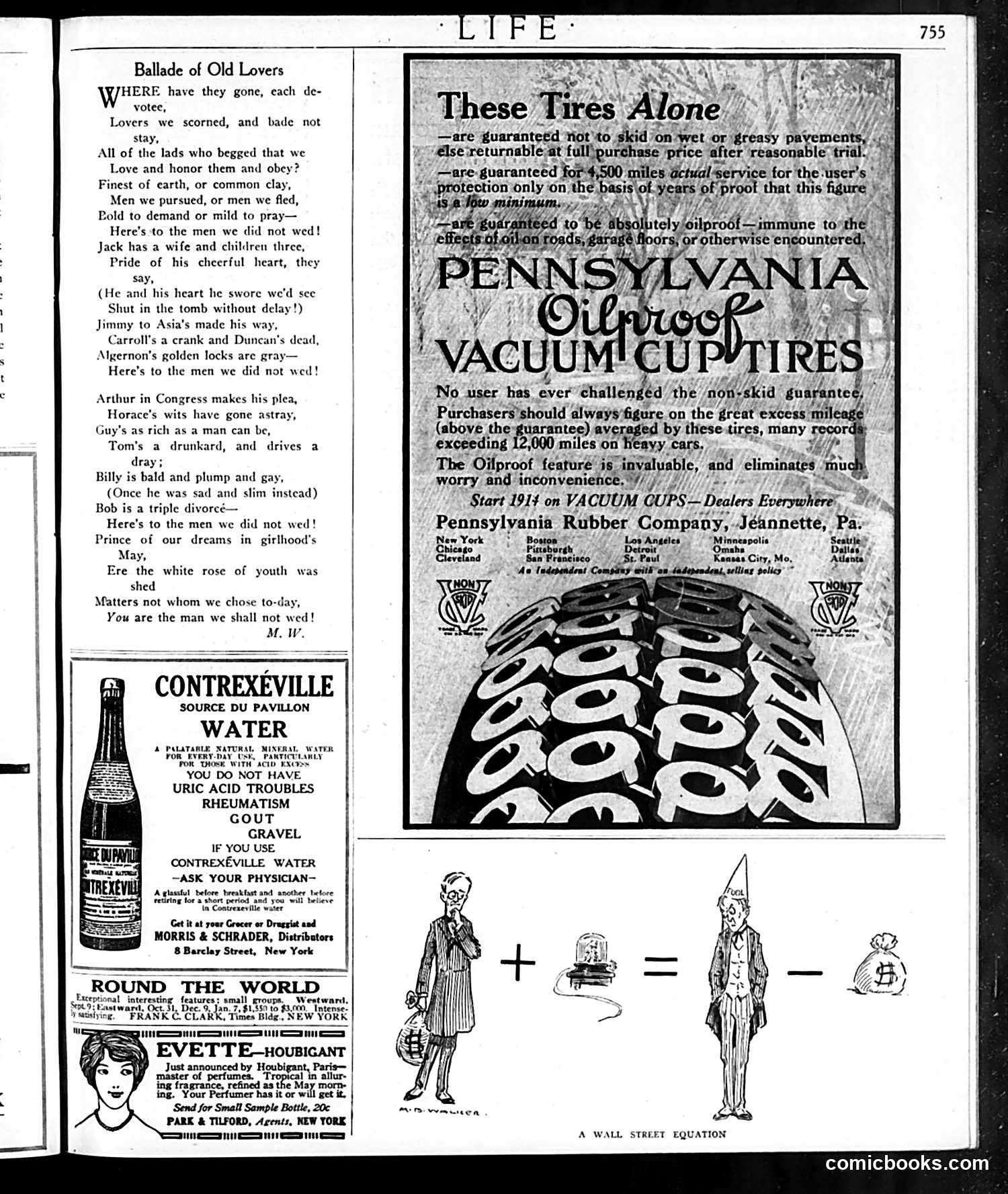
This page contains three distinct elements: **Left side:** A poem titled "Ballade of Old Lovers" by M.W. It's a nostalgic, melancholic verse about women reflecting on men they didn't marry—listing how their romantic prospects turned out (one became a congressman, another a drunkard, another bald). The refrain "Here's to the men we did not wed!" suggests wry acceptance of paths not taken. This is sentimental magazine poetry typical of the era. **Center:** A full-page advertisement for Pennsylvania Oilproof Vacuum Cup Tires, emphasizing durability (4,500 miles guaranteed) and waterproofing—practical selling points for early 1910s automobiles when tire reliability was a significant consumer concern. **Bottom right:** A small cartoon labeled "A Wall Street Equation" showing a formula: (woman in dress) + (hat) = (woman in pointed hat) − (small figure). This appears to satirize fashion trends, possibly mocking women's adoption of increasingly elaborate or absurd hat styles on Wall Street. The surrounding ads (mineral water, perfume) are standard period advertising. The page is primarily literary and commercial rather than political satire.
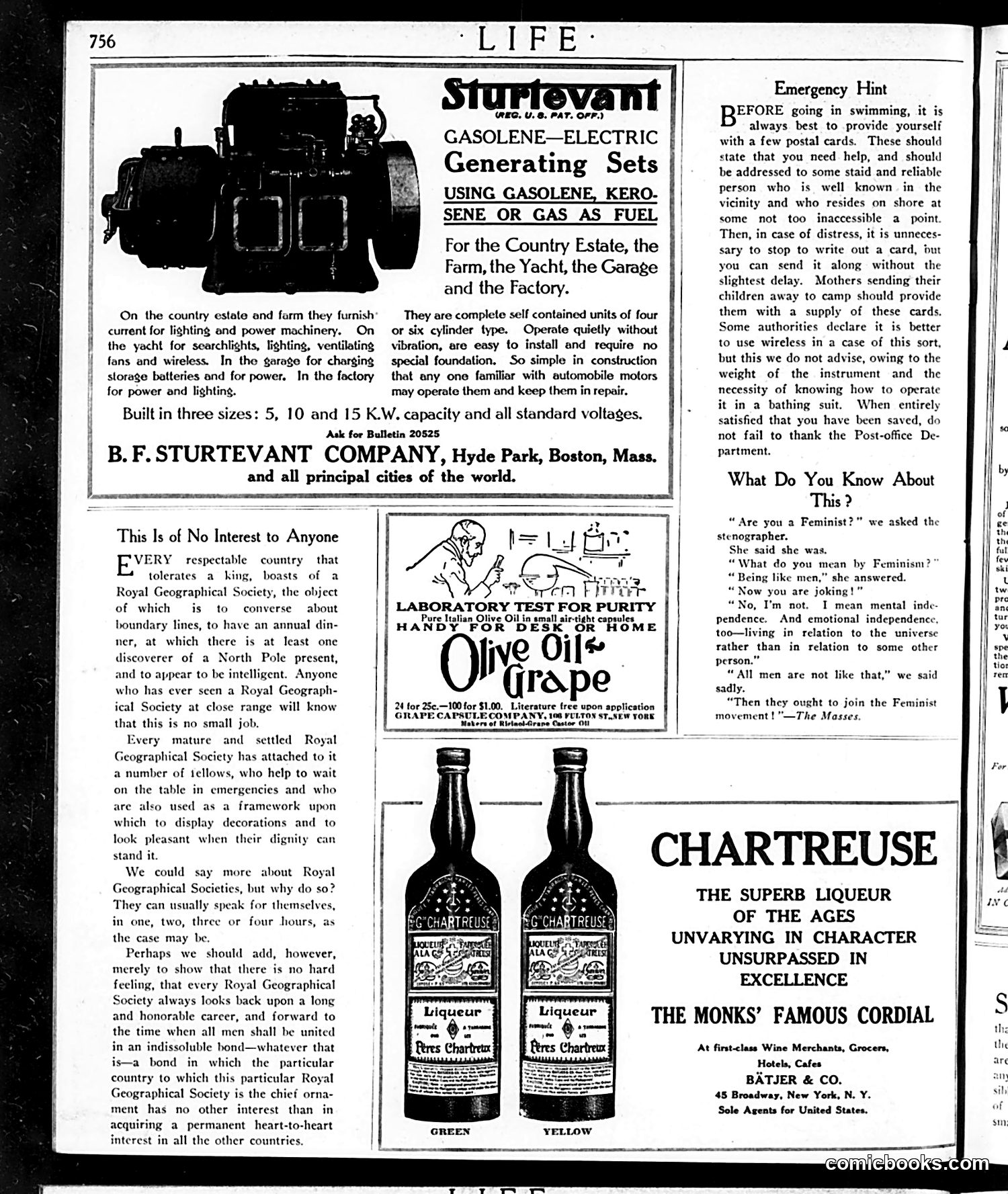
This page is primarily **advertisements and filler content** rather than political cartoons. The main satirical piece is "This Is of No Interest to Anyone," a humorous essay mocking **Royal Geographical Societies**—British institutions that convened to discuss exploration and boundary lines. The author satirizes their self-importance: they feature at least one North Pole discoverer at annual dinners, employ "fellows" as decorative table-servers, and drone on for hours. The final paragraph offers deadpan praise, suggesting these societies exist mainly to foster "heart-to-heart interest" between nations—an absurdly inflated purpose for what the author implies are rather dull, self-congratulatory clubs. The "Emergency Hint" section is **mock-serious advice**: send pre-written postcards requesting rescue while swimming rather than stopping to write letters during distress. The "What Do You Know About This?" section records a brief **feminist exchange**: when asked what feminism means, a stenographer answers "being like men," then clarifies she means mental and emotional independence—not literal imitation. The remaining content is **product advertising** (generators, olive oil, liqueur).
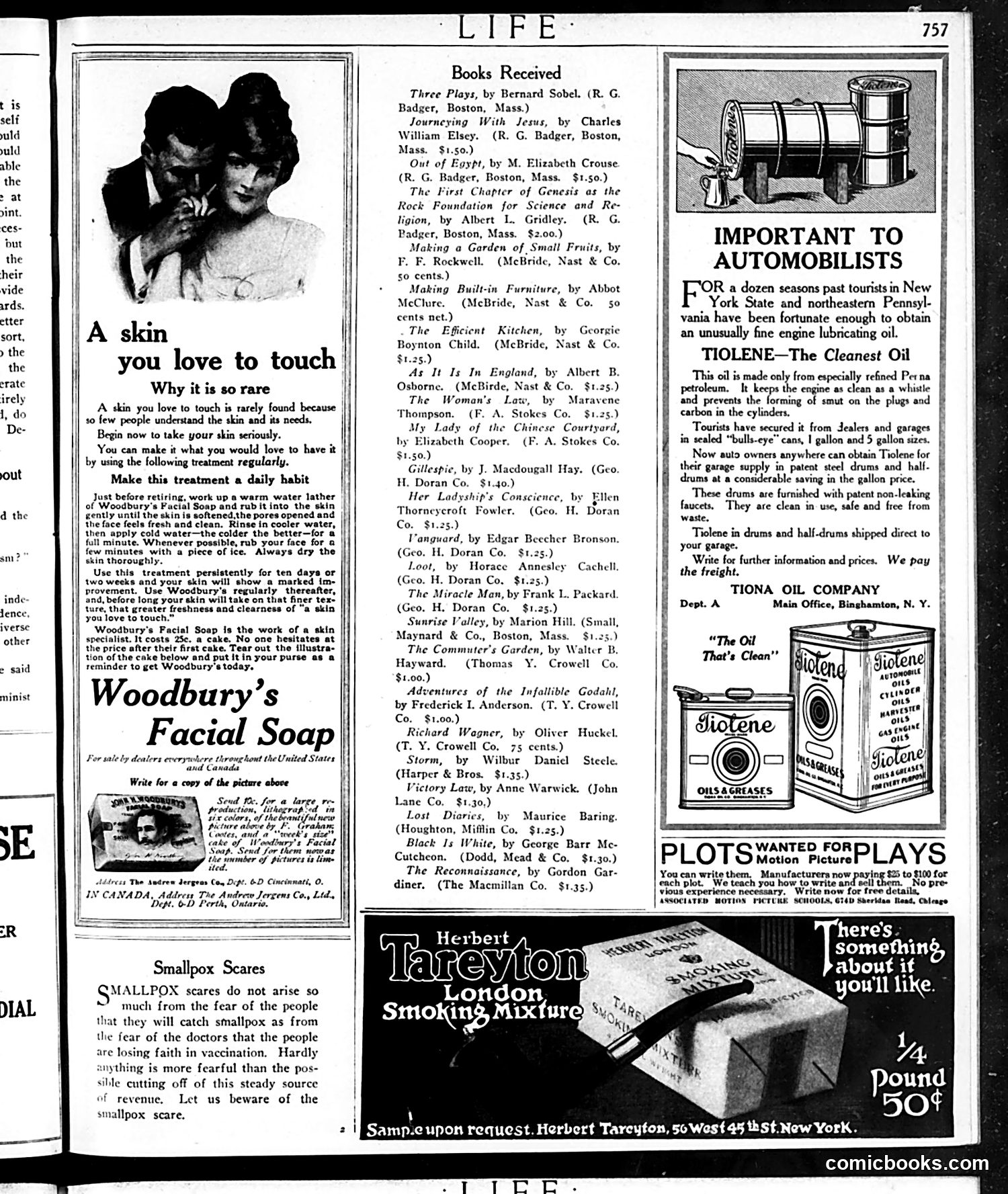
This page from *Life* magazine consists primarily of advertisements and book reviews, not political cartoons or satire. The notable content is a brief editorial item titled "Smallpox Scares," which expresses skepticism about public health campaigns promoting smallpox vaccination. The piece sarcastically suggests that doctors artificially manufacture fear about smallpox to maintain vaccination revenue, claiming the real threat is not the disease itself but "the fear of the doctors that the people are losing faith in vaccination." It concludes: "Hardly anything is more fearful than the possible cutting off of this steady source of revenue." This reflects anti-vaccination sentiment that existed in the early 20th century, presenting medical professionals as profit-motivated rather than genuinely concerned with public health. The tone assumes readers share cynicism about medical institutions' motives. The remainder of the page contains standard period advertising for Woodbury's Facial Soap, Tiolene Oil, and other products, plus a book review section.
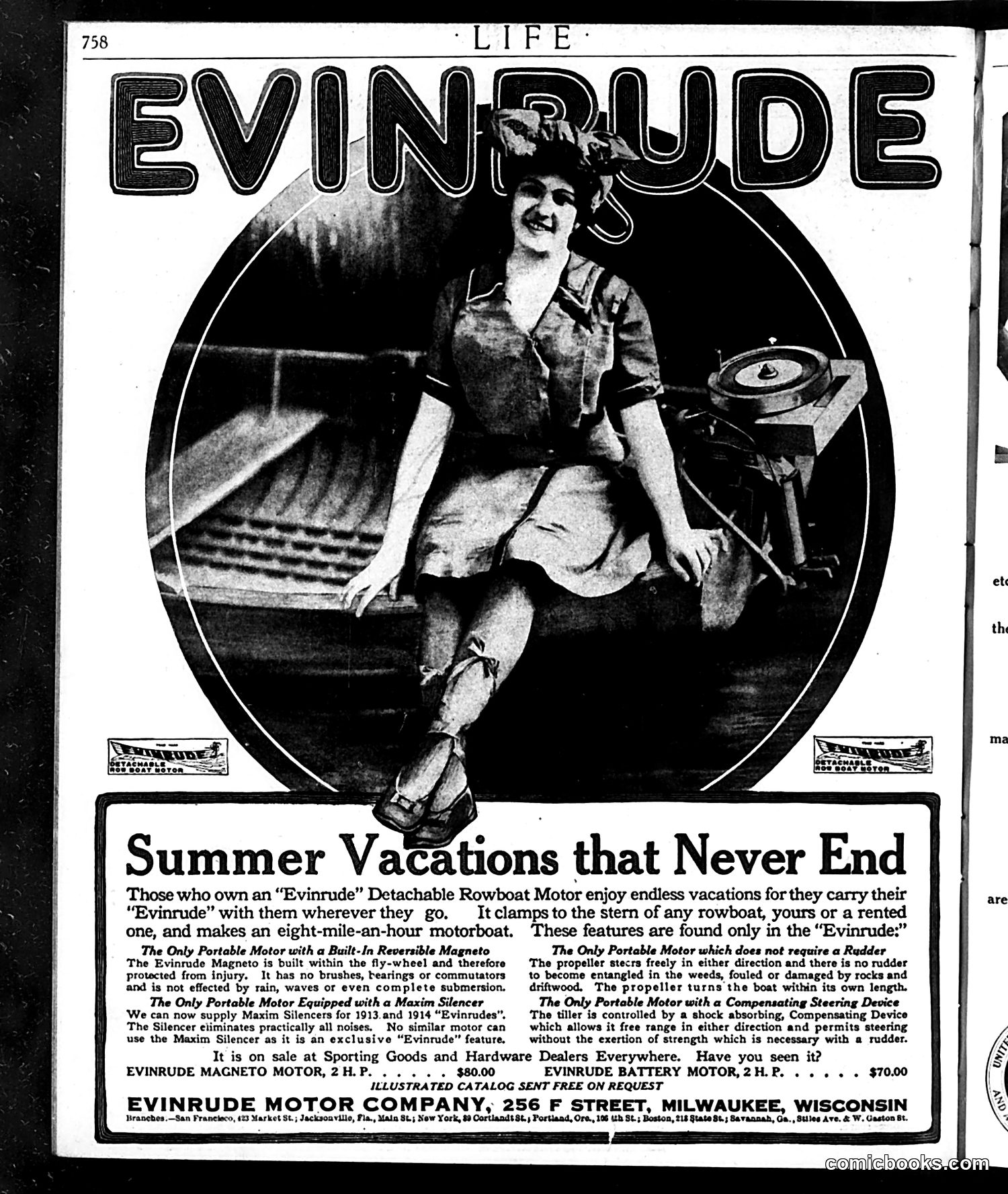
This is **not a political cartoon or satirical content**—it's a straightforward **product advertisement** for Evinrude outboard motors, appearing in Life magazine (page 758). The image shows a woman seated in a small motorized rowboat, smiling at the camera. The advertisement promotes the Evinrude as a portable, detachable motor that enables "endless vacations" because owners can transport it anywhere. The marketing emphasizes technical features: a built-in magneto, Maxim silencer (reducing noise), no rudder needed, and compensating steering. Prices listed are $80 for the magneto model and $70 for the battery model (circa 1913-1914). The "satire" here, if any, is subtle marketing language—the promise of "vacations that never end" is hyperbolic sales copy rather than genuine satire. This represents early 20th-century recreational technology marketing to leisure-class consumers.
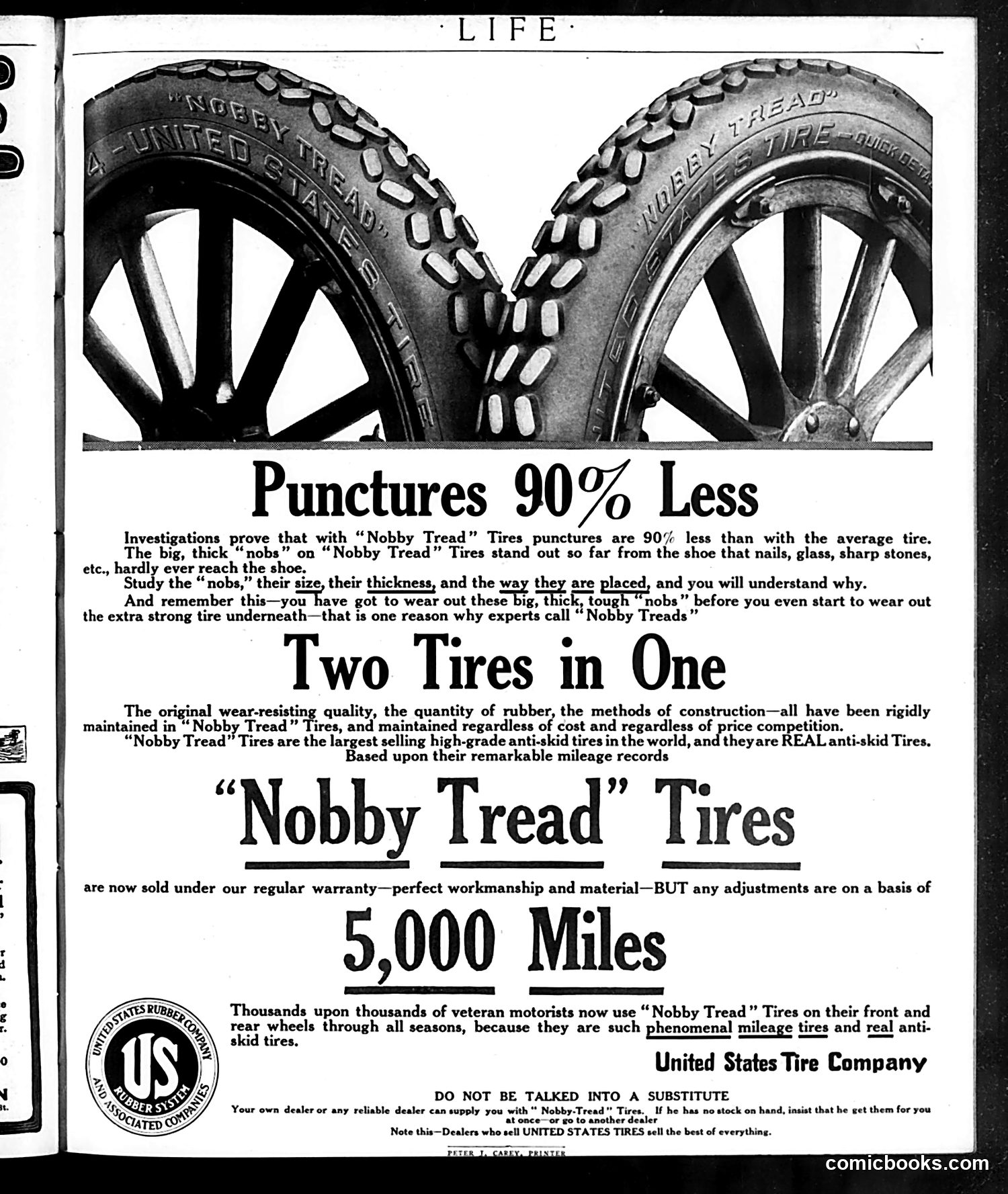
This is a **commercial advertisement**, not political satire. It promotes United States Tire Company's "Nobby Tread" automobile tires, featuring two tire images showing the distinctive tread pattern. The ad's selling points emphasize the tires' deep, prominent tread "nobs" (knobs) that supposedly reduce punctures by 90% compared to average tires—since debris gets caught in the protrusions rather than reaching the tire itself. The copy claims these are "two tires in one" due to their durability, warranted for 5,000 miles, and marketed as "real anti-skid" tires. The appeal to "veteran motorists" suggests this appeared during or shortly after WWI, when returning soldiers represented an aspirational consumer demographic. The warning against substitutes reflects competitive pressure in the early auto-tire market. This is straightforward product marketing with no satirical content.
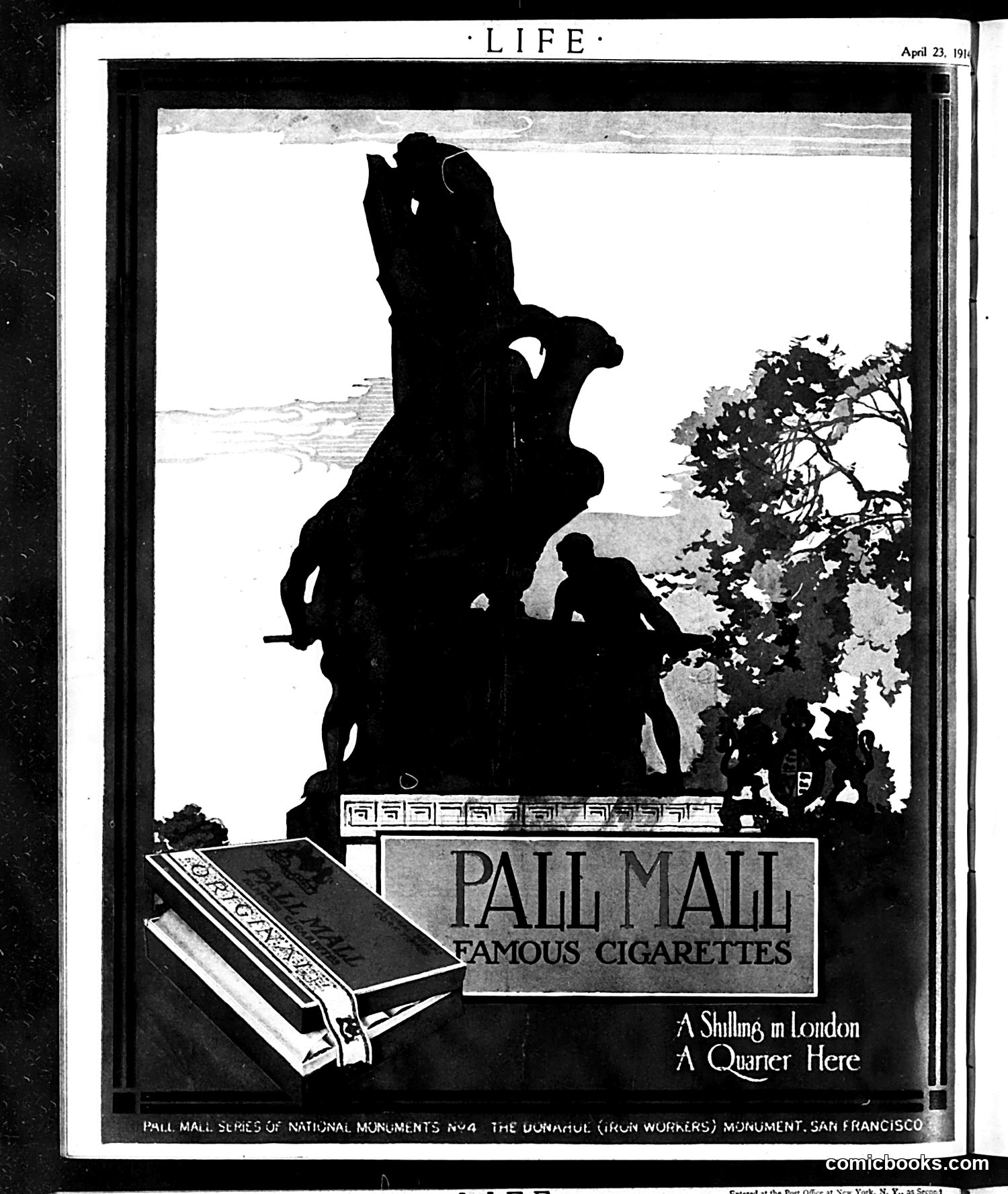
This is primarily a **cigarette advertisement** for Pall Mall Famous Cigarettes, not political satire. The image depicts a silhouetted monument showing workers or laborers in dynamic poses—appearing to construct or support something monumental. The text references "A Shilling in London / A Quarter Here," comparing British and American pricing for the product. At the bottom, it identifies this as part of a "Series of National Monuments" featuring "The Donahue (Irish Workers) Monument, San Francisco." The advertisement uses nationalist imagery and working-class iconography to market cigarettes by associating the product with labor, progress, and national pride—a common early 20th-century advertising strategy. There is no apparent satirical critique; this is straightforward commercial promotion.