
Life, 1914-04-23 · page 20 of 44
Life — April 23, 1914 — page 20: what you’re looking at
What you’re looking at
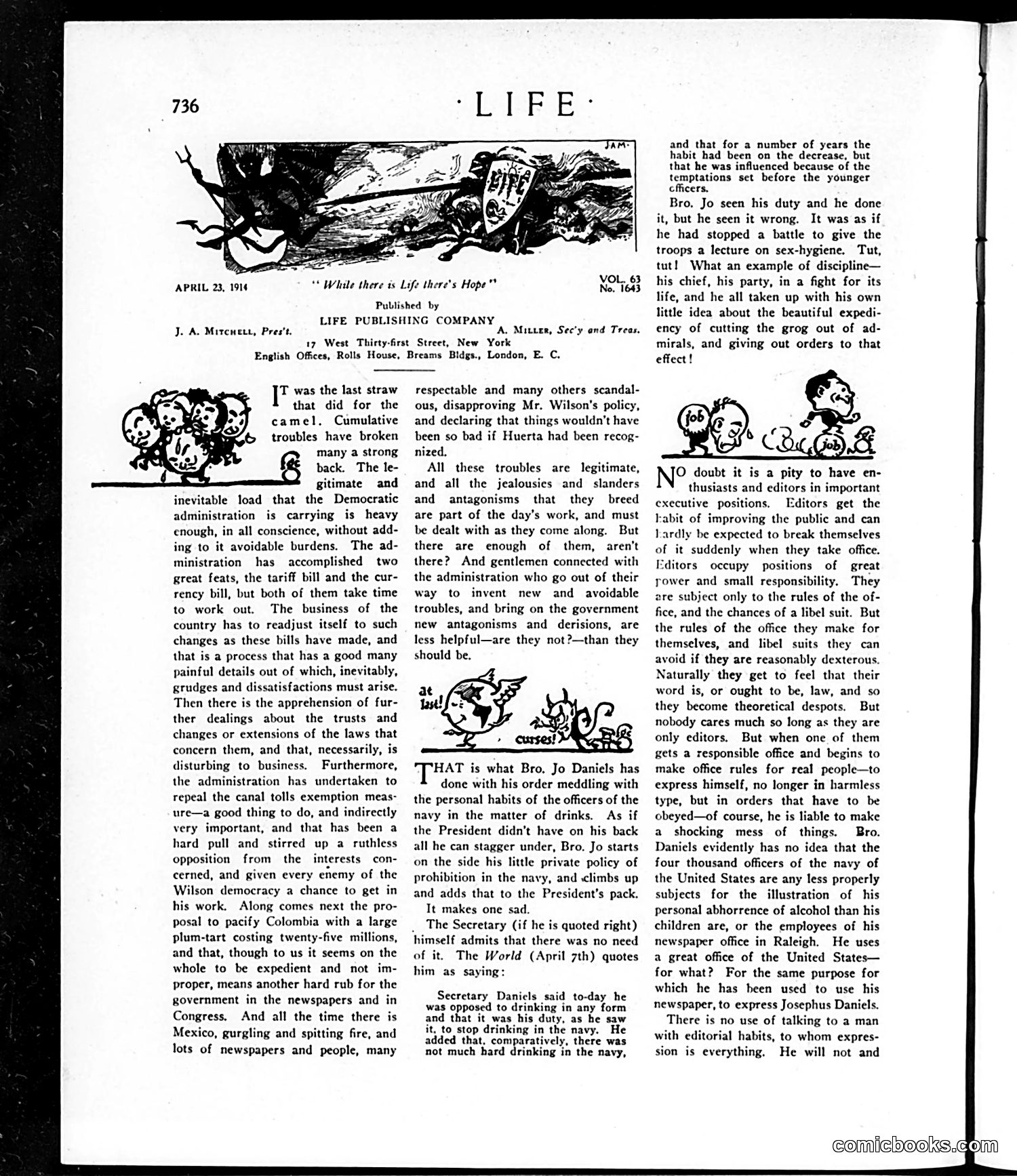
This page satirizes Secretary of the Navy Josephus Daniels for issuing an order restricting alcohol consumption among naval officers. The cartoon's central complaint: Daniels created an *unnecessary* problem during an already crisis-laden Wilson administration. The article catalogs legitimate challenges facing President Wilson—tariff reform, currency legislation, Colombia relations, and Mexico's instability—arguing the government has enough burdens without self-inflicted ones. Daniels admitted drinking in the navy was already declining and relatively minor, yet pursued prohibition anyway based on personal conviction. Life's satire is scathing: Daniels resembles a commander stopping a battle to lecture troops on hygiene—prioritizing his moral crusade over the administration's survival needs. The point: even well-intentioned reforms become harmful when they distract leadership from genuine crises. Daniels' private policy undermined his president's political position unnecessarily.
📄 Transcribed text from this page (OCR, searchable)
Machine-transcribed from the original scan — historical spelling and the odd misread are preserved.
APRIL 23, 1916 “* While there is Life there's Hope" Published by LIFE PUBLISHING COMPANY J. A. Mircnent, Pres’t. T was the last straw that did for the camel. Cumulative troubles have broken many a strong back. The le- gitimate and inevitable load that the Democratic administration is carrying is heavy enough, in all conscience, without add- ing to it avoidable burdens. The ad- ministration has accomplished two great feats, the tariff bill and the cur- rency bill, but both of them take time to work out. The business of the country has to readjust itself to such changes as these bills have made, and that is a process that has a good many painful details out of which, inevitably, grudges and dissatisfactions must arise. Then there is the apprehension of fur- ther dealings about the trusts and changes or extensions of the laws that concern them, and that, necessarily, is disturbing to business. Furthermore, the administration has undertaken to repeal the canal tolls exemption meas- ure—a good thing to do, and indirectly very important, and that has been a hard pull and stirred up a ruthless opposition from the interests con- cerned, and given every enemy of the Wilson democracy a chance to get in his work. Along comes next the pro- posal to pacify Colombia with a large plum-tart costing twenty-five millions, and that, though to us it seems on the whole to be expedient and not im- proper, means another hard rub for the government in the newspapers and in Congress. And all the time there is Mexico, gurgling and spitting fire, and lots of newspapers and people, many A. Mutute, Sec’y and Treas, 17 West Thirty-first Street, New York English Offices, Rolls House, Breams Bidgs., London, E. C. respectable and many others scandal- ous, disapproving Mr. Wilson's policy, and declaring that things wouldn’t have been so bad if Huerta had been recog- nized. All these troubles are legitimate, and all the jealousies and slanders and antagonisms that they breed are part of the day’s work, and must be dealt with as they come along. But there are enough of them, aren't there? And gentlemen connected with the administration who go out of their way to invent new and avoidable troubles, and bring on the government new antagonisms and derisions, are less helpful—are they not?—than they should be, 'HAT is what Bro. Jo Daniels has done with his order meddling with the personal habits of the officers of the navy in the matter of drinks. As if the President didn't have on his back all he can stagger under, Bro. Jo starts on the side his little private policy of prohibition in the navy, and climbs up and adds that to the President’s pack. It makes one sad. The Secretary (if he is quoted right) himself admits that there was no need of it. The World (April 7th) quotes him as saying: Seeretary Daniels said to-day he was opposed to drinking in any form and that it was his duty, as he saw it, to stop drinking in the navy. He added that, comparatively, there was not much hard drinking in the navy, and that for a number of years the habit had been on the decrease, but that he was influenced because of the temptations set before the younger cficers, Bro, Jo seen his duty and he done it, but he seen it wrong. It was as if he had stopped a battle to give the troops a lecture on sex-hygiene. Tut, tut! What an example of discipline— his chief, his party, in a fight for its life, and he all taken up with his own little idea about the beautiful expedi- ency of cutting the grog out of ad- mirals, and giving out orders to that N° doubt it is a pity to have en- thusiasts and editors in important executive positions, Editors get the abit of improving the public and can Lardly be expected to break themselves of it suddenly when they take office. Editors occupy positions of great rower and small responsibility. They are subject only to the rules of the of- fice, and the chances of a libel suit. But the rules of the office they make for themselves, and libel suits they can avoid if they are reasonably dexterous. Naturally they get to feel that their word is, or ought to be, law, and so they become theoretical despots, But nobody cares much so long as they are only editors, But when one of them gets a responsible office and begins to make office rules for real people—to express himself, no longer in harmless type, but in orders that have to be obeyed—of course, he is liable to make a shocking mess of things. Bro. Daniels evidently has no idea that the four thousand officers of the navy of the United States are any less properly subjects for the illustration of his personal abhorrence of alcohol than his children are, or the employees of his newspaper office in Raleigh. He uses a great office of the United States— for what? For the same purpose for which he has been used to use his newspaper, to express Josephus Daniels. There is no use of talking to a man with editorial habits, to whom expres- sion is everything. He will not and comichooks.