
Life, 1914-04-23 · page 16 of 44
Life — April 23, 1914 — page 16: what you’re looking at
What you’re looking at
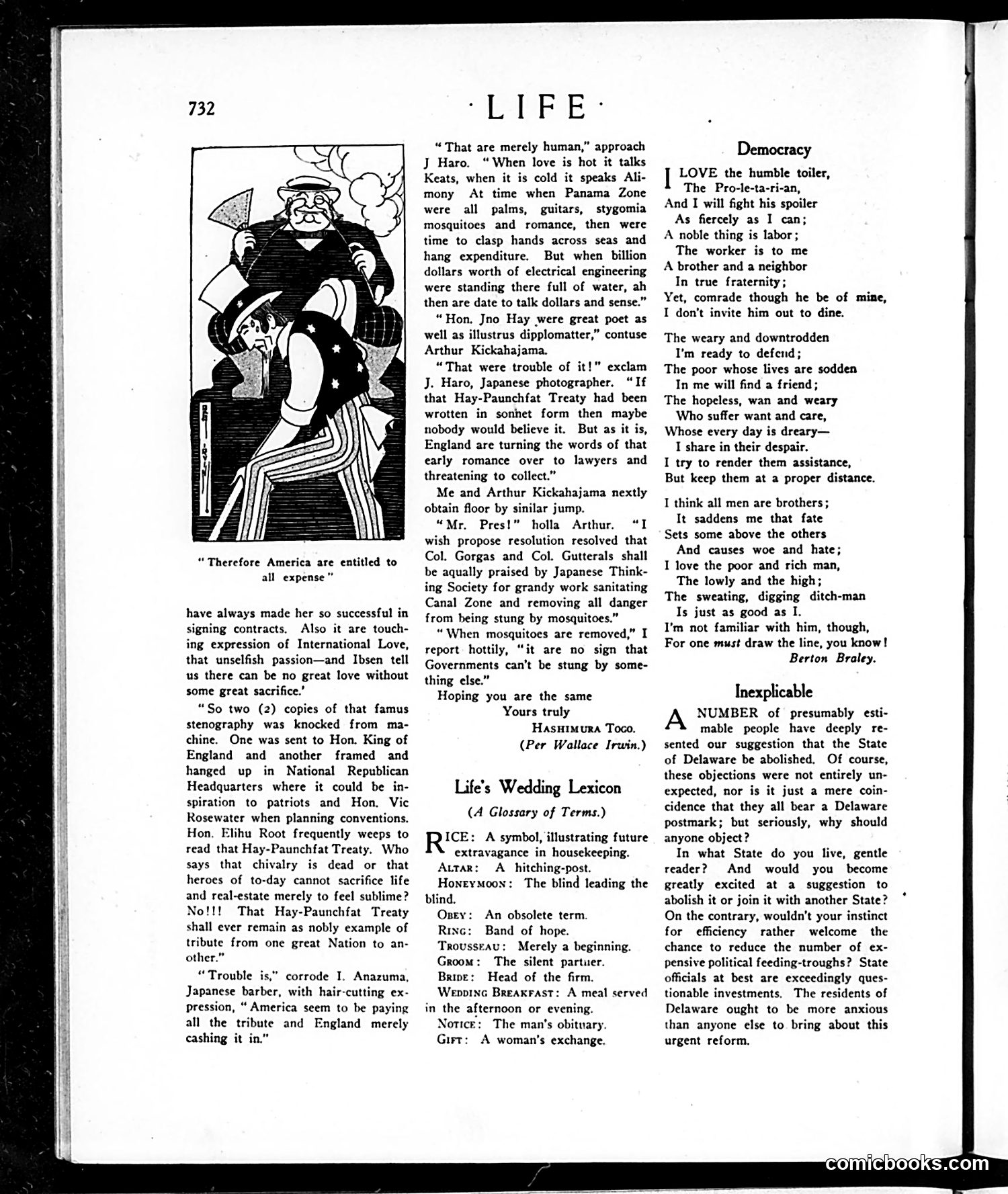
This page contains two distinct satirical pieces: **Left section:** A humorous dialogue (likely by Wallace Irwin, credited at bottom) mocking the Hay-Paunchfot Treaty between America and England. Japanese characters discuss how America gained the Panama Canal Zone through diplomatic romance-language, while England secured financial benefits. The satire suggests America made a poor deal—investing billions in engineering while England merely "cashed in." The crude dialect and caricature reflect period stereotypes. **Right section:** A poem titled "Democracy" that satirizes hypocritical progressive politics. The speaker claims deep solidarity with working-class laborers and the poor—yet refuses to actually associate with them socially. Each stanza contradicts itself, exposing the gap between professed ideals and actual conduct. The repeated refrain "but keep them at a proper distance" reveals the joke: performative compassion without genuine equality. Both pieces target political dishonesty through exaggerated contradiction.
📄 Transcribed text from this page (OCR, searchable)
Machine-transcribed from the original scan — historical spelling and the odd misread are preserved.
“Therefore America are entitled to all expense” have always made her so successful in signing contracts. Also it are touch- ing expression of International Love, that unselfish passion—and Ibsen tell us there can be no great love without some great sacrifice.’ “So two (2) copies of that famus stenography was knocked from ma- chine. One was sent to Hon. King of England and another framed and hanged up in National Republican Headquarters where it could be in- spiration to patriots and Hon. Vic Rosewater when planning conventions. Hon. Elihu Root frequently weeps to read that Hay-Paunchfat Treaty. Who says that chivalry is dead or that heroes of to-day cannot sacrifice life and real-estate merely to feel sublime? No!!! That Hay-Paunchfat Treaty shall ever remain as nobly example of tribute from one great Nation to an- other.” “Trouble is,” corrode I. Anazuma, Japanese barber, with hair-cutting ex- pression, “ America seem to be paying all the tribute and England merely cashing it in.” a oi “That are merely human,” approach J Haro. “When love is hot it talks Keats, when it is cold it speaks Ali- mony At time when Panama Zone were all palms, guitars, stygomia mosquitoes and romance, then were time to clasp hands across seas and hang expenditure. But when billion dollars worth of electrical engineering were standing there full of water, ah then are date to talk dollars and sense.” “Hon. Jno Hay were great poet as well as illustrus dipplomatter,” contuse Arthur Kickahajama. “That were trouble of it!" exclam J. Haro, Japanese photographer. “If that Hay-Paunchfat Treaty had been wrotten in sonnet form then maybe nobody would believe it. But as it is, England are turning the words of that early romance over to lawyers and threatening to collect.” Me and Arthur Kickahajama nextly obtain floor by sinilar jump. “Mr. Pres!” holla Arthur. “I wish propose resolution resolved that Col. Gorgas and Col. Gutterals shall be aqually praised by Japanese Think- ing Society for grandy work sanitating Canal Zone and removing all danger from being stung by mosquitoes.” “When mosquitoes are removed,” I report hottily, “it are no sign that Governments can’t be stung by some- thing else.” Hoping you are the same Yours truly Hasuimura Toco. (Per Wallace Irwin.) Life’s Wedding Lexicon (A Glossary of Terms.) ICE: A symbol, illustrating future extravagance in housekeeping. Attar: <A_ hitching-post. Honeymoon: The blind leading the blind. Osty: An obsolete term. Rinc: Band of hope. Troussrau: Merely a beginning. Groom: The silent partuer. Brive: Head of the firm. Weovinc BreaKrast: A meal served in the afternoon or evening. Notice: The man’s obituary. Girt: A woman's exchange. Democracy I LOVE the humble toiler, The Pro-le-ta-ri-an, And I will fight his spoiler As fiercely as I can; A noble thing is labor ; The worker is to me A brother and a neighbor In true fraternity; Yet, comrade though he be of mine, I don’t invite him out to dine. The weary and downtrodden I'm ready to defend; The poor whose lives are sodden In me will find a friend; The hopeless, wan and weary Who suffer want and care, Whose every day is dreary— I share in their despair. I try to render them assistance, But keep them at a proper distance. I think all men are brothers; It saddens me that fate Sets some above the others And causes woe and hate; I love the poor and rich man, The lowly and the high; The sweating, digging ditch-man Is just as good as I. I'm not familiar with him, though, For one must draw the line, you know! Berton Braley. Inexplicable A NUMBER of presumably esti- mable people have deeply re- sented our suggestion that the State of Delaware be abolished. Of course, these objections were not entirely un- expected, nor is it just a mere coin- cidence that they all bear a Delaware postmark; but seriously, why should anyone object? In what State do you live, gentle reader? And would you become greatly excited at a suggestion to abolish it or join it with another State? On the contrary, wouldn't your instinct for efficiency rather welcome the chance to reduce the number of ex- pensive political feeding-troughs? State officials at best are exceedingly ques- tionable investments, The residents of Delaware ought to be more anxious than anyone else to bring about this urgent reform,