
Life, 1914-04-23 · page 10 of 44
Life — April 23, 1914 — page 10: what you’re looking at
What you’re looking at
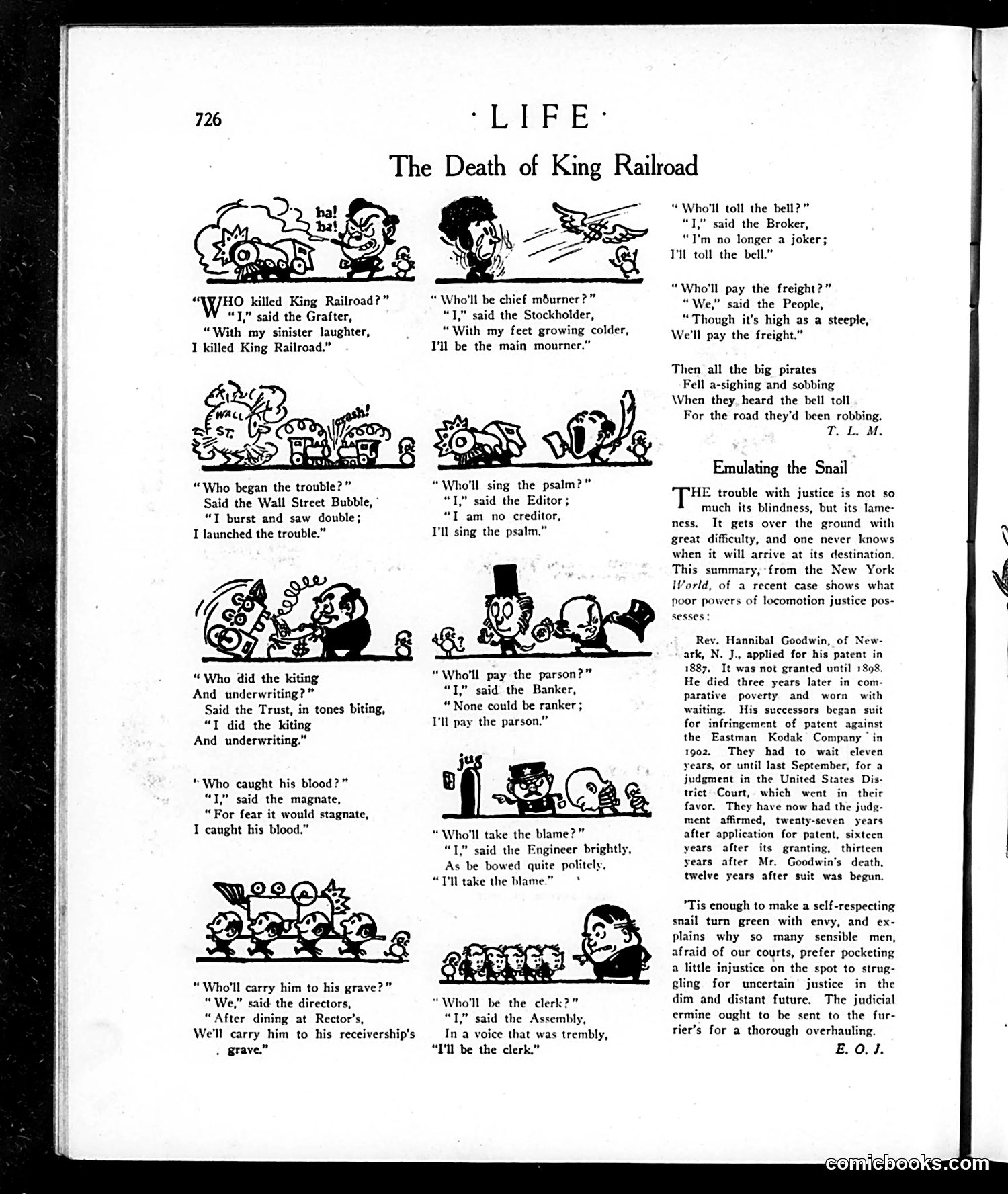
This is a satirical poem-and-cartoon sequence mocking corporate responsibility in early 20th-century American business. "King Railroad" represents the railroad industry itself, which the cartoon depicts as having caused harm (the "death"). Various figures—the Grafter, Stockholder, Wall Street Bubble, Editor, Trust, Magnate, Engineer, and others—all deflect blame for the railroad's problems. Each claims someone else bears responsibility: the Grafter blames his sister's laughter, the Stockholder blames his growing debts, the Engineer takes the blame reluctantly. The satire targets how corporate wrongdoing gets diffused across multiple parties, with no one accepting genuine responsibility. The accompanying article "Emulating the Snail" reinforces this critique through a legal case about patent justice delayed for twenty-seven years.
📄 Transcribed text from this page (OCR, searchable)
Machine-transcribed from the original scan — historical spelling and the odd misread are preserved.
TEsTRESE: The Death of King Railroad “wre killed King Railroad?” “I,” said the Grafter, “With my sinister laughter, I killed King Railroad.” “Who began the trouble?” Said the Wall Street Bubble, ° “I burst and saw double; I launched the trouble.” “Who did the kiting And underwriting?” Said the Trust, in tones biting, “I did the kiting And underwriting.” “Who caught his blood?” “T," said the magnate, “For fear it would stagnate, I caught his blood.” “Who'll carry him to his grave?” “We,” said the directors, “After dining at Rector’s, We'll carry him to his receivership’s . Brave.” “Who'll be chief mdurner?” “1,” said the Stockholder, “With my feet growing colder, V'll be the main mourner.” “Who'll sing the psalm?” “T,” said the Editor; “I am no creditor, I'll sing the psalm.” R, & “Who'll pay the parson?” “TI,” said the Banker, “None could be ranker ; I'll pay the parson.” “Who'll take the blame?” “1,” said the Engineer brightly, As be bowed quite politely, “T'll take the blame.” * “Who'll be the clerk?” “TI,” said the Assembly, In a voice that was trembly, “I'll be the clerk.” “Who'll toll the bell?” “I,” said the Broker, “I'm no longer a joker; I'll toll the bell.” “Who'll pay the freight?” “We,” said the People, “Though it’s high as a steeple, We'll pay the freight.” Then all the big pirates Fell a-sighing and sobbing When they heard the bell toll For the road they'd been robbing. L. M. Emulating the Snail 'HE trouble with justice is not so much its blindness, but its lame- ness. It gets over the ground with great difficulty, and one never knows when it will arrive at its destination. This summary, from the New York IVorld, of a recent case shows what poor powers of locomotion justice pos- sesses: Rev. Hannibal Goodwin, of New- ark, N. J., applied for his patent in 1887. It was not granted until 1898. He died three years later in com- parative poverty and worn with waiting. His successors began suit for infringement of patent against the Eastman Kodak Company ‘in 1902. They had to wait eleven years, or until last September, for a judgment in the United States Dis- trict. Court, which went in their favor. They have now had the judg- ment affirmed, twenty-seven years after application for patent, sixteen years after its granting, thirteen years after Mr. Goodwin's death, twelve years after suit was begun. ‘Tis enough to make a self-respecting snail turn green with envy, and ex- plains why so many sensible men, afraid of our courts, prefer pocketing a little injustice on the spot to strug- gling for uncertain justice in the dim and distant future. The judicial ermine ought to be sent to the fur- rier’s for a thorough overhauling. E. 0. J.